

The Kadjis: Fate Goddesses of Armenian Tradition
The Kadjis are Armenia's ancient fate goddesses, spinning destinies before birth and claiming lives at death. Learn who they are, what they ruled, and why they still haunt Armenian folklore.
Contents
The thread snaps the moment the Kadjis decide it will. No argument, no appeal, no second chance. In the Armenian highlands, where mountains press hard against the sky and winter can swallow a village overnight, the idea that fate is written before the first breath made a particular kind of sense. These were the goddesses who wrote it.
Long before Christian missionaries arrived in Armenia in the early fourth century AD, the Armenian people held a rich cosmology shaped by Iranian, Mesopotamian, and indigenous highland traditions. The Kadjis occupied a central place in that cosmology. They were not gentle spinners sitting quietly at a loom. Ancient Armenian sources and the folklore collected by nineteenth-century ethnographers paint them as fierce, sometimes terrifying beings who could bring rain, steal breath, and turn a man's mind inside out. Fate, in Armenian belief, was not a quiet bureaucratic process. It was a living force, carried by women who moved through the dark.
Who the Kadjis Are in Armenian Mythology
The word kadj (Armenian: քաջ) carries a double meaning that is itself a clue. In modern Armenian it means "brave" or "valiant." In older usage, and in folklore, it referred to a class of supernatural beings, sometimes demonic, sometimes ambiguous, whose power placed them beyond ordinary human categories. The Kadjis as fate goddesses draw from this second, older meaning.
In the pre-Christian Armenian pantheon, which scholars reconstruct largely from the works of the fifth-century historian Movses Khorenatsi (Moses of Khoren), whose monumental History of Armenia preserves fragments of earlier oral tradition, female supernatural figures appear repeatedly as guardians of destiny. The Kadjis were among the most prominent. They arrived at a newborn's cradle within three days of birth to decree the shape of that life. What they spoke could not be undone.
This function places them in a category that folklorists call "birth spirits" or "fate assigners," a category found across an enormous arc of cultures stretching from Western Europe through the Near East into Central Asia. What distinguishes the Armenian Kadjis is the texture of their character. They were not purely benevolent helpers, nor simple agents of doom. They carried intention. They could be generous or cruel according to their own judgment, and the literature suggests that the judgment was not always predictable.
The nineteenth-century scholar and ethnographer Garegin Srvandztiants, who documented Armenian oral traditions in extraordinary detail across two volumes published in 1874 and 1884, recorded accounts in which the Kadjis appear at births, weddings, and crossroads. They are usually described as beautiful women dressed in white, moving in groups, their voices like wind. Travelers who encountered them at night risked being swept away, maddened, or carried to some distant place.
The Moment of Fate: What Happens at the Cradle
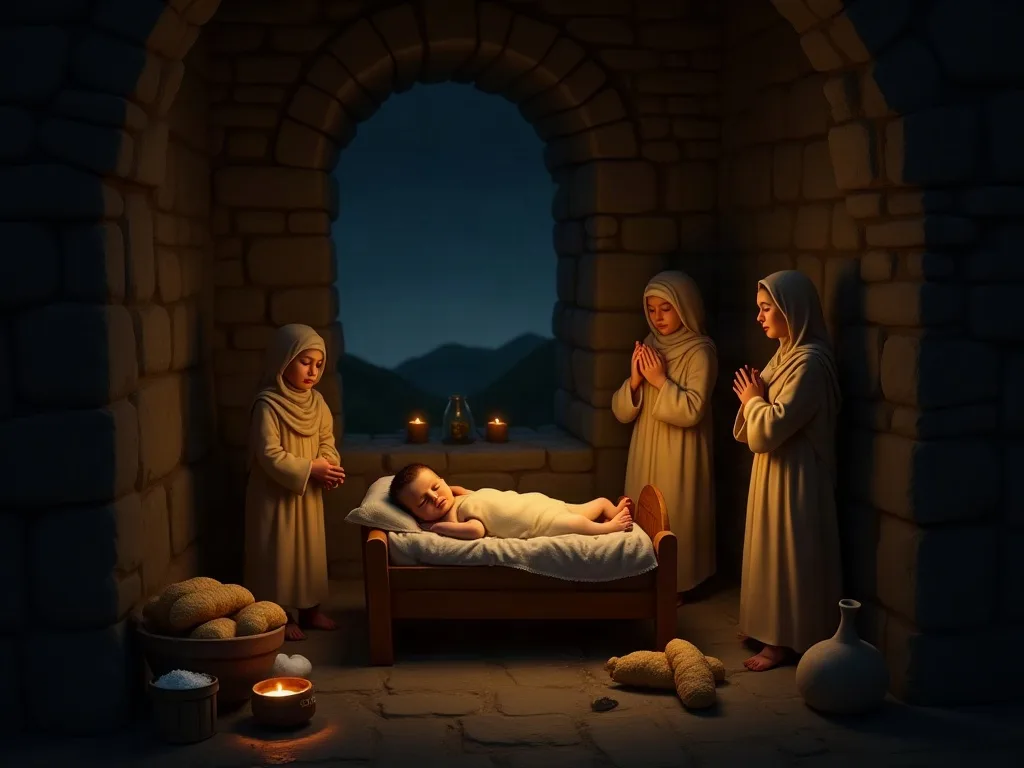
Three nights after a child enters the world, the Kadjis come. This belief, recorded consistently across Armenian-speaking communities in the Caucasus and in diaspora communities in Anatolia and Iran, describes the visit in very precise terms. The Kadjis arrive when the house is quiet. They speak over the sleeping infant. Their words set the course of the life.
What they determine varies by source, but the core elements are consistent:
- The length of the person's life
- Whether that life will bring wealth or poverty
- The manner of death
- The shape of the person's luck in love and war
Parents knew better than to sleep soundly on those three nights. Women of the household would stay awake, light candles, and leave offerings of food near the cradle: bread, salt, fruit, sometimes a small vessel of water. The goal was not to change the decree, which no human could do, but to encourage a favorable mood in the Kadjis as they deliberated. A pleased spirit might speak more gently over the child.
This ritual structure, an offering placed in the hope of a kinder fate rather than the avoidance of fate itself, reflects a theology that is both fatalist and negotiable at the margins. The Kadjis would decide. But the quality of that decision might bend slightly toward grace if they were welcomed properly.
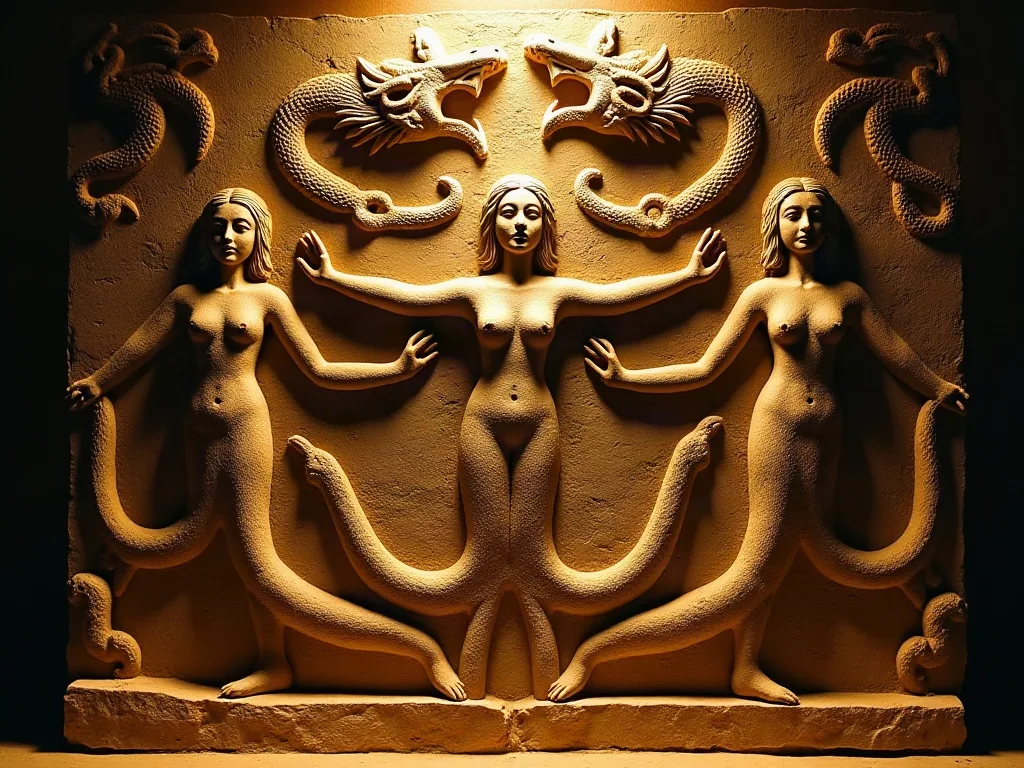
Kadjis, Vishaps, and the Architecture of the Old Armenian Cosmos
The Kadjis did not operate alone in the Armenian supernatural world. They shared that world with the vishaps (dragon-serpents of chaos), with the wind deity Vahagn, and with protective spirits called peri (from the Iranian pari, a class of luminous beings). Understanding where the Kadjis fit requires a brief look at the structure of that older cosmos.
Pre-Christian Armenian belief, reconstructed by scholars including the twentieth-century mythologist Aram Ghanalanyan, whose 1969 work Armenian Legends and Tales drew on decades of fieldwork, organized the supernatural world roughly into forces of order and forces of chaos, with a wide middle band of ambiguous beings who belonged to neither camp entirely. The Kadjis lived in that middle band.
They were not demons in the Christian sense. But they were not the calm, orderly dispensers of fate that one finds, say, in Roman mythology's three Parcae (Nona, Decima, and Morta). They could bring storms. They could cause illness. A person struck suddenly by a mysterious sickness might be described as "touched by the Kadji." The condition had a name in Armenian folk medicine, and it had prescribed remedies: particular herbs, specific prayers, the intervention of a ritual specialist who knew how to negotiate with these beings.
This double quality, fate-givers who could also strike, makes the Kadjis more structurally similar to the Norse Norns than to the Greek Moirai. The Norns, described in the Poetic Edda (a collection of Old Norse poems compiled around the thirteenth century), also move between the roles of fate-weavers and active forces in human events. Both traditions seem to preserve a very ancient layer of belief in which "fate" and "supernatural danger" were not cleanly separated categories.
The Night Riders: Kadjis as Wind Spirits and Storm Bringers
Some of the most vivid accounts of the Kadjis in Armenian folklore describe them not standing at a cradle but riding through the sky on stormy nights. This is where their association with kadj (valor, wildness) becomes visually clear. They moved through clouds. They caused whirlwinds. A sudden gust that knocked a man from a mountain path might be a Kadji passing.
Garegin Srvandztiants and later the scholar Ervand Lalayan, who published ethnographic studies of Armenian communities in the Caucasus between 1896 and 1916, both record stories in which the Kadjis travel in groups through the night sky, sometimes visible as streaks of light, sometimes heard as voices in the wind. Men who claimed to have seen them described women of extraordinary beauty or extraordinary terror, the two qualities sometimes appearing in the same figure.
This aerial character connects the Kadjis to a broader pattern in Eurasian mythology where fate goddesses are associated with movement, flight, and the liminal space between earth and sky. The Slavic Rozhanitsy (fate spirits present at birth in Russian and Bulgarian folk belief) share the birth-visit function. The Slavic Kikimora, a night spirit associated with spinning (and therefore with fate's thread), shares the nocturnal, domestic-disrupting quality. The Armenian Kadjis sit at the intersection of both types: they visit the home at night, and they ride the sky at will.
The Names and Faces: Individual Kadjis in the Sources
Unlike the Greek Moirai, who have clearly individuated names and functions (Clotho who spins, Lachesis who measures, Atropos who cuts), the Kadjis in the surviving sources rarely appear with personal names attached to specific roles. This is partly a result of how the tradition was transmitted. Pre-Christian Armenian mythology was largely an oral tradition. When Christian authorities gained control of Armenia in 301 AD (Armenia became the first state to adopt Christianity as a state religion), systematic efforts to suppress the older beliefs meant that detailed theological texts about the Kadjis were never written down by those who held them sacred.
What survives comes through folklore, through the kind of material that Srvandztiants, Lalayan, and later the scholar Manuk Abeghian (whose 1899 German-language study Der armenische Volksglaube, meaning "Armenian Folk Belief," remains a key scholarly reference) gathered from village communities in the nineteenth and early twentieth centuries. In those accounts, the Kadjis appear as a group, sometimes numbered at three, sometimes at seven. The number three is the more common figure in Armenian belief, which resonates with the triadic structure of fate-goddess traditions across the Indo-European world.
Abeghian's field interviews preserve a handful of localized epithets. Informants in the Ararat plain referred to one presiding figure among the three as Metz Kadji ("the Great Kadji"), understood to be the eldest and most authoritative of the triad, the one whose word the other two could not overrule. Communities around Lake Van described a figure called Gisher Kadji ("Night Kadji"), associated specifically with the stormy-sky aspect of the tradition rather than the cradle visit. And in Lalayan's Caucasian material, a third figure surfaces under the name Loys Kadji ("Light Kadji"), whose decree was said to govern a life's fortune in love more than its span or its death. These names did not coalesce into a canonical triad the way Clotho, Lachesis, and Atropos did in Greek tradition, but they confirm that at least some communities were moving toward individuated figures before the oral chain was broken.
Three Kadjis, three nights, three decrees. The pattern repeats with enough consistency that scholars treat the triad as likely original rather than a later borrowing.
Kadjis and the Transition to Christian Armenia
When Christianity became the official religion of the Armenian kingdom under King Tiridates III in 301 AD, the old gods did not vanish overnight. They were reclassified. The great fire deity Vahagn gradually blurred into Christian saints. The vishaps became identified with biblical serpents and demons. The Kadjis were pushed into the category of fallen or malevolent spirits, or reduced to witches and nightwalkers in the demonology that Christian clergy constructed to replace the older cosmology.
But the folk practices around birth, the three-night vigil, the offerings left at the cradle, the fear of a newborn touched by night-going spirits, persisted in Armenian communities for centuries after the official conversion. Ethnographers working in the nineteenth century documented these practices among Armenian Christian communities who had no conscious sense that they were practicing anything pre-Christian. The Kadjis had been folded into the furniture of everyday belief, half-forgotten as goddesses, but very much alive as things to fear and appease.
This is a pattern that religious historians call "crypto-paganism," though the term can be misleading because it implies concealment that was often simply continuity. People kept doing what worked. If leaving bread near the cradle on the third night had protected children for generations, the formal change in state religion was not sufficient reason to stop.

Comparative Echoes: From the Moirai to the Norns
No tradition exists in isolation. The Kadjis belong to a specific Armenian context, but they also participate in one of the most widespread mythological structures on the planet: the belief that female supernatural beings govern human fate, particularly at the moments of birth and death.
| Armenian Kadjis | Greek Moirai | |
|---|---|---|
| Number | Three (sometimes seven) | Three |
| Names | Rarely individuated; localized epithets like Metz Kadji | Clotho, Lachesis, Atropos |
| Primary action | Speak fate over the infant on the third night | Spin, measure, and cut the life-thread |
| Elemental nature | Wind, storm, night sky; can cause illness | Abstract, celestial; daughters of Zeus and Themis |
| Moral character | Wildly ambiguous; can bless or strike | Orderly; execute cosmic law |
| Approachable? | Yes, through offerings and ritual specialists | Rarely; their decrees are fixed by divine order |
| Primary sources | Srvandztiants, Lalayan, Abeghian (19th-20th c. ethnography) | Hesiod's Theogony, Plato's Republic |
The Greek Moirai (Clotho, Lachesis, Atropos) are the most familiar version of this archetype. Hesiod's Theogony, composed around 700 BC, names them as daughters of Zeus and Themis, goddesses of order. They spin, measure, and cut the thread of life. Plato, in The Republic, adds the figure of Lachesis speaking to souls before they are born, assigning them their lot.
The Norse Norns, described in the Völuspá (the "Prophecy of the Seeress," one of the oldest poems in the Poetic Edda), carve fate into the bark of a tree at Yggdrasil, the great cosmic ash. Their names, Urðr, Verðandi, and Skuld, translate roughly as "what has become," "what is becoming," and "what shall be." Time itself is fate in that conception.
The Roman Parcae, the Slavic Rozhanitsy, the Germanic Idisi, the Baltic Laima: each tradition within the broad Indo-European family produced a version of the birth-fate goddess, usually triadic, usually female, usually operating at the threshold between non-existence and life.
The Armenian Kadjis fit this pattern but carry their own charge. Their wildness, their aerial nature, their capacity to strike as well as to bless, makes them less administrative and more elemental than their Greek or Roman counterparts. They are not just fate-givers. They are forces of nature that happen to govern fate. The comparison table above makes the contrast vivid: where the Moirai operate as cosmic bureaucrats within a hierarchical pantheon headed by Zeus, the Kadjis answer to no higher authority the sources identify. They convene at the cradle because they choose to. That autonomy is part of what makes them so compelling, and so frightening.
The Kadji's Gift: What Fate Meant to Ancient Armenians
Understanding why the Kadjis mattered requires understanding what fate meant in the Armenian highlands, a world shaped by invasion, displacement, and survival. Armenia sits at the crossroads of empires. The Assyrians, the Persians, the Greeks, the Romans, the Parthians, the Byzantines, the Arabs, the Mongols, the Ottomans: each in turn pressed against Armenian territory, absorbed parts of it, displaced communities. In that context, a theology of fate that emphasized the decree laid down at birth was not fatalism in the passive, resigned sense. It was a framework for understanding why some survived and others did not, why one village endured while the next was destroyed, why a particular child grew to old age against all odds.
The Kadjis gave that framework a face. Fate was not an abstraction. It was a decision made by beings who could, at least in principle, be approached, propitiated, even nudged toward mercy. That was worth something. That was, in fact, a kind of hope: not that fate could be avoided, but that the beings who shaped it were not entirely indifferent to how they were treated.
Frequently Asked Questions About the Kadjis in Armenian Mythology
Frequently asked questions
Are the Kadjis the same as witches or demons in Armenian belief?
Not exactly. In pre-Christian Armenian belief, the Kadjis were supernatural fate-givers, powerful and unpredictable but not purely evil. After Armenia adopted Christianity in 301 AD, Christian authorities reclassified many pre-Christian supernatural figures as demons or malevolent spirits. The Kadjis were gradually pushed in that direction in official religious discourse, but in folk practice they retained their older, more ambiguous character: beings to be respected and appeased rather than simply feared as enemies.
When do the Kadjis visit a newborn, and what do they do?
According to Armenian folk tradition, the Kadjis arrive within three days of a child's birth, typically on the third night. They speak over the sleeping infant and decree the shape of the life ahead: its length, its fortune, its manner of ending. Families would stay awake on those nights and leave offerings of bread, salt, and water near the cradle to encourage a favorable judgment. The decree itself was considered unalterable once spoken.
How do the Kadjis compare to the Greek Moirai and Norse Norns?
All three traditions, Armenian, Greek, and Norse, preserve a triadic structure of female fate-givers who govern human life from birth to death. The Greek Moirai, named in Hesiod's Theogony, are associated with spinning thread. The Norse Norns carve fate into the wood of Yggdrasil. The Armenian Kadjis share the birth-visit function but are wilder and more elemental, associated with wind, storms, and the night sky. They can also cause illness or madness, a capacity their Greek and Roman counterparts generally lack.
What are the primary sources for knowledge about the Kadjis?
Because pre-Christian Armenian mythology was an oral tradition largely suppressed after 301 AD, the main sources are ethnographic rather than ancient texts. The most important are the work of Garegin Srvandztiants (published 1874-1884), Ervand Lalayan's Caucasian ethnographic studies (1896-1916), and Manuk Abeghian's Der armenische Volksglaube (1899). The fifth-century historian Movses Khorenatsi's History of Armenia preserves fragments of earlier belief without naming the Kadjis directly. Aram Ghanalanyan's 1969 Armenian Legends and Tales synthesizes much of this material.
Is the word 'kadj' related to the idea of bravery in Armenian?
Yes, and the double meaning is significant. In modern Armenian, kadj means brave or valiant. In older usage and in folklore, it referred to a class of powerful supernatural beings. The connection between valor and the supernatural in the same word suggests that the Kadjis were originally understood not as dark or evil but as intensely powerful, beings whose strength exceeded ordinary human categories. Their power over fate was a form of that supernatural valor.
Did Armenians ever attempt to change or challenge the fate the Kadjis decreed?
The theological position preserved in Armenian folk tradition is that the decree cannot be undone once spoken. However, the practice of leaving offerings before the third night suggests a belief that the judgment could still be influenced before it was fully set. Some accounts collected by Srvandztiants describe ritual specialists (sometimes called kakhards) who could negotiate with the Kadjis on behalf of a suffering person, not to reverse fate but to seek relief within its boundaries. The line between fixed destiny and negotiable fortune was deliberately kept ambiguous.
The Kadjis in Living Memory and Modern Armenian Identity
The Kadjis did not survive into the modern world as active religious figures. By the twentieth century, even in the most traditional Armenian communities, they had receded into folk memory: something grandmothers mentioned, something bound up with old birth practices that were disappearing. The catastrophe of 1915, the Armenian Genocide, in which the Ottoman state killed an estimated 1.2 million Armenians and destroyed the bulk of the community's cultural infrastructure in Anatolia, severed many transmission lines of oral tradition that had carried this knowledge for centuries.
The rupture was not simply demographic. When village communities were destroyed, so were the women who kept the birth rituals, who knew which herbs to leave at the cradle on the third night, who remembered the names by which the Kadjis were addressed in specific valleys. The knowledge was embodied and local, passed between generations of women in particular places. Once those places and those women were gone, the chain could not be spliced back together from documents alone.
Reconstruction became the work of diaspora scholars. In Beirut, Paris, Boston, and Los Angeles, Armenian intellectuals gathered survivor testimonies and cross-referenced them with the ethnographic records that Srvandztiants, Lalayan, and Abeghian had published before 1915. The Armenian General Benevolent Union and institutions like the Mekhitarist Congregation in Venice, which had preserved Armenian manuscripts for centuries, provided archival infrastructure. Scholars working in this diaspora context, including Hagop Oshagan in his monumental survey of Armenian literature and Levon Zekiyan in his comparative religious studies, treated the mythology not as a curiosity but as evidence of what Armenia had been before the interruption. Recovering the Kadjis was, in that sense, an act of cultural insistence: proof that an inner life had existed and would be named.
What survived came also through the Soviet Armenian academic tradition, which treated pre-Christian mythology as a legitimate field of study. Scholars like Ashot Abrahamian and the mythologist Armen Petrosyan, whose comparative work on Armenian mythological structures remains active today, have worked to reconstruct the fuller picture from what remains.
The Kadjis now appear in Armenian fantasy literature, in visual art, and in the work of composers and filmmakers who draw on the old stories. They occupy a position similar to the one the Norns hold in Scandinavian cultural imagination, or the Fates in the broader Western tradition: figures who have moved from living theology into the archive of a culture's deepest self-knowledge. They carry what Armenia always knew: that the decree comes before the cry, that the strong and the beautiful can be swept away without warning, and that the beings who governed this were never entirely tamed.
The thread was always theirs to hold.
Free 25-page sample
Want the whole story?
Take the first 25 pages free. If it pulls you in, the full edition is yours as an instant PDF download, with a paperback on Amazon for selected titles.
Armenian
The Armenian Mythology Book: Vahagn, Anahit, Aramazd and the Sacred Stories of the Caucasus Before Christ
Gods of Fire, Bronze, and the Forgotten Kingdom of Urartu
The pre-Christian gods of Armenia: Vahagn the dragon-slayer, Anahit the mother goddess, and the syncretic pantheon that merged Urartian, Persian, and Greek traditions before vanishing in 301 CE.
More from Armenian
All articles
Armenian
Vahagn: Armenian God of Fire, Thunder, and War
Vahagn roars through the red dawn, the Armenian god of fire, thunder, and war whose bronze-voiced hymns echo in the oldest Christian prayers. Discover the warrior deity who conquered chaos, shaped Armenia's spiritual identity, and survived conquest itself.

Armenian
Anahit: The Great Mother Goddess of Armenia
Anahit ruled Armenia's spiritual world for millennia as the Great Mother, keeper of waters, fertility, and wisdom. Discover how she shaped an entire civilization's understanding of divine power.

Armenian
Aramazd: The Creator God and Father of All
Aramazd stands at the foundation of Armenian myth as the supreme creator, the father from whom all life and divinity flow. Discover how this ancient god shaped the cosmos and why he vanished from Armenia's religious life after the conversion to Christianity.

Armenian
Hayk and Bel: The Founding Myth of Armenia
The story of Hayk's rebellion against the tyrant Bel explains how Armenia was born. A warrior's defiance, a nation's origin, and a line of kings that would rule for centuries.