

Gurzil: Lion God of War and the Sun
Gurzil commands the war and daylight of North African Berber tradition. A lion deity of ferocious strength, he shaped Libyan identity and survived Rome's conquest through Amazigh spiritual memory.
Contents
A lion stood at the gates of Libyan power long before Rome arrived. The Berber peoples of North Africa did not worship a distant, veiled god. They knew Gurzil as raw muscle and flame: the one who roared with the sun at dawn, who granted victory in battle, who wore the mane of the king. His name travels through ancient sources as "Gurzil" or "Gorgon" (not the Greek monster, but a distinct Libyan divinity), and his presence shaped how the Amazigh, the Berber peoples, understood strength, sovereignty, and the burning day.
For centuries, Gurzil embodied a brutal clarity. He was not a god of wisdom or cunning. He was the moment when a spear finds its mark, when the sun climbs highest and casts no shadow, when a warrior's blood rises hot. The Garamantes who rode camels across the Saharan frontiers honored him. Coastal Libyans who faced Greek and Phoenician traders carried his name into negotiation and conflict. Even as Rome's legions marched across North Africa, Gurzil remained woven into Berber identity so deeply that emperors and scholars took notice.
This is the story of a god who refused to vanish, and the lion-strength that kept him alive in the hearts of a people who would not forget him.
The Lion at the Heart of Libyan Faith
The Berbers of ancient Libya did not inherit their gods from a distant priesthood. They lived them. Gurzil emerged from the landscape itself: the tawny deserts where lions hunted, the high plateaus where the sun burned without mercy, the militant societies that depended on a warrior's courage to survive and rule.
The earliest written evidence comes from Greek and Roman observers who encountered Libyan religion firsthand. Herodotus, the Greek historian writing around 450 BC, documented the gods of the Libyan peoples he called "Libyans" (a broad term for all North African non-Egyptian peoples). While Herodotus named other deities, the god who emerges most vividly in later sources is Gurzil, whose cult flourished especially among the tribes of the interior and the southern reaches of what is now Libya and Algeria.
The Romans encountered Gurzil as they expanded into Africa. Inscriptions left by Roman soldiers and Berber allies preserve his name in the form "Gurzil" or sometimes "Gorgon," a term that Latin sources used to distinguish the Libyan lion-god from the Greek Gorgons. Pliny the Elder, the Roman naturalist who died observing the eruption of Vesuvius in 79 AD, mentions Libyan deities in his Natural History and preserves fragments of what the region's peoples held sacred. Archaeological finds from North African sites, particularly around present-day Libya and the Moroccan Atlas, reveal votive stones and altar fragments dedicated to gods whose names echo Gurzil's syllables.
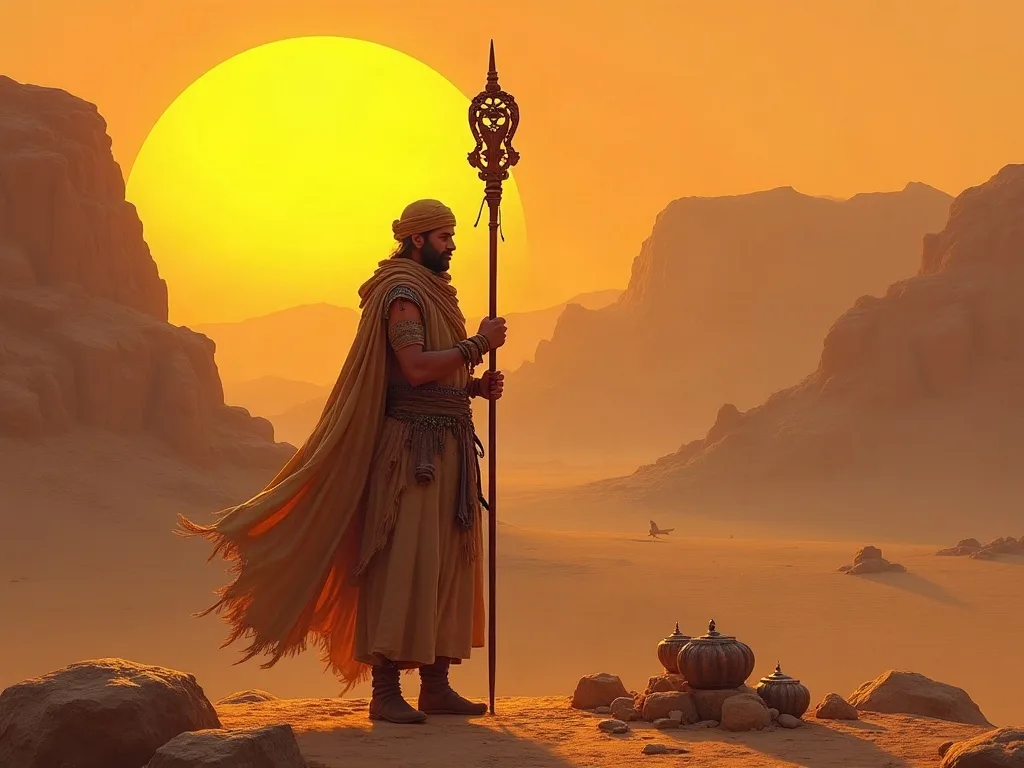
What emerges from these fragments is a god of terrible clarity. Gurzil was not soft or ambiguous. He was the sun at its most violent. He was the predator. Warriors painted his symbol on their shields. Berber kings claimed his favor. When a young man went to war, it was Gurzil's strength he called upon, not diplomacy or trickery.
The lion itself held profound meaning in Berber culture. Lions inhabited the North African landscape until recent centuries. To encounter a lion was to meet death face to face. To wear a lion's skin was to wear invincibility. To be called "of Gurzil's line" was the highest honor. The god's mane, his claws, his roar: these were not metaphors. They were the actual tools of divine power made visible in flesh.
War, Victory, and the Warrior's Path
When the Berber peoples went to war, Gurzil was not a distant witness. He was a combatant. His will determined whether a spear flew true, whether an ambush succeeded, whether the enemy's nerve broke first. This is the peculiar genius of Gurzil: he was not the god of war's strategy or politics. He was the god of combat itself, the moment when two forces collided and only one walked away.
The Garamantes, a powerful confederation that controlled trade routes across the Sahara for over a thousand years, held Gurzil as a patron deity. They were camel herders and raiders, people for whom quick striking power and courage under pressure were survival. Archaeological evidence from Garamantian sites shows dedications to gods including Gurzil, alongside other deities. The Garamantes understood power as a thing of bone and will: you conquered because you were stronger, faster, more willing to die than your enemy. Gurzil embodied this ruthless honesty.
Coastal Libyan tribes also venerated Gurzil, but with a different emphasis. Where the interior tribes called on him for conquest and territorial defense, coastal peoples appealed to Gurzil for protection against raids and for success in the constant low-level conflicts that marked Mediterranean commerce. A Berber trader heading out to meet Phoenician merchants would carry an amulet or recite a prayer to Gurzil: not for cunning in negotiation, but for the strength to stand firm, to not be cheated, to command respect through presence.
Roman sources preserve a telling detail. When Roman generals began recruiting Libyan auxiliaries and Berber allies, they did not demand that these warriors abandon Gurzil. Instead, Roman commanders often incorporated Berber religious practices into their military ritual. A Berber unit marching with Roman legions would invoke Gurzil before battle, and Roman officers learned that these invocations were not empty. Men who felt the god's favor fought with a ferocity that impressed even hardened Roman soldiers. The god transformed the warrior's body and will.
The Sun Rising Over Conquest
Beyond war, Gurzil ruled the sun itself. This was not metaphorical divinity. The Berber peoples watched the sun rise each dawn with the knowledge that their god was present in that fire. Each day brought the god's heat, his light, his inevitable power. In a landscape where water was precious and the sun could kill, Gurzil's dominion over daylight was not poetic: it was survival.
The sun's daily journey across the sky mirrored the warrior's path. At dawn, like a warrior rising to fight, the sun climbed higher, fiercer, hotter. At midday, like a warrior in full strength, it burned without mercy. At sunset, it descended but never died, only hidden, only resting before the next day's return. Gurzil was this cycle made divine.
Berber religious practice incorporated solar observation into ritual. Prayers at dawn invoked the god as he appeared. Midday heat was Gurzil's moment of full power, when offerings might be made (though heat-wilted flowers and water poured onto hot stone were practical as well as sacred). The setting sun prompted reflection on the day's victories and failures, on the god's will made manifest. This was not astronomy or metaphor: it was living theology.
The connection between solar power and royal authority ran deep in Berber tradition. A king was understood as a man chosen by Gurzil, touched by the god's favor, imbued with solar strength. Kings wore crowns or headdresses that mimicked the sun's rays. They were painted with ochre and gold dust that caught the light like flames. Their word was law because Gurzil's will flowed through them. When a king died, it was said that Gurzil had called him to serve in the god's court in the land beyond the sunset.

The Resilience of Gurzil Through Rome's Long Shadow
Rome's conquest of North Africa was neither swift nor complete. The process took centuries and left deep scars. Yet one remarkable fact stands: Gurzil endured. Even as Roman gods, Roman law, and Roman power spread across the region, Berber communities kept the god's name alive, kept the rituals, passed the stories to children who would be born under Roman rule.
This endurance reveals something fundamental about religious identity. Gurzil was not a god imposed by priesthood or codified in sacred texts. He lived in the bodies of warriors, in the heat of midday sun, in the roar of lions still prowling the interior plateaus. As long as Berbers existed, the god existed. Rome learned this hard lesson.
Some syncretism occurred. Roman soldiers and administrators who spent years in North Africa sometimes honored Gurzil alongside Jupiter, god of sky and lightning. Inscriptions from the Roman period preserve both names, side by side. But this was not replacement. Gurzil remained distinctly Berber, distinctly local, a god that only the people of the land could fully understand. A Roman could respect Gurzil's power. Only a Berber could truly serve him.
The Christian transformation of the Roman Empire in the 4th and 5th centuries AD slowly eroded formal worship of Gurzil in cities and Roman-controlled territories. Yet in the mountains and deserts, in villages far from Rome's reach, the god lived on. Berber peoples converted to Christianity over centuries, but traces of Gurzil embedded themselves in the culture itself. A warrior's courage was still attributed to his strength and will. The sun rising was still a daily miracle. Lions were still symbols of kingship and valor.
When Islamic armies arrived in North Africa in the 7th century, they encountered a region that had already seen conquest, Christianization, and cultural transformation. The Berber response to Islam was complex: some embraced it quickly, some resisted for generations. But again, Gurzil did not vanish. Instead, he transformed into cultural memory, into the Berber sense of themselves as a fierce people with ancient roots, people who had honored gods of war and sun long before any foreign power arrived.
Gurzil in the Wider Berber Pantheon
To understand Gurzil is to glimpse the full landscape of Berber divinity. He was not alone. The Berber peoples honored many deities: Tanit, a goddess associated with fertility and the night sky, whom Phoenician settlers also adopted and called by their own name; Baal Hammon, a god of fertility and renewal whose worship crossed into Berber practice; and local spirits and ancestors whose names are now lost to us, preserved only in faint inscriptions and the structures of tribal memory.
Gurzil occupied a specific niche. While Tanit was associated with cycles of growth and regeneration, with the soft vulnerability of birth and renewal, Gurzil was hardness and clarity. While Baal Hammon offered bounty and blessing, Gurzil demanded courage and combat readiness. The Berber pantheon reflected a people who understood that survival required both fertility and fierceness, both the mercy of seasonal rains and the will to fight.
Religious roles reflected this division. Female deities like Tanit were invoked during rituals of fertility, during planting season, during childbirth. Male warriors invoked Gurzil. But the gods were not entirely separated by gender or function. Berber religion was flexible, practical, alive. A mother might pray to Gurzil for her son's safety in battle. A king might honor Tanit as the source of his dynasty's prosperity. The gods interpenetrated one another, each strengthening the whole.
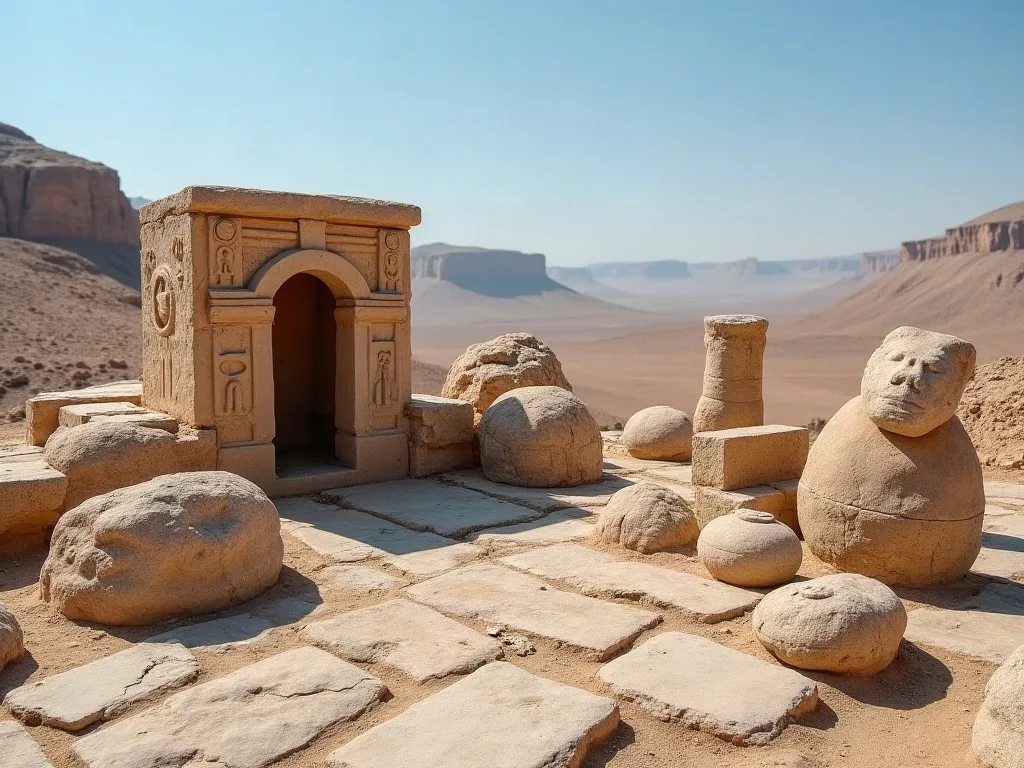
Archaeological sites across North Africa reveal evidence of this religious landscape. Temples and shrines show dedication to multiple deities. Votive offerings include weapons (suggesting Gurzil's warrior clients), fertility symbols (suggesting female deities), and solar imagery (confirming the sun god's presence). The picture that emerges is of a rich, coherent religious world where gods and humans were bound in relationships of reciprocal obligation. The god granted victory or fertility or health. The human offered prayer, sacrifice, and devotion in return.
The Modern Rediscovery of Gurzil
For much of the colonial and post-colonial periods, Gurzil was nearly forgotten outside of academic circles. European scholars studying ancient Libya mentioned him in passing. Berber oral traditions preserved fragments. But the god existed in a kind of historical twilight, known to specialists but absent from the broader cultural conversation.
In recent decades, this has shifted. As Berber (Amazigh) cultural identity has experienced a resurgence across North Africa, scholars and cultural activists have begun recovering the pre-Islamic religious heritage of the region. This is not a call to return to ancient worship. Rather, it is a recognition that understanding Gurzil and the pantheon of which he was part illuminates the deep history of Berber peoples, their values, their sense of themselves as a culture with roots extending back thousands of years.
Gurzil appears now in scholarly books on North African religion, in discussions of Berber identity and heritage, in the work of linguists and historians who trace how Amazigh language and culture survived conquest, conversion, and colonization. The lion god is no longer a footnote. He is recognized as a key figure in understanding how ancient Berbers understood power, divinity, and the world around them.
This recovery is important not as nostalgia, but as clarity. To know Gurzil is to know something essential about a people who resisted and endured, who kept their identity across empires and religions, who understood strength not as domination but as the capacity to survive and remain oneself.
Frequently asked questions about Gurzil: Lion God of War and the Sun?
Frequently asked questions
Was Gurzil worshipped only in Libya, or across the entire Berber region?
Gurzil's cult was strongest in what is now Libya and eastern Algeria, particularly among interior and Saharan Berber peoples like the Garamantes. Coastal and western Berber groups may have honored him, but with less emphasis. His name and worship were primarily a product of North African Libyan tradition, though Berber migration and trade spread knowledge of him across the Maghreb.
How do we know about Gurzil if the Berbers left no written mythology like the Greeks or Egyptians?
We know Gurzil through several channels: Greek and Roman historians like Herodotus and Pliny recorded encounters with his worship; inscriptions on stone altars and votive objects preserve his name; and oral tradition among Berber communities kept his memory alive through the Islamic period into modern times. Scholars combine these sources to reconstruct what ancient Berbers believed and practiced.
Did Gurzil have a specific myth or story, like the Greek gods?
Unlike the detailed mythological narratives preserved in texts like the Iliad or the Enuma Elish, Gurzil appears in sources as a divine presence and principle rather than a character in a grand narrative. His myths were likely embedded in ritual and oral poetry that never reached written form. What survives is his essence: a god of war, the sun, and fierce strength, rather than a biography.
How did Gurzil survive the spread of Christianity and Islam in North Africa?
Gurzil was not preserved as active worship after Christianization and Islamization, but he survived as cultural memory. His strength and association with Berber identity kept his name alive in oral tradition, in the values Berber peoples attributed to themselves, and in the landscape where lions still roamed. Modern recovery of Berber heritage has brought him back into scholarly and cultural conversation.
Are there other ancient gods comparable to Gurzil?
Yes. Sekhmet in Egyptian tradition was a lion-headed goddess of war; Ares in Greek mythology was a god of brutal combat; and across Africa and the Mediterranean, solar deities and warrior gods appear in various forms. What makes Gurzil distinctive is his fusion of solar power and Libyan Berber identity, a god whose very existence asserted the sovereignty and strength of the peoples who honored him.
Gurzil's Legacy and the Question of Ancient African Divinity
The modern study of ancient African religions has long struggled against a particular bias. European scholars, and even some African ones trained in colonial frameworks, often treated African gods as less "real," less philosophically complex, less worthy of serious study than Mediterranean or Asian deities. Gurzil was no exception. He appeared in academic works on ancient Libya as a marginal figure, interesting for historical curiosity but not profound enough for deeper engagement.
This bias is slowly dissolving. Scholars now recognize that the gods of ancient Africa were expressions of profound theological insight. Gurzil was not a primitive war-god in the sense of being unsophisticated. He was a god of a specific people solving specific problems: how to survive in a harsh landscape, how to understand power as something earned through courage and strength, how to live under a sun that could kill. These were not simple questions, and the god was not a simple answer.
The lion itself, as a divine symbol, carries weight across human cultures. But in ancient North Africa, the lion was not metaphorical. It was real. A Berber warrior might see a lion in the desert and know in that moment that he was face to face with his god's earthly form, that Gurzil was watching him, testing him, demanding that he show the courage of a lion or die trying. This fusion of divinity and animal reality, of theology and landscape, is something we have largely lost in more urbanized religions. Gurzil reminds us that sacred power can reside in a lion's roar, in the sun's heat on your skin, in the feeling of your own blood rising as you prepare for battle.
Today, as Berber and Amazigh peoples reclaim their cultural heritage, Gurzil emerges not as a relic but as a statement. He is a god who belonged to a people who refused to be erased. His persistence in memory, even in absence of formal worship, speaks to a deep truth: the gods that live in a culture's bones do not easily fade, no matter what empires march across the land, no matter what new religions demand allegiance. Gurzil remained, in the hearts of warriors, in the daily miracle of sunrise, in the roar of lions that still haunted the deserts where Berbers made their home.
Free 25-page sample
Want the whole story?
Take the first 25 pages free. If it pulls you in, the full edition is yours as an instant PDF download, with a paperback on Amazon for selected titles.
Berber
The Berber Mythology Book: The Gods, Spirits, and Sacred World of the Amazigh
The Amazigh: Gods, Spirits, and North Africa
The beliefs of North Africa’s first people, the Amazigh, who were old when Carthage was young: the sun and the moon, the jnun of the wild places, the cult of the ancestors and the caves, the goddess the Greeks called Athena, and a tradition that outlived every empire.
More from Berber
All articles
Berber
The Azru Oak: Sacred Tree Cult and Ritual Sites in Berber Tradition
The Azru Oak stands as the living spine of Berber sacred geography, where tribal councils, healing rites, and offerings to ancestral spirits converged for millennia. Discover how this revered tree shaped Berber law, spirituality, and community bonds across North Africa.
Berber
Masinissa: King and Cultural Hero of Numidia
Masinissa united Numidia and shaped the destiny of North Africa by walking between Carthage and Rome. His reign (202-148 BCE) transformed a fragmented kingdom into a civilized power that wrote its own laws.
Berber
Yennayer: Berber New Year and Agricultural Festival
Yennayer marks the Berber New Year on January 14, celebrating the spring planting season and ancestral connection to the land. Discover how this 2,944-year-old festival blends agricultural ritual, family tradition, and cultural identity across North Africa.
Berber
The Hand of Fatima in Berber Symbolism: Protection, Blessing, and Identity Across North Africa
The Hand of Fatima, or Khamsa, is far more than Islamic decoration in Berber culture. It carries layers of pre-Islamic protection magic, women's agency, and ancestral wisdom. Discover how Amazigh communities wove this symbol into identity, ritual, and everyday life across Morocco, Algeria, and Tunisia.