

The Hand of Fatima in Berber Symbolism: Protection, Blessing, and Identity Across North Africa
The Hand of Fatima, or Khamsa, is far more than Islamic decoration in Berber culture. It carries layers of pre-Islamic protection magic, women's agency, and ancestral wisdom. Discover how Amazigh communities wove this symbol into identity, ritual, and everyday life across Morocco, Algeria, and Tunisia.
Contents
A Berber woman's hand reaches toward the sky, palm outward. Five fingers spread. The gesture itself is the prayer; the symbol worn on her ankle, her doorway, her newborn's cradle holds centuries of belief. This is the Hand of Fatima, called Khamsa (five) in Arabic, Afus Tigmi in Tamazight (the Berber language). It is a shield against the evil eye. It is a blessing. It is a claim to power.
The Hand of Fatima in Berber symbolism bridges two worlds that historians long treated as separate: pre-Islamic Amazigh (Berber) spirituality and the Islamic traditions that arrived in North Africa around the 7th century CE. Yet for Berber communities across Morocco, Algeria, Tunisia, Libya, and beyond, this symbol became something neither wholly pagan nor wholly Islamic. It became theirs. A woman's hand raised in protection. A mother's hand blessing her child. A boundary drawn against unseen harm. The symbol endures because it solved a paradox: how to honor ancestral magic while living within Islam.
The Khamsa Before Islam: A Woman's Power
Long before Muhammad was born, the hand held power in North Africa. Archaeological evidence from Berber sites shows hand prints on cave walls dating back thousands of years. These were not merely art; they were acts of presence, of claiming space. A hand pressed into stone says: I was here. I matter.
In pre-Islamic Berber cosmology, the number five was sacred. It was the number of fingers that could bless or curse. Women, especially, held the knowledge of protective gestures. When a child fell ill, a mother's hand could draw symbols in the air. When a husband left for trade routes, a wife's open palm blessed his journey. The left hand, considered more intuitive and connected to the spirit world, carried particular potency.
Berber society was, and remains, heavily matrilineal in regions like the Kabyle and Rif mountains. Women held property, made legal decisions, and transmitted cultural knowledge to the next generation. A woman's raised hand was not a gesture of submission or servitude. It was an utterance of authority. In Berber spirituality, women were keepers of tagrest (blessing), practitioners of protective ritual, healers who knew which plants cured and which harmed.

The pre-Islamic Amazigh pantheon included protective deities associated with women and fertility. Archaeological evidence suggests veneration of a mother goddess figure, sometimes called Tanit in Carthaginian contexts (Carthage being itself a Phoenician-Berber cultural crossroads). The raised hand may have evoked these divine mothers, calling their protection down into the mortal world.
Islamic Arrival and the Legend of Fatima
When Islamic armies swept across North Africa in the 7th and 8th centuries, they did not erase Berber practice. Rather, Berber communities negotiated. They adopted Islam, but on Amazigh terms. The symbol of the hand acquired a new narrative in this synthesis: the hand of Fatima, daughter of the Prophet Muhammad.
Fatima is venerated in Islamic tradition as an exemplary woman. She was a healer, a mother to the Prophet's grandchildren (through her marriage to Ali ibn Abi Talib), and a figure of spiritual authority. Some traditions call her Fatima al-Zahra, the Radiant One. She is not worshipped (Islam forbids this), but she is honored as a bridge between heaven and earth.
The legend that anchored the symbol in Islamic culture varies by region. One common account states that Fatima saw her husband Ali returning home with a new, second wife. Overcome with emotion, she plunged her hand into a pot of hot oil. She did not cry out. Her hand bore the burn marks. When she raised her hand, the five fingers became a symbol of her steadfastness, her patience, her endurance of pain for the sake of family honor.
In Berber tellings of this story, Fatima's hand becomes a witness to female resilience. The symbol legitimized the pre-Islamic protective hand gesture under an Islamic name. Women could wear it, paint it, whisper prayers to it, and be participating in Islam (honoring Fatima) while also honoring ancestral practice.

The Structure and Imagery of the Khamsa
The Khamsa hand appears in several related forms across Berber material culture. The most iconic version shows an open palm with five fingers splayed symmetrically. Often, the center of the palm features an eye, a triangle, or geometric patterns. In Berber versions, especially from the Atlas Mountains, these central designs echo ancient Amazigh symbols: spirals representing the sun or water, chevrons representing mountains and endurance.
The numbers and symmetries matter. Five is tamazight (five in Tamazight), but it is also the number of fingers, the number of pillars in Islamic prayer, the number of senses. In Berber numerology, five connects the material and spiritual. A hand with five fingers touches earth and reaches toward sky.
The eye in the palm is called the ain (eye). In Berber belief, the evil eye (taceglawt) is a real force. A person's jealousy, their gaze, their unguarded admiration can harm. The eye in the khamsa returns that gaze. It sees the seer. It deflects envy before it can lodge in the body.
Berber artisans painted khamsas on wooden doors, carved them into lintel stones, wove them into carpet patterns, and cast them in silver and bronze. The symbol appears on:
- Doorways of family homes (especially prominent in Moroccan riads and Algerian kasbahs)
- Amulets worn by women and children
- Carpets and textiles (a weaver would often include khamsa motifs as protection for the household)
- Painted clay vessels used for storing water or grain
- Talismans buried under thresholds to guard against intruders
In the Kabyle region of Algeria, Berber women traditionally embroidered khamsas into their marriage cloths. The symbol was a dowry protection; it said: this woman brings blessing and protection to your house.
The Evil Eye and the Khamsa's Purpose
Understanding the khamsa requires understanding taceglawt, the evil eye. In Berber and broader Mediterranean belief, the evil eye is not superstition; it is understood as a real psychic force. A person (often someone envious or burdened with too much admiration) can harm another through their gaze. This is not witchcraft in the sense of deliberate spellcasting; often, it happens unconsciously.
A child who is praised too effusively falls ill. A bride who is complimented at her wedding develops a fever. A man's business prospers, and then, after a wealthy neighbor visits, it declines. These are attributed to the evil eye. The harm is real (the illness, the failure), but the mechanism is spiritual.
The Khamsa hand acts as a barrier. It is placed where gaze enters: on doors, over beds, on a baby's cradle. The eye within the khamsa sees the evil eye coming and neutralizes it. The raised fingers form a shield. A person wearing a khamsa amulet is saying: you may look, but you cannot harm.
Importantly, the khamsa is not offensive magic. It is purely protective. In Islamic theology, which forbids certain magical practices, the khamsa occupies a borderline space: it is a ruqya (protection spell) that invokes divine help through the symbol of Fatima, the Prophet's daughter. This theological legitimacy allowed the symbol to flourish even as Berber communities became more formally Islamic.
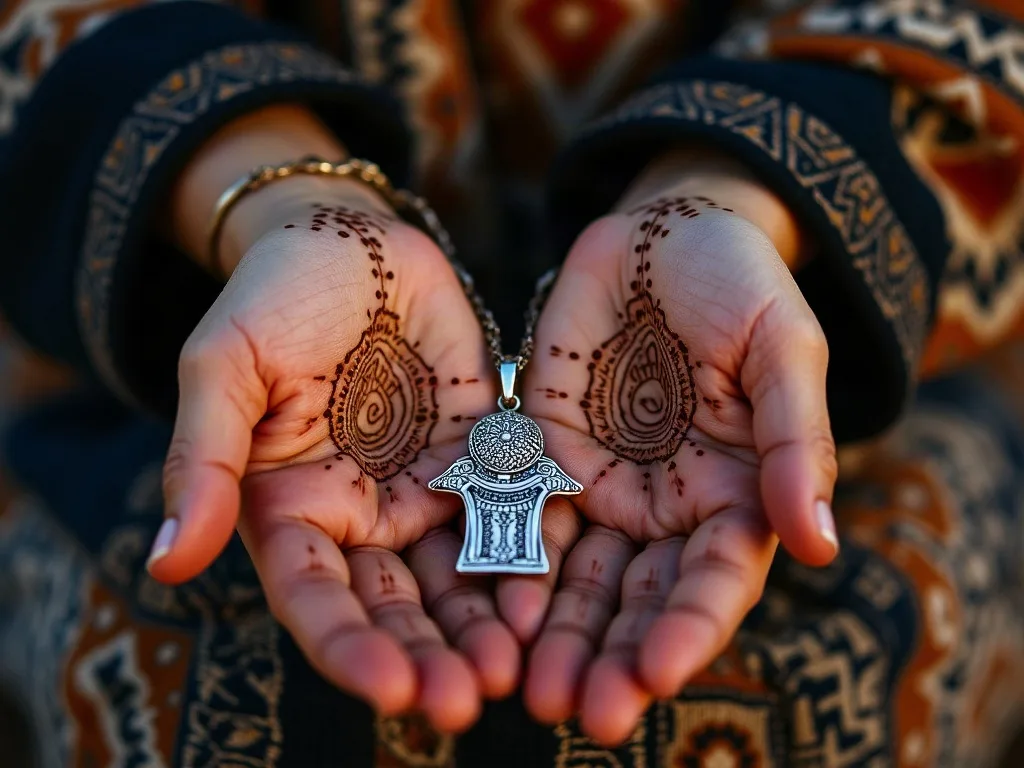
The Hand of Fatima as Feminine Power
For Berber women, the khamsa carried a particular resonance. In Islamic law (as interpreted across North Africa), women's legal standing, inheritance rights, and movement were increasingly restricted compared to pre-Islamic Berber practice. Yet the khamsa offered a symbolic counterweight.
A Berber mother wearing a khamsa amulet was participating in a lineage of female protection that predated Islam. She was the guardian of her household's spiritual welfare, just as her grandmother had been. When she painted a khamsa on her doorway or wove it into a carpet, she was declaring her agency. This is my house. I protect it. I bless those who enter.
In Berber folklore, women are often portrayed as more spiritually powerful than men. A woman's blessing holds more weight than a man's curse. A mother's prayer can change fate. The khamsa, in this context, is a material expression of this belief. The raised hand is a woman's hand. The five fingers are her authority.
Berber marriage rituals often center on the symbolic transfer of protective power. When a bride arrives at her husband's house, she may paint or present a khamsa. She is saying: I bring blessing here. I protect this threshold now. In some regions, the khamsa was embroidered onto the bride's clothing as part of her trousseau, a portable blessing she carried to her new household.
Regional Variations Across the Maghreb
The khamsa does not appear identically across all Berber regions. Materials, designs, and contexts shift.
In Morocco, the khamsa is pervasive in the medinas of Fes and Marrakech, painted in indigo or henna on doorways. In rural Atlas Mountain villages, Berber weavers incorporate khamsa motifs into azembli (traditional carpets), often alongside Tifinagh (ancient Berber script) symbols. The Moroccan khamsa often includes intricate geometric patterns in the center, reflecting pre-Islamic Amazigh artistic traditions.
In Algeria, especially in Kabylie (Kabyle region), the khamsa appears as a carved or painted protection for homes built into mountainsides. Here, it is often paired with Tifinagh letters or symbols referencing Tamazgha, the Berber homeland. Algerian khamsa amulets, worn by women and children, tend to be more elaborate in silver work, sometimes incorporating jasper, lapis, or coral.
In Tunisia, the khamsa has become thoroughly integrated into Islamic Tunisian culture, yet Berber communities maintain distinct variations. Djerba, a Berber island off Tunisia's coast, has a centuries-long tradition of khamsa painting and amulet crafting. Djerbian khamsas often feature intricate henna patterns or geometric designs unique to the island.
Pre-Islamic Berber Hand Symbolism
Protective gesture rooted in women's spiritual authority; associated with unnamed protective deities; evoked through ritual hand movements and the number five; transmitted orally within families.
Islamic Khamsa (Post-7th Century)
Same protective function, now anchored to Fatima (daughter of the Prophet); legitimized within Islamic theology; portable as amulets; visible on homes and clothing; the narrative allows both Islamic observance and ancestral continuity.
The Khamsa in Berber Ritual and Daily Life
For Berber families, the khamsa is not merely decorative. It is active. It works.
A newborn in a Berber household is protected by a khamsa placed above the crib or tied to the baby's wrist. The gesture invokes Fatima's protection and the ancestral protection of mothers stretching back generations. When a mother whispers a blessing over the khamsa, she is not simply wishing her child well; she is ritually securing the child within a protected space.
In courtship and marriage, the khamsa marks transitions. A young woman might receive a khamsa amulet from her mother as she reaches adolescence. The gesture says: you are now a woman. You carry protection. You carry power. When she marries, the khamsa may be woven into her wedding clothes or gifted to her by her mother-in-law, sealing the integration into a new household.
Berber healers, traditionally women, use the khamsa in their practice. When treating an illness believed to be caused by the evil eye, the healer may place a khamsa amulet on the patient's body or ask the patient to wear one. The healer may recite Quranic verses (particularly ayat al-kursi, the Throne Verse, a powerful protective prayer) while gesturing with an open hand. The khamsa and the prayer work together; the hand is both the gesture and the symbol.
In many Berber communities, the khamsa is not a private object. A doorway khamsa is public. It announces to the neighborhood: this house is protected. It warns potential thieves or ill-wishers. It also invites blessing from passersby. A traveler seeing a khamsa might pause to offer a silent prayer for the household within.
The Evil Eye and Its Countermeasures: Berber Perspectives
The Berber understanding of the evil eye operates within a broader cosmology of seen and unseen forces. The visible world (the material, the body) is always permeable to the invisible world (the spiritual, the psychic, the divine). A person is not simply a body; they are a body inhabited by amahil (spirit), watched over by protective forces, and vulnerable to harmful forces.
The evil eye enters through the gaze. But what makes a gaze harmful? In Berber belief, several factors converge:
- Envy or jealousy in the looker's heart
- Excessive admiration or praise (which can "weaken" the admired person)
- The looker's own spiritual imbalance or bitterness
- Sometimes, simply the focused attention of someone with naturally powerful sight
A woman with a particularly intense gaze might be known, without accusation, to have a "strong eye." She is not blamed for this; it is her nature. But precautions are taken around her. When she compliments a child, the parents might immediately touch the child's forehead and whisper a protective prayer. When she visits a newborn, the family might place a khamsa in her line of sight, deflecting her gaze.
The khamsa is the primary defense, but Berber households employ multiple countermeasures:
- Kohl (taksirt) applied to the eyes of babies and young children, believed to darken and protect the eye
- Salt, kept in bowls near doorways to absorb harmful energy
- Henna hand prints left on walls and doorways (a pre-Islamic practice that predates the khamsa)
- The color blue, which is widely considered protective in Mediterranean cultures
- Mirrors, which some believe reflect the evil eye back to its source
The khamsa is the most visible and most revered of these protections, and it bridges the ancestral Berber tradition and the Islamic context that legitimizes it.
The Khamsa in Berber Art and Craftsmanship
Berber artisans have elevated the khamsa into fine art. The symbol appears in multiple media, each with its own conventions and symbolic weight.
In carpet weaving, the khamsa is often woven into traditional Berber carpets, particularly azembli from the Middle Atlas and High Atlas regions. The weaver might include a single prominent khamsa in the carpet's center, or integrate smaller khamsa motifs as borders. Each carpet is handmade, and the weaver's choice to include the khamsa is deliberate. The carpet is not only beautiful; it is protective. A family might lay it in the living room or hang it near the entrance, combining aesthetic and spiritual function.
In metalwork, especially silver craft, the khamsa amulet is a prestige object. Berber silversmiths in Morocco and Algeria create khamsas as pendants, with intricate filigree work, sometimes inlaid with gemstones. These are not mass-produced; they are crafted individually. A woman might wear a silver khamsa as a sign of status and spiritual authority.
In painted ceramics and tilework, the khamsa appears on zellige (geometric tile work) in Moroccan and Algerian houses and mosques. The khamsa, rendered in blue and white or other color combinations, becomes part of the built environment. Walking through a medina in Fes or Marrakech, a visitor encounters khamsas on painted wooden doors, on the walls above markets, on fountains. The symbol is woven into the city itself.
In henna art, particularly for wedding celebrations, the henna artist (traditionally a woman) might incorporate a khamsa into the design painted on the bride's hands and feet. The henna khamsa is temporary, lasting weeks before fading. Yet during those weeks, it is active: it protects the bride during her vulnerable transition from unmarried to married life. The henna itself is considered protective, and the khamsa amplifies that protection.
The Khamsa in Contemporary Berber Identity
In the 20th and 21st centuries, as Berber communities have mobilized to reclaim linguistic, cultural, and political recognition (the Amazigh Movement), the khamsa has become a symbol of cultural continuity and resistance.
The symbol is invoked in discussions of Berber women's rights and autonomy. Activists reference the historical authority of Berber women and point to the khamsa as an emblem of female power. A woman wearing a khamsa amulet is making a statement about her heritage, her identity, and her refusal to be erased by Arab-dominated narratives of North African history.
The Tamazight language (formerly marginalized in Morocco, Algeria, and Tunisia) is now co-official in Morocco and Algeria. With this recognition comes renewed interest in pre-Islamic Berber symbols. The khamsa, once viewed as primarily Islamic, is increasingly reclaimed as an Amazigh symbol. Young Berber women get khamsas tattooed, incorporating Tifinagh letters or other Amazigh motifs alongside the hand.
In diaspora communities, the khamsa has become a way to maintain connection to homeland. Berber immigrants to France, Belgium, Germany, and North America wear khamsa amulets and hang them in their homes. The symbol says: I carry Berber culture. I carry protection. I belong to a lineage that stretches back before Islam, before colonialism, to the ancient mountains of the Maghreb.
Yet the khamsa is not frozen in tradition. Contemporary Berber artists reinterpret the symbol. Some create abstract paintings centered on the khamsa, deconstructing and reimagining it. Others use the symbol in graffiti art in Algerian and Moroccan cities, as a claim on urban space. The khamsa becomes political: it is a statement of indigenous presence.
Scholarly Debates and Cross-Cultural Parallels
Scholars of Mediterranean religion have long noted the khamsa's similarity to protective symbols in Jewish, Christian, and Muslim traditions. The Hand of Miriam (sister of Moses and Aaron) appears in Jewish protective amulets, sometimes with similar symbolism. The Hindu hand mudra (gesture) called abhaya mudra (the gesture of fearlessness) also involves an open hand raised in blessing and protection. The crossed-finger gesture in Western tradition (for luck or warding off evil) operates in a similar protective register.
These similarities have led some scholars to propose that the khamsa represents a broad Mediterranean and Near Eastern protective archetype, adapted and reinterpreted across religions. Others argue for independent development: that human cultures, when facing similar threats and anxieties, naturally gravitate toward similar symbolic solutions. The open hand is universal. The number five is present in all humans. The gesture of protection is instinctive.
For Berber communities, the point is not scholarly consensus but lived meaning. The khamsa is Berber because Berbers practice it, not because historians can trace a linear origin. It is Islamic because it honors Fatima, and Berber communities are Muslim. It is ancestral because it connects to pre-Islamic practice. These layers coexist; they do not cancel each other out.
Some contemporary Berber scholars argue that the widespread presence of the khamsa across North Africa, the Mediterranean, and the Middle East reflects not a single origin point but a shared cosmology: the understanding that invisible forces threaten visible well-being, and that human agency (through ritual, symbol, and prayer) can mediate that threat. In this reading, the khamsa is not borrowed from Islam; rather, Islam arrived in North Africa and encountered already-existing Berber protective practices, and a synthesis occurred.
Protective Magic and Islamic Orthodoxy
One persistent tension surrounds the khamsa's relationship to Islamic law. Mainstream Islamic jurisprudence (fiqh) prohibits certain magical practices, particularly those that invoke spirits (jinn) or that are understood as directing divine will through human manipulation.
Yet the khamsa occupies a protected theological space. It is not understood as magic in the forbidden sense. Instead, it is classified as a ruqya (protection), which most Islamic scholars permit provided the protection invokes God's will and does not involve idolatry or forbidden substances. The khamsa, anchored in the figure of Fatima (a historical person, not a deity), and understood as a passive protective device (not an active spell), is theologically acceptable to most Muslim scholars.
In practice, Berber communities do not debate the theological permissibility of the khamsa. It is present in homes, in mosques (sometimes woven into prayer rugs), and in the hands of the devout. Imams (Islamic scholars) do not typically condemn it. Some bless it. The symbol has achieved a kind of legitimacy through ubiquity and integration into Islamic Berber life.
However, in strictly Salafi or conservative Islamic communities (which have gained ground in some North African regions in recent decades), the khamsa is sometimes viewed with suspicion as a residue of superstition or pre-Islamic practice. Young converts to Salafi Islam might be counseled against wearing khamsas. This represents a tension within contemporary Islam in North Africa: between Islamic modernizers who see the khamsa as superstitious, and communities for whom the khamsa is integral to faith and identity.
The Khamsa in a Globalized World
The Hand of Fatima has become global. Tourists to Morocco and Tunisia buy khamsa amulets as souvenirs. The symbol appears in New Age spirituality, often under the name "Hand of Hamsa," divorced from its Berber or Islamic context, repackaged as a universal protective symbol. Fashion designers incorporate khamsa motifs into clothing and jewelry, sometimes with explicit homage to Berber tradition, sometimes with no awareness of origin.
This globalization presents both opportunity and loss. On one hand, the khamsa's international circulation means that more people encounter and appreciate Berber artistry and cosmology. Berber artists and craftspeople have found markets for khamsa amulets and textiles far beyond North Africa. Young Berbers in diaspora communities can purchase amulets and learn from their mothers about the symbol's meaning.
On the other hand, mass production and cultural appropriation dilute the khamsa's significance. A khamsa mass-produced in China and sold in a mall boutique is not the same as a hand-painted khamsa on a Moroccan doorway or a handmade silver amulet crafted by a Berber silversmith. The global khamsa is emptied of context. Its meaning becomes generic: protection, good luck, a beautiful symbol. The Berber and Islamic histories, the feminine authority it evokes, the specific cosmology of the evil eye, the relationship to pre-Islamic Amazigh spirituality: these are lost.
Berber cultural organizations and scholars are working to preserve and educate about the khamsa's true significance. Museums in Marrakech, Algiers, and Tunis feature exhibits on Berber protective symbols, including the khamsa. Documentaries and academic works explore the symbol's history and meaning. Yet the challenge remains: how to honor the khamsa's global presence while ensuring its origins and deeper significance are not erased.
Frequently asked questions about the Hand of Fatima in Berber culture
Frequently asked questions
Is the Hand of Fatima purely Islamic, or does it have pre-Islamic Berber roots?
The Hand of Fatima is a genuine synthesis. Pre-Islamic Berber spirituality included protective hand gestures rooted in women's spiritual authority and the sacred significance of the number five. When Islam arrived in North Africa around the 7th century, Berber communities did not abandon these practices; instead, they connected them to Fatima, the Prophet's daughter, creating a symbol that honored both ancestral tradition and Islamic faith. It is neither purely Islamic nor purely pre-Islamic, but rather a negotiated blend that emerged from Berber cultural agency.
What does wearing a khamsa amulet actually protect against?
In Berber and broader Mediterranean belief, a khamsa primarily protects against the evil eye (taceglawt), understood as the harmful spiritual force emanating from a person's jealous or excessive gaze. The khamsa is believed to reflect this force, preventing it from lodging in the body or household. Secondary benefits include general blessing and protection against misfortune. Importantly, the protection is understood as spiritual: the amulet does not prevent physical harm (like a shield would), but rather neutralizes unseen hostile intent or dangerous attention.
Why is the number five significant in the khamsa?
Five is the number of fingers on a human hand, and the hand itself is central to protection in Berber spirituality (the gesture of an open hand raised in blessing or warding is cross-cultural). In Berber numerology and broader Islamic tradition, five also carries sacred weight: there are five pillars of Islam, five daily prayers, and five elements in some cosmologies. The khamsa literally means "five" in Arabic. For Berber communities, five represents the meeting point of material and spiritual, with each finger connecting earth and sky through the raised hand.
How is the khamsa different from other protective symbols like the hamsa in Jewish tradition?
Both the khamsa and the Jewish hamsa involve an open hand and share protective function across Mediterranean and Near Eastern cultures. The primary difference is in the religious and cultural anchoring. The khamsa is specifically connected to Fatima (Islamic context) and to Berber pre-Islamic protective practice, making it integral to North African identity. The hamsa is rooted in Jewish and Hebrew tradition, sometimes connected to Miriam. While they may share common roots in a shared Mediterranean cosmology, they developed along different cultural and religious pathways and carry different meanings within their respective communities.
Can non-Berbers or non-Muslims wear a khamsa amulet respectfully?
The khamsa is increasingly worn globally, including by people with no Berber or Islamic heritage. Many Berber artisans and scholars welcome this, seeing it as appreciation and support for Berber culture and craftsmanship. However, respectful wearing involves understanding the symbol's history and significance, not merely treating it as a fashionable decoration. Wearing a khamsa made by a Berber artisan, purchasing from Berber communities, and learning about the symbol's meaning are ways to honor its origins. Appropriation occurs when the symbol is stripped of context, commercialized without acknowledgment of its source, or marketed as generic "global spirituality."
Is there a 'correct' way to display or wear a khamsa?
Tradition suggests placing khamsas above doorways, on thresholds, or near the entrances to living spaces, where the evil eye would first enter. Wearing one as a pendant or amulet on the body (wrist, neck, ankle) is common, especially for children and women. Some traditions suggest the khamsa should face outward (palm facing away) to deflect harmful gaze. However, Berber practice varies by region and family custom. The key principle is intentionality: the khamsa should be placed or worn with awareness of its protective purpose, not randomly or without thought. In contemporary contexts, people also hang khamsas in cars, above beds, or in workplaces.
The Khamsa as Unfinished Narrative
The Hand of Fatima in Berber symbolism remains in motion. It is not a fixed, ancient symbol preserved in amber. Every generation of Berber women reinterprets it, repaint it, weave it anew. Contemporary Berber artists deconstruct and reconstruct the symbol. Activists reclaim it as a marker of indigenous presence. Diaspora communities carry it across oceans as an anchor to homeland.
The symbol's power lies in its refusal to be only one thing. It is pre-Islamic and Islamic. It is feminine and universal. It is deeply traditional and radically modern. A young Berber woman in Casablanca might get a khamsa tattooed on her ankle alongside Tifinagh letters, reclaiming ancestral symbols as an act of political identity. Her grandmother might have painted the same symbol on her doorway without articulating its political meaning, yet both are equally authentic.
The khamsa endures because it solves a real human problem: the need to feel protected in an uncertain world. It endures because it connects Berber communities to their mothers, grandmothers, and the ancestral mothers stretching back before history had a name for them. It endures because Berber women have insisted on its significance, wearing it, passing it down, teaching their daughters and granddaughters that their hands, raised in blessing and protection, hold power.
In a globalized world where Berber culture is often marginalized or absorbed into Arab or European identities, the khamsa remains a visible, wearable, paintable claim: I am Berber. I carry protection. I belong to a lineage of women whose hands have blessed and protected for centuries. The symbol survives because the communities that created it survive, and they are not finished with it yet.
Free 25-page sample
Want the whole story?
Take the first 25 pages free. If it pulls you in, the full edition is yours as an instant PDF download, with a paperback on Amazon for selected titles.
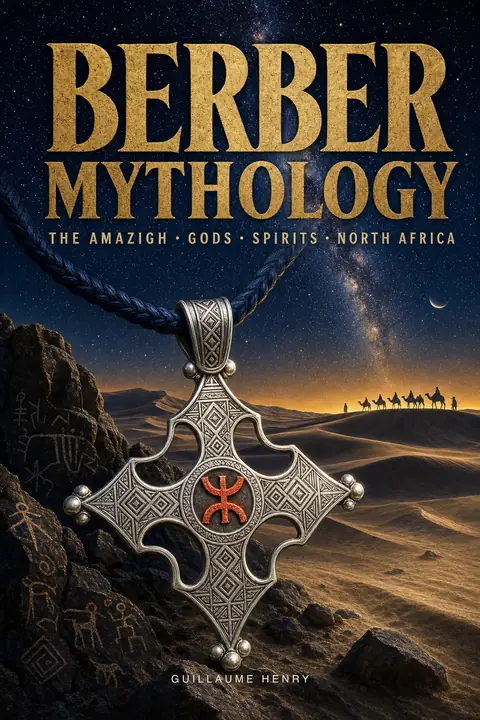
Berber
The Berber Mythology Book: The Gods, Spirits, and Sacred World of the Amazigh
The Amazigh: Gods, Spirits, and North Africa
The beliefs of North Africa’s first people, the Amazigh, who were old when Carthage was young: the sun and the moon, the jnun of the wild places, the cult of the ancestors and the caves, the goddess the Greeks called Athena, and a tradition that outlived every empire.
More from Berber
All articles
Berber
The Azru Oak: Sacred Tree Cult and Ritual Sites in Berber Tradition
The Azru Oak stands as the living spine of Berber sacred geography, where tribal councils, healing rites, and offerings to ancestral spirits converged for millennia. Discover how this revered tree shaped Berber law, spirituality, and community bonds across North Africa.
Berber
Masinissa: King and Cultural Hero of Numidia
Masinissa united Numidia and shaped the destiny of North Africa by walking between Carthage and Rome. His reign (202-148 BCE) transformed a fragmented kingdom into a civilized power that wrote its own laws.
Berber
Yennayer: Berber New Year and Agricultural Festival
Yennayer marks the Berber New Year on January 14, celebrating the spring planting season and ancestral connection to the land. Discover how this 2,944-year-old festival blends agricultural ritual, family tradition, and cultural identity across North Africa.

Berber
The Myth of Isli and Tislit: Star-Crossed Lovers in Berber Tradition
Two siblings, separated by their father's curse, meet as strangers and fall in love before discovering their blood bond. The Berber myth of Isli and Tislit explores forbidden desire, family secrecy, and the landscape itself as witness to human tragedy.