

The Azru Oak: Sacred Tree Cult and Ritual Sites in Berber Tradition
The Azru Oak stands as the living spine of Berber sacred geography, where tribal councils, healing rites, and offerings to ancestral spirits converged for millennia. Discover how this revered tree shaped Berber law, spirituality, and community bonds across North Africa.
Contents
In the valleys and plateaus of the Rif, the Atlas, and the High Plains of North Africa, Berber communities gathered beneath ancient oak trees to settle disputes, honour their dead, and petition the spirits who dwelled in wood and stone. These were not casual meetings. Each tree held a name, a history, and a web of ritual obligations that bound families and clans together across generations. The Azru Oak (from the Tamazight word azru, meaning "oak tree") was the most prominent of these sacred trees, transforming from a botanical fact into the axis of Berber spiritual and social life.
This was not a religion written in scrolls or codified in temples built by distant rulers. The Azru Oak was accessible: rooted in village commons, its branches open to the sky, its trunk worn smooth by centuries of hands pressing against it in supplication, oath-taking, and communal gatherings. What unfolded beneath it shaped the rhythm of Berber existence.
Berber civilization spans thousands of years across North Africa, from the Mediterranean coast to the Sahara, and the oak trees that punctuated this landscape became anchors for community identity, legal tradition, and spiritual practice. The Azru Oak sites were not temples but thresholds, where the visible world of tribe and clan met the invisible realm of ancestors, divine beings, and sacred power.
The Sacred Geography of Berber Oak Trees
Berber sacred space operated through a logic of place rather than building. Mountains, springs, tombs, and trees became nodes in a network of power and obligation. The oak trees that survived in Berber territory were themselves remarkable: in a landscape often dry and sparse, an ancient oak represented abundance, shelter, and temporal continuity. A tree that had stood for three hundred years had witnessed the lives of a dozen generations; it held their accumulated weight of ritual and memory.
The word azru (also spelled azrou) carries a secondary meaning in Tamazight: solid, strong, enduring. The oak itself embodied this quality. Unlike the softer trees, oaks retained their strength through seasons of drought. Their deep roots drew water from sources invisible to surface sight. For the Berbers who depended on reading the land for survival, the oak's resilience was not metaphorical; it was observable fact that warranted reverence.
Berber sacred trees were not evenly distributed. The most significant Azru Oak sites emerged where certain conditions converged: the tree grew near a water source, tribal lands intersected, or the site held ancestral memory. The great oak of Kabylie, the oak at Tizi n'Tichka pass, the tree at Ifrane: each became a locus of legal authority, ritual action, and community identity. These were the places where tribal assemblies (tajmat) convened, where disputes were settled under customary law (izerf), and where offerings were made to unseen powers.
Ritual Practices at the Azru Oak
The rituals enacted beneath the Azru Oak were as diverse as the Berber communities themselves, yet certain patterns recur across the ethnographic and oral record. Oaths sworn under the oak tree held binding force; the tree itself was understood to witness and enforce them. A man who broke such an oath was believed to incur not merely social shame but spiritual contamination; the oak would not shelter him again. This was a form of sacred contract written not in ink but in communal acceptance and spiritual sanction.
Healing rites congregated at certain oak sites, particularly those near springs or in locations associated with saintly figures (iseggen or marabouts, holy men revered for their spiritual power). A healer would bring the afflicted person to rest against the oak's trunk; visitors would tie cloth strips to its branches as tokens of petition and gratitude. These strips, called icchetraf in some Berber dialects, accumulated over decades, transforming the tree into a visible record of communal prayer. When the tree grew so laden with cloth that the wind could barely move its branches, the community understood that the oak's power had grown heavy with response.
Fertility rites formed another major strand of Azru Oak ritual. Childless women visited the tree and lay their hands upon its bark, whispering requests to the spirits believed to inhabit or visit the oak. Newly married couples might walk together around the tree in ceremonial circumambulation, binding themselves to fertility and to the land itself. These were not shamanic rites performed by specialists alone; they were acts woven into the fabric of seasonal and life-cycle ceremony that every member of the community could perform and witness.
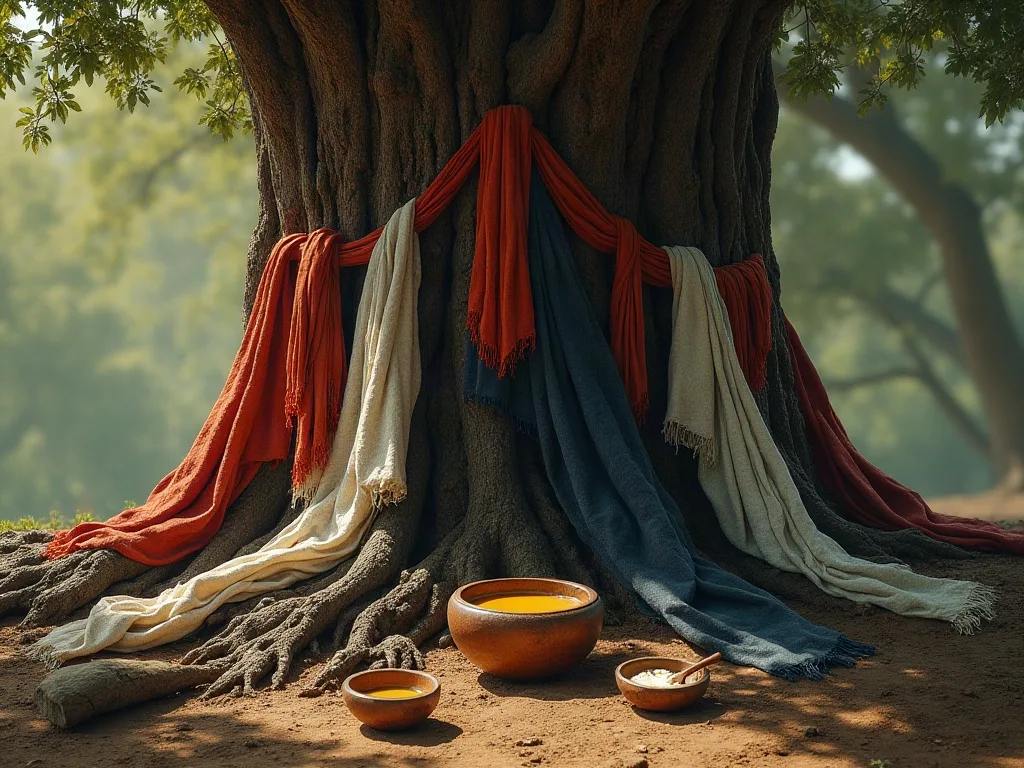
Funeral processions paused at significant oak trees on their journey to burial grounds. The deceased was remembered aloud; the tree served as a threshold between the village of the living and the dwelling place of the dead. Some communities understood the oak as a pathway for ancestral spirits: the tree's roots reached down to the underworld where the dead dwelt; its branches stretched toward heaven. To pass beneath it was to pass into a space where the living and dead could communicate.
The Azru Oak and Berber Law
Perhaps the most consequential function of the Azru Oak sites was legal and political. In many Berber communities, formal political structure centred on the village assembly (tajmat), which held sovereign power over local affairs. This assembly convened regularly, often weekly or monthly, to adjudicate disputes, allocate resources, and enforce customary law (izerf or adat).
The Azru Oak provided the setting and lent its authority to these proceedings. A judgement delivered under the oak carried weight that it might not carry in a mere household or marketplace. The tree was understood as a guarantor of justice; its presence sanctified the act of ruling. Elders sat in a circle around the oak's base or leaned against its trunk as they deliberated. The disputants stood before the tree and before the community, their words carried to the assembled people and to the tree itself.
Customary law among Berber peoples was not codified but transmitted orally, refined through generations of precedent and debate. The oak tree sites became physical archives of this legal tradition. A judge might invoke the memory of a previous ruling delivered at this same tree; the community remembered its outcome. The oak became a living text, its authority grounded in historical memory and in the collective recognition that justice delivered here had validity.
Oath-taking ceremonies were formalized acts that often involved the Azru Oak. A person might swear an oath by placing his hand on the tree trunk and invoking both the tree's power and the assembled witnesses. To later deny the oath was to deny the collective memory of the entire community. This created a powerful incentive to tell the truth at the outset, knowing that falsehood would be recorded in communal memory and carried forward for years.

Spiritual Beings and the Azru Oak
Berber cosmology recognized a category of spiritual beings (jnoun or jinn, spirits; azeggughn, the powerful ancestral dead; and lxir, blessing or divine favour) that inhabited natural features. The Azru Oak was understood to be a dwelling place or a frequent meeting point for such beings. This was not abstract theology; it shaped behaviour. A person did not cut wood from a sacred oak, did not speak disrespectfully beneath its branches, did not perform ritually unclean acts in its presence.
The spirits associated with oak trees were often understood as female, connected to fertility, protection of children, and the welfare of flocks. In some traditions, the oak was inhabited by a tisidit (a female spirit or saint), who would grant children to the barren and healing to the sick. In others, the oak was home to ancestral spirits who maintained their interest in the affairs of the living. A man who wished to consult these spirits might spend the night beneath the Azru Oak, fasting or performing ritual ablutions, waiting for dreams or visions that would guide him.
Offerings left at the oak took multiple forms: milk poured at the tree's roots, bread and meat hung from branches, cloth strips tied to twigs, and honey cakes set on the ground as gifts to the spirits. These were not offerings to a distant deity but provisions for immediate, present, and accessible spiritual forces. The boundary between the material and spiritual world grew thin at the Azru Oak; the offerings bridged it.
The Azru Oak Sites in Historical and Contemporary Context
European ethnographers and colonial administrators who entered Berber territory in the nineteenth century documented extensive use of sacred oak trees in ritual and governance. The French ethnologist Edmond Doutté, among others, recorded detailed accounts of ceremonies performed at specific oak sites across Algeria and Morocco. These accounts, while filtered through colonial-era assumptions and sometimes patronizing attitudes, capture the genuinely central role that the Azru Oak played in Berber communal life.
Colonial authorities recognized that these oak sites held political power. Villages organized around them; disputes were settled by reference to precedent established under their boughs; resistance movements used them as gathering points. French administrators sometimes attempted to restrict access to sacred oak trees or to co-opt them into colonial administrative structures, understanding intuitively that control of these places meant control of community decision-making. The Azru Oak was not marginal to Berber society; it was central, and colonial powers behaved accordingly.
In the twentieth and twenty-first centuries, the role of Azru Oak sites shifted but did not disappear. Many Berber communities, particularly in urban areas or in regions profoundly transformed by modernization, abandoned the formal ritual use of oak trees. Village assemblies met in schoolhouses or community centres rather than in groves. Legal matters moved into state courts administered according to written law rather than customary practice.
Yet even in altered form, the Azru Oak retained symbolic weight. In the Rif region of northern Morocco, certain oak sites remain pilgrimage destinations. Families continue to visit them on significant dates, to leave offerings, to invoke the spirits believed to dwell there. The practice has narrowed but not vanished; it has become more private, more family-centred, less the focus of formal community governance. This transformation reflects broader shifts in Berber society but also the resilience of the oak's hold on spiritual imagination.
Comparative Sacred Trees in Other Traditions
The Berber veneration of the Azru Oak was not isolated. Across the Mediterranean and beyond, ancient societies invested sacred trees with political and spiritual significance. The oak groves of the Dodona sanctuary in ancient Greece, where the oak's rustling leaves were interpreted as oracular speech, paralleled the Berber understanding of the oak as a site of communication between human and spiritual realms. The druidic oak groves of Celtic Europe served similarly as seats of legal authority and places of prophetic power.
What distinguishes the Berber Azru Oak tradition is the integration of all these functions into a single, dispersed, decentralized system. Rather than a single famous tree at a distant sanctuary, Berber sacred oak sites were distributed across the landscape. Each village, each major tribal grouping, had its own significant oak or oaks. This meant that legal authority, spiritual power, and communal identity were rooted not in a central location but in the local landscape itself. The Azru Oak was always at hand, accessible, embedded in the rhythms of daily and ceremonial life.
Sacred Trees and Environmental Transformation
The history of Azru Oak sites in North Africa is inseparable from environmental change. The oak forests that once covered much of the Atlas and the Rif have been progressively reduced by logging, grazing, and agricultural expansion over centuries. Some of the most famous Azru Oak sites stood in forests that were extensively cleared during the colonial period for timber or to make way for settlements and roads. A few of these groves survived; many did not.
This environmental loss had direct consequences for Berber ritual and governance. When the oak was cut, the community lost not merely a tree but a locus of spiritual and legal power. Some communities relocated their sacred gatherings to remaining oaks; others adapted their practices to accommodate the loss. This was not merely sentimental; it represented a genuine reconfiguration of community authority and spiritual practice.
Today, several conservation initiatives in Morocco and Algeria have emerged specifically to protect historically significant oak groves and to maintain the Azru Oak sites that remain. These efforts are driven not primarily by Western conservation principles but by Berber communities themselves, who recognize that the survival of the oak sites is bound to the survival of Berber cultural identity and practice. The Azru Oak that endures is thus simultaneously an ecological and a cultural artifact, whose preservation serves both purposes.
Frequently Asked Questions About the Azru Oak and Berber Sacred Tree Tradition
Frequently asked questions
Did all Berber communities recognize the same sacred oak sites, or did each region have its own?
Both. Major oak sites like the celebrated oaks of Kabylie were known across wide regions and attracted visitors from multiple tribes. Simultaneously, each village or tribal confederation maintained its own local sacred oak for assembly and ritual. The Azru Oak tradition was thus simultaneously universal and intensely local, with prestige sites acting as pillars in a broader network of sacred geography.
What was the role of women in rituals at the Azru Oak?
Women participated centrally in fertility rites, healing ceremonies, and offerings at sacred oaks, though their roles in formal legal assemblies varied by region and period. Some communities permitted women to attend and speak in village assemblies convened at the Azru Oak sites; others restricted formal legal participation to male household heads. Women's ritual activities, particularly around healing and fertility, were considered equally essential to community wellbeing.
How did Islam's expansion into North Africa affect Berber oak tree veneration?
The spread of Islam from the seventh century onward reshaped but did not eliminate Azru Oak rituals. Many sacred oak sites became associated with Islamic saints (marabouts) or were understood through an Islamic framework while retaining their core ritual functions. The practice of leaving offerings and seeking intercession evolved to encompass Islamic piety while preserving pre-Islamic patterns of belief and practice. This syncretism remains visible at many sites today.
Are any ancient Azru Oak sites still active in ritual use?
Yes, though the nature of their use has transformed. Several oak groves in the Rif and Middle Atlas remain pilgrimage destinations, particularly around significant religious or seasonal dates. Local communities continue to visit these sites to leave offerings, to seek blessing or healing, and to commemorate ancestors. The formal legal and governance functions have largely shifted to modern administrative structures, but the spiritual and commemorative roles persist.
What primary sources document the Azru Oak tradition?
The Azru Oak is known primarily through oral tradition, ethnographic documentation (particularly nineteenth and twentieth-century French and Spanish ethnographic accounts), Berber oral narrative, and contemporary community practice. Few pre-colonial written sources exist specific to these trees, as Berber tradition was predominantly oral. The ethnographic record, while imperfect, provides the most detailed historical documentation available.
The Persistence of Sacred Groves in Contemporary Berber Identity
The Azru Oak in modern Berber consciousness functions simultaneously as historical memory, spiritual resource, and symbol of cultural continuity. For Berber activists and cultural scholars, the oak groves represent a pre-Islamic, pre-Arab Berber heritage that extends back millennia. These sites embody an alternative vision of authority, governance, and spirituality to both Western models and to the state systems that have dominated North Africa.
Contemporary Berber cultural movements have invested heavily in recovering and documenting Azru Oak traditions, publishing accounts of specific sites, organizing protection initiatives, and incorporating the oak into artistic and literary representations of Berber identity. This recovery work is not merely archival; it is politically and spiritually generative. To remember the Azru Oak is to assert that Berber people once organized their affairs differently, that legitimate alternatives to centralized state governance and to Arab-centric historical narratives existed and endured. The tree becomes a living argument for Berber autonomy and cultural dignity.
The survival of even a single ancient oak on a hillside in the Rif or the High Plains carries disproportionate weight in this contemporary context. It is a witness, a artifact, and a catalyst for memory and pride. For visitors who come to press their hands against the bark and to invoke the spirits believed to dwell there, the Azru Oak remains what it has always been: a threshold between the visible and invisible, a place where human need meets spiritual response, and a living link to generations of ancestors who stood in the same place and whispered the same prayers.
Free 25-page sample
Want the whole story?
Take the first 25 pages free. If it pulls you in, the full edition is yours as an instant PDF download, with a paperback on Amazon for selected titles.

Berber
The Berber Mythology Book: The Gods, Spirits, and Sacred World of the Amazigh
The Amazigh: Gods, Spirits, and North Africa
The beliefs of North Africa’s first people, the Amazigh, who were old when Carthage was young: the sun and the moon, the jnun of the wild places, the cult of the ancestors and the caves, the goddess the Greeks called Athena, and a tradition that outlived every empire.
More from Berber
All articles
Berber
Masinissa: King and Cultural Hero of Numidia
Masinissa united Numidia and shaped the destiny of North Africa by walking between Carthage and Rome. His reign (202-148 BCE) transformed a fragmented kingdom into a civilized power that wrote its own laws.
Berber
Yennayer: Berber New Year and Agricultural Festival
Yennayer marks the Berber New Year on January 14, celebrating the spring planting season and ancestral connection to the land. Discover how this 2,944-year-old festival blends agricultural ritual, family tradition, and cultural identity across North Africa.
Berber
The Hand of Fatima in Berber Symbolism: Protection, Blessing, and Identity Across North Africa
The Hand of Fatima, or Khamsa, is far more than Islamic decoration in Berber culture. It carries layers of pre-Islamic protection magic, women's agency, and ancestral wisdom. Discover how Amazigh communities wove this symbol into identity, ritual, and everyday life across Morocco, Algeria, and Tunisia.

Berber
The Myth of Isli and Tislit: Star-Crossed Lovers in Berber Tradition
Two siblings, separated by their father's curse, meet as strangers and fall in love before discovering their blood bond. The Berber myth of Isli and Tislit explores forbidden desire, family secrecy, and the landscape itself as witness to human tragedy.