Berber
Pre-Islamic Amazigh cosmology, deities, spirits, and the survival of ancestral beliefs under Roman rule and Islamic syncretism across North Africa.
The indigenous peoples of North Africa, stretching from the Nile to the Atlantic and from the Mediterranean to the Sahel, have been called by many names: Libyans by the Greeks, Numidians and Mauri by the Romans, Amazigh in their own language. Berber mythology is not a single tradition but a family of cosmologies that survived Roman colonisation, Byzantine rule, and the arrival of Islam, though each wave reshaped what came before. What remains is fragmentary: a handful of deity names in Latin inscriptions, ethnographic asides from Herodotus and Procopius, oral traditions recorded centuries after Islamisation, and ritual practices that continue in Moroccan valleys and Kabyle villages today.
Reconstructing this tradition requires reading across genres. Pre-Islamic gods appear in Roman-era texts under Latinised names. Cosmological structure survives in folk tales and seasonal rites. Islamic saints' tombs often stand on older sacred sites, and the jinn and other spirits of Berber belief predate the Quran's own jinn by centuries.
Who the Berbers Are, and What Remains
The term Berber is exonymic, derived from the Greek barbaroi and later adopted by Arab conquerors. Amazigh, meaning "free people" or "noble men," is the endonym preferred by many communities today. The Amazigh languages form a branch of the Afroasiatic family, related distantly to ancient Egyptian and Semitic tongues. By the time Herodotus travelled the North African coast in the fifth century BCE, Berber-speaking peoples occupied the Maghreb, the Sahara, and the Canary Islands.
What survives of their pre-Islamic religion comes in three forms. First, Roman-era inscriptions and texts that name gods and describe rites, often through the distorting lens of interpretatio Romana. Second, medieval Arab chroniclers like Ibn Khaldun, who recorded customs and genealogies but wrote centuries after Islamisation. Third, oral tradition and ritual practice documented by French ethnographers in the nineteenth and twentieth centuries, at a moment when colonialism was already altering the communities it claimed to study.
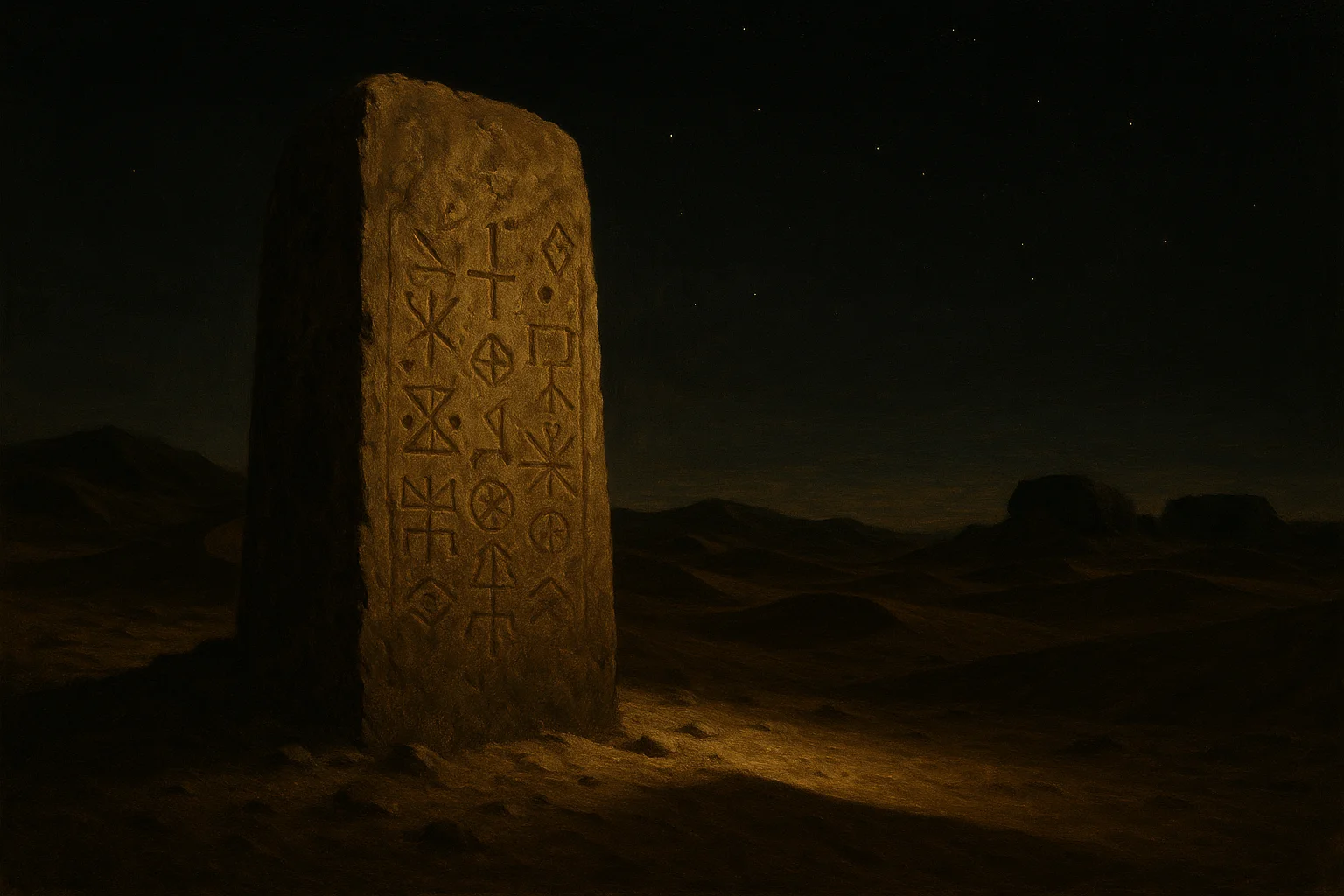
No native Berber scripture exists. Literacy arrived with Punic traders, Roman administrators, and later Arab scholars. The cosmology must be inferred from fragments.
The Pre-Islamic Pantheon
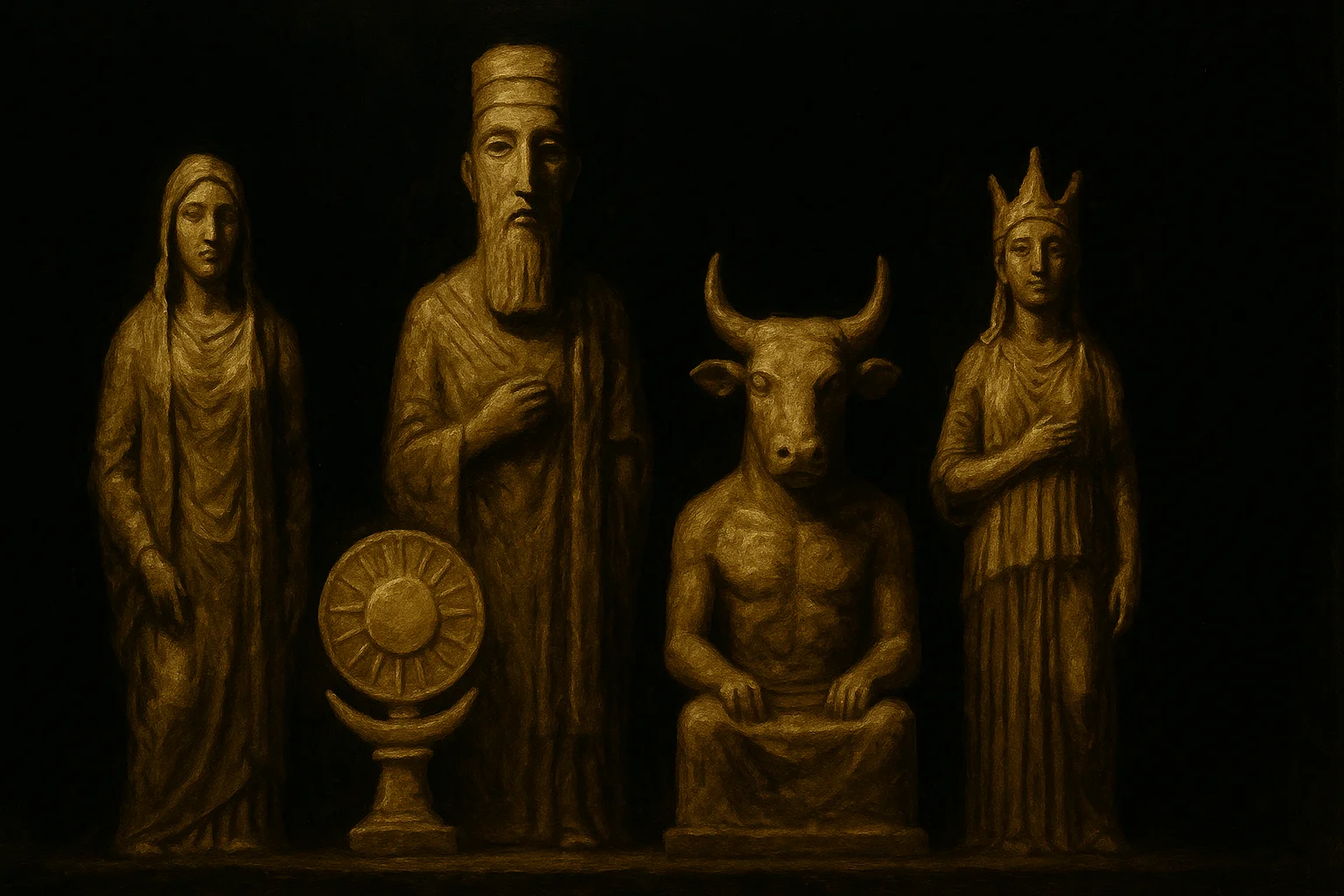
The gods of the Berbers were not uniform across the Maghreb. Regional variation was the rule. A deity worshipped in Numidia might be unknown in Mauretania. Still, certain figures recur often enough in the sources to suggest a shared mythological grammar.
Agurzil, the Bull-Headed War God
Agurzil appears in Corippus' sixth-century epic Iohannis, which recounts Byzantine campaigns against Berber tribes. Corippus describes Agurzil as a war god carried into battle in the form of a bull or bull-headed idol. The deity's cult was centred among the Laguatan tribes of Tripolitania. Procopius, writing slightly earlier, mentions the same god and notes that the Berbers swore oaths by him before combat.
The bull iconography links Agurzil to older Mediterranean and Near Eastern traditions: the Cretan bull cults, the Apis bull of Egypt, the storm gods of Anatolia. Whether these connections represent shared ancestry or convergent symbolism is unclear. What is certain is that Agurzil functioned as a patron of warriors and a guarantor of tribal oaths.
Anzar, Rain and Fertility
Anzar survives more vividly in oral tradition than in ancient texts. His name means "rain" in several Berber dialects, and he is invoked in agricultural rites across Morocco and Algeria. The most widespread ritual, still performed in some villages, involves a procession led by a young woman or doll representing the "bride of Anzar." Participants sing songs asking Anzar to send rain and ensure a good harvest.
The ritual structure resembles other Mediterranean rain-making rites, but the continuity of the name and the specificity of the songs suggest a pre-Islamic origin. Anzar is sometimes described as a celestial figure who descends to earth, sometimes as a spirit dwelling in springs and rivers. The ambiguity is typical of deities whose mythology was never codified in writing.
Ifri and the Cave Goddess Tradition
The word ifri means "cave" in Tamazight, and it also names a goddess associated with caves, fertility, and protection. Caves held sacred significance across Berber territories. Herodotus, in Book 4 of the Histories, describes Libyan oracles located in caves, though he does not name the deity. Pliny the Elder, in Natural History 5.1-46, mentions cave shrines in Mauretania where offerings were made to ensure safe childbirth.
Ifri's cult may have been localised rather than universal. The goddess is not mentioned by Roman sources under that name, but the Latin inscriptions from North Africa frequently reference a Dea Caelestis or Juno Caelestis, often identified with the Punic Tanit. Some scholars argue that Ifri was absorbed into this syncretic figure, though the evidence is circumstantial.
Cosmology and the Structure of the World
No Berber creation myth survives in its original form. What can be reconstructed comes from comparative analysis of oral tales and ritual symbolism. The world is often described as layered: a sky realm, the earth, and an underworld or subterranean domain. The sky is the domain of rain and celestial forces, the earth is the site of human and animal life, and caves and springs serve as thresholds to the unseen.
The sun and moon feature prominently in folk tales, often personified as siblings or spouses. In some versions, the sun is female and the moon male, reversing the gender associations common in Indo-European mythologies. The stars are sometimes described as the children of the sun and moon, or as ancestral spirits watching over the living.
Mountains hold cosmological significance. The Atlas range, which gives its name to the Titan who holds up the sky in Greek myth, was sacred to Berber communities long before Greek contact. High places were sites of sacrifice and oath-taking. The boundary between earth and sky was permeable at mountain peaks.
Water sources, especially springs, are liminal spaces where the divine can be encountered. Anzar's rain descends from above, but he is also present in the wells and rivers that sustain life. The cave goddess Ifri bridges the surface and the depths. This vertical cosmology, with its emphasis on thresholds, persists in Islamic-era saint veneration, where tombs and shrines are often located at springs, caves, or mountain passes.
Spirits, Ancestors, and the Unseen
Jinn Before and After Islam
The jinn of Berber tradition predate the Islamic jinn, though the two have become thoroughly intertwined. Pre-Islamic Berber belief held that the landscape was populated by invisible beings who could help or harm humans. These spirits inhabited wild places: forests, ruins, crossroads, and bodies of water. They were neither wholly benevolent nor wholly malevolent, but required respect and propitiation.
When Islam arrived, the Quranic jinn, created from smokeless fire and capable of belief or disbelief, merged with the older Berber spirits. The result is a complex demonology that draws on both traditions. In Moroccan and Algerian folk belief, jinn can possess humans, cause illness, and grant knowledge. They are invoked in healing rituals and blamed for misfortune. The werewolf legends of the Maghreb, in which humans transform into predatory animals, sometimes involve jinn as the agents of transformation.
The continuity of jinn belief across the Islamic conversion suggests that the older spirit cosmology was flexible enough to accommodate the new theological framework. The jinn did not disappear; they were reinterpreted.
Ancestral Veneration and the Cult of Saints
Ancestor veneration is central to Berber religious practice, both before and after Islam. The dead are not entirely gone; they remain present as guardians and intermediaries. Tombs of important ancestors become pilgrimage sites, and offerings are made to ensure their favour.
With Islamisation, this practice was redirected toward marabouts, or Muslim saints. A marabout is often a Sufi holy man whose tomb becomes a shrine. Pilgrims visit to seek blessings, healing, or intercession. The structure of the cult, however, mirrors pre-Islamic ancestor veneration. The saint is addressed as a protector, offerings are left at the tomb, and annual festivals mark the saint's day.
In many cases, marabout shrines are built on older sacred sites. A spring sacred to Anzar becomes the tomb of a saint who brings rain. A cave associated with Ifri becomes the burial place of a female saint. The continuity is not accidental. Islam did not erase the sacred geography; it renamed it.
Guanche Mythology: The Canary Islands Branch
The Guanche people of the Canary Islands spoke a Berber language and practised a religion that preserved elements lost or transformed on the mainland. Isolated from North Africa after the islands were settled, possibly in the first millennium BCE, the Guanche developed their own mythological traditions.
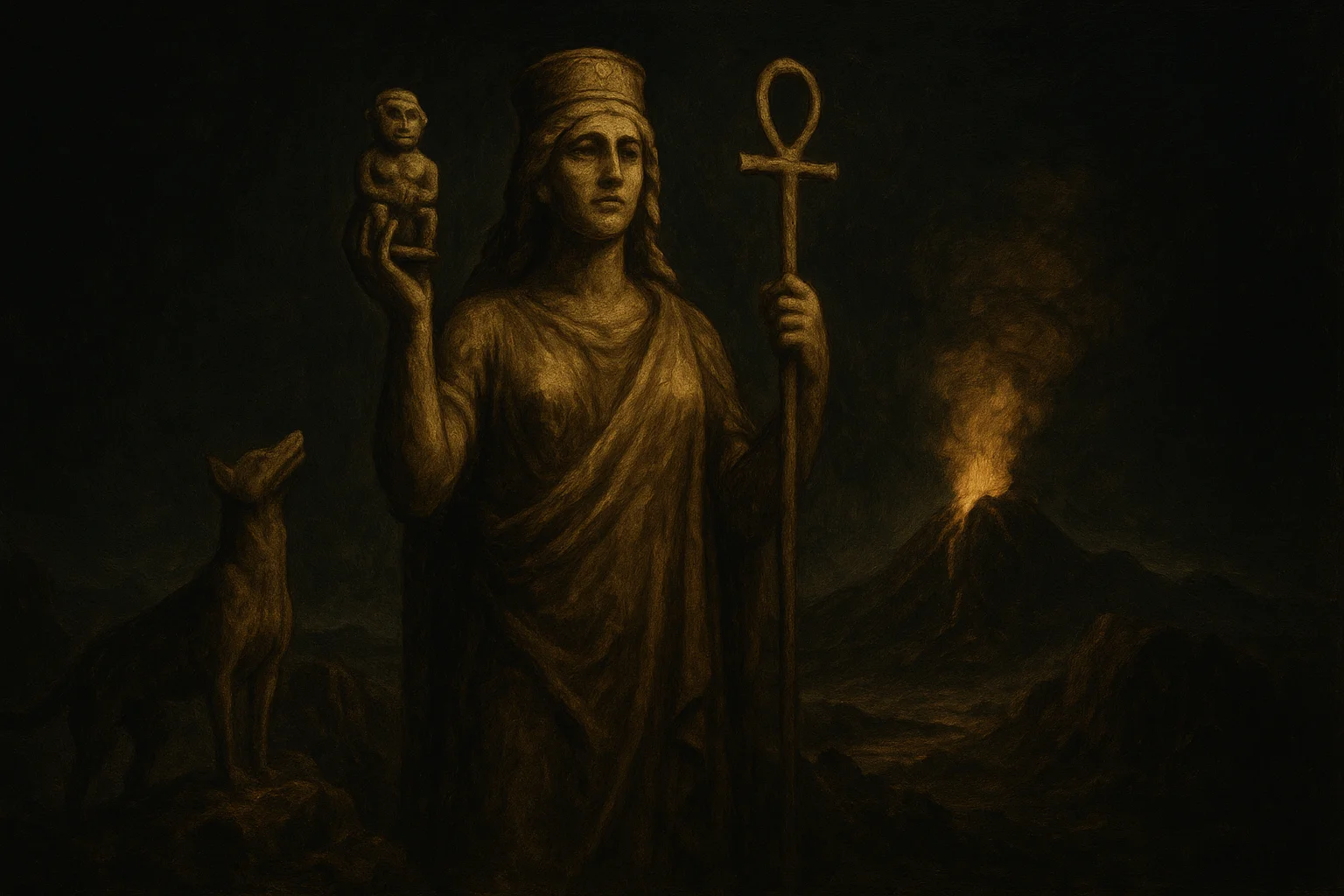
The Guanche worshipped a supreme deity called Achamán, associated with the sky and creation. Opposed to Achamán was Guayota, a malevolent figure linked to the volcano Teide. Guayota was sometimes described as a dragon or demonic entity who kidnapped the sun, plunging the world into darkness until Achamán intervened. The myth echoes solar eclipse narratives found across cultures, but the volcanic setting is distinctly Canarian.
The Guanche also venerated ancestral spirits and mummified their dead, a practice that suggests contact with or parallel development to Egyptian funerary customs. The mummies were placed in caves, continuing the Berber association of caves with the sacred and the dead.
Spanish conquest in the fifteenth century destroyed Guanche society, but fragments of their mythology were recorded by early chroniclers. The parallels with mainland Berber belief, particularly the cave burials and the emphasis on a sky god, confirm the shared origins of the two traditions.
Roman Encounters and Interpretatio Romana
When Rome conquered North Africa, it encountered a religious landscape it could not ignore. Roman policy was to absorb local gods into the imperial pantheon through interpretatio Romana, the practice of identifying foreign deities with Roman equivalents. Berber gods were thus renamed and reinterpreted.
Inscriptions from Numidia and Mauretania identify local gods as Saturn, Jupiter, or Mercury. The god Baal Hammon, originally Punic but widely worshipped by Berbers, became Saturnus Africanus. A Berber war god might be equated with Mars. A fertility goddess became Juno or Ceres. The process was not purely cynical; Roman soldiers and settlers genuinely believed that the gods they encountered were local manifestations of universal divine forces.
Apuleius, a Berber himself, born in Madaurus in the second century CE, offers a rare insider perspective. His Metamorphoses (The Golden Ass) is set in North Africa and features mystery cults, magic, and divine intervention. The goddess Isis, who appears at the novel's climax, was widely worshipped in the region and may have absorbed attributes of older Berber goddesses.
"I am Nature, the parent of all things, mistress of the elements, the first offspring of time, sovereign of the spiritual world, queen of the dead, and foremost of the heavenly beings." Apuleius, Metamorphoses, Book 11
The speech, delivered by Isis, reflects the syncretic theology of Roman North Africa, where Greek, Roman, Punic, and Berber traditions blended into a cosmopolitan religious culture.
Berber Agurzil
War god carried into battle as bull-headed idol; patron of oaths and tribal warriors; cult centred in Tripolitania.
Roman Mars
War god of the Roman state; protector of soldiers and agricultural fields; often syncretised with local war deities across the empire.
Islamic Syncretism and Survival
The Arab conquest of the Maghreb in the seventh and eighth centuries brought Islam to Berber lands. Conversion was gradual and uneven. Some tribes adopted Islam quickly, others resisted for generations. Even after formal conversion, older beliefs persisted beneath the surface.
Islam's strict monotheism left no room for the old gods, but it did accommodate spirits and saints. The jinn, already part of Quranic cosmology, provided a category into which older Berber spirits could be folded. Maraboutism, the veneration of saints, allowed ancestor cults to continue in Islamic garb. Seasonal festivals, once dedicated to Anzar or other agricultural deities, were reframed as Islamic celebrations.
Ibn Khaldun, writing in the fourteenth century, observed that Berber tribes retained customs that predated Islam. He noted their reverence for certain mountains and springs, their reliance on diviners and healers, and their resistance to Arab cultural dominance. His Kitab al-Ibar preserves details of Berber genealogies and traditions that might otherwise have been lost.
Leo Africanus, a sixteenth-century traveller and geographer, described Berber practices in Morocco and noted the persistence of pre-Islamic elements. He recorded festivals involving processions, animal sacrifices, and invocations of rain, all of which he recognised as distinct from orthodox Islamic practice.
- Seasonal rain rites invoking Anzar continue in rural Morocco and Algeria.
- Cave shrines remain pilgrimage sites, now associated with Muslim saints.
- Jinn are blamed for illness and misfortune, and exorcism rituals blend Quranic recitation with older formulae.
- Tattoos and amulets bearing pre-Islamic symbols are still used for protection.
- Oral tales feature heroes, tricksters, and supernatural beings that predate Islam.
The survival is not a matter of resistance but of adaptation. Berber mythology did not vanish; it changed shape.
Oral Tradition and the Problem of Sources
The absence of a written Berber scripture means that mythology survives primarily in oral tradition. Folk tales, songs, proverbs, and ritual formulae carry cosmological knowledge forward, but oral transmission is fluid. Stories change with each telling, and the line between pre-Islamic and Islamic elements is often impossible to draw.
French colonial ethnographers recorded thousands of Berber tales in the nineteenth and twentieth centuries. These collections are invaluable but also problematic. The ethnographers were outsiders, often working through interpreters, and their assumptions shaped what they recorded. They were looking for "primitive" survivals and sometimes invented continuities where none existed.
Still, patterns emerge. The same deity names, the same ritual structures, the same cosmological themes appear across regions and across centuries. The oral tradition is not a perfect archive, but it is the archive we have.
Modern Berber communities, particularly in Morocco and Algeria, have begun to reclaim and document their own traditions. Cultural organisations record songs, publish folk tales, and advocate for the recognition of Amazigh identity. This work is not purely nostalgic; it is an assertion of continuity in the face of centuries of marginalisation.
Frequently asked questions
What gods did the Berbers worship before Islam?
The pre-Islamic Berber pantheon included Agurzil, a bull-headed war god; Anzar, a rain and fertility deity; and Ifri, a cave goddess associated with protection and childbirth. Regional variation was significant, and many local deities were known only within specific tribes or territories. Roman sources often renamed these gods using interpretatio Romana, making reconstruction difficult.
How did Roman colonisation affect Berber religious practice?
Rome absorbed Berber gods into its own pantheon through interpretatio Romana, equating local deities with Roman equivalents like Saturn, Mars, and Juno. This process preserved some deity names in inscriptions but obscured their original attributes. Berber communities continued to worship at traditional sites, though often under Latinised names. Apuleius' Metamorphoses offers a rare glimpse of this syncretic religious culture.
What is the connection between Berber and Guanche mythology?
The Guanche people of the Canary Islands spoke a Berber language and shared cosmological elements with mainland Berber traditions, including cave burials, ancestor veneration, and a sky god. Isolated after their migration to the islands, the Guanche developed distinct myths, such as the conflict between Achamán and Guayota. Spanish conquest in the fifteenth century ended Guanche society, but recorded fragments confirm the shared origins.
Do Berber communities still practice pre-Islamic beliefs?
Pre-Islamic elements survive in Islamised forms. Rain rites invoking Anzar continue in rural areas, cave shrines are now associated with Muslim saints, and jinn beliefs blend Quranic and older Berber cosmology. Seasonal festivals, protective amulets, and oral tales preserve pre-Islamic structures, though they are now interpreted within an Islamic framework. The survival is a matter of adaptation rather than unchanged continuity.
What primary sources exist for reconstructing Berber cosmology?
Primary sources include Herodotus' Histories, which describes Libyan customs; Roman-era inscriptions naming Berber gods; Corippus' Iohannis and Procopius' History of the Wars, which mention Agurzil; and medieval Arab chroniclers like Ibn Khaldun. Apuleius' Metamorphoses offers a Berber perspective on North African religion. Oral tradition, recorded by ethnographers, provides additional material, though it is often difficult to date or attribute.
How did Islam change Berber mythology?
Islam replaced the old gods with strict monotheism but absorbed older cosmological structures. Jinn beliefs merged with Quranic jinn, ancestor veneration was redirected toward Muslim saints, and seasonal rites were reframed as Islamic festivals. Sacred geography remained largely unchanged: springs, caves, and mountains continued to be sites of pilgrimage, now associated with marabouts. The result is a layered tradition in which pre-Islamic elements persist beneath Islamic forms.