

Tanit: Goddess of Fertility and the Moon
Tanit ruled the Carthaginian sky as goddess of fertility, the moon, and sacred fire. Her crescent symbol marked temples from North Africa to Iberia, and her worship outlasted empires.
Contents
The crescent hangs low over the ancient port. Salt air off the Gulf of Tunis drifts between stone columns, and somewhere behind the tophet's gate, a priestess lifts a terracotta figurine with open arms toward the sky. She is offering it to Tanit, the great goddess whose face no sculptor ever fixed in final form, whose power no single city could keep to itself.
Tanit: Goddess of Fertility and the Moon stands at the crossroads of Berber, Phoenician, and Punic religious thought. She absorbed influences from across the Mediterranean, yet her essential character remained rooted in the ancient Amazigh soil of North Africa. She presided over birth and harvest, over the rhythms of the lunar calendar, over the fire that purifies. Carthage made her its most prominent deity for several centuries, building her a sacred precinct near the harbor that archaeologists still excavate today.
What makes Tanit remarkable is not simply her power but her longevity. Empires fell around her. Rome razed Carthage in 146 BCE. Yet Tanit's symbol kept appearing on amulets, mosaic floors, and burial stelae deep into the Roman imperial period, quietly outlasting the civilization that had proclaimed her Queen of Heaven.
Tanit's Origins: Berber Roots and Phoenician Grafts

The question of where Tanit begins is genuinely contested among scholars. One current of academic opinion connects her name to the Semitic root tnt, meaning "serpent lady" or possibly to a Phoenician toponym. Another, championed by scholars of Amazigh history, derives her from a pre-Phoenician North African goddess tradition, pointing to the persistence of crescent-and-disc motifs in Berber funerary art that predate Phoenician colonization in the region.
When Phoenician traders founded Carthage around 814 BCE (a date drawn from ancient sources including Timaeus of Tauromenion), they brought their own pantheon with them. Chief among their deities were Baal Hammon and Astarte. Yet within two or three centuries, Tanit had supplanted Astarte as Baal Hammon's consort and ranked ahead of him in temple dedications. That displacement is striking. It suggests Tanit was not simply imported but emerged from a fusion: Phoenician theological structures wrapped around an older Berber goddess whose worship was already alive in the landscape.
The Berber connection surfaces in her lunar attributes. Amazigh communities across the Maghreb maintained deep reverence for moon symbolism, and the crescent appears on Tuareg jewelry, Kabyle architecture, and ceremonial objects with a consistency that speaks to indigenous tradition rather than borrowed iconography. The Berber mythological tradition preserved a cosmology in which celestial bodies were living presences, not merely astronomical features, and Tanit fits precisely within that worldview.
Her name may also carry echoes of Neith, the Egyptian goddess of war and creation worshipped across the border in the Nile Delta. Some scholars, noting the geographic proximity and long commercial contact between Egypt and Carthage, suggest the two goddesses shared a conceptual lineage. Neith's double arrow symbol and Tanit's raised-arm figure both convey a sense of cosmic guardianship that transcends any single mythological canon.
Queen of Heaven: Tanit's Role in Carthaginian Religion
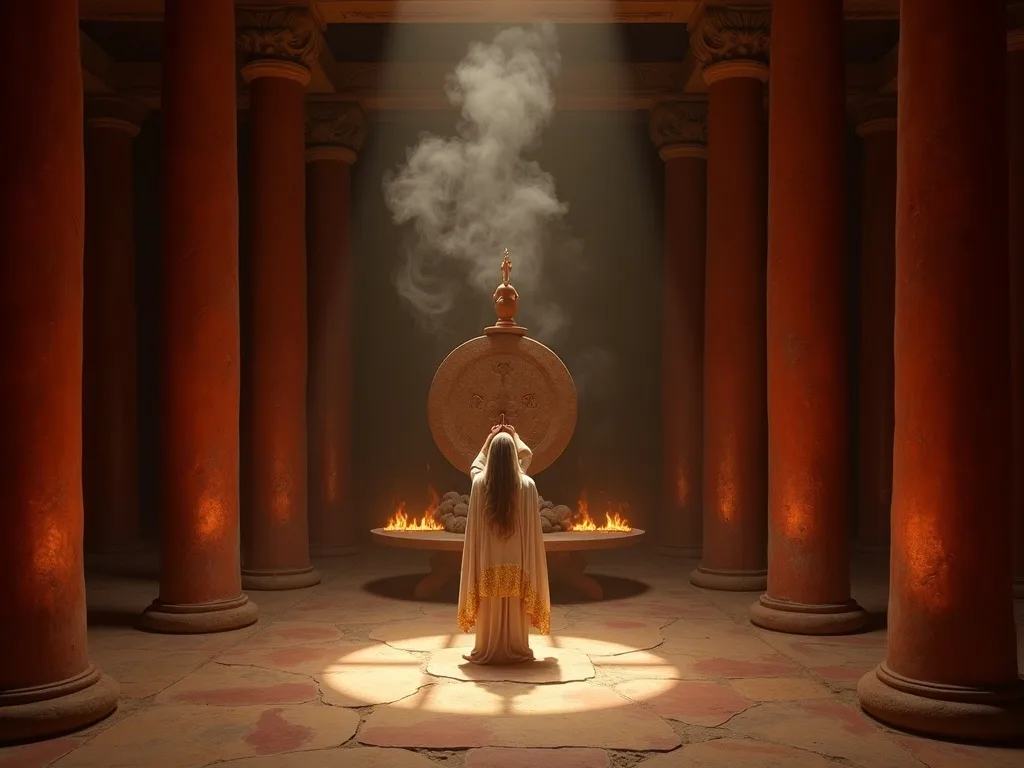
Carthaginian inscriptions from the 5th century BCE onward name Tanit with the epithet Pene Baal, meaning "Face of Baal," suggesting she was understood as the visible, luminous aspect of divine power while her consort Baal Hammon represented a more hidden, chthonic force. This pairing mirrors lunar-solar dualisms found across ancient Near Eastern religion, but Tanit's role was never subordinate. She consistently appears first in dedicatory formulae, a position of theological primacy.
Her worship encompassed several overlapping functions:
- Lunar governance: Tanit regulated the monthly calendar, tides, and the cycles governing female fertility. Pregnant women and new mothers brought votive offerings to her sanctuaries.
- Protection of the city: She served as a tutelary goddess, a guardian whose symbol was painted on shields and carved above city gates. Livy and other Roman authors occasionally acknowledge her civic importance even while describing Carthage as an enemy.
- Celestial fire: Tanit was associated with the sacred flame kept burning in her temples. This fire had a purifying function, conceptually linked to the idea that the moon's reflected light cleanses what the sun scorches.
- Agricultural abundance: Grain stores, olive harvests, and the first fruits of the season were brought to her in thanksgiving. North African soil was among the most productive in the ancient Mediterranean, and Tanit was credited with its generosity.
Her priesthood appears to have included both men and women, and some inscriptions suggest hereditary priestly offices within noble Carthaginian families. The cult was not austere. Music, procession, and the burning of incense featured prominently. A passage in Diodorus Siculus describes the rites of Baal Hammon and Tanit with a solemnity that implies elaborate liturgical performance rather than improvised devotion.
The Sign of Tanit: Anatomy of a Sacred Symbol
No other artifact defines Tanit: Goddess of Fertility and the Moon as completely as her geometric emblem. The Sign of Tanit appears in thousands of variations on the stelae that once crowded the tophet precinct at Carthage (modern Salammbô, Tunis), and on equivalent sacred spaces in Motya, Sardinia, Malta, and along the Iberian coast.
The basic form is simple: a trapezoid or triangle at the base, a horizontal crossbar at mid-height, and a circle at the top. Scholars interpret this as a stylized human silhouette, arms extended in a gesture of offering or blessing. Some versions add a crescent moon below the circle. Others incorporate a raised hand or a uraeus-style serpent curling around the disc.
What the sign does not have is a face. This absence was almost certainly deliberate. Ancient aniconic worship, the tradition of venerating the divine through abstract symbols rather than lifelike statues, ran deep in Phoenician and Punic religion. The Kaaba in Mecca perpetuates a cognate tradition. Tanit's faceless emblem invited the worshipper to project the divine without being constrained by a sculptor's interpretation.
The symbol's persistence is geographically extraordinary. It appears on:
- Votive stelae at the Tophet of Salammbô, numbering in the thousands
- Bronze pendants found at Ibiza (Ibosim in Punic) dating to the 3rd century BCE
- Sardinian standing stones (betili) with crescent-and-disc carvings predating Phoenician contact
- Roman-period mosaic floors in the Tunisian interior, where the symbol survived religious change by shifting into a decorative register
That mosaic evidence is telling. When Rome absorbed North Africa, Tanit did not vanish. She migrated, her symbol becoming a protective household motif that required no theological explanation.
The Tophet Controversy: Child Sacrifice or Sacred Cemetery?
No aspect of Tanit's cult generates more scholarly heat than the tophet. The word itself comes from the Hebrew Bible, where topheth designates a site of fire offerings in the Valley of Hinnom near Jerusalem. Roman and Greek authors, particularly Diodorus Siculus and Plutarch, claimed that the Carthaginians sacrificed children to Baal Hammon and Tanit, burning infants in a great bronze idol whose arms tipped the offerings into a furnace.
The archaeological reality is murkier. Excavations at the Salammbô tophet, conducted from the 1920s onward by French archaeologists and more recently by the Institut National du Patrimoine of Tunisia, have recovered thousands of urns containing cremated remains of infants and young children, along with the charred bones of sheep, goats, and lambs. Most urns sit beneath carved stelae dedicated to Baal Hammon and Tanit.
Two competing interpretations have dominated scholarship for decades:
Interpretation A (ritual sacrifice): The urns represent children deliberately killed and offered to the gods, a practice attested in ancient sources and echoed by the Hebrew Bible's condemnation of Moloch worship. Scholars including Lawrence Stager (Harvard) and Jeffrey Schwartz argued that the age profile of the infant remains, newborns to age four, and the ritual context point to intentional sacrifice.
Interpretation B (sacred cemetery): The urns hold children who died of natural causes, particularly high infant mortality in the ancient world, and who were given a special sacred burial because of their liminal status between the human and divine worlds. Scholars including Josephine Quinn (Oxford) and Piero Bartoloni contend that dedicating a child's ashes to a goddess was an act of mourning and consecration, not killing.
A 2023 reassessment of zooarchaeological data from the Salammbô site, published in the Journal of Archaeological Science, found a higher proportion of animal remains than previously catalogued. The authors concluded: "The revised faunal ratios are more consistent with a sanctuary in which animal substitution was the normative offering, with human infant deposits representing exceptional rather than routine practice." This quantitative reframing has not resolved the debate, but it has shifted the burden of proof significantly toward those who argue for systematic sacrifice.
What matters for understanding Tanit is that the tophet was her sacred space. Whatever the precise nature of the offerings, the community brought its most intimate losses and most solemn vows to her precinct. She presided over the boundary between life and death, a role consistent with lunar goddesses across many traditions.
Tanit and Her Mediterranean Kin
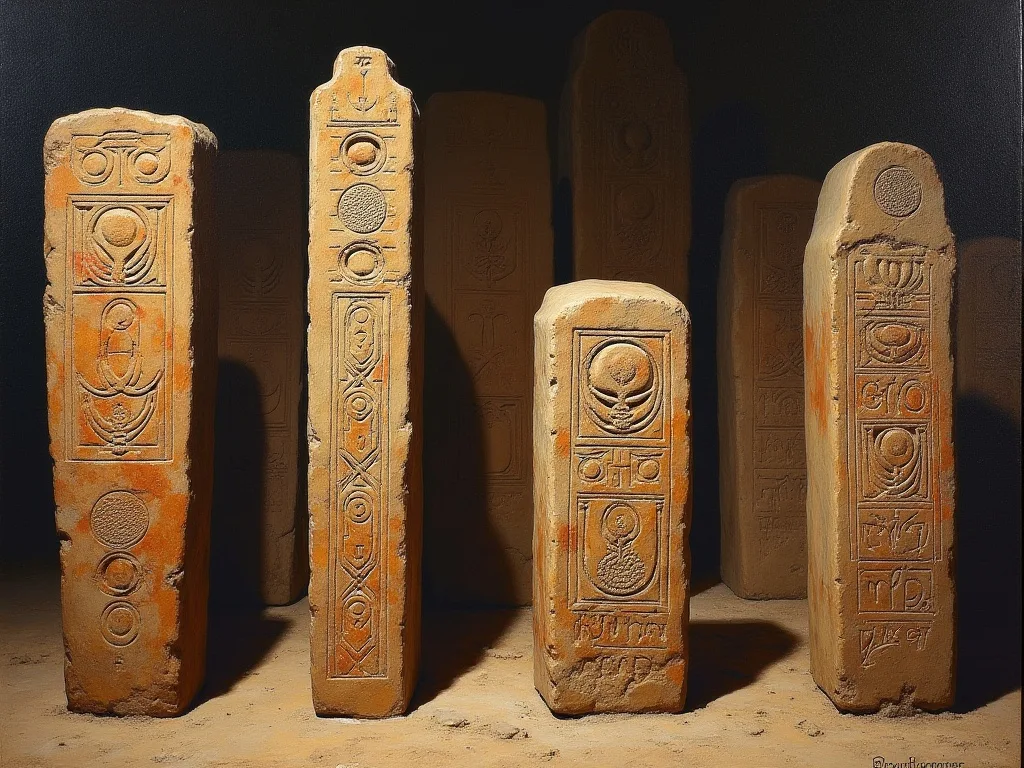
Tanit did not exist in isolation. The ancient Mediterranean was a world of theological borrowing, where goddesses traded epithets and attributes across sea lanes. Several overlapping traditions illuminate her character.
Astarte, the Phoenician goddess of love and war, was Tanit's immediate precursor in Carthage. As Tanit rose in prominence from the 5th century BCE onward, Astarte receded, though the two never became fully synonymous. Astarte was more explicitly erotic and martial; Tanit's lunar and maternal qualities gave her a different emotional register.
| Aspect | Tanit (Punic) | Caelestis (Roman) |
|---|---|---|
| Primary domain | Lunar fertility, celestial fire, city protection | Healing, celestial sovereignty, storm protection |
| Iconography | Aniconic Sign of Tanit, crescent, raised-arm figurines | Enthroned goddess with lion, sometimes with radiate crown |
| Principal sanctuary | Tophet of Salammbô, Carthage | Temple at Carthage (refounded colony) |
| Key devotees | Punic noble families, Carthaginian sailors, mothers | North African provincials, Emperor Septimius Severus |
| Survival strategy | Geometric symbol migrated to household decoration | Imperial patronage, then absorption into Juno cult |
The Roman goddess Caelestis, worshipped primarily in North Africa from the 2nd century CE onward, is widely understood by scholars as a direct continuation of Tanit under a Latin name. The Emperor Septimius Severus, who was born in Leptis Magna (modern Libya) and knew North African religious traditions intimately, gave Caelestis-Tanit unusual imperial prominence. Her temple at Carthage remained active until the Christian bishop Augustine of Hippo described crowds attending her festivals in the early 5th century CE. The comparison above captures how the transition was as much a rebranding as a true theological rupture: Caelestis kept Tanit's portfolio while adopting Roman visual grammar.
The comparison with Isis is instructive. Both goddesses wore the crescent; both were invoked by nursing mothers; both presided over cycles of death and renewal. The Isis cult spread from Egypt across the Hellenistic world and eventually reached Rome, following trade routes that intersected repeatedly with Tanit's own sphere of influence. Some Punic communities in the Levant conflated the two goddesses openly, producing hybrid imagery that combined the Sign of Tanit with Isis's distinctive headdress.
Further west, the goddess worshipped at Ibiza, where Tanit's cult was strongly embedded, shares characteristics with the Iberian goddess Ataecina, a lunar-chthonic deity of the western Mediterranean. Whether direct syncretism occurred or whether parallel traditions happened to converge is a question philologists and archaeologists continue to work through.
Tanit in the Berber Landscape Beyond Carthage
Carthage fell, but the Berber populations of the interior had never been Carthaginian subjects in a simple sense, and their veneration of lunar goddesses did not require a port city to survive. Amazigh communities in the Aures Mountains, the Kabyle highlands, and the Saharan fringes maintained cosmological traditions that scholars of indigenous North African religion identify as continuous with the pre-Punic substrate that once gave Tanit her deepest roots.
The Tuareg, who preserved a matrilineal social structure unique in the Islamic Sahara, maintained reverence for the moon as a feminine presence governing time and fertility. Tuareg women historically controlled household and property inheritance, and the moon's phases structured agricultural and pastoral calendars. Whether this constitutes a direct descent from Tanit worship is impossible to prove through a clean genealogical line, but the structural resonances are genuine enough to have attracted serious anthropological attention.
In modern Tunisia, the Sign of Tanit has become a cultural emblem of national identity. It appears on jewelry, ceramics, and public murals, functioning as a marker of pre-Islamic Tunisian heritage. The Musée National du Bardo in Tunis holds one of the finest collections of Punic stelae in the world, many of them bearing the goddess's symbol, and attracts visitors from across North Africa and Europe. The ancient mythology of North Africa feeds this contemporary appetite for deep roots that predate any single empire's reach.
The Amazigh cultural renaissance of the late 20th and early 21st centuries has also drawn Tanit into contemporary identity politics. Berber-language activists and cultural advocates have claimed her as a symbol of indigenous North African womanhood, separate from both Arab and European frameworks. This is mythological reactivation in real time: a 2,500-year-old goddess becoming a rallying point for minority language rights in Morocco, Algeria, and Tunisia.
Tanit's Iconography in Art and Archaeology
Classical statuary of Tanit is rare. The aniconic tradition of Punic religion meant that her cult did not produce the kind of large-scale figurative sculpture that Roman Jupiter or Greek Athena received. What survives is remarkable nonetheless.
Terracotta figurines, particularly the "goddess with raised arms" type recovered in huge quantities from Carthaginian deposits, are interpreted as Tanit votives. These small objects, typically 15 to 25 cm tall, show a female figure with disk-like face, arms lifted in a gesture of blessing or supplication, and a cylindrical body that evokes the geometric Sign of Tanit in three dimensions. They were cheap enough for ordinary worshippers to afford, which suggests the cult had broad popular roots beyond elite priestly circles.
A remarkable series of Tanit masks, hollow terracotta faces with exaggerated features, open mouths, and painted decoration, have been found at Carthage and in Sardinian tophet deposits. Their precise function is debated: protective apotropaic masks, votive substitutes for human faces, or elements of priestly ritual costume. Their expressive intensity is difficult to look at without feeling the weight of the devotion that produced them.
The stelae are the most systematic evidence. At Salammbô, upward of 6,000 carved limestone and sandstone stelae have been catalogued, bearing the Sign of Tanit, Baal Hammon's crescent-and-disc, dedicatory inscriptions in Punic, and sometimes a combination of Egyptian motifs: the Eye of Horus, the caduceus, the lotus. This iconographic mixing speaks to Carthage's position as a commercial and cultural crossroads, where religious symbols arrived by ship from every corner of the Mediterranean and were absorbed into local practice without apparent contradiction. Readers interested in how similar cross-cultural mythological flows shaped neighboring traditions will find useful context in the Egyptian gods overview.
Frequently Asked Questions about Tanit, Goddess of Fertility and the Moon
Frequently asked questions
Was Tanit originally a Berber goddess or a Phoenician one?
The scholarly consensus leans toward a fusion origin. Phoenician colonists arriving in North Africa from the 9th century BCE brought a religious framework that included Astarte and Baal Hammon, but the rapid rise of Tanit to chief deity status suggests she absorbed or displaced a pre-existing Amazigh lunar goddess whose worship was already embedded in the landscape. Purely Phoenician genealogies cannot explain her iconographic distinctiveness from Levantine traditions. The most defensible position is that Tanit emerged at the intersection of both currents.
What did the Sign of Tanit actually represent?
The Sign of Tanit is a stylized anthropomorphic figure: triangular or trapezoidal body (the torso), a horizontal bar (outstretched arms), and a circle (the head), often with a crescent moon beneath the circle. It represents a human posture of offering or blessing and doubles as an abstract emblem of the goddess herself. Its deliberate abstraction fits the Punic aniconic tradition, which preferred geometric symbols to anthropomorphic statues. The sign appears on thousands of votive stelae from Carthage, Sardinia, Malta, and the Iberian Peninsula.
Did the Romans continue worshipping Tanit after they destroyed Carthage?
Yes, under the name Caelestis (or Dea Caelestis). The Roman province of Africa retained deep Punic cultural roots, and the goddess's cult proved impossible to erase. She received Roman-period temples in Carthage itself, which was refounded as a Roman colony after 44 BCE. The Emperor Septimius Severus (reigned 193 to 211 CE), a native of North Africa, gave the cult unusual imperial support. Augustine of Hippo, writing around 400 CE, mentions crowds still attending Caelestis festivals in Carthage, confirming the cult persisted into the Christian era.
What is the connection between Tanit and child sacrifice?
Classical authors including Diodorus Siculus and Plutarch claimed Carthaginians sacrificed children to Baal Hammon and Tanit. Archaeological excavations of the tophet sanctuary at Salammbô have found thousands of urns with cremated infant remains beneath dedicatory stelae. The interpretation is genuinely debated: some scholars argue these urns represent ritual sacrifice; others argue they constitute a sacred cemetery for children who died naturally, with the offerings made in mourning and consecration. A 2023 study in the Journal of Archaeological Science, reassessing faunal remains at the site, found higher proportions of animal deposits than previously counted, supporting the view that animal substitution was the norm rather than the exception. No definitive consensus exists.
How does Tanit relate to modern Berber cultural identity?
The Sign of Tanit has become a significant emblem of Amazigh (Berber) cultural identity in the 21st century, especially in Tunisia, Algeria, and Morocco. Berber-language activists use her image to assert a pre-Islamic, pre-Arab North African heritage rooted in indigenous tradition. In Tunisia, her symbol appears on nationally marketed jewelry and ceramics. This is a living example of mythological reactivation: an ancient goddess whose cult had fragmented into folk tradition finding renewed relevance as a political and cultural symbol.
Which primary sources mention Tanit directly?
Ancient literary sources that explicitly name Tanit are surprisingly few. Most evidence is epigraphic: thousands of Punic votive inscriptions beginning with the formula "To our Lady Tanit Face-of-Baal and to Baal Hammon" (lrbt ltnt pn b'l wlb'l hmn). Classical authors more often describe Punic religious practices without naming Tanit specifically, attributing rites to "the goddess" or conflating her with Juno, Astarte, or Caelestis. Diodorus Siculus (Library of History, Book XX) describes crisis-period sacrifices in Carthage. Plutarch's De Superstitione touches on similar themes. The bulk of our knowledge rests on archaeological evidence rather than narrative literary tradition.
Tanit's Afterlife: From Roman Caelestis to Contemporary Symbol
The story of Tanit: Goddess of Fertility and the Moon does not end with the fall of Carthage, or with the closure of her last formal temple. It shifts register, moves underground, and resurfaces in forms that would have puzzled her original priests.
Roman Caelestis kept the theological core intact. Worshippers in the 2nd and 3rd centuries CE petitioned her for healing, fertility, and protection against storms, the same portfolio Tanit had held for five hundred years. When Christianity spread through North Africa in the 3rd and 4th centuries, competing directly with her cult, the process was protracted. Augustine's Confessions and City of God both position Caelestis-Tanit as the primary popular rival to Christian monotheism in the region, which is itself a measure of her enduring hold on the population.
The Islamic conquest of North Africa in the 7th century CE did not obliterate folk memory of the goddess either. Ethnographers working in the Maghreb in the 19th and 20th centuries documented persistent folk rituals invoking a feminine lunar presence in agricultural communities, rituals whose participants often had no conscious connection to ancient Carthaginian religion but whose symbolic vocabulary retained crescent imagery, fire offerings, and prayers for fertility that scholars found structurally consonant with Punic practice.
The critical difference between Tanit and many other lost goddesses is that she has living communities actively reclaiming her. The Amazigh renaissance, gathering force since the 1990s, has produced poets, musicians, and visual artists who invoke Tanit as a founding ancestral figure. A Kabyle poet does not need to have read Punic inscriptions to recognize in Tanit something that belongs to her cultural inheritance. That intuition, partly romantic, partly grounded in genuine historical continuity, keeps the goddess alive in a way that academic archaeology alone cannot. Similar dynamics of living mythological reclamation appear in the story of Isis in the modern world, where a goddess survived empire, exile, and time on the strength of popular devotion.
There is also the straightforward reality of the symbol. Any North African market sells pendants bearing the Sign of Tanit alongside Amazigh geometric patterns and the Islamic Khamsa. These objects circulate without theological commentary, worn by people of different faiths and none. The sign has become what linguists call a "floating signifier": an emblem whose meaning shifts depending on who carries it but whose visual force has never dimmed in three thousand years.
That is an extraordinary run for a goddess whose name no living person can pronounce with certainty. The crescent endures.
Free 25-page sample
Want the whole story?
Take the first 25 pages free. If it pulls you in, the full edition is yours as an instant PDF download, with a paperback on Amazon for selected titles.
Berber
The Berber Mythology Book: The Gods, Spirits, and Sacred World of the Amazigh
The Amazigh: Gods, Spirits, and North Africa
The beliefs of North Africa’s first people, the Amazigh, who were old when Carthage was young: the sun and the moon, the jnun of the wild places, the cult of the ancestors and the caves, the goddess the Greeks called Athena, and a tradition that outlived every empire.
More from Berber
All articles
Berber
The Azru Oak: Sacred Tree Cult and Ritual Sites in Berber Tradition
The Azru Oak stands as the living spine of Berber sacred geography, where tribal councils, healing rites, and offerings to ancestral spirits converged for millennia. Discover how this revered tree shaped Berber law, spirituality, and community bonds across North Africa.

Berber
Masinissa: King and Cultural Hero of Numidia
Masinissa united Numidia and shaped the destiny of North Africa by walking between Carthage and Rome. His reign (202-148 BCE) transformed a fragmented kingdom into a civilized power that wrote its own laws.

Berber
Yennayer: Berber New Year and Agricultural Festival
Yennayer marks the Berber New Year on January 14, celebrating the spring planting season and ancestral connection to the land. Discover how this 2,944-year-old festival blends agricultural ritual, family tradition, and cultural identity across North Africa.
Berber
The Hand of Fatima in Berber Symbolism: Protection, Blessing, and Identity Across North Africa
The Hand of Fatima, or Khamsa, is far more than Islamic decoration in Berber culture. It carries layers of pre-Islamic protection magic, women's agency, and ancestral wisdom. Discover how Amazigh communities wove this symbol into identity, ritual, and everyday life across Morocco, Algeria, and Tunisia.