
The Seven Sleepers of Ephesus in Berber Tradition: A Sacred Bridge Between Islam and Amazigh Folklore
The Seven Sleepers of Ephesus crossed from Islamic scripture into Berber oral tradition as a story of faith tested by time itself. Discover how this sacred cycle shaped Amazigh spirituality and remains alive in ritual and remembrance across North Africa.
Contents
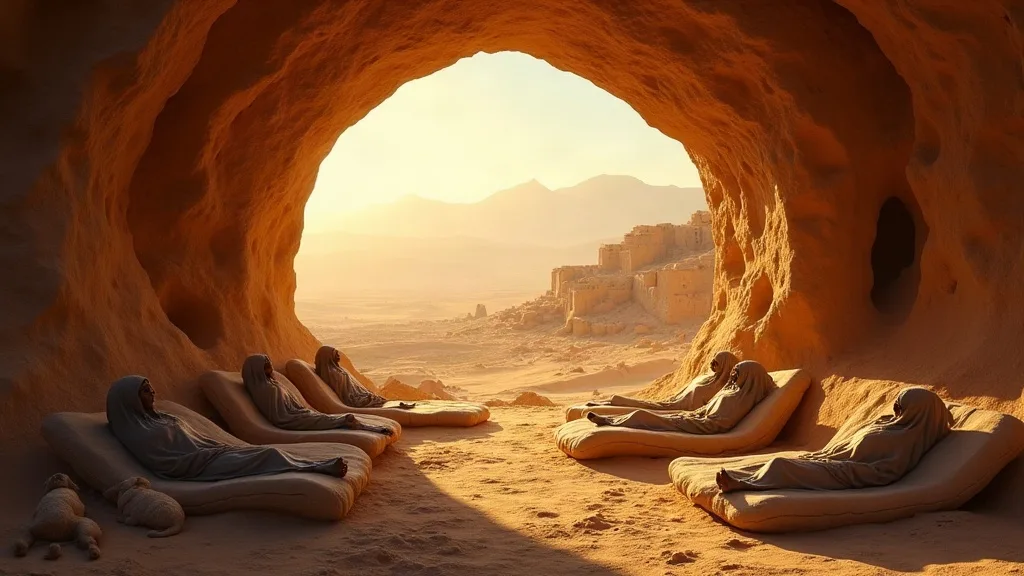
A dog entered a cave in Ephesus and lay down between two sleepers. The year was the reign of the Roman Emperor Decius, or so the oldest versions claim; the sleepers would wake more than three centuries later. For the Berber peoples of the Maghreb, this story was never simply a curiosity from distant Byzantine lands. It arrived through Islamic tradition, traveled the merchant routes, settled into gatherings around fires, and grew roots in the spiritual soil of Amazigh life. Today, the Seven Sleepers of Ephesus in Berber tradition stands as one of the most compelling bridges between revealed religion and indigenous custom, a proof that sacred stories reshape themselves when they move into new hands.
The tale itself is ancient and layered. It appears in the Quran (Chapter 18, "Al-Kahf"), where it carries theological weight: a test of faith, a sign that God's sovereignty transcends human time and mortality. But the Berbers did not inherit a sterile religious fact. They inherited something alive and permeable, something that could hold their own anxieties about invasion, oppression, time, and survival. The Seven Sleepers became a mirror in which they saw their own resistance.
The Quranic Foundation and Early Islamic Transmission
The Quranic account names no individuals; it speaks of "a number of young men who believed in their Lord." The surah tells of youths fleeing persecution (many Islamic commentators link this to Decius's anti-Christian campaigns), seeking refuge in a mountain cave. There, God grants them a miraculous sleep: "We put a cover over their ears in the cave for a number of years" (18:11, Quran translation by Muhammad Taqi-ud-Din al-Hilali and Muhammad Muhsin Khan). They wake, disoriented, believing only a day has passed. A thousand years later, Islamic scholars would debate every detail: exactly how long they slept, whether their dog was part of the miracle, how the town recognized them.
This scriptural account reached Berber lands within centuries of the Islamic conquest of North Africa in the 7th century. Unlike Arab conquest narratives that sometimes dwell on military triumph, the Berber reception of Islam was uneven and creative. Indigenous Berber tribes, already monotheistic or inclined toward spiritual intensity, absorbed Islamic teachings while maintaining parallel oral traditions. The Seven Sleepers fit perfectly into this hybrid spiritual space: a story affirming divine justice and eternal remembrance, told in a voice that grew increasingly Amazigh.
How the Story Migrated into Berber Oral Culture
Berber oral transmission is not careless repetition. It is architectural. A story arriving from the towns and scholars among Islamic elites would pass through the voices of merchants, caravanseers, Sufi teachers, and storytellers in the Rif Mountains, the Atlas ranges, and the Saharan oases. With each retelling, it absorbed local concerns.
In early Berber versions, recorded sparsely in colonial-era ethnographic work and more substantially in contemporary oral histories, the emphasis shifted from theological debate to spatial and temporal mystery. The sleepers became less a theological proof-text and more a phenomenon: an event that defied normal human reckoning. Berber storytellers asked the questions their communities needed answered. Why do some places hold sacred time differently? How long is a sleep, and what does sleep mean for the soul? Can a person be removed from history and then restored to it?
The cave itself gained specificity in Berber memory. In some versions, it lay not in distant Asia Minor but somewhere nearer: in the mountains of the Kabylie, in the Aurès, in the Anti-Atlas. Place names shifted. The dog, a creature outside human moral judgment, became a marker of the sleepers' innocence and divine protection. The span of time (often given as 300 years in Islamic sources, sometimes 309) became a measure of cosmic patience, of how long Amazigh resistance could endure under external pressures.
The Sleepers as a Symbol of Resilience Under Occupation
Here lies the vital heart of the story's survival in Berber tradition. The Maghreb lived through successive waves of domination: Roman, Byzantine, Arab, Berber dynasties, Ottoman, French colonization. The narrative of the Seven Sleepers, when told in a Berber village or around a winter fire, became a meditation on time under occupation.
A community facing erasure could hear in the tale of the sleepers something like hope: that a people might retreat into a protected space (the cave), enter a kind of suspension (the sleep), and emerge transformed but intact. The long sleep was not death. It was not assimilation. It was a holding. The dog, curled in the cave, represented the unbreakable bond of the community. When the sleepers woke, the dog was still there.
Berber scholars and cultural historians, particularly those working to document Amazigh folklore in the latter 20th century, began to recognize the Seven Sleepers as a keystone myth in Berber spirituality. Unlike stories that came purely from Arab tradition, or purely from pre-Islamic Berber religion, the Seven Sleepers existed in a liminal space. It was Quranic yet local, universal yet intimately theirs. It spoke to the experience of peoples who had survived conquest, maintained identity through dispersal, and kept faith in a God who did not move at human speed.
Sacred Sites and Living Pilgrimage
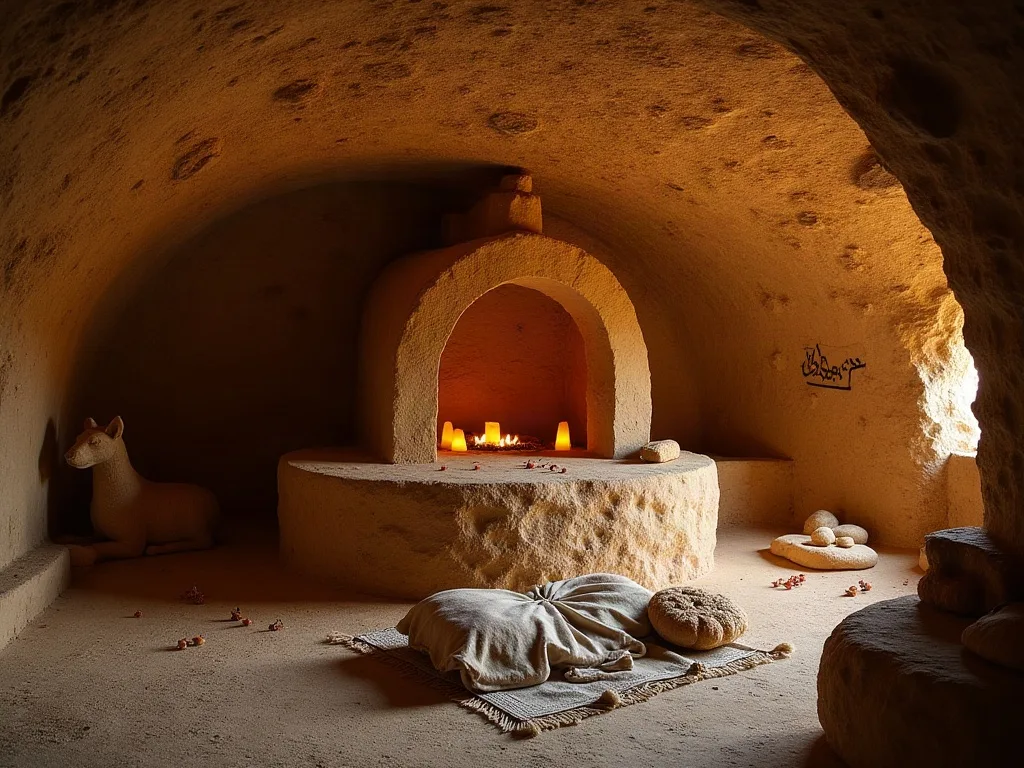
The abstraction of the myth became concrete when Berber communities began to anchor it to landscape. Across North Africa, particularly in Algeria and Morocco, caves and tombs claimed connection to the Seven Sleepers. Some scholars place one significant shrine in the Kabylie region; others point to sites in the Aurès Mountains, where Berber resistance to colonial rule was fiercest.
These were not shrines in the formal sense of official Islamic religious architecture. They were places where ordinary Berber people, particularly women and those seeking intercession for health or justice, would come to remember. The Sleepers became saintly figures in popular Berber Islam, less doctrinally precise than the scholarly Islamic tradition but no less devout. Pilgrims would leave offerings: bread, cloth, written requests. Storytellers would recite versions of the awakening at religious gatherings.
The geographer and ethnographer Germaine Tillion, who spent years documenting Berber life before and after Algerian independence, noted the persistence of such shrines and the stories attached to them. The Seven Sleepers were woven into the ritual calendar of many Berber communities, invoked during times of crisis or transition. A young bride might visit to pray for protection. A family suffering loss might travel to make an offering. The sacred story became a lived practice.
The Sleepers in Tamazight Storytelling Traditions
The Tamazight language, spoken by Berber populations across Morocco, Algeria, and scattered throughout the diaspora, absorbed and carried the story. In oral Tamazight narratives, the tale often shifts in rhythm and emphasis from Arabic Islamic versions. Berber storytellers are known for their use of call-and-response, repetitive refrains, and embedded moral asides that interrupt the plot to address the audience directly.
In Tamazight versions documented by anthropologist and folklorist Jacqueline Naudillon and others working in the Moroccan Atlas, the Seven Sleepers might be introduced with a formula acknowledging the Quranic source but then moving into a distinctly Amazigh register: the names of the sleepers take on Berber-sounding forms, the cave becomes a specific mountain pass known locally, and the "awakening" is framed not just as a return to the world but as a clarification. The sleepers awaken to understand something the dreaming world could not grasp.
In some tellings, the dog speaks or acts as a guardian with semi-mystical powers. In others, the sleepers' sleep is compared to the hibernation of animals or the dormancy of seeds, embedding the story into ecological knowledge. The Berber relationship to the seasons, to transhumance (seasonal herding), and to the land's cycles of apparent death and renewal finds echoes in the sleep and awakening.
Scholarly Debates: History, Theology, and Oral Transmission
Islamic scholars have long debated the historical kernel of the Seven Sleepers story. Some propose a connection to the Sleepers' Cave near Ephesus (now in Turkey), a site that attracted both Christian and Muslim pilgrims in medieval times. Others see the tale as a spiritual allegory, not anchored to any single historical event. The Quranic text itself distances the historical claim: "You might say they were three, or five, or seven; only God knows the exact number" (18:22).
When this scholarly uncertainty reaches Berber tradition, it takes on a different character. The Berber storyteller is not concerned with vindicating a specific historical event. Rather, the indeterminacy becomes part of the story's power. The sleepers' names are unknown; the exact duration is uncertain; the cave's location varies. This vagueness is not weakness but flexibility. A story without fixed historical coordinates can belong to any landscape, any listener's family, any moment of crisis.
Contemporary Berber scholars and cultural historians, including researchers affiliated with universities in Algeria and Morocco studying Amazigh heritage, have begun to examine how oral traditions like the Seven Sleepers persist and evolve. Their work shows that Berber oral transmission is not static folklore but a living adaptive system. Each generation retells the story with new details, new emphases, sometimes new interpretations shaped by current events. During the Algerian War of Independence (1954-1962), for instance, the Sleepers' resistance in the cave took on new resonance in villages facing French military campaigns.
The Dog as a Sacred Witness
The dog deserves particular attention in Berber versions of the tale. In Islamic tradition, the animal is called al-raqim (the protector or guardian) in some interpretations. In Berber retellings, the dog becomes almost a character in its own right: loyal, unwavering, present across the entire span of the sleep and awakening.
This elevation of the dog's role may reflect Berber pastoral culture, where dogs are essential working animals and companions. A shepherd's dog is not a pet; it is a co-survivor, a partner in the struggle against predators and harsh weather. The dog lying in the cave with the Seven Sleepers is thus not an odd detail but a profound one. It represents continuity, innocence, and the bond between humans and other beings that transcends even miraculous time.
In some Berber versions, the dog ages or changes visibly when the sleepers awake, a sign of the centuries that have truly passed despite their sleep. In others, the dog remains unchanged, reinforcing the miracle's totality. These variations reveal how Berber storytellers used the dog as a gauge of time, a creature whose presence or transformation could make the temporal rupture comprehensible to listeners.
The Sleepers in Modern Berber Spirituality and Identity
In the 21st century, the Seven Sleepers persist in Berber spiritual and cultural discourse, though in transformed ways. As Amazigh language and culture have gained official recognition in Morocco (Tamazight became an official language in 2011) and in broader Berber diaspora communities, scholars and activists have revisited traditional stories, including the Seven Sleepers, as emblems of cultural continuity and resilience.
The story appears occasionally in contemporary Amazigh literature and poetry, referenced by writers exploring themes of awakening, identity, and the relationship between a people and their sacred history. It also appears in some Sufi circles in North Africa, where the mystical dimension of the sleep (understood as a spiritual withdrawal or meditative state) resonates with Sufi concepts of fana (annihilation of self in the divine).
Younger Berber communities, particularly in diaspora contexts (France, Canada, the United States), have engaged with the story through a lens of postcolonial memory. The sleep and awakening become a metaphor for cultural suppression and cultural recovery. The cave becomes a symbol of spaces (language, ritual, oral tradition) where a people preserve themselves against external pressure.
Echoes in Other Mediterranean and Islamic Traditions
The Seven Sleepers story did not remain unique to either Islamic or Berber tradition. Christian communities in the Eastern Mediterranean maintained their own versions, sometimes claiming the sleepers had been Christian martyrs. Byzantine sources, Jewish textual tradition, and Syrian Christian narratives all touched and shaped the tale. When Berber communities encountered the story, they were receiving it not from a single pure source but from a cosmopolitan Mediterranean circulation of sacred lore.
This circulation is itself a form of proof that such stories carry universal dimensions while remaining culturally specific. The themes of time suspended, faith tested, innocence protected, and resurrection into a changed world resonate across faith communities and cultures. Yet each tradition localizes the story, makes it speak to particular concerns. The Berber version emphasizes survival and identity; the Christian version emphasizes martyrdom and resurrection; the Islamic scholarly version emphasizes divine omniscience and the relativity of human time.
The Seven Sleepers and the Future of Amazigh Heritage
Contemporary Berber cultural institutions, including universities, cultural centers, and heritage organizations in Algeria, Morocco, and the diaspora, are working to document and preserve stories like the Seven Sleepers in their Amazigh forms. Oral history projects and digital archival work have begun to capture variations across regions and generations. This documentation work is not neutral archiving; it is an assertion that Berber oral tradition is sophisticated knowledge deserving preservation and study at the same level as written literatures.
The Seven Sleepers story also serves educators and cultural activists working to demonstrate to young Berbers that their tradition is not a static pre-modern artifact but a living, thinking engagement with major religious and philosophical questions. The story shows how Amazigh peoples have always been interpreters and creators, not mere recipients, of the traditions they inherited. They took a Quranic account and made it their own.
Frequently asked questions about the Seven Sleepers of Ephesus in Berber tradition?
Frequently asked questions
Did the Seven Sleepers actually exist historically?
Islamic scholars debate whether the story rests on a historical core. Some point to a cave near Ephesus in Turkey that drew pilgrims. Others read it as a spiritual allegory. For Berber tradition, historical verification mattered less than the story's power to speak to lived experience: the need to endure, to trust in divine justice, and to preserve identity across disruption.
How does the Berber version differ from the Quranic account?
The Quran emphasizes theological debate and divine omniscience. Berber oral versions shift emphasis to spatial mystery, temporal strangeness, and survival. The dog becomes more prominent. The cave gains local geography. The sleep becomes less a theological proof and more a lived experience of time suspended, making the story resonant with pastoral and seasonal rhythms of Amazigh life.
Are there actual shrines dedicated to the Seven Sleepers in Berber lands?
Yes. Across Algeria and Morocco, particularly in mountain regions like the Kabylie and the Aurès, caves and tombs have been connected to the Seven Sleepers by local tradition. These are not formal Islamic shrines but sacred sites where Berber communities gather for pilgrimage, prayer, and offering, especially during times of crisis or transition.
Why does the dog matter so much in Berber tellings?
In pastoral Berber culture, dogs are partners in survival, not pets. The dog in the cave represents loyalty, innocence, and the continuity of the community across the entire span of the miraculous sleep. Some versions show the dog aging as proof of the centuries; others keep it unchanged, intensifying the miracle. The dog is a gauge of time and a symbol of unbreakable bonds.
Is the Seven Sleepers story still part of living Berber tradition?
It persists in spiritual practice, storytelling, and contemporary Amazigh literature and poetry. As Berber language and culture gain official recognition and as diaspora communities engage with heritage, the story has been revisited as a symbol of resilience and cultural awakening. It remains alive, reinterpreted for each generation's concerns.
How did a Quranic story become so integral to Amazigh identity?
The Berbers did not passively receive Islamic tradition. They were creative interpreters and adapters. The Seven Sleepers resonated with Berber anxieties about survival under occupation and erasure. The story's flexibility (uncertain details, shifting geography, portable themes) allowed it to become localized, made it theirs. It became a bridge story that affirmed both Islamic faith and Amazigh particularity.
The Sleepers as a Bridge Between Worlds
The Seven Sleepers of Ephesus in Berber tradition are ultimately a story about how sacred narratives travel, take root, and bloom differently in new soil. The tale arrived from Islamic scripture and the Mediterranean literary tradition but did not remain foreign. It was absorbed, retold, localized, and transformed until it belonged fully to Amazigh spiritual life.
This process says something profound about culture itself: that tradition is not a fixed museum piece but a living conversation across time. The Berbers received the Quranic story with reverence but also with imagination. They honored the source while making it speak to their own historical moment, their own landscape, their own spiritual hunger.
In doing so, they preserved something that pure orthodoxy might have flattened. The Seven Sleepers, in Berber hands, became not just a theological fact but a testimony: that time can be endured, that identity can be preserved across disruption, that a people can sleep through long oppression and awaken whole. The dog curled in the cave, the certain face of faith in an uncertain world, remains a figure that Berber families recognize as their own.
Free 25-page sample
Want the whole story?
Take the first 25 pages free. If it pulls you in, the full edition is yours as an instant PDF download, with a paperback on Amazon for selected titles.
Berber
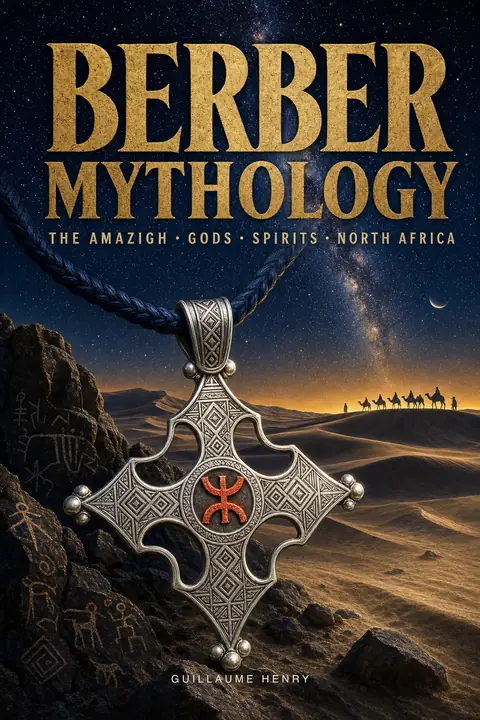
The Berber Mythology Book: The Gods, Spirits, and Sacred World of the Amazigh
The Amazigh: Gods, Spirits, and North Africa
The beliefs of North Africa’s first people, the Amazigh, who were old when Carthage was young: the sun and the moon, the jnun of the wild places, the cult of the ancestors and the caves, the goddess the Greeks called Athena, and a tradition that outlived every empire.
More from Berber
All articles
Berber
The Azru Oak: Sacred Tree Cult and Ritual Sites in Berber Tradition
The Azru Oak stands as the living spine of Berber sacred geography, where tribal councils, healing rites, and offerings to ancestral spirits converged for millennia. Discover how this revered tree shaped Berber law, spirituality, and community bonds across North Africa.
Berber
Masinissa: King and Cultural Hero of Numidia
Masinissa united Numidia and shaped the destiny of North Africa by walking between Carthage and Rome. His reign (202-148 BCE) transformed a fragmented kingdom into a civilized power that wrote its own laws.
Berber
Yennayer: Berber New Year and Agricultural Festival
Yennayer marks the Berber New Year on January 14, celebrating the spring planting season and ancestral connection to the land. Discover how this 2,944-year-old festival blends agricultural ritual, family tradition, and cultural identity across North Africa.
Berber
The Hand of Fatima in Berber Symbolism: Protection, Blessing, and Identity Across North Africa
The Hand of Fatima, or Khamsa, is far more than Islamic decoration in Berber culture. It carries layers of pre-Islamic protection magic, women's agency, and ancestral wisdom. Discover how Amazigh communities wove this symbol into identity, ritual, and everyday life across Morocco, Algeria, and Tunisia.