
The Marzeah: Ritual Feasting and Ancestor Veneration
The marzeah was a sacred Canaanite feast where the living drank with the dead. Uncover its rites, its gods, and why scholars still argue about its true purpose.
Contents
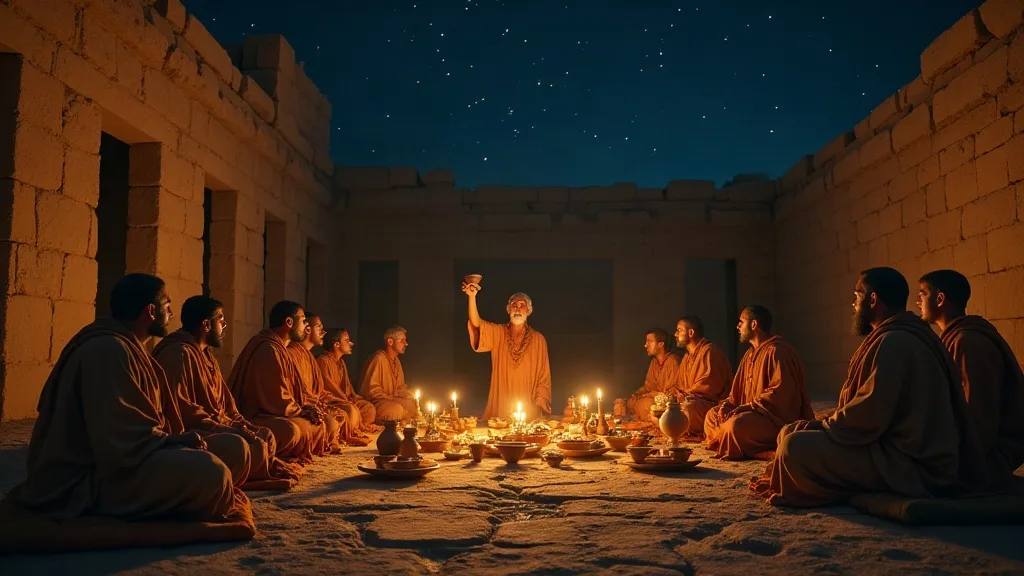
The wine had been poured before dawn. By the time the last guests reclined on their cushions, the amphorae were already half-empty and the names of the dead had been spoken aloud three times. This was not a funeral. It was something older and stranger: the marzeah, a ritual feast where the boundary between the living and their ancestors dissolved, at least for one long, wine-soaked night.
The practice appears in texts stretching across more than a thousand years of the ancient Near East, from Ugarit on the Syrian coast around 1400 BC to the Hebrew prophets of the eighth century BC who railed against it with unmistakable fury. That kind of longevity does not happen by accident. The marzeah met a deep human need: the need to keep the dead present, useful, and appeased.
What the Ugaritic Tablets Actually Say
The fullest early evidence for the marzeah comes from Ugarit, a prosperous Bronze Age city-state on the coast of modern Syria, destroyed around 1185 BC. Its scribes pressed cuneiform signs into clay tablets that archaeologists excavated from 1929 onward, and among those tablets are contracts, god-lists, and mythological poems that mention the mrzh with enough frequency to suggest it was a fixture of civic and religious life.
One text, known as KTU 1.114, describes the god El, the high god of the Canaanite pantheon, presiding over a divine banquet where the drinking goes catastrophically wrong. El drinks until he collapses. He soils himself. He requires a special cure the next morning involving dog-hair and a plant whose identity scholars still argue about. The scene is comic, but the setting is unmistakably a marzeah, complete with heavy wine consumption and a gathering of divine figures that mirrors what humans enacted below.
Scholars including John McLaughlin, in his 2001 study The Marzeah in the Prophetic Literature, argue that this mythological scene served as a charter: the gods themselves held the first marzeah, so mortals who repeated the ritual participated in something cosmically sanctioned. The feast was not imitation of the divine. It was extension of it.
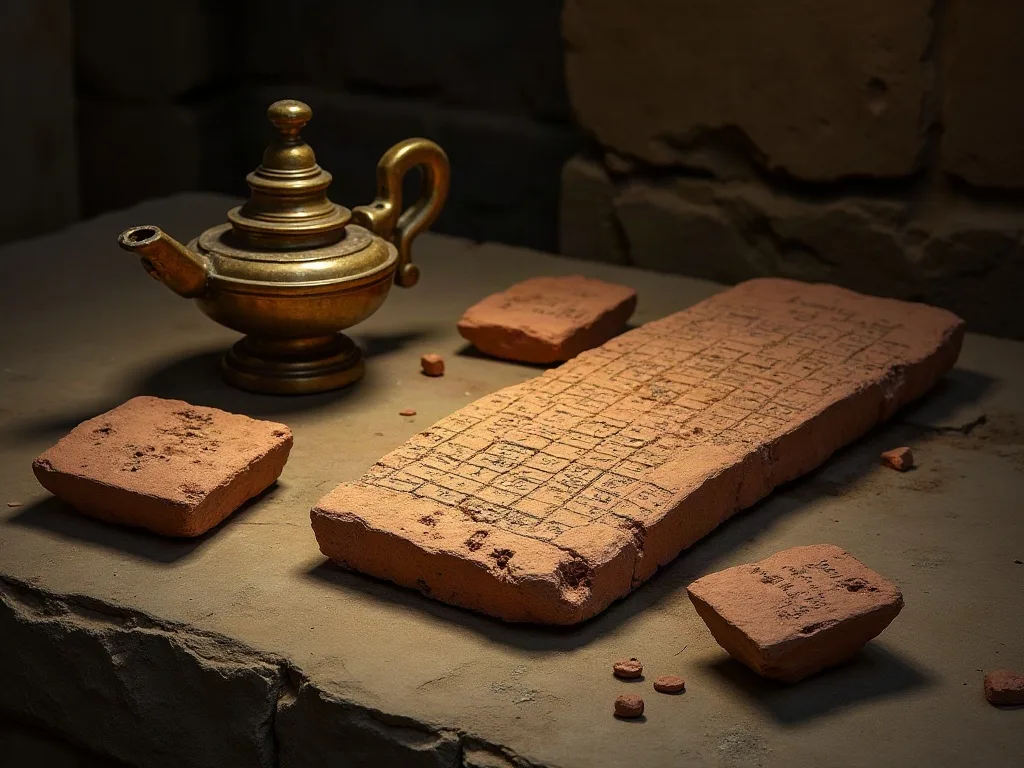
Other Ugaritic documents are more administrative than mythological. Several clay tablets record that a marzeah association owned land, held property in common, and received specific allocations of wine from the royal household. One text lists the members of a marzeah of the god Baal, the storm-god and son of El whose mythology dominates the Ugaritic corpus. This tells us that the institution was not spontaneous; it was organized, financed, and sometimes royally sponsored.
The Structure of the Feast: Wine, Meat, and the Absent Dead
A marzeah gathering followed a pattern that can be reconstructed, cautiously, from scattered references. The venue was typically a dedicated building, called a bet mrzh (house of the marzeah) in some texts, or occasionally the tomb-precinct itself. Members gathered on a fixed occasion, reclined rather than sat upright (a posture that carried its own aristocratic weight in the ancient world), and consumed wine in quantities the sources describe without embarrassment.
Meat was almost certainly part of the meal. The word rzh in related Semitic languages carries connotations of shouting, mourning, and feasting together, a bundle of meanings that ties the institution to grief-rituals and the loud communal eating that follows a death in many cultures even today. Think of an Irish wake, scaled up across generations and institutionalized into a regular calendar date.
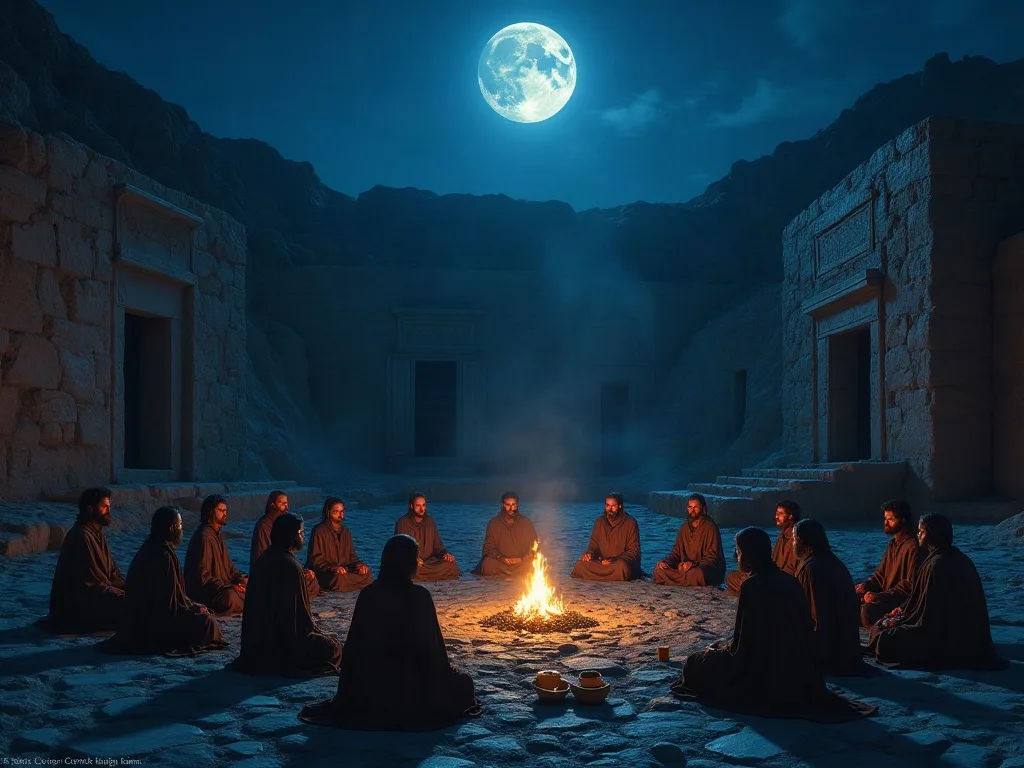
The presence of the dead was not metaphorical. Funerary texts from Ugarit refer to rpum (often transliterated as Rephaim), the spirits of dead kings and heroes who could be summoned to participate in ritual meals. The Ugaritic text KTU 1.20-22, sometimes called the Rephaim texts, describes these spirits feasting for two or three days before returning to their underworld domain. The living poured libations, spoke the names of deceased ancestors, and may have left portions of food and wine at the edge of the table or at a dedicated vessel. The dead ate their share in the only way the dead can: through offering.
Baal held a special relationship with the Rephaim. The great Baal Cycle, the longest mythological text from Ugarit, frames his death and resurrection partly in terms of what the living owe the dead and what the dead can still give the living. A world where Baal is absent is a world where the feasts fail and the crops die. The marzeah, in that light, was not only commemoration. It was maintenance: keeping the channels open between worlds so that both sides continued to receive what they needed.
The Marzeah in Phoenician and Later Evidence
Ugarit was destroyed by the Sea Peoples around 1185 BC, but the marzeah did not die with the city. Phoenician inscriptions from the ninth and eighth centuries BC, particularly from Sidon and Marseille (the Marseille Tariff inscription, dated around 400 BC, mentions a mrzh in the context of sacrificial regulations), show the institution alive and recognizable. The Marseille text is broken in places, but enough survives to confirm that a priestly tariff governing feasts included the marzeah as a distinct ritual category requiring specific animal offerings.
A Phoenician inscription from Piraeus, the port of Athens, dated to the fourth century BC, records a marzeah association of Sidonian merchants operating in Greece. These were expatriate traders maintaining their ancestral rites far from home, pooling money to fund feasts that kept them connected to their dead and, presumably, to the gods who watched over commerce and sea-passage. The institution traveled with its people. It was portable religion.
Later Nabataean inscriptions from the first centuries BC and AD continue to use the term mrzh for banqueting associations, suggesting that the basic social and ritual structure persisted across linguistic and political changes spanning more than a millennium.
The Hebrew Prophets and the Drinking Problem
The most hostile witnesses to the marzeah are also among its most detailed. The Hebrew prophet Amos, writing in the eighth century BC, attacks wealthy Israelites who lie on ivory-inlaid beds, eat lambs and calves, drink wine by the bowlful, anoint themselves with fine oils, and are "not grieved for the ruin of Joseph" (Amos 6:4-6). Most scholars reading this passage now recognize the setting as a marzeah. The posture (reclining), the wine quantities, the self-anointment, and the deliberate disconnection from national suffering all fit the pattern.
Amos was not condemning feasting as such. He was condemning feasting as insulation: the elite of Samaria using a sacred institution to insulate themselves from political and moral accountability. The mrzh gave them cover. It was holy. It was ancient. It had divine precedent in the very behavior of El himself. But Amos saw the ritual hijacked in service of indifference.
Jeremiah 16:5-8 goes further. God instructs the prophet not to enter the bet mrzh (the term appears here in Hebrew), not to mourn with those who mourn, not to eat or drink with them. The reason given is that God has withdrawn his blessing from the people, so the rituals that once connected living and dead, human and divine, are now void. The marzeah becomes a site of divine silence rather than divine presence. Jeremiah's prohibition reads like the revocation of a license: this rite used to work, and now it does not.
El's Banquet and the Theology of Sacred Excess
Return to KTU 1.114, the tablet of El's disastrous drinking bout, because it rewards a closer look. El does not simply drink too much at a private party. He drinks at a gathering of the gods, a divine marzeah, and his intoxication is described in terms that parallel royal ritual: he is helped from his seat, he falls, he is tended by a figure named Thkmt (possibly a divine healer or a wine-server), and he receives a morning remedy. The whole sequence is structured like a liturgy, with each stage named and ordered.
Scholars have debated whether this text was recited during an actual marzeah, perhaps as a kind of comedic myth that gave participants permission to drink freely because even the king of the gods could not resist the wine. Or perhaps it served as a cautionary frame, reminding participants that excess has a cost even for the divine. Both readings are plausible, and they are not mutually exclusive. Sacred excess and its consequences often travel together in ancient religious practice.
What the El text establishes theologically is important: the marzeah is not a human invention. It is a practice the gods themselves perform. The divine and human versions mirror each other across the membrane of the sacred. When mortals poured wine for their dead ancestors, they were doing what El's assembly did at the divine feast, holding a community together across the boundary of death by the shared act of eating and drinking.
The Rephaim: Who Were the Dead at the Feast?
The Rephaim deserve their own moment. In the Hebrew Bible, the word repha'im often refers to the shades of the dead in a general sense, inhabitants of Sheol (the underworld). But in the Ugaritic texts, the rpum are a specific, prestigious class: the spirits of dead kings and warriors, sometimes called "the Healers" or "the Healthy Ones" by scholars who note a possible connection to a root meaning health or wholeness.
The Rephaim texts (KTU 1.20, 1.21, 1.22) are badly preserved but show these figures arriving on horseback and in chariots after being summoned, feasting for two or three days, and then departing. Their arrival is good news: healthy, powerful dead kings blessing the living with their presence is the ancient Near Eastern equivalent of an ancestral force backing the current social order. The king who could summon his dead predecessors to feast had divine lineage written in wine and meat, not just in words.
El is the god who oversees this cosmic hospitality. His title in Ugaritic texts, ab adm ("father of humanity"), positions him as the patriarch of both living and dead, the one who keeps the table set on both sides of death. The marzeah, conducted under his sanction, was an act of cosmic housekeeping: maintaining the relationships that held the world together.
Ancestor Veneration Across the Ancient Near East
The marzeah was not unique to Canaan in its impulse, only in its specific form. Mesopotamian texts describe the kispu ritual, a regular offering of food and water to the dead, performed by the eldest son on the first and fifteenth of each month. Egyptian feasts of the valley gathered the living and the images of the dead in temple precincts for shared meals. The Hittite aniur rituals fed the spirits of dead kings.
What makes the marzeah distinctive is its club structure. The kispu was a family obligation; every household performed it for its own dead. The marzeah was a voluntary association: you joined, you paid dues, you attended regularly, and the group collectively maintained the rites for its members' dead. This social structure meant that a person without surviving children, or one whose family had fallen on hard times, could still have their ancestral feast performed after death, because the marzeah covered them.
The institution therefore addressed one of the deepest anxieties of the ancient world: the fear of dying without descendants to remember you. The marzeah expanded the definition of who counted as kin. Mot, the Ugaritic god of death whose name simply means "Death," ruled a domain where the forgotten perished twice. The marzeah was one answer to Mot: a human institution that refused to let people be forgotten.
The Marzeah's Long Shadow: From Qoheleth to Qumran
Several scholars, including Philip King and Lawrence Stager in Life in Biblical Israel (2001), have argued that the marzeah cast a long shadow over Israelite literature. The opening chapters of Ecclesiastes, where the speaker experiments with wine, feasting, and pleasure before concluding that all is hevel ("vapor" or "breath"), may be structured as a marzeah meditation: a literary version of the ritual excess that leads, in El's myth and in human experience, to a morning reckoning.
At Qumran, the community that produced the Dead Sea Scrolls near the first century BC, some texts describe sacred communal meals with a strong eschatological character: meals at which the Messiah would preside at the end of days. John Collins and other Dead Sea Scrolls scholars have noted resemblances between this idealized meal and the older marzeah tradition, filtered through centuries of Israelite adaptation. The dead kings of Ugarit summoned to feast became, in this later framework, the righteous dead awaiting resurrection at a final banquet.
The continuity is not direct. There were centuries of intervening transformation, monotheization, rejection of "pagan" rites by the prophets, exile, and reconstruction. But the basic shape, a sacred meal that collapses the distance between living and dead, divine and human, present and future, is recognizable across all of it.
Frequently Asked Questions about the Marzeah
Frequently asked questions
How do we know the marzeah involved ancestor veneration specifically?
The Ugaritic Rephaim texts (KTU 1.20-22) directly describe the spirits of dead kings being summoned to a multi-day feast that mirrors the marzeah's structure. Additionally, Jeremiah 16:5 uses the phrase bet mrzh in a context explicitly linked to mourning and the dead. The combination of club-organized feasting, heavy wine consumption, and formal invocation of the dead across multiple textual sources makes ancestor veneration a near-certain component, not a scholarly inference projected onto the evidence.
Was the marzeah condemned throughout Israelite history, or was it once accepted?
The earliest Hebrew references do not frame the marzeah as inherently wrong. Jeremiah 16 reads as a specific, historically-bounded prohibition, not a blanket condemnation of the institution's ancient validity. Amos attacks the social abuse of the ritual by the wealthy, not the ritual itself. Scholars like Brian Schmidt argue that ancestor veneration, including marzeah-style feasting, was practiced widely in Israel before the centralizing religious reforms of the late monarchy period began to restrict it.
What did participants actually eat and drink at a marzeah?
Wine is mentioned explicitly and repeatedly in every major source, including the El banquet text and Amos 6. Meat appears almost certainly: the Marseille Tariff inscription regulates animal offerings in connection with a marzeah, and the broader feast context across Ugaritic texts involves slaughtered animals. Bread and oil are plausible based on analogous ancient Near Eastern ritual meals, though the specific evidence for the marzeah does not name them directly.
How long did a marzeah typically last?
The Rephaim texts describe the spirits feasting for two to three days. Administrative texts from Ugarit suggest regular, recurring gatherings rather than single annual events, though an annual feast tied to a seasonal calendar is also possible. The duration likely varied by association, occasion, and the resources available. Extended drinking over several days is consistent with what Amos describes and with the El banquet's aftermath.
Did women participate in the marzeah?
The surviving texts name male members almost exclusively, and the Amos passage targets elite men by name. However, the evidence is thin enough that arguments from silence are risky. Some scholars note that household-based mourning rituals in the ancient Near East frequently involved women as primary practitioners, and that the marzeah's connection to mourning may have included female participants in roles the administrative texts simply did not record.
How the Marzeah Reshaped Our Understanding of Ancient Religion
For most of the twentieth century, scholars read Canaanite religion primarily through the lens of its mythology, the great stories of Baal and Mot, El and Asherah, the cosmic battles and divine marriages. The marzeah evidence forced a correction. It showed that Canaanite religion also had a robust institutional life at the social level, voluntary associations, property ownership, royal patronage, and regular calendar observance. The religion was not just stories told around fires. It was organizations with dues.
More importantly, the marzeah evidence complicated the sharp line that older scholarship drew between "official" Canaanite polytheism and Israelite monotheism. If the bet mrzh appears in Jeremiah's Hebrew, and if Amos is attacking Israelites for practicing something recognizable as a marzeah, then the boundary between Canaanite and Israelite religious practice was, for much of the pre-exilic period, genuinely porous. The marzeah moved across that boundary the same way the Phoenician merchants moved from Sidon to Piraeus: with its rituals intact, adapting to new contexts without losing its core logic.
That core logic is worth holding onto as the final thought here. The marzeah answered a question that no amount of theology resolves cleanly: what do the living owe the dead, and what can the dead still give the living? It answered with food, wine, spoken names, and the warmth of a room full of people who have promised to remember. Ancient, practical, and quietly radical, the marzeah insisted that death is not the end of obligation, or of relationship.
Read the full book
Want the whole story?
The complete edition is an instant PDF download here, with a paperback on Amazon for selected titles.
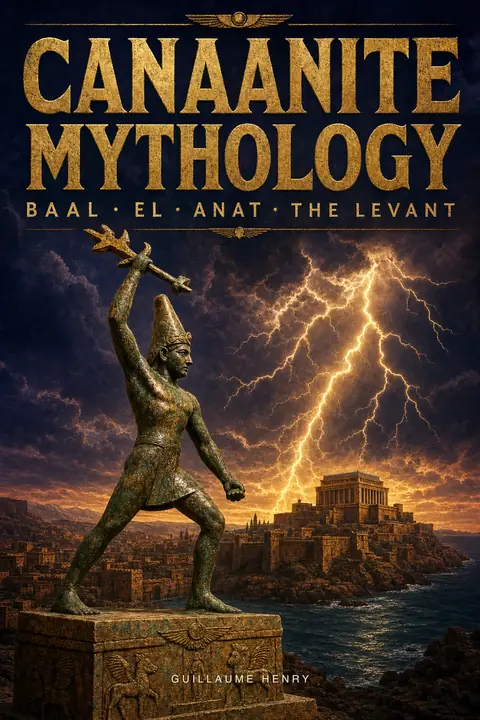
Canaanite
The Canaanite Mythology Book: Baal, El, Anat, and the Gods of the Ancient Levant
Baal, El, Anat, and the Gods of the Levant
The gods the Hebrew Bible warned against, recovered from the clay tablets of Ugarit: El the patriarch, Baal the storm-rider, Anat the war goddess, and Mot the lord of death. The mythology behind the Bible’s great rival.
More from Canaanite
All articles
Canaanite
El: The Father of Gods in Canaanite Religion
El ruled the Canaanite pantheon as the ancient king of gods, a weathered father whose name meant simply "god." Discover how this Syrian deity shaped Near Eastern belief for a thousand years before fading from memory.

Canaanite
Asherah: The Queen of Heaven and Consort of El
Asherah ruled the Canaanite pantheon as the Queen of Heaven, the consort of El, and the mother of seventy gods. Discover how this ancient goddess shaped Levantine belief and why her worship scandalized biblical writers.

Canaanite
Mot: The God of Death and the Underworld in Canaanite Myth
Mot rules the Canaanite underworld with an insatiable hunger, devouring all things mortal. Explore how this ancient god of death embodied fear, finality, and the cosmic struggle between life and extinction.
Canaanite
Anat: The Warrior Goddess of Love and Battle
Anat stands alone in Canaanite myth: a goddess who commands bloodshed and desire with equal fury. Explore the warrior deity who protected kings, seduced gods, and defied every boundary of her world.