

Buda: The Evil Eye and Blacksmith Sorcery in Ethiopian Mythology
In Ethiopian belief, the Buda are blacksmith sorcerers who cast the evil eye and transform into hyenas at night. A living tradition older than Christianity in the highlands.
Contents
The forge fires die down at dusk. A blacksmith wipes soot from his hands, steps out of his workshop, and the village watches him from behind half-closed doors. Not because the craft is dangerous, though it is. Because of what people say he becomes when the sun goes down.
Buda: the evil eye and blacksmith sorcery sits at the heart of one of Ethiopia's oldest and most persistent belief systems. Across the Ethiopian highlands, among Amhara, Tigrinya, Oromo, and Gurage communities alike, the buda is both a person and a power: a member of a stigmatised artisan caste believed to carry the capacity to harm through the gaze, to shape-shift into hyenas, and to devour the life-force of the living. This is not a story that has grown dusty with time. Families still hang amulets above their doorways. Priests still write protective scrolls. And blacksmiths still live apart.
The belief cuts through centuries of Ethiopian Orthodox Christianity, through Islam in the eastern lowlands, through layers of pre-Abrahamic religion that scholars trace to ancient Cushitic traditions. That such a conviction has survived every conversion, every empire, and every modernisation push says something about how deep it runs, and how much it reveals about the way highland Ethiopia thinks about craft, envy, and the boundary between the human and the animal.
Who the Buda Are: Caste, Craft, and Inherited Suspicion
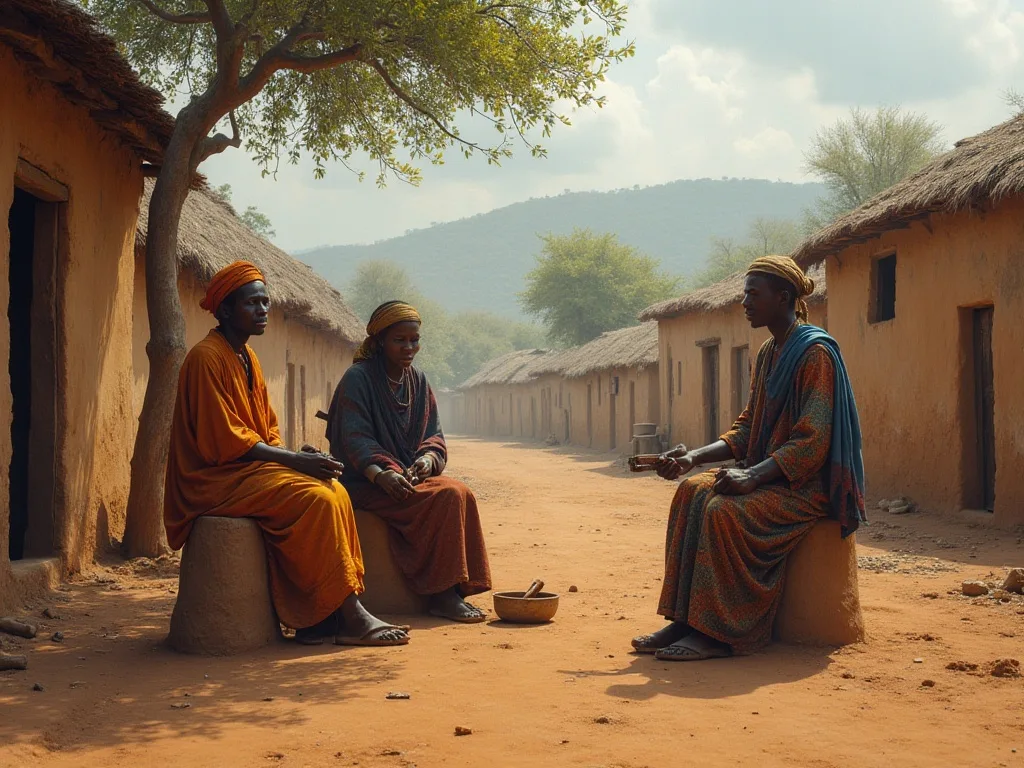
The word buda (sometimes written bouda or buda' in scholarly transcription) is Amharic in origin, though cognate terms exist across Cushitic and Semitic languages of the Horn of Africa. In its narrowest sense, it names the evil eye itself. In wider use, it names the person who carries it.
That person is almost always an ayte (in Amharic contexts), a member of an occupational caste whose work involves transforming raw matter: blacksmiths, potters, tanners, weavers, and sometimes woodworkers. Among the Amhara of the central highlands, the blacksmith caste is called Tegadelti or more commonly Mähal Säfari. Among the Gurage of southern Ethiopia, the equivalent group is the Fuga. In Oromo society, the caste system known as gosa places artisan clans in a separate stratum called Watta or Tumtu.
What these groups share is a relationship with fire and transformation. They take inert materials, iron ore, clay, animal hide, and they change them into something useful and powerful. That capacity for transformation, so admired in the product, becomes terrifying in the producer. The logic is ancient: anyone who can change iron into a blade can presumably change a living person into something else too.
Anthropologist Donald Levine, who spent years studying Amhara society and published his findings in Wax and Gold (1965), documented how deeply this caste distinction penetrates social life. Blacksmiths did not eat with farmers. They did not intermarry with them. They lived in distinct quarters at the edge of settlements. They were paid for their work but kept at a distance. Levine observed that the ambivalence toward craftsmen mirrored ambivalences about power itself: necessary, admired, and feared.
The Italian scholar Carlo Conti Rossini, working in Ethiopia in the early 20th century, traced related beliefs across Tigrinya-speaking communities in what is now Eritrea, finding consistent patterns: the artisan class as inheritor of a double reputation, skilled and dangerous, indispensable and polluting.
The Evil Eye: How the Buda Harms
The evil eye belief, called ayin hara in Hebrew tradition, mal de ojo in Spanish-speaking cultures, and malocchio in Italian, appears on every inhabited continent. What makes the Ethiopian buda tradition distinctive is how it fuses the evil eye with a specific social group and a specific set of animal transformations.
In the Ethiopian understanding, the buda does not need to intend harm. The gaze can injure without malice. A buda who admires a healthy child, praises a fat cow, or compliments a fine piece of cloth may set off a chain of deterioration in the object of that admiration. This is the mechanism at the core of many evil eye traditions worldwide: the envious or over-attentive gaze is itself corrosive.
But in Ethiopia, the harm goes further. The buda is believed to feed on its victims. In illness narratives collected by medical anthropologist Tekeste Wolde-Mariam and others, patients suffering from unexplained wasting, fever, or mental disturbance are often described as having been eaten by a buda, the Amharic phrase is buda bellaw, literally "the buda ate him." The language is viscerally physical. This is not metaphor in the minds of those who use it. The buda consumes life-force.
Buda-inflicted illness typically presents, in folk diagnostic categories, as sudden weight loss, listlessness, jaundiced eyes, and erratic behaviour. These symptoms map, loosely, onto conditions including malaria, tuberculosis, and psychotic episodes, which has led some scholars to argue that the buda belief provides a culturally coherent explanation for illnesses whose biomedical cause was historically invisible or untreatable. But reducing the belief entirely to a misdiagnosis framework misses the point. The buda system is also about social tension, envy management, and the policing of community boundaries.
Among the Oromo, the evil eye is called buda or bouda and is similarly connected to the artisan stratum. Researcher Asmarom Legesse, in his landmark study Gada (1973), noted that the Oromo caste of Tumtu blacksmiths occupied a structurally ambiguous position in the gada age-grade system, participating in some rituals but barred from others, which reinforced their aura of liminal power.

Shape-Shifting at Night: The Buda as Hyena
Here the belief takes its most striking turn. Across Amhara, Tigrinya, and Gurage traditions, the buda is not merely a person with a dangerous gaze. At night, after eating what is sometimes described as special food or performing a secret ritual, the buda sheds human form and becomes a hyena.
The spotted hyena (Crocuta crocuta) carries enormous symbolic weight in the cultures of the Horn of Africa. It is a scavenger, a bone-crusher, a creature that haunts the edges of settlements and eats the dead. In Ethiopian towns, hyenas were historically tolerated at the town margins, fed scraps to keep them from entering homes. In Harar, the ancient walled city in eastern Ethiopia, the practice of feeding hyenas by hand persists to this day, a performance that dramatises the uneasy compact between human settlement and the hyena's liminal world.
The buda becomes the hyena by crossing exactly that threshold. The transformation, described in oral accounts collected by researcher Hirut Teferi and others, typically involves the buda eating a special meal, rubbing the body with a particular substance, or reciting a formula at midnight. The hybrid being that results, part blacksmith, part hyena, is called in Amharic wereanimal or simply described as buda ye hyena timkihit (a buda in hyena form). It moves through the darkness, enters homes, and gnaws at the spirit or body of its victims.
The connection between blacksmiths and hyenas is not arbitrary. Both occupy the threshold. The blacksmith transforms raw matter at the edge of the village; the hyena transforms corpses at the edge of settlement into nothing. Both are necessary and repulsive. Both deal in transformation that polite society would rather not think about.
This linkage has parallels elsewhere. In West African belief systems, smiths are often associated with dangerous, liminal power: Ogun, the Yoruba god of iron, is simultaneously a patron of blacksmiths and a deity of violence and the wild. The structural logic is the same: mastery over transformation grants proximity to forces that ordinary humans avoid.
Protective Rituals Against the Buda
Because the buda threat is taken seriously, the responses to it are elaborate and deeply integrated into daily life.
The most visible protection is the amulet system. Ethiopian Orthodox Christians wear leather pouches called kitab or mäqtäb, containing handwritten scrolls produced by a dabtara, a trained lay religious practitioner who sits outside the formal clergy but commands esoteric textual knowledge. These scrolls typically incorporate Ge'ez scripture passages, often from Psalms, combined with the names of protective angels, and specific binding formulas against buda.
Among the most commonly invoked is the archangel Raguel, known in Ethiopian Orthodox tradition as the angel who takes vengeance on the world for its sins and whose name appears in 1 Enoch, an ancient text preserved in full only in the Ethiopian Orthodox biblical canon. This canon is broader than both the Catholic and Protestant canons: it includes 1 Enoch, Jubilees, and several other texts considered apocryphal elsewhere. That textual richness gives Ethiopian religious practice a distinctive toolkit against supernatural threats.
The dabtara tradition warrants its own pause. These practitioners, who have studied at church schools for years but have not been ordained as priests or deacons, occupy a position that mirrors the buda: they handle powerful, potentially dangerous knowledge. They are respected and slightly feared. Researcher Kay Shelemay, in her study of Ethiopian church music and religious practice, noted this structural similarity without pressing it to a conclusion, but it is suggestive.
Other protective measures include:
- Hanging a blue bead (tsade mirtit) or blue string above a doorway, since blue is believed to deflect the evil eye in many Eastern Mediterranean and African traditions.
- Spitting lightly when a stranger praises a child or animal, to neutralise the compliment before it can harm.
- Burning incense (etan) in the home, especially at dusk, when buda activity is believed to peak.
- Placing iron, the blacksmith's own material turned against him, near newborns.
That last protection is striking. Iron drives away the buda in some traditions, which means the blacksmith's own product becomes a ward against the blacksmith's power. The logic is apotropaic: like repels like.
The Buda and the Zar: Two Modes of Spiritual Affliction
Ethiopian supernatural belief distinguishes carefully between different categories of affliction. The buda attacks from outside, through the gaze, through envy, through nocturnal predation. The zar, by contrast, is a spirit that enters and possesses.
The zar tradition, shared across Ethiopia, Sudan, Somalia, and parts of Egypt and the Arabian Peninsula, involves spirits that take up residence inside a person, most often a woman, causing illness, erratic behaviour, and social disruption. The cure is not exorcism but negotiation: the zar must be identified, given a name, and appeased through ritual, dance, music, and offerings. The zar cult runs parallel to Ethiopian Orthodox and Islamic practice without fully integrating into either.
The distinction between buda affliction and zar possession matters to practitioners. A dabtara asked to treat a patient will probe the symptom profile to determine which category applies, because the remedies differ. Wasting illness with a clear social trigger (a blacksmith was present, someone offered unusual praise) points toward buda. Possession behaviour with no clear external cause points toward zar.
This diagnostic logic reveals something important: Ethiopian supernatural belief is not a vague, undifferentiated fear of the occult. It is a structured system with categories, procedures, and specialists. It works the way a medical taxonomy works, by narrowing from symptom to cause to treatment.
The Buda in Ethiopian Orthodox Christianity
Ethiopian Christianity has the longest continuous history of any African church, traditionally dated to the mission of Frumentius in the 4th century AD and confirmed by the chronicles of the early Aksumite empire. The Ethiopian Orthodox Tewahedo Church claims a theological lineage older than Rome's formal acceptance of Christianity, and its traditions include elements that western Christianity discarded centuries ago.
Yet this ancient church has never fully extinguished buda belief. Instead, the two systems have achieved a working coexistence. The buda is reframed, in Christian contexts, as a person who has made a pact with Satan, whose gaze channels demonic power rather than purely human envy. The protective scrolls invoke Christ, Mary, and the archangels against it. The framework is Christian; the threat being addressed is pre-Christian.
This is not unique to Ethiopia. The accommodation of older supernatural beliefs within a later monotheism appears across the world: in Andean Catholicism's treatment of huacas (sacred places and objects from Inca religion), in Japanese Shinto's integration with Buddhism, in the persistence of ancient healing traditions within Islamic practice across North Africa. The pattern is one of layering, not replacement.
Scholars of Ethiopian religion, including Ephraim Isaac (who has written on the Ge'ez textual tradition) and Getatchew Haile (the foremost scholar of Ge'ez manuscripts), have noted that the Ethiopian Orthodox canon's inclusion of 1 Enoch provides direct scriptural warrant for believing in a complex, populated spirit world where angels fall, spirits afflict humans, and special knowledge is needed to navigate the gap. The buda system is not a popular aberration from orthodox Ethiopian Christianity. It is partly continuous with it.

Buda Beliefs Across Ethnic and Religious Lines
One of the most telling features of the buda tradition is its cross-community persistence. The belief does not belong to one ethnicity, one religion, or one region.
Among Amhara Orthodox Christians, the buda is a caste-specific, hereditary power. Among Oromo Muslims and practitioners of the traditional Waaqeffanna religion (centred on the sky deity Waaqa), equivalent beliefs cluster around the artisan castes. Among the Gurage, where both Christianity and Islam coexist with older belief layers, the Fuga artisan caste occupies the equivalent position to the Amhara blacksmith caste.
In the Tigrinya-speaking highlands of northern Ethiopia and Eritrea, researchers including Alessandro Triulzi documented similar structures in the late 20th century. Even in the Somali cultural sphere at the Horn's easternmost edge, where Islam is dominant and historically deep, beliefs about the evil eye (il cambe in Somali) and about the danger of artisan castes (the sab groups) echo the same structural logic.
This geographic and religious spread suggests the belief predates the major conversions of the first millennium AD. It likely belongs to a Cushitic substratum of belief shared across the region, modified but not erased by Christianity and Islam.
The persistence is also partly social. As long as occupational castes exist and are maintained by endogamy (marrying within the group) and residential separation, the psychological and social distance that feeds the buda belief will be reproduced. Caste-based artisan communities remain a feature of Ethiopian social life, despite urban migration and modernisation.
How the Modern World Has Changed (and Not Changed) the Buda Tradition
Ethiopia's rapid urbanisation in the late 20th and early 21st centuries has brought former caste members into cities where their identity is less visible. A blacksmith's grandson in Addis Ababa may not work iron and may not be identified by anyone as buda. The residential separation has dissolved. The occupational marker has faded.
Yet the belief has not simply evaporated. Urban Ethiopians, educated in modern schools, will often hold a dual frame: they accept biomedical explanations for illness while also acknowledging that buda harm is possible. Ethnographic interviews conducted by researchers at Addis Ababa University in the 2000s and 2010s found that even university students and professionals described personal or family experiences of buda affliction that they had sought to address through both medical and traditional channels simultaneously.
The amulet trade continues in the Merkato, Addis Ababa's vast open market and one of the largest markets in Africa. Dabtara practitioners still operate in the city. The blue bead still hangs above apartment doors.
What has shifted is attribution. In village contexts, a specific blacksmith neighbour could be named as the source of buda harm. In the city, the source becomes vague, an unknown buda from a crowd, someone at a restaurant, a stranger on a bus who stared too long. The threat has become anonymous, which in some ways makes it harder to neutralise. The old protection of knowing exactly who posed the danger has given way to a more generalised, ambient unease.
This transformation parallels shifts in how urban societies everywhere manage supernatural anxiety: from specific, named threats embedded in community relationships to diffuse, structural fears about unknown others.
Frequently Asked Questions About the Buda in Ethiopian Mythology
Frequently asked questions
Is the Buda belief unique to Ethiopia, or does it appear in neighbouring cultures?
The buda belief is most developed and best documented in Ethiopia, but closely related beliefs appear across the Horn of Africa and northeastern Africa. Tigrinya-speaking Eritreans, Somali communities, and some Sudanese groups share beliefs linking artisan castes to the evil eye and supernatural harm. The underlying logic, that those who transform matter through fire or craft carry a dangerous power, appears in Cushitic-speaking cultures broadly and likely predates the spread of both Christianity and Islam in the region.
Do Ethiopian Christians and Muslims both believe in the Buda?
Yes. The belief cuts across religious lines in Ethiopia. Ethiopian Orthodox Christians frame the buda in demonic or Satanic terms, and use protective scrolls invoking Christ and the archangels. Ethiopian Muslims, including Oromo practitioners, maintain cognate beliefs about artisan castes and the evil eye, with protective measures drawn from Islamic tradition, such as Quranic recitation and the use of the hamsa hand symbol. The structural belief in caste-linked supernatural harm predates both religions in the region.
Why are blacksmiths specifically associated with the Buda power?
The association comes from the blacksmith's role as a transformer of raw matter. Iron ore enters the forge and exits as a blade or tool; the blacksmith commands a process that changes the fundamental nature of things. In symbolic logic common to many world cultures, this mastery over transformation implies a capacity to transform other things, including people. The blacksmith also occupies a liminal social position, living apart, working with fire and materials considered dangerous, and producing objects that are both protective and lethal. That combination of indispensability and strangeness generates the aura of supernatural danger.
What are the primary sources for studying the Buda tradition?
There is no single ancient text equivalent to the Eddas or the Popol Vuh for buda belief. The tradition is documented through ethnographic fieldwork, oral accounts, and religious material culture. Key scholarly sources include Donald Levine's Wax and Gold (1965) on Amhara society, Asmarom Legesse's Gada (1973) on Oromo social structure, and various articles in the Journal of Ethiopian Studies. The protective scrolls themselves, thousands of which survive in manuscript collections in Addis Ababa, Oxford, and Paris, constitute primary source material: they name the threats they ward against, including buda by name.
Can a person be cured of Buda affliction, and how?
Traditional treatments vary by community and religious context. Among Ethiopian Orthodox Christians, the primary recourse is a protective scroll (kitab) produced by a dabtara, combined with prayer, fasting, and sometimes the ritual consumption of holy water (tsebel). The afflicted person may visit a healing shrine. In some Oromo communities, a traditional healer (qaallu) performs diagnostic and healing rituals. In urban settings, both biomedical treatment and traditional remedy are often pursued simultaneously. The goal in traditional treatment is typically to identify the source of buda harm and neutralise the link between the buda and the victim, rather than to punish the buda directly.
How does the Buda belief relate to actual social discrimination in Ethiopia?
The buda belief has historically reinforced and justified the social marginalisation of artisan castes in Ethiopia. Because blacksmiths, potters, and tanners were believed to carry a dangerous power, exclusion from community spaces, prohibition of intermarriage, and residential segregation were rationalised as protective measures. Human rights organisations and Ethiopian scholars have documented cases of discrimination against caste-descendant communities in the 20th and 21st centuries. The belief system and the social hierarchy reinforce each other: caste separation produces the social distance that makes buda fears plausible, and buda fears justify caste separation.
The Buda Tradition and the Wider Question of Artisan Stigma
The Ethiopian buda tradition is vivid and specific, but the question it raises is not Ethiopian alone. Why do so many cultures across history and geography associate craft, particularly metalwork, with supernatural danger?
The Norse smith Völundr (also called Wayland in Old English tradition) is a master craftsman and a figure of uncanny, dangerous power. In Greek mythology, Hephaestus is divine, but lame, cast out, and volatile, brilliant and frightening in equal measure. The Yoruba deity Ogun, patron of all who work iron, demands blood sacrifice and governs both creation and destruction. In South Asian traditions, certain castes of metalworkers occupy structurally marginal positions similar to the Ethiopian artisan castes.
The pattern is too widespread to be coincidental. The scholar of comparative religion Mircea Eliade explored this cross-cultural phenomenon in The Forge and the Crucible (1962), arguing that the smith's mastery over fire and transformation placed him symbolically at the boundary between the human and the divine, or the human and the demonic, depending on the tradition. The smith knows things other people do not. He works at night, when others sleep. He shapes the tools of war and the tools of peace with the same hands.
The Ethiopian buda tradition is one of the richest and most socially embedded expressions of this universal human anxiety. It has survived because it is not just a supernatural belief: it is a map of social relationships, a theory of illness, and a framework for understanding why some people seem to hold a power that others can feel but not see. That combination, cosmological, medical, and social all at once, is precisely what makes belief systems durable.
The forge fires will go out tonight. Tomorrow they will be lit again.
Read the full book
Want the whole story?
The complete edition is an instant PDF download here, with a paperback on Amazon for selected titles.
Ethiopian
The Ethiopian Mythology Book: The Queen of Sheba, the Ark of the Covenant, and the Sacred Legends of Aksum
The Queen of Sheba, the Ark of the Covenant, and the Kingdom of Aksum
The sacred legends of Ethiopia, the one African kingdom never conquered: the Queen of Sheba and her journey to King Solomon, the Ark of the Covenant said to rest at Aksum, Waaqa the sky-god of the Oromo, and the saint-kings who carved the churches of Lalibela. Drawn from the Kebra Nagast and the living oral tradition.
More from Ethiopian
All articles
Ethiopian
The Kebra Nagast: Ethiopia's Sacred National Epic
The Kebra Nagast, Ethiopia's greatest literary and spiritual treasure, tells how the Queen of Sheba bore Solomon's son and founded a dynasty that would claim descent from Israel's king. Discover the epic that shaped an empire's identity and survives as living scripture today.

Ethiopian
Lalibela: The Rock-Hewn Churches and King's Vision
Discover how King Lalibela carved twelve churches from solid rock in Ethiopia's highlands, creating a sacred landscape that blends ancient Christian devotion with legendary ambition. A journey to Jerusalem without leaving home.

Ethiopian
Atete: Oromo Goddess of Fertility and Femininity
Atete embodies the generative power at the heart of Oromo spirituality. This goddess shapes the cycles of birth, growth, and renewal across the Ethiopian highlands and pastoralist cultures of the Horn of Africa.

Ethiopian
The Nine Saints: Founders of Ethiopian Monasticism
Nine Syrian monks arrived in Ethiopia in the 5th century and transformed its spiritual landscape. Discover how the Nine Saints founded Ethiopian monasticism, shaping the Tewahedo Church and a monastic tradition that endures today.