
The Aztec Calendar Stone: Sun, Time, and Cosmic Destruction
Carved from basalt and buried for centuries, the Aztec Calendar Stone maps five worlds, four cataclysms, and a universe held together by sacrifice. Here is what every face and glyph actually means.
Contents
A disc of dark basalt, 3.6 metres across and weighing roughly 24 tonnes, sits today in the National Museum of Anthropology in Mexico City. It does not tick. It does not rotate. But for the Mexica people who carved it sometime around 1502 CE, it was the most complete picture of reality anyone had ever put in stone.
The Aztec Calendar Stone was rediscovered on 13 December 1790, buried beneath the main plaza of Mexico City, the old heart of Tenochtitlan. Workers laying new cobblestones struck it with their shovels. Within a generation, Europeans had renamed it the "Calendar Stone" and assumed it was a giant sundial or a civic clock. Neither reading is correct. The disc is a cosmogram: a carved map of how time, the sun, and human existence fit together inside a universe that has already ended four times.
What follows is the story carved into those concentric rings, read from the center outward, circle by circle.
The Face at the Center: Tonatiuh and the Fifth Sun
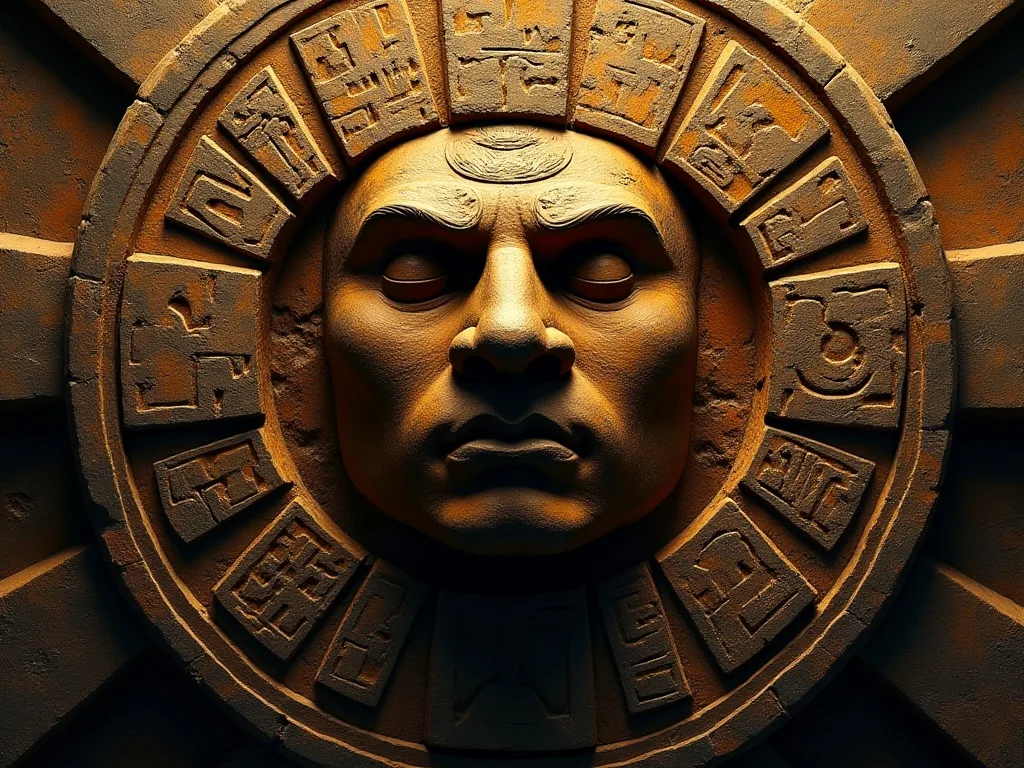
The first thing your eye goes to is a face. Large, direct, neither smiling nor frowning. Most scholars identify it as Tonatiuh, the Aztec sun god, though a minority argue it represents Tlaltecuhtli, the earth deity. The face peers out of the glyph for Ollin, the Nahuatl word for "movement" or "earthquake," and that context matters enormously.
Around Tonatiuh's face, four square panels branch out like compass points. Each contains a date glyph and each names one of the four suns that came before the present age. The Mexica, drawing on far older Nahuatl cosmological traditions, believed the universe had been created and destroyed four times before humans like us walked the earth.
- 4 Jaguar (Nahui Ocelotl): the first sun, ruled by Tezcatlipoca. It ended when jaguars devoured every living thing.
- 4 Wind (Nahui Ehecatl): the second sun, governed by Quetzalcoatl. Hurricanes tore it apart, and the survivors became monkeys.
- 4 Rain (Nahui Quiahuitl): the third sun, presided over by Tlaloc, the rain god. A rain of fire consumed it, and the people left behind became butterflies and dogs.
- 4 Water (Nahui Atl): the fourth sun, under Chalchiuhtlicue, the jade-skirted water goddess. A great flood drowned it, and the survivors turned into fish.
The fifth panel, at the center, is the present sun: 4 Movement (Nahui Ollin). This one, Mexica theology taught, will not be wrecked by jaguars or wind or fire or water. It will end in earthquakes. The very name of the current age is a countdown. Placing Tonatiuh's face inside the Ollin glyph is not decoration. It is a warning built into the stone itself.
The Mexica source for this cosmology is primarily the Leyenda de los Soles (Legend of the Suns), a Nahuatl text compiled in 1558 that preserves oral traditions stretching back at least to the Toltec period. The creation myth of the Fifth Sun also appears in the Historia de los mexicanos por sus pinturas, and both texts agree on the essential sequence of destruction.
The Tonalpohualli: Reading the Day-Count Ring
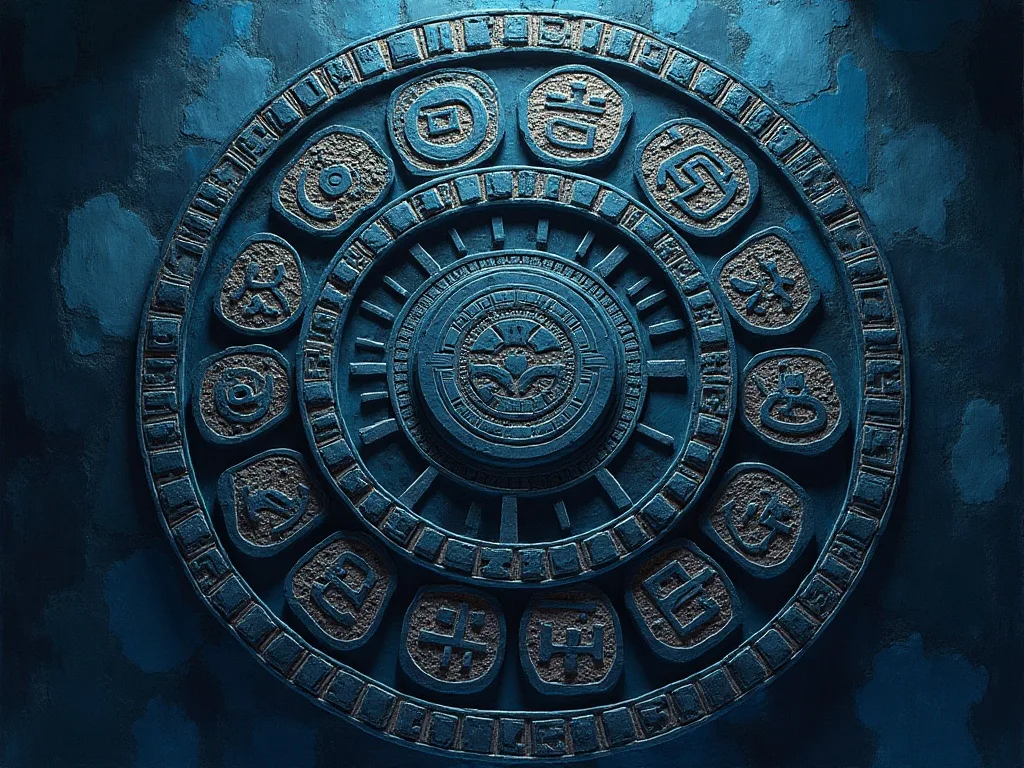
Move your eyes out from the central panel and you reach the second major ring. This band contains 20 named day signs arranged in sequence, moving counterclockwise. These are the 20 days of the tonalpohualli, the 260-day ritual calendar that formed the backbone of Aztec religious life.
The tonalpohualli (the word means "count of days" in Nahuatl) was not a solar calendar. It tracked a cycle of 260 days created by combining 20 day names with numbers 1 through 13. Every single day in the cycle had its own patron deity, its own omen, its own ritual requirements. A child born on 1 Crocodile (Ce Cipactli) had a very different fate than one born on 1 Death (Ce Miquiztli). Priests called tonalpouhque read this calendar the way later Europeans would consult horoscopes, except with far greater institutional weight behind each reading.
The 20 day signs carved on the stone are:
Cipactli (Crocodile), Ehecatl (Wind), Calli (House), Cuetzpalin (Lizard), Coatl (Serpent), Miquiztli (Death), Mazatl (Deer), Tochtli (Rabbit), Atl (Water), Itzcuintli (Dog), Ozomatli (Monkey), Malinalli (Grass), Acatl (Reed), Ocelotl (Jaguar), Cuauhtli (Eagle), Cozcacuauhtli (Vulture), Ollin (Movement), Tecpatl (Flint Knife), Quiahuitl (Rain), Xochitl (Flower).
This ring is why the monument picked up its colonial nickname. But the tonalpohualli is one layer of many, and reading it in isolation misses the theological depth behind the whole composition.
The Solar Year and the Rings Beyond
Outside the day-sign ring, the stone moves into broader cosmic territory. The next bands carry solar rays, astronomical signs linked to the 365-day solar calendar called the xiuhpohualli (year count), and a series of jade and turquoise discs that some scholars read as stellar references.
The xiuhpohualli divided the year into 18 months of 20 days each, with 5 unnamed "empty" days (nemontemi) at the end, days considered so unlucky that people tried to do as little as possible during them. The intersection of the 260-day tonalpohualli and the 365-day xiuhpohualli produced the 52-year Calendar Round (xiuhmolpilli, "binding of the years"), after which both cycles completed simultaneously and a new calendrical era began.
The Calendar Round held enormous cultural weight. At the end of each 52-year cycle, the Mexica performed the New Fire Ceremony (Toxiuhmolpilia) on the Hill of the Star near Iztapalapa. Priests extinguished every fire in Tenochtitlan, climbed the hill, and watched for a key star cluster (most likely the Pleiades) to cross the zenith at midnight. If the stars kept moving, the world would continue and a new fire could be drilled on the chest of a sacrificial victim, carried by runners back to relight every hearth in the city. The relief and celebration were genuine. The alternative was unthinkable.
The Fire Serpents: Xiuhcoatl and the Frame of the World
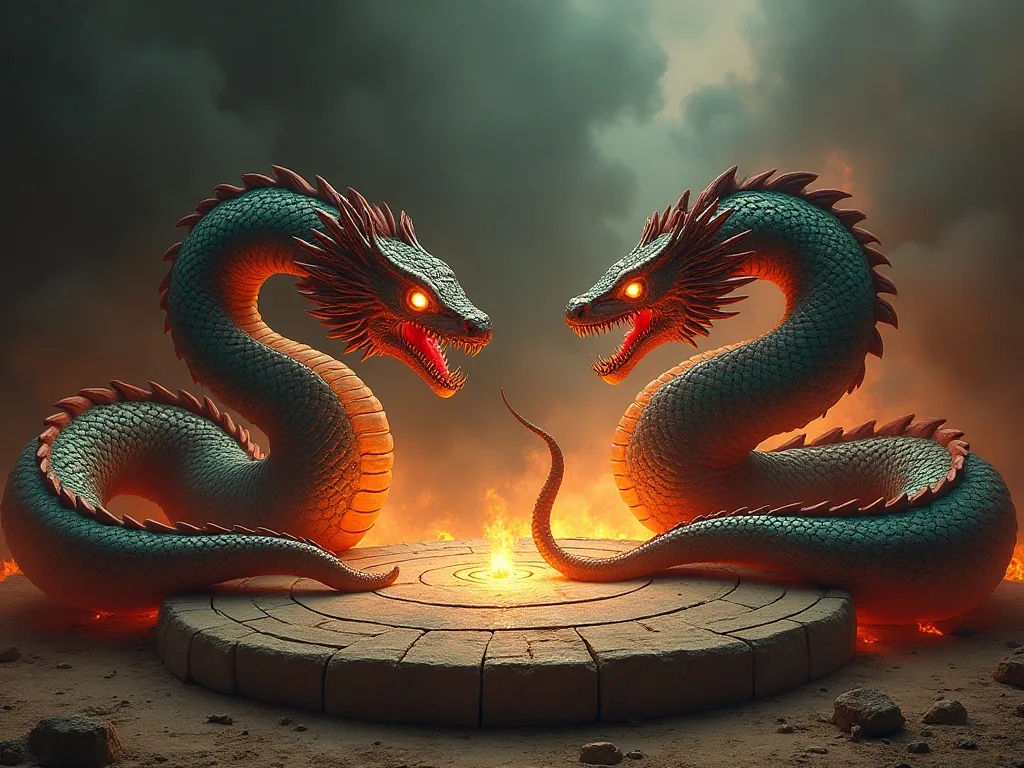
The outermost ring of the stone is defined by two enormous serpents. They face each other at the bottom of the disc, their tails meeting at the top. Between their open jaws, each serpent carries a face: one face is identified as Tonatiuh again, the other as a deity representing the night sun, the solar aspect that travels through the underworld between dusk and dawn.
These serpents are Xiuhcoatl, the fire serpents, intimately associated with Huitzilopochtli, the Aztec god of war and the sun. In the founding myth of Tenochtitlan, Huitzilopochtli used a Xiuhcoatl as a weapon to dismember his sister Coyolxauhqui and scatter his four hundred brothers across the sky, where they became the stars. The fire serpent is both a weapon and a temporal boundary: it marks the edge of a cosmic cycle, the point where one age ends and another might, or might not, begin.
Their placement encircling the entire disc is not arbitrary. The Xiuhcoatl holds the cosmos together the same way a frame holds a painting. Step outside it and there is nothing, no time, no light, no order. The stone says: everything you know exists inside these coils.
Commissioned by Axayacatl: The Political Theology of the Stone
The Sun Stone was almost certainly commissioned during the reign of Tlatoani Axayacatl, who ruled Tenochtitlan from 1469 to 1481. A date glyph near the inner rings reads 13 Reed (Matlactliomei Acatl), which corresponds to 1479 CE in the Western calendar, strongly suggesting the carving was completed or dedicated that year.
This timing matters. Axayacatl's reign was politically turbulent. He fought a catastrophic war against the Tarascans to the west and lost badly, one of the few major military defeats Tenochtitlan suffered in the fifteenth century. Commissioning a cosmogram that placed the Mexica sun, Mexica ritual cycles, and Mexica sacrificial theology at the literal center of the universe was also a political act. The stone told everyone who saw it: Tenochtitlan does not just rule central Mexico. It holds up the sky.
The monument was originally painted in red, blue, yellow, and white. Traces of pigment survived long enough for early colonial observers to describe them. Today's bare basalt is the stripped-down version. The original would have blazed in the sun, visible from a distance in the main temple precinct (Templo Mayor), where it probably stood vertically or lay flat as a sacrificial platform. The exact placement is still debated by archaeologists, but its proximity to the Templo Mayor complex is not in doubt.
What Sacrifice Has to Do with the Sun
To read the Sun Stone without understanding sacrifice is to miss the engine that, in Mexica thought, keeps every ring turning.
At Teotihuacan, generations before the Mexica, the gods gathered in darkness and made a decision. Two deities, one proud and one humble, threw themselves into a fire. The proud one flinched and became the moon. The humble one, Nanahuatzin, leaped without hesitation and became the sun. But the new sun would not move. The other gods had to sacrifice themselves, giving their blood so the fifth sun could cross the sky. The Mexica took this origin story and built a theology around it: the sun requires human blood to keep moving, because without blood the cosmic debt goes unpaid and the world freezes.
This is what the Ollin glyph at the center of the stone encodes. The face inside it is not just the sun. It is the sun demanding payment. The four clawed hands flanking the face hold human hearts. The date 4 Movement, written directly onto the face of the god, is simultaneously the name of the current age and the name of its future destruction. The stone makes the deal visible.
Ritual specialists called tlamatinime (philosophers or "knowers of things" in Nahuatl) debated the nature of this cosmic compact at length. Some accounts, preserved in the writings of Franciscan friar Bernardino de Sahagún's Florentine Codex (compiled 1545-1590 from indigenous informants), suggest the sun would have moved eventually without sacrifice. Others insist the blood debt was absolute. The stone does not resolve this debate. It simply states the stakes.
Colonial Burial and Modern Rediscovery
After Hernán Cortés and his allies brought down Tenochtitlan in 1521, Spanish colonial authorities systematically dismantled or buried pre-Columbian monuments. The Sun Stone was likely buried face-down deliberately, perhaps to suppress its religious power. It lay under the Plaza Mayor of Mexico City for 269 years.
Its 1790 rediscovery came during the reign of Viceroy Juan Vicente de Güemes, and the stone was initially mounted on the west tower of the Metropolitan Cathedral before being moved to the National Museum in 1885. The transfer marked a turning point: Mexican nationalism was beginning to claim indigenous heritage as its own foundation. The Sun Stone became a symbol not just of Aztec religion but of Mexican identity, appearing on everything from coins to postage stamps to football club badges.
Antonio León y Gama published the first serious scholarly study of the monument in 1792, correctly identifying many of the day signs and arguing against the simple "sundial" interpretation. Later scholars, including Alfonso Caso in the mid-twentieth century, built the modern iconographic framework for reading the stone. Caso's 1967 book remains a foundational reference.
The Stone's Shadow in the Modern World
The Sun Stone is the most reproduced symbol of pre-Columbian Mesoamerica. Its image circulates in contexts its carvers could never have imagined: gym logos, tattoo parlors, documentary title cards, airport murals. This ubiquity has a paradox inside it.
The more the image spreads, the more the original meaning compresses. Most people who wear the Sun Stone as a tattoo know it vaguely as something "Aztec" or "ancient." Very few carry the image knowing it encodes a theology of cosmic debt, cyclical destruction, and a sun that will one day shake the earth apart. The compressed version is not wrong, exactly. It is just a fragment.
That gap between image and meaning is itself part of the stone's afterlife. Mexica priests designed it to be read by trained specialists who could decode every glyph. The casual colonial tourist, the nationalism-era journalist, the modern tattoo artist: all of them have encountered the disc, taken something from it, and left the rest behind. The stone absorbs all these readings and keeps its face turned toward us, neither explaining nor withholding, waiting for whoever looks long enough to ask the right questions.
Frequently Asked Questions About the Aztec Calendar Stone
Frequently asked questions
Is the Aztec Calendar Stone actually a functional calendar?
Not in the way a wall calendar works. It does not track specific dates or allow users to count forward through time. It is better understood as a cosmogram: a visual theology that maps the structure of time, the sequence of cosmic ages, and the ritual cycles the Mexica used to keep the universe running. The 20 day signs of the tonalpohualli appear on it, but they are symbolic rather than operational.
Where is the Aztec Calendar Stone today, and can visitors see it?
The stone has been on permanent display at the National Museum of Anthropology (Museo Nacional de Antropología) in Mexico City since 1964, when the museum moved to its current building in Chapultepec Park. It stands upright in the Mexica Hall. Admission is open to the public and the disc is viewable at close range, though behind protective barriers.
What does the face in the center of the Sun Stone represent?
Most scholars identify the central face as Tonatiuh, the Aztec sun deity, placed inside the glyph for Ollin (movement or earthquake), which names the current Fifth Sun. A minority of researchers argue the face is Tlaltecuhtli, the earth lord or earth lady, based on the claw-like hands and downward-facing position. The debate is ongoing, but the Tonatiuh identification remains the scholarly consensus.
How does the Sun Stone relate to Aztec human sacrifice?
The central imagery is directly tied to the creation myth of the Fifth Sun, in which the gods sacrificed themselves so the new sun would move across the sky. The clawed hands on either side of the central face hold human hearts, symbolizing the ongoing debt humans owe to keep the sun in motion. The date glyph 4 Movement, embedded in the central face, carries the prophecy that this age will end in earthquakes, making the stone simultaneously a creation narrative and an eschatological warning.
Who commissioned the Aztec Calendar Stone and why?
The most widely accepted view is that Tlatoani Axayacatl commissioned the stone during his reign (1469-1481 CE), with the carving likely completed around 1479 based on an internal date glyph reading 13 Reed. Beyond its religious function, the monument served a political purpose: placing Mexica cosmology, with Tenochtitlan at the center of the universe, in permanent stone validated the empire's claim to cosmic authority at a moment when Axayacatl's military campaigns had suffered setbacks.
What happened to the original colors of the Sun Stone?
Colonial and early post-colonial descriptions record that the stone was originally painted in red, blue, yellow, and white. The pigments were applied over the carved basalt surface and would have made the iconography far more legible at a distance. By the time the stone was seriously studied in the nineteenth and twentieth centuries, almost all the paint had weathered away. The bare grey-black basalt seen today is a much reduced version of the original object.
Unresolved Questions: Who Exactly Is That Face?
The scholarly debate over the central figure of the Aztec Calendar Stone has never fully closed. For most of the twentieth century, Alfonso Caso's identification of the face as Tonatiuh held firm. But in 2004, art historian Richard Townsend and, separately, epigrapher Khristaan Villela raised questions about the downward-pointing position of the claws and the iconographic details of the headdress, suggesting the face may depict Tlaltecuhtli in a specific aspect associated with the earth's mouth consuming the setting sun.
More recently, archaeoastronomer Anthony Aveni has argued that the stone's concentric structure encodes not just mythological time but actual observational astronomy, with certain ring dimensions reflecting sightlines used at Teotihuacan and Tula. If Aveni is right, the stone bridges two traditions: inherited Toltec astronomical knowledge reformulated in Mexica religious terms.
Neither question is settled. The identification of the central face affects how we read the entire monument's theology. If it is Tonatiuh, the stone celebrates the sun. If it is Tlaltecuhtli, it may be celebrating the earth that will one day consume the sun. Both readings are internally consistent with Mexica thought. Both are supported by real iconographic evidence. The stone sits in its hall in Chapultepec and does not choose between them.
That irresolution is, perhaps, appropriate. A culture that named its current age after the earthquake that will eventually destroy it had no reason to build monuments that resolved all ambiguity. The face stares out because it expects you to keep looking.
Read the full book
Want the whole story?
The complete edition is an instant PDF download here, with a paperback on Amazon for selected titles.
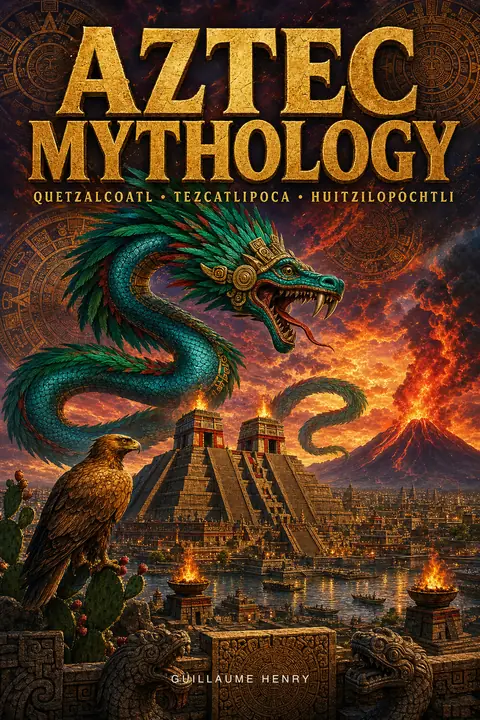
Aztec
The Aztec Mythology Book: Quetzalcoatl, Huitzilopochtli, Tezcatlipoca, and the Five Suns of the Mexica
Blood, Feathered Serpents, and the Cosmic Engine of Tenochtitlan
The gods, heroes, and sacred calendar of the Mexica civilization. From the feathered serpent Quetzalcoatl to the five world ages, the complete mythology of Tenochtitlan.
More from Aztec
All articles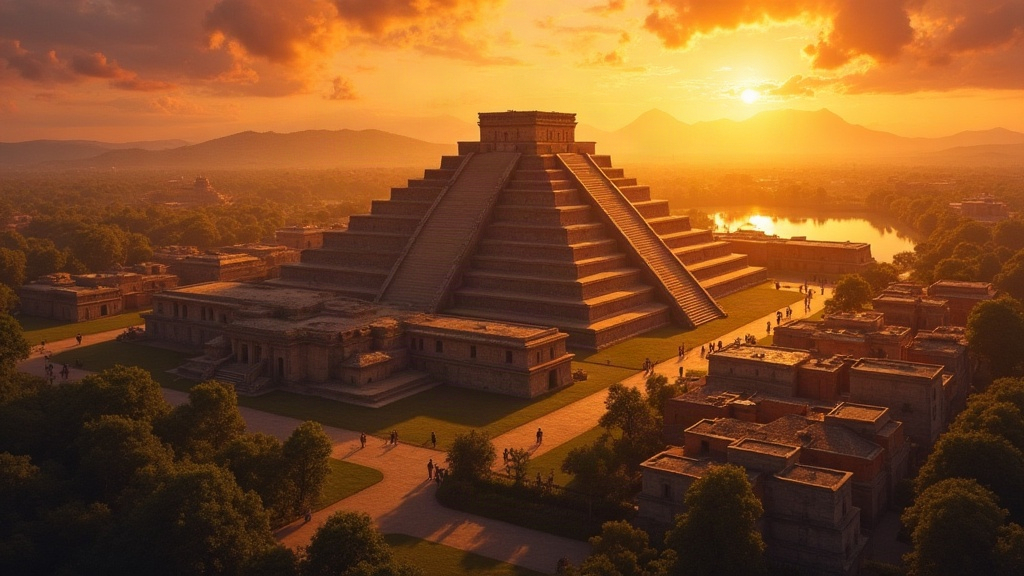
Aztec
Tenochtitlan: The Sacred Aztec Capital
Tenochtitlan rose from an island in Lake Texcoco as the Mexica people's promised homeland, guided by their god Huitzilopochtli. Discover how this sacred city became the center of the Aztec Empire and why its temples, waterways, and ceremonial heart shaped an entire civilization.
Aztec
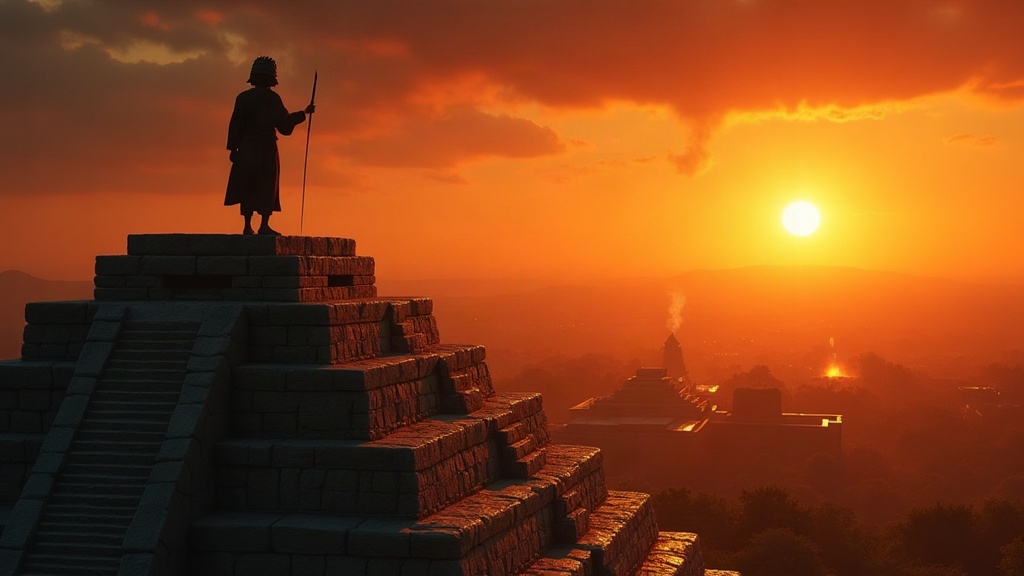
The Legend of the Fifth Sun: Why the Aztecs Believed Humanity Required Divine Blood
The Aztecs lived under a cosmological clock. They believed the world had been created and destroyed four times before. The fifth world, their world, could only survive if the gods received constant nourishment: human blood. Discover how mythology, astronomy, and ritual wove together in one of history's most misunderstood civilizations.

Aztec
Coatlicue: Mother of Gods and the Aztec Pantheon
Coatlicue, the serpent-skirted mother, bore the sun god and ruled over fertility, childbirth, and death in Aztec belief. Discover how the Aztecs honoured her as the generative force behind their entire pantheon and cosmos.

Aztec
Tlaloc: God of Rain and Fertility in Aztec Mythology
Tlaloc brought water to the Aztec world, but his gifts came with terror. Discover how the rain god shaped Mesoamerican religion, from mountain shrines to the sacred cenotes where thousands sought his blessing.