
The Nunnehi: Cherokee Spirit People of the Mountains
The Nunnehi are immortal spirit beings of Cherokee tradition who dwell inside mountains and beneath rivers, helping lost travelers and warriors in moments of desperate need. Who are they, and what do the old stories reveal?
Contents
A Cherokee hunter pauses on a ridge in the Great Smoky Mountains. Mist fills the hollows below like a slow breath. Somewhere inside the rock beneath his feet, drums are beating. He hears singing, clear and close, yet no fire is visible, no camp in sight. He is not afraid. His grandmother told him about this.
The singers are the Nunnehi, the immortal "People Who Live Anywhere," spirit beings who have occupied the mountains, rivers, and high balds of Cherokee country since before the first human memory. They are not ghosts. They are not demons. They are something older and harder to name: a parallel people, fully alive, who share the landscape with the Ani-Yun-Wiya, the Cherokee, without ever quite being seen.
Scholars who have studied Cherokee oral tradition, particularly James Mooney whose landmark 1900 work Myths of the Cherokee gathered stories directly from Eastern Band elders, describe the Nunnehi as benevolent supernatural beings with particular power during times of war, famine, and loss. Their stories run through the entire emotional register of Cherokee life, from comedy to grief, from rescue to vanishing. Understanding them means understanding something central about how the Cherokee people read the land around them.
Who the Nunnehi Are: Beings Beyond Category
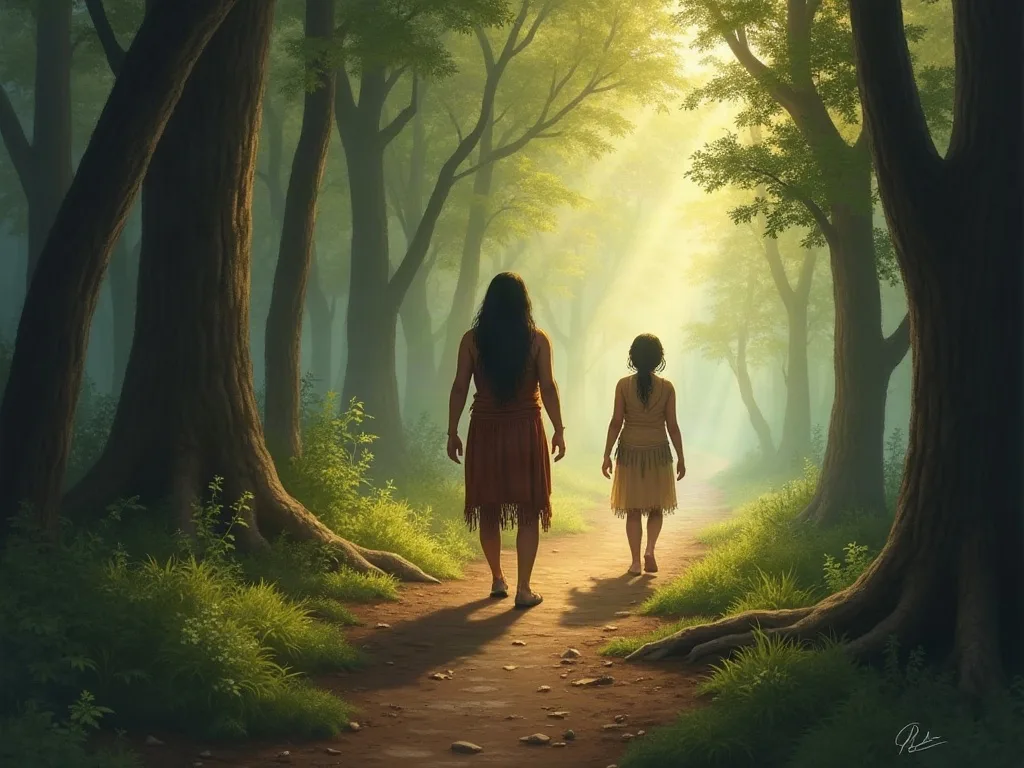
The Nunnehi resist easy classification. They look like ordinary Cherokee people. When they appear, witnesses describe them as dressed in traditional clothing, speaking fluent Cherokee, behaving with warmth and hospitality. Nothing marks them as supernatural in the moment of encounter. The strangeness comes only after: the village that cannot be found again, the host who smiles and then steps back into solid rock, the feast that leaves no trace.
In Cherokee cosmology, reality has layers. The physical world sits between an upper world of order and a lower world of chaos and creative energy. The Nunnehi inhabit neither extreme. They occupy the same middle world as humans, but they move through it differently. They are not subject to hunger, illness, or death. They can make themselves invisible. Their towns, which Cherokee tradition places inside specific peaks like Pilot Knob in North Carolina and Blood Mountain in Georgia, are permanent and prosperous while human settlements rise and fall around them.
James Mooney recorded that the Cherokee regarded the Nunnehi as essentially friendly, with a particular protective role toward the Ani-Yun-Wiya as a whole people. Several accounts place them at turning points in Cherokee military history, arriving to fight alongside Cherokee warriors when defeat seemed certain. This separates them sharply from the trickster beings and dangerous little people also present in Cherokee tradition, such as the Yunwi Tsunsdi, the "Little People," who could help or harm depending on how they were treated.
The Nunnehi are consistently large, or at least full-sized. They are consistently dignified. And they are consistently on the side of Cherokee survival.
Mountains as Living Homes: Where the Nunnehi Dwell
The Blue Ridge and Smoky Mountains are not mere backdrop in Cherokee cosmology. They are inhabited in a literal sense. Mooney's informants named specific locations where the Nunnehi were known to keep their townhouses: inside Nikwasi Mound near present-day Franklin, North Carolina; beneath the waters of the Hiwassee River; inside the great dome of Tlanusiyi, a place along the Hiwassee known for dangerous spirits; and within several high peaks in the Unicoi and Nantahala ranges.
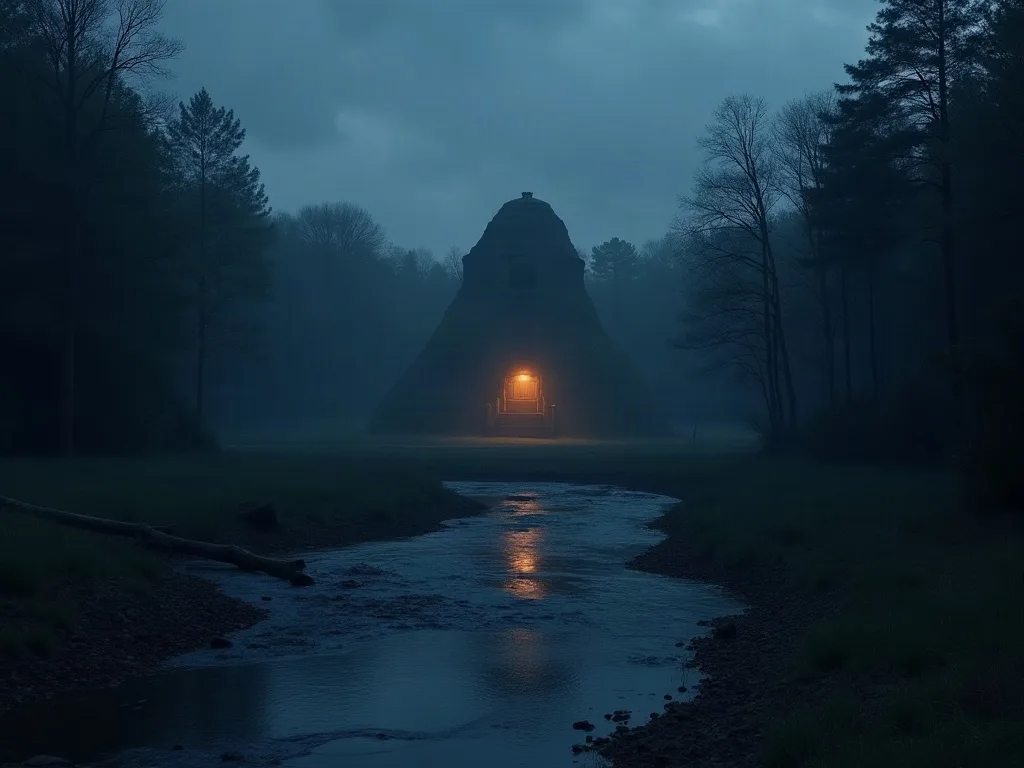
Nikwasi deserves particular attention. The mound at Nikwasi was a real earthwork, the central civic and ceremonial structure of a historical Cherokee town. Cherokee tradition held that a Nunnehi townhouse existed inside the mound, and that in times of attack, the Nunnehi warriors inside would stream out to defend it. Mooney recorded one specific oral account in which an enemy force attacking Nikwasi was suddenly met by an enormous army that seemed to emerge from the mound itself. The attackers were routed. The Nunnehi returned inside. The Cherokee counted their own dead and found none missing, confirming to them that the fighters had not been human.
This is not simply legend dressed up as history. For the Cherokee, the boundary between mythic event and historical event was porous. Stories about the Nunnehi at Nikwasi functioned as both origin narrative and territorial claim. To tell the story was to assert a relationship between the Cherokee people and that specific piece of land, a relationship witnessed and protected by beings older than any current human generation.
The underwater dwellings matter too. Several Nunnehi accounts place their towns beneath rivers and lakes. A person who slipped beneath the surface during certain conditions might find themselves inside a Nunnehi village, dry and warm, surrounded by people going about ordinary life. This detail connects to a broader pattern in Cherokee thought in which bodies of water are thresholds, places where the boundary between visible and invisible worlds grows thin.
The Rescue Stories: When the Nunnehi Intervene
The most emotionally powerful Nunnehi accounts are rescue stories. A child wanders from camp and is gone for days, then walks back into the village well-fed and cheerful, explaining that kind people in a warm house took care of them. A lost hunter follows the sound of a drum until he finds shelter, then wakes at the edge of his own familiar trail. A warrior, separated from his unit and badly wounded, is carried by strangers to safety and wakes healed.
These stories share a structure. The human is in genuine danger: cold, lost, starving, wounded. The Nunnehi appear in fully human form. They offer practical help: food, shelter, direction, medicine. At some point the human realizes something is not ordinary, usually because the Nunnehi's village cannot be explained by any geography the person knows. Then the Nunnehi send the person home, intact.
Mooney's collection includes an account of a group of Cherokee travelers who sheltered with what they believed was a village of friendly strangers during a snowstorm. The food was plentiful, the fires warm. When the storm cleared and the travelers prepared to leave, their hosts walked with them to the path, gave them food for the road, and then, at the trailhead, simply were no longer there. No village was visible behind them. The travelers turned back and saw only old-growth forest.
What the Nunnehi require in return is instructive. In most accounts, they ask for nothing. But when someone is offered the chance to remain with them permanently, a choice occasionally extended to humans who seem to belong more comfortably among the Nunnehi than among their own people, the offer is not reversible. A handful of Cherokee oral accounts describe individuals who chose to stay. Those people were understood to have crossed a threshold. They were not dead. They were simply elsewhere, living inside the mountain with the spirit people, occasionally glimpsed at a distance by relatives who caught a figure on a ridge that looked, for a moment, exactly like the person they had lost.
The Nunnehi in War: Protectors of the Cherokee Nation
The Nunnehi's role as military protectors is among the most striking features of their mythology and the one that most distinguishes them from similar spirit beings in other traditions. They do not merely help individuals. They intervene in collective crises.
Beyond the Nikwasi account, Mooney recorded traditions in which the Nunnehi warned Cherokee communities of impending attack, appearing to respected elders in dreams or in the form of strangers with urgent news. They were understood to be invested in Cherokee survival as a people, not only as individuals. This gave the Nunnehi a quasi-civic function unusual for supernatural beings, who in most traditions operate within personal or family bonds rather than national ones.
One tradition recorded by anthropologists working with Eastern Band Cherokee communities in the early twentieth century holds that during the most catastrophic period of Cherokee history, the forced removal of the 1830s that would become known as the Trail of Tears, some communities prayed to the Nunnehi to take them into the mountains before the soldiers arrived. According to these accounts, some communities disappeared without trace, absorbed into the Nunnehi world beneath the peaks, where they remain, alive and whole, beyond the reach of any government order.
This is a grief-soaked tradition, and recognizing it as such matters. The story of absorption into the Nunnehi world is not only supernatural narrative. It is a way of holding onto the idea that something of the Cherokee people was preserved, hidden, protected, against a violence that was entirely real. The Nunnehi become, in this context, an image of what cannot be taken.
Encountering the Nunnehi: Rules of the Meeting

Not everyone who claimed to hear drums inside a mountain or glimpse a figure on a trail had actually encountered the Nunnehi. Cherokee tradition was precise about the conditions and signs of a genuine encounter, and it was equally precise about the obligations those encounters created.
The drums were the most reliable sign. The Nunnehi held dances, as the Cherokee did, and the sound of their drumming could be heard through stone and earth, especially at night near known Nunnehi locations. Hearing the drums was not dangerous. Approaching the source was acceptable. But attempting to force entry into a Nunnehi space, to dig into the mound looking for the townhouse, to break the surface of the river looking for the underwater village, was understood to be foolish and potentially harmful, not because the Nunnehi would punish the intruder, but because the act itself revealed a failure of understanding that would make the encounter impossible anyway.
The Nunnehi, as Mooney's informants explained, could be approached with respect and would often respond. Hunters who found themselves near a known Nunnehi location might speak aloud, acknowledging the spirit people, asking for guidance or safety. This was not prayer in a strict sense. It was closer to courtesy extended to neighbors you happened to know were home.
Direct conversation with the Nunnehi, when it happened, was described as completely natural. They spoke the Cherokee language. They knew the names of your relatives. They knew which pass was safe and which was not. The uncanny quality of the meeting only emerged in retrospect, when you tried to explain to someone else where you had been.
Read about the Yunwi Tsunsdi, the Cherokee Little People
Parallels Across Traditions: Kindred Spirit Peoples
The Nunnehi are not a unique phenomenon in world mythology, though they are distinctly Cherokee in character. Parallel traditions appear across cultures, each shaped by its own landscape and cosmological logic.
The Tuatha De Danann of Irish mythology are perhaps the closest structural parallel: a fully realized people who retreated into the hills and mounds of Ireland as human civilization took hold, becoming the Aes Sidhe, the fairy mounds people, still present beneath the land, occasionally visible, capable of helping or harming humans depending on how they were treated. The Irish mound tradition and the Cherokee mound tradition parallel each other with startling precision, though no contact between these cultures is possible given their geographic separation, which suggests both arose from something common to human experience: the sense that the landscape is inhabited by presences older than any living person.
The Peri of Persian and wider Iranian mythology, benevolent spirit beings who inhabit mountains and high places, share the Nunnehi's protective role and their ambiguous visibility. The Norse Huldre folk, hidden people who live inside mountains in Scandinavian tradition, parallel the Nunnehi in their simultaneous proximity to and withdrawal from ordinary human life. In each case, the spirit people are not remote or celestial. They are next door. The wall between their world and ours is thin and, on the right night, permeable.
What distinguishes the Nunnehi within this global pattern is their specifically civic character, their investment in the survival of a particular people, the Cherokee, and their connection to actual named places in the southern Appalachians. The Nunnehi are not generic mountain spirits. They belong to a specific geography with specific names, and that specificity has survived because the Cherokee people who carried these stories survived.
The Nunnehi in Living Cherokee Tradition
The Nunnehi are not a relic. Among the Eastern Band of Cherokee Indians in North Carolina, awareness of the Nunnehi remains culturally active, though how individuals and families relate to these traditions varies widely, as it always has. The Nikwasi Mound in Franklin, North Carolina, is still a place of significance. Local accounts of unusual sounds near certain peaks in the Smokies continue to circulate.
The broader academic world encountered the Nunnehi primarily through Mooney's 1900 volume, and that text remains a primary reference, though it must be read with awareness of the context in which it was produced: a Bureau of American Ethnology project in which a non-Cherokee researcher, however respectful, was collecting stories from a community that had survived enormous trauma. Later scholars, including Anthropologist Raymond Fogelson and Cherokee studies scholar Gillian Berchowitz, have worked to understand Cherokee spiritual traditions on their own terms rather than through comparative frameworks imposed from outside.
What those later scholars consistently confirm is that the Nunnehi stories are not simple folklore. They encode a sophisticated understanding of human vulnerability, of landscape as living presence, and of community survival as something that requires allies beyond the purely human. The Nunnehi are, in the most fundamental sense, the land itself made personal: the mountains answering back when the Cherokee people spoke to them.
Learn about the role of sacred mountains in world mythology
Frequently Asked Questions About the Nunnehi
Frequently asked questions
What does the name Nunnehi actually mean in Cherokee?
The word Nunnehi (sometimes spelled Nûñnë'hï in older phonetic transcriptions) derives from a Cherokee root meaning "those who live anywhere" or "those who travel everywhere." It emphasizes their unrestricted movement through the landscape, unlike localized spirits tied to a single feature. James Mooney, who worked with Eastern Band Cherokee elders between 1887 and 1890, recorded this translation in his 1900 Myths of the Cherokee, which remains the foundational primary source for Nunnehi lore.
Are the Nunnehi the same as the Cherokee Little People?
No. The Nunnehi and the Yunwi Tsunsdi (the Little People) are distinct categories of spirit being in Cherokee tradition. The Yunwi Tsunsdi are small, often mischievous, and their interactions with humans can be helpful or harmful depending on context. The Nunnehi appear full-sized, behave with consistent dignity and kindness, and have a specific role as protectors of the Cherokee nation during times of collective crisis. Both belong to the broader landscape of Cherokee supernatural beings, but they occupy different roles.
Can the Nunnehi permanently take a human into their world?
Yes, according to Cherokee oral tradition. In several accounts recorded by Mooney and later collectors, humans were offered the option of remaining with the Nunnehi permanently. Those who accepted were understood to have crossed a one-way threshold: they were not dead, but they were no longer available to the human world. Relatives might occasionally glimpse them on a distant ridge. This tradition was especially resonant during the era of forced removal in the 1830s, when some communities reportedly prayed to be absorbed into the Nunnehi world rather than face deportation.
Which specific places in the Appalachian Mountains are associated with the Nunnehi?
Mooney's informants named several specific locations: Nikwasi Mound near Franklin, North Carolina (perhaps the most famous, with accounts of Nunnehi warriors emerging during battle); Pilot Knob in the North Carolina mountains; Blood Mountain in northern Georgia; the Hiwassee River valley; and certain high peaks in the Nantahala and Unicoi ranges. These are real, named geographic features, which anchors the Nunnehi tradition to a specific, mappable homeland rather than a generalized supernatural landscape.
What is the primary written source for Nunnehi stories?
James Mooney's Myths of the Cherokee, published by the Bureau of American Ethnology in 1900, is the foundational written source. Mooney gathered stories directly from Eastern Band Cherokee elders in North Carolina between 1887 and 1890. The text must be read critically, as with any colonial-era ethnography, but it preserves a large body of Nunnehi accounts that might otherwise have been lost to the written record. Later scholars including Raymond Fogelson have supplemented and contextualized Mooney's work using community-centered approaches.
How do the Nunnehi compare to fairy beings in European tradition?
The structural parallels are striking. Like the Irish Aes Sidhe (the people of the fairy mounds), the Nunnehi live inside hills and earthworks, are fully human in appearance, are not hostile by nature, and can take humans permanently into their world. Like the Norse Huldre folk, they are neighbors to humanity rather than remote celestial beings. The key difference is that the Nunnehi have a specifically national, protective role toward the Cherokee people as a collective, rather than operating primarily within individual or family relationships, which is the more common pattern in European fairy traditions.
What the Silence Inside the Mountain Means
The Nunnehi tradition has lasted because it answers a question that no other Cherokee story quite addresses: what does the land owe us, and what do we owe the land?
The answer the Nunnehi provide is relational. The mountains are not indifferent. They have occupants who pay attention, who hear the drums of human grief and human need, who come out when the situation is desperate enough. The relationship is not transactional. You cannot summon the Nunnehi with the right ritual. You can only live rightly, speak respectfully, and trust that the presences inside the stone are aware of you.
Modern Cherokee scholars have noted that this tradition functions as a form of ecological ethics before that language existed. A landscape understood as inhabited by beings who see everything you do is a landscape you treat differently than one understood as empty matter. The Nunnehi make the Blue Ridge watchful. They make the Hiwassee attentive. They populate the silence with intention.
That is not a small thing. And it is not only ancient. People still lower their voices near Nikwasi Mound. People still note when the woods go quiet in the wrong way. The drums inside the mountain are not a metaphor that anyone in that tradition feels the need to explain. They are simply there, as they always have been, just on the other side of the stone.
Read the full book
Want the whole story?
The complete edition is an instant PDF download here, with a paperback on Amazon for selected titles.
Cherokee
The Cherokee Mythology Book: The Uktena, the Spirits, and the Sacred Stories
The Uktena, the Spirits, and the Sacred Stories
The sacred stories of the Cherokee: how the world was made on the back of a water beetle, the horned serpent Uktena and its blazing crystal, the Little People who live inside the mountains, and the medicine that holds it all together. Recorded from the elders before it could be lost.
More from Cherokee
All articles
Cherokee
The Trail Where They Cried: Mythology and Memory of Removal
The Trail of Tears reshaped Cherokee mythology itself. Discover how forced removal in 1838-1839 became a sacred narrative of survival, covenant, and the land's eternal connection to a people who refused to disappear.

Cherokee
The Seven Clans: Cherokee Social and Spiritual Structure
The Cherokee nation organized itself through seven matrilineal clans, each with its own spiritual role, animal symbol, and responsibility to the people. Discover how this ancient system shaped Cherokee law, kinship, identity, and survival for centuries.
Cherokee
Sequoyah: Creator of the Cherokee Syllabary
Sequoyah invented a written system for the Cherokee language in just 12 years, transforming a spoken-only tradition into a literate nation. His genius was practical, not mystical: he saw that other peoples had captured their words on paper, and he figured out how.
Cherokee
The Green Corn Ceremony: Cherokee Harvest Renewal Ritual
The Green Corn Ceremony, or Iisgano'asdi in Cherokee, is the nation's most sacred annual gathering: a four-day harvest festival where the people renew their covenant with the Creator, cleanse themselves of past wrongs, and begin the year anew. Discover how a single ear of corn became the axis of Cherokee identity and spiritual restoration.