
The Daughter of the Sun: A Cherokee Death Origin Story
When the Sun wept for her daughter, her tears threatened to drown the world. The Cherokee myth of the Daughter of the Sun is one of the oldest explanations for why death is permanent - and why grief must have limits.
Contents
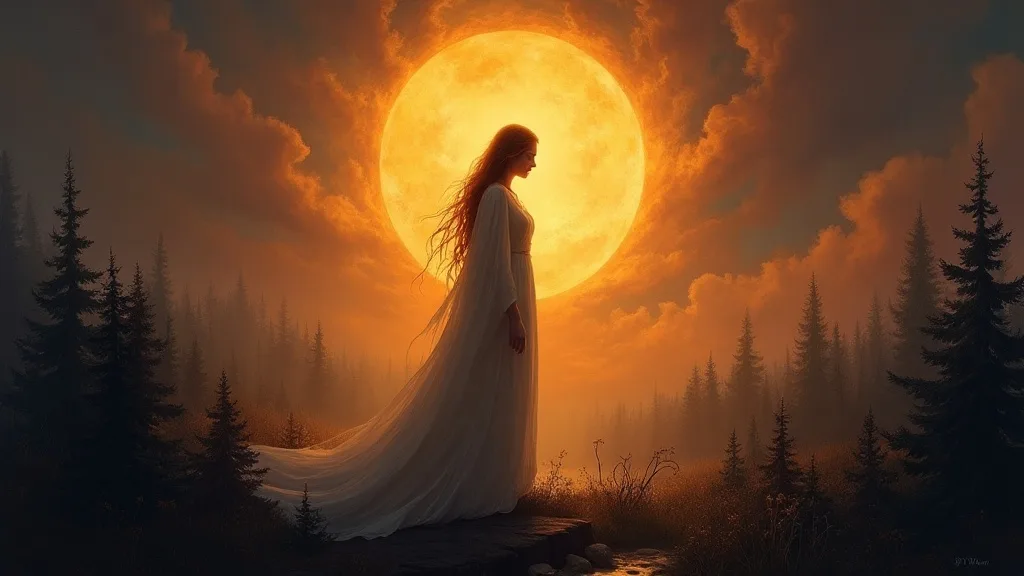
The Daughter of the Sun lay still in the Darkening Land. She had been bitten by a snake meant for someone else, and nothing the people carried could bring her back. Her mother, Unelanuhi - the Sun herself - learned the news and stopped shining. The sky went cold, and the world began to die alongside the girl.
That is the opening movement of one of the most structurally complete origin myths the Cherokee tradition preserved: a story that accounts for the permanence of death, the origin of ritual mourning, and the precise threshold beyond which the living cannot follow the dead. It is not a tale of divine cruelty. It is, at its core, a story about what love costs when it refuses limits.
The myth was recorded in detail by ethnographer James Mooney in the 1880s during his fieldwork with the Eastern Band of Cherokee in North Carolina. His 1900 publication Myths of the Cherokee (Bureau of American Ethnology, 19th Annual Report) remains the primary written source for the English-speaking world, though oral variants circulate among Cherokee communities today with different emphases and shadings.
Unelanuhi and the People Below
Unelanuhi, whose name translates roughly as "the apportioner" or "the one who lives in the sun," is not a distant abstraction. In Cherokee cosmology she moves on a fixed track across the sky dome, pausing at midday above the house of her daughter to eat. The daughter lives at the apex of the sky arch, equidistant from the eastern and western horizons, and she receives her mother every day without fail.
The people of the earth, however, irritated Unelanuhi. When they looked up at her, they squinted and twisted their faces into ugly grimaces. Her nephew, the Moon, received different treatment: when people looked at him they smiled. This asymmetry stung. The Sun began sending down an intensified heat, a burning wrath aimed at the earth's surface.
People died. Sickness spread. The Little People - the Yunwi Tsunsdi, small spirit-beings who inhabit the cliffs and stream banks - told the humans that the only cure was to kill the Sun. The method they proposed: transform two men into snakes, position them along the path the Sun walked at noon, and strike when she arrived at her daughter's house.
The plan failed. One snake, transformed into a copperhead, was positioned too close to the door. When the Sun arrived, her brilliance paralyzed him. The other, a uktena - a great horned serpent of considerable spiritual power - struck, but struck the wrong target. He bit the daughter, not the mother. The girl collapsed. By the time anyone reached her, she was gone.
The Journey to the Darkening Land
The Darkening Land - Usunhiyi in Cherokee - sits at the western edge of the world, the direction where the sun descends each evening. It is not a place of punishment. It has no moral gradations of reward or torment. The dead simply go there, and they continue a form of existence that mirrors life in muted tones: they dance, they sing, they feel something like joy. But they no longer move at the pace of the living.
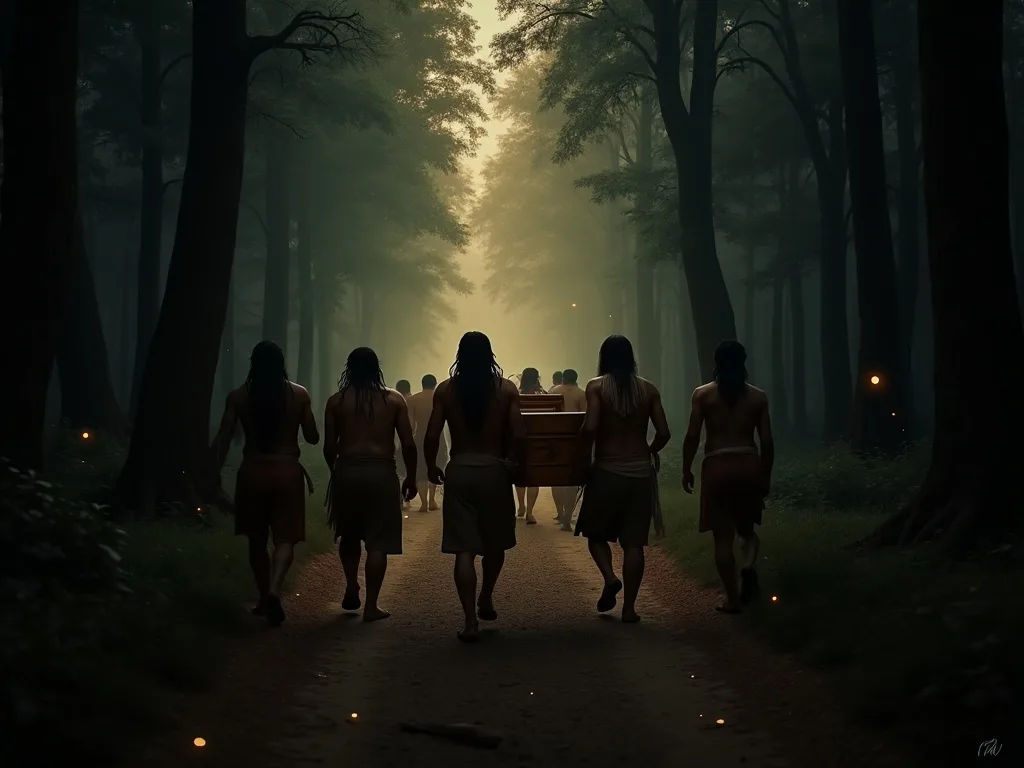
The people understood, after the daughter's death, that they had caused something catastrophic. Unelanuhi stopped crossing the sky. She sat, turned inward, weeping. Crops failed. The cold grew unnatural. Seven men were chosen, given a box, and given careful instructions: go to the Darkening Land, find the girl among the dancing dead, place her in the box, and carry her back without opening the lid until they reached home.
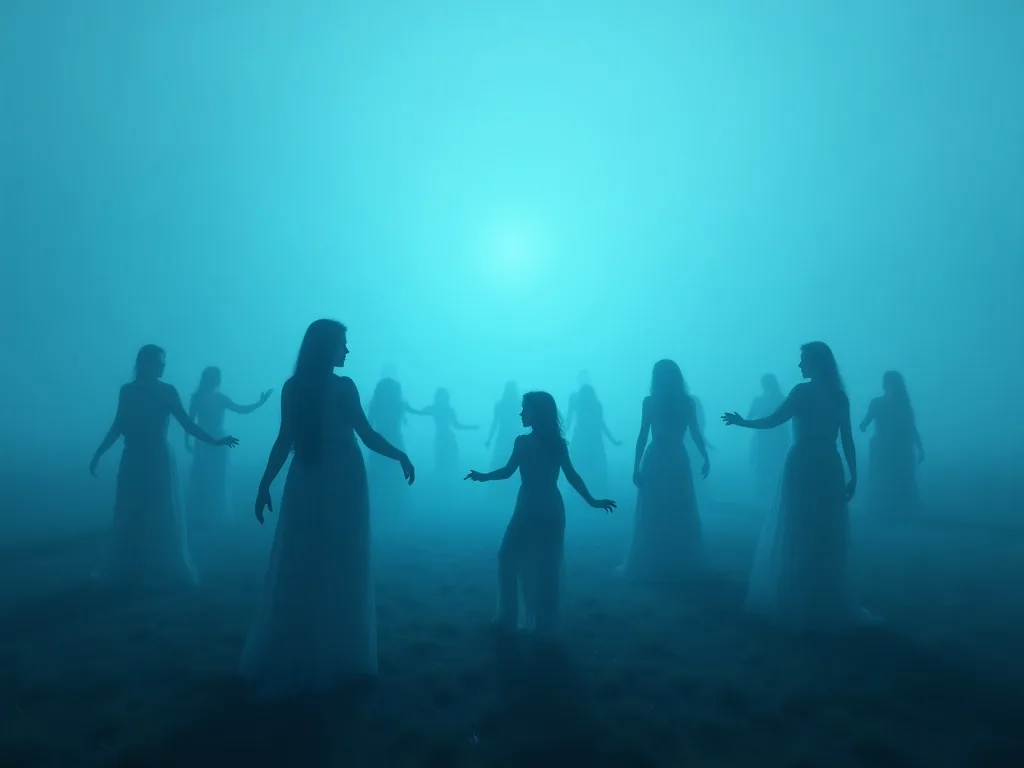
Cherokee cosmology and the structure of the spirit world shaped every constraint in this mission. The Darkening Land is not unreachable, but it operates on different temporal logic. The seven men walked west. They arrived, eventually, at a place where the dead were dancing in a great circle, moving counterclockwise - the direction associated with spirit-time as opposed to the sun's clockwise passage. Among the dancers they spotted the girl.
They called to her, and she paused. They placed her in the box. She asked to be let out as they walked: she was thirsty, then hungry, then cramped. Each request the men refused. They were only a day's walk from home when she said she could not breathe. The sounds from inside the box grew urgent. One of the men, unable to hold steady, lifted the lid just slightly - enough to check, he told himself.
A red bird flew out. The girl's spirit, freed, returned instantly to the Darkening Land.
Why Death Is Now Permanent
That single opened lid sealed the fate of every human being who would ever live. Before this moment, the myth implies, retrieval was possible. The dead were dancers, not ash. The gap between the living and the dead was a matter of distance and discipline. The opened box closed the door permanently.
The Cherokee origin of death rests not on divine punishment or cosmic war but on a failure of nerve - a deeply human failure, motivated not by malice but by love and anxiety. The man who opened the box was not wicked. He was worried. The myth neither condemns him harshly nor excuses him entirely. It simply states the consequence: Unelanuhi declared that because of what happened, all people who die must remain dead. The door will not open a second time.
This structure has a precise parallel in Orpheus and Eurydice, the Greek myth where a musician nearly retrieves his wife from Hades but turns back to look at her, and she vanishes. Both stories encode the same prohibition: the living cannot fully trust themselves in the presence of death. The threshold demands an almost inhuman detachment. Neither Orpheus nor the Cherokee man could sustain it.
Scholars of comparative mythology, including Ake Hultkrantz in his work on North American religious traditions, have noted that "look-back" and "open-the-container" taboo structures appear across Indigenous North American, Siberian, and Eurasian traditions, suggesting either deep cultural diffusion or an independently derived human intuition about the fragility of the boundary between life and death.
The Sun's Grief and the Flood That Nearly Came
The retrieval had failed. Unelanuhi now knew her daughter was permanently gone. She began weeping with a force that no one had anticipated. Her tears fell as rain. The rain intensified. The creeks rose. The people understood quickly that if the Sun's grief continued without interruption, the whole of the earth would be inundated.
The solution was not philosophical argument or divine intercession. It was music. The people gathered the best dancers and singers they could find, and they performed before the Sun. For a long time she ignored them. Then one group began a particular song, struck a particular rhythm, and the Sun looked down. She almost smiled. The rain thinned. She looked away again, and the rain resumed. The dancers tried again. This time she did smile, and the rain stopped entirely.
This episode - rarely discussed in secondary literature as carefully as the box-opening sequence - carries its own weight of meaning. Grief is not pathological in this myth. It is a natural force as powerful as flood water. But grief that continues without limit becomes destructive to the living world. The cure is not stoicism or denial; it is communal performance, beauty offered to the bereaved until something in them yields. The myth is simultaneously an origin story for mourning ritual and an argument for the social function of song.
The Uktena: The Serpent That Changed Everything
The creature that bit the girl deserves more than a supporting role. The uktena - rendered in some transcriptions as Uktena - is among the most significant supernatural animals in Cherokee tradition. It appears as a great serpent, often horned, sometimes with a crest of antlers, carrying a blazing crystal in its forehead called the Ulunsu'ti (or Ulunsuti). The crystal was said to grant its possessor extraordinary powers of divination, particularly in hunting and love magic, but acquiring it required approaching the uktena closely enough to kill it - an almost suicidal act.

In the death origin myth, the uktena is not acting maliciously as an independent agent. It was recruited, transformed, sent on a mission that went wrong. The wrongness is structural: powerful spirit-beings are not precision instruments. They carry their own gravitational force. When the uktena struck, it struck the daughter because she was the brightest presence at the threshold of the sun-house. The error is meaningful. The beings closest to the Sun were the most vulnerable.
The uktena in Cherokee myth resurfaces across multiple stories, always carrying this doubled quality: devastating power that can be redirected toward human benefit, but only at enormous cost. That quality connects directly to how the Cherokee understood the nature of sacred force generally: not good or evil, but directional and consequential.
Ritual Echoes: What the Myth Authorizes
Origin myths do not simply explain the past. They authorize behavior in the present. The Daughter of the Sun story underwrites several recognizable elements of Cherokee mourning and ritual practice.
The prohibition against prolonged grief - specifically, the idea that excessive weeping endangers the living - appears in Cherokee mortuary custom. Mourning had a prescribed duration. When the period ended, the bereaved were expected to release their grief publicly, partly through song, partly through community gathering. The Sun's own dangerous weeping was the mythological template for this constraint.
The use of music and dance to interrupt destructive grief connects to the broader Cherokee ceremonial complex, including the Green Corn Ceremony and various healing dances, all of which treat communal rhythm and song as mechanisms for restoring cosmic and social balance.
The box itself, and the prohibition against opening it, mirrors structures found in Cherokee medicine practice. Certain sacred objects, certain bundles, were not to be opened outside specific ritual contexts. The consequence of premature opening was not metaphorical: something essential would escape before it was ready to be received.
The story also clarifies the geography of the afterlife in a way that had practical implications for ritual specialists. The Darkening Land is west, but it is not unreachable by the living. What makes it unreachable is human weakness at the threshold, not physical distance. Medicine practitioners who worked with the dead - calling on ancestors, managing the passage of newly deceased persons - operated within a cosmological model the myth had precisely described.
Comparative Mirrors Across Traditions
The structural bones of this myth appear in strikingly different mythological bodies across the world. Three parallels are worth holding beside the Cherokee original.
The Greek parallel is the most cited. Orpheus descends to the underworld for Eurydice, persuades Hades and Persephone with his music, receives permission to lead her back - on the condition that he not look back. He looks back. She disappears. The formal elements match: a beloved retrieved from death, a prohibition at the threshold, a failure of nerve, a permanent closure. But the emotional texture differs. Orpheus looks back from a surfeit of longing; the Cherokee man opens the box from anxiety. One is drawn toward the dead; the other is trying to protect them. Both fail, but the failures have different shapes.
The Izanami parallel from Japanese mythology is structurally closer in one respect. Izanagi descends to Yomi to retrieve his dead wife Izanami, is told not to look at her, and then breaks the prohibition by lighting a fire in the dark cavern. He sees her rotting body, flees in horror, and the boundary between the living and the dead is sealed permanently. The failure here produces disgust and terror rather than grief, but the sealed boundary is identical in function.
The Persephone myth moves in the opposite direction, with a mother (Demeter, analogous structurally to Unelanuhi) whose grief at her daughter's absence causes the earth to go cold and barren. The solar parallelism is almost exact: the Sun stops crossing the sky; Demeter withdraws from the earth's fertility. Both are resolved by music and collective human effort in the Cherokee version, by a divine compromise in the Greek. The contrast reveals something about Cherokee cosmological priorities: humans are not powerless spectators of divine grief. They intervene. They succeed.
Cherokee Myth
The Daughter of the Sun is retrieved by seven ordinary men, not a hero with supernatural gifts. The prohibition is spatial and physical: do not open the container. The failure comes from anxiety about the retrieved person's wellbeing. The sealed boundary affects all humanity permanently. Grief is a flood that music can stop.
Greek Orpheus
Orpheus is a singular musician whose gift is the retrieval instrument. The prohibition is visual: do not look back. The failure comes from an excess of longing or doubt. The sealed boundary affects primarily Orpheus himself. Grief is a song that opens the underworld.
The Myth in the Long Record: Mooney, Oral Tradition, and What May Be Lost
James Mooney collected the version most English-speaking readers know during the late nineteenth century, when Cherokee communities in North Carolina had already survived the Trail of Tears (1838-1839) and were living under significant cultural pressure. His informants were speaking from memory and community tradition, not from a written archive. Mooney was rigorous by the standards of his time, but he was not Cherokee, he was not a specialist in cosmological systems, and the framing categories he used (myth, legend, superstition) did not always match the categories his sources operated within.
The result is that Mooney's text is essential and incomplete simultaneously. The version he recorded is internally consistent and detailed enough to support serious analysis. But Cherokee oral tradition almost certainly carried variants, deeper ritual contexts, and cosmological layers that his notes did not capture. Scholars like Raymond Fogelson, who worked with the Eastern Band in the twentieth century, noted that ceremonial knowledge about death and the afterlife was among the most restricted categories in Cherokee intellectual life - not easily shared with outside researchers regardless of their intentions.
What this means practically: the Daughter of the Sun story as it appears in print is probably a sketch of something richer. The broad structural elements are likely accurate. The cosmological geography - Darkening Land to the west, sun-house at the sky's apex, counterclockwise dance of the dead - is consistent with other Cherokee material and with archaeological evidence from the broader Mississippian cultural sphere, within which early Cherokee towns participated. But ritual specifics, the names of the seven men, the identity of the song that finally made the Sun smile: those details may be deliberately absent from the public record.
What the Opened Box Still Teaches
The story does not end with failure. It ends with a world reshaped by failure. Unelanuhi smiles, the rain stops, the earth survives. The dead stay dead, but the living learn how to grieve within limits. That is not a tragic conclusion. It is a practical one, the kind of practical wisdom that origin myths often carry beneath their dramatic surface.
The opened box is not a metaphor for human sinfulness or cosmic bad luck. It is a record of the exact moment when one kind of world became another. Before the box opened, death was theoretically reversible. After it closed, death was structural - built into the nature of things. The Cherokee did not frame this as punishment. They framed it as consequence, which is a meaningfully different thing. Punishment implies an angry judge. Consequence implies a world with coherent rules, rules that apply even when you are trying to do something good.
That distinction - between a punishing cosmos and a consequential one - is one of the most important structural features separating Cherokee cosmological thought from Abrahamic frameworks. The man who opened the box is not Adam. He did not corrupt human nature. He demonstrated it. The grief that followed was not divine wrath but solar mourning, and the response to solar mourning was not prayer but song.
The myth preserves something rare: a death origin story that leaves room for human dignity even in the moment of its founding failure.
Frequently Asked Questions About the Daughter of the Sun
Frequently asked questions
Who is Unelanuhi and what role does she play in Cherokee cosmology?
Unelanuhi is the Cherokee Sun goddess, whose name is often translated as "the apportioner." She is explicitly female, which distinguishes Cherokee solar cosmology from many Old World traditions where the sun is male. She travels a fixed arc across the sky each day, stopping at her daughter's house at midday. Her emotional responses - burning anger, then devastating grief - are direct forces in the physical world, causing drought and flood respectively. She is not worshipped in the Abrahamic sense, but she is central to the cosmological system that structures Cherokee ritual and seasonal life.
What is the Darkening Land and how does Cherokee tradition describe the afterlife?
The Darkening Land, called Usunhiyi in Cherokee, lies to the west - the direction the sun descends each evening. It is not a place of torment or reward. The dead there continue a form of existence that resembles life: they dance in circular formations, moving counterclockwise. The boundary between the living and the dead is geographical and temporal rather than moral. James Mooney's 1900 account in Myths of the Cherokee is the primary written source, though oral tradition among the Eastern Band of Cherokee preserves additional dimensions of this geography.
Why does the myth say death became permanent after the box was opened?
The myth presents death's permanence not as divine punishment but as structural consequence. When the seven men were sent to retrieve the girl, the explicit condition was that the box must not be opened until they reached home. One man opened it from concern for the girl's comfort, and her spirit escaped back to the Darkening Land. Unelanuhi's response was to declare that all who die must now stay dead. The logic is that the pathway of retrieval was a fragile one, dependent on perfect containment; once it was broken, that particular door sealed permanently.
How does this myth compare to other world myths about retrieving the dead?
The most direct structural parallel is the Greek myth of Orpheus and Eurydice, where a musician nearly retrieves his dead wife from Hades but breaks a prohibition at the threshold and loses her permanently. A secondary parallel is the Japanese myth of Izanagi descending into Yomi to retrieve Izanami, where a broken prohibition (lighting a fire) reveals the horror of death and seals the boundary. The Cherokee story is distinctive in using seven ordinary men rather than a hero, in locating the failure in anxiety rather than longing or horror, and in framing the sealed boundary as consequence rather than punishment.
What is the uktena and why was it chosen to strike the Sun?
The uktena is one of the most powerful supernatural creatures in Cherokee tradition: a great horned or crested serpent carrying a blazing crystal called the Ulunsu'ti in its forehead. It was chosen for the assassination attempt because of its raw power and its ability to be transformed and redirected by the Little People (Yunwi Tsunsdi). The plan failed because the uktena struck the daughter rather than Unelanuhi - the most luminous presence at the threshold of the sun-house absorbed the strike meant for the Sun herself. The uktena recurs across Cherokee mythology as a figure of dangerous, misdirectable sacred force.
How was this myth recorded and how reliable is the written record?
The primary written account comes from James Mooney, a Bureau of American Ethnology ethnographer who worked with Eastern Band Cherokee communities in North Carolina in the 1880s, publishing his findings in Myths of the Cherokee (1900). Mooney was meticulous by nineteenth-century standards, but he was an outsider working through interpreters, and certain categories of ceremonial knowledge were deliberately withheld from him. The structural elements of the myth he recorded are internally consistent and corroborated by other Cherokee material, but deeper ritual contexts and oral variants remain in community tradition and are not fully represented in print.
Read the full book
Want the whole story?
The complete edition is an instant PDF download here, with a paperback on Amazon for selected titles.
Cherokee
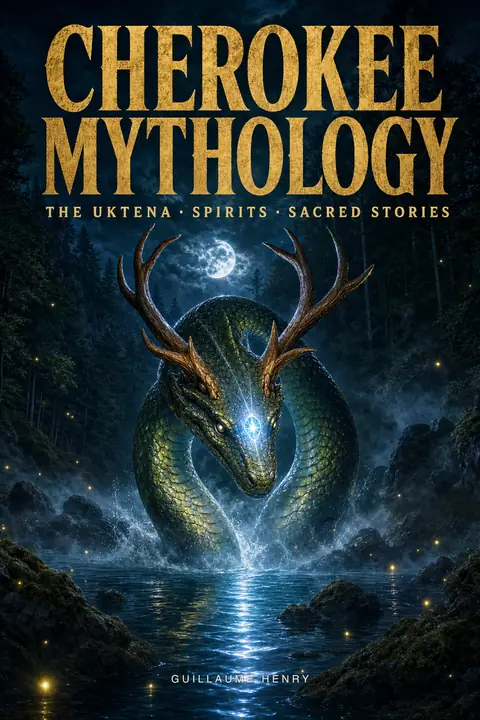
The Cherokee Mythology Book: The Uktena, the Spirits, and the Sacred Stories
The Uktena, the Spirits, and the Sacred Stories
The sacred stories of the Cherokee: how the world was made on the back of a water beetle, the horned serpent Uktena and its blazing crystal, the Little People who live inside the mountains, and the medicine that holds it all together. Recorded from the elders before it could be lost.
More from Cherokee
All articles
Cherokee
The Trail Where They Cried: Mythology and Memory of Removal
The Trail of Tears reshaped Cherokee mythology itself. Discover how forced removal in 1838-1839 became a sacred narrative of survival, covenant, and the land's eternal connection to a people who refused to disappear.

Cherokee
The Seven Clans: Cherokee Social and Spiritual Structure
The Cherokee nation organized itself through seven matrilineal clans, each with its own spiritual role, animal symbol, and responsibility to the people. Discover how this ancient system shaped Cherokee law, kinship, identity, and survival for centuries.
Cherokee
Sequoyah: Creator of the Cherokee Syllabary
Sequoyah invented a written system for the Cherokee language in just 12 years, transforming a spoken-only tradition into a literate nation. His genius was practical, not mystical: he saw that other peoples had captured their words on paper, and he figured out how.
Cherokee
The Green Corn Ceremony: Cherokee Harvest Renewal Ritual
The Green Corn Ceremony, or Iisgano'asdi in Cherokee, is the nation's most sacred annual gathering: a four-day harvest festival where the people renew their covenant with the Creator, cleanse themselves of past wrongs, and begin the year anew. Discover how a single ear of corn became the axis of Cherokee identity and spiritual restoration.