
Jurupari: Initiation Rites and the Sacred Flutes
Jurupari is the lawgiver-spirit at the heart of Amazonian initiation ritual, where sacred flutes carry divine law, transform boys into men, and are forbidden to women on pain of death.
Contents
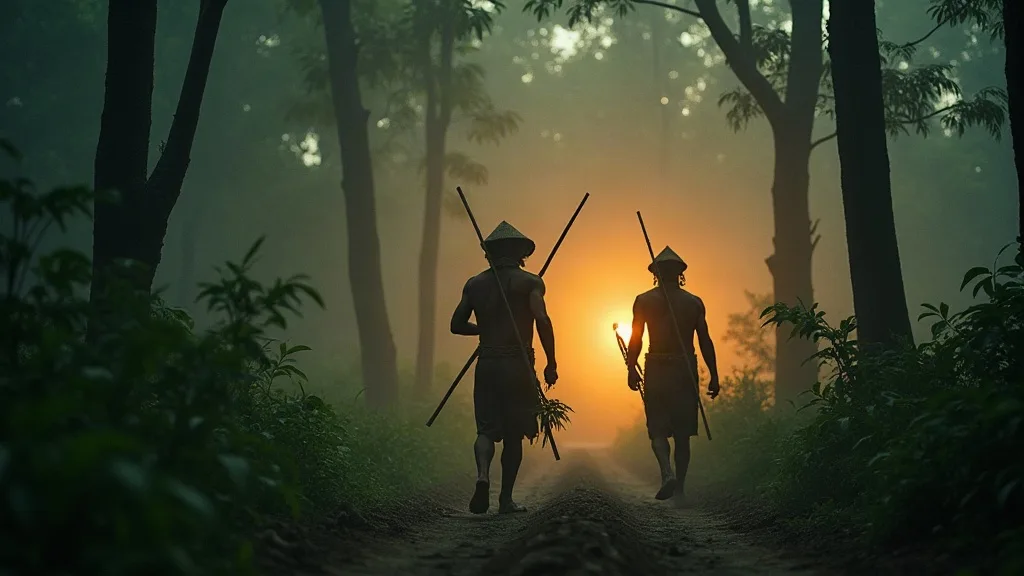
The village falls silent before dawn. Every woman and child has been sent indoors, doors shut, eyes down. From the forest edge comes a sound that is not quite music: a low, resonant moan that rises and folds, doubles back on itself, fills the lungs of the men who walk behind it. These are the voices of Jurupari, the sacred flutes, and the men carrying them have fasted for three days. The boys who will hear them tonight will not be boys by morning.
This scene has played out across the northwest Amazon basin for longer than any written record reaches. The Jurupari initiation rites belong to the Tupi-Guarani-speaking peoples and their neighbours, above all the Desana, Tukano, and Arawakan groups of the Vaupés River region. Scholars, travellers, and missionaries have been writing about these ceremonies since the sixteenth century, and most of them got it wrong. What they called "devil worship" is, on close reading, one of the most carefully structured sets of religious law in the Americas: a full moral code, a cosmology, a theory of gender, and an ordeal of transformation, all encoded in a pair of bamboo tubes.
Who Jurupari Is: Spirit, Lawgiver, and Transformer
Jurupari is a Portuguese rendering of a name that carries weight across dozens of Amazonian languages: Yuruparí, Iurupari, Yurupichuna, depending on the community telling the story. The root connects, in several linguistic analyses, to notions of the mouth (yuru) and to darkness or spirit (pari). He is not a god in the Olympian sense, seated above and governing from a distance. He inhabits the world directly: in the forest, in the instruments, in the bodies of initiates during the rite.
The most complete mythic account available to readers outside the Amazon comes from a nineteenth-century text called the Uaupés Chronicle, recorded by Maximiano José Roberto, a literate Baniwa man, around 1890. In that account, Jurupari is born of a virgin woman impregnated by the juice of the puxiuri fruit. He grows up instantly, delivers a law, and is then killed by fire at his own instruction, because his flesh must not remain in the world. His bones become the first sacred flutes. His law, however, stays.
That law has specific content. It governs what men eat during initiation fasts, how marriage alliance works between clans, the correct seasonal timing for ceremonies, the hierarchy among initiated men, and above all the absolute separation of the flutes from female sight. This last rule is not decorative. Jurupari's myth cycles, as recorded in the early twentieth century by the ethnomusicologist Theodor Koch-Grünberg, consistently explain that the original order of the world placed women in control of the sacred instruments. A primordial reversal transferred that power to men. The current ritual law is, in a sense, the maintenance of that reversal: the periodic restatement that the world is now correctly ordered.

The Structure of the Initiation Rite
The ceremony the flutes anchor is not a single night's ordeal. In the communities where it has been documented most fully, the Desana and Barasana of the Colombian Vaupés, the process unfolds across several days and passes through distinct phases.
Fasting and isolation open the sequence. Boys who have reached puberty, typically between twelve and fifteen years old, are separated from daily village life. They eat minimally: no meat, no fish with blood, no salt. The point is not punishment. The body must be emptied so that something else can enter.
The approach of the flutes comes at night. Initiated men bring the flutes from the forest, where they are normally stored wrapped in palm leaves and hidden from any woman or uninitiated person. The sound arrives before the instruments do. Boys who have never heard it know it is coming; they have been told since childhood that this sound belongs to Jurupari, and that it will change them.
Physical ordeal follows. Accounts from the Barasana, documented by Stephen Hugh-Jones in his 1979 study The Palm and the Pleiades, describe scarification, immersion in cold water, and the application of ants whose sting is designed to produce pain that the initiate must absorb without crying out. The insects used in Vaupés communities are related to, though distinct from, the bullet ants used in some neighbouring Satere-Maue practices. The pain is not cruelty. It is syntax: the body learns, through sensation, where the boundary between boyhood and manhood runs.
Ingestion of sacred substances punctuates the night. Caapi, the liana-based psychotropic known more widely as ayahuasca, appears in some but not all documented versions of the rite. Where it is present, it functions as a medium through which the initiate encounters Jurupari directly, seeing the spirit's form or receiving fragments of his law in vision.
The revelation of the flutes is the ceremonial climax. The boys see the instruments face-to-face for the first time. In Barasana cosmology, documented by Hugh-Jones and his wife Christine Hugh-Jones, this moment is understood as a kind of death and rebirth: the boy dies, and the initiated man rises. The flutes are shown, named, explained. Their names are secret, belonging to the male ritual register of the community's language.
Reintegration closes the process. The initiates are washed, fed, and formally re-introduced to the community in a new social identity. They now carry knowledge women do not have. They are responsible for keeping that knowledge safe.

The Sacred Flutes Themselves: Materials, Sound, and Meaning
The instruments called Jurupari are typically made from paxiuba palm (Socratea exorrhiza), a tall Amazonian palm whose trunk naturally separates into a hollow tube. Two main flutes form a pair: one is considered male, the other female, and the two voices together produce the harmonic identity of Jurupari. Neither is complete alone.
In communities where detailed organological study has been possible, such as the work carried out by Elizabeth Tolbert and reviewed in the Yearbook for Traditional Music, the flutes produce a drone-based sound that is deliberately non-melodic in the Western sense. The goal is not a tune. It is a presence. The low frequency vibrations travel through the chest wall of anyone nearby. You do not hear Jurupari so much as feel him settle into your ribs.
The instruments are not played by the initiates themselves. Adult men with specific ritual knowledge carry them. The right to carry a particular flute may be inherited patrilineally, and in some communities it is the central mark of male ceremonial authority. A man who carries Jurupari carries the law.
Some communities in the upper Vaupés keep multiple sets of flutes, each associated with a different ancestor-spirit or clan, and the Jurupari flutes are the highest rank among them. The anthropologist Jonathan Hill, working with the Wakuenai people, documented in his 1993 book Keepers of the Sacred Chants how the malirrna sacred chants and the flute traditions form a single integrated ritual complex, a living archive of cosmological knowledge stored not in writing but in sound and bodily practice.
Why Women Cannot See the Flutes: A Cosmological Reading
The prohibition is the element outsiders find most startling, and it is the most frequently misread. Early missionaries read it as misogyny. Some nineteenth-century evolutionists read it as evidence of "primitive" patriarchy. Both readings miss the internal logic entirely.
Within the Tupi-Guarani and Vaupés mythological framework, the current gender order is a reversal of a prior state. In the beginning, according to the Uaupés Chronicle and parallel texts collected by Robin Wright among the Baniwa, women held the sacred instruments. They were the ritualists. Then Jurupari transferred this power to men, giving them his law and his body in the form of the flutes.
The prohibition on women seeing the flutes is, from inside this logic, a constant re-enactment of that cosmic transfer. Every time the flutes pass through the village and women stay indoors, the foundational moment is replicated. The rite does not exclude women as inferior beings. It positions men as the current custodians of a power that has a history and could, the myth implies, have a future. The cosmology does not claim male supremacy is eternal. It claims it is the current arrangement, maintained by ritual repetition.
Viveiros de Castro, in his work on Amazonian perspectivism, points out that many Amazonian cosmologies treat gender, species, and social identity as positions rather than fixed essences. Jurupari's world is one where the positions can shift: they have shifted before and the ritual work is to hold them in place. This is a markedly different claim from the static hierarchies that nineteenth-century European observers assumed they were seeing.
Tupi-Guarani mythology connects this logic to a wider Amazonian concern with transformation: the same symbolic universe produces the shape-shifting shamans, the cannibal spirits, and the permeable boundaries between human and animal forms.
Jurupari Across Communities: Regional Variations
The Jurupari tradition is not monolithic. Across the hundreds of kilometres separating the Tupi-speaking peoples of the coast from the Vaupés communities in the interior, and again from Guarani groups further south, the figure takes different shapes.
Among the Desana of the Colombian Vaupés, documented in remarkable depth by Gerardo Reichel-Dolmatoff in his 1971 book Amazonian Cosmos, Jurupari connects directly to the Sun Father (Pámurifni) as a civilising emissary. The rite is tied to seasonal calendrics: specific constellations, particularly the Pleiades, signal when the ceremony must be held. Miss the window and the crops fail, the fish disappear, the community falls out of alignment with cosmic time.
The Barasana, studied by Hugh-Jones, emphasise the ancestral dimension: Jurupari is one of the He, the primordial anaconda-ancestor-spirits who emerged from the cosmic river at the beginning of time and whose bones became the sacred instruments. Here the flutes are literally ancestors, and playing them is a form of ancestral speech.
The Baniwa of the upper Rio Negro, as documented by Robin Wright in Cosmos, Self and History in Baniwa Religion (1998), carry a version in which Jurupari's adversary is Kuwai, another primordial being whose songs also require strict gender protocols. The two traditions have interacted and cross-pollinated for centuries, producing regional variants that scholars still argue about.
Among coastal Tupi groups, the spirit's name survived into colonial records but the full initiatory structure was disrupted by Portuguese contact beginning in the early sixteenth century. What remains are fragments: references to the flutes in Jesuit mission records, names in village chronicles, and the iconography of certain ceramic traditions that archaeologists associate with pre-contact Tupi ceremonial life.

The Jesuit Encounter and the Word "Jurupari"
The name itself owes its wide circulation to Jesuit missionaries who, arriving in Brazil from the 1540s onward, encountered spirit-beings they could not fit into Christian categories. They settled on the Portuguese word for devil, and Jurupari became a catch-all term for any Amazonian spirit that demanded ritual observance outside Christian practice.
Father José de Anchieta, writing in the 1560s, used the name to describe what he saw as demonic influence in coastal Tupi communities. Father Cristóbal de Acuña, descending the Amazon in 1639, recorded communities performing rites to a spirit he called Yurupari with evident dread. Neither man understood what he was watching. Both left detailed enough accounts that later anthropologists, reading against the grain of the missionary disgust, could reconstruct significant structural information.
The irony is rich. By giving the spirit a common name and writing it into their reports, the missionaries inadvertently created a thread of documentation that let twentieth-century ethnographers trace the tradition's spread. The word they used as a synonym for evil became the primary scholarly label for one of Amazonia's most sophisticated ritual systems.
Comparative mythology finds echoes here. The way Jurupari carries both law and transgression simultaneously, the way the sacred is also the forbidden, resonates with Hermes in Greek mythology, the boundary-crosser who is simultaneously divine messenger and trickster. It resonates even more directly with Tezcatlipoca in Nahuatl tradition, the dark mirror who shows men what they are and what they must become.
Sound as Sacred Law: What the Flute Music Encodes
Music in the Jurupari complex is not background. It is the primary medium of religious knowledge, and communities treat it with the same care that text-based traditions give to scripture.
Jonathan Hill's fieldwork among the Wakuenai established that sacred chant cycles, which accompany the flutes in ceremonial contexts, encode genealogies, territorial boundaries, and clan histories in ways that are only fully intelligible to initiated men who have received years of training. The same principle applies to the flute melodies: they carry meaning that is not translatable into ordinary speech. A man who knows how to play Jurupari correctly knows, simultaneously, where his clan came from, what it owes to neighbouring clans, and which territories belong to whom. The music is a legal document and a history book, played on bones.
This is why the loss of the tradition is so serious in communities where missionisation, forced relocation, or the death of ceremonial specialists has broken the chain. When a village loses its last Jurupari-player, it does not merely lose a musical practice. It loses a library.
The sacred flutes of Jurupari also serve a calendrical function. Among the Desana, Reichel-Dolmatoff documented that the ceremonial cycle aligns with the movement of the Pleiades across the night sky. The flutes sound when the Pleiades reach specific positions; their silence during other seasons is as meaningful as their sound. This astronomical dimension places the Jurupari complex in the same broad family as the solar observatories of the Andes and the Venus calendrics of Mesoamerica: Amazonian peoples mapped cosmic time with the same precision, using different instruments.
Jurupari in the Modern Amazon: Survival, Loss, and Revival
The twentieth century was catastrophic for the communities that carry the Jurupari tradition. Rubber extraction between the 1870s and 1920s decimated populations. Catholic and later Protestant missions suppressed ceremonies and confiscated or destroyed flutes. Brazilian and Colombian state policies variously forced settlement, banned indigenous languages in schools, and disrupted the age-grade systems that gave the initiation rite its social context.
And yet the tradition has not died. In the Colombian Vaupés, a number of Desana and Barasana communities have maintained ceremonial knowledge in families even through decades of mission schooling. Some communities, empowered by the constitutional recognition of indigenous rights in Colombia's 1991 constitution and Brazil's 1988 constitution, have begun deliberate revival programmes, training young men in the flute traditions and re-establishing the ceremonial calendar.
The UNESCO listing of the Yuruparí tradition of the Vaupés River basin communities as Intangible Cultural Heritage in 2011 gave the revival political leverage. It also created tensions: heritage frameworks designed for relatively static cultural forms struggle with a living tradition that demands secrecy, seasonal timing, and gender separation that some younger community members question. The negotiation between preservation and adaptation is ongoing, and it belongs entirely to the communities themselves.
Guarani mythology carries parallel debates about the place of traditional ceremony in contemporary indigenous life, and the Jurupari communities share many of the same pressures and strategies.
Frequently Asked Questions About Jurupari and the Sacred Flutes
Frequently asked questions
What does the name Jurupari actually mean?
The name comes from Tupi-Guarani roots, most likely combining yuru (mouth) with pari (a term linked to spirit or darkness in several related languages). Different communities spell and pronounce the name differently: Yuruparí, Iurupari, Yurupichuna. The Portuguese missionaries who spread the name treated it as a generic word for "devil," which obscured its specific meaning as a named lawgiver-spirit with a defined mythological biography.
Are the sacred flutes still played today?
Yes, in several communities in the Colombian and Brazilian Vaupés region. The Desana, Barasana, and some Baniwa communities have maintained flute traditions through the twentieth century despite significant external pressure to abandon them. Following the constitutional recognition of indigenous rights in Colombia (1991) and Brazil (1988), and the UNESCO intangible heritage listing in 2011, a number of communities have actively worked to transmit the tradition to younger generations.
Why are women forbidden from seeing the flutes?
The prohibition reflects a foundational myth in which women originally controlled the sacred instruments and Jurupari transferred that power to men. Every ceremonial performance re-enacts that transfer. Within the community's cosmological logic, this is not a claim about female inferiority; it is a ritual maintenance of a specific cosmic arrangement, one that the myth itself presents as historically contingent rather than eternal. Anthropologists including Eduardo Viveiros de Castro have documented this internal logic in detail.
What is the connection between Jurupari and ayahuasca?
In some communities, particularly in the upper Vaupés region, the psychotropic brew made from the Banisteriopsis caapi liana (called caapi locally) forms part of the initiation ceremony and allows initiates to encounter Jurupari in visionary form. However, ayahuasca is not universal to all Jurupari ceremonies. Its presence or absence varies by community, and many aspects of the rite, including the flute music, the fasting, and the physical ordeal, are considered fully meaningful without it.
What are the primary academic sources on Jurupari?
Key sources include Gerardo Reichel-Dolmatoff's Amazonian Cosmos (1971) on the Desana; Stephen Hugh-Jones's The Palm and the Pleiades (1979) on the Barasana; Jonathan Hill's Keepers of the Sacred Chants (1993) on the Wakuenai; Robin Wright's Cosmos, Self and History in Baniwa Religion (1998); and the Uaupés Chronicle recorded by Maximiano José Roberto around 1890, which remains the most detailed indigenous-authored mythological account.
How does Jurupari compare to initiation spirits in other traditions?
The structural parallels are strong. Like the Hopi kachina spirits of the American Southwest, whose masks must be removed before uninitiated children, Jurupari's flutes carry knowledge that changes the person who receives it legitimately and endangers those who receive it out of sequence. Like the Greek mystery cults at Eleusis, the Jurupari rite works through progressive revelation: each level of initiation grants access to a new register of knowledge. The specific content differs enormously, but the architecture of transformation through controlled disclosure is widely shared.
What the Flutes Still Teach About Sacred Law and Living Knowledge
Communities that maintain the Jurupari initiation rites today are not preserving a museum piece. They are practising a system in which the flutes do real work: they order social relations, mark the passage from boyhood to adulthood, calibrate the community's relationship to seasonal time and ancestral territory, and transmit legal knowledge across generations without writing.
This is the element that deserves the most attention from anyone seriously interested in how human societies organise meaning. Most of the world's knowledge systems depend on text, which can be copied, stored, translated, and eventually separated from the people who produced it. The sacred flutes of Jurupari carry knowledge that cannot be separated from the living body that plays them, the living body that hears them, and the living community that maintains the protocols around them. Strip out any one of those elements and the knowledge is not just hidden. It is, in a real sense, gone.
Jonathan Hill's concept of the "sonic archive," developed in his Wakuenai research and extended by subsequent ethnomusicologists, points toward what is at stake. Music here is not ornamentation over a more fundamental verbal or textual tradition. It is the primary form. The words, the genealogies, the territorial maps, and the moral code exist most fully in sound, in the way a particular passage for the male flute answers a particular passage for the female flute, in the way silence at the right moment carries as much meaning as sound.
The comparison to text-based legal traditions is instructive. A written constitution is no stronger than the political will to uphold it. The Jurupari law, stored in bamboo and breath and bodies, is no stronger than the community's willingness to keep initiating. But it is also no weaker. It has survived five centuries of missionisation, economic disruption, and state assimilation policy because the knowledge it carries is genuinely valuable to the people who hold it. That survival is, by any measure, remarkable.
Tupi-Guarani cosmology holds that the world is renewed by ceremony, not by prayer. The flutes of Jurupari, sounding through the Amazonian night, are that renewal made audible.
Free 25-page sample
Want the whole story?
Take the first 25 pages free. If it pulls you in, the full edition is yours as an instant PDF download, with a paperback on Amazon for selected titles.

Tupi-Guarani
The Tupi-Guarani Mythology Book: The Land Without Evil, the Twin Heroes, and the Spirits of the Rainforest
Namandu, the Twin Heroes, and the Land Without Evil
The mythology of the Tupi and Guarani peoples of the Amazon and the Atlantic forest: Namandu the creator who unfolded the world out of darkness, the twin heroes raised by jaguars, Tupa of the thunder, the fire-serpent Boitata, and the long search for the Land Without Evil.
More from Tupi-Guarani
All articles
Tupi-Guarani
Tupã: The Thunder God and Supreme Creator of Tupi-Guarani Myth
Tupã commands the sky as both destroyer and creator: the Tupi-Guarani supreme god who speaks through thunder, shapes the cosmos, and rules over all lesser powers. Discover how this ancient deity shaped the worldview of millions across the Amazon and beyond.

Tupi-Guarani
The Origin of Manioc: Mani and the Gift of Cassava
In Tupi-Guarani lore, a girl named Mani died of a broken heart and transformed into the cassava root, becoming the foundation of survival for generations. Discover how a myth of grief became the story of a continent's staple crop.

Tupi-Guarani
Anhangá: The Forest Protector and Trickster Spirit
Anhangá is the shape-shifting guardian of Tupi-Guarani forests, a spirit who punishes hunters who show disrespect to animals and plants. Part protector, part deceiver, this creature embodies the deep ecology of Amazonian belief.

Tupi-Guarani
Sumé: The Culture Hero and Civilizing Prophet of the Tupi-Guarani
Sumé taught agriculture, language, and moral law to the Tupi-Guarani peoples before vanishing into the sea. This foundational culture hero bridges the sacred and the everyday in South American oral tradition.