
The Maracá: Sacred Rattle and Ritual Instrument of Tupi-Guarani Mythology
The maracá was no simple noisemaker. For the Tupi-Guarani, this gourd rattle channeled divine speech, summoned spirits, and placed the shaman at the threshold between worlds. Learn its full story.
Contents
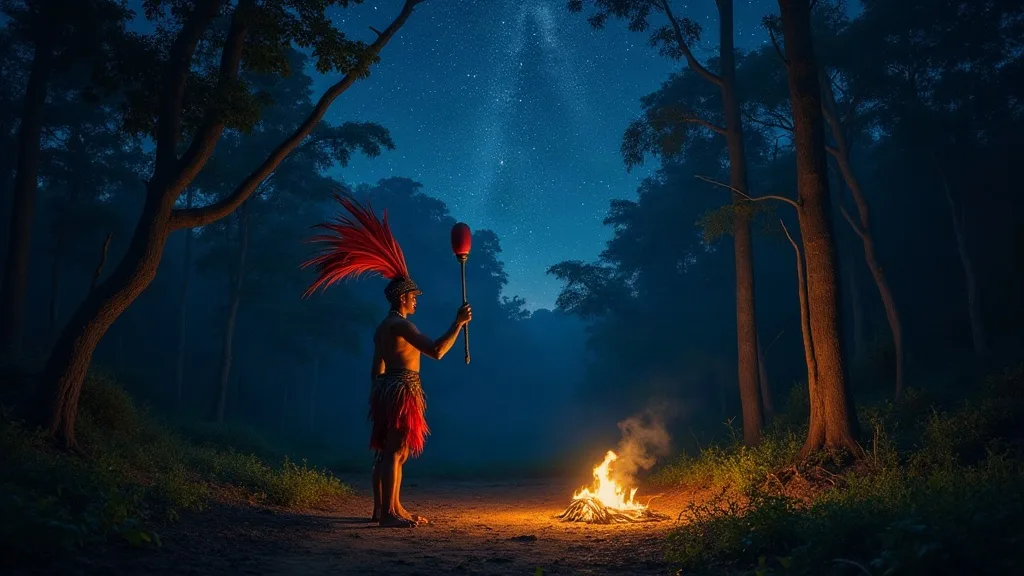
A shaman lifts the gourd. He shakes it once, twice. The seeds inside clatter against dry shell, and something shifts in the air around the fire. That sound is not music. It is a summons.
For the Tupi and Guarani peoples of lowland South America, the maracá was the single most charged object a religious specialist could hold. Not a weapon, not a crown. A rattle made from a hollow gourd, filled with seeds or pebbles, fitted with a wooden handle, and decorated with feathers. Simple in construction. Absolute in authority.
Early European chroniclers could not quite account for what they were seeing. The Franciscan friar André Thevet, writing in 1557 after time among the Tupinambá of coastal Brazil, described the maracá as something the shamans treated "as if it were alive." He was closer to the truth than he knew. In Tupi-Guarani thought, the rattle was not a tool the shaman used. It was a being that spoke through him.
The Gourd That Speaks: Origins of the Maracá in Tupi-Guarani Cosmology
To understand why a gourd could carry cosmic weight, you have to understand how the Tupi-Guarani conceived of speech itself. In their cosmological framework, the world did not begin with light or water. It began with a word. The deity the Guarani call Ñamandu (also written Ñande Ru, meaning "Our Father") first existed in primordial darkness, and from that darkness he created divine speech before anything else. Not the world, not other gods. Speech came first.
The anthropologist León Cadogan recorded this cosmogony in the 1950s among the Mbya Guarani of Paraguay, publishing it as Ayvu Rapyta ("The Foundation of Human Language") in 1959. What Cadogan documented was remarkable: a creation hymn in which Ñamandu sits in original darkness, generating the ayvu, the sacred word-soul, from within himself. That ayvu then radiates outward to create the gods, the earth, and eventually the first humans. Language is not a product of the cosmos. Language is its root.
The maracá plugged directly into this cosmogony. The rattle's sound mimicked the primordial vibration, the first movement of the ayvu through nothingness. When a pajé (the Tupi term for a shaman or ritual specialist) activated the instrument, he was re-enacting creation at a smaller scale. He was re-opening the channel between the human world and the divine word.
This is why the maracá was never played casually. Specific rituals governed when it could be shaken, in which direction it should face, how long it could sound before silence was required. Among several Guarani groups, a maracá that was shaken outside ritual context was believed to "go quiet permanently," losing its spiritual charge. The instrument held power only because the community agreed to treat it as sacred. That collective agreement was itself a form of religious practice.
Maíra, the Transformer, and the First Rattle
Maíra (also rendered Maíra-Monan or Maíra-até depending on the subgroup) stands at the center of Tupi mythological tradition as the great transformer and teacher of humanity. Different regional traditions give him different attributes, but one thread is nearly universal: Maíra is the source of the rattle's power.
The Tupinambá tradition, recorded by Hans Staden in his 1557 account and by Jean de Léry in History of a Voyage to the Land of Brazil (1578), held that the maracá carried Maíra's voice precisely because Maíra had once traveled among humans in human form. He taught the cultivation of manioc, the techniques of featherwork, and the protocols of ritual speech. When he departed, he left behind his voice, compressed into the seeds inside the first gourd.
This myth follows a pattern found widely in Tupi traditions: a powerful being transforms rather than simply vanishes. Maíra does not die. He passes into objects, into ritual practices, into the songs the shaman sings. The maracá becomes his continued presence on earth. Ownership of a maracá was therefore not a privilege of craft or status. It was the inheritance of a relationship with a divine figure. Readers curious about comparable transformer-hero cycles elsewhere in the Americas may find the Popol Vuh's Hero Twins instructive: like Maíra, Hunahpu and Xbalanque pass their power into enduring forms rather than departing cleanly.
Jean de Léry, a Huguenot pastor who lived among the Tupinambá from 1556 to 1558, left one of the earliest detailed accounts of maracá ritual. He described entire villages gathering while shamans carrying rattles moved from house to house, chanting. Women and children pressed themselves to the ground in fear or reverence. The maracá's sound preceded the shaman's voice, clearing a ritual space before words followed. De Léry, deeply uncomfortable with what he was witnessing, nevertheless admitted the ceremony had an order and a logic he could not dismiss as mere chaos.
The Pajé and the Rattle: A Bond That Took Years to Build
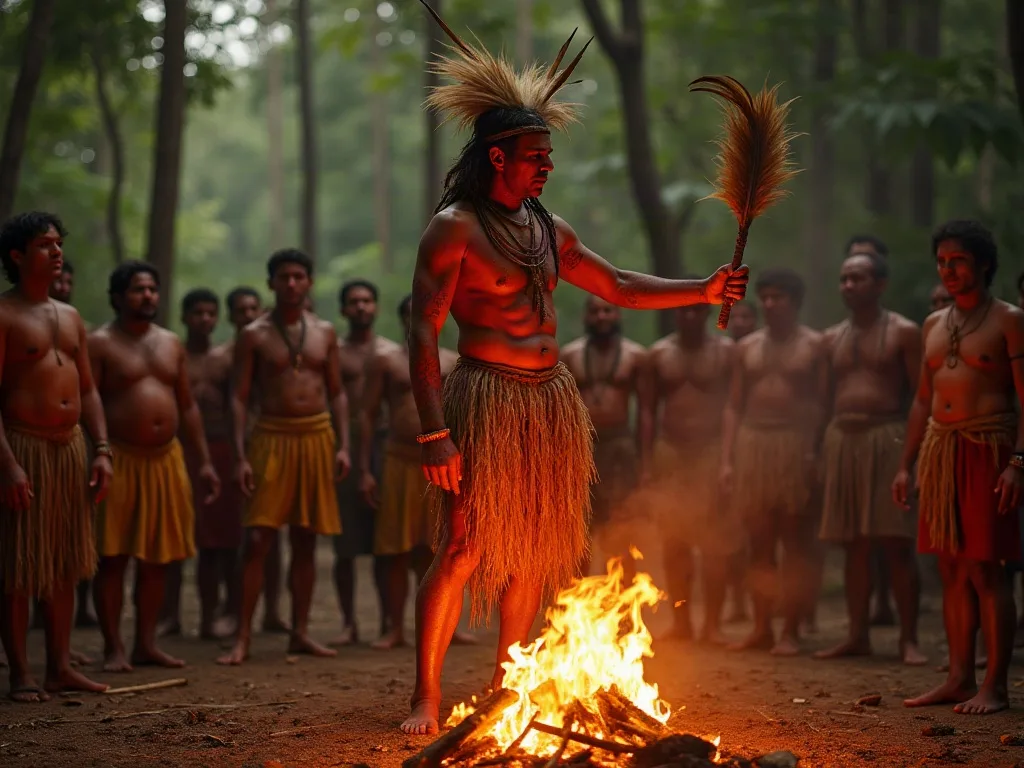
A shaman did not simply acquire a maracá. The instrument came to him through vision, illness, and long apprenticeship. Among the Tupinambá and related coastal groups, a young man who showed signs of becoming a pajé would undergo a period of fasting and isolation during which he was believed to hear the rattle's voice before the physical object was even in his hands. The sound came first. The gourd followed.
Once a pajé received his maracá, usually from an elder specialist, he spent months learning to "awaken" it. This involved specific songs, the feeding of the instrument with tobacco smoke, and a series of dialogues in which the shaman spoke to the rattle and listened for its response. This was not metaphor. In the Tupi-Guarani framework, the maracá was genuinely understood as capable of communication. It could refuse to answer. It could fall silent as a warning.
The anthropologist Alfred Métraux, whose 1928 study La Religion des Tupinamba remains a foundational reference, noted that a shaman's maracá was so closely identified with his personal power that enemies sought to destroy or steal it. A pajé whose rattle was taken was considered spiritually crippled. Some accounts describe shamans who died of grief when their rattles were confiscated or burned.
Catholic missionaries, who arrived in waves from the 1540s onward, understood this bond clearly enough to target it. Jesuits operating in the Jesuit Reductions of Paraguay, the mission settlements established between 1609 and 1768, made the confiscation and destruction of maracás a routine part of conversion. Burning the rattles was not symbolic vandalism. It was understood by both missionaries and Guarani as an act of direct spiritual war.
Structure and Sound: What the Maracá Is Made Of
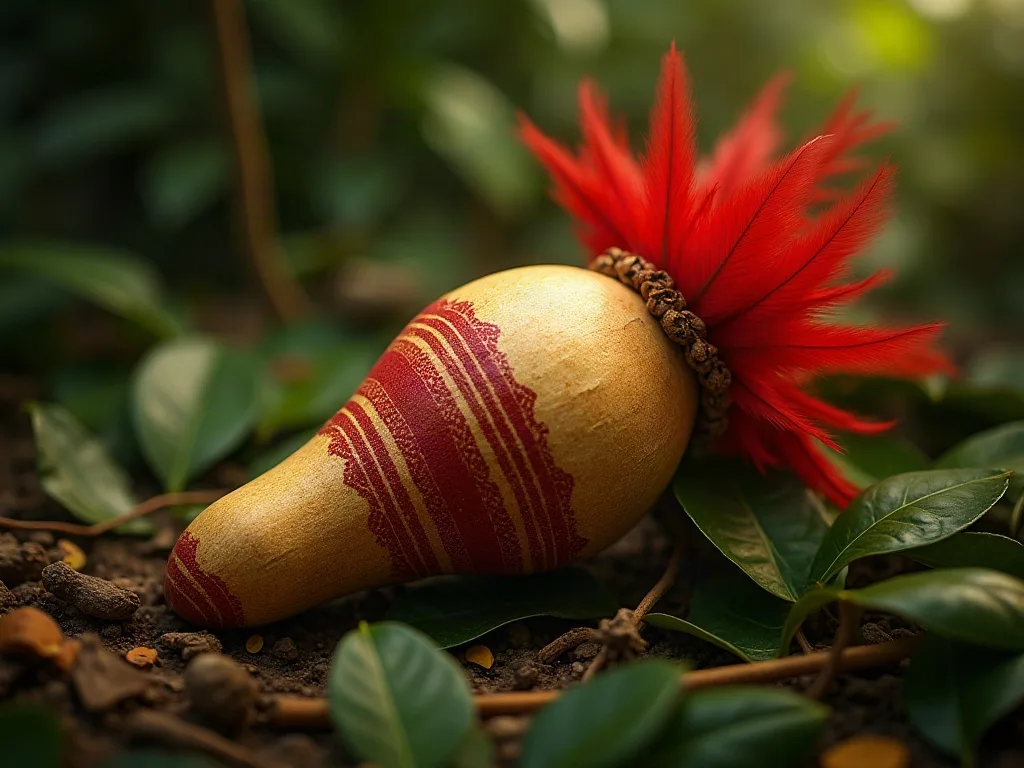
The physical maracá is constructed with care that directly reflects its sacred status. The primary body is a dried gourd, typically from the bottle gourd (Lagenaria siceraria), hollowed and cleaned. Seeds, small stones, or hardened resins are placed inside to produce the characteristic dry, percussive rattle. A hardwood handle is inserted through the base, sometimes carved, sometimes plain.
Decoration marks the instrument's spiritual identity. Feathers are attached to the handle and around the gourd's neck: red feathers from the scarlet macaw (Ara macao) are particularly associated with divine fire and solar power in Tupi traditions. White egret feathers signal purity and connection to the sky. The gourd itself may be painted with red urucum dye, the same pigment used to mark warriors' bodies for ceremony and combat.
The sound produced depends entirely on the filling. Seeds produce a dry, whispering rattle. Small stones produce a sharper, more piercing report. Some ritual maracás were tuned very deliberately, the craftsman shaking the gourd repeatedly while adding or removing filling until the sound matched a specific pitch known from tradition or dream. The result was an instrument that was, in every sense, custom-built for a spiritual purpose.
It is worth noting how this acoustic intentionality contrasts with instruments in neighbouring traditions. Among the Shipibo-Conibo of the upper Amazon, the shacapa leaf-bundle rattle produces a softer, susurrating wash of sound associated with the movement of healing plant-spirits rather than with divine speech. The Tupi-Guarani maracá's harder, seed-clatter timbre was selected precisely because it could cut through communal noise and announce a sacred threshold, an audible declaration that ordinary time had ended.
The Maracá and the Land Without Evil: Ritual Use in Migration Ceremonies
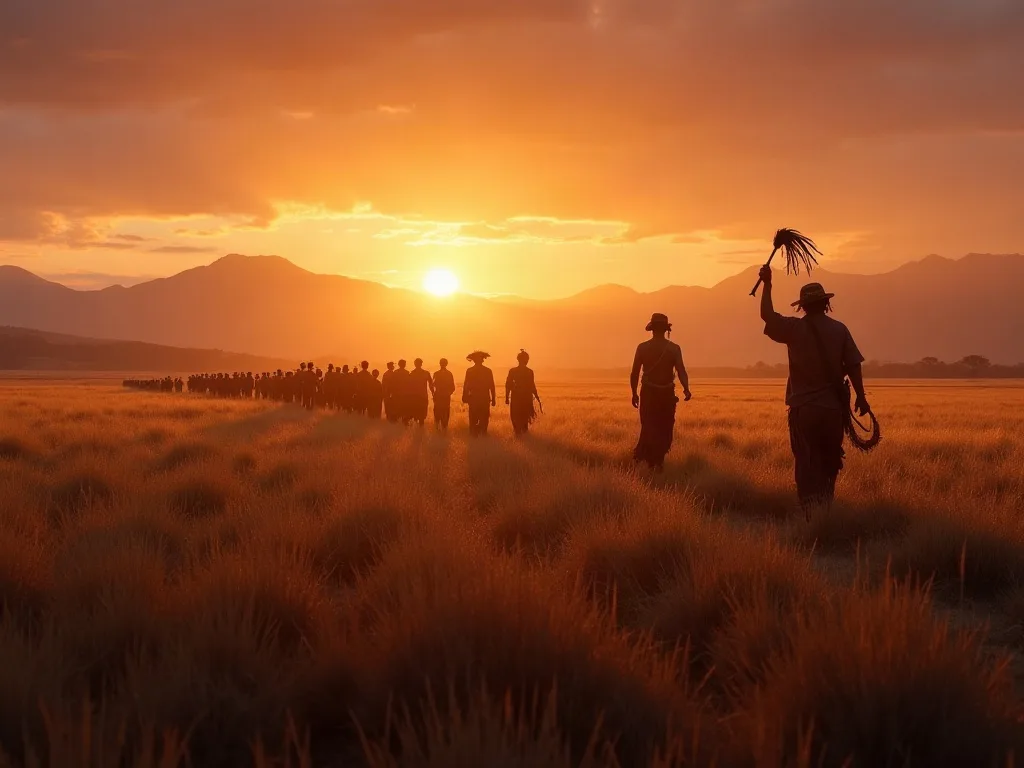
One of the most striking contexts in which the maracá appeared was the extraordinary prophetic migrations the Tupi-Guarani periodically undertook in search of a place called Yvy Marã Eÿ, the "Land Without Evil." These were not simple relocations. They were eschatological pilgrimages, sometimes involving thousands of people, driven by the visions and songs of charismatic shamanic leaders.
Yvy Marã Eÿ was understood as a paradise beyond the sea or beyond the mountains where death, disease, and the labor of agriculture did not exist. The body itself would become light there. The corn would grow without planting. This belief drove multiple large migration events recorded in colonial sources, including the famous late 15th-century movement of Tupinambá groups from the interior toward the Atlantic coast, which Portuguese colonizers encountered with bewilderment.
The maracá was the ritual engine of these migrations. Shamanic prophets, called caraíbas ("holy men" or "prophets") by the Tupinambá, led the processions while shaking their rattles continuously. The rattle's sound was understood as navigation: it oriented the group toward the sacred destination. Without the sound of the maracá, the pilgrimage would lose its divine sanction. The instrument was literally showing the way.
Alfred Métraux, Hélène Clastres (whose 1975 study La Terre sans Mal examined this tradition in depth), and Pierre Clastres in his ethnographic writings all treated the maracá-led migration as one of the most extraordinary religious phenomena in pre-Columbian and early colonial South America. The rattle was not peripheral to this movement. It was the movement's authority. Comparable eschatological longing expressed through ritual sound also shapes the Ghost Dance traditions of the North American Plains, though the instruments and cosmological idioms differ markedly, a reminder that the desire to reach a world without suffering is not unique to any single hemisphere.
The Maracá Across Tupi-Guarani Subgroups: Variations on the Same Voice
The Tupi-Guarani linguistic family is large, covering dozens of distinct groups spread across Brazil, Paraguay, Bolivia, and Argentina. The maracá appears across almost all of them, but its exact form, protocols, and mythological associations shift meaningfully.
Among the Kayabí of the upper Teles Pires River in central Brazil, the rattle is closely linked to water spirits and is used in healing ceremonies where the shaman moves it over a sick person's body, drawing out the illness. Among the Araweté of the Xingu River basin, studied by Eduardo Viveiros de Castro in the 1980s, the rattle accompanies songs in which the shaman actually converses with cannibal gods called Maï, negotiating for the souls of the recently dead. Viveiros de Castro's published fieldwork, including his 1992 monograph From the Enemy's Point of View, records in careful detail how the rattle audibly signals the handoff between the human shaman's voice and the Maï deity's words: a listener present in the ritual house would hear a clear change in vocal register at each moment the maracá sounded, marking when the human voice yielded to a divine one.
The Guaraní Ñandeva of Paraguay and Brazil use the maracá specifically in the mitã kunumi pepy, the boys' initiation ceremony, where the lip-piercing that marks young men's entry into full social and spiritual life is accompanied by sustained rattle-playing by senior shamans. The sound is understood to hold the initiates steady across the threshold of transformation. Readers interested in comparable initiation rites across indigenous South America may find the Yawari ritual of the Kamayurá a useful parallel: there too, sustained sound-making by specialists scaffolds the dangerous passage between states of being.
What unites all these variations is the core logic: the maracá's sacred rattle is a threshold instrument. It marks the boundary between ordinary time and sacred time, between human speech and divine speech, between the visible world and the one beyond it.
What Colonial Records Got Right and Wrong
The European chronicles that documented the maracá are invaluable. They are also compromised by the frame through which their authors looked.
André Thevet, Jean de Léry, Hans Staden, and José de Acosta all recorded maracá ceremonies in ways that preserved crucial detail. But they consistently interpreted what they saw through the lens of European demonology. Where Tupi observers heard the voice of Maíra or Ñamandu, the missionaries heard the devil. The burning of rattles, the punishment of pajés, and the systematic replacement of indigenous ceremony with Catholic liturgy were not incidental to colonial expansion. They were one of its primary instruments.
What the missionaries did not entirely manage to destroy was the cosmological logic. The belief that speech is sacred, that certain sound-objects carry divine presence, and that ritual specialists hold the responsibility of maintaining the connection between worlds: all of this persisted in modified forms through the colonial period and into the present. In many Guaraní communities in Paraguay and southern Brazil today, the maracá remains part of active ceremonial life, used in the ñemongarai (the ceremony of sacred naming) and in healing rituals conducted by mbaéipy specialists (ritual healers).
The Maracá's Echo in Living Ceremony
The persistence of the maracá is not nostalgia. Among the Mbya Guaraní, who have maintained a relatively unbroken tradition of ceremonial practice through the colonial period, the rattle remains central to the opy (the ritual house), where nightly singing and prayer ceremonies keep the community's relationship with Ñamandu alive.
Scholars including Bartomeu Melià, who spent decades working with Guaraní communities in Paraguay, and more recently Robin Wright, whose research covers multiple Amazonian groups, have noted that the maracá's role has not fossilized. The instrument continues to adapt: new songs are composed, new healing protocols develop, new shamans go through the old initiatory process of hearing the rattle before holding it. The instrument remains alive in the same sense the Tupinambá always insisted it was.
For the Guaraní religious worldview, the cosmos requires active maintenance. It is not a stable system that runs on its own. Human ritual action, particularly the sound of the sacred rattle, is part of what holds the world together. Without the maracá, without the pajé's voice, without the ongoing performance of these ceremonies, the fragile earth risks collapse into the next cosmic destruction. The instrument is not a memory of power. It carries power now.
Frequently Asked Questions About the Maracá
Frequently asked questions
What is the maracá made from, and why does the material matter?
The maracá is made from a dried bottle gourd (Lagenaria siceraria) filled with seeds or small stones and fitted with a wooden handle. The material matters because the gourd itself is understood as a transformation of a living plant, already carrying organic spiritual energy. The seeds inside echo the agricultural cosmology of Tupi-Guarani thought, where seeds represent life compressed into a small, portable form. Red macaw feathers added to the handle connect the instrument to solar and fire symbolism. Every material choice is thus a theological statement: the rattle assembles sky, earth, and seed into a single handheld object.
Who was allowed to use the maracá in Tupi-Guarani communities?
In most Tupi-Guarani traditions, the maracá was the instrument of the pajé (shaman or ritual specialist), obtained through a visionary process and then "awakened" through months of song and tobacco-smoke offerings. Among some groups, senior community members might use smaller rattles in specific ceremonies, but the full ritual instrument, the one understood to channel divine speech, belonged to trained specialists. Métraux's 1928 research documents cases where women could also become pajés with their own maracás, though this was less common in coastal Tupinambá groups.
How is the maracá connected to the Tupi-Guarani concept of the 'Land Without Evil'?
The caraíbas (prophetic shamans) who led the great Tupi-Guarani migrations toward Yvy Marã Eÿ (the Land Without Evil) used the maracá as both a navigational and an authorizing instrument. Hélène Clastres's 1975 study La Terre sans Mal describes how the rattle's continuous sound during these pilgrimages signaled divine approval and maintained the sacred character of the march. The maracá essentially declared that the movement was a ritual act, not simply a migration.
Did the maracá survive European colonization and missionary activity?
Yes, though not without serious damage. Jesuit missionaries in the Paraguayan Reductions and Portuguese colonial authorities in Brazil both targeted maracás for confiscation and burning, understanding their role in indigenous religious authority. Despite this, the instrument persisted in communities that maintained ceremonial independence. Among the Mbya Guaraní of Paraguay and Brazil, the maracá is still used in active ceremonies today, including the ñemongarai (sacred naming ceremony) and nightly prayer rituals in the opy (ritual house).
How does the maracá compare to similar sacred rattles in other South American traditions?
Sacred gourd rattles appear across Amazonia and beyond, from the Yanomami to the Shipibo-Conibo and the Tukano-speaking groups of the northwest Amazon. In many cases these instruments share the logic of sound as spiritual threshold-crossing. What distinguishes the Tupi-Guarani maracá is its specific connection to a cosmogony of divine speech: the idea that sound itself is the root of creation, so the rattle's sound re-enacts the original creative act. This cosmological depth is documented most directly in Cadogan's Ayvu Rapyta recordings, which preserve Ñamandu's creative word-hymn in its Mbya Guarani form, and in Viveiros de Castro's From the Enemy's Point of View (1992), which records how the Araweté maracá audibly mediates exchanges between living shamans and the Maï cannibal gods. Together these primary-source anchored accounts give the Tupi-Guarani instrument a particularly dense mythological identity that few parallel instruments in the ethnographic record can match.
The Maracá in Modern Scholarship and Indigenous Reclamation
The study of the maracá has evolved considerably since Métraux's foundational work in the 1920s and 1930s. Eduardo Viveiros de Castro's concept of Amerindian perspectivism, developed through fieldwork with the Araweté and other Amazonian groups from the 1980s onward, offers a framework that takes the rattle's "personhood" seriously without reducing it to superstition. In this view, the Tupi-Guarani were not confused about the maracá being a gourd. They held a different but coherent theory of what kinds of things can have interiority, agency, and voice. The rattle is not imagined as a gourd pretending to be alive; it is understood to have genuinely acquired a subject-position through the ritual relationships formed around it, a distinction that perspectivism makes philosophically tractable in a way that earlier anthropological models could not.
This matters for contemporary indigenous rights movements. Guaraní and Tupinambá communities across Brazil, Paraguay, Argentina, and Bolivia have, since the 1980s, engaged in active processes of cultural recovery that include the relearning of maracá construction and ceremonial protocols. Museum collections in Lisbon, Paris, and São Paulo hold some of the oldest surviving instruments, and indigenous scholars and community leaders have increasingly demanded both access to these objects and repatriation discussions.
The Mbya Guaraní ceremonial tradition, in particular, has become a reference point in international UNESCO discussions about intangible cultural heritage. The maracá is not a relic from that tradition. It is part of what that tradition is, right now, still producing.
What started as seeds in a gourd keeps making sound. The shaman lifts the instrument. The fire crackles. And somewhere between the dry rattle of seeds and the night air, a channel opens that has been opening, in this same shape, for centuries.
Free 25-page sample
Want the whole story?
Take the first 25 pages free. If it pulls you in, the full edition is yours as an instant PDF download, with a paperback on Amazon for selected titles.
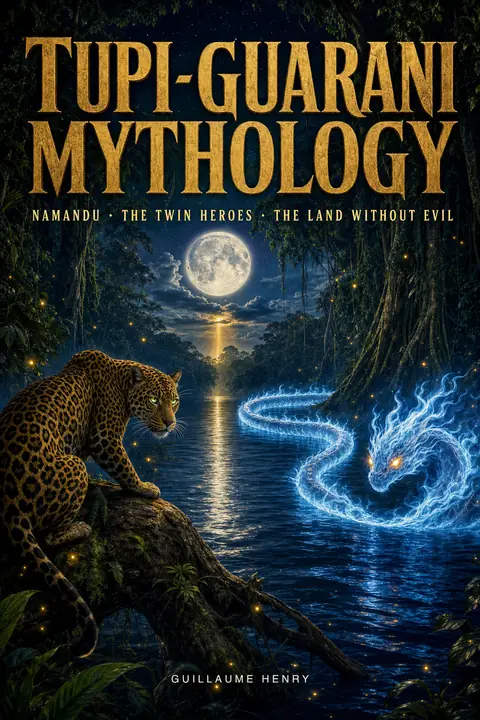
Tupi-Guarani
The Tupi-Guarani Mythology Book: The Land Without Evil, the Twin Heroes, and the Spirits of the Rainforest
Namandu, the Twin Heroes, and the Land Without Evil
The mythology of the Tupi and Guarani peoples of the Amazon and the Atlantic forest: Namandu the creator who unfolded the world out of darkness, the twin heroes raised by jaguars, Tupa of the thunder, the fire-serpent Boitata, and the long search for the Land Without Evil.
More from Tupi-Guarani
All articles
Tupi-Guarani
Tupã: The Thunder God and Supreme Creator of Tupi-Guarani Myth
Tupã commands the sky as both destroyer and creator: the Tupi-Guarani supreme god who speaks through thunder, shapes the cosmos, and rules over all lesser powers. Discover how this ancient deity shaped the worldview of millions across the Amazon and beyond.

Tupi-Guarani
The Origin of Manioc: Mani and the Gift of Cassava
In Tupi-Guarani lore, a girl named Mani died of a broken heart and transformed into the cassava root, becoming the foundation of survival for generations. Discover how a myth of grief became the story of a continent's staple crop.

Tupi-Guarani
Anhangá: The Forest Protector and Trickster Spirit
Anhangá is the shape-shifting guardian of Tupi-Guarani forests, a spirit who punishes hunters who show disrespect to animals and plants. Part protector, part deceiver, this creature embodies the deep ecology of Amazonian belief.

Tupi-Guarani
Sumé: The Culture Hero and Civilizing Prophet of the Tupi-Guarani
Sumé taught agriculture, language, and moral law to the Tupi-Guarani peoples before vanishing into the sea. This foundational culture hero bridges the sacred and the everyday in South American oral tradition.