

Kim-un-kamuy: The Bear God of the Ainu
Kim-un-kamuy, the Ainu Bear God, rules the mountains as a divine visitor in animal skin. Learn who he is, why the Iyomante ritual honours him, and what his myth reveals.
Contents
A bear steps out of the forest and into the village. He is enormous, deliberate, unhurried. The Ainu people of Hokkaido watch him come, not with fear, but with reverence. To them, this animal is not a predator to be hunted. He is a god wearing a fur coat, passing through the human world on a diplomatic visit, and it is their sacred duty to send him home in style.
That god is Kim-un-kamuy: The Bear God, lord of the mountains, supreme guest of the Ainu cosmos. His story sits at the heart of Ainu spiritual life, threading through ritual, song, and oral tradition in ways that no single text can fully capture. It is a theology of reciprocity: the bear gives his body, the people give their gratitude, and the whole cycle holds the world in balance.
Who Kim-un-kamuy Is in the Ainu Cosmos
The Ainu, the indigenous people of Hokkaido (Japan's northernmost main island), Sakhalin, and the Kuril Islands, understand the world as divided into two realms: Ainu Mosir (the Land of Humans) and Kamuy Mosir (the Land of the Gods). These realms are not distant from each other. They overlap, press against each other, and beings cross between them constantly.
Kamuy is the Ainu word for divine spirit or god, and it covers a vast category of beings: fire, water, the owl, the salmon, disease, thunder. Almost every powerful, remarkable, or dangerous entity has a kamuy form. But Kim-un-kamuy, whose name breaks down as kim (mountain), un (dwelling), and kamuy (god), sits at or near the top of this hierarchy. Scholars such as Neil Gordon Munro, whose fieldwork in Hokkaido in the early twentieth century produced the posthumous study "Ainu Creed and Cult" (1962), and Bronislaw Pilsudski, who recorded Ainu oral literature around 1902-1905, both noted that the bear occupied a singular position in Ainu religious thought: not merely the greatest animal, but a god whose earthly form was a temporary costume.
In some recorded oral traditions, Kim-un-kamuy is described as living in a divine longhouse in the mountains, feasting with other gods, wearing a great bear coat when he descends to the human world. The coat, the fur, the claws: these are his travel clothes, the shape he takes when he has business among humans.
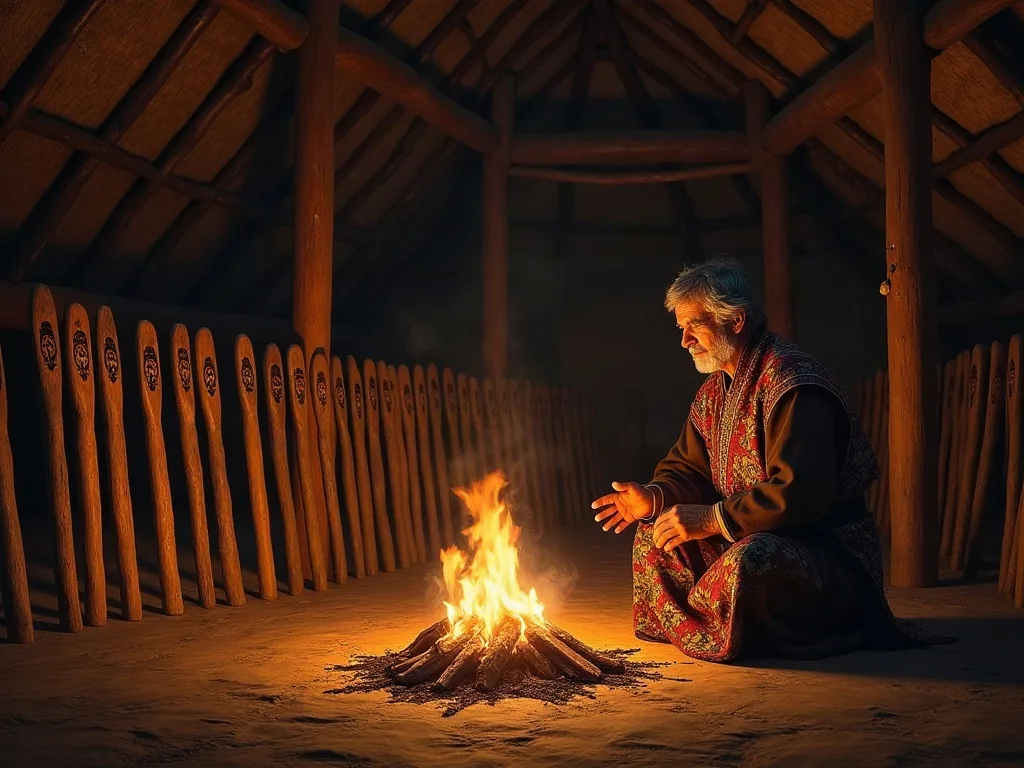
The Myth of the Divine Guest
The core narrative around Kim-un-kamuy is not a single fixed story in the way that, say, the myth of Izanagi and Izanami is a fixed narrative in Japanese tradition. It operates more like a living framework: a set of beliefs that structured every encounter between the Ainu and bears.
The logic runs like this. In Kamuy Mosir, Kim-un-kamuy and the other mountain gods live much as humans do. They wear animal skins as one wears a cloak. When a god wants to bring gifts to humans, fish, meat, fur, he puts on that cloak and walks into the human world. The hunter who spots him, the villager who receives him: they are the hosts of a divine guest. And like any host, they have obligations.
The worst thing an Ainu could do was treat this guest with disrespect: leave the bones broken, fail to perform the correct rites, send the god home without the proper words and offerings. If that happened, Kim-un-kamuy would return to his divine longhouse insulted, and word would spread among the kamuy. Gifts would stop coming. Hunts would fail. The relationship between the two worlds would fray.
But if the rites were done correctly, if the meat was eaten gratefully, the bones preserved and ceremonially returned, the prayers spoken with care, then Kim-un-kamuy arrived back in Kamuy Mosir laden with beautiful gifts: the sake (rice wine) the humans had offered, the prayers that read like letters of recommendation, the carved wooden objects called inau placed at the ceremony's center. He would tell the other gods about the generous humans he had visited. And he would come back.
This is not a myth of conquest over nature. It is a myth of mutual obligation.
The Iyomante: Sending Kim-un-kamuy Home
No discussion of Kim-un-kamuy: The Bear God can avoid the Iyomante (also spelled Iyomande), the bear-sending ceremony. It is one of the most extensively documented rituals in the anthropological record of indigenous Japan, described in detail by early Western observers including the British missionary John Batchelor, who lived among the Ainu from the 1870s onward and published "The Ainu and Their Folk-Lore" in 1901.
The ceremony followed a specific arc:
- A bear cub was captured, ideally very young, often after its mother was killed in a hunt.
- The cub was brought into the village and raised by an Ainu woman, sometimes nursed alongside human infants. This was not domestication in any ordinary sense. The cub was a sacred guest, fed, played with, and treated with the dignity owed to a visiting deity.
- After one to three years, when the bear had grown large enough, the village prepared for the Iyomante. This was a multi-day festival involving prayer, song, ceremonial food, sake, and the elaborate construction of inau, the shaved and curled wooden prayer sticks that served as offerings and messengers between the worlds.
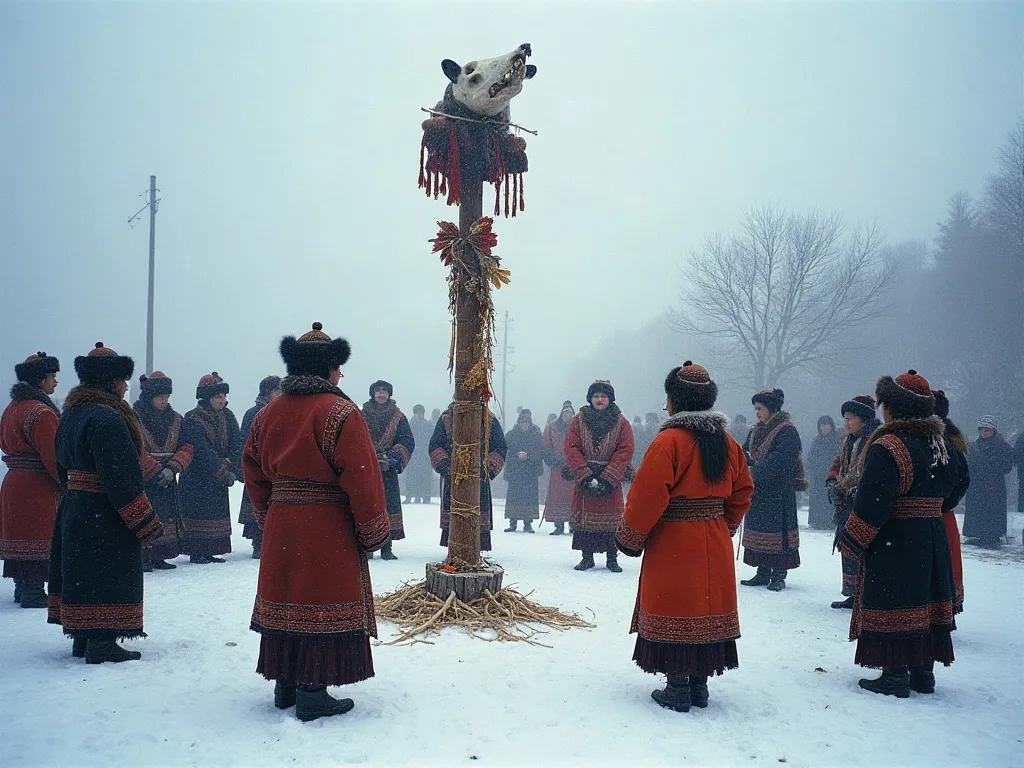
- The bear was led out and killed, as swiftly and respectfully as possible, with prayers spoken continuously. The skull was then placed on a sacred pole and treated as the seat of the god's spirit.
- The community feasted on the bear's meat together, and the skull was sent off with gifts: inau, sake, beads, prayers. These were the luggage Kim-un-kamuy would carry back to Kamuy Mosir.
The emotional register of the Iyomante confused early outside observers, who could not reconcile the obvious affection the Ainu showed the cub with its ritual killing. But the Ainu framework resolves this: you love the guest, you feast the guest, and then you send the guest home properly. The farewell is not a loss. It is a completion.
Kim-un-kamuy and the Ainu Oral Tradition
The primary sources for Ainu religious thought are almost entirely oral. The Ainu did not develop a writing system, and their sacred knowledge lived in yukar (epic oral poems), kamuy yukar (divine oral poems spoken in the first person of a deity or animal), upaskuma (traditional tales), and ceremonial speech.
In the kamuy yukar tradition recorded by scholars including the Ainu poet and scholar Yukie Chiri, who published "Ainu Shinyoshu" in 1923 at just nineteen years old, bears sometimes speak in the first person. A kamuy yukar attributed to a bear might begin with the bear-god describing his longhouse in the mountains, his decision to visit humans, the hunt, and his joy at being properly honored. These poems are not laments. They read, in the translations scholars have provided, as expressions of satisfaction: the god enjoyed his visit, he was treated well, he is going home pleased.
This literary form is unique. Rather than humans narrating the myth of a god, the god narrates his own experience of interacting with humans. It places Kim-un-kamuy not as a remote, unknowable force, but as a being with an interior life, preferences, and something very close to gratitude.
The Ainu oral tradition also includes cautionary accounts of what happens when the rites are neglected. In several recorded stories, a bear spirit returns in dreams or visions to complain of mistreatment, of broken bones, of disrespectful hunters. These accounts function as both theology and practical ethics: treat the bear correctly, or suffer consequences.
The Mountain and the Sacred Geography
Kim-un-kamuy is a mountain deity, and mountains in Ainu thought are serious places. They are not simply terrain. They are the antechambers of Kamuy Mosir, the zones where the divine world presses most closely against the human one. Hunters entering the mountains were entering a liminal space, a border zone, and they carried specific protocols with them.
Before a hunt, prayers were addressed to Kim-un-kamuy and to the fire goddess Ape Fuchi (or Kamuy Fuchi), the most immediate divine presence in any Ainu household, whose flame carried prayers between the worlds. A hunter who spoke respectfully to the fire before leaving asked Ape Fuchi to carry his words to the mountain gods, to let Kim-un-kamuy know that a human was coming, that the visit would be respectful, that the human asked permission to receive a gift.
This geography of the sacred, from the hearthfire in the home to the mountain peaks where gods lived, structured Ainu daily life. The bear was the creature who moved most visibly between those zones. He came down from the mountain. He was encountered at the forest edge, at the riverbank. He was, in a literal and theological sense, a border-crosser.
The Ainu spiritual tradition is rich with other kamuy who operate in similarly liminal ways: the owl god Kotan Kor Kamuy (guardian of the village), the salmon god who brought food from the sea, the fox who carried messages. But none commanded the same ritual weight as Kim-un-kamuy.
Kim-un-kamuy Compared to Other Bear Gods
Bear deity traditions appear across the northern circumpolar world with striking consistency. The Nivkh people of Sakhalin (geographic neighbors of the Ainu) also practiced bear ceremonies with structural similarities to the Iyomante. The Khanty and Mansi peoples of western Siberia held elaborate bear festivals lasting several days, with theatrical performances and sacred songs addressed to the bear's skull.
Further west, among the ancient Germanic and Scandinavian peoples, the bear held elite status: Odin was connected to bears through the berserkers, warriors who wore bear skins and fought in states of divine fury. The Norse word bjorn (bear) became a personal name precisely because of the bear's charged spiritual status.
These parallels suggest something very old: a circumpolar tradition of treating the bear as a divine being requiring careful ritual management, stretching across Siberia, Japan, Scandinavia, and into the Americas. Scholars including Tim Ingold (in "Hunters, Pastoralists and Ranchers", 1980) and more recently Rane Willerslev have discussed the bear-as-person concept across hunting cultures as a near-universal structure of animist thought.
What makes Kim-un-kamuy distinctive within this broader pattern is the sophistication of the theological framework the Ainu built around him: the explicit language of diplomatic exchange, the bear as a god in costume, the reciprocity logic of gift and counter-gift. The Ainu were not simply propitiating a dangerous animal. They were conducting inter-world diplomacy.
The Decline and Revival of the Iyomante
By the twentieth century, the Iyomante faced serious pressure. Japanese imperial policy from the Meiji era (1868-1912) onward worked to assimilate the Ainu, suppress indigenous practices, and redirect Ainu children into Japanese schools. The 1899 Hokkaido Former Aborigines Protection Act, widely criticized by scholars and Ainu advocates, banned many traditional practices and pushed the Iyomante toward extinction.
By the mid-twentieth century, the ceremony had largely disappeared from public practice. A small number of elders maintained knowledge of the rites, but the living community capable of performing a full Iyomante had shrunk dramatically.
In 1994, the Ainu activist Shigeru Kayano became the first Ainu member of the Japanese parliament, and his election marked a turning point in official recognition of Ainu culture. Japan's government finally recognized the Ainu as an indigenous people in 2019, a decision that came with funding for cultural preservation and a new national museum, the Upopoy National Ainu Museum, which opened in Shiraoi, Hokkaido, in 2020.
The Iyomante's status today is complicated. Some Ainu groups have revived ceremonial bear-sending rituals using a bear skull rather than a live bear, satisfying both the spiritual intent and the requirements of modern animal welfare law. Others argue that the full ceremony, with a living bear raised in the community, is the only authentic form. The debate is internal to the Ainu community, and outsiders are rightly not the arbiters of it.
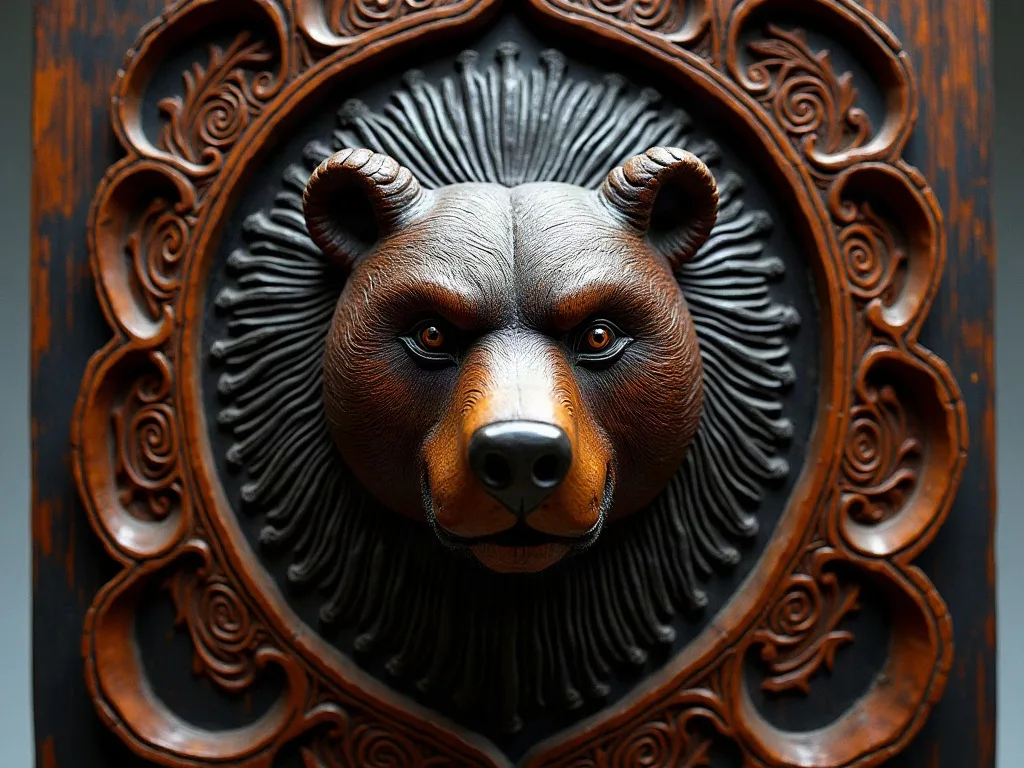
What is not in doubt: the figure of Kim-un-kamuy remains central to Ainu cultural identity. His image appears in contemporary Ainu art, woodcarving, textile design, and the ceremonies communities are working to restore.
The Theology of the Bear: What Kim-un-kamuy Teaches
Strip away the anthropological framing, and Kim-un-kamuy: The Bear God carries a very precise idea about how the world works: nothing is free, everything is relationship, and the natural world is not a resource but a community of persons who expect to be treated accordingly.
Modern environmental philosophy sometimes rediscovers this idea as if it were new. Robin Wall Kimmerer's "Braiding Sweetgrass" (2013) traces a similar ethic through Potawatomi tradition. The Ainu had built it into their most sacred ritual centuries before. The bear god who visits, gifts his body, and expects honor in return is a theological statement about the terms of coexistence on a shared planet.
This is not romanticism. The Ainu were skilled hunters who killed bears and ate them. The theology did not prevent the killing. It structured it, gave it meaning, and imposed obligations of respect and reciprocity that functioned, in practice, as a form of ecological ethics. Take what you need, honor what you take, and ensure the relationship continues.
That logic is Kim-un-kamuy's deepest teaching, and it translates across any tradition, any landscape, any century.
Frequently asked questions about Kim-un-kamuy, the Ainu Bear God
Frequently asked questions
What does the name Kim-un-kamuy mean?
The name breaks into three Ainu-language elements: kim (mountain), un (dwelling or residing), and kamuy (god or divine spirit). Together it means roughly "the god who dwells in the mountains." The name directly identifies the bear deity with the high, forested terrain of Hokkaido that was his primary domain in Ainu spiritual geography.
Is Kim-un-kamuy the most important god in Ainu religion?
Scholars generally regard Kim-un-kamuy as the most ritually significant of all the Ainu kamuy, the divine spirits who populate their cosmos. The fire goddess Ape Fuchi (Kamuy Fuchi) is considered the most immediately present deity in daily household life, since her flame carries prayers between worlds. But no kamuy received the elaborate, multi-day ceremonial attention that Kim-un-kamuy received through the Iyomante bear-sending ritual.
What was the Iyomante, and why did the Ainu practice it?
The Iyomante was a bear-sending ceremony in which a bear cub, raised in the village for one to three years, was ritually killed, honored with prayers, inau (carved wooden offerings), sake, and feasting, and then ceremonially sent back to Kamuy Mosir, the Land of the Gods. The Ainu practiced it because they understood the bear as a divine guest who had temporarily taken animal form to bring gifts to humans. The ceremony was the proper way to say thank you and send the god home with gifts he would carry back to the divine realm.
Are there written Ainu texts about Kim-un-kamuy?
The Ainu had no traditional writing system, so the primary sources are oral: yukar (epic poems), kamuy yukar (divine first-person poems), and upaskuma (traditional tales). These were recorded by scholars beginning in the early twentieth century. Particularly important are the records made by Bronislaw Pilsudski around 1902-1905, John Batchelor's ethnographic work published in 1901, Neil Gordon Munro's posthumous "Ainu Creed and Cult" (1962), and the Ainu scholar Yukie Chiri's "Ainu Shinyoshu" (1923). Modern Ainu cultural institutions in Hokkaido continue the work of preserving and translating these oral traditions.
How does Kim-un-kamuy compare to bear deities in other cultures?
Bear deity traditions appear across the entire circumpolar world, from Siberian peoples like the Khanty and Mansi to the Nivkh of Sakhalin and Norse-Germanic cultures where the bear carried elite warrior symbolism. The structural parallels include: the bear treated as a person requiring ritual respect, bear-skull ceremonies, multi-day celebrations at the kill, and the idea that the bear's spirit continues after death. What sets Kim-un-kamuy apart is the theological precision of the Ainu system: the explicit framing of the bear as a god in costume, the inter-world diplomatic logic, and the highly formalized reciprocity of gift and prayer.
Is the Iyomante still practiced today?
In its traditional full form, involving a live bear raised in the village, the Iyomante has largely ceased, partly due to Japanese assimilation policies from the Meiji era onward and partly due to modern animal welfare considerations. Some Ainu communities have revived modified forms of the ceremony, using a bear skull rather than a live animal, as a way of maintaining the spiritual and cultural intention of the rite. Since Japan officially recognized the Ainu as indigenous in 2019, and with the opening of the Upopoy National Ainu Museum in 2020, there has been renewed community-led effort to restore and transmit Ainu ceremonial practices.
Kim-un-kamuy in Contemporary Ainu Art and Identity
The bear god did not stay in the past. Walk through any exhibition of contemporary Ainu art and Kim-un-kamuy appears in woodcarving, textile pattern, ceramic design, and print. The bear's image is one of the most persistent marks of Ainu visual identity, carried through centuries of suppression into a twenty-first-century cultural resurgence.
Ainu artists working today, including those affiliated with the Upopoy National Ainu Museum in Shiraoi and community groups across Hokkaido, use the bear not as nostalgia but as a living claim: this is who we are, this relationship is real, this theology still speaks.
The scholar Mark Hudson, writing on Ainu identity and material culture, has noted that the persistence of bear imagery in Ainu art reflects an ongoing negotiation between tradition and modernity that is characteristic of many indigenous communities. The bear is simultaneously an ancestor, a god, a cultural marker, and a political statement.
That an ancient figure, a mountain god in a fur coat, can carry so much freight in 2026 says something about the staying power of good theology. Kim-un-kamuy offered the Ainu a way to live inside the natural world without standing apart from it. In a century when the relationship between humans and their ecosystems is under severe strain, the bear god's core idea, that coexistence requires reciprocity, mutual respect, and genuine gratitude, is one that travels well beyond the mountains of Hokkaido.
Free 25-page sample
Want the whole story?
Take the first 25 pages free. If it pulls you in, the full edition is yours as an instant PDF download, with a paperback on Amazon for selected titles.
Ainu
The Ainu Mythology Book: The Kamuy, the Bear Spirit, and the Sacred World of Hokkaido
The Kamuy, the Bear Spirit, and Hokkaido
The beliefs of the indigenous people of northern Japan: a world where everything (fire, water, owl, and bear) is a kamuy, a god wearing a disguise, who visits the human world as a guest and must be sent home with honor. Preserved in the great epic songs, the yukar.
More from Ainu
All articles
Ainu
The Ainu Creation Story: How the World Rose from the Primordial Sea
Before Japan existed, before humans walked the earth, the Ainu tell of a time when only water and sky collided. Discover how divine beings created the islands, brought forth life, and shaped a world where nature itself is sacred.

Ainu
Repun Kamuy: The Orca God of the Sea
The Ainu revered Repun Kamuy, the orca deity who commands the sea and guides fishers through treacherous waters. Discover how this killer whale god shaped maritime survival, ritual, and the spiritual relationship between the Ainu and the ocean.

Ainu
Inaw: Sacred Wooden Offerings in Ainu Ritual and Spirit Communication
Inaw are carved wooden sticks that carry prayers between the human and spirit worlds in Ainu religion. Learn how these humble offerings bridge the sacred and everyday, and why they remain central to Ainu cultural identity today.

Ainu
Kotan Kor Kamuy: The Village Guardian Owl
Meet Kotan Kor Kamuy, the watchful owl spirit who guards Ainu villages from harm. In Ainu belief, this kamuy oversees human settlements and stands as protector of community bonds. Discover how a vigilant nocturnal hunter became one of the Ainu peoples' most trusted spiritual guardians.