

Okikurumi: The Culture Hero Who Taught the Ainu to Live
Okikurumi descended from the heavens to teach the Ainu people fire, hunting, and ritual. Learn the myths, symbols, and legacy of this divine culture hero from Hokkaido.
Contents
The river was wrong. The salmon were dying upstream, the arrows were missing, and the people on the banks of the Ishikari had no word yet for the ceremony that would put things right. Then a figure descended from Kamuy Mosir, the divine realm above the clouds. He wore a robe stitched from crane feathers and carried knowledge the way a hunter carries a quiver: ready, purposeful, aimed at a target. His name was Okikurumi, and the Ainu were about to learn how to live.
This is not a story about a god who demands worship. Okikurumi: The Culture Hero occupies a different register in Ainu sacred memory. He did not create the world; the Ainu cosmology already had makers for that. What Okikurumi created was the human world inside the world: the tools, the prayers, the correct way to greet a bear, the correct way to cook millet, the correct way to send a salmon's bones back to the water so that its spirit could return. Without those protocols, existence was raw and dangerous. With them, it became livable.
The oral traditions that preserve his story were recorded in a genre called yukar (long heroic songs performed from memory, sometimes across multiple nights) and kamuy yukar (divine songs sung from the perspective of a spirit). Scholars like Bronisław Piłsudski, who lived among the Ainu at the turn of the twentieth century, and later Neil Gordon Munro, documented these accounts before colonial pressures forced Ainu culture underground. What survived is layered and sometimes contradictory, the way living oral traditions always are. That is not a flaw. It is proof that the story was genuinely used.
Where Okikurumi Comes From: Heaven, Not Earth
The Ainu universe is layered. At the top sits Kamuy Mosir, the land of the gods (kamuy means spirit or divine being; mosir means land or island). Below it stretches Ainu Mosir, the human world, which the Ainu identified with the islands of Hokkaido, Sakhalin, and the Kurils. Below human territory lies Pokna Mosir, the underworld.
Okikurumi was born in Kamuy Mosir as the son of the creator god Pasekamuy (also called the god of the sky-above-the-sky in some accounts). His father sent him downward, not as punishment but as a mission. The human world was struggling. People existed, but they did not yet know the correct forms for living within a world populated by kamuy in every river, tree, mountain, and animal. Getting those forms wrong was not merely impolite; it was catastrophic. An improperly thanked bear could send its spirit back to Kamuy Mosir with a bad report. The fish might stop running. The hunting grounds might close.
So Okikurumi descended. Some accounts place his arrival near the Saru River in what is now the Hidaka region of Hokkaido, a location that remained sacred to Ainu communities for generations. He arrived not as a conquering supernatural force but as a teacher who needed to be watched, imitated, and remembered.

The Gifts He Brought: Fire, Arrows, and the Right Words
Every culture hero carries gifts, and the gifts reveal what a people values. Prometheus brought fire to the Greeks and paid for it on a rock. Quetzalcoatl gave maize and calendar knowledge to Mesoamerican peoples. Okikurumi's portfolio was equally precise and far more domestic in the best sense of that word.
Fire came first, or close to first. The Ainu hearth (ape) was not simply a heat source. It was the home of Ape Kamuy, the goddess of fire, who served as an intermediary between the human household and the divine world. Every ceremony, every prayer, every meal depended on fire being present and being addressed correctly. Okikurumi demonstrated the rites that turned a practical flame into a sacred channel.
He also transmitted the techniques of hunting and fishing that the Ainu would refine over centuries. But the technical knowledge was always inseparable from the ritual knowledge. The Ainu iyomante, or bear ceremony, is the most widely known example. When a bear was killed, its spirit (ramat) needed to be formally escorted back to Kamuy Mosir with food, wine (sake made from millet or purchased from Japanese traders in later centuries), carved wooden inau offerings, and correct spoken prayer. Without that ceremony, the bear's spirit would be lost and angry; the hunt would fail. Okikurumi taught the procedure, step by step.
He taught the carving of inau (ritual wood shavings bent into curling offerings, placed at altars and given to spirits as gifts). He taught the proper way to address the kamuy of the sea, the mountains, and the sky before entering their domains. He taught millet cultivation in versions of the tradition that reflect later agricultural contact, showing how the tradition adapted without losing its core.
Perhaps most crucially, he taught language: not the Ainu language itself, which people already spoke, but the sacred register of Ainu speech used in prayer and ceremony. The yukar traditions that preserved his own story were, in a sense, one of his own gifts turned back on him.
Okikurumi's Companion and the Female Strand of the Tradition
No culture hero acts alone. In many Ainu accounts, Okikurumi was accompanied by his sister or wife figure Turesh, sometimes called Okikurumi Turesh Mat (the woman who accompanies Okikurumi). She appears less frequently in the scholarly record, partly because early outside researchers, mostly male, focused on the heroic male narrative. But within Ainu oral tradition, Turesh held knowledge specific to women's domains: weaving, childbirth prayers, the management of the household fire altar, and the correct address to plant spirits during the gathering of medicinal herbs.
Some scholars, including Emiko Ohnuki-Tierney in her work on Ainu cosmology, have noted that the pairing of Okikurumi and Turesh reflects a broader Ainu principle: the cosmos runs on complementary pairs. Male and female, mountain and sea, human and kamuy, interior and exterior. The culture hero himself embodied that balance in his dual nature as a divine being (kamuy) who lived among humans as if he were one.
Okikurumi is, in this sense, a hinge figure. He is human enough to teach by example, divine enough to have access to the knowledge worth teaching.
The Yukar That Tell His Story: Oral Architecture
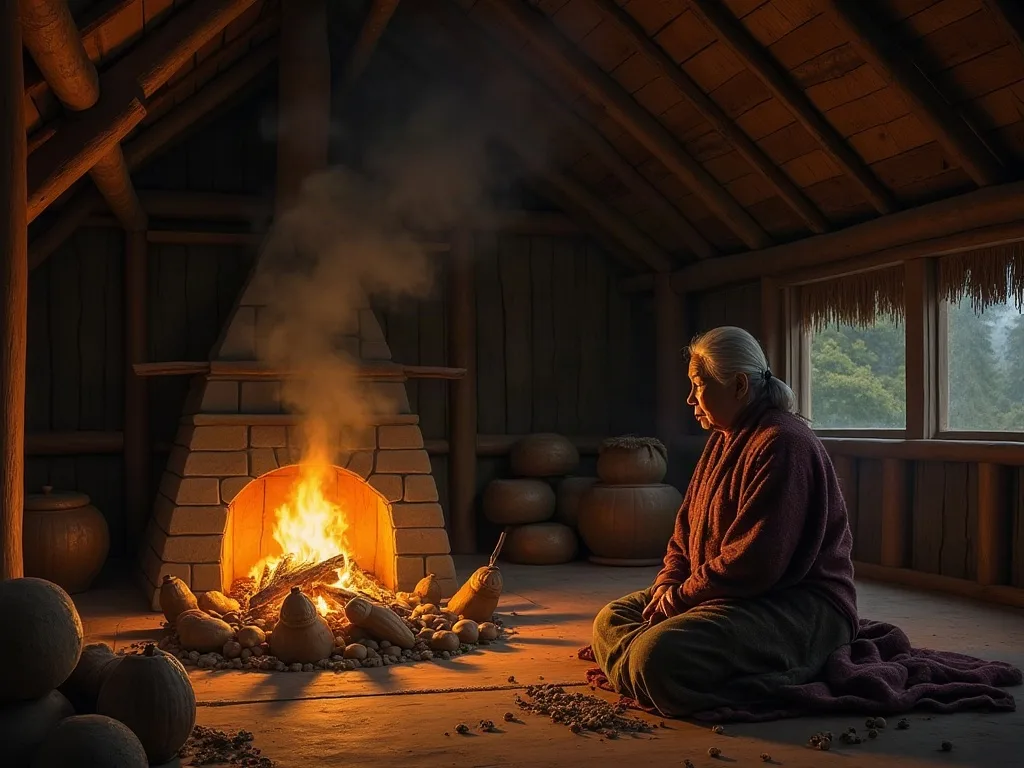
The primary sources for Okikurumi's mythology are not written texts. They are yukar, sung or chanted poems performed by skilled Ainu practitioners called yukar ekasi (elder performers). A single yukar could last an entire night. The performer sat by the fire, beat a rhythm on a round drum or against their own knee, and sang through the voice of the hero himself. Ainu heroic songs use the first person: Okikurumi does not appear as "he" but as "I", pulling the audience into his perspective.
Bronisław Piłsudski's 1912 collection "Materials for the Study of the Ainu Language and Folklore" preserved some of the earliest transcriptions from Sakhalin Ainu communities. Piłsudski, a Polish exile to Siberia, spent years in these communities and learned the language well enough to record texts directly from performers. His materials, later analyzed by Kirsten Refsing and others, remain one of the most important primary archives.
The yukar about Okikurumi tend to follow a pattern. He arrives in the human world, observes that something is wrong (the people lack a skill, a ceremony, a tool), performs the correct action while others watch, explains what he has done and why, and then either moves on to another location or ascends back to Kamuy Mosir. The structure is pedagogical. It is designed to be remembered and repeated, because repetition is how an oral culture stores knowledge.
This means that within the yukar tradition, retelling Okikurumi's story is itself an act of cultural transmission. Every performance was a renewal of the original teaching.
The Bear Ceremony and Okikurumi's Deepest Teaching
The iyomante (bear-sending ceremony) is the ritual most associated with Okikurumi's teaching and the one that has attracted the most outside attention, sometimes respectful, sometimes reductive.
Here is how it worked, as described across multiple recorded accounts. A bear cub was captured, often in spring, and raised inside the village as a guest and a divine messenger. For one to three years, the community fed, played with, and cared for this bear. Then, at the ceremony, the bear was killed in a prescribed way, its spirit released. Elaborate offerings of food, inau carvings, and prayers accompanied the death. The bear's spirit was addressed as an honored guest being sent home to Kamuy Mosir carrying gifts and good news about how well it had been treated.
The theological logic behind this is important to understand clearly. In Ainu belief, animals are kamuy who put on animal "clothing" to visit the human world and offer their bodies as food. The ceremony does not kill a bear; it sends a divine visitor home. The correct ceremony ensures the visitor will want to return, bringing other kamuy with it in the form of abundant game, fish, and plant life.
Okikurumi taught this ceremony because he understood both sides of the transaction. As a being who moved between Kamuy Mosir and Ainu Mosir, he knew what the kamuy needed from the encounter and what the humans needed in return. The iyomante is essentially a diplomatic protocol for interspecies relations, and Okikurumi was the diplomat who drafted it.
Outside observers, particularly nineteenth-century missionaries and colonial administrators, misread the ceremony as evidence of primitive superstition. Contemporary anthropologists have worked to correct that framing. The iyomante reflects a sophisticated ecological ethics: you take from the natural world only what you return to it, and you return it with gratitude expressed in formal terms that both parties understand.
Okikurumi Across Regions: Names, Variants, and Local Traditions
The Ainu were not a single homogeneous population. Communities on Hokkaido, Sakhalin, and the Kuril Islands had distinct dialects, material cultures, and, predictably, distinct versions of their oral traditions. Okikurumi appears under different names across these regional traditions.
In Sakhalin Ainu communities, he is sometimes called Aeoina Kamuy (literally "the god who came among the Ainu"). In some Hokkaido traditions, he appears as Okikirmui or Okikurupe. Scholars debate whether these represent the same figure under regional pronunciation shifts or whether originally distinct local heroes were merged into a single canonical figure through cultural contact between Ainu communities.
What stays constant across the variants is the function. A divine figure of superior knowledge descends from or travels through the spirit world to transmit practical and ritual knowledge to humans. Whether his robe is made of crane feathers or owl feathers, whether his first gift is fire or arrows, the transaction is the same: he knows, humans do not yet know, and his purpose is to close that gap.
Izanami and Izanagi, the Japanese creator pair whose mythology developed in parallel with Ainu traditions on the same archipelago, offer an instructive contrast. Where Japanese creation myth focuses on the origin of the islands and the gods themselves, Ainu tradition centers on the transmission of right practice within an already-existing world. The cosmological emphasis differs fundamentally.

Okikurumi and Ainu Identity in the Modern Period
The Meiji government of Japan annexed Hokkaido in 1869 and began a systematic assimilation policy that banned Ainu language, restricted traditional ceremonies including the iyomante, and reclassified Ainu land as state property. For much of the twentieth century, being Ainu was something many families hid. The yukar tradition nearly broke.
Nearly, but not entirely. Practitioners like Yukie Chiri (1903-1922), who died at nineteen after transcribing Ainu oral texts into Japanese, preserved critical material. Her posthumously published "Ainu Shinyoshu" (collection of Ainu divine songs, 1923) brought kamuy yukar to Japanese readers for the first time and included material related to the Okikurumi cycle. She remains a foundational figure in Ainu literary history.
Japan officially recognized the Ainu as an indigenous people in 2019. The Upopoy National Ainu Museum, which opened in Shiraoi, Hokkaido in 2020, now presents Ainu oral traditions, including the Okikurumi mythology, to tens of thousands of visitors annually. Living Ainu practitioners have worked with museum staff to ensure the presentations remain grounded in community knowledge rather than outside ethnographic interpretation.
The figure of Okikurumi has not remained static in modern Ainu cultural production. Contemporary Ainu artists, writers, and activists invoke him as a symbol of cultural resilience and of a knowledge system sophisticated enough to sustain a people for thousands of years across some of the most demanding landscapes on earth. That is not nostalgia. It is argument: if Okikurumi's teaching was good enough to govern relations between humans, bears, salmon, and the cosmos for millennia, it carries wisdom worth listening to now.
Parallels and Echoes: Okikurumi Among World Culture Heroes
Comparative mythology has a tendency to flatten differences in the search for universal patterns. That tendency is worth resisting here. But the parallels between Okikurumi and other culture heroes from across the world do illuminate what the Ainu tradition shares with broader human mythological thinking, and what it does differently.
Prometheus brought fire against divine will and suffered for it. Okikurumi brought fire as part of a divinely sanctioned mission and was honored for it. The contrast says something important about how each culture understood the relationship between divine authority and human capability. For the Greeks, human knowledge came at a cost paid in divine suffering. For the Ainu, human knowledge was a gift that came with responsibility, specifically the responsibility to use it correctly and to maintain the relationships that made the gift possible.
Coyote, the trickster-transformer common across many North American Indigenous traditions, transforms the world through cunning, accident, and desire. Okikurumi transforms the world through deliberate pedagogy. The trickster and the culture hero are not the same archetype, though they sometimes overlap. Okikurumi belongs firmly in the culture hero camp: his actions are purposeful, his knowledge is reliable, and his legacy is the ceremonial framework that holds Ainu society together.
The closest structural parallel may be Maui in Polynesian tradition, another figure who fishes entire islands out of the sea, captures the sun, and brings tools and techniques to humans. Both Okikurumi and Maui operate at the boundary between divine and human worlds, using access to cosmological knowledge for practical human benefit. Both are loved rather than feared.
Frequently Asked Questions About Okikurumi
Frequently asked questions
Is Okikurumi a god or a hero?
He is both, depending on how you define the terms. In Ainu cosmology, Okikurumi is a kamuy, a divine spirit, who descended to live among humans. But he functions as a culture hero: a figure whose primary role is to transmit practical and ritual knowledge to humanity. He is not worshipped in the way that Greek gods received temple offerings, but he is addressed in prayer and remembered in ceremony as the source of Ainu civilizational knowledge.
What is the primary source for Okikurumi's mythology?
The main sources are Ainu yukar and kamuy yukar, oral epic poems performed from memory across multiple generations. The earliest systematic outside documentation comes from Bronisław Piłsudski's fieldwork in the early twentieth century, particularly his 1912 collection of Sakhalin Ainu texts. Yukie Chiri's "Ainu Shinyoshu" (1923) added a crucial Hokkaido-centered perspective. Later scholars including Neil Gordon Munro, Hitoshi Watanabe, and Kirsten Refsing built on these foundations.
What did Okikurumi actually teach the Ainu?
According to the yukar traditions, Okikurumi transmitted fire rituals, hunting and fishing techniques, the correct protocols for the iyomante (bear ceremony), the carving of inau (ritual wood-shaving offerings), agricultural practices including millet cultivation, and the sacred registers of speech used in prayer. Each transmission was inseparable from its ceremonial context: the technical and the ritual were never separated in Ainu knowledge.
Why are there multiple names for the same figure?
The Ainu were not a single unified group with a central religious authority. Communities across Hokkaido, Sakhalin, and the Kuril Islands maintained distinct oral traditions in different dialects. Names like Okikurumi, Aeoina Kamuy, and Okikirmui reflect regional pronunciation and emphasis rather than entirely different figures. Scholars debate whether these represent a single original figure diversified by geography or originally separate local heroes who merged over time as communities interacted.
Is the Ainu bear ceremony still practiced today?
The iyomante was suppressed under Japanese assimilation policies for much of the twentieth century. Since the 1980s, Ainu cultural revival movements have worked to restore ceremonial practices, including scaled versions of the bear ceremony. The 2019 recognition of Ainu indigenous status and the opening of the Upopoy National Ainu Museum in 2020 have supported this revival, though the form and extent of current practice varies among communities and remains a matter of community-internal discussion rather than outside prescription.
How does Okikurumi compare to Japanese mythological figures?
Japanese mythology, as recorded in the Kojiki (712 AD) and the Nihon Shoki (720 AD), centers on the origin of the Japanese islands and the imperial lineage of the gods. Ainu mythology developed independently on the same archipelago and has a different focus: right relationship between humans and the spirit world, and the transmission of practical-ceremonial knowledge. Okikurumi has no direct equivalent in Japanese tradition. The closest functional parallel in the Japanese canon would be culture-transmitting deities like Okuninushi, who organized the human world, but even that comparison has clear limits.
Okikurumi's Legacy in an Age of Ecological Reckoning
There is a reason Okikurumi's teachings are drawing renewed attention outside Ainu communities. The core logic of his cultural curriculum, that humans exist within a web of relationships with non-human beings who have their own interests and their own standing, maps directly onto contemporary debates about ecology, animal ethics, and what philosophers now call "more-than-human" ethics.
The iyomante ceremony operated on a principle that modern ecology is only beginning to formalize: reciprocity within ecosystems is not optional. The Ainu did not treat salmon, bears, or deer as resources to be extracted. They treated them as kamuy in temporary animal form, and the relationship required ongoing negotiation, gratitude, and return. The bear was raised with care. Its spirit was sent home with gifts. The expectation was that the relationship would continue because both parties had honored it.
Scholars working at the intersection of Indigenous knowledge systems and environmental science, including researchers affiliated with the International Society of Ethnobiology, have pointed to Ainu ecological practice as a case study in sustainable resource management grounded in relational cosmology rather than extraction logic. Okikurumi is the mythological source of that practice: the figure who established the terms of the contract between human and non-human worlds.
That contract is still being renegotiated. Ainu activists and scholars are working to ensure that the knowledge Okikurumi transmitted is not reduced to museum display or academic footnote. It is, they argue, a living system of thought. The crane-feathered figure who came down from Kamuy Mosir to teach a people how to live did not leave a finished monument. He left a method: pay attention to the world around you, address it correctly, give back what you take, and the relationship holds.
That method is not an artifact. It is an instruction still in use.
Free 25-page sample
Want the whole story?
Take the first 25 pages free. If it pulls you in, the full edition is yours as an instant PDF download, with a paperback on Amazon for selected titles.
Ainu
The Ainu Mythology Book: The Kamuy, the Bear Spirit, and the Sacred World of Hokkaido
The Kamuy, the Bear Spirit, and Hokkaido
The beliefs of the indigenous people of northern Japan: a world where everything (fire, water, owl, and bear) is a kamuy, a god wearing a disguise, who visits the human world as a guest and must be sent home with honor. Preserved in the great epic songs, the yukar.
More from Ainu
All articles
Ainu
The Ainu Creation Story: How the World Rose from the Primordial Sea
Before Japan existed, before humans walked the earth, the Ainu tell of a time when only water and sky collided. Discover how divine beings created the islands, brought forth life, and shaped a world where nature itself is sacred.

Ainu
Repun Kamuy: The Orca God of the Sea
The Ainu revered Repun Kamuy, the orca deity who commands the sea and guides fishers through treacherous waters. Discover how this killer whale god shaped maritime survival, ritual, and the spiritual relationship between the Ainu and the ocean.

Ainu
Inaw: Sacred Wooden Offerings in Ainu Ritual and Spirit Communication
Inaw are carved wooden sticks that carry prayers between the human and spirit worlds in Ainu religion. Learn how these humble offerings bridge the sacred and everyday, and why they remain central to Ainu cultural identity today.

Ainu
Kotan Kor Kamuy: The Village Guardian Owl
Meet Kotan Kor Kamuy, the watchful owl spirit who guards Ainu villages from harm. In Ainu belief, this kamuy oversees human settlements and stands as protector of community bonds. Discover how a vigilant nocturnal hunter became one of the Ainu peoples' most trusted spiritual guardians.