
Brahma, Vishnu, and Shiva: The Hindu Trimurti
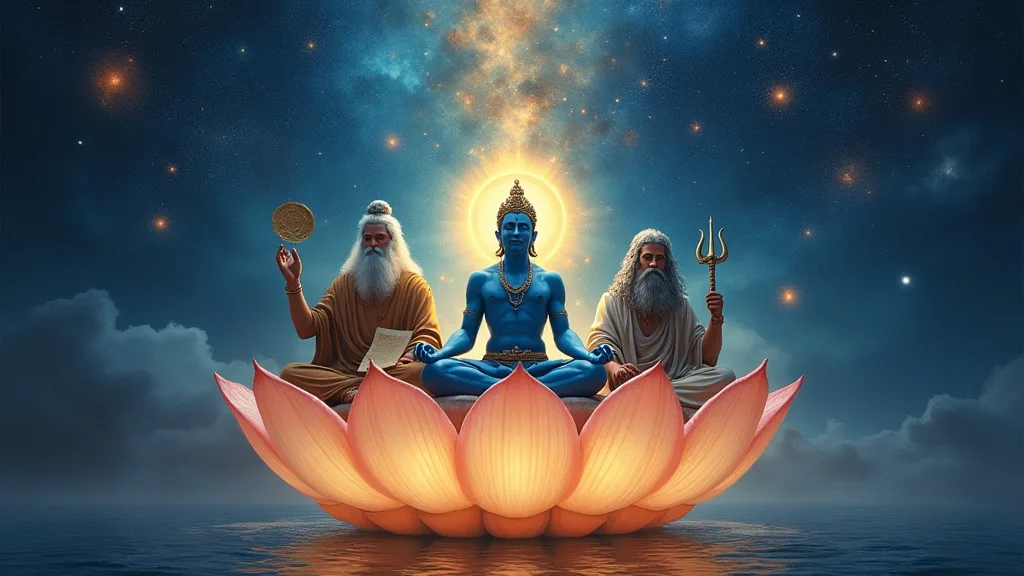
The Trimurti binds three supreme forces into one cosmic principle: Brahma creates, Vishnu sustains, Shiva destroys. Together they map the full arc of existence in Hindu thought.
Contents
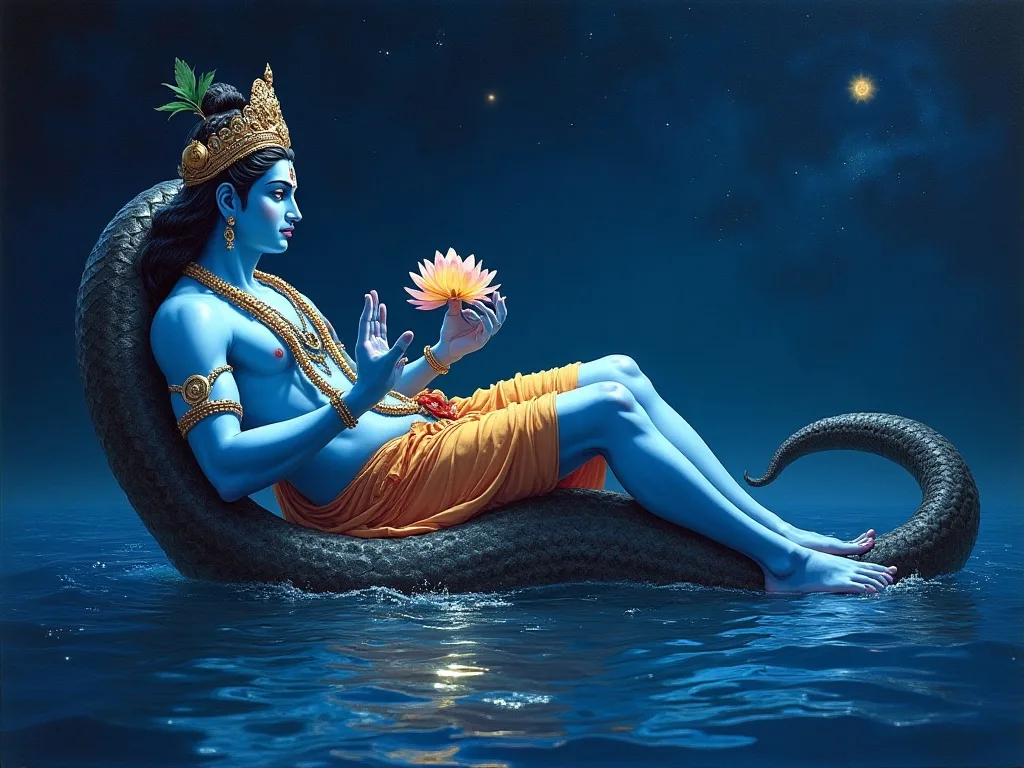
At the beginning of a cosmic cycle, before a single star had formed, there was only Vishnu resting on the coils of the serpent Shesha, adrift on the primordial ocean. From his navel a lotus grew, and from that lotus Brahma emerged, blinking into the void, already burning with the compulsion to make something. That image alone contains an entire philosophy. Creation is not an act of will imposed from outside the universe; it blossoms from within the sustainer himself.
Brahma, Vishnu, and Shiva: the Hindu Trimurti is one of the most intellectually ambitious concepts in any religious tradition. Rather than ranking three deities in a simple hierarchy, the Trimurti frames them as three aspects of a single cosmic process: emanation, maintenance, and dissolution. The Sanskrit word trimurti means "three forms" - tri (three) plus murti (form or embodiment). It acknowledges that reality has at least three irreducible modes, each requiring its own divine face.
The concept does not appear fully formed in the earliest Vedic literature. It crystallised gradually, reaching mature expression in texts like the Matsya Purana, the Kurma Purana, and the celebrated philosophical poem Kumara Sambhava by Kalidasa (approximately 4th-5th century CE). Each age of Hindu theology weighted the three figures differently, which is why their relationships, rivalries, and reconciliations fill hundreds of narrative chapters across the Puranas.
Brahma: the Architect Whose Temples Stand Empty
Brahma is the least worshipped of the three, and that paradox is itself a teaching. Across all of India, only a handful of temples are dedicated primarily to him; the most famous stands at Pushkar in Rajasthan, a city whose very existence is traced to Brahma's intervention. The Padma Purana explains the scarcity with a story: Brahma lied to Vishnu during a cosmic argument over which of them was supreme, claiming he had seen the top of Shiva's infinite pillar of light (jyotirlinga) when he had not. Shiva cursed him: Brahma would never receive the worship owed to a creator. The myth is brutal and precise. It encodes a theological point - creation, however magnificent, is not the ultimate category. It is the starting condition, not the destination.
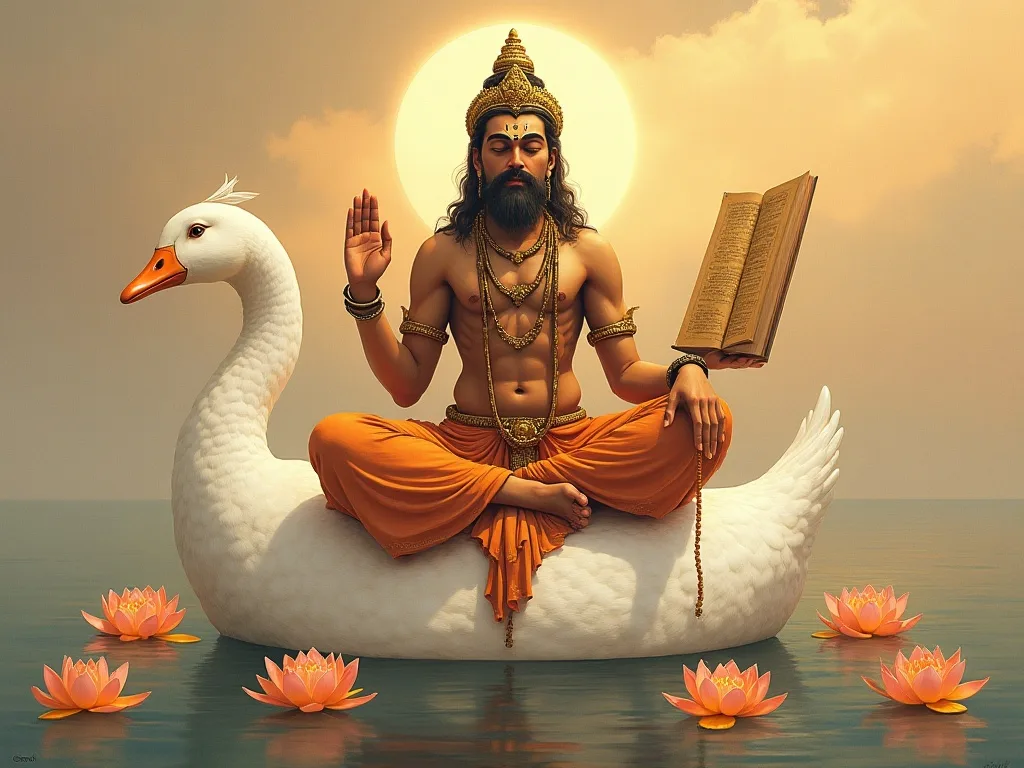
Brahma's iconography packs that complexity into a single image. He has four heads, each facing a cardinal direction, each reciting one of the four Vedas: the Rigveda, the Samaveda, the Yajurveda, and the Atharvaveda. He carries a water pot (kamandalu), a string of beads (akshamala), a book, and a lotus. His mount (vahana) is Hamsa, the sacred goose, a bird that in Hindu symbolism can separate milk from water - a metaphor for the discrimination (viveka) required to perceive pure consciousness within the mixed stuff of the material world.
The Shatapatha Brahmana, one of the oldest prose texts attached to the Vedas, already knows a self-originating creator called Prajapati who wills the cosmos into being through internal heat (tapas). Brahma absorbs and later replaces Prajapati in much post-Vedic literature, inheriting both the creative function and the ambivalence: the creator is also responsible for maya (cosmic illusion), for multiplicity, for the veil that makes the one appear many. He is revered but also feared, admired but also blamed.
His consort is Saraswati, goddess of language, music, and learning, which makes symbolic sense: creation without articulation remains potential, not actual. The first act of creation is arguably the act of naming.
Vishnu: the Preserver Across Ten Avatars
If Brahma generates the conditions for existence, Vishnu is the principle that keeps those conditions stable long enough for life to matter. His Sanskrit name derives from the root vish, meaning "to pervade," and that etymology is a doctrinal statement: Vishnu does not rule from above, he saturates reality from within. He is the logic that holds cause and effect together, the thread that prevents the cosmic fabric from unravelling between one act of creation and the next.
Vishnu's iconography is immediately distinctive. He is blue-skinned, suggesting both the infinite sky and the deep ocean, and he carries four attributes: the Sudarshana Chakra (a spinning discus, emblem of the mind cutting through illusion), the Shankha (a conch shell whose sound is the primordial Om), the Kaumodaki (a mace, representing the power of knowledge), and the Padma (a lotus, signifying purity arising from the mud of the world). His mount is Garuda, the great eagle-deity, swift enough to carry divine intervention anywhere in the cosmos.
What distinguishes Vishnu theologically is his doctrine of avatars - embodied descents into the world when dharma (cosmic and moral order) tilts toward collapse. The Bhagavata Purana lists ten primary avatars, the Dashavatara, though some texts enumerate twenty-two, others over a hundred:
- Matsya (the fish), who rescued the first man Manu and the Vedas from a cosmic flood
- Kurma (the tortoise), who supported Mount Mandara during the churning of the cosmic ocean (Samudra Manthan)
- Varaha (the boar), who dove to the bottom of the primordial sea to rescue the Earth-goddess Bhudevi from the demon Hiranyaksha
- Narasimha (the man-lion), who destroyed the demon Hiranyakashipu through a loophole in a divine boon
- Vamana (the dwarf), who recovered the three worlds from the demon king Bali in three cosmic strides
- Parashurama (Rama with the axe), the warrior-brahmin who rid the world of corrupt kshatriyas
- Rama, the righteous king of the Ramayana
- Krishna, the charioteer-philosopher of the Bhagavad Gita
- Buddha, incorporated into later Vaishnava lists as a corrective avatar who came to reform cruel sacrificial practices
- Kalki, the future avatar, yet to arrive, who will come on a white horse at the end of the current age (Kali Yuga) to restore dharma
The evolutionary progression implicit in the list - from fish to amphibian to mammal to human - struck 19th-century scholars like H. H. Wilson and later comparative mythologists as uncanny. Whether the Dashavatara anticipates evolutionary biology or simply reflects India's older understanding of cosmic time remains a live scholarly conversation.
Vishnu's devotional tradition, Vaishnavism, became one of the largest strands of Hinduism, with Krishna and Rama as its most culturally central figures. The Bhagavad Gita, arguably the most influential single text in Hindu philosophy, is a speech by Krishna-Vishnu to the warrior Arjuna before battle, covering duty, devotion, non-attachment, and the nature of the self (atman). The Gita's chapter 11 contains one of the most extraordinary passages in religious literature: Arjuna asks to see Vishnu's true form, and what he sees is everything, all of time, all destruction, all creation, all faces, terrifying and beautiful at once.
Shiva: the Destroyer Who Dances Creation Back into Being
Shiva is the most paradoxical member of the Trimurti, and that paradox is not a flaw in the theology. It is the point. He is the Destroyer - but what he destroys is the accumulated weight of form, attachment, and ego. Destruction, in this framing, is not the opposite of creation; it is its precondition.
His oldest traceable form may be the "Proto-Shiva" seal from the Indus Valley Civilisation (c. 2500-1900 BCE), which shows a seated figure with buffalo horns surrounded by animals, identified tentatively with the Vedic figure Rudra, the howling storm god who stands apart from the other Vedic devas. The Rigveda addresses Rudra with unmistakable ambivalence: he is both healer and destroyer, both the archer whose arrows bring plague and the physician who can cure it. Shiva inherits this double nature wholesale.
His iconography contains more information per square inch than almost any other figure in world religion:
- Third eye at the centre of his forehead: the eye of higher perception that, when opened fully, can incinerate whatever it regards
- Crescent moon in his matted hair (jata): Shiva contains time, including the lunar cycle of waxing and waning
- River Ganga flowing from his locks: he alone could absorb the force of the celestial river Ganga's descent to earth without the world being shattered by the impact
- Snake around his neck: Vasuki the naga, symbol of death and regeneration - what is worn as an ornament by Shiva is what kills ordinary beings
- Trident (trishula): representing the three functions of the Trimurti held in one hand, or alternatively the three gunas (qualities of matter: sattva, rajas, tamas)
- Ash on his skin: cremation ash, marking him as the lord of the charnel ground, of endings, of what remains after everything else is gone
- Nandi the bull as his mount: patience, strength, and the jiva (individual soul) waiting before the gateway of consciousness
His most abstract form is the Shivalinga, a vertical stone pillar rising from a circular base (yoni), representing the axis of cosmic energy, the point where the formless meets form. The Shiva Purana contains the narrative of Brahma and Vishnu failing to find the top and bottom of this infinite pillar, establishing Shiva's ultimate priority in that tradition.
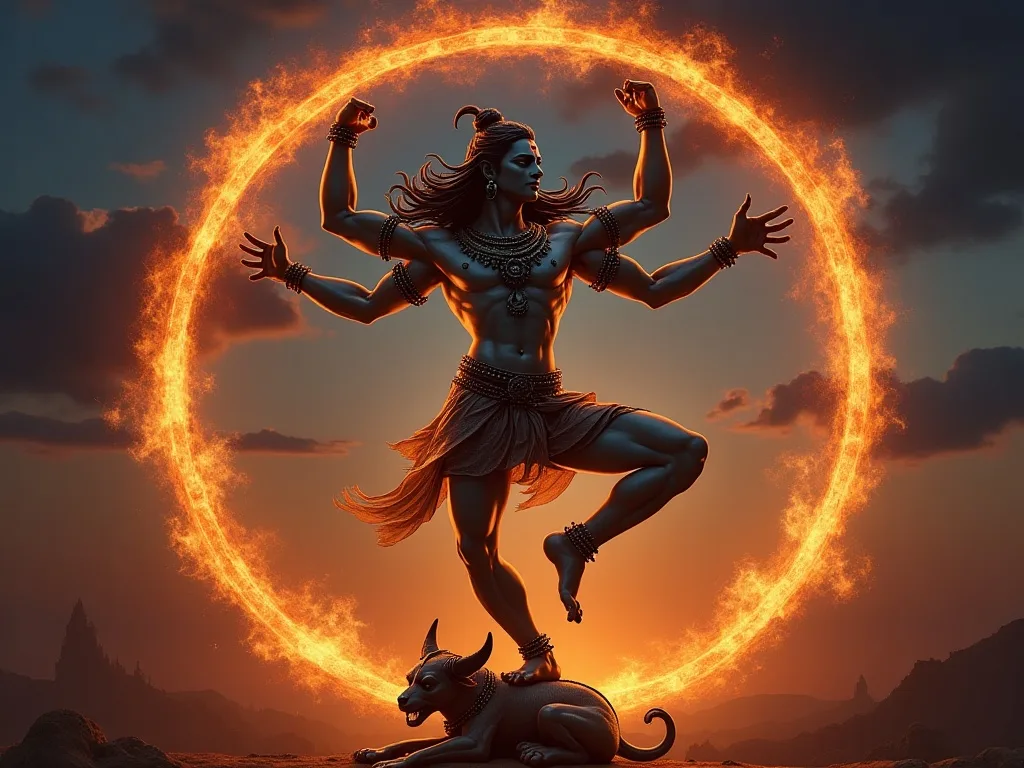
Shiva's dance, the Nataraja form, is perhaps the single most philosophically loaded image Hinduism ever produced. Cast in bronze by Chola artisans in the 9th-12th centuries CE, the Nataraja shows Shiva dancing inside a ring of fire (prabhamandala), his upper right hand holding the drum of creation (damaru), his upper left hand holding the flame of destruction, his lower right hand raised in the gesture of reassurance (abhaya mudra), his lower left hand pointing down to his raised left foot, which represents liberation (moksha). He stands on the demon of ignorance, Apasmara Purusha. The entire cosmos - creation, preservation, dissolution, concealment, and liberation - compressed into a single posture.
Shiva is also the supreme ascetic, spending vast ages in meditation on Mount Kailash, and simultaneously the passionate husband of Parvati, father of Ganesha and Kartikeya. He contains the celibate and the erotic, the recluse and the householder, the destroyer and the most tender father. Shaivism, the devotional tradition centred on him, is as broad as Vaishnavism, encompassing everything from the fiercely non-dualist Kashmir Shaivism to the Tamil Shaiva Siddhanta to the Tantric Kapalika sects who performed rituals at cremation grounds.
How the Three Relate: Unity, Rivalry, and Philosophical Synthesis
The Trimurti concept does not mean the three are always harmonious. The Puranas are full of their contests. In the Shiva Purana, Shiva is the absolute reality and the other two are his manifestations. In the Bhagavata Purana, Vishnu is the supreme Brahman and the others serve under him. The Devi Bhagavata Purana frames the goddess Devi (or Shakti) as the energy underlying all three - they are her instruments. These are not contradictions in a poorly organised mythology. They are distinct theological positions, each argued with rigor, each supported by an entire devotional community.
The Trimurti as a unified concept tends to emerge most clearly in texts concerned with philosophical reconciliation. The Matsya Purana (Chapter 53) states directly that Brahma, Vishnu, and Shiva are one being appearing in three guises. The 8th-century philosopher Adi Shankaracharya, who founded the Smarta tradition, formalised this approach, proposing that any of the principal deities - Vishnu, Shiva, Shakti, Ganesha, Surya - could be worshipped as the supreme absolute (Brahman), since all are equally valid names and faces for the one undivided reality.
Vishnu
Domain: Preservation of cosmic and moral order (dharma)
Nature: Immanent, engaged, descends repeatedly into history as avatars
Primary emotion: Grace (prasada), protectiveness, compassion
Sacred symbol: The lotus, the conch, the discus
Mount: Garuda, the eagle
Primary sacred texts: Bhagavata Purana, Vishnu Purana, Bhagavad Gita
Devotional tradition: Vaishnavism
Shiva
Domain: Dissolution of form, liberation from samsara
Nature: Transcendent, withdrawn, dwelling at the edge of the world (cremation grounds, Himalayan peaks)
Primary emotion: Vairagya (detachment), but also fierce love for his devotees
Sacred symbol: The trishula, the damaru, the linga
Mount: Nandi, the bull
Primary sacred texts: Shiva Purana, Linga Purana, Agamas of Kashmir Shaivism
Devotional tradition: Shaivism
The tension between Vishnu and Shiva also produced some of the most creative syncretic figures in Hindu art. Harihara fuses the two in a single body, half Vishnu (right side, marked with the conch and crown) and half Shiva (left side, marked with the jata, the crescent moon, and the ash). Some of the finest Harihara sculptures come from 7th-century Cambodia, showing how quickly the Trimurti concept spread through Indianised kingdoms of Southeast Asia - Angkor Wat itself is largely a Vaishnava temple, though its architectural symbolism draws on Shaiva cosmology for its mountain-spine structure.
The Trimurti in Cosmological Time
The Trimurti only makes full sense against the backdrop of Hindu cosmological time, which operates on a scale that dwarfs most other religious cosmologies. A single day of Brahma (Brahma's day) equals 4.32 billion human years - the kalpa. At the end of each day, Brahma sleeps, and during his night the cosmos is partially dissolved by Shiva. At the end of Brahma's full lifespan (311 trillion human years by some calculations), a total dissolution (mahapralaya) occurs, and even Brahma dissolves back into Vishnu, who rests again on the serpent Shesha until the next lotus rises.
Within each kalpa, time is subdivided into four yugas (ages): Krita (or Satya), the golden age of perfect dharma; Treta, slightly diminished; Dvapara, half; and Kali Yuga, the current age, the darkest quarter. The Trimurti's roles shift subtly across these ages. Vishnu's avatars appear most often in Krita and Treta, when a specific intervention can still correct the course. In Kali Yuga, the imbalance is structural, and only Kalki's total intervention at the age's end will reset the cycle. Shiva's dissolution waits at the cosmic scale.
This timeframe is not merely poetic hyperbole. The Surya Siddhanta (c. 4th-5th century CE) and the Aryabhatiya (499 CE) used the same long-cycle framework as the basis for astronomical calculation, embedding mythological time into India's tradition of precise mathematics.
Cross-Cultural Echoes: Trinities Beyond India
The Trimurti is often compared to other divine trinities, and the comparison rewards careful attention. The Christian Trinity - Father, Son, and Holy Spirit - is a theological statement about the internal relations of a single God, not a functional division of cosmic labour. The Norse trio of Odin, Vili, and Ve who shaped the cosmos from the body of Ymir bears a surface resemblance, but those three are brothers performing a single act, not ongoing cosmic functions. The Egyptian pairing of Ra, Osiris, and Ptah (Creator, Sustainer, and craftsman-god) comes structurally closer, and some scholars of comparative religion, including Wendy Doniger in "The Hindus: An Alternative History," have noted that the impulse to divide cosmic function into three is widespread enough to suggest a deep pattern in human theological imagination.
What sets the Trimurti apart is its systematic character. It is not just three gods who happen to be important. It is an argument: that reality has exactly three irreducible modes of operation, and that any cosmology which acknowledges only creation, or only preservation, or only destruction, is incomplete. A theology that ends at creation cannot explain why anything persists. A theology that ends at preservation cannot explain change. A theology that ends at destruction loses the thread of continuity. Only all three together describe a full cycle.
The Greek concept of the three Moirai - Clotho (spinner), Lachesis (allotter), and Atropos (cutter) - maps the same logic onto individual fate rather than cosmic scale: creation, duration, and severance. That this structure recurs in cultures with no direct contact with each other suggests the Trimurti is tapping something genuinely structural about how minds model cyclical processes.
Frequently Asked Questions About the Hindu Trimurti
Frequently asked questions
Are Brahma, Vishnu, and Shiva equal in Hindu worship today?
In practice, they are not equally worshipped. Vishnu and Shiva command vast devotional traditions (Vaishnavism and Shaivism) with hundreds of millions of adherents each. Brahma receives far less active worship, a state explained in the Padma Purana by the curse Shiva placed on him after he lied about seeing the top of the jyotirlinga. Temples dedicated primarily to Brahma are rare; the Brahma temple at Pushkar in Rajasthan is the most significant.
Is the Trimurti concept found in the Vedas?
The Trimurti as a formalised three-in-one concept does not appear in the four Vedas. The Vedas know Brahma (as Prajapati or Brahmanaspati), Vishnu (as a solar deity who takes three strides), and Rudra (Shiva's precursor). The Trimurti as an explicit doctrine emerges in the Puranas, especially the Matsya, Kurma, and Vishnu Puranas, texts compiled between roughly 300 and 1200 CE. The philosophical synthesis was then formalised further by Adi Shankaracharya in the 8th century CE.
What is the difference between the Trimurti and the concept of Brahman?
Brahman (neuter, with a long final vowel) is the impersonal absolute, the ground of all being, formless and beyond attributes in the Advaita Vedanta school. The Trimurti consists of three personal deities who are, in that same philosophical tradition, expressions or "faces" of Brahman taking on qualities for cosmic function. Brahma the creator-god is not the same as Brahman the absolute - the names are cognate but the concepts are distinct. The Mandukya Upanishad and the Brahma Sutras handle this distinction with great care.
What role does the goddess Shakti play in relation to the Trimurti?
The Shakta theological tradition, especially as expressed in the Devi Bhagavata Purana and Devi Mahatmya, frames the three members of the Trimurti as dependent on the goddess Shakti (also called Devi or Adi Parashakti) for their power. Brahma's creative capacity requires his consort Saraswati; Vishnu's preservation requires Lakshmi; Shiva's transformative power requires Parvati-Shakti. Without these feminine energies, the male principles are considered inert. Some texts go further, presenting Devi herself as the supreme absolute of whom the Trimurti are merely instruments.
How did the Trimurti concept spread beyond India?
The Trimurti spread across Southeast Asia as Hindu kingdoms established themselves in what are now Cambodia, Indonesia, Thailand, and Vietnam between roughly the 1st and 14th centuries CE. Angkor Wat (12th century, Cambodia) is a Vaishnava monument built on a Shaiva cosmological template. The island of Bali retains a living Hindu tradition in which the Trimurti remains central. The earliest Trimurti sculpture outside India is often cited as a 6th-century example from Phnom Da in Cambodia. In the colonial period, Western scholars encountered the Trimurti and frequently compared it to the Christian Trinity, a comparison that illuminates the limits of both.
The Trimurti's Grip on Contemporary Hindu Thought and Global Culture
Modernity has not dimmed the Trimurti; it has given it new platforms. In popular culture, the three figures appear repeatedly in Indian cinema, most famously in the 1963 Hindi film Trimurti and in dozens of mythological retellings. The novelist Amish Tripathi built a bestselling trilogy beginning with The Immortals of Meluha (2010) reimagining Shiva as a historical human who becomes mythologised. Devdutt Pattanaik, India's most widely read mythologist, has written extensively on how the Trimurti encodes psychological states - Brahma as the creative mind, Vishnu as the rational mind, Shiva as the meditative mind - making the ancient framework a tool for contemporary self-understanding.
Physicists have occasionally drawn parallels between the Trimurti's cosmic cycle and thermodynamic processes - creation as the increase of complexity, preservation as a steady state, destruction as entropy's final claim - though these analogies are more poetic than rigorous. What is rigorous is the recognition that the Trimurti solved a genuine philosophical problem: how to honour the reality of change and the reality of persistence without privileging one over the other. That question does not age.
Ganesha, son of Shiva and Parvati, now arguably India's most globally recognised deity, stands at the intersection of all three cosmic registers. He removes the obstacles that prevent creation from proceeding; he sustains the threshold between known and unknown; and he destroys the illusions that prevent clear sight. The Trimurti's logic, it turns out, fractals downward into each member of the divine family. Every god in the Hindu pantheon contains a version of the same three-phase structure that the Trimurti maps at the cosmic scale.
That is, perhaps, the deepest claim the Trimurti makes. The rhythm of creation, sustenance, and dissolution is not just something that happens to the universe. It is the structure of any process that endures long enough to be worth understanding.
Free 25-page sample
Want the whole story?
Take the first 25 pages free. If it pulls you in, the full edition is yours as an instant PDF download, with a paperback on Amazon for selected titles.
Hindu
The Hindu Mythology Book: Vishnu, Shiva, Brahma, the Mahabharata, and the Sacred Stories of India
Vishnu, Shiva, Brahma, the Mahabharata, and the Sacred Stories of India
The Rigveda, the Mahabharata, the Ramayana, and the major Puranas. Every god, every avatar, every sacred epic.
More from Hindu
All articles
Hindu
The Bhagavad Gita: Krishna's Discourse on Duty and Devotion
On the eve of the Kurukshetra war, Krishna reveals the nature of the soul, duty, and liberation to a trembling Arjuna. The Bhagavad Gita's 700 verses have shaped Hindu thought for over two millennia.
Hindu
Lakshmi: Goddess of Wealth and Prosperity
Lakshmi stands at the center of Hindu cosmic order as the goddess who grants wealth, fortune, and abundance. Her eight forms, her lotus throne, and her ancient origins reveal a deity far richer than any single attribute.

Hindu
Hanuman: The Monkey God of Devotion and Strength
Half-divine warrior, half-devoted servant, Hanuman stands as one of Hinduism's most beloved figures. His story is one of extraordinary power placed entirely at the feet of love.
Hindu
Krishna: The Divine Cowherd and Supreme God
Dark-skinned, flute in hand, Krishna stands at the center of Hindu devotion: trickster, warrior, philosopher, and the universe itself wearing a peacock feather.