
The Ora: Guardian Spirits and Fates of Albanian Belief
The Ora are the invisible guardians of Albanian myth, each one bound to a single human soul at birth. Part fate-weaver, part protector, they shape destiny from the shadows of mountain and sky.
Contents
She arrives the moment a child draws its first breath. No one sees her. She has no temple, no altar carved from stone. But she is there, choosing the life she will guard, binding herself to it the way a river binds itself to a valley. The Albanians call her the Ora, and she will not leave until the person she watches over is dead.
Some spirits of the ancient world protect whole cities or forests. The Ora protects one person. That specificity, that deep personal bond between a spirit and a single human fate, is what makes her unlike almost any other figure in European mythology. She is not a god towering above you. She is yours, walking the same path you walk, sleeping when you sleep, terrified when you are terrified.
This is not a creature of later invention. Albanian scholars, especially the 19th-century folklorist and patriot Thimi Mitko, recorded her in songs, proverbs, and oral narratives gathered from communities across what is now Albania and the Albanian-speaking regions of North Macedonia, Kosovo, and southern Italy. The Ora belongs to a pre-Christian stratum of belief so old that linguists and mythographers still argue about where she originally came from.
What the Ora Actually Is
The word ora in Albanian comes from a Latin root hora, meaning "hour" or "time," but the concept itself almost certainly predates Latin contact. Scholars of Albanian mythology, including Robert Elsie in his 2001 reference work A Dictionary of Albanian Religion, Mythology and Folk Culture, argue that the Ora belongs to a pre-Roman layer of Paleo-Balkan belief, shared with Illyrian populations who lived in the region centuries before the Roman legions arrived.
She takes the form of a woman. Descriptions gathered from folk accounts are remarkably consistent: a female figure, often seen in dreams or at the edges of waking, sometimes dressed in white, sometimes in the colours of the household she guards. She can appear beautiful and radiant when the person she protects is prospering. When disaster is coming, she looks pale, thin, even wounded. Her appearance is not decorative. It is diagnostic. A man who dreams of his Ora weeping knows that something terrible is on its way.
The Ora is deeply individual. Every person has exactly one. Brothers in the same family have different Ora with different strengths. This matters enormously in Albanian folk thought because it explains why two people raised in identical circumstances can have radically different lives. The difference is not luck. The difference is the quality of the Ora assigned at birth.
She has no fixed home in the landscape. Some accounts place her near the person she guards. Others describe her wandering the mountains or resting near water, connected to her human charge by an invisible thread that stretches no matter the distance.
The Ora and the Logic of Fate
Albanian folk culture has a very precise and almost mathematical relationship with fate. The word fati (from the same Latin root as the English "fate") sits alongside the Ora in the conceptual vocabulary of destiny. But where fati describes the general arc of a life, the Ora is the agent who enforces it, or who fails to.
This dual structure is subtle but important. A person's fate is set. The Ora is the mechanism through which fate operates in the world. She can be strong enough to protect her human against illness, accident, and enemy action. Or she can be overwhelmed. When a person dies young or suffers repeated misfortune, the traditional explanation is not that fate was cruel, but that the Ora was weak, frightened, or defeated in some invisible conflict.
The strongest Ora are sometimes called Zana e Orave, linking them conceptually to the Zana, the wild mountain fairies of Albanian belief who have their own fierce, independent character. The Zana are spirits of the highlands, beautiful and dangerous, who protect hunters and avenge disrespect. The Ora shares their female nature and their protective function, but the Ora is attached to a person rather than to a place.
Because the Ora can be weakened, certain practices in Albanian folk tradition were explicitly designed to protect her. Speaking ill of a sleeping person was considered dangerous, not to the person directly, but to their Ora, who was thought to be most vulnerable when her charge was unconscious. Nightmares were not random. They were signs that the Ora had been attacked.
How the Ora Communicates
She does not speak in daylight. The Ora's primary channel of communication is the dream. Albanian folk accounts collected by Mitko and later by the 20th-century scholar Mark Tirta describe a consistent pattern: the Ora appears in a dream, her appearance signalling the emotional temperature of what is coming. Radiant and calm means safety. Agitated or sorrowful means illness or death approaching. The dream is not symbolic in the way a modern therapist might interpret it. It is literal information from a spiritual companion who genuinely knows.
In some accounts, the Ora can speak directly to a person who is on the edge between sleep and waking, a liminal state that Albanian folk culture treats with great seriousness. She may warn of an enemy's plan, redirect a choice, or simply make her presence felt as a warmth, a certainty that someone watchful is near.
There are also rare accounts where the Ora acts in the physical world. In stories recorded from the mountain communities of northern Albania, an Ora is described as arriving at a crossroads before her human, turning back a threat the person would have walked directly into. She does not leave footprints. She is not seen by other people. But the danger passes.
This invisibility is part of her nature. She is not meant to be perceived. The moment a person becomes fully aware of their Ora, something in the relationship has shifted, usually toward crisis. Seeing your own Ora clearly, in full daylight, is an omen of death in several Albanian folk accounts. The veil between protector and protected is there for a reason.
The Ora Compared to the Moirai and the Norns
The obvious comparison is the Moirai of Greek mythology: Clotho who spins the thread of life, Lachesis who measures it, and Atropos who cuts it. Three figures, collective, operating at the level of cosmic administration. They are not interested in individuals; they manage the structure of fate itself.
The Norns of Norse mythology, who weave the threads of destiny at the base of Yggdrasil, operate similarly. They are vast, impersonal, and concerned with the fates of gods as much as humans.
The Ora (Albanian)
Personal: one Ora per individual human, assigned at birth and loyal to that person alone. Her strength varies between people. She can be harmed, frightened, or defeated. She communicates through dreams and sometimes acts physically in the world. Her relationship with her human is intimate and reciprocal.
The Moirai (Greek)
Universal: three Moirai governing fate for all mortals and even the gods. They do not belong to any individual. Their decisions are largely irreversible. They are rarely described as communicating directly with humans. The relationship is one of cosmic authority, not personal bond.
The Ora is far more personal than either. She can lose. The Moirai do not lose. Atropos's shears are inevitable; the Ora's protective power is not. This makes the Albanian figure emotionally richer in one specific sense: she introduces genuine uncertainty. You might survive. Your Ora might be strong enough. Or she might not be.
The closest parallel in European tradition may actually be the Roman genius or juno, the spiritual double that accompanied every Roman male or female through life. But even the genius was more abstract, more tied to lineage and household cult, less vividly personal than the Ora, who has a face you might see in dreams.
The Ora in the Albanian Oral Epic Tradition
The Albanian oral epic tradition, recorded most extensively by the Austrian scholar Johann Georg von Hahn in the 1850s and later by Albanian ethnographers across the 20th century, places the Ora inside some of its most emotionally charged narratives.
In several epic songs from the northern Albanian kreshnik cycle, the hero's Ora appears at a moment of crisis to either warn him or, in tragic versions, to confirm that his time has come. The hero's death is not a surprise to his Ora. She knows before he does. Her grief, sometimes expressed as wailing heard by no one else, is the emotional counterpoint to the hero's bravery. He fights without fear because he does not know. She watches without intervening because the fate is already written.
This narrative function is precise and intentional. The Ora in the epic tradition is not a deus ex machina. She does not rescue the hero at the last second. She witnesses. Her witnessing gives the hero's death a cosmic weight it would otherwise lack: someone who loved this specific person, with this specific life, is watching, and mourning, and the audience knows it.
Albanian oral epic heroes are almost always described in relation to their Ora's strength. A mighty warrior has a mighty Ora. The greatest heroes are those whose Ora fought invisible battles in the spirit world parallel to the hero's physical battles on earth.
The Shtriga: The Ora's Opposite
Every protective figure in Albanian mythology has a counter-figure, and the Ora's is the Shtriga. Where the Ora guards, the Shtriga hunts. The Shtriga is a witch-like creature, often described as a woman who can transform into an insect or a small animal at night and drain the life force from sleeping children, especially infants.
The Shtriga operates precisely in the space where the Ora is most vulnerable: the night, the sleeping state, the moment when the protective spirit is closest to being overwhelmed. Communities across Albania historically treated the Shtriga with intense practical caution. Crosses made from pig bones placed at a church door on a Sunday were said to reveal a Shtriga in human form, because she would be unable to leave.
The relationship between Shtriga and Ora is not explicitly theorised in the folk sources, but the structural logic is clear. The Shtriga attacks what the Ora defends. The infant who dies suddenly and inexplicably has lost the first battle between these two forces. The child who survives has an Ora strong enough to resist.
Regional Variations Across the Albanian-Speaking World
The Ora is not identical everywhere. In the communities of the Albanian diaspora in southern Italy, the Arbëreshë, who have preserved a form of 15th-century Albanian culture in remarkable isolation, the Ora retains her core character but acquires some additional features tied to the domestic sphere. She is more frequently associated with the threshold of the house, and her weakness is sometimes linked to the state of the household itself.
In Kosovo and in the Macedonian Albanian communities, collected accounts from the 20th century describe the Ora in closer connection to the concept of besa (the sworn pledge of Albanian customary law, the Kanun). A person who keeps their besa has a stronger Ora. Moral failure weakens her. This is a significant detail: it means the Ora is not purely deterministic. Human behaviour can influence the strength of the spirit that protects you.
In some southern Albanian traditions, the Ora shades into the concept of the Mira, a fortune-spirit associated specifically with women and with the household's prosperity. The Mira presides over the milk of cows, the weaving of cloth, the fertility of the home. She is gentler than the northern Ora but serves a parallel function: invisible, female, deeply attached to a specific person or space.
The Ora in Modern Albanian Culture
The 19th century Albanian national awakening, called the Rilindja Kombëtare (National Renaissance), was a period when Albanian intellectuals deliberately drew on pre-Christian folk belief to build a distinct cultural identity separate from both Ottoman Islam and Greek Orthodoxy. The Ora became a significant figure in this cultural project.
The poet Naim Frashëri, one of the most important figures of the Rilindja, used imagery drawn from the Ora tradition in his poetry to evoke the Albanian people's spiritual connection to their land and fate. The Ora was not just a folk belief: she was recruited into a broader argument about the depth and distinctiveness of Albanian civilisation.
Today, the Ora appears in Albanian literature, film, and visual art. She has been reinterpreted by contemporary Albanian writers as a figure of feminine power, of the invisible labour of care, of the maternal forces that sustain human life without receiving credit for it. The Shtriga has similarly been reclaimed by some Albanian feminist writers as a figure of female knowledge persecuted by patriarchal systems, a reversal that would have surprised the mountain communities who once left pig-bone crosses at church doors.
Academic interest in the Ora has grown alongside broader scholarly attention to Paleo-Balkan religion. Researchers at the University of Pristina and the University of Tirana have in recent decades produced comparative work linking the Ora to pre-Roman Illyrian belief systems, though direct textual evidence from the Illyrian period is sparse. The argument rests largely on the Ora's linguistic root, her structural parallels with other ancient fate-spirits, and the remarkable consistency of her description across geographically separated Albanian communities.
Frequently Asked Questions About the Ora of Albanian Mythology
Frequently asked questions
Is the Ora male or female?
The Ora is almost always described as female in both northern and southern Albanian folk accounts. This is consistent across the sources collected by Thimi Mitko in the 19th century and the later ethnographic work of Mark Tirta. Men and women alike have a female Ora. In a small number of accounts from specific regional traditions, male protective spirits with similar functions appear, but the canonical Ora is feminine.
Can a person lose their Ora during their lifetime?
Folk accounts suggest the Ora can be weakened, frightened, or defeated in invisible conflicts with hostile spirits such as the Shtriga, but true separation from one's Ora before death is extremely rare in the recorded tradition. The Ora is assigned at birth and remains until death. Her weakness does not mean her absence: it means her human charge is more exposed to harm.
What is the relationship between the Ora and the Albanian concept of fate (fati)?
They operate at different levels. Fati describes the overall arc of a person's destiny, the broad shape of the life they were given. The Ora is the active agent who enacts, protects, and sometimes fails to protect that fate in the material world. Robert Elsie's A Dictionary of Albanian Religion, Mythology and Folk Culture describes this as a layered cosmology where fate is the script and the Ora is the actor performing it.
How is the Ora different from the Zana?
The Zana are wild mountain spirits tied to specific high-altitude landscapes, springs, and forests. They protect places and, by extension, the hunters and warriors who move through those places. The Ora is tied to a specific person. A Zana can bless or curse many different individuals who enter her territory. An Ora belongs to one person only and has no other charge. The two figures can interact in folk narratives, and the strongest Ora are sometimes described in terms borrowed from Zana imagery, but they remain structurally distinct.
Is the Ora still believed in today?
Active belief in the Ora as a literal spiritual being has declined significantly across the 20th and 21st centuries, particularly in urban areas. In rural and diaspora communities, especially among the Arbëreshë of southern Italy, the Ora survives as a living cultural reference point. Among Albanian intellectuals and artists, she has become a symbol of ancestral identity and pre-Christian spiritual heritage, used metaphorically but with genuine reverence for the tradition she represents.
The Ora and the Unresolved Question of Illyrian Continuity
The single most debated question surrounding the Ora is where she actually comes from. The Albanian language is classified as its own branch of the Indo-European family, with no surviving close relatives. Albanians are widely considered descendants of the ancient Illyrians or closely related Paleo-Balkan peoples, but Illyrian left almost no written records. Its religious content is nearly lost.
This creates a problem and an opportunity. The Ora cannot be traced through texts the way the Greek Moirai can be traced through Hesiod's Theogony (a poem from around 700 BC that catalogues divine genealogy) or the Norns through the Prose Edda (compiled by the Icelandic scholar Snorri Sturluson around 1220 AD). She exists almost entirely in the living oral tradition, recorded in writing only from the 19th century onward.
Some scholars argue this makes her a relatively late creation, a local synthesis of Roman juno imagery, Slavic fate-spirit traditions (the South Slavic sudjenice, fate-women who appear at a child's birth), and indigenous Albanian folk practice. Others, including the linguist Eric Hamp, argued until his death in 2019 that Albanian preserves genuinely archaic Indo-European material not found elsewhere, and that the Ora may represent exactly this kind of survival.
What is not debated is the Ora's coherence. Across Albania, Kosovo, North Macedonia, and the Arbëreshë villages of Calabria and Sicily, a figure with the same name, the same female form, the same personal bond to a single human, and the same communicative use of dreams appears with striking consistency. Whatever her ultimate origin, she was real enough to survive five centuries of Ottoman rule, the radical 20th-century atheism of Enver Hoxha's regime (which banned all religion in Albania in 1967 and punished its practice), and the full pressure of modernisation. That kind of survival does not happen by accident. It happens because a figure speaks to something people genuinely need: the feeling that someone specific, beyond family and beyond gods, is watching only you.
Read the full book
Want the whole story?
The complete edition is an instant PDF download here, with a paperback on Amazon for selected titles.
Albanian
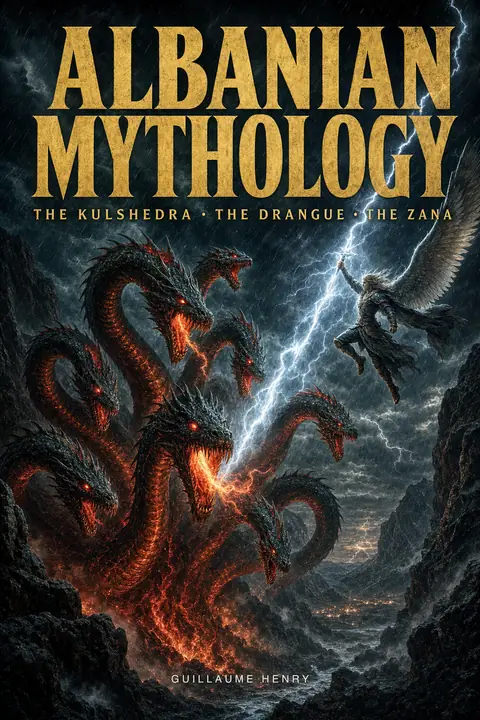
The Albanian Mythology Book: The Kulshedra, the Drangue, and the Spirits of the Mountains
The Kulshedra, the Drangue, and the Zana
The mythology of the Albanian highlands: the Kulshedra, a fire-belching dragon-hag who hoards the rains, the Drangue, winged heroes born to fight her, and the Zana, mountain nymphs who bless and curse. A pagan world that survived in the songs of the highland warriors.
More from Albanian
All articles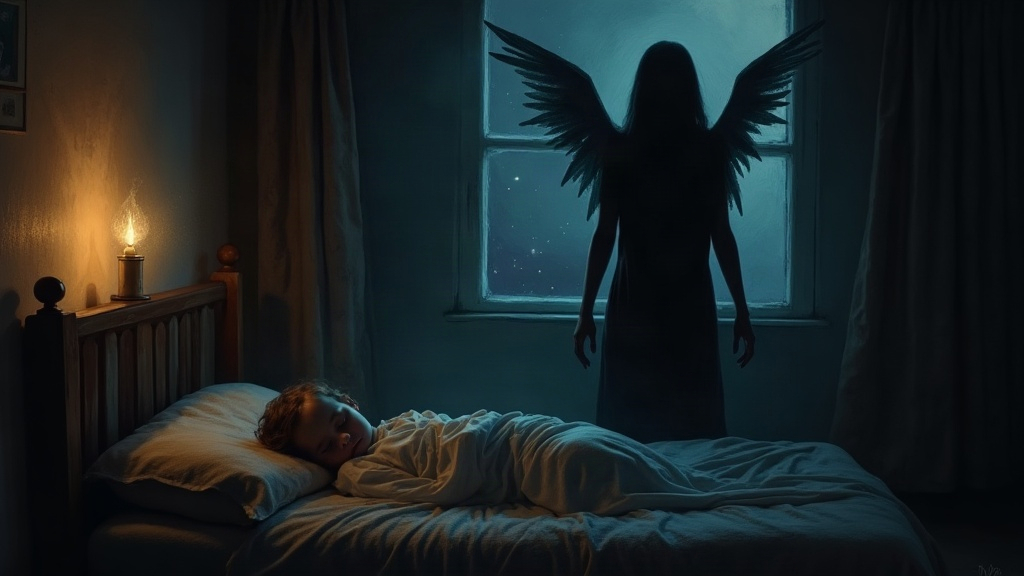
Albanian
The Shtriga: Witch-Vampire of Albanian Folklore
The Shtriga is a witch-vampire hybrid from Albanian folklore who feeds on the life force of sleeping children. Part demon, part woman, entirely dangerous, she embodies the fears of a culture caught between Christianity, Islam, and older Balkan beliefs.
Albanian
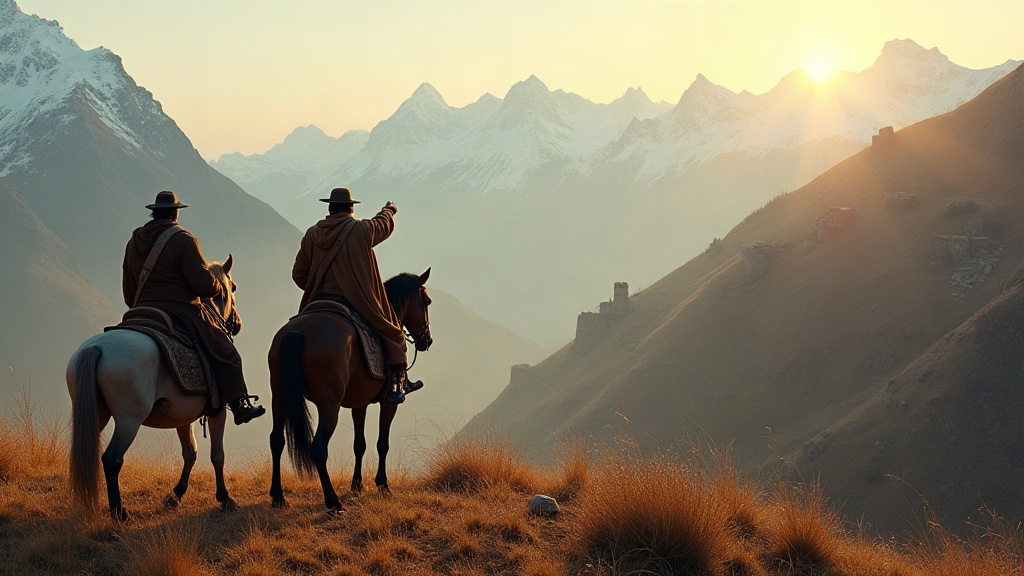
Muji and Halili: The Epic Heroes of Albanian Legend
Muji and Halili are the legendary twin heroes of Albanian epic poetry, warriors bound by blood and honor who defend their land against mythical monsters and foreign invasion. Discover how their deeds shaped Albanian cultural identity for centuries.
Albanian
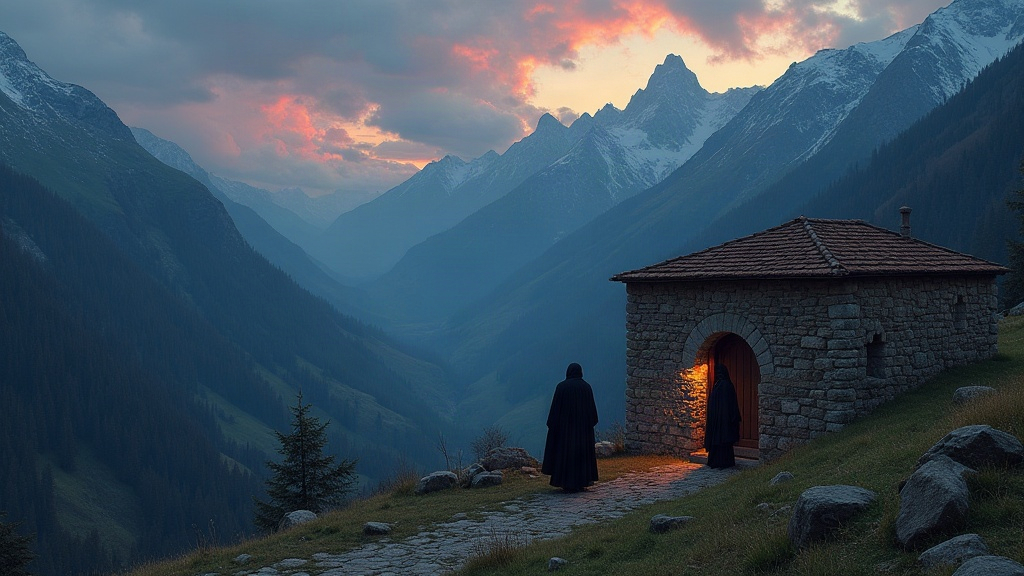
The Besa: Sacred Code of Honor in Albanian Culture
The Besa is Albania's oldest unwritten law: a sacred pledge of honor, protection, and hospitality that has shaped Albanian identity for centuries. Discover how this ancient code binds community, defies conquest, and survives in modern Albania.
Albanian
E Bukura e Dheut: The Earthly Beauty and Goddess of Nature in Albanian Mythology
E Bukura e Dheut embodies the earthly beauty and goddess of nature in Albanian mythology, representing fertility, growth, and the sacred landscape. Discover how this ancient figure shaped Albanian spiritual life and persists in folk tradition today.