
Anglo-Saxon Runes: The Futhorc and Magical Inscriptions
The Anglo-Saxons carved their runes into swords, jewels, and bone. Each mark was a letter, a word, and a power bound in stone. This is the full story of the Futhorc.
Contents
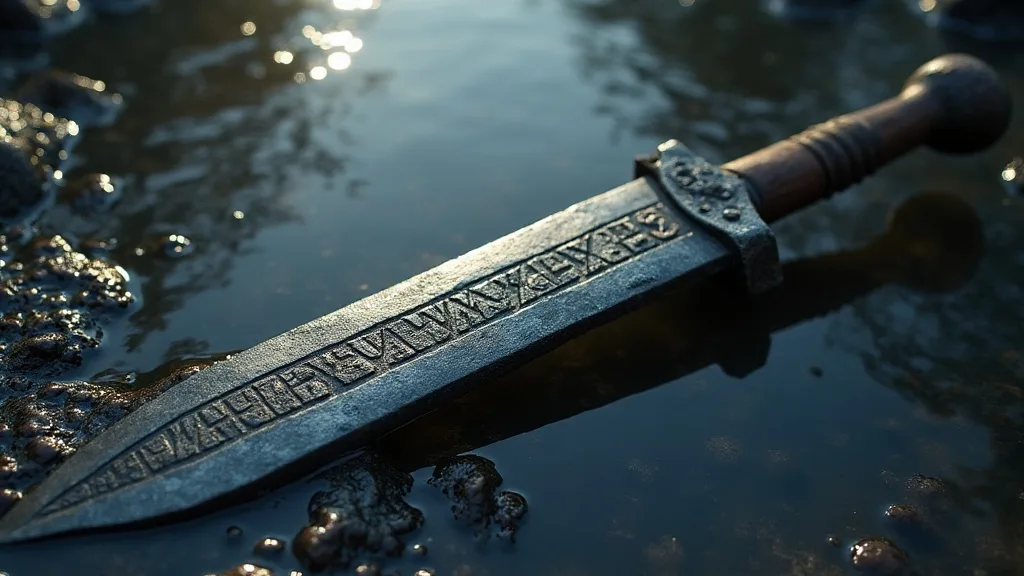
A sword blade emerges from the Thames mud, its iron dark with age. Along the flat, a row of cut marks runs toward the hilt. They are not decoration. They are not a craftsman's signature. They are runes, and the Anglo-Saxons who buried that blade in the river believed those marks did something: they named the weapon, bound a force to it, maybe kept the edge keen through a winter campaign.
Anglo-Saxon runes are among the most evocative survivals from early medieval England. Carved into metal, bone, stone crosses, and wooden objects, they record a language, a cosmology, and a set of beliefs about the hidden weight of letters. They are called, collectively, the Futhorc (a name derived, like the Norse Futhark, from its first six letters). And they have been misread, romanticised, and misappropriated for centuries. What they actually say, and what they meant to the people who cut them, is a richer story than any fantasy has imagined.
From the Elder Futhark to the Anglo-Saxon Futhorc
The story starts on the continent, not in England. Germanic peoples across northern Europe were writing in runes from at least the 2nd century AD. The system they used, the Elder Futhark of 24 signs, spread from Scandinavia to the Rhine valley, inscribed on brooches, weapon fittings, and memorial stones. Scholars today read it in objects as far apart as the Danish Golden Horns of Gallehus (5th century) and Roman-era spearheads found in Poland.
When the Angles, Saxons, and Jutes crossed the North Sea and settled Britain from around 450 AD onward, they brought this writing system with them. But Old English was phonetically richer than the older Germanic dialects the Futhark was built for. New vowel sounds needed new signs. So the system grew. Two new runes appeared early: os and ac, covering sounds that had no Elder Futhark equivalent. Later manuscripts and stone inscriptions show the system reaching 28 runes by the 7th century and 33 runes in its fullest documented form.
The word Futhorc itself mirrors this expansion. The Elder Futhark takes its name from F-U-TH-A-R-K. The Anglo-Saxon version shifts the vowel in the fourth position: F-U-TH-O-R-C, because the sound of the fourth rune changed as Old English developed. It is a small linguistic detail that carries large significance: these people were not simply copying an inherited alphabet. They were adapting it, testing it against their own spoken language, and finding it necessary to build new tools.
The 33 Runes: Names, Sounds, and the Weight of Each Sign
Every rune in the Futhorc had three things: a phonetic value (the sound it represented), a name (a full Old English word), and a set of associations (natural, cosmic, social) attached to that name. This triple character is what makes runes different from a purely functional alphabet like Roman letters.
The rune feoh (F) meant cattle, wealth, moveable property. The rune ur (U) meant aurochs, the enormous wild ox of the European forests. Thorn (TH) named a thorn or giant. Os (O) named a god, or a river-mouth, depending on the tradition. Rad (R) meant riding, a journey on horseback. Cen (C/K) meant torch, a lit fire in darkness. These are not arbitrary labels. They are the word-picture that the letter carries every time it is written.
This system - where each letter is also a word and a concept - is documented in the Rune Poems. Three survive: the Old English Rune Poem (preserved in a manuscript copied around 1000 AD, though likely older), the Old Norwegian Rune Poem, and the Icelandic Rune Poem. The Old English version is the closest to the Futhorc. Each stanza describes one rune's name-word in a short, gnomic verse. The entry for feoh opens: "Wealth is a comfort to all men, yet every man must share it freely if he wishes to gain glory in the sight of the Lord." The entry for ur says: "The aurochs is proud and has great horns; a very savage beast, it fights with its horns; a well-known moor-stalker, it is a courageous animal."
The runes carry a moral and cosmological freight, not just a phonetic one. A scribe writing ur into a text was writing a sound and also invoking, at some level, an image of raw strength in the wild.
Runic Inscriptions Across Anglo-Saxon England: The Physical Evidence
About 200 runic objects survive from Anglo-Saxon England, a small corpus but remarkably varied. The great concentrations are in the north, in Northumbria, where the tradition of monumental stone carving lasted longest. But finds appear from Kent to Yorkshire, in graveyards, rivers, and church walls.
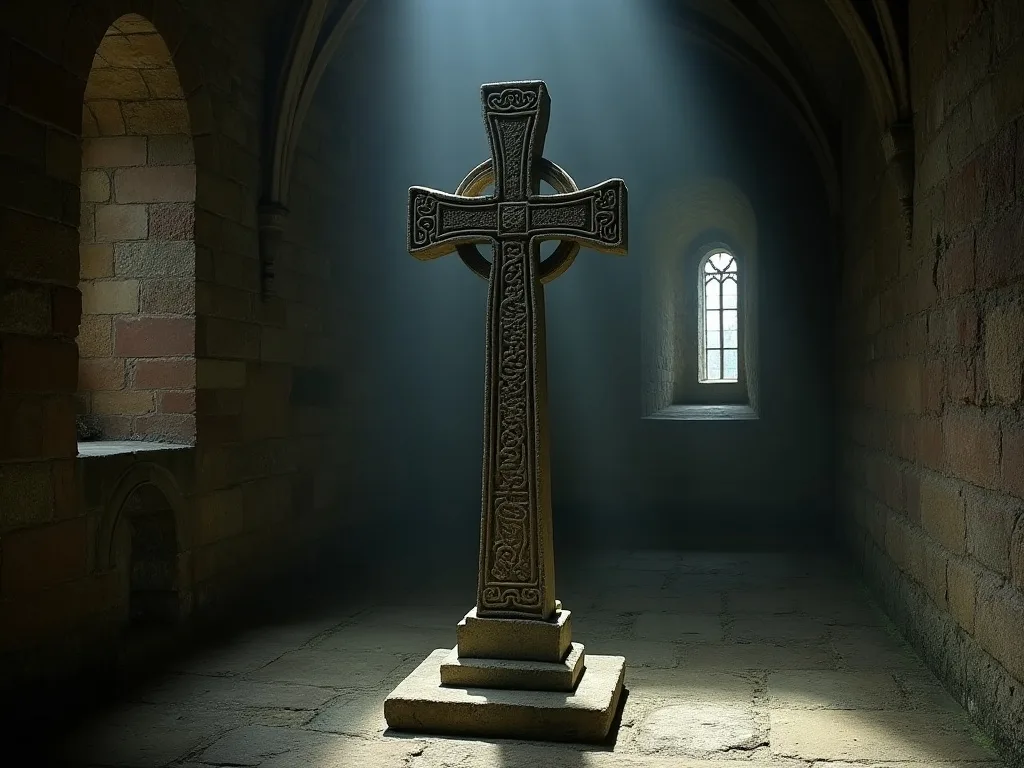
The Ruthwell Cross, standing in a small church in Dumfriesshire, Scotland, is the most celebrated. Carved in the 7th or 8th century, it carries portions of an Old English poem about the Crucifixion, later identified as part of The Dream of the Rood. The runic text runs along the vine-scroll borders of the stone. It is one of the earliest surviving pieces of Old English poetry, written in a script that predates most written Old English by generations. The Ruthwell Cross shows that runes were not marginal or pagan survivals in Christian Northumbria. They were a prestige medium, worthy of a major theological monument.
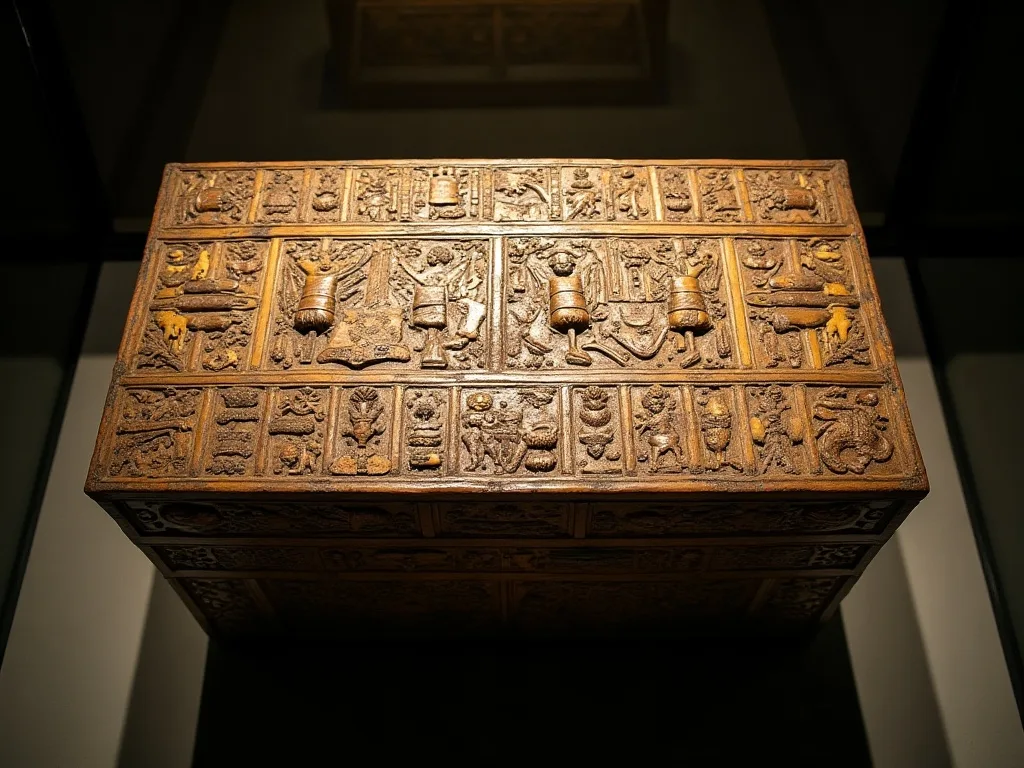
The Franks Casket (British Museum, early 8th century Northumbria) is a small whale-bone box whose panels mix runic inscriptions with Roman lettering. The scenes on it range from the Germanic legend of Wayland the Smith to the Adoration of the Magi, annotated in Old English runes and Latin letters side by side. The runic captions name the scenes in riddling, allusive language. One panel shows the sacking of Jerusalem by Titus in 70 AD; another shows a scene from the Norse mythological tradition. The craftsman who made it moved between worlds, Christian and Germanic, Latin and runic, without apparent tension.
The Sword from the Thames (held at the British Museum) bears a runic owner's inscription. Several other blades, scramasaxes (single-edged fighting knives), and spear fittings carry similar marks. The famous Thames scramasax, also at the British Museum, has a full runic alphabet along its blade, a striking reminder that the alphabet itself could function as an inscription, a demonstration of knowledge and perhaps of power.
Portable objects carry the majority of surviving Anglo-Saxon runic texts: combs, brooches, coins, a few wooden objects (most organic material has not survived), and bone pieces. Many of these short inscriptions record an owner's name or a maker's mark. But a significant number are harder to read as purely functional labels.
Magic, Protection, and the Force of Named Letters
The question of whether Anglo-Saxon runes were "magical" is one scholars approach with care, because the modern idea of magic does not map cleanly onto early medieval thought. But the evidence for a belief in runic efficacy, the idea that the right marks cut into the right material could do something in the world, is strong.
The Old English poem Beowulf, composed sometime between the 7th and 10th centuries, mentions "victory-runes" (sigerunas) inscribed on weapon guards. The poem Solomon and Saturn, a strange dialogue between the biblical Solomon and the Roman god Saturn, describes the letters of the Pater Noster (the Lord's Prayer) as warriors that beat down the devil - each letter personified as a fighting figure. This is not standard Christian theology. It is a rune-logic applied to Latin letters: the idea that the written word has force, that each letter carries power that can be directed.
The Lacnunga and Leechbook of Bald, Old English medical manuscripts from the 10th century, prescribe remedies that combine herbal preparations with spoken charms and, in some cases, written characters. The charms draw on Christian prayer, classical medicine, and older Germanic traditions simultaneously. Some scholars, notably Karen Jolly in her 1996 study Popular Religion in Late Saxon England, argue that this mixing was not confusion but a coherent system: Christian power and inherited Germanic efficacy ran in parallel channels, and a practitioner used both.
The runic alphabet poem's entries for specific runes hint at this force. Tir (the rune named for the god Tiw, cognate with Norse Tyr) is described as "a guiding star" that keeps faith with noble men. Eoh (yew-tree) is described as a tree that holds fire within its bark, a tree that outlives all others, a tree "joyless in the homestead." The yew carried associations with death, endurance, and the boundary between worlds across northern European cultures. A scribe cutting eoh into an object was deploying that entire complex.
Bind-runes (single characters that merged two or three runes into one form) appear on several Anglo-Saxon objects. They may represent abbreviations, monograms, or concentrated magical combinations - the scholarly debate is not settled. What is clear is that they were deliberate choices, not scribal shortcuts.
The Rune Poems as Cosmological Text
The Old English Rune Poem deserves attention as a document in its own right, separate from its function as a key to the alphabet. It survives in a manuscript compiled by Humfrey Wanley in the early 18th century from an older original that subsequently burned in the Cottonian Library fire of 1731. Our text comes from a transcription made just before the fire, which means we have the words but not the original parchment.
The poem moves through all 29 runes it covers (the version that survived did not include all later additions) in short stanzas of three to five lines each. Some stanzas are purely descriptive of the natural world: the entry for lagu (water, sea) reads as a meditation on the danger and beauty of ocean travel. Others carry an unmistakably elegiac tone that connects the Rune Poem to the great Old English elegies like The Wanderer and The Seafarer.
The entry for ing is one of the most discussed. Ing names the hero or god Ing, an ancestor-figure connected to the Ingvaeones (a grouping of Germanic peoples described by the Roman historian Tacitus in his 1st-century work Germania). The stanza says: "Ing was first seen among the East-Danes, then went east over the waves, the wagon ran behind; that is what the stout-hearted men called him." This cryptic couplet encodes a migration myth: a divine ancestor who came from the east, founded a people, and departed by sea. It connects directly to the figure known in Norse tradition as Freyr or Yngvi-Freyr, god of fertility and ancestor of the Yngling dynasty of Swedish kings.
The Rune Poem is therefore not just a mnemonic for scribes. It is a compressed mythological record, carrying stories about gods, ancestors, natural forces, and the moral obligations of a warrior society - all encoded in the form of an alphabet primer.
Anglo-Saxon Runes in Christian Context
The survival of runic writing deep into the Christian period of Anglo-Saxon England is striking, and it has generated significant scholarly discussion. The Church did not uniformly condemn runes. What it condemned were specific practices: divination, idol worship, the veneration of stones and trees. Runes as a writing system could be deployed in entirely orthodox contexts, and the Ruthwell Cross proves it.
At the same time, the 7th-century Synod of Nantes and various Carolingian councils warned against the use of written characters in healing and protective contexts. Some Anglo-Saxon penitentials (handbooks for confessors) list "using letters for healing" among minor sins. The ecclesiastical discomfort was not with writing as such but with writing deployed as an autonomous force, as if the marks themselves had power independent of God.
This tension mirrors a broader dynamic in Anglo-Saxon Christianity. The conversion of England (roughly 597 AD with Augustine of Canterbury's mission, though the process was long and uneven) did not erase older Germanic cosmology. It layered over it, absorbed parts of it, and argued with the rest. The runic tradition survived partly because it was useful (it was a writing system), partly because it was prestigious (stone monuments and prestige objects used it), and partly because the beliefs associated with it did not require a wholesale rejection of Christianity to maintain.
The Ruthwell Cross stands in a church. The Franks Casket shows the Magi. Yet both use runes, and both carry older associations just below the surface.
Runic Literacy: Who Could Read and Write Them
Modern readers sometimes assume that runes were esoteric, known only to priests or sorcerers. The evidence suggests something more distributed. Old English kennings (compound poetic words) and riddles, especially in the Exeter Book (a manuscript compiled around 970 AD), sometimes encode runic letters as part of their solution. The riddler assumed the audience could recognise and decode a runic sign embedded in a verse. That is not the assumption of a writer addressing an esoteric specialist. It is the assumption of a poet addressing literate courtiers and educated clergy.
The production of runic inscriptions, however, required skill. Cutting clean runes into hard materials demanded a trained hand. Many inscriptions are confident and well-spaced; others are hesitant or incorrect, suggesting copying without full comprehension. This pattern, skilled makers alongside less skilled ones, is what you would expect in a literate culture with a specialised craft tradition rather than a secret society.
Runic literacy was probably concentrated among metalworkers, stone carvers, and ecclesiastical scriptoria, but knowledge of the alphabet's meanings spread further. A sword-owner might not have been able to carve his own blade's runes, but he likely knew what the marks on the hilt were meant to accomplish.
Cross-Cultural Connections: Runes, Norse Mythology, and the Wider Germanic World
The Anglo-Saxon Futhorc did not exist in isolation. It was in constant dialogue with the runic traditions of Scandinavia and the continent. Norse mythology preserves the most extensive runic mythology: Odin hung nine nights on Yggdrasil to win the runes, an act of self-sacrifice for cosmic knowledge recorded in the Havamal, a collection of Old Norse wisdom poetry. The Futhorc shares many rune names with the younger Norse Younger Futhark, though the two systems diverged in number, form, and some associations.
The Anglo-Saxon rune Tiw names the same deity as Old Norse Tyr, the one-handed god of law and battle. The rune Wynn (joy) has no direct Norse parallel but connects to a concept of community well-being found across Germanic literature. The rune Dag (day) appears in both traditions as a symbol of hope, light breaking over darkness.
What this cross-cultural web shows is that runes were not simply an English phenomenon. They were a shared Germanic inheritance, adapted locally but carrying a common metaphysical grammar. When an Anglo-Saxon smith cut a protective rune into a sword, he was working in a tradition that his Danish trading partners and his Norse raiding neighbors would have recognised, even if the specific letter-forms had diverged.
Frequently Asked Questions About Anglo-Saxon Runes and the Futhorc
Frequently asked questions
How many runes does the Anglo-Saxon Futhorc contain?
The Futhorc expanded over time. Early Anglo-Saxon inscriptions use 28 runes. The fullest documented version, found in late manuscripts, reaches 33. The growth reflects the phonetic richness of Old English, which needed more letters than the original 24-rune Elder Futhark provided. The Old English Rune Poem covers 29 runes in its surviving form.
Are Anglo-Saxon runes the same as Viking runes?
No. They share a common ancestor (the Elder Futhark) but are different systems. Viking Age Scandinavia used the Younger Futhark, which actually reduced the alphabet to 16 runes to simplify inscription. Anglo-Saxon England expanded the system to accommodate Old English sounds. The rune names and many letter-forms overlap, but the two alphabets diverged significantly from around the 7th century onward.
What is the primary source for understanding the meaning of each rune?
The Old English Rune Poem is the main source for the Anglo-Saxon tradition. It gives a verse description of each rune's name-word and its associations. Scholars also compare it to the Old Norwegian and Icelandic Rune Poems, and to inscriptions on surviving objects. The poem itself survives only through an 18th-century transcript made before the original manuscript burned in the Cottonian Library fire of 1731.
Did the Christian Church ban Anglo-Saxon runes?
Not uniformly. The Church objected to specific uses, particularly divination and healing charms that attributed power to the marks themselves. But runes as a writing system were acceptable: the Ruthwell Cross, one of the great monuments of early Christian Northumbria, carries a runic text of a devotional poem. The tension was between using runes as letters and using them as autonomous sources of power.
What is the most famous runic object from Anglo-Saxon England?
The Ruthwell Cross and the Franks Casket are the most studied for their literary and cultural complexity. Among portable objects, the Thames Scramasax (a large knife now in the British Museum) is notable for carrying a complete runic alphabet along its blade, a rare survival of the full Futhorc on a single object.
Were runes used after the Norman Conquest in 1066?
Runic use in England declined sharply after the Norman Conquest, which brought Latin literacy and French cultural prestige into English court and religious life. A handful of post-Conquest runic inscriptions exist, mostly in northern England and Scotland, suggesting the tradition lingered at the edges. By the 12th century, runes had largely disappeared from English usage, surviving mainly in Scandinavia, where they continued into the medieval and even early modern period.
The Futhorc After England: Legacy, Misreading, and What the Marks Still Hold
The story of Anglo-Saxon runes did not end with the Normans. It went underground, resurfaced in antiquarian scholarship, and eventually became one of the most misappropriated symbol-sets in modern culture.
19th-century Romanticism rediscovered runes through the lens of nationalism. German scholars like Karl Simrock and Wilhelm Grimm treated runic inscriptions as evidence of an Aryan spiritual heritage, a move that distorted the evidence and had catastrophic consequences when Nazi ideologues adopted specific runes (the Sig rune, the Tiwaz rune) as symbols of their movement. This appropriation has nothing to do with what Anglo-Saxon or Norse people believed. It is a 20th-century political invention layered over medieval material.
Contemporary scholarship has worked to strip those overlays away. Researchers like Raymond Ian Page, whose 1987 book Runes remains a standard introduction, and R.I. Page's work in An Introduction to English Runes (1973), established rigorous frameworks for reading inscriptions without projecting modern meanings. More recent work by scholars like John Hines and Mindy MacLeod (whose 2006 book Bind-Runes examines the evidence for composite runic signs) has pushed the field toward finer-grained material analysis.
What the Futhorc actually preserves is something more interesting than any appropriation allows for: a record of a people who thought hard about the relationship between language and reality. For the Anglo-Saxons who cut a rune into a sword, or painted one onto a healing bowl, or set one in the border of a stone cross, the letter was not an arbitrary sign. It was a compressed world. The word and the thing it named were connected. Writing was not just recording. It was, in some deep sense, doing.
That idea has never fully gone away. Every time a poet chooses a word for its sound as much as its meaning, every time a calligrapher cuts a letter with ceremony, something of the runic logic is still at work. The Futhorc is a medieval alphabet and a philosophical position: that names have weight, and that cutting the right mark in the right place changes something in the world.
Read the full book
Want the whole story?
The complete edition is an instant PDF download here, with a paperback on Amazon for selected titles.
Anglo-Saxon
The Anglo-Saxon Mythology Book: Woden, Thunor, Beowulf, and the Lost Gods of Pre-Christian England
The Sacred Stories Before Christianity Buried Them
The mythology of pre-Christian England: Woden's ravens, Thunor's thunder, Beowulf's monsters, and the Wyrd sisters who wove fate. Recovered from Beowulf, royal genealogies, and the grave goods.
More from Anglo-Saxon
All articles
Anglo-Saxon
Hengist and Horsa: Legendary Founders of Anglo-Saxon England
Two brothers from Germanic lands, Hengist and Horsa led the first English settlers across the North Sea. Their arrival around 449 CE marks the beginning of Anglo-Saxon England, though history and legend now blur beyond recognition.
Anglo-Saxon
The Wild Hunt in Anglo-Saxon Belief: Spectral Riders and the Hunt for Souls
The Wild Hunt in Anglo-Saxon belief was a ghostly procession across the night sky, led by divine or demonic riders who hunted both the living and the dead. Discover how this ancient vision shaped English folklore for over a thousand years.
Anglo-Saxon
The Sutton Hoo Ship Burial: Archaeology and Myth
In 1939, archaeologists uncovered a 27-meter ship buried in Suffolk, England, holding treasures and weapons from the 6th century. The Sutton Hoo ship burial bridges Anglo-Saxon reality and the epic worlds of Beowulf, revealing how real kings were sent to their gods.
Anglo-Saxon
Eostre: Goddess of Spring and Dawn
Eostre is the Anglo-Saxon goddess of spring, dawn, and fertility, known through a single historical mention by the Venerable Bede. Discover how this shadowy deity shaped the season of renewal and inspired the modern holiday of Easter.