

Dievas: The Supreme Sky God of Baltic Mythology
Dievas rules the Baltic sky as a silver-robed king who rides across the heavens, judges the living, and dances at peasant weddings. Here is his full story.
Contents
Picture a silver-robed king descending from a hilltop estate at dusk. He wears a sword at his belt, a cloak stitched with stars, and he moves with the unhurried confidence of someone who has watched every harvest since the earth was young. He is not wrathful. He does not hurl lightning in a rage. He sits with farmers at long wooden tables, listens to their disputes, and departs before dawn without leaving a footprint. That king is Dievas, and for thousands of years he presided over the Baltic sky with a quiet authority that has no easy parallel in world mythology.
The Baltic peoples, principally the Lithuanians and Latvians who survived the last great pagan holdout in medieval Europe, left no holy book. Their theology lived inside dainas, the traditional sung poems collected in tens of thousands by 19th-century folklorists. Those songs are short, vivid, and precise. They do not argue. They simply show: the sky god rides, the sky god measures the fields, the sky god weeps silver tears when a young person dies too soon. Reading them is less like consulting scripture and more like watching an old film in which everything important happens in the background.
Who Dievas Is: Name, Origin, and Sky-Father Lineage
Dievas (Lithuanian) and his Latvian twin Dievs share the same root as the Sanskrit Dyaus Pita, the Greek Zeus, and the Latin Deus. All descend from the Proto-Indo-European Dyeus Ph2ter, meaning "Sky Father," the luminous daytime sky personified as a male sovereign. Linguists trace this divine name back roughly 5,000 years, making it one of the oldest recoverable god-names in any language.
The parallel with Zeus and the Vedic Dyaus is real, but it tells only half the story. While Zeus absorbed thunder and absorbed the older sky-father role into a personality defined by power and sexual conquest, Dievas moved in a different direction. He became a god of moral order, of measured judgment, of the careful stewardship that sustains a farming community through a hard northern winter. The thunder function split away and landed with Perkūnas, the storm god who would become his great counterpart in the Baltic pantheon.
Lithuanian and Latvian sources consistently picture Dievas as a landowning nobleman. He lives on a hill, a detail that echoes the sky itself, since hills meet the horizon. He keeps horses. He tends a farm of his own. This is not metaphor dressed up as story: the imagery suggests a theology in which the sky god is genuinely immanent, present in the rhythms of agricultural life rather than remote behind cloud and fire.

Dievas in the Dainas: What the Songs Actually Say
The dainas collected in the 19th century by Krišjānis Barons (Latvia) and others preserve details that no single theological text ever systematized. Scholars like Marija Gimbutas and Algirdas Julien Greimas spent careers trying to reconstruct the coherent theology underneath them. What they found was not chaos but a remarkably stable set of images repeated across centuries and geographies.
Dievas moves through the songs as a figure of several consistent qualities:
- He is a silver king. Silver appears constantly: silver reins, a silver sword, silver tears. Silver in Baltic thought connotes the sky's light at dawn and dusk, neither the blaze of noon nor the darkness of midnight. It is the light of thresholds.
- He rides across the heavens on horseback, measuring the fields below. The measuring detail is crucial. It places him in the role of cosmic surveyor, the one who ensures that property and justice remain aligned.
- He attends human celebrations. Several dainas place Dievas at weddings, at harvest festivals, sometimes simply at the gate of a farmstead at nightfall. He is not watching from a distance. He participates.
- He weeps for the dead. When a young person dies, the songs say Dievas mourns and wraps the soul in a cloth for the journey ahead. This emotional register separates him sharply from Zeus or Odin, neither of whom weep easily.
The Latvian scholar Haralds Biezais, who published the definitive study of Latvian folk religion in 1972, argued that Dievs in the dainas is best understood not as an abstract deity but as the divine model of the ideal Baltic nobleman: just, present, emotionally available, and deeply embedded in the agricultural calendar.
The Cosmic Partnership: Dievas and Perkūnas
No picture of Dievas is complete without Perkūnas, the thunder god whose name survives in Lithuanian place names and curses to this day. The two form the central polarity of Baltic theology.
Dievas
Domain: The bright sky, moral order, judgment, the calendar, the harvest measure.
Character: Calm, kingly, present in human life through gentle participation.
Weapons: A silver sword worn at the belt, never drawn in the myths.
Relationship to humans: Descends to sit at their tables; weeps at their deaths.
Enemies: None explicitly; he resolves conflict rather than fighting it.
Perkūnas
Domain: Storm, thunder, lightning, combat, the cleansing rain.
Character: Active, fierce, the divine warrior who pursues evil.
Weapons: An axe or hammer that shatters oak trees and drives away the velnias (underworld spirits).
Relationship to humans: Protects from above, unpredictable, awe-inspiring.
Enemies: Velnias (also spelled Vels), the underworld deity associated with cattle and the dead.
The Dievas-Perkūnas-Velnias triad has attracted intense scholarly attention because it mirrors the tripartite structure that comparative mythologist Georges Dumézil identified across Indo-European religion: sovereignty, force, and fertility/death. Dievas holds the sovereign function. Perkūnas wields force. Velnias, the serpentine underworld deity who guards cattle and the souls of the dead, holds the chthonic-fertility pole. Baltic mythology preserved this ancient three-part structure more cleanly than almost any other surviving tradition.
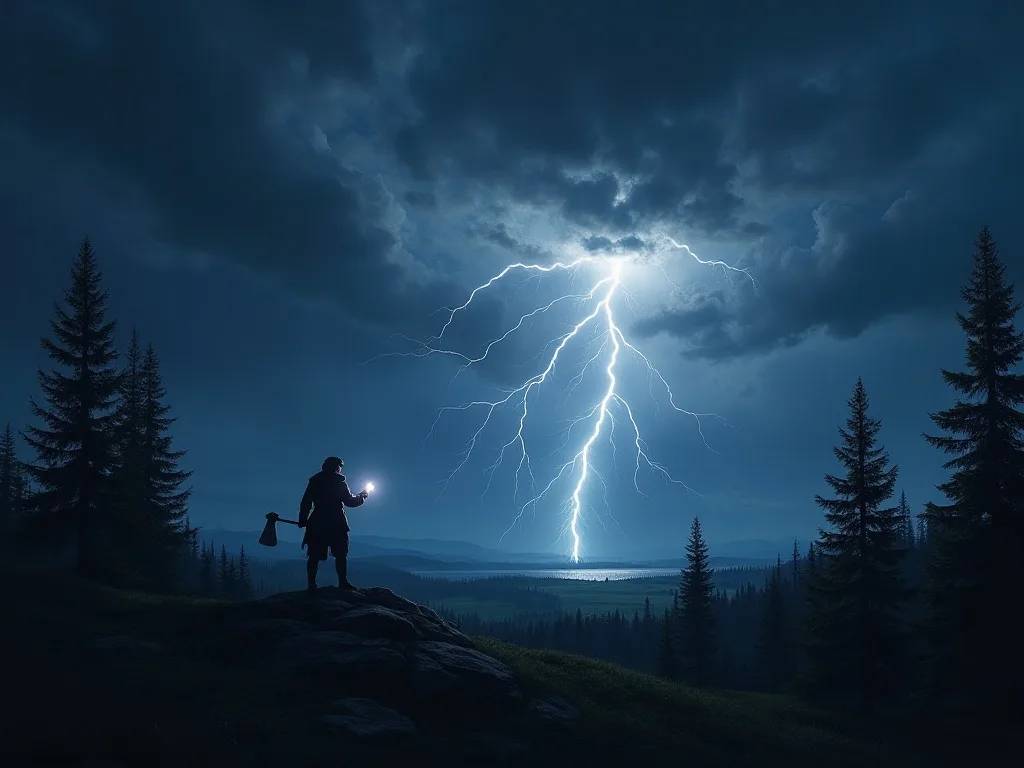
Dievas and the Sun: The Courtship Myth of the Baltic Sky
One of the oldest narrative clusters in Lithuanian and Latvian tradition involves Dievas, the sun goddess Saulė, and the moon god Meness (Lithuanian: Mėnulis). The story runs roughly as follows:
Saulė and Meness were married at the dawn of time. Dievas presided over the wedding, as he presides over all things. But Meness was unfaithful: he began an affair with the morning star, Aušrinė. When Dievas discovered this, he did not destroy Meness. He drew his silver sword and cut the moon in two. That is why the moon waxes and wanes: it is slowly healing, and every month it breaks again.
This myth, preserved in Latvian dainas and studied at length by Gimbutas in her 1963 work "The Balts," is one of the few genuine Baltic cosmogonic narratives with a clear moral structure. Dievas here acts not as a destroyer but as a judge who enforces cosmic law. He does not rage. He does not pursue the moon across the sky. He makes a single, precise cut, and then steps back. The punishment is proportional. The cosmos continues.
The myth also reveals something important about Saulė, the sun goddess, who in Baltic tradition is a powerful female figure in her own right: she drives a chariot, she weeps amber tears into the sea, she dances at midsummer. Dievas and Saulė are not husband and wife in the primary texts. They are co-regents of the sky, each with a distinct sovereignty. This horizontal arrangement between male sky and female sun is unusual in Indo-European religion, where the sun is typically male.
The Ethics of Dievas: A God Who Judges, Not Punishes
What separates Dievas: the supreme sky god of Baltic mythology from most of his Indo-European cousins is his ethical posture. He is consistently portrayed as a god who cares about justice between human beings. Several dainas describe him measuring fields at dawn to ensure that no neighbor has moved a boundary stone in the night. Others show him listening to quarrels and handing down verdicts that both parties must accept.
This made him, in practical terms, a god of oaths. Contracts sworn before Dievas were binding in a way that no human court could enforce. The breaking of an oath was not merely a legal failure; it was a cosmic rupture that Dievas himself would eventually correct.
Crucially, this correction was never violent. Dievas does not send plague or flood. He does not arrive in storm. He waits. The dainas suggest that the dishonest neighbor will eventually find his fields barren, his cattle thin, his children unlucky. The punishment is ecological: the natural world mirrors the moral state of the person. This is a theology of immanence rather than wrath, and it fits precisely the agricultural Baltic world in which every bad harvest felt like a moral verdict.
Dievas on the Ground: Worship, Ritual, and Sacred Spaces
Because no Baltic temples have been found and no liturgical texts survived, most of what we know about worship comes from three sources: the dainas themselves, the reports of Christian missionaries who were appalled by what they encountered, and later folklore gathered after conversion.
The missionaries, particularly the chronicles of the Teutonic Knights and the Livonian Order in the 13th and 14th centuries, describe outdoor sacred spaces called romuva (the most famous was reportedly a massive oak sanctuary in what is now northeastern Poland, tended by a figure called the krivis, a chief priest). Dievas was honored at the highest point of the sacred space, often associated with the burning of an eternal fire.
Dievas was not worshipped through blood sacrifice in the same way that Perkūnas was. The dainas suggest that his offerings were agricultural: the first sheaf of grain, the first cup of new beer poured on the ground, the first milk of spring. These were not gifts designed to appease a dangerous force. They were acknowledgments, the farmer's way of saying: I see you measuring my fields, and I am measuring back.
Midsummer, known as Rasos in Lithuanian and Jāņi in Latvian, was the central calendar festival. Dievas and Saulė were both honored. Fires burned on hilltops. Dew gathered at dawn was considered sacred and medicinal. Young people leaped over flames, a ritual that may preserve an older practice of passing between the sky god's light and the earth below.

After Conversion: How Dievas Survived Inside Christianity
When Lithuania converted in 1387 and Latvia followed into the Livonian Confederation over the following decades, the Christian God did not simply replace Dievas. The two names merged. In modern Lithuanian, Dievas is the standard word for God. In Latvian, Dievs means the same. The sky father who rode across the dainas and cut the moon with his silver sword became, in name at least, the God of the Bible.
This linguistic absorption was not accidental. Christian missionaries recognized that the name already carried the right connotations: a single male sovereign of the sky, just, omnipresent, morally serious. They kept the word and systematically replaced the stories.
But the stories did not fully disappear. Deep in the rural daina tradition, especially in areas that remained culturally isolated through the 18th and 19th centuries, the old images persisted. Dievas still measured fields. Dievas still wept at funerals. The sun goddess Saulė still danced at midsummer. The Baltic mythological tradition proved extraordinarily resilient because it lived in song, and songs are harder to burn than manuscripts.
The 19th-century nationalist movement accelerated a conscious revival. Lithuanian intellectuals like Simonas Daukantas wrote histories that celebrated the pre-Christian past. Latvian collectors like Krišjānis Barons published the Latvju dainas between 1894 and 1915, a six-volume collection of over 35,000 folk songs. Dievas re-emerged not as a pagan relic but as a symbol of cultural continuity.
Cross-Cultural Echoes: Dievas in the Indo-European Family
Placing Dievas inside the broader Indo-European family illuminates both his distinctiveness and his antiquity. The comparison with Zeus is irresistible but ultimately limited. Zeus absorbed the sky-father role and then expanded into a personality defined by power, transformation, and sexual dominance. Dievas never moved in that direction. He stayed close to the original Dyeus: luminous, sovereign, morally ordered.
The closer parallel is actually the Vedic Varuna, not Dyaus. Varuna in the Rigveda is the guardian of rta, cosmic order, the god who watches human behavior from the sky and notes every broken oath in his divine register. He does not punish with fire. He enfolds the guilty in his net, a slow and inevitable reckoning. The Dievas who measures boundary stones and waits for the dishonest farmer to fail is recognizably the same theological idea in a different landscape.
The Germanic Tyr, the Norse god of law and single combat, offers another partial echo. Tyr in the Prose Edda is the one-handed god who guarantees oaths and governs the assembly. Like Dievas, he is not the most powerful god in his pantheon, but he is the most just. The sky-father role in Indo-European religion consistently generates this figure: not the biggest hammer in the room, but the one everyone trusts to count the votes.
Frequently asked questions about Dievas, the Baltic sky god
Frequently asked questions
Is Dievas the same as the Christian God in Baltic cultures?
The name merged with Christianity after Lithuania's 1387 conversion, and today "Dievas" in Lithuanian and "Dievs" in Latvian simply mean "God." But the pre-Christian Dievas was a distinct figure: a sky king who rode on horseback, measured fields, attended weddings, and cut the moon with a silver sword. The name was reused; the mythology was replaced, though it survived in folk songs for centuries.
What is the relationship between Dievas and Perkūnas?
They form the two poles of Baltic sky theology. Dievas governs the bright sky, moral order, and cosmic judgment. Perkūnas governs storms, thunder, and active combat. Where Dievas is still and judicial, Perkūnas is kinetic and fierce. Together with Velnias, the underworld deity, they form a triad that scholars like Georges Dumézil and Marija Gimbutas compare to tripartite structures found across Indo-European religion.
What are the primary sources for Baltic mythology?
There is no single canonical text like the Norse Eddas or the Greek Theogony. The main sources are the dainas, traditional sung folk poems collected in large numbers during the 19th century, particularly Krišjānis Barons's six-volume Latvian collection (1894-1915). Supplementary sources include chronicles from Teutonic and Livonian missionaries, later folklore records, and comparative linguistic work tracing Proto-Indo-European roots.
Why does Dievas weep in the Baltic songs?
His tears, usually described as silver, mark him as a god who is emotionally present in human life. The dainas show him weeping particularly when young people die before their time. This emotional register distinguishes him from many Indo-European sky gods and reflects the Baltic theological emphasis on Dievas as a participant in human experience, not a remote sovereign. Haralds Biezais argued that this quality mirrors the ideal of the just and empathetic Baltic nobleman.
What does the myth of Dievas cutting the moon mean?
In the Baltic cosmogonic myth preserved in Latvian dainas, the moon god Meness was unfaithful to the sun goddess Saulė, and Dievas punished him by cutting him with a silver sword. The waxing and waning of the moon is explained as a wound that slowly heals and re-opens each month. The myth positions Dievas as the enforcer of cosmic moral law, specifically marital fidelity, and frames the lunar cycle as a permanent record of divine justice.
How is Dievas different from Zeus despite sharing the same root name?
Both descend from the Proto-Indo-European sky father Dyeus Ph2ter, but they evolved very differently. Zeus became a god of power, transformation, and broad cosmic command. Dievas remained closer to the original archetype: luminous, morally ordered, and identified with agricultural justice. He never developed Zeus's character for dramatic intervention or personal vengeance. The closer Indo-European parallel is the Vedic Varuna, who watches human oaths from the sky and enforces cosmic order through patient reckoning rather than force.
Dievas in the 21st Century: Romuva, Revival, and a Living Tradition
The story of Dievas did not end with the medieval conversion or the Soviet occupation that suppressed Baltic religious expression through most of the 20th century. Since Lithuanian independence in 1990 and Latvia's in 1991, a formal neo-pagan movement called Romuva (Lithuania) and Dievturība (Latvia, literally "holding to Dievs") has worked to reconstruct and practice the old religion.
Dievturība was founded in 1925 by Ernests Brastiņš, a Latvian artist and ethnographer who argued that the dainas preserved a genuine theology, not just folk poetry. His work was suppressed under Soviet rule, but the movement revived after 1991 and received official recognition in Latvia in 2011. Today it has several hundred active practitioners who celebrate the old calendar festivals, sing the dainas in ritual context, and maintain that Dievs is not a historical curiosity but a living presence.
Romuva in Lithuania follows a similar path. Its chief figure for decades was Jonas Trinkūnas, who died in 2014 after building the movement into an internationally recognized indigenous religion. Romuva practitioners tend sacred fires, honor Dievas at hilltop ceremonies, and frame their practice as a direct continuation of the pre-Christian tradition rather than a modern reconstruction.
What these movements preserve, beyond the songs and the ceremonies, is a particular idea of the divine: a sky god who measures rather than judges, who participates rather than commands, who weeps at human funerals and dances at human weddings. In an era when many people find traditional religion either too authoritarian or too abstract, the quiet silver king of the Baltic sky offers something genuinely unusual: a supreme deity whose primary relationship with humanity is one of careful, attentive presence. That image, 5,000 years old and still alive in sung poetry and hilltop fires, is not nothing.
Read the full book
Want the whole story?
The complete edition is an instant PDF download here, with a paperback on Amazon for selected titles.
Baltic
The Baltic Mythology Book: Perkūnas, Saulė, Dievas, and the Gods of Lithuania and Latvia
Perkūnas, Saulė, and Dievas
The last pagans of Europe: the Lithuanians and Latvians who kept their old gods into the 1400s. Perkūnas the thunderer, Saulė the sun, the sky-god Dievas, and a forest religion preserved in tens of thousands of folk songs.
More from Baltic
All articles
Baltic
The Grass Snake: Sacred Household Guardian of Baltic Homes
The grass snake was no mere reptile in Baltic homes, it was a household god, a protective spirit that lived in the walls and brought prosperity. Learn how this sacred creature shaped daily life and spiritual belief in Lithuania and Latvia.

Baltic
Dainas: Sacred Folk Songs as Living Mythology
Dainas are more than songs, they are Lithuania and Latvia's oldest mythology preserved in four-line verses sung for millennia. Discover how peasants encoded gods, rituals, and cosmic wisdom into folk poetry that shaped Baltic identity and survives today.

Baltic
Žemyna: Mother Earth Goddess of the Baltic Lands
Žemyna stands at the heart of Baltic spirituality as the life-giving earth mother who nurtures crops, heals the sick, and guards the sacred bond between humans and land. Discover how this ancient goddess shaped Lithuanian and Latvian culture for centuries.

Baltic
The Sacred Oak: World Tree of Baltic Tradition
The Sacred Oak stands at the center of Baltic cosmology as the world tree connecting earth, sky, and the underworld. Discover how Lithuania and Latvia's ancient oak groves shaped a mythology that survived centuries of Christian suppression.