
The Sacred Oak: World Tree of Baltic Tradition
The Sacred Oak stands at the center of Baltic cosmology as the world tree connecting earth, sky, and the underworld. Discover how Lithuania and Latvia's ancient oak groves shaped a mythology that survived centuries of Christian suppression.
Contents
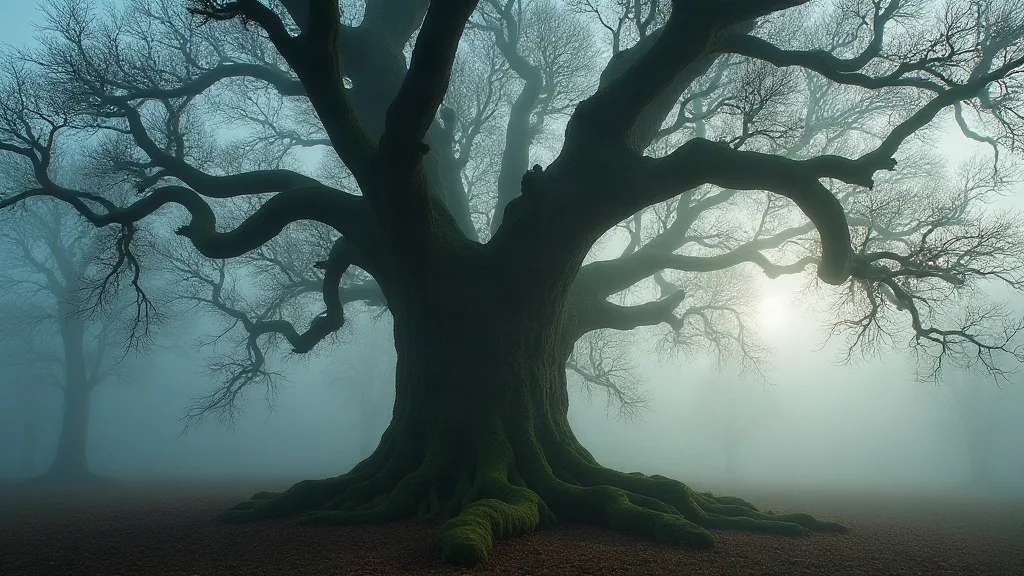
In the deepest forests of Lithuania and Latvia, ancient oaks still stand older than Christianity itself. Their gnarled trunks rise like living pillars between worlds. These were not merely trees; they were the body of cosmos, the place where gods descended, where humans left offerings, where the boundary between the living and the dead grew thin.
The Sacred Oak is not a single myth told in a surviving epic like Hesiod's Theogony or the Norse Prose Edda. Instead, it is a living symbol recovered from fragments. Archaeological evidence, folk customs that persisted through five centuries of Christian rule, and the rare written accounts by outsiders give us a portrait of how the Balts understood the tree as the axis of all existence.
Unlike the Norse Yggdrasil, which appears in full genealogy in medieval texts, the Baltic world tree remained largely unrecorded by the peoples who sustained it. This makes reconstructing it both harder and more intimate: we must read the tree in the landscape itself, in the persistence of oak veneration in modern Lithuanian and Latvian folk practice, and in the accounts of those who tried to destroy the sacred groves.
The Baltic World Tree in Cosmology
The Baltic peoples (primarily the Lithuanians, Latvians, and the now-extinct Prussians) conceived of existence as a vertical axis. The Sacred Oak stood at that center, its roots reaching into the depths below, its canopy soaring into the realm above. Unlike the horizontal geography of a flat map, the world was structured along this single, sacred line.
The tree had three realms. Below the earth lay Velinas, the realm of the dead, ruled by the god Veles or Velinas. The middle world held the living: humans, animals, and the sacred groves where Balts gathered. Above stretched the sky realm, home to the sky father Dievas and other celestial deities. The oak's roots, trunk, and crown were not merely physical; they were channels through which divine will flowed downward and human prayer ascended.
This cosmological structure appears in the later folk traditions of Lithuania and Latvia. In Latvian folklore, the world tree (sometimes called the Oak of Fate, Laima's oak, in connection with the goddess Laima who guided human destiny) was attended by guardian spirits. These spirits knew the fates of mortals and recorded them in the tree's rings, much as later Norse tradition attributed knowledge to the Norns who watered Yggdrasil.
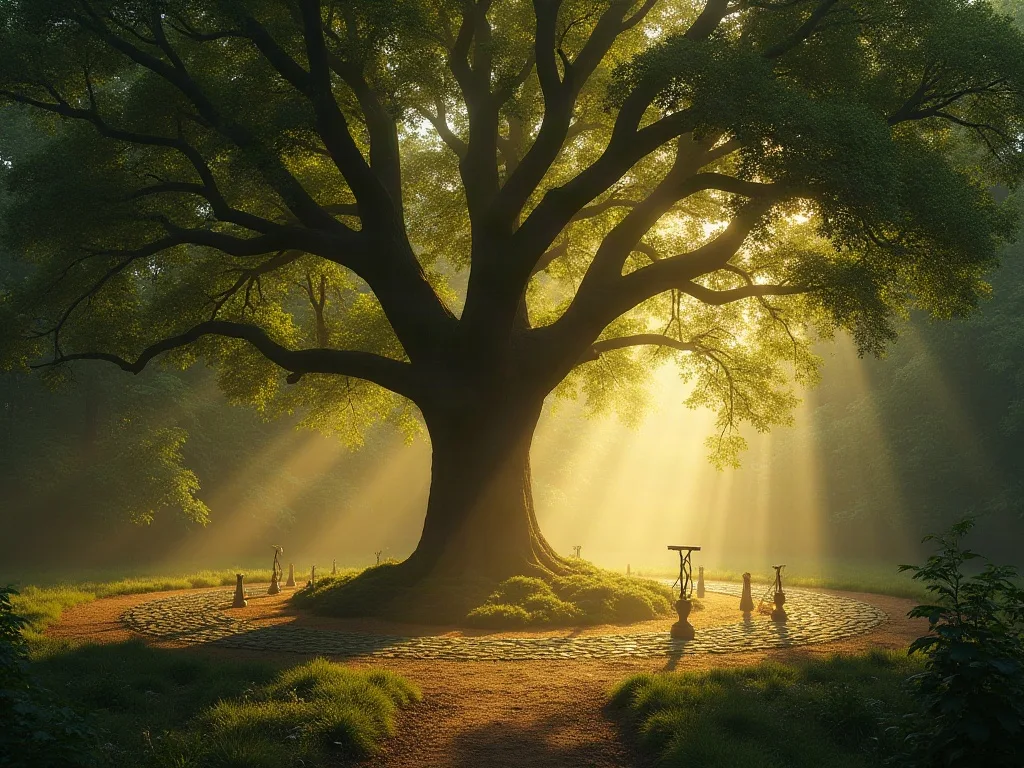
Lithuanian sacred groves (alkai, plural of alkas) were often centered on a single great oak or a cluster of oaks. These were not forests left wild; they were tended spaces, sacred enclosures marked by fences, where the community gathered for ritual. The oak within that grove was the embodiment of the cosmic tree: a physical anchor point where heaven and earth touched.
The God of Thunder and the Oak
No deity in Baltic religion is more closely bound to the oak than Perkunas (called Perkuns in Latvia, Perkele in East Slavic regions). He is the thunder god, the wielder of lightning, the protector of the sky. And his sacred tree is the oak.
In Latvian folk song (daina), Perkunas rides across the sky in a chariot pulled by goats, his hammer striking clouds to produce thunder. That hammer, in some traditions, is said to strike oaks, splitting them with lightning. Yet these lightning-struck oaks were not seen as cursed; they were sacred marks, proof that Perkunas himself had touched the tree and blessed it.
The oak also belonged to Perkunas in another way. Oak groves were places where thunder god was invoked in times of drought or plague. Young warriors would gather at the sacred oak to swear oaths, understanding that Perkunas himself witnessed those vows. To break an oath sworn at the oak was to invite the god's wrath in the form of lightning.
This connection between Perkunas and the oak may explain why, centuries later, when Christian missionaries sought to Christianize the Balts, they made the destruction of sacred oaks a primary target. To cut down the oak was to sever the connection between the god and his people. The German crusaders and later Polish-Lithuanian authorities understood, even if they did not articulate it in mythological terms, that the oak was the spiritual center of resistance.
The World Tree in Daily Life and Ritual
Unlike Yggdrasil, which remains mythological in the Norse sources, the Sacred Oak was embedded in ritual. The tree was not a metaphor; it was a place where gods and humans met.
The most important gathering was likely the Jūrė, a ritual festival held in spring or early summer in the sacred groves. The entire community would assemble before the great oak. They would leave offerings: bread, animals, honey, and beer. Some accounts describe people dancing around the tree, singing sacred songs. A priest or priestess, likely one trained in the knowledge of omens, would read the signs: the flight of birds, the entrails of sacrificed animals, the sound of wind in the oak's branches. These signs revealed the will of the gods for the coming season.
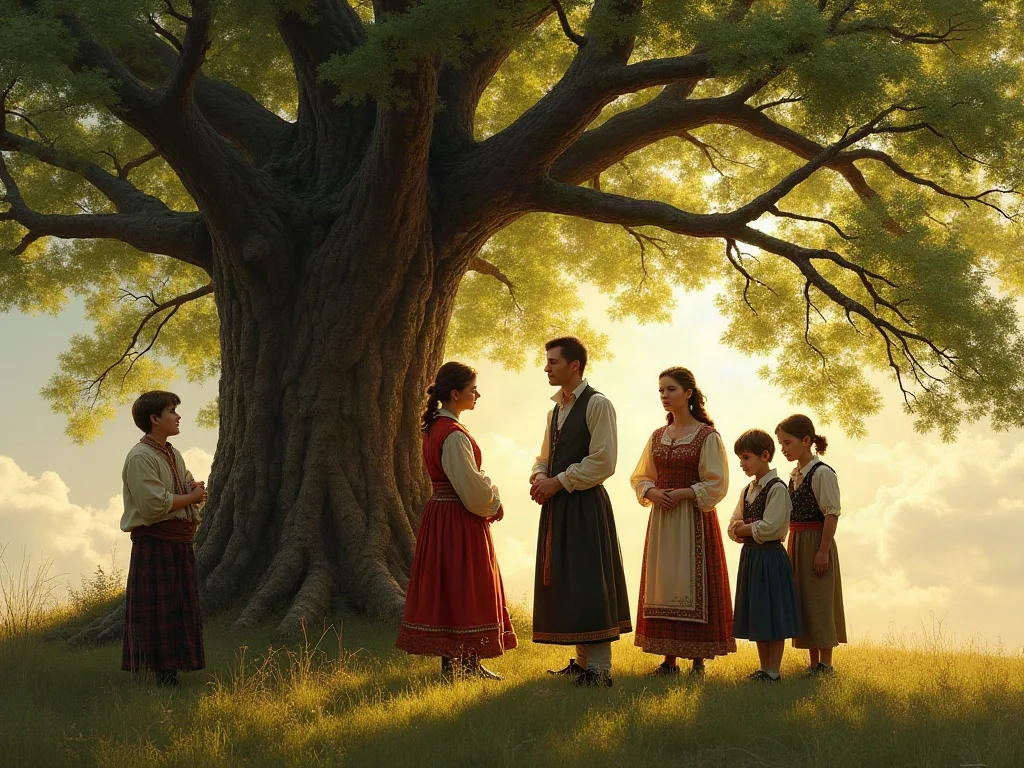
The oak also served as a gathering point for oath-taking and legal judgment. In societies without written law codes, oaths sworn before witnesses and before the god were binding. A young man might swear his betrothal oath beneath the oak's branches. A warrior might swear loyalty to a chieftain. A merchant might swear the truth of his goods. The oak witnessed all, and Perkunas (or another god invoked at that grove) stood as the enforcer of that oath.
Some oaks became local deities in their own right. A particularly ancient or massive oak might be given a name and treated as a being with its own agency and power. People would leave small offerings at its base: flowers, carved wooden figures, scraps of cloth. When someone was ill, they might go to that oak and whisper their ailment to the bark, asking for healing. When a woman could not conceive, she might embrace the oak, believing that the tree's fertility and age could transfer to her body.
This animism, which treats trees as living beings with intelligence and will, was not primitive superstition to the Balts; it was a logical extension of their understanding of the cosmos. The tree was alive. It thought. It listened. It remembered.
The Destruction of the Sacred Groves
The suppression of oak worship became one of the most violent and deliberate aspects of Christianization in the Baltic regions. Unlike Scandinavia, which had largely converted to Christianity by the 11th century through trade and gradual cultural shift, Lithuania and Latvia remained pagan well into the 14th and 15th centuries. And they resisted fiercely.
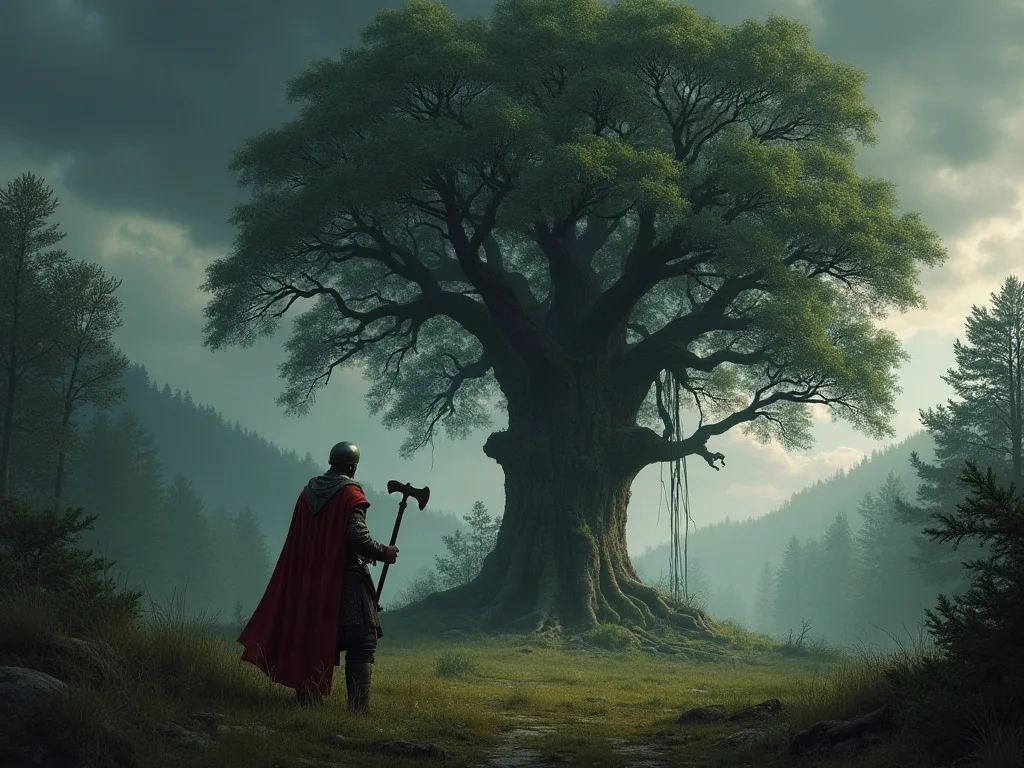
The German Order of the Teutonic Knights, tasked by the Pope with crusading against the "last pagans of Europe," made the destruction of sacred groves a military objective. Between the 13th and 16th centuries, crusaders systematically burned oak groves and cut down ancient trees. They understood, correctly, that the oak was the religious center. To kill the tree was to kill the faith.
There are accounts, likely embellished but grounded in historical event, of massive oaks being felled. One Lithuanian oak was said to be so large that it took an entire team of men, working for days, to fell it. When it fell, the people watching wept. Some sources describe Christian priests planting crosses in the stumps of sacred oaks, a symbolic replacement of the pagan axis with the Christian symbol.
Yet the oaks were never entirely erased. In the remote countryside, away from towns and German garrisons, sacred oak groves persisted. Folk practices maintained themselves under thin Christian covers. A sacred oak might be said to be protected by a saint. A ritual at the oak's base might be disguised as a Christian feast day. The tree continued its work in the shadows.
This persistence is unlike the Norse case. In Scandinavia, the written mythology of the Eddas survived in Iceland, preserved in manuscripts even after the society had Christianized. In Lithuania and Latvia, no such manuscripts existed. The mythology lived only in practice, in the folk memory of the community, in the continued reverence for ancient trees. To study the Sacred Oak is to study a tradition that survived not through texts but through the refusal of a people to abandon their groves.
The Oak and the Goddess Laima
While Perkunas is the thunder god most obviously linked to the oak, another deity also claimed connection to the world tree: Laima, a goddess of fate, fertility, and household blessing.
Laima, in Latvian tradition, is sometimes described as dwelling in the oak. She oversees the destiny of each person, recording their fate in the tree's rings or in a book kept within the oak's heart. When a child is born, Laima visits to decide its fate. When death approaches, Laima comes again. The oak is her temple; it is where she keeps her records.
This overlap between Laima and the oak suggests that the Sacred Oak was not the exclusive property of any single deity. Instead, it was a cosmological center that multiple deities inhabited or visited. Perkunas descended to the oak during storms. Laima dwelt there to record fates. Dievas, the sky father, gazed down from above and saw the tree as the axis connecting him to the world below. The oak, in this sense, was a parliament of gods, a place of meeting and intersection.
Laima also appears in Lithuanian folklore as a protective force over oaks. She was said to appear to those who cut down oaks without permission, bringing sickness or bad fortune. This suggests that the protection of the tree was not simply a religious duty but a moral one, enforced by the goddess herself.
Scholarly Debates and Reconstructions
Scholars of Baltic religion, most notably Marija Gimbutas (whose work on Indo-European goddess religions, despite some debated conclusions, drew attention to Baltic traditions), and more recent scholars like Algirdas Greimas and Haralds Biezais, have attempted to reconstruct the Sacred Oak mythology from fragmentary evidence.
The primary sources are limited. We have accounts by medieval crusaders and missionaries, which are often hostile and designed to emphasize the "paganism" they were opposing. We have folk tales and songs collected in the 19th and early 20th centuries. We have archaeological evidence of sacred groves and ritual deposits. We have the surviving place names and surnames that reference oak groves (Ąžuolas in Lithuanian means oak, and many surnames and place names incorporate it, suggesting the tree's cultural centrality).
One scholarly question remains unresolved: how much of what we call Baltic mythology is genuinely ancient, and how much is a reconstruction influenced by 19th-century Romanticism and a desire to recover a pre-Christian identity? Lithuanian and Latvian folklore was systematically collected in the 19th century, at a time when European nationalism was surging, and collectors may have emphasized elements they thought were ancient or "authentic" over others.
Nevertheless, the core consistency across sources is striking. The oak as world tree, the connection to thunder and sky, the role in oath-taking and ritual, the persecution under Christianity: these appear repeatedly, in sources separated by centuries and by geography (Prussian, Lithuanian, Latvian). This consistency suggests an underlying historical reality, even if the exact details remain disputed.
The Oak in Modern Baltic Identity
In contemporary Lithuania and Latvia, the oak has reclaimed a place of cultural prominence. It is no longer a religious center in the way it was before Christianity, but it is a symbol of national identity, historical continuity, and resistance to foreign domination.
The Lithuanian flag, adopted in the 20th century, features a coat of arms that includes various heraldic elements, but the oak appears frequently in municipal symbols and historical imagery. Folk costumes, particularly in rural areas, often incorporate oak-leaf motifs. Traditional songs and dances continue to reference the sacred groves.
There is also a contemporary revival of Baltic paganism, sometimes called Romuva (meaning "temple"), founded in the 1990s in Lithuania. This modern religious movement draws on reconstructed mythology and historical sources to practice a form of neo-paganism rooted in the pre-Christian tradition. The sacred oak is central to these practices. Romuva practitioners gather at groves, make offerings, and attempt to honor the old gods in ways they believe are continuous with ancient practice.
This revival is not unique to the Balts; we see similar reconstructed paganisms across Europe (Heathenry in Scandinavia, Druidry in Britain and Gaul). But the Lithuanian and Latvian case is distinctive because the folk tradition never entirely lapsed. The thread of connection was never completely severed. Modern Romuva practitioners are not inventing something wholly new; they are recovering and revitalizing something their grandmothers' grandmothers never completely let go of.
The Sacred Oak thus embodies a specific kind of historical trauma and recovery. It is a symbol of a culture nearly extinguished and of that culture's refusal to be erased. Every ancient oak that still stands in Lithuania or Latvia is, in a real sense, a survivor. It has outlasted empires, ideologies, and centuries of pressure to disappear.
The Oak in Comparative Mythology
Comparative study reveals that the Sacred Oak is one version of a broader Indo-European pattern of sacred trees. The Norse Yggdrasil is an ash tree (or sometimes depicted as a yew), but it too is an axis mundi, a world tree connecting realms. The Greek myth of the Oak of Dodona, sacred to Zeus, involved an oracular oak whose rustling leaves revealed the god's will. The Celtic druids (whose name may derive from a word for oak) had their own sacred groves and tree lore.
The oak appears in Indo-European traditions more broadly because the oak was a real, dominant tree in the forests where Indo-European peoples settled. It was massive, long-lived, resilient, and impressive. It was natural to imagine such a tree as the structure holding up the world.
But the Baltic Sacred Oak has a particular texture. Unlike Yggdrasil, which exists primarily in medieval literary sources, the Baltic oak remains partly embedded in landscape and folk practice. Unlike the Oak of Dodona, which became a historical monument and tourist site, the Baltic sacred oak was actively suppressed and had to survive in secret. This gives the Baltic tradition a quality of persistence under duress, of a faith maintained not through written texts or institutional continuity but through the stubborn refusal of communities to forget their groves.
Frequently asked questions about the Sacred Oak and Baltic World Tree
Frequently asked questions
Did the Baltic peoples write down myths about the Sacred Oak?
No written mythology from the Baltic peoples themselves survives. Unlike the Norse, who had the Eddas, or the Greeks, who had Homer, the Balts left no written epics. What we know comes from accounts by outsiders (often hostile), archaeological evidence of sacred groves, and folk traditions collected in the 19th and 20th centuries. This makes the Sacred Oak harder to study but also more intimately connected to lived practice.
How is the Baltic Sacred Oak different from Yggdrasil?
Both are world trees connecting cosmic realms, but they serve different cultural roles. Yggdrasil appears fully formed in medieval Norse texts and functions as a structural metaphor for the cosmos. The Baltic Sacred Oak was a living, physical center of ritual and community. Communities gathered at actual oaks for oath-taking, divination, and sacrifice. Yggdrasil was a mythological framework; the Sacred Oak was a place you could touch.
Why did Christian rulers target the sacred oak groves?
Christian authorities understood that the oak groves were the spiritual heart of Baltic paganism. Destroying the trees meant breaking the connection between the people and their gods. The Teutonic Knights and later Polish-Lithuanian rulers systematically cut down sacred oaks, sometimes replacing them with crosses, as a way of implanting Christianity and ending pagan resistance. The groves were so central that their destruction was seen as necessary to complete the Christianization process.
Do sacred oak groves still exist in Lithuania and Latvia today?
Some ancient oaks survive in protected areas and have been designated as cultural monuments. Modern practitioners of Romuva, a reconstructed Baltic paganism, have identified sites of former sacred groves and established new ritual spaces. However, most ancient groves were destroyed or lost over centuries. Those oaks that remain are treated as national heritage and symbols of cultural continuity rather than as active religious centers, though neo-pagan communities do gather at these sites.
How does Perkunas relate to the oak tree?
Perkunas, the thunder god, is the deity most directly associated with the oak. The oak was his sacred tree, and oaks were struck by his lightning during storms. This was interpreted not as a curse but as a blessing: the god had marked the tree as his own. Thunder god was invoked at oaks for protection, and oaths sworn beneath an oak were understood to be witnessed and enforced by Perkunas himself.
What is Romuva, and how does it relate to the ancient oak tradition?
Romuva is a modern Baltic pagan religion founded in Lithuania in the 1990s. It is a reconstruction of pre-Christian Baltic religion based on historical sources, folklore, and archaeological evidence. Practitioners gather at sacred groves and sites associated with ancient oaks to make offerings and honor the old gods. While Romuva is modern, it attempts to restore a tradition that was continuous in folk practice even during the Christian centuries, making it a genuine recovery rather than a complete invention.
The Oak as Memory and Resistance
What makes the Sacred Oak unique among world trees is that it never fully became myth. It remained a thing. Even as Christianity spread, even as the old religion was suppressed, ancient oaks continued to grow in remote corners of Lithuania and Latvia. They were not safely contained in texts like Yggdrasil or stored in the memory of priests trained in classical lore. They stood in forests where anyone could find them.
This is why the oak endures as a symbol of Baltic identity. It is not merely a mythological abstraction but a living connection to the past. When a Lithuanian or Latvian stands before an ancient oak today, they stand before something that their ancestors stood before. The tree has not changed in any fundamental way; it has only grown older. To touch that bark is to touch history directly.
The persistence of the Sacred Oak in Baltic consciousness through five centuries of Christianity, Soviet rule, and cultural displacement represents something profound about how societies preserve what they value most. Not through power or force, but through stubbornness, through the quiet work of grandmothers teaching their children to leave bread at the base of an old tree, through stories whispered in winter darkness that seemed harmless enough to a Christian overlord but carried the full weight of a vanished world.
The oak endures because the people refused to let it go.
Read the full book
Want the whole story?
The complete edition is an instant PDF download here, with a paperback on Amazon for selected titles.
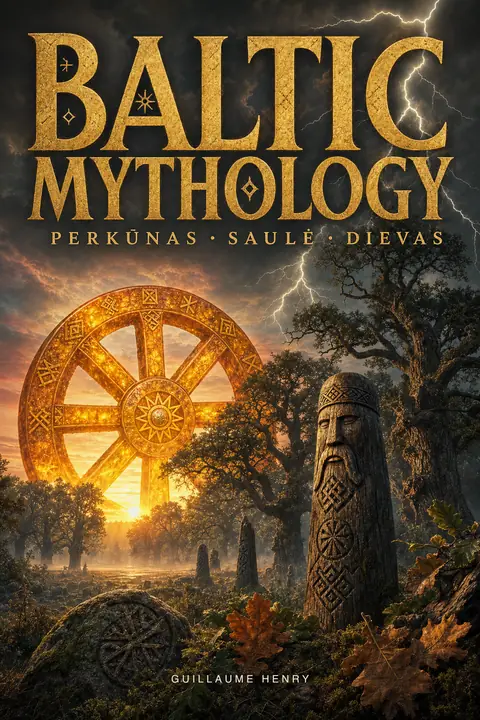
Baltic
The Baltic Mythology Book: Perkūnas, Saulė, Dievas, and the Gods of Lithuania and Latvia
Perkūnas, Saulė, and Dievas
The last pagans of Europe: the Lithuanians and Latvians who kept their old gods into the 1400s. Perkūnas the thunderer, Saulė the sun, the sky-god Dievas, and a forest religion preserved in tens of thousands of folk songs.
More from Baltic
All articles
Baltic
The Grass Snake: Sacred Household Guardian of Baltic Homes
The grass snake was no mere reptile in Baltic homes, it was a household god, a protective spirit that lived in the walls and brought prosperity. Learn how this sacred creature shaped daily life and spiritual belief in Lithuania and Latvia.
Baltic
Dainas: Sacred Folk Songs as Living Mythology
Dainas are more than songs, they are Lithuania and Latvia's oldest mythology preserved in four-line verses sung for millennia. Discover how peasants encoded gods, rituals, and cosmic wisdom into folk poetry that shaped Baltic identity and survives today.

Baltic
Žemyna: Mother Earth Goddess of the Baltic Lands
Žemyna stands at the heart of Baltic spirituality as the life-giving earth mother who nurtures crops, heals the sick, and guards the sacred bond between humans and land. Discover how this ancient goddess shaped Lithuanian and Latvian culture for centuries.

Baltic
The Creation of the World from the Cosmic Egg in Baltic Mythology
Baltic peoples believed the world hatched from a cosmic egg laid by a celestial waterfowl, a creation motif that bridges Bronze Age Indo-European roots and medieval folk memory. Discover how this myth shaped Baltic cosmology and echoes across global traditions.