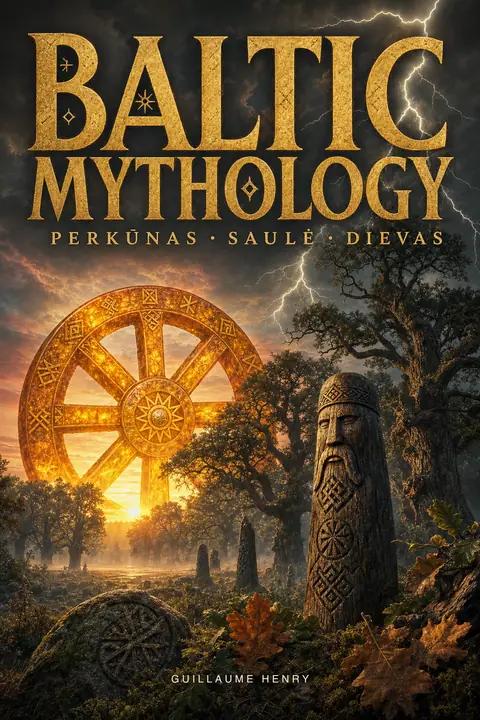
Baltic
Lithuanian, Latvian, and Prussian gods, cosmology, and sacred practices. What the dainas preserve, what the chronicles distort, and what survives today.
The Baltic peoples resisted Christianisation longer than almost any other European culture. When the Teutonic Knights finally subdued the Old Prussians in the thirteenth century and Lithuania officially converted in 1387, the old gods did not vanish. They retreated into folk songs, seasonal rituals, and the memory of grandmothers who sang while weaving. What survives is fragmentary, recorded late, and often filtered through the eyes of chroniclers who did not speak the language or understand what they were watching.
Baltic mythology is not a single tradition. It comprises at least three distinct branches: Lithuanian, Latvian, and Old Prussian, each with its own pantheon, ritual calendar, and cosmological emphasis. The sources are thin, the reconstructions are contested, and the line between authentic oral memory and nineteenth-century romantic invention is not always clear.
What Baltic mythology is, and what survives
Baltic mythology refers to the pre-Christian religious traditions of the Baltic-speaking peoples: Lithuanians, Latvians, and the now-extinct Old Prussians. These groups shared linguistic roots and certain cosmological structures, but they were never politically unified, and their mythologies diverged in detail. Lithuanian tradition centres on Perkūnas the thunderer and a complex system of household and field deities. Latvian religion, preserved largely in folk songs called dainas, emphasises solar and seasonal cycles. Old Prussian belief, known only through hostile Christian chroniclers, featured gods whose names and functions remain debated.
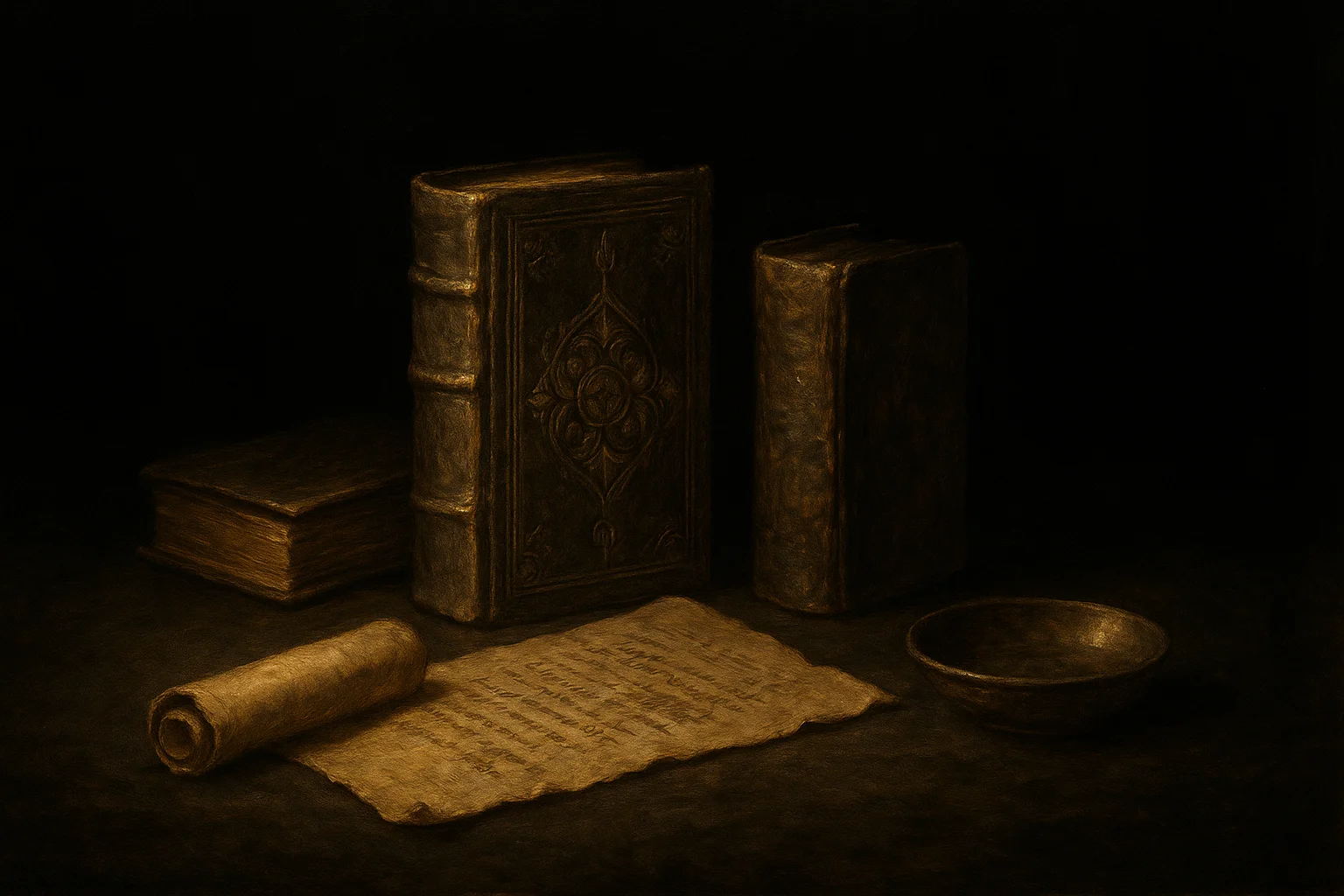
What survives is not scripture. There are no Baltic equivalents to the Eddas or the Vedas. Instead, we have folk songs recorded centuries after Christianisation, reports by medieval Polish and German chroniclers, and the testimony of Jesuit missionaries who arrived too late to see the old religion in full practice. The songs are genuine, but their interpretation is not always straightforward. A daina about the sun's daughter may preserve a myth, or it may be a metaphor for a wedding. Context has been lost.
The Old Prussians, conquered and converted by the Teutonic Order in the thirteenth century, left almost nothing in their own voice. Their gods are known from lists compiled by outsiders, often with Latin glosses that obscure as much as they clarify. By the sixteenth century, the Old Prussian language was dying. By the eighteenth, it was gone.
The sources: dainas, chronicles, and the problem of late recording
The single richest source for Baltic mythology is the corpus of Latvian dainas, collected and catalogued by Krišjānis Barons in the late nineteenth century. These are short, formulaic folk songs, often four lines long, sung by women during work, weddings, and funerals. Barons gathered over a million variants. Many reference gods, spirits, and cosmological events, but they were never intended as theological texts. They are allusive, not explanatory.
Lithuanian tradition was recorded later and less systematically. The sutartinės, polyphonic folk songs, preserve archaic linguistic forms and ritual contexts, but they are even more opaque than the dainas. Nineteenth- and twentieth-century folklorists transcribed them, but by then the meanings had often been forgotten by the singers themselves.
The earliest written accounts come from Polish and German chroniclers. Jan Długosz, writing in the fifteenth century in his Annales seu cronici incliti regni Poloniae, describes Lithuanian paganism with a mixture of curiosity and disdain. Maciej Stryjkowski's Kronika Polska, Litewska, Żmódzka (1582) lists gods and rituals, but Stryjkowski was a Catholic canon writing a century after Lithuania's official conversion. His sources are unclear, and some of his god-names appear nowhere else.
Jan Łasicki's De diis Samagitarum (1615) is a short tract listing Samogitian (western Lithuanian) deities. It is often cited, but Łasicki was a Protestant polemicist, not an ethnographer. Simon Grunau's Preussische Chronik, written in the sixteenth century, is the main source for Old Prussian gods, but Grunau was a Teutonic Knight writing in German, and his reliability is contested. Some of the gods he names may be his own inventions or misunderstandings.
The pantheon: Dievas, Perkūnas, Saule, and the structure of the sky
The Baltic sky is ruled by three figures: the distant father, the thunderer, and the sun. Their relationships vary by region, but the structure is consistent. This is a pantheon shaped by agrarian life, seasonal cycles, and the omnipresence of weather.
Dievas: the sky father
Dievas, whose name simply means "god" and shares a root with Latin deus and Sanskrit deva, is the high god of the Lithuanians. He is remote, rarely invoked in daily ritual, and associated with the vault of the sky itself. In some dainas, Dievas is a farmer who ploughs the heavens. In others, he is a blacksmith forging the sun. His role is structural rather than personal. He does not intervene in human affairs the way Perkūnas does.
Latvian tradition sometimes conflates Dievas with the Christian God, a syncretism that complicates interpretation. In older songs, Dievas appears as a patriarch overseeing the cosmic household, but his attributes are vague. He is more principle than personality.
Perkūnas: thunder, oak, and justice
Perkūnas is the most vividly characterised god in Baltic tradition. His name means "striker" or "thunderer," and he is the god of storms, oak trees, and justice. Chroniclers describe him as the most popular deity among the Lithuanians, invoked before battle and during droughts. Stryjkowski reports that eternal fires were kept burning in his honour, tended by priests who faced death if the flame went out.
Perkūnas rides across the sky in a chariot, hurling stone axes at devils and dragons in European tradition who hide in rivers and forests. When lightning strikes a tree, the wood is considered sacred. Oak groves were his sanctuaries, and offerings of beer and bread were poured at their roots. He is a god of order, the enemy of chaos, and the protector of oaths.
His mythology overlaps with that of other Indo-European thunder gods, but the details are distinctly Baltic. Unlike Thor, Perkūnas does not have a named hammer. Unlike Indra, he does not drink soma. He is a local god, tied to the landscape of the eastern Baltic, where summer storms are sudden and violent.
Saule: the sun goddess and her daily journey
Saule, the sun, is female in Baltic tradition, as she is in Germanic and many other Indo-European mythologies. She is a goddess of warmth, growth, and the daily rhythm of life. In the dainas, Saule is often depicted as a bride, a mother, or a weaver. She rises from the sea each morning, crosses the sky in a chariot or boat, and descends into the underworld at night.
Her mythology is rich with domestic metaphor. She spins golden thread, she washes her face in the sea, she dances at weddings. But she is also a cosmic figure. Her daily journey structures time itself. The solstices are moments when Saule pauses, and rituals mark her turning.
In some songs, Saule has daughters who are courted by the moon or the morning star. These narratives are fragmentary, but they suggest a cosmology in which celestial bodies are persons, not merely objects. The sun is not a thing that shines. She is someone who works, who rests, who mourns.
Goddesses of fate, earth, and death
Baltic religion is unusual among Indo-European traditions for the prominence of its goddesses. They are not consorts or secondary figures. They are autonomous powers who govern birth, death, and the land itself.
Laima: fate and childbirth
Laima is the goddess of fate, childbirth, and marriage. Her name derives from a root meaning "luck" or "portion." She is present at every birth, determining the child's destiny. In some traditions, there are three Laimas, spinning the thread of life like the Greek Moirai or the Norse Norns. In others, Laima is singular, a goddess who can be petitioned but not defied.
Women in labour called on Laima, and offerings were left for her at crossroads. She is both benevolent and implacable. She gives life, but she also sets its limits. In the dainas, Laima is sometimes depicted weaving or measuring cloth, metaphors for the span of a human life.
Žemyna: the earth mother
Žemyna, whose name means "earth," is the goddess of the soil, crops, and the fertility of the land. She is invoked at planting and harvest, and offerings of bread and beer are poured directly onto the ground. In some traditions, she is the wife of Perkūnas. In others, she is independent, a goddess older than the sky gods.
Žemyna is not a distant figure. She is the dirt under the plough, the grain in the field, the boundary stone at the edge of the farm. Farmers swore oaths by her name, and to break such an oath was to invite crop failure. She is immanent, not transcendent.
Vėlės and the realm of the dead
The vėlės are the spirits of the dead, and the word also refers to the underworld itself. In Lithuanian tradition, the dead do not disappear. They remain present, especially during certain times of the year. The feast of Vėlinės, still observed in Lithuania, is a time when the living set out food for the dead and light candles at graves.
The vėlės are not ghosts in the modern sense. They are ancestors, protective and sometimes demanding. They expect to be remembered. Neglect them, and misfortune follows. Honour them, and they bless the household. The boundary between the living and the dead is permeable, not absolute.
Lithuanian vėlės
Spirits of the dead who remain active in the world, requiring regular offerings and remembrance at household altars and gravesides.
SlavicNav
The realm of the dead, often located across water, where ancestors dwell but do not typically return to the living world.
Old Prussian deities and the Teutonic erasure
The Old Prussians were the first Baltic people to face sustained Christian conquest. The Teutonic Order, a military-religious order of German knights, invaded Prussia in the thirteenth century and waged a brutal campaign of conversion. By 1283, the last Prussian resistance had been crushed. The old religion was suppressed, its priests killed or converted, its sacred groves burned.
What little we know of Old Prussian gods comes from hostile sources. Simon Grunau lists deities like Perkūns (cognate with Lithuanian Perkūnas) and Potrimpo, a god of rivers or crops. Jan Łasicki adds names like Patrimpas and Patollo, but the functions he assigns them are inconsistent with other sources. Some scholars suspect Łasicki invented or misunderstood his material.
Archaeological evidence is sparse. The Teutonic Knights destroyed temples and reused sacred sites for churches. A few stone idols survive, but without inscriptions or context, their identification is speculative. The Old Prussian language, once spoken across the southern Baltic coast, is now known only from a handful of glossaries and a single catechism translated in the sixteenth century.
The erasure was thorough. By the time folklorists arrived in the nineteenth century, Old Prussian tradition was beyond recovery. What remains are names without stories, and stories without names.
Sacred groves, fire rituals, and the persistence of practice
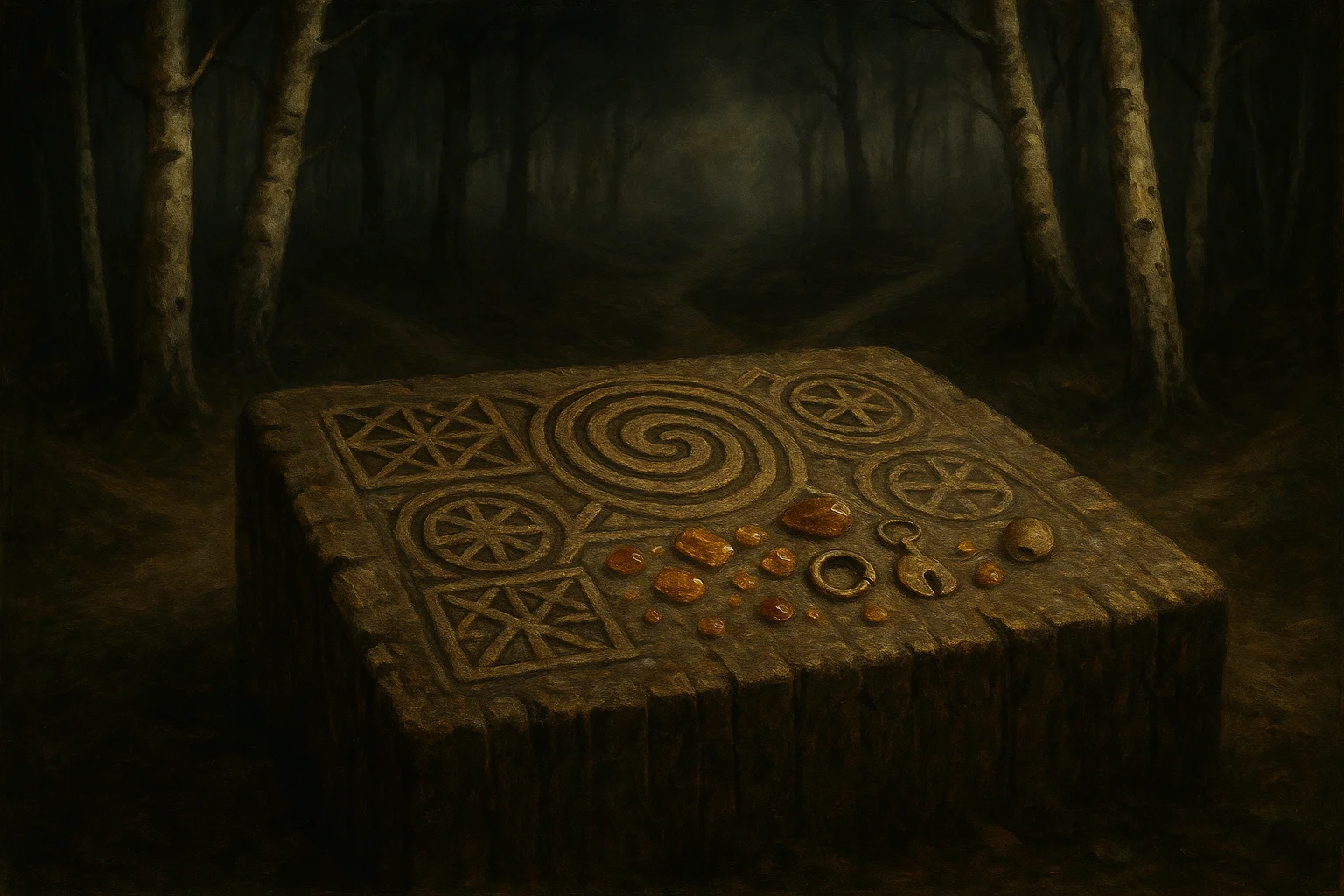
Baltic paganism was not a religion of temples. It was a religion of groves, springs, and open-air sanctuaries. Oak groves were especially sacred, associated with Perkūnas and protected by taboo. To cut a tree in such a grove was to invite divine retribution. Chroniclers report that Lithuanians would not enter these groves without permission from the priests, and that offerings of animals, beer, and bread were left at the roots of the oldest oaks.
Fire was central to Baltic ritual. Eternal flames were kept burning at major sanctuaries, tended by priests or priestesses. Stryjkowski describes a fire at Vilnius that burned for centuries, fed with oak wood and never allowed to go out. When the flame was finally extinguished after Lithuania's conversion, it was considered a cosmic disaster.
Household rituals persisted long after official Christianisation. The hearth fire was sacred, and offerings were made to it daily. The threshold of the house was a boundary between worlds, and spirits called creatures of forest and water were believed to cross it at certain times. Bread was left out for the vėlės, and beer was poured onto the ground for Žemyna.
Seasonal festivals marked the agricultural calendar. Midsummer, the feast of Rasos or Joninės, was a night of fire, song, and divination. Young people leapt over bonfires, and wreaths were floated on rivers. The winter solstice, Kūčios, involved rituals to ensure the sun's return. These festivals were Christianised but never fully replaced. The old names and gestures survived.
They worship fire, which they call Znicz, and they keep it burning perpetually, and if it goes out, they believe great misfortune will follow. Maciej Stryjkowski, Kronika Polska, Litewska, Żmódzka (1582)
Cosmology: the world tree, the celestial forge, and the serpent below
Baltic cosmology is vertical. The world is structured in layers: sky, earth, and underworld, connected by a great tree or pillar. The sky is the realm of Dievas, Perkūnas, and Saule. The earth is the domain of Žemyna and the living. The underworld is where the vėlės dwell and where the sun travels at night.
The world tree, sometimes called the austras koks or "tree of dawn," stands at the centre of the cosmos. Its roots reach into the underworld, its trunk supports the earth, and its branches hold up the sky. In some dainas, the sun rests in its branches at night. In others, the tree is the axis around which the stars revolve.
At the base of the tree, or beneath the earth, lies a serpent coiled beneath the world tree. This serpent is sometimes depicted as an enemy of Perkūnas, who strikes it with lightning. In other traditions, the serpent is a guardian or a symbol of the underworld's power. The mythology is fragmentary, and the serpent's role is not fully clear.
The celestial forge is another recurring image. In some songs, Dievas or Perkūnas is a blacksmith who hammers the sun into shape or forges the stars. The sky is not a passive dome. It is a workshop, a place of labour and creation. This image may reflect the importance of metalworking in Baltic culture, or it may be an older Indo-European motif.
Baltic mythology today: revival, folklore, and living tradition
Baltic mythology did not die in 1387. It went underground, surfacing in folk songs, seasonal rituals, and the quiet practices of rural life. In the nineteenth century, as nationalism swept across Europe, Baltic intellectuals turned to their pagan past as a source of identity. Folklorists collected songs, linguists reconstructed god-names, and poets wrote epics based on fragments.
This revival was not purely scholarly. It was political. For Lithuanians and Latvians living under Russian or German rule, the old gods were symbols of autonomy and resistance. The dainas were not just songs. They were proof of a culture that had survived conquest and conversion. But the revival also invented. Nineteenth-century poets filled in gaps, harmonised contradictions, and sometimes created myths where none had existed.
Today, Baltic paganism exists in several forms. There are neopagan movements, particularly Romuva in Lithuania and Dievturība in Latvia, which attempt to reconstruct pre-Christian practice. These groups hold seasonal festivals, maintain sacred groves, and honour the old gods. Their rituals are based on folklore and scholarship, but they are modern creations, not unbroken traditions.
At the same time, elements of Baltic paganism persist in folk practice. Midsummer fires are still lit, offerings are still left for the dead, and certain trees and springs are still considered sacred. These practices are not always labelled as pagan. They are simply what people do, handed down from grandparents who handed them down from theirs.
The line between revival and survival is not always clear. A woman who leaves bread for the vėlės may not think of herself as pagan. A family that lights a fire on Midsummer may not know they are honouring Saule. But the gestures remain, and the gods, in some form, are still remembered.
Frequently asked questions
What are the main gods in Baltic mythology?
The core deities are Dievas (the sky father), Perkūnas (thunder and justice), Saule (the sun), Laima (fate and childbirth), and Žemyna (the earth). Old Prussian tradition includes additional gods like Perkūns and Potrimpo, though their functions are less certain. The pantheon varies between Lithuanian, Latvian, and Old Prussian sources.
Why did Baltic paganism survive longer than other European traditions?
Lithuania was geographically isolated, politically fragmented, and resistant to external conquest. The Teutonic Order conquered the Old Prussians in the thirteenth century, but Lithuania remained independent and pagan until 1387. Even after official conversion, rural areas maintained folk practices for centuries. The lack of centralised religious authority made suppression difficult.
How reliable are the dainas as mythological sources?
The dainas are genuine folk songs, but they were recorded centuries after Christianisation and were never intended as theological texts. They preserve fragments of myth, but interpretation requires caution. Many songs are metaphorical, and their original meanings may have been lost by the time folklorists transcribed them. They are valuable but incomplete.
What happened to Old Prussian mythology?
Old Prussian religion was systematically destroyed by the Teutonic Order during the thirteenth-century conquest. Sacred groves were burned, priests were killed, and the population was forcibly converted. By the sixteenth century, the Old Prussian language was dying, and by the eighteenth, it was extinct. What survives are fragmentary lists of god-names recorded by hostile chroniclers.
Are there connections between Baltic and Slavic mythology?
Yes, but the relationship is debated. Baltic and Slavic languages share a common ancestor, and some deities have cognates: Lithuanian Perkūnas and Slavic Perun, for example. However, the mythologies diverged significantly. Baltic tradition emphasises solar and earth goddesses more than Slavic does, and the cosmologies differ in structure. Borrowing and shared inheritance are both likely.
How accurate are modern Baltic pagan revivals?
Modern movements like Romuva and Dievturība are reconstructions based on folklore, chronicles, and comparative mythology. They are sincere attempts to revive pre-Christian practice, but they are not unbroken traditions. Much has been lost, and modern practitioners must fill gaps with educated guesses. The rituals are meaningful, but they are also modern creations.
Further reading on Mythologis
- The serpent coiled beneath the world tree in Norse cosmology
- Dragons in European tradition and their roles as guardians and chaos symbols
- Creatures of forest and water across European folklore
- Werewolf legends and shapeshifting in Baltic and Slavic tradition
- Vampire folklore and the undead in eastern European belief