
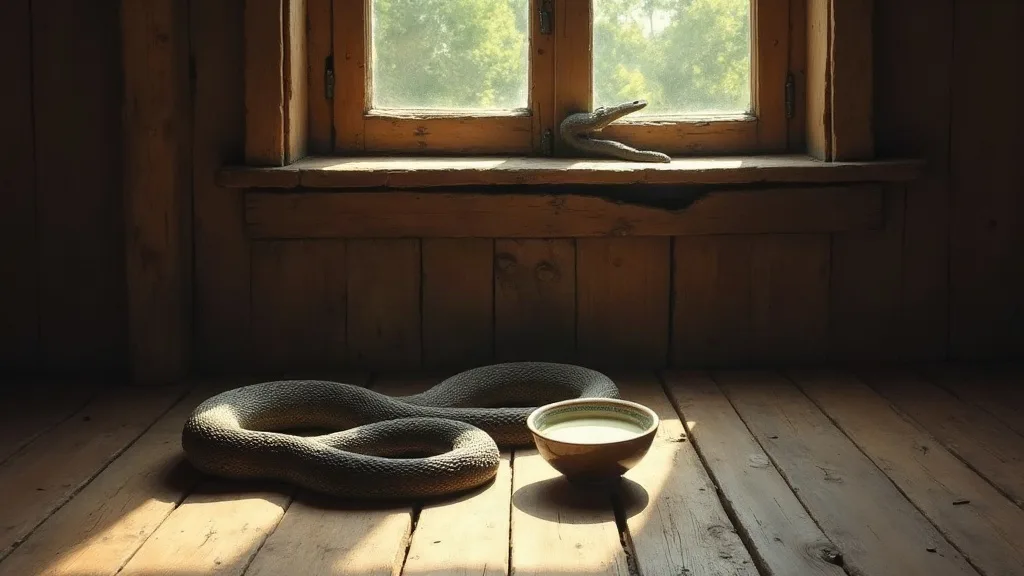
The Grass Snake: Sacred Household Guardian of Baltic Homes
The grass snake was no mere reptile in Baltic homes, it was a household god, a protective spirit that lived in the walls and brought prosperity. Learn how this sacred creature shaped daily life and spiritual belief in Lithuania and Latvia.
Contents
The grass snake coils in the corner of a farmhouse kitchen, its dark body catching the firelight. No one moves. The family watches in silence, then goes about their meal. Centuries ago, in the homes of Lithuania and Latvia, this was not an intrusion. It was a visitation.
The grass snake was no ordinary creature in Baltic households. It was zmija, the household serpent, a guardian spirit believed to bring fertility to crops, protection to livestock, and prosperity to the family that sheltered it. Where other European cultures saw a pest or a symbol of danger, the Baltic peoples saw a sacred companion, a bridge between the mortal home and the divine forces that sustained life.
The relationship between Baltic peoples and grass snakes reveals something essential about how the ancients understood the boundary between the natural and the sacred. The snake was not distant mythology. It lived under the floorboards. It shared the warmth of the hearth. It was household religion made flesh.
Origins and Household Divinity in Baltic Belief
The concept of a protective household spirit has deep roots in Baltic religion, stretching back to pre-Christian times when the Dievas (the sky god) and his celestial court were not the only powers at work in daily life. Local spirits inhabited specific places: the bathhouse, the threshold, the barn, the forest edge. The grass snake occupied a singular position, it was the domestic guardian, the spirit most intimate with family survival.
Lithuanian and Latvian sources, though fragmented and filtered through Christian chroniclers, preserve traces of this ancient understanding. The snake was understood to be not simply an animal but a spirit-animal, possibly a manifestation of an ancestor's protective power or a minor household deity. In Old Prussian, the word anguis (snake) appears in place names and personal names suggesting religious significance. In Lithuanian, zmija carries connotations of wisdom, abundance, and guardianship.
The grass snake's role as sacred household guardian emerged directly from the economic and spiritual reality of Baltic agricultural life. Farmers depended on the successful harvest, the health of cattle, the safety of stored grain through winter. A snake in the home did not destroy these things, on the contrary, snakes hunted mice and rats, the true destroyers of stores. What began as practical coexistence transformed into sacred relationship.
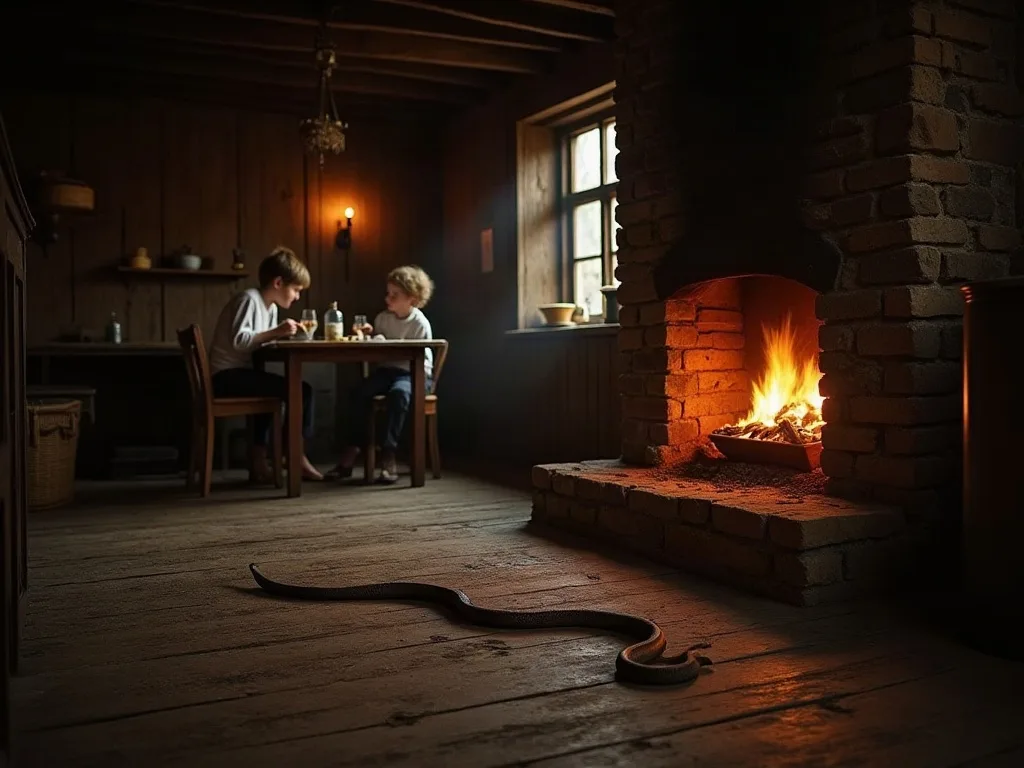
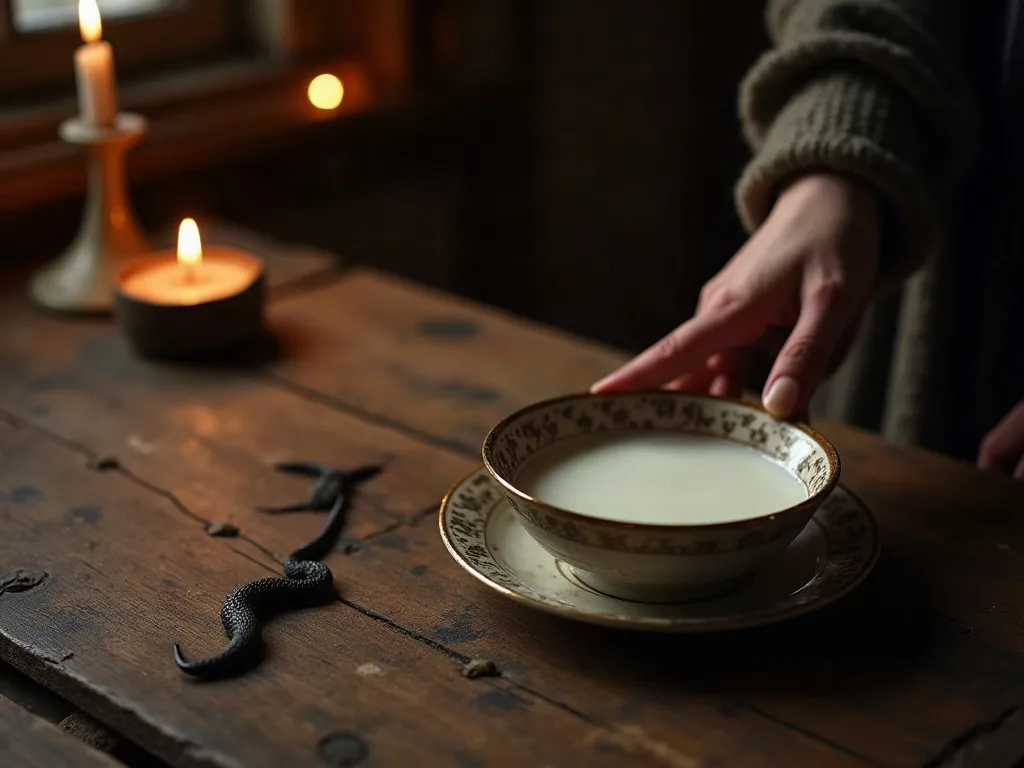
The household serpent became institutionalized in Baltic domestic practice. If a family found a grass snake in their home, they did not kill it. They fed it milk, cream, or eggs. They provided it shelter. Some accounts describe families deliberately attracting snakes to their homes or choosing not to leave their premises if the snake departed, believing that the creature's absence signaled divine disfavor.
The Snake and Household Prosperity
A grass snake dwelling in a home brought tangible blessings, or so Baltic belief held. The creature was associated with:
- Fertility of fields and livestock
- Protection from hunger and want
- Safe childbirth and healthy children
- Preservation of stored food from vermin and decay
- Good fortune in domestic and business matters
The connection between the serpent and fertility runs deep in Indo-European mythology, but the Baltic version is distinctly domestic in scale. Where the serpent in many traditions is a cosmic force or an underworld power, the Baltic grass snake is a neighbor, a housemate, almost a family member.
Accounts from 19th-century ethnographers, people collecting folklore from communities still living in the shadow of pagan practice, describe elaborate rituals of hospitality toward the household snake. At mealtimes, food was set aside for the serpent. During harvests, a portion of grain was left for it. Some families believed that if they fed the snake well, it would not leave, and if it left, misfortune would follow.
One recorded account describes a Lithuanian family that discovered a grass snake in their home. The mother began leaving a saucer of milk each morning. The snake drank from it regularly. After several years of this care, the family prospered; their cattle multiplied, their harvest was abundant, their children were healthy and strong. When the snake vanished one winter, the family experienced a sudden reversal: illness struck the livestock, the fields yielded poorly, and the household fell into difficulty. In Baltic understanding, this was no coincidence but cause and effect.
Symbolism: The Sacred Serpent and Divine Connection
The grass snake embodied several symbolic dimensions simultaneously. It was:
A link to the earth's fertility. Snakes shed their skin, emerging renewed, a natural image of regeneration and abundance. In Baltic cosmology, fertility was not abstract but essential; it was the difference between thriving and starvation.
A representative of the otherworld. Snakes live in hidden places, in crevices and burrows beneath the visible world. By inhabiting the walls of a home, the household serpent represented a living connection to the powers beneath the floorboards, the spirits of the land itself.
An ancestral presence. Some scholars suggest that the grass snake may have represented a protective ancestor, the household guardian returned in animal form. This interpretation finds support in Baltic beliefs about transformation and the permeability of the living and dead.
A mediator between human and divine. By dwelling in the home and accepting food from human hands, the grass snake created a sacred exchange, a covenant of mutual obligation between household and spirit.

The serpent's color and form also carried meaning. The dark, sinuous body moving through shadow created an impression of otherness, of a presence that belonged to two worlds at once. Its silence and stillness made it seem wise, patient, watchful. When it appeared, it was not as an intrusion but as a recognition, the family was blessed with a visitor from the realm of spirits.
Rituals and Daily Practice
The relationship between Baltic families and grass snakes was formalized through daily and seasonal ritual, though these practices were never written down in formal liturgies, they were simply how one lived.
Morning offerings. In many households, fresh milk or cream was placed in a saucer each morning, often near the hearth or in the room where the snake was most frequently seen. This was not feeding an animal but honoring a guest from the other side.
Seasonal acknowledgment. At harvest time, families would set aside grain or other products for the snake, ensuring it had plenty through the winter. This practice echoed larger communal offerings to gods and spirits.
Protection from harm. Crucially, a household member who killed the snake, or allowed it to be killed, was believed to invite disaster. The killer might suffer illness, injury, or death. The family would face poverty, disease among livestock, or failed harvests. This taboo reinforced the snake's sacred status and ensured its physical safety.
Boundaries of hospitality. The snake was tolerated in certain spaces, the kitchen, the barn, the storeroom, but its presence in a sleeping chamber might prompt gentle relocation rather than eviction. The relationship was not unlimited but bounded by practical domestic life.
The Grass Snake and Household Deities
The grass snake must be understood within the broader landscape of Baltic household religion. The domestic sphere in Baltic belief was not simply secular space, it was religiously organized. The hearth had its spirit guardian, the threshold had its protector, the barn had its own sacred presence.
The household serpent occupied a unique position because it was visible, tangible, and present. While other household spirits might be invoked through words or offerings left in designated places, the grass snake was a direct manifestation. It could be seen. It could eat from your hand. It could leave or return.
This immediacy gave the grass snake a kind of spiritual authority that abstract deities did not possess. The family did not need to imagine whether the household serpent existed, it coiled in the corner, concrete and undeniable.
Some scholars propose connections between the household grass snake and larger figures in Baltic mythology. The name Vėlinas, the lord of the dead and the underworld, is sometimes linked etymologically to concepts of dwelling and inhabitation. The grass snake, as a dweller in the liminal spaces of the home, might represent a minor manifestation of such chthonic powers, not death itself, but the earth-bound forces that sustained fertility and growth.
Cross-Cultural Echoes: The Household Snake Across Indo-European Traditions
The Baltic grass snake is not entirely unique. Similar sacred household serpents appear in other Indo-European traditions, though often less centrally.
In Vedic India, serpents (nagas) are associated with fertility, water, and abundance. While not exactly household spirits in the Greek or Baltic sense, they are sacred beings that must be honored. Shiva himself wears serpents as ornaments, and the king cobra is treated with reverence and protection.
In Slavic tradition, similar beliefs in household snakes persist, particularly among Russian and Ukrainian communities. The zmei (dragon) or household serpent is sometimes seen as a protective spirit, though this belief is less systematized than in Baltic cultures.
In Germanic tradition, we find echoes in the concept of landvættir, spirits of place that must be respected and honored, though these are not typically serpentine.
The Baltic version stands out for its domestic intimacy and the central role the creature plays in family prosperity. The grass snake is not a deity to be worshipped from a distance but a neighbor to be fed, a companion to be protected, almost a family member with its own rights and place in the household.
The Grass Snake in Historical Sources
Our knowledge of the grass snake's sacred role in Baltic life comes from several layers of sources, each filtered through its own perspective and limitations.
Medieval chronicles by German Crusaders and missionaries (such as the Chronicon Prussicum) contain scattered references to snake worship among Baltic peoples. These accounts are often hostile, the chroniclers were attempting to justify conquest and conversion, but they do confirm that serpent veneration was real and widespread enough to warrant mention.
19th-century ethnographic collections are more detailed. Scholars like Matthias Mieses and later Lithuanian folklorists recorded accounts from peasant communities still living according to older patterns. These accounts describe the daily practice of feeding household snakes, the belief in their protective power, and the taboos surrounding their harm.
Linguistic evidence supports the religious significance. The Old Prussian anguis appears in place names like Angstiberghe, suggesting sacred associations with snakes in specific locations. Lithuanian zmija carries connotations of wisdom and guardianship in folk tradition.
Archaeological evidence is limited but suggestive. Some ancient Baltic burial sites contain snake-related artifacts and symbols, though interpretation remains contested.
The challenge is that Baltic paganism was largely suppressed or went underground after Christianization (which occurred centuries after other European regions, Lithuania was not formally Christian until 1387, and rural practices persisted far longer). By the time detailed records were kept, the beliefs had already been Christianized, hidden, or reinterpreted. The household snake might be explained away as simply a practical pest-control measure or redescribed in terms the Christian recorder could accept.
Yet the consistency of accounts across regions and centuries suggests a core belief system that persisted despite suppression. The household serpent was real in the minds and daily lives of Baltic peoples, and it shaped behavior, ritual, and worldview.
Decline and Survival
Christianization challenged the sacred status of the household snake, but it did not eliminate it. The transition from pagan to Christian Lithuania and Latvia was gradual and complex. In rural communities, the old practice of feeding snakes and treating them as household protectors persisted well into the 19th and 20th centuries, sometimes reframed in Christian terms (the snake as a sign of God's providence, for instance) or simply maintained as custom without explicit religious justification.
By the modern era, the belief had largely faded in urban centers, though it persisted in isolated rural areas. 20th-century ethnographers noted that some elderly Baltic people still remembered the old practice or maintained it quietly. The reverence for grass snakes, the prohibition against killing them, and the association with household prosperity lived on in folk memory and folk practice.
Today, the grass snake survives as a cultural memory in Baltic folklore and literature. Writers and artists have drawn on the image of the household serpent as an emblem of a lost spiritual world, a connection to pre-Christian belief that remains potent in the imagination.
The Grass Snake and Modern Understanding
The grass snake's role as a sacred household guardian speaks to something ancient peoples understood that we sometimes forget: the boundary between the domestic and the divine was permeable. The home was not simply a shelter from nature but a sacred space that required maintaining right relationship with the powers, both natural and supernatural, that dwelt within and around it.
The practical truth is simple: grass snakes do eat rodents, and rodents were destructive to stored food. But the Baltic peoples elevated this fact to a spiritual principle. The snake was not merely useful; it was an agent of divine protection. By honoring it with food and protection, the family acknowledged its role in the cosmic order and ensured their own place within it.
This worldview, where the smallest creature can carry sacred significance, where the boundary between animal and spirit is fluid, where daily ritual and cosmic order are connected, represents a way of understanding the world that many modern people have lost. Reading about the grass snake in a Lithuanian farmhouse, we glimpse that world: humble, concrete, and yet saturated with meaning.
Frequently asked questions about the grass snake in Baltic tradition?
Frequently asked questions
Was the grass snake actually worshipped as a god?
Not in the formal sense, it was not given temples or large public cult. Rather, it was revered as a household spirit or minor deity, treated with the daily ritual respect that one might offer a powerful neighbor. The relationship was intimate and practical rather than grand or distant.
Did all Baltic families keep grass snakes, or only some?
Sources suggest the practice was widespread but not universal. Some families deliberately attracted snakes to their homes or chose not to harm them if they appeared. Others may have tolerated them without the same level of veneration. The belief system was clearly shared, but individual observance likely varied.
What happened if a household snake was killed?
The belief was that killing the snake would bring severe consequences: illness, injury, or death to the killer; poverty, disease, or failed harvests to the family. This taboo was powerful enough to deter harm across communities and centuries, reinforcing the snake's sacred status.
How does the Baltic grass snake compare to other serpent traditions?
While serpents appear in many Indo-European mythologies as symbols of fertility or cosmic power, the Baltic grass snake is unique for its domestic intimacy. It is not a distant deity but a housemate, a practical guardian whose presence in everyday life makes it sacred. This fusion of the mundane and the divine is distinctly Baltic.
Are grass snakes still revered in Lithuania and Latvia today?
The formal belief system has largely faded, though cultural memory persists in folklore, literature, and art. Some rural communities may retain elements of the old respect for snakes. The grass snake appears in modern Baltic culture as a symbol of lost spiritual connection and ancestral wisdom.
What sources tell us about the household serpent?
Medieval chronicles, 19th-century ethnographic collections, linguistic evidence in place names and words, and oral traditions recorded in the 20th century all contribute to our understanding. No single primary text exists; instead, we piece together a picture from multiple fragmentary sources.
The Household Serpent in the Modern Recovery of Baltic Spirituality
The grass snake has experienced a quiet revival in recent decades as part of a broader renewal of interest in Baltic indigenous religion and pre-Christian spirituality. Organizations dedicated to the reconstruction of Baltic paganism, known as Dievas or Romuva, have drawn on historical sources and oral tradition to revive rituals and worldviews centered on respect for nature, local spirits, and household guardians.
The grass snake appears in this revival not as a relic but as a teaching, a reminder that the sacred is not confined to grand deities and cosmic narratives but lives in the intimate spaces of home and daily practice. For contemporary practitioners seeking to reconnect with Baltic ancestral spirituality, the household serpent represents a form of religion that is accessible, practical, and rooted in real relationship with the natural world.
This modern recovery is itself valuable because it demonstrates that the belief was never truly eradicated. It persisted in memory, in folk practice, in the stubborn refusal of rural communities to fully abandon the reverence their ancestors held for the creature sharing their space.
The image of milk placed each morning beside the hearth for an unseen serpent guest, this small act carries within it the entire worldview of Baltic peoples. The home is a sacred threshold. The creatures we share it with are more than accidents of nature. Prosperity comes not from individual effort alone but from maintaining right relationship with the forces, visible and invisible, that dwell alongside us. The grass snake, in its silence and in the simplicity of its hunger, teaches us about a way of being in the world that many cultures have lost: attentive, humble, ritualized, alive to the presence of the sacred in the ordinary.
Read the full book
Want the whole story?
The complete edition is an instant PDF download here, with a paperback on Amazon for selected titles.

Baltic
The Baltic Mythology Book: Perkūnas, Saulė, Dievas, and the Gods of Lithuania and Latvia
Perkūnas, Saulė, and Dievas
The last pagans of Europe: the Lithuanians and Latvians who kept their old gods into the 1400s. Perkūnas the thunderer, Saulė the sun, the sky-god Dievas, and a forest religion preserved in tens of thousands of folk songs.
More from Baltic
All articles
Baltic
Dainas: Sacred Folk Songs as Living Mythology
Dainas are more than songs, they are Lithuania and Latvia's oldest mythology preserved in four-line verses sung for millennia. Discover how peasants encoded gods, rituals, and cosmic wisdom into folk poetry that shaped Baltic identity and survives today.

Baltic
Žemyna: Mother Earth Goddess of the Baltic Lands
Žemyna stands at the heart of Baltic spirituality as the life-giving earth mother who nurtures crops, heals the sick, and guards the sacred bond between humans and land. Discover how this ancient goddess shaped Lithuanian and Latvian culture for centuries.

Baltic
The Sacred Oak: World Tree of Baltic Tradition
The Sacred Oak stands at the center of Baltic cosmology as the world tree connecting earth, sky, and the underworld. Discover how Lithuania and Latvia's ancient oak groves shaped a mythology that survived centuries of Christian suppression.

Baltic
The Creation of the World from the Cosmic Egg in Baltic Mythology
Baltic peoples believed the world hatched from a cosmic egg laid by a celestial waterfowl, a creation motif that bridges Bronze Age Indo-European roots and medieval folk memory. Discover how this myth shaped Baltic cosmology and echoes across global traditions.