
Dainas: Sacred Folk Songs as Living Mythology
Dainas are more than songs, they are Lithuania and Latvia's oldest mythology preserved in four-line verses sung for millennia. Discover how peasants encoded gods, rituals, and cosmic wisdom into folk poetry that shaped Baltic identity and survives today.
Contents
In the depths of Lithuanian and Latvian villages, women have sung the same four-line verses for over a thousand years without writing them down. No books. No priests. Just voice passing to voice, field work merging into melody. These songs carried the names of gods most people today have never heard of, Dievas, Laima, Vėlinas, woven into verses about flax harvest, wedding nights, and the boundary between life and death. This was how Baltic peoples kept their mythology alive when outside powers banned their pagan temples and demanded Christian conversion. The songs survived where stone temples did not.
These four-line verses are called dainas (pronounced "DIE-nahs" in Lithuanian, "DIE-nas" in Latvian). The word means "songs," but calling them mere folk songs misses the point entirely. Each daina is a small, complete world: cosmology in miniature, ritual instruction hidden in metaphor, prayers the Church could not suppress because they sounded like entertainment. A song about a woman weaving linen could also be an invocation of the goddess Laima, who governed fate. A verse about sun and moon was also a map of cosmic order. The daina held the whole of Baltic spiritual life inside itself, passed mouth to mouth, generation to generation, through centuries when Baltic paganism had no priests, no temples, and officially no existence.
Today, Dainas are listed by UNESCO as a Masterpiece of the Oral and Intangible Heritage of Humanity. In Lithuania and Latvia, they remain so rooted in national identity that to sing a daina is to speak your ancestors' language in their own meter. Yet outside the Baltic world, almost no one knows them.
The Living Archive: How Dainas Preserved Pagan Belief
For roughly three hundred years, from the 14th century onward, Lithuania and Latvia faced intense Christian pressure. The Teutonic Knights invaded from the west. The Polish-Lithuanian Commonwealth pushed southward. Russian Orthodox influence crept in from the east. Pagan temples were demolished. Pagan priests were killed or converted. Pagan practice was forbidden by law. And yet the gods did not disappear. They lived on in the daina.
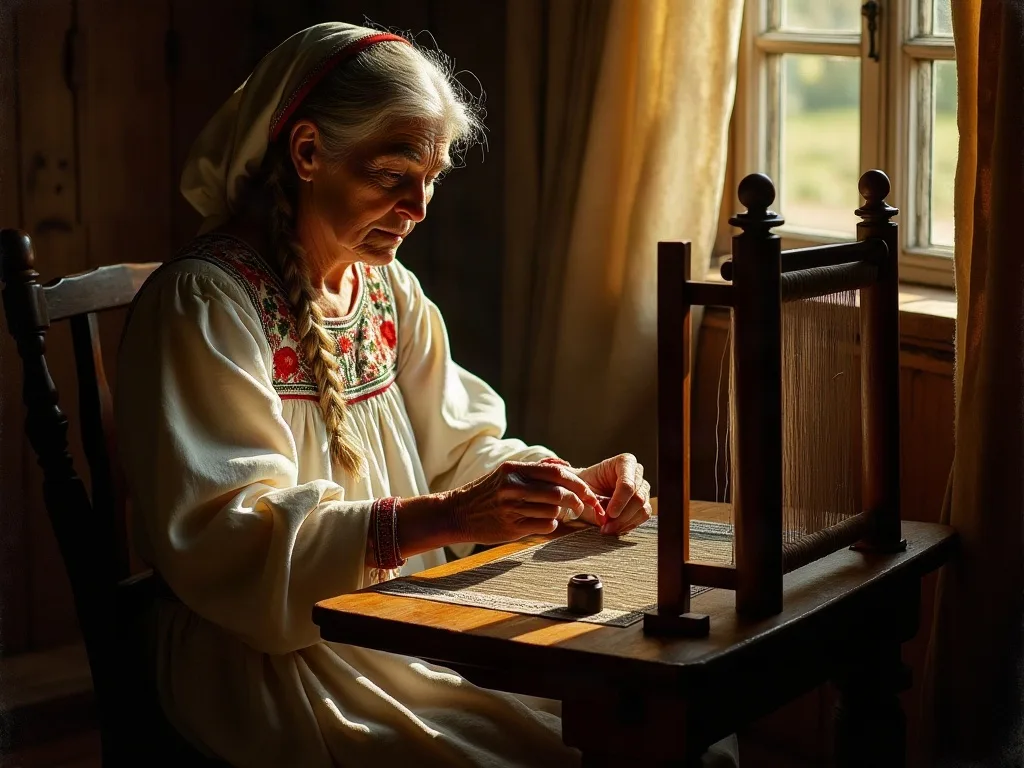
A priest could forbid a Dievas temple, but he could not forbid a song about the sky. A magistrate could punish a fertility ritual, but a harvest daina, sung while women bound grain, looked like nothing but communal work. The genre itself became a perfect vessel for forbidden knowledge. The daina's shortness made it easy to memorize and transmit. Its association with female work (spinning, weaving, harvest, mourning at wakes) made it less visible to male authority figures checking compliance with new laws. A daina about a bride leaving her home at marriage carried within it the entire sequence of Laima-centered protection rituals that had always marked a woman's transition into a new household. The song WAS the ritual, compressed into verse.
Scholars call this process "mythological camouflage." Juozas Baltrušaitis, the Lithuanian folklorist and mythologist who first systematically collected and analyzed dainas in the early 20th century, recognized that the peasants who sang these verses were not simple farmers repeating nursery rhymes. They were custodians. They understood the layers. A daina about "the sun's daughters" was both a charming image and a direct reference to Saulė, the sun goddess, whose cult and feast days had been suppressed but whose presence no law could erase from the community's spiritual calendar.
The daina worked because it was embedded in the actual rhythms of life. A woman did not sing a daina as a formal religious ceremony, she sang it while her hands worked. The song merged action and word. This embodied quality meant that when a daina was sung, it was not understood as a "pagan superstition" being secretly preserved; it was simply part of the work itself. The ritual WAS the song WAS the labor. And so, while other pagan traditions across Europe were either driven underground into witchcraft or extinguished entirely, the Baltic dainas remained in the open, hidden in plain sight.
The Structure of Sacred Verse: What Makes a Daina
A daina is always four lines long. Each line is roughly eight to ten syllables, unrhymed but bound by alliteration and parallelism. The form is so consistent that linguists have identified it as the original Indo-European folk verse meter, a living fossil of a verse form that is probably at least 4,000 years old, carried from the Bronze Age into the present.
The form itself carries meaning. The four lines often follow a pattern of statement, complication, reversal, and resolution. Or they build an image in three lines and then step back in the fourth for reflection. The absence of end rhyme forces the listener to focus on internal sound patterns, word repetition, and the weight of single words. This makes each daina feel carved, essential, every word matters because nothing decorative can hide in rhyme.
Here is a daina translated into English (original in Lithuanian):
The sun rose in the east, The moon set in the west, I cannot see my lover, My heart is split in two.
This is not poetry in the Romantic sense. It is a tool. The cosmic symmetry of sun and moon establishes order and balance; the personal grief in the third and fourth lines places the singer's loss within that cosmic framework. Her suffering is not arbitrary. It echoes the larger movements of heaven. The daina does not console her, it aligns her pain with necessity.
Thousands of dainas follow similar structures. Many are arranged in thematic cycles: dainas about love, dainas about work, dainas about death and the afterlife, dainas about the gods themselves, dainas about seasonal transitions. A young woman learning to be a wife would have learned dainas that encoded the entire practical and spiritual knowledge she needed. A woman mourning at a wake would have sung dainas that guided her through the proper relationship with the dead, ensuring they reached Vėlinas's realm safely and did not linger as malevolent spirits.
The daina is so integral to Baltic identity that it became a form of citizenship. In the 19th century, when Lithuanian and Latvian nationalists were fighting for independence from Russian and German rule, dainas became central to the independence movement. To sing a daina was to assert that you were Lithuanian or Latvian, that your nation had a soul distinct from the empires that occupied your land. The form that had hidden paganism under Christian rule became the vessel for hidden national identity under imperial rule. Dainas were sung at secret gatherings. They were published in underground newspapers. They became the voice of resistance.
The Gods Within the Songs: Dainas as Sacred Narrative
The most important gods of Baltic mythology appear in dainas not as the elaborate, articulated characters found in Norse sagas or Greek epics, but as presences, forces, relationships. Because the dainas themselves are the only extensive source we have for Baltic mythology, there is no Lithuanian equivalent of Hesiod's Theogony, no Latvian Poetic Edda, the gods are known through these songs in a unique way. They are known through their effects on human life, not through genealogical narratives or epic battles.
Dievas, the sky god, appears constantly but sparsely in dainas. A song might address him as "father" or invoke his blessing on a harvest. His essence is remote authority, benevolent but distant. Unlike the interventionist gods of Greek or Norse mythology, Dievas seems to maintain order rather than to act within the world. This reflects a cosmology in which the highest god does not compete with other forces; he establishes the fundamental structure within which all other powers move.
Laima appears far more frequently in dainas, and in a much more intimate way. She is the goddess of fate, childbirth, the household, and the transitions between states. A woman in labor would have invoked Laima. A bride leaving her home would have sung to Laima for protection. A mother would have called on Laima to guard her children from sickness and misfortune. Dainas about Laima are not remote myths; they are prayers woven into daily action.
Laima appears in dainas often in relationship with other female powers, Ragana, the spinner-goddess associated with fate and sometimes with witchcraft, and the Laumės (singular: Laima), forest nymphs or powerful female beings who could bless or curse. The dainas suggest a complex female divine cosmos that has no exact parallel in Indo-European mythology. If the Norse had Norns spinning fate at Yggdrasil's roots, the Balts had Laima and Ragana present in every significant moment of a woman's life. And they were sung to, not worshipped at temples, but addressed directly in the moments when women needed their aid.
Vėlinas, the lord of the dead and the underworld, governs an entire category of dainas focused on death, mourning, and the proper treatment of the deceased. These are not cheerful songs. They acknowledge that death takes everyone, that the dead must be honored but also released, that communication with the dead is possible but bounded by rules. A daina sung at a funeral served as instruction for the living about how to treat the boundary between the living and the dead world.
Saulė, the sun goddess, appears in dainas as a powerful female divinity whose daily journey across the sky mirrors and validates women's daily cycles of work. Unlike the masculine solar deities of other Indo-European traditions, Saulė is explicitly female in Baltic tradition, and dainas suggest a cosmology in which the sun's feminine power is essential to fertility and growth.
The gods in dainas are not characters in a story. They are grammar. They provide the structure through which Balts could understand and narrate their own lives. When a daina invokes Laima during childbirth, it is not an escape into mythology; it is an application of cosmic principle to a human moment. The daina does not separate the sacred from the ordinary. It shows that all moments, spinning thread, binding grain, burying the dead, are sacred because they involve the same forces that structure the cosmos.
The Manuscript Rescue: When Dainas Were Finally Written Down
For well over a thousand years, dainas existed only in memory and in singing practice. This was not because Baltic peoples lacked literacy. Lithuania and Latvia had scribes, chronicles, and written laws. But the dainas were consciously kept oral. They belonged to women's work and to spaces the written word did not enter. They were sung, not recorded.
The first significant collection of dainas began in the 1880s, when Lithuanian and Latvian intellectuals recognized that the village women who carried these songs were aging, that industrialization and modernization were changing rural life, and that the songs might be lost forever. Scholars fanned out across the countryside with notebooks and pens. Some used early phonograph equipment. The work was urgent and sometimes chaotic, but it was systematic.
The most important collector was Kasimir Būga (Lithuanian), who understood that dainas were not quaint folk entertainment but encoded historical, religious, and linguistic information. By comparing variants of the same daina across different regions, he could trace how the songs had evolved, what regional differences existed, and what the most ancient strata of the tradition might be. Jānis Pliekšāns (Latvian pen name Rainis) and other Latvian scholars conducted parallel work on their own tradition.
By the early 20th century, over a million dainas had been collected. The figure seems almost impossible until you understand the scale of the tradition. In a single village, an older woman might know 500 dainas. Multiply that by thousands of villages across Lithuania and Latvia, and the number begins to make sense. The dainas are not a small, elite corpus. They are the voice of an entire population.
The challenge then became how to organize, analyze, and present such a vast body of material. The first major published collection was the Lithuanian Dainas series, which categorized songs by theme: love, work, death, the gods, seasonal transitions, and many others. This thematic organization, while useful for access, somewhat obscured the fact that individual dainas were not isolated pieces but part of lived cycles. A woman learning to be a wife would have absorbed a whole set of dainas about marriage, pregnancy, childbirth, and the goddess Laima's role in each transition. The songs were a curriculum, not a collection of independent thoughts.
The recognition of dainas as a cultural treasure accelerated through the 20th century. When Lithuania and Latvia regained independence after the Soviet collapse in 1990, dainas became a symbol of national survival. The language of an entire people, suppressed under occupation, had been carried forward in four-line verses. This fact alone secured dainas' place as central to Baltic identity and to global recognition of intangible cultural heritage.
Dainas in Motion: How They Were Actually Sung
Understanding dainas as written text misses something essential. They were not sung alone, quietly, as a private meditation. They were sung communally, often while work was happening. The context transformed the meaning.
Dainas about flax and linen were sung during the season when women prepared flax, a labor-intensive process involving soaking, beating, combing, and spinning fibers into thread. The work was hard and repetitive. A group of women would sing dainas together while they worked, the melody and rhythm coordinating their movements, dividing the labor into manageable units, turning monotony into meaning. A daina about Laima protecting the household was not an isolated religious thought; it was woven into the actual physical act of transforming plant fiber into cloth.
Dainas were sung at life transitions. At weddings, specific dainas guided the bride through the ritual of leaving her birth family and joining her husband's household. These were not sentimental or romantic, they were practical and spiritual at once. They told her what to do, what to feel, how to understand the change happening to her. A bride would sing, and in singing, she would inhabit the role and begin to become the woman she needed to be in her new place.
At wakes and funerals, dainas addressed the dead directly. The living sang to establish the proper relationship with the deceased, to honor them, to help them find their way to Vėlinas's realm, and, importantly, to let them go. These were not sentimental grieving songs in the modern sense. They were functional. They had a job to do, and they did it through repetition, through the community's voice reinforcing the message, through the ritual structure the songs themselves provided.
Dainas were also sung purely for pleasure and courtship. Young people would gather and sing dainas about love, attraction, teasing, and desire. These songs were not just entertainment. They were how young people learned about relationships, how they expressed feelings that might otherwise be inexpressible in the formal context of family and village authority. A daina was something a young woman could sing that would not get her punished, even though the song itself might be quite direct about desire and loss.
The music itself was relatively simple, often modal and pentatonic (using five notes rather than the eight-note scale familiar in modern Western music). The simplicity meant that any voice could join. The repetitive structure of the daina's four lines meant it could be learned quickly and transmitted easily. And the modal music meant that dainas could be sung in antiphonal or call-and-response patterns, groups of voices weaving together. The form was designed for transmission and for community participation.
Continuity and Change: Dainas in the Modern Era
The question every living tradition faces is how to survive in a world that did not create it. For dainas, this has been a constant negotiation since the moment they were first written down. Recording them fixed them, which protected them but also risked making them seem like museum pieces rather than living practice.
In the early 20th century, among urban Lithuanian and Latvian intellectuals and artists, there was a deliberate effort to revive dainas as a core expression of national identity. Composers began to write art music based on daina melodies. Poets studied the verse form. National ensembles were founded to perform dainas on concert stages. This was not a return to village tradition, it was something new, a conscious claiming of folk tradition as a source of national art and identity.
This had both positive and negative consequences. On one hand, dainas were saved and celebrated. On the other hand, dainas performed on concert stages in carefully arranged harmonies by trained singers in costumes is a different thing from dainas sung by women in a field or at a funeral. The concert version is beautiful and impressive, but it has been extracted from the context that gave it meaning.
After Soviet occupation (1940-1990), dainas took on even more charged significance. During the Soviet period, dainas were officially tolerated, the state sponsored folk ensembles and performances, but their religious content was downplayed or reframed as cultural heritage rather than spiritual practice. And yet, for Lithuanians and Latvians, singing dainas remained a way of asserting continuity with a pre-Soviet, pre-Russian, pre-imperial identity. The songs were a form of resistance without being formally illegal.
Today, dainas continue to be sung in villages in Lithuania and Latvia, particularly among older women and in ceremonial contexts like weddings and midsummer festivals. They are also taught in schools as part of cultural education. They are performed by professional ensembles. They are studied by scholars. They are recorded, archived, and digitized. UNESCO recognition has given them global prestige.
The tradition faces challenges particular to any oral tradition in a written, digital age. Fewer young people learn dainas through daily singing practice with older women. The contexts that made dainas necessary, village life, hand labor, seasonal cycles, the need for guidance through life transitions, are fading. And yet, dainas have also found new contexts. They are sung at political rallies. They appear in contemporary art and music. They are translated and studied internationally. The tradition is not frozen in the past; it is adapting.
Dainas and the World: Why They Matter Beyond the Baltic
Dainas matter to scholars of mythology and folklore for a simple reason: they are the most extensive surviving source for pre-Christian Baltic religion. The Baltic peoples, Lithuanians, Latvians, and several smaller extinct groups, maintained their pagan religion longer than almost any other Indo-European population. While Norse peoples were Christianized by the 11th century and Celtic peoples by the 7th, Balts maintained pagan practice into the 15th and 16th centuries, and pagan beliefs persisted in folk practice much longer. The dainas preserve what was believed, celebrated, and feared in that world.
For comparative religionists, dainas offer unique evidence. While we know the Norse pantheon through literary sources like the Prose Edda and the sagas, sources written down centuries after Christianization and often edited by Christian scribes, the dainas were collected directly from living singers in the 19th century, before they had time to be significantly altered by scholarly interpretation or Christian overlay. They are not perfect sources, no source is, but they are remarkably direct.
Dainas also matter because they demonstrate a form of cultural transmission and spiritual practice that is radically different from the textual, hierarchical religious structures familiar in modern Europe. There were no daina theologians. There was no orthodoxy. The tradition existed in variation. Different villages sang different versions of the same daina. The same woman might sing a verse differently depending on context. The flexibility was not a weakness but a strength. It meant the tradition could adapt while remaining recognizable. It meant it could be learned and transmitted without formal institutions.
This model of religion through song and memory rather than through text and institution has parallels in other oral cultures, in the Aboriginal songlines of Australia, in the griotic traditions of West Africa, in the oral epics of Central Asia. Dainas are one of the most extensively documented examples of how such a system can work, how it can preserve complex knowledge, how it can remain vital across centuries of pressure to adopt external religious forms.
For artists and musicians, dainas offer a model of how folklore can be a source without being a museum exhibit. Contemporary composers in and beyond the Baltic have drawn on dainas. The tradition has influenced modern Lithuanian and Latvian music, art, and literature. This is not because dainas are aesthetically perfect by modern standards, they are not. It is because they contain something that the modern world often lacks: a direct relationship between language, music, labor, ritual, and belief.
Dainas and the Gods: How Songs Map the Sacred
The relationship between the daina and the divine is not mediated by priests or institutions. When a woman sang a daina about Laima, she was not reporting on the goddess; she was invoking her, addressing her, bringing her presence into the moment. The song was not a description of the divine; it WAS the interaction with the divine.
This is why understanding dainas requires resisting the impulse to treat them as "sources" in the academic sense. A scholar can read a daina and extract information about what Balts believed about Laima or Vėlinas or Dievas. But the daina itself is not making a statement that can be separated from the act of singing it. The form and the content are inseparable. The four-line structure, the meter, the imagery, the music, all of these are part of the religious act.
Different dainas addressed different moments when divine presence was most acute. Birth dainas invoked Laima. Death dainas addressed Vėlinas. Seasonal dainas celebrated the transitions marked by the sun goddess Saulė and other powers. Work dainas called on divine blessing for the labor at hand. And love dainas, perhaps the largest category, navigated the most charged moments of relationship, desire, and loss, often in implicit conversation with divine forces that governed fate and attraction.
The dainas do not describe a distant pantheon. They show a world in which the sacred and the ordinary are not separated. A harvest is both a practical necessity and a sacred act. A wedding is both a social transition and a spiritual passage guarded by Laima. Death is both the end of life and the beginning of another relationship, with Vėlinas and the realm of the dead. The dainas embed the gods in the texture of daily life so thoroughly that separating them is impossible.
Frequently asked questions about Dainas: Sacred Folk Songs as Living Mythology
Frequently asked questions
How many dainas have been collected, and are they still being discovered?
Over one million dainas have been collected from Lithuanian and Latvian sources since the 1880s. New variants and previously unrecorded dainas continue to emerge from elderly singers and archives, though the most intensive period of collection occurred in the late 19th and early 20th centuries. The Lithuanian Dainas database now contains over 220,000 documented variants, organized by theme and region.
What is the connection between dainas and actual pagan religious practice?
Dainas are not descriptions of religious practice, they ARE religious practice in sung form. When a woman sang a daina about Laima during childbirth or marriage, she was performing the ritual itself. The song functioned as prayer, instruction, and blessing simultaneously. This is why dainas survived Christian suppression so effectively: the rituals could not be forbidden because they wore the disguise of entertainment or work songs.
Can dainas be translated effectively into other languages, or is something lost?
Translation preserves content but loses form. The daina's four-line structure, its alliteration, its internal rhyme, and its modal meter are integral to its meaning and function. A daina read in translation conveys the story or image but not the experience of singing it communally, not the texture of the original language, not the embodied practice that made the daina work. The best approach is to learn dainas alongside translations: the words in one language, the music and form in another.
Are dainas still being sung in Lithuania and Latvia today?
Yes, but in transformed contexts. Village women, particularly those over 60, continue to sing dainas in family and ceremonial settings. Dainas are taught in schools, performed by professional folk ensembles, and sung at national festivals and celebrations. The tradition is living but changed, more formalized, more public, less integrated into daily labor. Nevertheless, dainas remain central to Lithuanian and Latvian cultural identity.
How do dainas compare to other folk song traditions in Europe?
Dainas are unique in their directness as a source for pre-Christian religion and in their integration into work and ritual rather than being separated as 'entertainment.' While folk traditions across Europe preserve older beliefs, dainas do so with unusual clarity and in an unusually unbroken transmission. Their form, the four-line structure, appears to be proto-Indo-European and has parallels in Slavic and other ancient traditions.
The Persistence of the Sacred in Verse: Dainas Beyond the Written Word
The daina represents something that modern culture often struggles to understand: how knowledge, belief, and spiritual practice can be maintained without institutions, without texts, without formal authority. For over a thousand years, the gods of the Baltic world, Dievas, Laima, Vėlinas, Saulė, and others, lived not in temples or books but in the voice of women singing as they worked. The mythology was not something learned from priests but something lived, sung, embodied in action.
When scholars first began to collect dainas seriously in the 19th century, some hoped they were capturing a "pure" pre-Christian Baltic religion frozen in time. But dainas are not fossils. They are living. They have changed across centuries, adapted to new circumstances, absorbed Christian elements while maintaining pagan cores, served political purposes in independence movements, been elevated to art forms, been archived and taught in schools. The tradition has not remained static; it has persisted by being flexible.
This flexibility is not a sign of weakness or inauthenticity. It is what has allowed dainas to survive in a world that has repeatedly tried to erase them. The woman singing a daina in a 21st-century festival is part of the same unbroken transmission as the woman singing the same verse in a 15th-century field, even if the context, the music's arrangement, and the singer's understanding of the gods have all changed. The form carries the continuity.
The world has largely moved on from oral tradition. We document everything now. We write down what used to be sung. We separate labor from ritual from entertainment. We have temples or churches for the sacred, schools for knowledge, concert halls for music. The daina represents an older integration of these categories, an older way of knowing that persisted into the modern era, documented in time before it was lost entirely.
Today, as dainas are sung on concert stages and studied in universities, as they are translated into dozens of languages and recognized by UNESCO, they carry something that no amount of scholarship can fully translate. They are proof that a mythology can live in voice and memory, in the muscles of labor and the joy of singing together. The gods in the dainas are not dead and gone. They are present in the moment of singing, in the community of singers, in the continuation of a tradition that has survived every attempt to erase it. That persistence, that refusal to disappear, is what makes dainas more than a historical artifact. It is what makes them, still, a living mythology.
Read the full book
Want the whole story?
The complete edition is an instant PDF download here, with a paperback on Amazon for selected titles.
Baltic
The Baltic Mythology Book: Perkūnas, Saulė, Dievas, and the Gods of Lithuania and Latvia
Perkūnas, Saulė, and Dievas
The last pagans of Europe: the Lithuanians and Latvians who kept their old gods into the 1400s. Perkūnas the thunderer, Saulė the sun, the sky-god Dievas, and a forest religion preserved in tens of thousands of folk songs.
More from Baltic
All articles
Baltic
The Grass Snake: Sacred Household Guardian of Baltic Homes
The grass snake was no mere reptile in Baltic homes, it was a household god, a protective spirit that lived in the walls and brought prosperity. Learn how this sacred creature shaped daily life and spiritual belief in Lithuania and Latvia.

Baltic
Žemyna: Mother Earth Goddess of the Baltic Lands
Žemyna stands at the heart of Baltic spirituality as the life-giving earth mother who nurtures crops, heals the sick, and guards the sacred bond between humans and land. Discover how this ancient goddess shaped Lithuanian and Latvian culture for centuries.
Baltic
The Sacred Oak: World Tree of Baltic Tradition
The Sacred Oak stands at the center of Baltic cosmology as the world tree connecting earth, sky, and the underworld. Discover how Lithuania and Latvia's ancient oak groves shaped a mythology that survived centuries of Christian suppression.

Baltic
The Creation of the World from the Cosmic Egg in Baltic Mythology
Baltic peoples believed the world hatched from a cosmic egg laid by a celestial waterfowl, a creation motif that bridges Bronze Age Indo-European roots and medieval folk memory. Discover how this myth shaped Baltic cosmology and echoes across global traditions.