
Mėnuo: The Moon God and Celestial Wanderer
Mėnuo is the Moon God of Baltic mythology, a wandering celestial king whose marriage to the Sun goddess and eternal cycle of phases shaped ancient Lithuanian cosmology. Explore his myths, symbols, and surviving folklore.
Contents
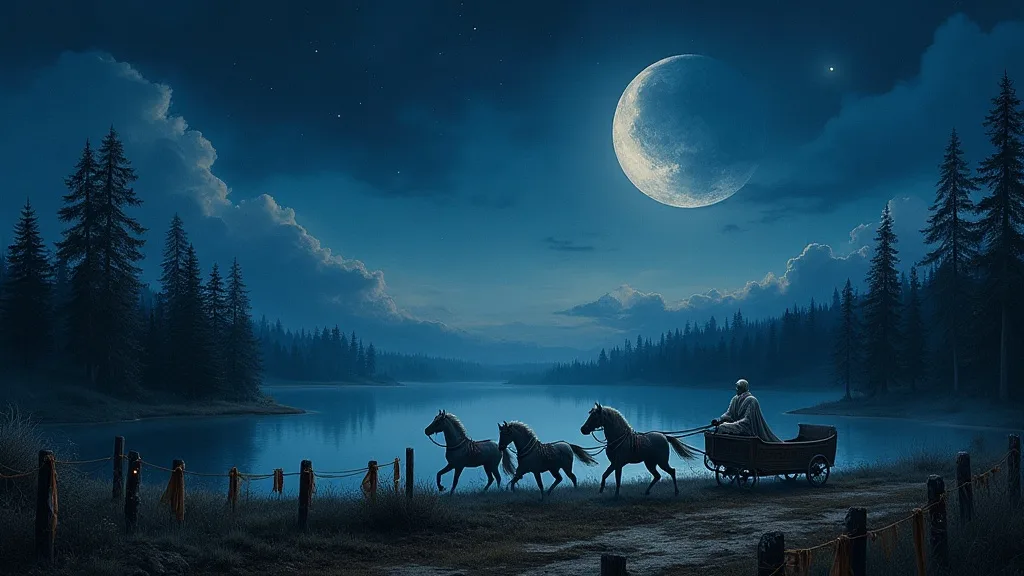
The sky was a royal court before it was an abstraction. In the ancient Baltic imagination, every movement of the moon was a decision made by a person: a king riding his chariot across the darkness, a husband drifting away from his wife, a being who could be punished for faithlessness by the sword of a god. That person was Mėnuo, the Moon God of Baltic mythology, one of the most richly preserved celestial deities in any European tradition outside the Greco-Roman corpus.
He waxes and he wanes, courts the Sun and is cut for the betrayal, and then rises again. The cycle is not metaphor. To the Lithuanian and Latvian peoples who revered him, it was biography.
Mėnuo's Name and Its Ancient Roots
Mėnuo (also spelled Meness in Latvian, Menulis in older Lithuanian texts) derives from the Proto-Indo-European root *meh₁- or *ménots, the same ancestral word that gives Latin mensis (month), Greek mene (moon), and Sanskrit māsa (month or moon). The connection is not coincidental. Linguists have traced this root through dozens of daughter languages, and the Baltic forms are among the most archaic: Lithuanian and Latvian retained features of Proto-Indo-European that Sanskrit texts from 1500 BC and later Latin had already eroded.
This etymology matters for mythology because it tells us that Mėnuo's name is his function. He is, literally, "the Measurer," the being whose phases structured the calendar. The Lithuanian word for "month," mėnesis, comes from the same root, which means that every time a Baltic farmer said "this month" he was, without knowing it, invoking a deity. Time was a body, and that body was the Moon.
The Latvian cognate Meness appears in dainas, the traditional Latvian folk songs collected in enormous numbers by Krišjānis Barons between 1894 and 1915. Barons gathered over 200,000 dainas, and a substantial cluster centers on the Moon's astronomical and mythological role, making Latvian folklore one of the richest archives for reconstructing Baltic celestial belief.
The Celestial Court: Mėnuo, Saulė, and the Sky Family
Baltic cosmology arranged the sky as a household. At its center stood two sovereigns: Saulė (the Sun), a goddess of warmth, weaving, and justice, and Mėnuo, her consort. Their marriage was the axis around which the visible cosmos turned.
Saulė rose each morning from her stone palace in the east, drove her copper chariot across the sky, and descended each evening to dance with the stars. Saulė, the Baltic Sun goddess, was not passive light; she was an active, ethical presence, one who wept amber tears for the dead and who rewarded virtuous behavior. Mėnuo, by contrast, moved in darkness. He rode his own chariot through the night, shifting his face, arriving late or leaving early, and this rhythmic unreliability became, in myth, a moral failing.
According to songs preserved in Lithuanian and Latvian tradition, Mėnuo and Saulė were married at the beginning of cosmic time, when the sky was still new. They had children: the stars (žvaigždės), who are sometimes listed individually, and especially Aušrinė, the Morning Star (associated with Venus), who kindled the fire in Saulė's palace each dawn. Some accounts also bring Perkūnas, the Thunder God, into the family structure as a son or close kin, though his relationship to the celestial parents is more complex in different regional variants.
The household metaphor was not decorative. It encoded the agricultural calendar. Farmers planted by the Moon's phases, slaughtered animals when the Moon was waning, harvested when it was full, and read its halo for weather. Mėnuo was as practical as a calendar printed on paper, and equally present on the wall of every home.
The Betrayal and the Punishment
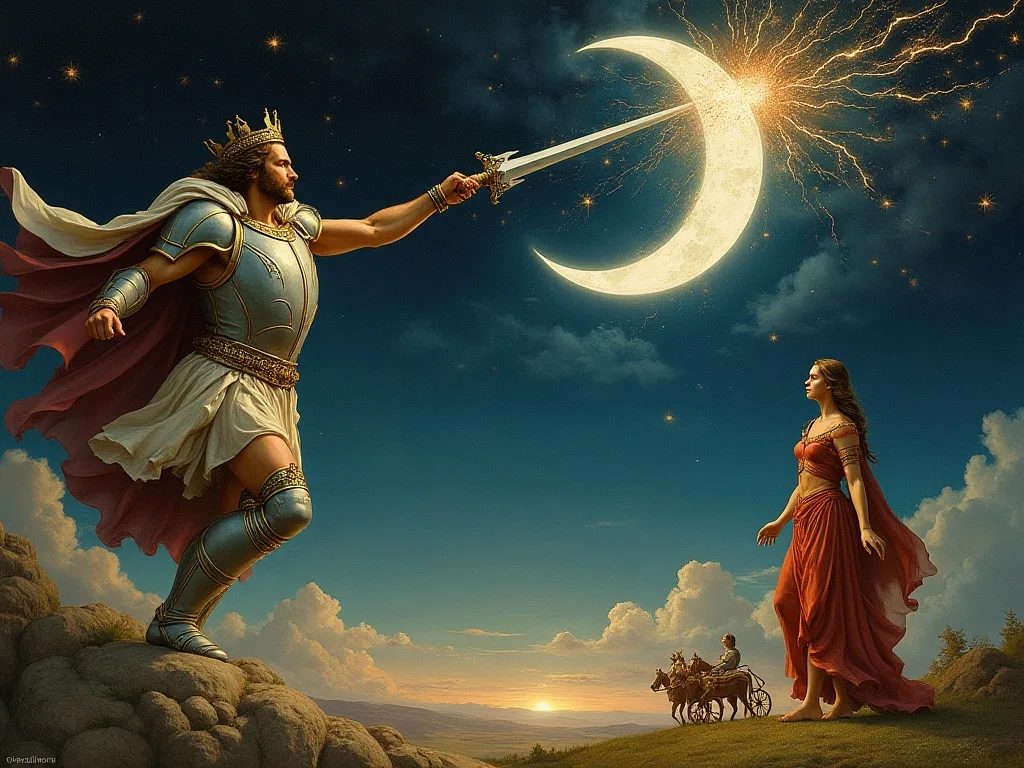
The most dramatic myth preserved about Mėnuo concerns his infidelity. He abandoned Saulė, his wife, and "walked with the Morning Star," a phrase from the dainas that most scholars read as sexual infidelity, whether toward Aušrinė or another celestial figure. The specific identity of the other party varies by song, but the consequence is consistent: Perkūnas, the God of Thunder, drew his sword and cut Mėnuo.
This is why the Moon appears sliced in the sky. The waning crescent, in Baltic eyes, was a wound.
The scholar Marija Gimbutas, in her work on Old European religion, connected this myth to a broader Indo-European pattern where a moon deity's inconstancy is punished by a sky-weapon: the Vedic god Soma is weakened by the gods and must be restored, and the Greek Selene's lover Endymion is put into eternal sleep. But the Baltic version is unusually explicit about the moral logic: infidelity to the solar queen is punished by the god of storms and order. Thunder restores cosmic propriety.
The Lithuanian poet and bishop Maironis (1862-1932) referenced this myth in his verse, treating Mėnuo's punishment as a foundational national image rather than a curiosity. The myth had enough cultural charge to carry into literary romanticism, which tells us it was vivid in living folk memory well into the nineteenth century.
After his cutting, Mėnuo heals. He grows back, waxes full, wears his silver crown again. Then, over the following weeks, he is cut once more. The cycle is both astronomical and moral: betrayal, punishment, recovery, betrayal again. Some dainas express sympathy for the Moon, portraying him as pitiable rather than villainous. Others are cooler in judgment. The folk tradition held space for both readings.
Mėnuo as Warrior, King, and Guide of the Dead
Mėnuo was not only a domestic figure. In several song traditions he appears as a warrior or chieftain, riding through the night in silver armor, carrying a sword that reflected light. His chariot was pulled by gray horses; some Latvian songs specify two horses, others say he rode alone. The imagery matched the practical experience of travel by moonlight, when a full moon made the road visible and a new moon left travelers in pitch darkness.
This warrior aspect connected Mėnuo to death and the afterlife. Because souls were thought to travel at night, and because the Moon lit the road, he became a psychopomp of sorts: the guide who watched over journeys made in darkness. Lithuanian funeral songs sometimes address Mėnuo directly, asking him to light the path of the newly dead. He was not a ruler of the underworld in the way that Veles governed the Slavic realm of the dead, but a lantern-carrier, a watcher of transition.
This role appears most clearly in the Baltic concept of the Dievo sūneliai, the "Sons of God." These twin figures, cognates of the Vedic Ashvins and the Greek Dioscuri (Castor and Pollux), sometimes appear as helpers of Mėnuo or as rescuers who assist the Sun when she is threatened. The parallels between the Baltic twins and Vedic mythology have occupied comparative mythologists since the nineteenth century, and the Moon's connection to these rescuer figures reinforces the idea that Mėnuo belonged to a very old layer of shared Indo-European belief.
The Phases as Theology: How the Baltic Calendar Encoded Mėnuo
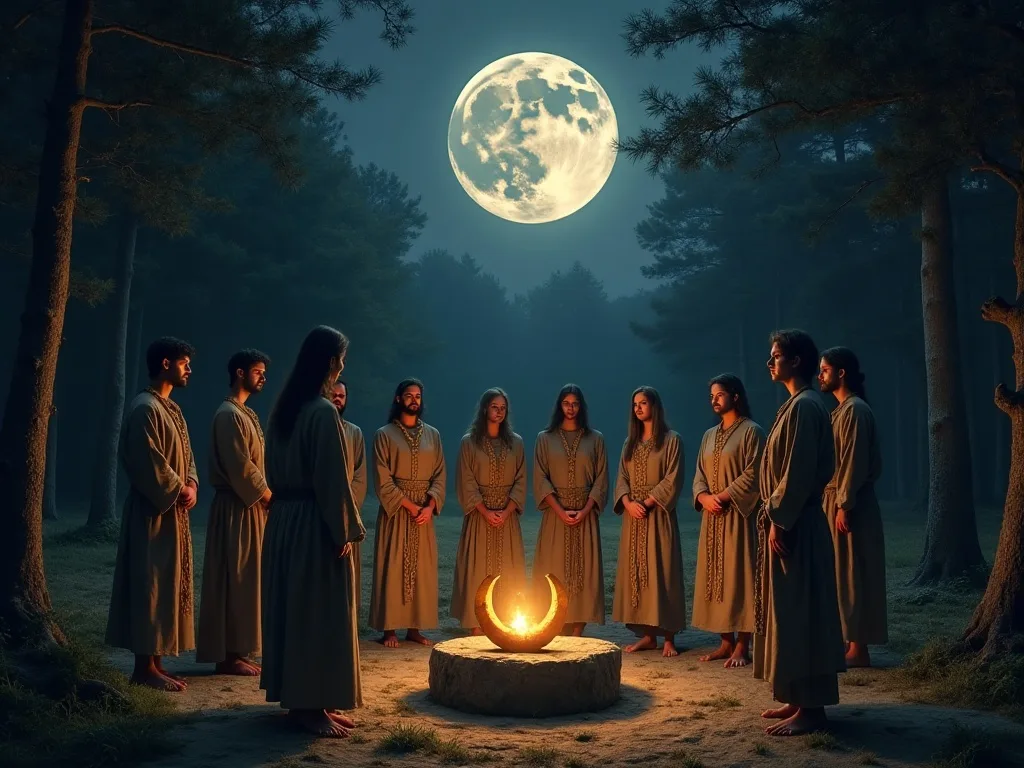
Baltic religious life tracked the lunar cycle with unusual precision. The four phases of the Moon corresponded to distinct ritual moments: new Moon for beginnings, waxing Moon for growth and marriage ceremonies, full Moon for major communal feasts, waning Moon for cutting, slaughter, and endings. This was not superstition in the pejorative sense; it was a coherent system of temporal theology in which Mėnuo's body was a clock and a guide.
The feast calendar included several days sacred to Mėnuo specifically:
- Užgavėnės, the pre-Lenten feast held near the February new Moon, incorporated imagery of the Moon's death and the Sun's return, blending Mėnuo's waning with the end of winter.
- The midsummer feast of Rasos (also called Joninės or St. John's Eve after Christianization) involved bonfires that echoed the Sun's power, but the Moon's fullness in June was read as a sign of Mėnuo's reconciliation with Saulė, the high point of their relationship before the slow separation began again in autumn.
- Harvest rituals in September and October often invoked the Moon's waning as protective: grain cut under a waning Moon was thought to resist rot and vermin.
The German chronicler Peter of Dusburg, writing in 1326 in his Chronicon terrae Prussiae, described Baltic (specifically Old Prussian and Lithuanian) religious life as organized around celestial bodies, fire, and serpents. He did not name Mėnuo directly, but his description of Moon-veneration among the Baltic peoples corroborates the dense folk tradition recorded in later centuries.
Symbols and Iconography of Mėnuo
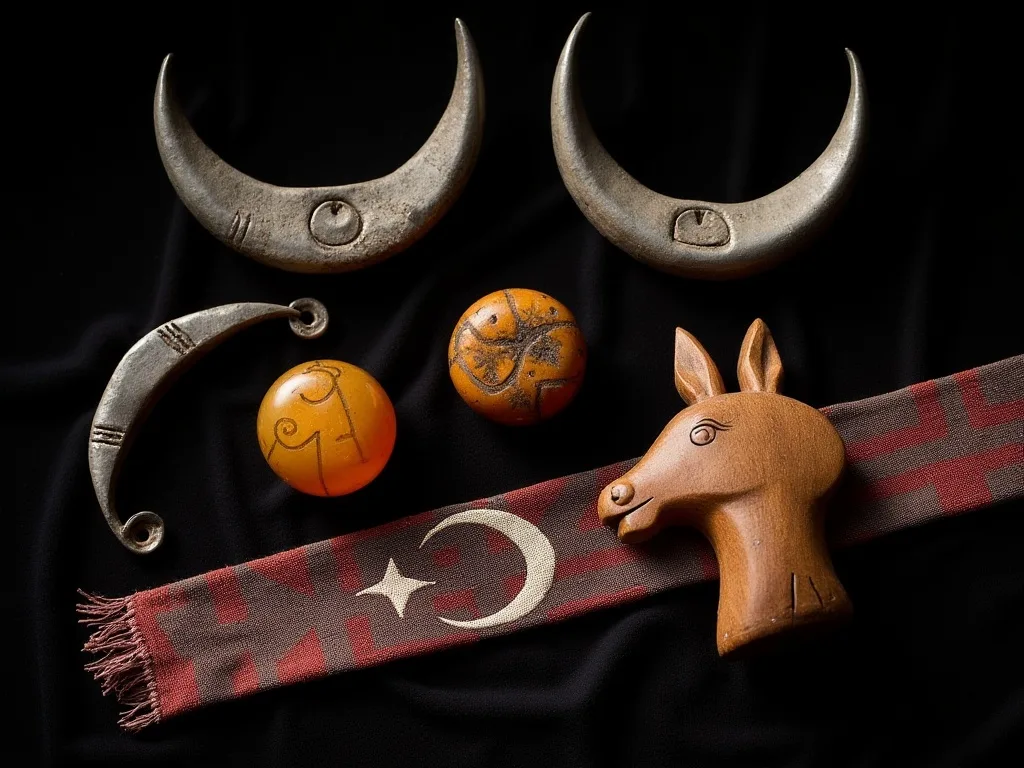
Mėnuo's visual vocabulary was rich and specific. The crescent moon appeared on Baltic jewelry, woven textiles, carved wood, and later on the amber amulets sold throughout the Baltic trading network. The crescent form, called mėnulio ragas (horn of the Moon) in Lithuanian, was one of the most common decorative motifs in Baltic material culture from the Bronze Age onward.
Silver was his metal. Moonlight on water is silver; the full Moon seen through cloud is silver; the color was so consistently linked to Mėnuo that silver jewelry was ritually appropriate for night ceremonies and for the dead. Iron, by contrast, belonged to Perkūnas, the Thunder God who punished the Moon, which is why iron amulets were thought to protect against night spirits while silver calmed them.
The crescent motif appears on Lithuanian juosta (woven sashes), used in ritual contexts including weddings and funerals. A bride's sash might carry crescent patterns to invoke Mėnuo's blessing on her marriage, and by extension to ask for the faithfulness that he himself failed. The irony was embedded in the symbolism.
Horse imagery accompanied Mėnuo consistently. His chariot's gray horses appear in multiple dainas, and horse-shaped amulets associated with the moon have been recovered from Bronze Age Baltic burial sites in Latvia and Lithuania. The horse-moon connection links to a broader Indo-European pattern visible in Vedic texts, where the Moon deity and the horse are repeatedly associated.
Mėnuo in Comparative Mythology: Soma, Sin, and Khonsu
Masculine Moon Gods are rarer than they might seem. Most of the world's major mythologies cast the Moon as female: Greek Selene and Artemis, Roman Luna, Hindu Chandra in some interpretations, Aztec Tecuciztecatl (male but subordinate to solar power). The unambiguously masculine Moon God is a signature of specific traditions, and comparing them reveals important patterns.
Soma, the Vedic moon deity described in the Rigveda (composed roughly 1500-1200 BC), was both a moon god and the divine drink of immortality, a combination that placed him at the center of Vedic ritual. Like Mėnuo, Soma waxed and waned, and in the Rigveda his diminishment was explained as the gods drinking him down, draining his power, before he was restored. Both Mėnuo and Soma are wounded or depleted by powers greater than themselves, then recover, then repeat the cycle.
Sin, the Sumerian and Akkadian Moon God worshipped in Ur and Harran, was a bearded king whose crescent was his crown. His epithet Nannar in Sumerian texts meant "the bright one," and he was lord of time and the calendar. Like Mėnuo, Sin was associated with cattle (the crescent resembled horns), with the measurement of months, and with wisdom derived from witnessing the night. His cult persisted in Harran, in what is now southern Turkey, until at least the tenth century AD, centuries after Islam had transformed the surrounding culture.
Khonsu, the Egyptian Moon God, was a falcon-headed youth whose name meant "the traveler" or "the wandering one." The parallel with Mėnuo as wanderer is striking, though the cultural contexts diverge completely. Khonsu was associated with healing and with the calculation of time, roles that echo Mėnuo's calendar function and his nightly journey.
What unites these masculine Moon Gods across completely separate traditions is the pattern of motion, measurement, and inconstancy. The Moon moves; male deities in many traditions are associated with motion (hunting, warfare, travel) rather than the static abundance associated with goddess figures. The masculine Moon God is the deity of the road, the measurer of time, the one who cannot stay still.
Mėnuo's Survival: From Pagan Baltic Religion to Modern Lithuanian Identity
The Christianization of Lithuania was the last in Europe: the Grand Duchy of Lithuania officially converted in 1387, centuries after most of the continent. This means that Baltic pagan traditions survived longer in written proximity to literate observers, and that folk memory preserved details that had faded elsewhere. Mėnuo's mythology lived inside dainas, proverbs, agricultural customs, and textile patterns long after the church had replaced him nominally with the Christian calendar.
Nineteenth-century nationalist movements in both Lithuania and Latvia made the recovery of pagan mythology a cultural priority. Scholars like Teodoras Narbutas (1784-1864), whose Litauische Geschichte collected and systematized Lithuanian folk belief, and later Jonas Basanavičius (1851-1927), the physician and folklorist who gathered hundreds of Lithuanian tales and songs, treated Mėnuo and Saulė as cornerstones of national identity. Their work was scholarly, but also political: to have a mythology as old and coherent as Greek or Norse mythology was a claim to civilizational depth.
Today, the crescent moon appears on Lithuanian folk art sold globally, on embroidery, on amber pendants, on ceramics. The Lithuanian language itself carries Mėnuo's presence: the word for "month" is still mėnesis, the word for "year" is metai, and the folk weather-wisdom tied to lunar phases persists in rural communities alongside satellite forecasts.
The Baltic mythological tradition is one of the few in Europe where pre-Christian cosmology was recorded in enough detail to sustain genuine scholarly reconstruction. Mėnuo sits at its center, not as a relic, but as a living thread in the culture he once measured.
Frequently Asked Questions About Mėnuo the Baltic Moon God
Frequently asked questions
Is Mėnuo male or female, and why does it matter?
Mėnuo is unambiguously male in Lithuanian and Latvian tradition, which makes him unusual among European moon deities. Most Indo-European cultures cast the Moon as feminine. Baltic mythology reverses this: the Sun (Saulė) is the goddess, and the Moon is her husband-king. Scholars like Marija Gimbutas have argued this reversal preserves an archaic Proto-Indo-European pattern, though the debate continues. The gender assignment matters because it shapes the entire myth: the marital drama, the betrayal, the punishment by Perkūnas, and the cycle of waxing and waning all depend on Mėnuo being a husband who can be faithless.
What is the story of Mėnuo and Perkūnas?
According to Baltic dainas, Mėnuo married the Sun goddess Saulė at the beginning of time, then abandoned her and "walked with the Morning Star." Perkūnas, the Thunder God, punished this infidelity by cutting Mėnuo with his sword. The Moon's waning crescent is that wound. Mėnuo heals, grows full, and then is cut again, which is why the Moon cycles eternally between fullness and a slender crescent. This myth was well-known enough to be referenced by Lithuanian literary figures as late as the nineteenth century.
What are the primary sources for Mėnuo's mythology?
The richest sources are the Latvian dainas, traditional folk songs collected systematically by Krišjānis Barons between 1894 and 1915, numbering over 200,000 songs. Lithuanian folklore was gathered by scholars including Jonas Basanavičius in the late nineteenth century. Medieval sources are thin but not absent: Peter of Dusburg's 1326 Chronicon terrae Prussiae describes Baltic celestial veneration in general terms. The comparative framework was built largely by scholars like Marija Gimbutas and more recently by Algirdas Julius Greimas, whose Of Gods and Men (1992) provided structural analysis of Lithuanian mythological figures.
How did the Baltic people use Mėnuo's phases in daily life?
The lunar cycle governed farming, medicine, and ritual. Seeds were planted on the waxing Moon, grain was cut on the waning Moon to resist rot, and major rites like weddings were timed to the full Moon. Mėnuo's face was read for weather: a halo around the Moon predicted rain, a red Moon predicted wind. Funeral songs addressed Mėnuo directly, asking him to light the path of the dead. These practices were still documented in Lithuanian rural communities in the early twentieth century, long after official Christianization.
How does Mėnuo compare to Soma in Vedic mythology?
Both are masculine Moon Gods who wax, wane, and are depleted by forces greater than themselves before recovering. Soma in the Rigveda (composed c. 1500-1200 BC) is drained by the gods drinking the ritual beverage he embodies, then restored; Mėnuo is cut by Perkūnas, then heals. Both are associated with the measurement of time, with the calendar, and with a kind of cyclical immortality. The structural parallel is strong enough that comparative mythologists use it as evidence for a shared Proto-Indo-European Moon God archetype, though direct transmission is impossible to prove.
Does Mėnuo appear in modern Lithuanian culture?
Yes. The crescent moon remains one of the most common motifs in Lithuanian folk art: on woven sashes (juostos), amber jewelry, ceramics, and woodwork. The Lithuanian word for "month" (mėnesis) preserves his name in everyday speech. Nineteenth-century nationalist scholars elevated Mėnuo and Saulė to symbols of Lithuanian cultural identity, and this framing persisted into contemporary folk revival movements. Modern Lithuanian neo-pagan communities (practicing Romuva) include Mėnuo in their ritual calendar.
Mėnuo and the Unresolved Debate Over Baltic Theology's Age
Scholars have argued for decades about how much of what we call "Baltic mythology" is genuinely ancient and how much was reconstructed, romanticized, or even invented by nineteenth-century nationalists hungry for a mythology to match their neighbors. It is a fair question. The written record for Baltic paganism is thin before 1387, and even Peter of Dusburg's chronicle is an outsider account written by a Teutonic Knight, which is roughly equivalent to reading about Greek religion from a Roman general's dispatch.
But the comparative evidence is harder to dismiss. The Baltic languages are the most archaic branch of the Indo-European family still spoken, more conservative in phonology and grammar than any other living language group. If Proto-Indo-European had a masculine Moon God who measured time and whose phases encoded the moral order of the sky, Lithuanian and Latvian tradition is exactly where you would expect the clearest echo to survive. The dainas, for all their later collection and editing, carry patterns of imagery (the sword-wound, the silver crown, the gray horses, the morning star infidelity) that align too precisely with Vedic and Anatolian parallels to be nationalist confabulation.
The ongoing work of scholars like Norbert Vėlius, whose multi-volume Baltų religijos ir mitologijos šaltiniai (Sources of Baltic Religion and Mythology, published 1996-2005) compiled every primary reference to Baltic deities from external chronicles, gives researchers a sober base. Mėnuo appears in enough independent sources, from enough different centuries and regions, to be considered a genuine deity of the tradition rather than a scholarly construction.
What remains genuinely open is the theology: whether Mėnuo was worshipped with priests and temples, or whether his cult was primarily domestic and agricultural. The Baltic tradition, unlike the Norse or Greek, appears not to have produced monumental temple architecture dedicated to celestial gods. His altars were probably the field, the threshold, and the open sky. In that sense, the wandering Moon God had an appropriately unenclosed worship: no roof, no walls, just the night and the road and the slow arc from crescent to full and back again.
That kind of theology is hard to excavate, but it leaves traces in exactly the places Mėnuo always traveled: language, song, the patterns woven into a sash, and the habit of glancing up at the sky before planting in the morning.
Read the full book
Want the whole story?
The complete edition is an instant PDF download here, with a paperback on Amazon for selected titles.
Baltic
The Baltic Mythology Book: Perkūnas, Saulė, Dievas, and the Gods of Lithuania and Latvia
Perkūnas, Saulė, and Dievas
The last pagans of Europe: the Lithuanians and Latvians who kept their old gods into the 1400s. Perkūnas the thunderer, Saulė the sun, the sky-god Dievas, and a forest religion preserved in tens of thousands of folk songs.
More from Baltic
All articles
Baltic
The Grass Snake: Sacred Household Guardian of Baltic Homes
The grass snake was no mere reptile in Baltic homes, it was a household god, a protective spirit that lived in the walls and brought prosperity. Learn how this sacred creature shaped daily life and spiritual belief in Lithuania and Latvia.

Baltic
Dainas: Sacred Folk Songs as Living Mythology
Dainas are more than songs, they are Lithuania and Latvia's oldest mythology preserved in four-line verses sung for millennia. Discover how peasants encoded gods, rituals, and cosmic wisdom into folk poetry that shaped Baltic identity and survives today.

Baltic
Žemyna: Mother Earth Goddess of the Baltic Lands
Žemyna stands at the heart of Baltic spirituality as the life-giving earth mother who nurtures crops, heals the sick, and guards the sacred bond between humans and land. Discover how this ancient goddess shaped Lithuanian and Latvian culture for centuries.
Baltic
The Sacred Oak: World Tree of Baltic Tradition
The Sacred Oak stands at the center of Baltic cosmology as the world tree connecting earth, sky, and the underworld. Discover how Lithuania and Latvia's ancient oak groves shaped a mythology that survived centuries of Christian suppression.