
Perkūnas: The Thunder God and Divine Warrior of Baltic Mythology
Meet Perkūnas, the thunder god who shaped Baltic belief for millennia: wielder of lightning, protector of cosmic order, and the last deity standing against Christian conversion. Discover how one ancient warrior defined an entire mythology.
Contents
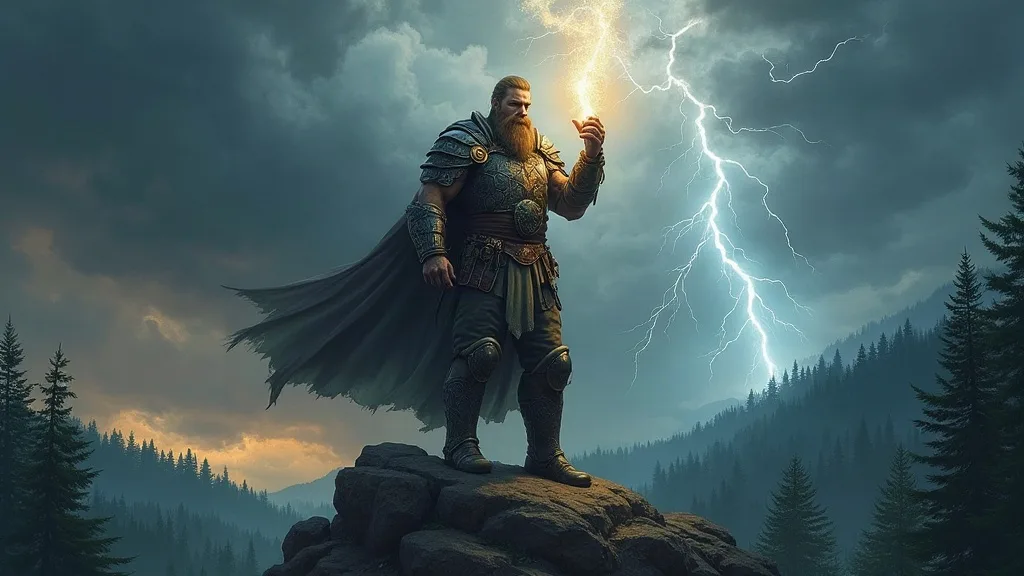
The sky splits open. A roar tears through the clouds. Perkūnas rides forth, his beard bristling with power, his axe raised to strike. For thousands of years, Baltic peoples looked upward when thunder rolled and saw not a blind force of nature but a god who fought for order, justice, and the survival of the cosmos itself.
Perkūnas is one of Europe's most enduring divine figures, a god whose worship stretched across Lithuania, Latvia, and Prussia for millennia. Even as Christianity swept across the continent, Perkūnas lingered in folk memory, in oak groves, in the stories grandmothers told their grandchildren. He represents something primal about how humans perceive power: the warrior who protects, the storm that cleanses, the upholder of sacred law.
What makes Perkūnas unusual is how much we know about him. Unlike many ancient European gods whose names survive only as fragments in foreign texts, Perkūnas remained alive in Baltic tradition well into the modern era. Folklorists recorded his stories in the 19th century. His name echoes across languages. He reveals what a warrior god actually meant to people who lived close to the land and the sky.
The Name and Origins of the Thunder God
The word Perkūnas itself carries weight. Linguists trace it back to ancient Indo-European roots, possibly connected to perkun-, meaning "striker" or "to strike." The same root spawned Perun in Slavic mythology and even distant echoes in the Germanic Fjörgyn (which appears in Norse sources as a title for Odin). This linguistic kinship reveals something crucial: Perkūnas belongs to a family of thunder deities that shaped the spiritual world across much of Indo-European-speaking peoples.
The earliest written references to Perkūnas come from Christian missionaries and chroniclers who arrived in the Baltic lands between the 13th and 16th centuries. They often recorded him dismissively, as a "demon" or a "false god" to be overcome. Yet in their accounts, we glimpse his power. In 1324, a German chronicler noted that Perkūnas was the god "whom the Lithuanians fear more than any other." By the time systematic documentation began in earnest, in the 19th century, Baltic folk traditions had preserved an astonishing amount of material about this god.
Unlike the Mediterranean pantheons preserved in classical texts, knowledge of Perkūnas survived through oral tradition. Mothers sang songs to him. Farmers left offerings in oak groves. The religion had no formal priesthood writing scripture; it lived in rhythm with the seasons and the storms. This makes Perkūnas both less documented and more authentically preserved than many ancient gods.
The Warrior and His Weapons
Perkūnas was, first and foremost, a fighter. He did not sit in a palace dispensing abstract wisdom. He moved through the cosmos engaged in constant struggle, defending the sacred order against the forces of chaos.
His primary weapon was the axe or hammer. Depending on the source, Baltic traditions describe him wielding either a massive stone axe (perkūnragis in Lithuanian, sometimes called "thunder's horn") or a hammer, much like Thor in Norse mythology. When Perkūnas threw this weapon, it became a lightning bolt. The axe would fall to earth, and ancient Balts would search the ground after storms, believing that fragments of his divine weapon lay buried in the soil. These stones, when found, were treated as sacred objects with protective power.
His chariot was another crucial detail. Perkūnas rode across the sky in a cart drawn by goats or horses, the wheels thundering as they rolled above the clouds. The sound of his wheels was the rumble of thunder. The sparks from the friction were lightning. This image connects him directly to the material, visible world. The Baltic peoples did not worship an invisible abstraction; they saw and heard their god.
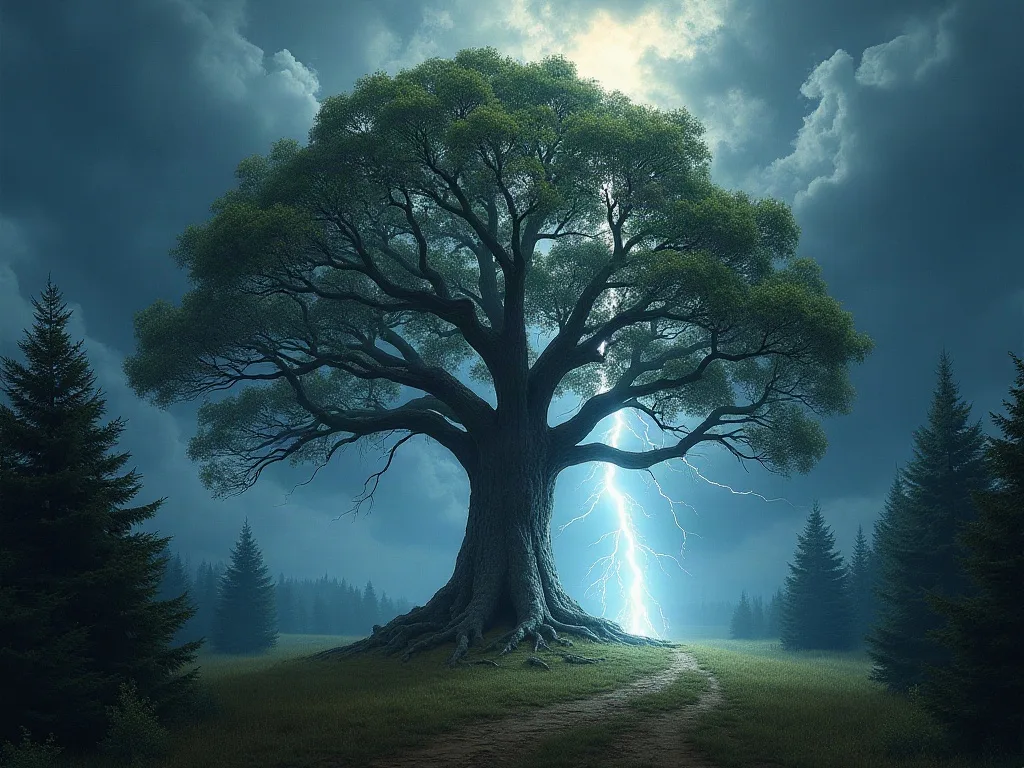
Perkūnas was not alone in his labors. He had companions and allies. Oak trees were sacred to him, places where he descended to rest or to receive offerings. Sacred groves, especially those with ancient oaks, were his temples. When lightning struck an oak, Balts did not fear the tree was cursed; they believed Perkūnas had chosen that spot as a place of power.
The Cosmic Enemy: The Struggle Against Chaos
The deepest layer of Perkūnas mythology reveals a god engaged in perpetual war. He did not fight human enemies; he fought the forces that threatened the cosmos itself. His primary antagonist was Vėlinas, god of the underworld and death, or in some traditions, a serpentine figure representing chaos and the forces of decay.
The battle between Perkūnas and chaos was not a single mythological moment fixed in the past. It was ongoing. Every storm was evidence of his struggle. Every thunder sound was the noise of combat. When lightning struck the earth, Perkūnas was fighting to maintain the boundary between the ordered world and the chaotic void.
This cosmic role gave Perkūnas moral authority. He was not merely powerful; he was necessary. His fighting was not aggression but duty. The Balts understood him as the guardian who kept the dangerous powers at bay, who ensured that the world remained habitable, that crops grew, that humans could live and prosper.
In some traditions, this struggle had sexual and generative dimensions. Perkūnas pursued a goddess figure, sometimes called Laima (goddess of fate and protection) or Dievas's daughter. The mythology hints at fertility rites and seasonal renewal. The god's power was not solely destructive; the rains he brought nurtured the earth. The storms that seemed violent also brought the moisture essential for life.
The Sacred Oak and the Ritual Landscape
For the Balts, Perkūnas's presence was not a matter of theology but of geography. He inhabited specific places, and those places became sacred because of his connection to them.
Oak groves served as temples. When a community needed to approach Perkūnas, they went to the ancient oaks. These were not building-temples like Greek sanctuaries; they were living, natural spaces where the boundary between the divine and human world grew thin. Offerings were left at the base of the trees or hung from the branches. Archaeological evidence and later folk accounts describe bones of sacrificed animals, precious objects, and food left as gifts.
The sacred fire also featured in these rituals. Balts would maintain eternal flames in the groves, sometimes in specially built structures near the largest oaks. The fire was not for sacrifice (though animals were killed) but for purification and communication. It was the visible counterpart to lightning, the earthly version of Perkūnas's own blazing power.
What strikes modern observers is the sophistication of this system. The Balts did not need a priesthood to enforce beliefs. The landscape itself taught them. When storms approached, people thought of Perkūnas. When lightning struck a tree, people saw his hand at work. The religion was written into nature, renewed with every season, visible in every dramatic weather event.
The Resistance to Conversion
The arrival of Christianity in the Baltic lands in the 13th century brought one of the longest and most intense conflicts in European religious history. The Teutonic Knights, a military order, came to "convert" Lithuania, Latvia, and Prussia. But the Balts were not easily displaced from their gods.
Perkūnas became the symbol of resistance. While other gods faded from the record or became merged with Christian saints, Perkūnas remained stubbornly alive in popular devotion. The Church recognized him as a threat; bishops and missionaries specifically targeted oak groves, cutting down the ancient trees that served as his temples. If Perkūnas lost his sacred landscape, his power would diminish.
Yet even this assault could not erase him entirely. The conversion was gradual, and in many places syncretism took hold. Perkūnas was not killed by Christianity; he was absorbed into it. In some regions, he merged with Saint George or other warrior saints. In folk tradition, he simply went underground, becoming a figure of legend and story rather than active cult worship.
The last organized resistance to Christian conversion in mainland Europe came from Lithuania, which did not formally adopt Christianity until 1387, nearly 150 years after its neighbors. During those centuries, warriors and priests continued to defend the old faith, to protect the sacred groves, to keep Perkūnas's cult alive. When conversion finally came, it came through political pragmatism, not spiritual defeat.
Perkūnas Across the Baltic Peoples
While Perkūnas was the paramount god across all Baltic regions, subtle variations emerged. The Lithuanians, who maintained the most detailed mythological tradition, preserved the richest accounts of him. In Lithuanian folklore, he appears as Perkūnas or Perkunas, a bearded warrior who rides the sky and hurls his axe at demons.
The Latvians called him Pērkons, and their traditions emphasized his role as a protector of crops and cattle. When a storm approached, Latvian farmers would pray to Pērkons for protection, understanding that while his power was immense, his aims were aligned with human welfare.
In Old Prussian tradition, recorded before the Prussian language disappeared entirely, he was Perkunos. The Prussians, conquered earliest by the Teutonic Knights, lost direct knowledge of their mythology sooner than the Lithuanians and Latvians, but the name and basic characteristics persisted in fragmentary sources.
Linguistically and theologically, all three were variations of one figure. The god was not parochial to a single tribe or region. He belonged to the Baltic peoples as a whole, a figure of pan-Baltic authority. This universality made him harder to suppress. Conversion in one region could not entirely eliminate a god whose presence was woven into the landscape and sky of all Baltic lands.
The Cosmic Family and Divine Relationships
Perkūnas did not exist in isolation. While our sources are fragmentary, they hint at a broader divine family and a set of relationships that structured the Baltic cosmos.
Dievas, the sky god, occupied a position above Perkūnas, somewhat like Zeus above Poseidon in Greek mythology. Dievas was more remote, more primordial, associated with the celestial vault itself rather than with the dramatic, visible power of storms. Perkūnas, by contrast, was closer to humans, more tangible, more directly involved in earthly affairs. This division of labor gave the pantheon a hierarchy without making Perkūnas subordinate in the popular imagination. When people faced a storm, it was Perkūnas they addressed, not the distant Dievas.
Vėlinas represented the underworld and death, a power that Perkūnas opposed. Some sources suggest that Perkūnas and Vėlinas embodied a cosmic duality: life and death, growth and decay, order and entropy. The world needed both, and their tension sustained existence.
Laima was a goddess associated with fate, protection, and childbirth. She appears in some mythological fragments as Perkūnas's consort or as the object of his pursuit. The relationship suggests fertility themes and seasonal mythology, though the surviving sources are too sparse to reconstruct a complete narrative.
The gods did not rule in complete separation. They intersected, they encountered one another, they balanced each other's power. This reflected a sophisticated understanding of how forces operate in nature and in human life.
Perkūnas in Modern Folk Tradition and Scholarship
Unlike the Norse gods, who were revived through 19th-century Romanticism and continue to inspire modern fiction and practice, Perkūnas experienced a different kind of afterlife. He remained alive primarily in folk tradition, in the memories of rural communities who maintained older customs long after official Christianization.
In the 19th and 20th centuries, folklorists like Jonas Basanavičius collected stories and songs about Perkūnas from Lithuanian speakers. These materials preserved a living mythology, not a dead literary archive. People still told tales of the thunder god. Children still heard his stories. The landscape still spoke of him.
In the 20th century, as nationalism grew across Europe, Perkūnas became a symbol of Baltic identity and resistance. In Lithuania especially, recovering Perkūnas became a way of reclaiming a pre-Christian, distinctly Baltic heritage in the face of Soviet domination. He represented continuity with an ancient past that no foreign power could erase.
Modern scholars like Marija Gimbutas and more recent researchers have integrated Baltic mythology into the broader study of Indo-European religions, showing how Perkūnas illuminates the shared patterns of sky gods and thunder deities across cultures. His mythology provides crucial evidence for reconstructing the beliefs of proto-Indo-European peoples.
Today, while mainstream Christianity dominates the Baltics, Perkūnas has not vanished. He appears in literature, in artistic works, in the reimagined pagan movements that draw on historical sources. He remains, as he has for centuries, a figure of power and continuity.
Perkūnas and the Wider European Thunder God Family
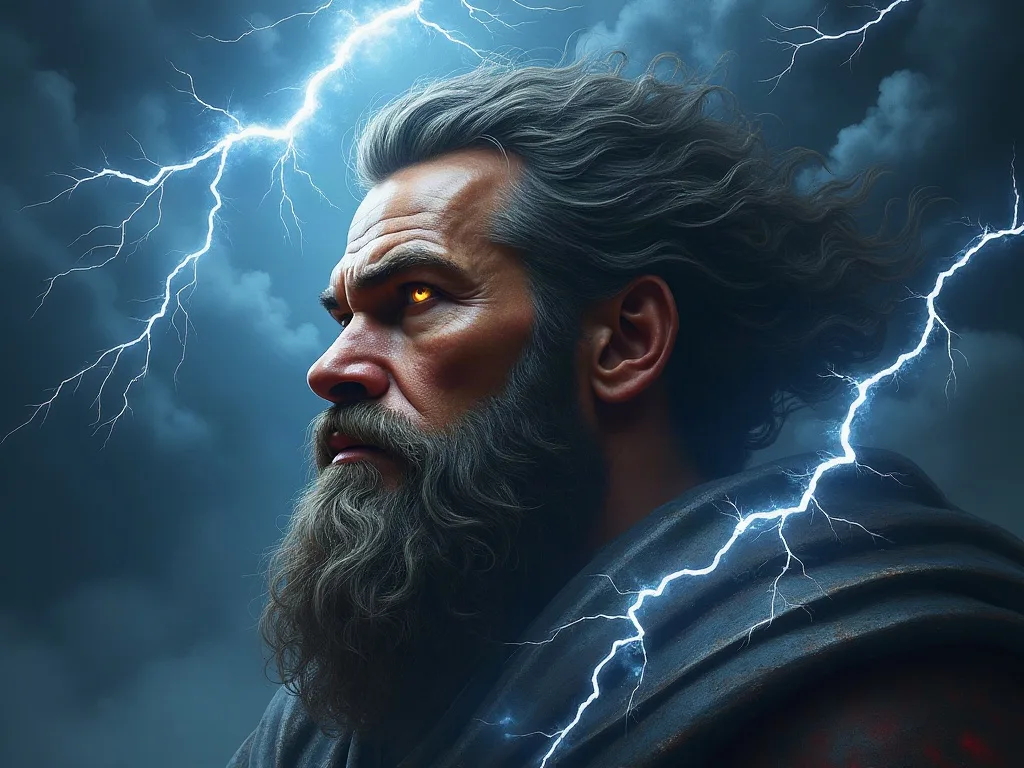
To understand Perkūnas's significance fully, it helps to place him in the company of other European thunder deities. Thor in Norse mythology, Taranis in Celtic traditions, Jupiter in Roman religion (specifically Jupiter Tonans, "the thunderer"), and the Slavic Perun all represent variations on the same archetype. The shared Indo-European roots of these peoples produced shared mythological patterns.
What distinguishes Perkūnas is how long he remained in active worship and how completely his tradition was preserved in oral form. The Norse mythology we know comes largely through written texts recorded centuries after the religious shift to Christianity. The Celtic gods survive mainly through fragmented classical sources and much later medieval Irish texts. But Perkūnas was actively worshipped into the medieval period and remembered in living folklore into the modern era.
This means that Perkūnas mythology, while less extensively written down than Norse or Greek traditions, may in some ways be more authentically preserved. The stories were not filtered through a literary tradition controlled by the victorious religion. They passed from grandmother to grandchild, living in the landscape, renewed with every storm. This makes Perkūnas a unique window into how Indo-European religions actually functioned in their communities.
The Enduring Question: Nature God or Moral Force?
Scholars continue to debate the deepest layers of Perkūnas's meaning. Was he primarily a nature god, a personification of the storm and lightning? Or was he a moral force, a defender of justice and cosmic order?
The evidence suggests both, integrated into a single figure. Perkūnas was fully engaged with the natural world; the Balts experienced him in weather, in seasons, in the physical sky. Yet he was not reducible to natural forces. He had will, intention, and purpose. He fought against chaos because the cosmos demanded order. He protected the weak from demons and harmful forces. He was a warrior with a moral cause.
This integration reflects a pre-modern understanding of nature as neither purely mechanical nor purely symbolic, but as alive with intention. The storm was both weather and the action of a powerful being. The two descriptions were not contradictory; they were aspects of the same reality.
This perception shaped how Balts lived. It made them attentive to the sky, to signs, to the movements of the sacred world around them. It connected their moral lives to the natural world and the cosmos. It meant that ethics and weather, human behavior and the movements of the heavens, were linked. This is not primitive superstition but a sophisticated way of holding together different dimensions of experience.
Frequently asked questions about Perkūnas, the Baltic thunder god?
Frequently asked questions
What exactly was Perkūnas's weapon, and why did the Balts search for it after storms?
Perkūnas wielded either an axe or hammer that became a lightning bolt when thrown. Balts believed that fragments of this divine weapon fell to earth as meteorite stones or special rocks found after storms. These were treated as sacred objects with protective power, kept in homes or worn as amulets. The practice reflects a theological understanding: the god's weapon was not metaphorical but physically present in the world, a tangible bridge between the divine and human realms.
How did Perkūnas survive Christian conversion better than other Baltic gods?
Perkūnas's connection to the natural world, especially storms and oak groves, made him harder to erase. The Church could build churches and convert rulers, but it could not eliminate the sky or the ancient trees. Perkūnas was also absorbed into Christian saint traditions, particularly warrior saints like Saint George. In folk memory and rural communities, especially in Lithuania which converted latest, Perkūnas persisted as a legendary figure even after official Christianization, maintaining a dual existence in folk tradition alongside Christian belief.
What was the relationship between Perkūnas and Dievas, the sky god?
Dievas was the more remote, primordial sky god associated with the celestial vault itself, while Perkūnas was his more active, tangible counterpart engaged in direct cosmic struggles. Dievas represented the overarching cosmic order; Perkūnas defended that order through constant action. Both were sky gods, but Dievas was transcendent and distant, while Perkūnas was immanent and involved in the human world. This mirrored how different divine forces operated at different scales in the Baltic cosmos.
Is there evidence that Perkūnas mythology influenced other European thunder gods like Thor?
All the major Indo-European thunder gods, Perkūnas, Thor, Perun (Slavic), Taranis (Celtic), and Jupiter Tonans (Roman), derive from shared proto-Indo-European religious patterns and linguistic roots. They are not one god transmitted across cultures but rather parallel developments from a common mythological template. The similarity in names, attributes, and functions reflects their common ancestry in the religions of prehistoric Indo-European peoples. Perkūnas is not a copy of Thor but rather a cousin, both inherited from the same ancient tradition.
What role did oak groves play in Perkūnas worship?
Oak groves were Perkūnas's temples on earth. These were sacred natural spaces where offerings were left and where communities gathered to approach the god. The oaks themselves were seen as connected to Perkūnas; when lightning struck an oak, it was evidence of his presence. Balts maintained eternal fires in or near these groves as earthly counterparts to lightning. The groves were not merely symbolic locations but active ritual spaces where the boundary between divine and human worlds grew thin. Christian missionaries specifically targeted these groves, cutting down the ancient trees, because they understood that Perkūnas's power was rooted in them.
Perkūnas and the Question of Survival in Modern Times
The story of Perkūnas does not end with the triumph of Christianity. In the 20th century, as European peoples sought to recover their pre-Christian heritage, Perkūnas became a figure of cultural pride and spiritual inquiry in Lithuania especially. He represented a continuous thread connecting modern Balts to a distinctly Baltic identity, untainted by the imposed religions of conquering powers.
Today, Perkūnas appears in contemporary Lithuanian literature, art, and popular culture. He has not become a trendy modern phenomenon like the Norse gods in contemporary paganism, but he remains a living figure in the imagination of Baltic peoples. Academic scholarship continues to illuminate his role in Indo-European religions, showing how a careful study of Perkūnas mythology illuminates the shared spiritual patterns of peoples who migrated across Europe thousands of years ago.
What makes Perkūnas remarkable is not that he vanished and was recovered, but that he never fully vanished. Unlike the Greek gods who became literary artifacts or the Norse gods who had to be resurrected from medieval texts, Perkūnas lived in the land, in the sky, in stories told in farmhouses and fields. He is a god who survived not because scholars preserved him but because people remembered him, kept him alive through acts of attention and reverence.
The thunder that rolls across Lithuanian and Latvian skies today still carries his name in popular memory. The ancient oaks still stand in sacred groves. The god who rode his chariot above the clouds, who fought chaos to maintain the cosmos, who protected the weak and demanded justice, remains a presence in the world he once so vividly inhabited.
Read the full book
Want the whole story?
The complete edition is an instant PDF download here, with a paperback on Amazon for selected titles.
Baltic
The Baltic Mythology Book: Perkūnas, Saulė, Dievas, and the Gods of Lithuania and Latvia
Perkūnas, Saulė, and Dievas
The last pagans of Europe: the Lithuanians and Latvians who kept their old gods into the 1400s. Perkūnas the thunderer, Saulė the sun, the sky-god Dievas, and a forest religion preserved in tens of thousands of folk songs.
More from Baltic
All articles
Baltic
The Grass Snake: Sacred Household Guardian of Baltic Homes
The grass snake was no mere reptile in Baltic homes, it was a household god, a protective spirit that lived in the walls and brought prosperity. Learn how this sacred creature shaped daily life and spiritual belief in Lithuania and Latvia.

Baltic
Dainas: Sacred Folk Songs as Living Mythology
Dainas are more than songs, they are Lithuania and Latvia's oldest mythology preserved in four-line verses sung for millennia. Discover how peasants encoded gods, rituals, and cosmic wisdom into folk poetry that shaped Baltic identity and survives today.

Baltic
Žemyna: Mother Earth Goddess of the Baltic Lands
Žemyna stands at the heart of Baltic spirituality as the life-giving earth mother who nurtures crops, heals the sick, and guards the sacred bond between humans and land. Discover how this ancient goddess shaped Lithuanian and Latvian culture for centuries.
Baltic
The Sacred Oak: World Tree of Baltic Tradition
The Sacred Oak stands at the center of Baltic cosmology as the world tree connecting earth, sky, and the underworld. Discover how Lithuania and Latvia's ancient oak groves shaped a mythology that survived centuries of Christian suppression.