
Velnias: The Trickster God of the Underworld
Velnias rules the Baltic underworld as cattle-lord, trickster, and keeper of the dead. Uncover his ancient duel with the sky god Perkūnas and why he endured as a Christian devil.
Contents
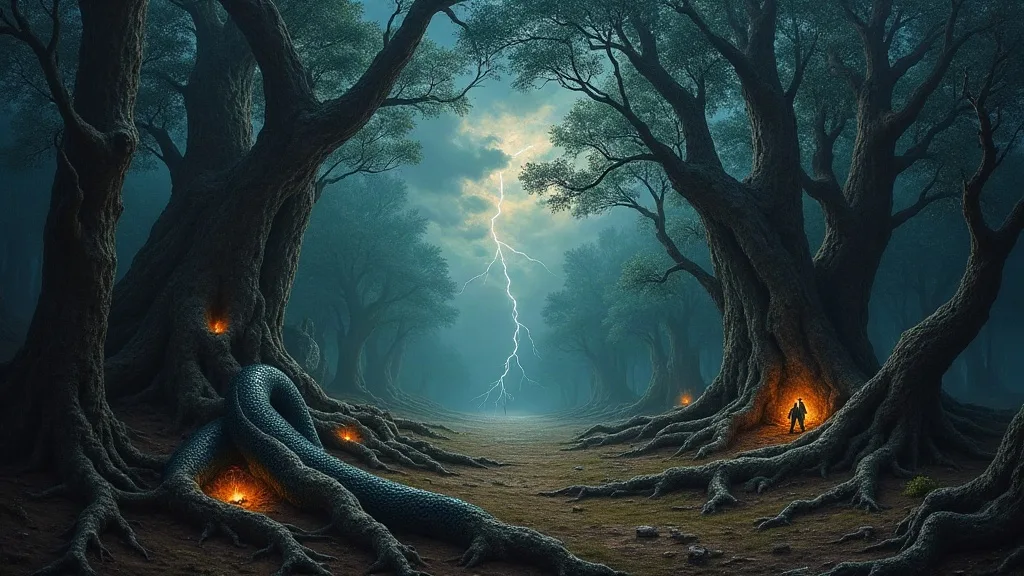
The serpent moves first. Before the storm cracks open the sky, before Perkūnas hurls his axe and splits the oak, Velnias is already coiled at the roots of the cosmic tree, counting what is owed to the dead. He does not rage. He waits, shifts shape, slips sideways into a cow, a black dog, a travelling merchant. The storm god wins most battles. Velnias wins most arguments.
Baltic mythology is one of the oldest surviving Indo-European traditions, preserved not in a tidy epic but in fragments: folk songs called dainos, fairy tales, place names, and the hostile footnotes of medieval Christian missionaries who came north and found people still feeding their dead at hearth-side fires. Among the gods who lived inside those fragments, Velnias (sometimes spelled Vels or Vels in Latvian) stands apart. He is the lord of the underworld, the protector of cattle and the dead, the patron of poetry and trickery, and the adversary of the sky. He is one figure, but he holds the contradictions of an entire cosmology.
The Name Behind the God: Linguistic Roots of Velnias
Velnias in Lithuanian, Vels in Latvian, Vels in Old Prussian traces: the name's skeleton reaches back to a Proto-Indo-European root, *wel-, meaning "to see" or "to perceive," with a secondary cluster around death, the realm below, and those who have passed on. The Sanskrit Vala, the Avestan Vayu (in his chthonic aspect), the Vedic Varuna in his role as keeper of cosmic order beneath the surface: scholars such as Marija Gimbutas and Jaan Puhvel have placed these side by side and found the family resemblance hard to dismiss.
In Lithuanian, vėlė means the soul of the dead. Vėlinės is the festival at which those souls are fed and honored, still celebrated in Lithuania every November 1st and 2nd, layered now under Catholic All Souls' Day. The god's name is built from the same root as the word for the dead he rules. He is not just their king; he is, in some sense, their collective personification.
The Latvian form, Vels, is paired with Māra, the dark feminine principle associated with death and cattle, suggesting that in the Latvian branch the underworld partnership was gendered in ways the Lithuanian sources only hint at. The Old Prussian evidence is sparser, lost to the near-total destruction of that language and people by the Teutonic Knights in the thirteenth century, but what survives reinforces the picture: a being below, associated with livestock, souls, and the seasonal rhythm of death and return.
Cattle, the Dead, and the World Below
Velnias governs two domains that look unrelated to modern eyes: the dead and cattle. In the Baltic world, they were the same thing.
Cattle were wealth, sustenance, and sacred intermediary all at once. When an animal died, it crossed the boundary Velnias held. When a person died, they too moved into his keeping. The underworld he rules, called Viln or simply the land below the earth, is not a place of punishment. It mirrors the world above: fields, rivers, forests, herds. The dead live there much as they lived here, and the boundary between the two worlds is permeable at certain seasons.
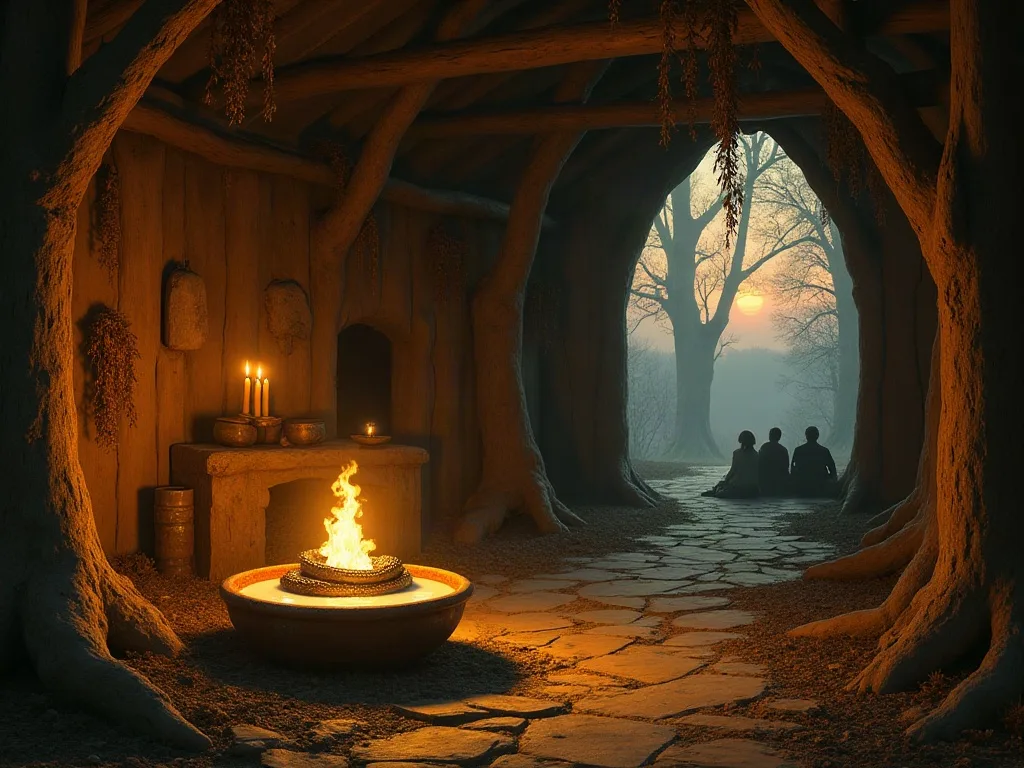
This is why Velnias is a god who herds. Medieval Lithuanian chronicles record that cattle-breeders made offerings at sacred groves specifically to him. A passage in Matthaeus de Mechow's 1517 Descriptio Sarmatiarum describes Lithuanian villagers propitiating a serpent figure connected to household prosperity and the welfare of livestock. That serpent, the žaltys, was considered sacred, often kept under the hearth or in a clay pot of milk, fed by the family. Many scholars read the žaltys as a domestic face of Velnias himself, the underworld power made small and household-friendly.
The serpent connection is structural, not ornamental. In Indo-European cosmology, the sky god stands at the top of the cosmic axis, associated with light, height, and the eagle. His opponent inhabits the roots, associated with the underworld, water, cattle, and the serpent. Velnias occupies that lower pole, not as evil but as necessary counterweight. Without the roots, the tree falls.
The Great Duel: Velnias Against Perkūnas
No story in Baltic mythology is more central than the recurring conflict between Velnias and Perkūnas, the thunder god. The Lithuanian linguist and mythologist Algirdas Julien Greimas spent decades reconstructing this myth from folk materials, and his 1992 work Of Gods and Men remains the foundational analysis in English translation.
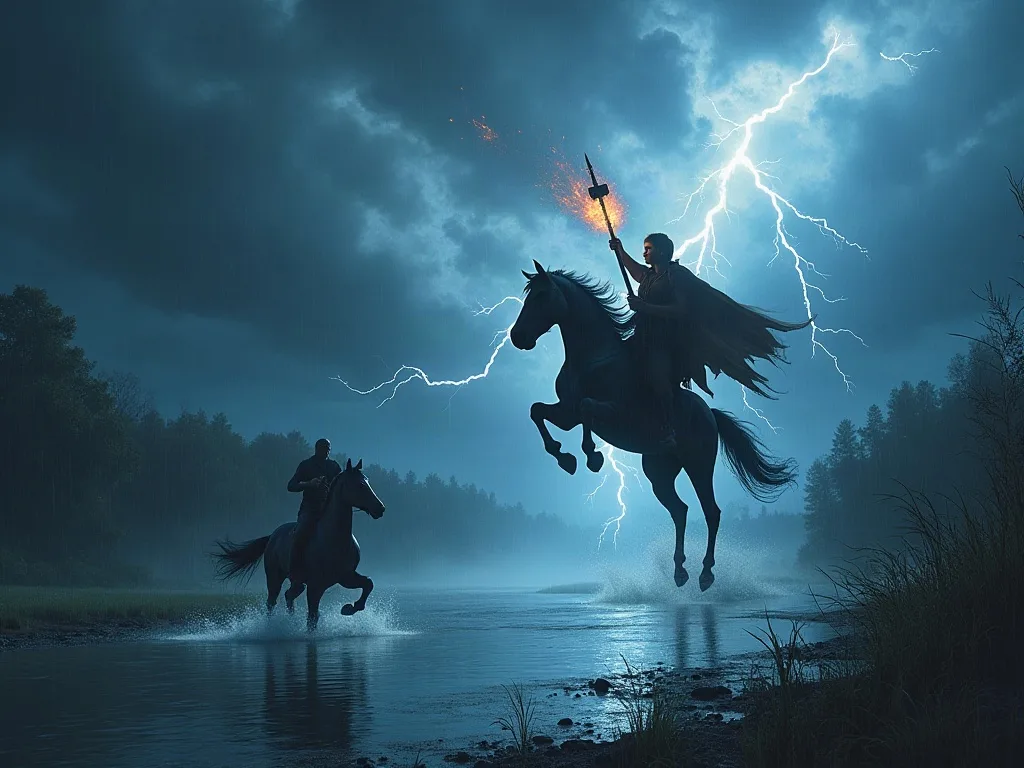
The myth works like this: Velnias steals something that belongs to the upper world, typically cattle, sometimes a woman, sometimes the sun itself. Perkūnas hunts him with thunder and lightning. Velnias flees, shifting shape rapidly: a man, then a horse, then a stone, then a tree, then a fish in the river. Perkūnas strikes each hiding place with lightning. Eventually Velnias is cornered and either killed (temporarily) or driven back below ground, and the stolen goods are returned. Rain follows the battle as a natural consequence, and the crops grow.
This is a myth of seasonal renewal wearing the costume of a chase. The thunder god's victory is not permanent, because Velnias must return. The cycle needs him. He will steal again, be hunted again, and in that pursuit the rains that feed the earth will fall again. He is the engine of the cycle precisely because he cannot be permanently defeated.
What makes Velnias something more than a simple villain is what he does during the chase. He argues. He deceives. He uses words where Perkūnas uses force. Several folk song fragments collected by nineteenth-century Lithuanian folklorists show Velnias negotiating, mocking, reframing the terms of the conflict. He is the god whose weapon is language, ambiguity, and the sideways look. That made him the patron of poets, musicians, and travelers, all people who live by wit rather than strength.
Velnias as the Lord of the Dead: Ancestor Cult and the November Feast
The Baltic relationship with the dead was not haunted by dread. It was relational. The dead were kin, and kin had obligations.
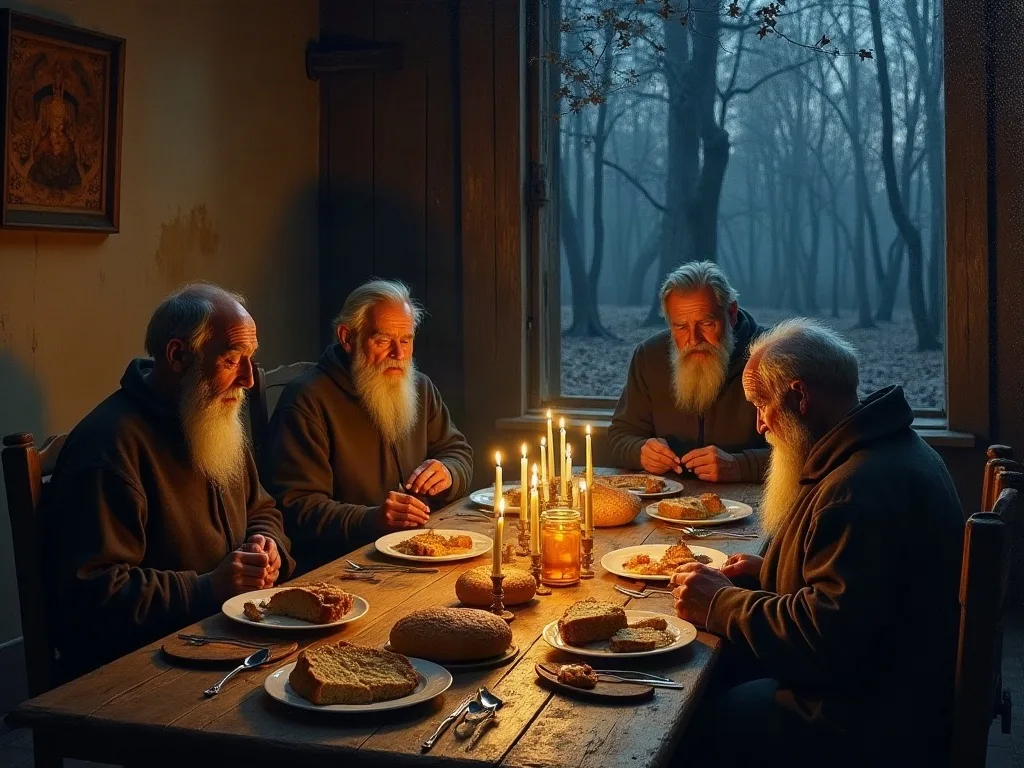
Velnias presided over a tradition scholars call the ancestor cult. Twice a year, in spring (Užgavėnės territory) and especially in autumn at Vėlinės, the barrier between living and dead thinned. The dead returned to their households, sat at the table, received food and drink poured for them. The head of household would speak to them, update them on family news, ask for their counsel. When the feast ended, the ancestors were formally escorted back to the underworld, back to the care of Velnias.
This is attested not just in folklore but in chronicles. The Jesuit missionary Jacob Wujek, writing about Lithuania in the late sixteenth century, describes with clear irritation the persistence of offerings to the dead at hearth-fires, the practice of leaving food at graves, and the reverence shown to sacred snakes kept inside homes. He saw it as pagan survival to be exterminated. What he documented was in fact one of the longest-running ancestor-cult practices in European history.
Velnias is the caretaker in that system. He receives the dead, tends them, and returns them when summoned. He is not a judge like the Greek Hades or an executioner like the Egyptian Osiris. He is closer to a shepherd of souls, which is structurally consistent with his role as cattle-lord. The same word covers both herds.
Trickster, Poet, Shapeshifter: The Character of Velnias
The trickster role of Velnias deserves its own examination, because it carries implications beyond personality.
Tricksters in world mythology tend to operate at boundaries: between sacred and profane, living and dead, human and animal, high and low. They are boundary figures because their function is to keep the system porous. A cosmos with no trickster calcifies. Velnias holds the boundary between the world of the living and the world of the dead, which is exactly the boundary that must stay permeable for life to continue. The dead feed the soil. The soil feeds the cattle. The cattle feed the living. The living die and feed the dead. Velnias manages the gate.
His patronage of poetry follows from this. In Baltic folk tradition, the finest verbal art, the tightest daina, the cleverest riddle, carried a touch of the underworld's knowledge. The dead know what the living cannot see. A poet who spoke with the authority of true insight was understood to have some access to that lower knowledge, and that access ran through the domain of Velnias. The Greek Hermes carries a similar freight: psychopomp, trickster, patron of speech and cunning. The structural position is the same, even if the mythologies developed independently.
His shapeshifting, documented across dozens of Lithuanian folk tales, serves the same purpose. Identity is not fixed below the ground. The dead are not the persons they were; they are something more fluid. Velnias shifts shape because that is the nature of his realm. He models what death does to form.
From God to Devil: The Christian Transformation of Velnias
When Christian missionaries reached Lithuania, the last pagan country in Europe to be formally converted (the official baptism of Grand Duke Jogaila came in 1387), they faced a well-populated pantheon. Perkūnas was too storm-loud, too obviously powerful, to be ignored. He was identified with the Devil in some accounts, with thunder saints like Elijah in others.
Velnias suffered a cleaner demonization. His underworld address, his serpent associations, his role as the one who holds the dead: all of these made him an obvious candidate for the Christian Devil. In Lithuanian folk vocabulary, velnias became a common word for devil long before the pagan memory faded. You can hear children today saying eik pas velnius!, "go to the devil," without any idea that they are addressing one of the oldest gods in Europe.
This semantic slide is one of the most-studied phenomena in Baltic religious history. The folklorist Norbert Vėlius, whose multivolume Baltic Religion project ran through the 1980s and 1990s, argued that the demonization was never complete at the popular level. The household snake still received milk in rural Lithuania well into the twentieth century. Vėlinės survived intact under its Catholic cover. The ancestor feasts continued. Velnias was pushed underground in the social sense, but like his mythological self, he never disappeared permanently.
Some scholars, including Vykintas Vitkauskas, note a pattern in the folk material where Velnias is depicted as ultimately benign toward humans even in his "devil" form: he cheats nobles and clergy, but rewards the poor and clever. The trickster's moral compass did not reset when his name changed.
Comparative Echoes: Velnias Across Indo-European Traditions
The argument for Velnias as an Indo-European inheritance rests on a convergence of evidence across languages and traditions.
The Slavic Volos (or Veles), attested in the medieval Russian Primary Chronicle compiled by the monk Nestor around 1113, is the closest neighbor. Volos/Veles is the god of cattle, the underworld, and oath-keeping in the Slavic world. The Primary Chronicle records a treaty between Rus prince Sviatoslav and the Byzantine emperor in 971, sworn "by Perun and by Veles the god of cattle." The pairing is identical to the Baltic structure: sky-thunder deity and underworld-cattle deity as the two poles of the cosmos.
The Vedic Vala is a cave-demon who imprisons the cattle of the gods until the hero Indra releases them with a thunderbolt. Indra is the storm god; the cattle-prison below ground is structurally the same myth as Velnias stealing the herds of the upper world. The linguist Calvert Watkins, in How to Kill a Dragon (1995), traced this "hero slays serpent to release cattle/light/rain" pattern across Greek, Vedic, Anatolian, and Baltic materials and identified it as one of the oldest recoverable Indo-European narrative formulas.
Even Thor and Jörmungandr in Norse mythology can be read against this template: the thunder god perpetually at war with the great serpent below, neither able to permanently destroy the other, because the cosmos requires both.
Frequently Asked Questions about Velnias, Baltic Trickster God of the Underworld
Frequently asked questions
What are the primary sources for the myth of Velnias?
No single Baltic epic survives. The sources are scattered: medieval chronicles like Matthaeus de Mechow's 1517 "Descriptio Sarmatiarum," Jesuit missionary reports from the sixteenth and seventeenth centuries, and the enormous folklore collections gathered by Lithuanian and Latvian scholars in the nineteenth century, especially the work of Krišjānis Barons on Latvian dainas. Algirdas Julien Greimas's 1992 reconstruction "Of Gods and Men" synthesizes these fragments into the most complete scholarly account available in English.
Is Velnias the same deity as the Slavic Veles?
They are cognate, meaning they share a common Proto-Indo-European ancestor deity, but they developed independently in the Lithuanian and Slavic traditions. Both are cattle lords and underworld figures paired against a thunder god. The Slavic Veles is attested in the 971 Rus-Byzantine treaty recorded by Nestor in the "Primary Chronicle." Linguists reconstruct a shared Proto-Balto-Slavic precursor, but the Baltic Velnias retained richer trickster and shapeshifting characteristics in his surviving folk record than the Slavic Veles.
Why was Velnias associated with both cattle and the dead?
In Baltic agrarian society, cattle were the primary measure of household wealth and survival. When cattle died, they crossed the boundary into the underworld. When humans died, they too entered that domain. Velnias governed the line between the living world above and the world below, which naturally made him lord of everything that crossed it: dead animals, dead people, and by extension the fertility that cycles back up through the soil. The roles are not contradictory; they are two aspects of the same boundary function.
How did Velnias survive the Christianization of Lithuania?
Lithuania was the last European country to officially convert, not doing so until 1387, and even then conversion was largely political. Velnias survived in two forms. First, his name became the Lithuanian common word for "devil," a linguistic ghost that preserved the memory of his underworld role. Second, his cult survived in disguised practice: the ancestor feasts of Vėlinės continued under All Souls' Day, the sacred household snake kept receiving offerings in rural areas into the twentieth century, and folk tales continued to feature a clever underground figure who outwits the powerful.
What does the Velnias-Perkūnas myth explain about the natural world?
The myth functions as an explanation for rain, seasonal change, and agricultural fertility. When Velnias steals the cattle (or the sun, or the clouds that hold rain) and Perkūnas chases him with lightning strikes, the thunderstorms that result bring rain to the fields. The pursuit ends, the water falls, the crops grow. The myth also explains why storms are violent: the thunder god is genuinely angry, not performing. The cycle must repeat every year because Velnias cannot be permanently eliminated; the world needs both poles of the cosmic axis to function.
Did Velnias have dedicated temples or priests?
The Baltic religious landscape did not feature large stone temples in the Mediterranean style. Sacred sites were groves, springs, hilltops, and the domestic hearth. Velnias was propitiated primarily at household and agricultural levels: offerings at snake shrines under the hearth, libations poured at graves during Vėlinės, first-fruits set aside for the lord of cattle. Some chronicles mention specialist ritualists called vaidilutai or žyniai (wise-folk) who mediated with the underworld, but whether these constituted a dedicated priesthood of Velnias specifically is debated among scholars.
The Living Underground: Velnias in Modern Baltic Identity
Lithuania regained independence in 1990 after fifty years of Soviet occupation. The Soviet period had suppressed religious practice broadly, including the pagan revival movements called Romuva that had begun in the early twentieth century. After 1990, Romuva re-emerged as a formal religious organization, and with it came a renewed engagement with Velnias not as a folk-devil but as a genuine theological figure.
Contemporary Baltic neo-pagans, drawing on Vėlius's scholarship and the wider Indo-European comparative record, position Velnias as a sacred principle of natural balance: the underworld's claim on what the upper world produces, the memory the living owe the dead, the creative potential hidden in darkness. Several Lithuanian artists and poets have used him as a central symbol, and the November Vėlinės has seen a striking revival as both a secular cultural event and a religious observance.
What is striking about this reception is how little it has to invent. Velnias did not disappear; he went below, consistent with his nature, and waited. The folk tales never stopped being told. The sacred snakes were kept quietly in some households until well within living memory. The ancestor meals continued. When Lithuanians reached back for him after 1990, they found him still there, at the roots, in the old place, counting what the living owed and keeping the gate between the worlds with the unhurried patience of something that cannot be permanently killed by any storm.
That is his deepest character: not chaos, not evil, but persistence. The thunder passes. The serpent remains.
Read the full book
Want the whole story?
The complete edition is an instant PDF download here, with a paperback on Amazon for selected titles.
Baltic
The Baltic Mythology Book: Perkūnas, Saulė, Dievas, and the Gods of Lithuania and Latvia
Perkūnas, Saulė, and Dievas
The last pagans of Europe: the Lithuanians and Latvians who kept their old gods into the 1400s. Perkūnas the thunderer, Saulė the sun, the sky-god Dievas, and a forest religion preserved in tens of thousands of folk songs.
More from Baltic
All articles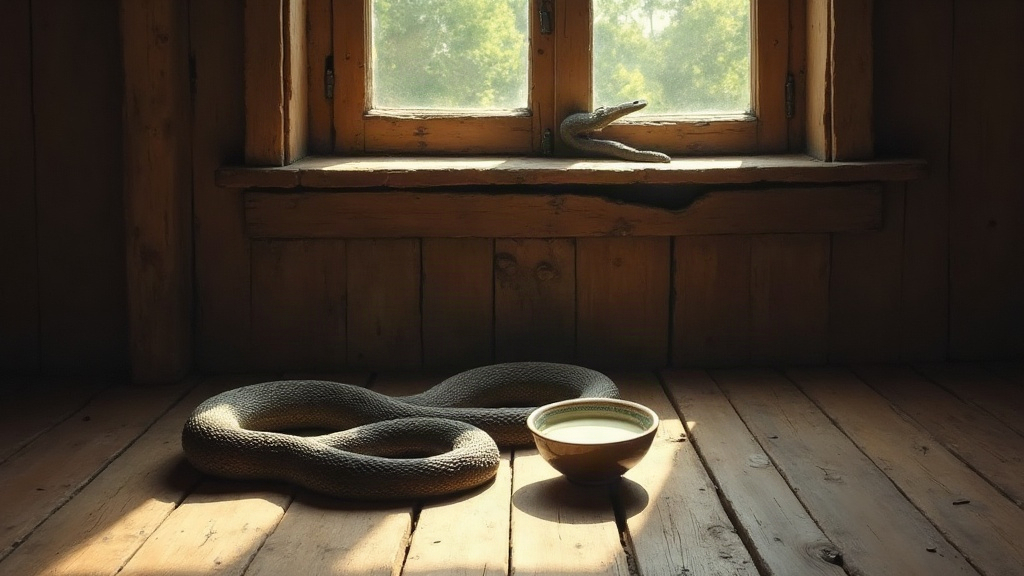
Baltic
The Grass Snake: Sacred Household Guardian of Baltic Homes
The grass snake was no mere reptile in Baltic homes, it was a household god, a protective spirit that lived in the walls and brought prosperity. Learn how this sacred creature shaped daily life and spiritual belief in Lithuania and Latvia.

Baltic
Dainas: Sacred Folk Songs as Living Mythology
Dainas are more than songs, they are Lithuania and Latvia's oldest mythology preserved in four-line verses sung for millennia. Discover how peasants encoded gods, rituals, and cosmic wisdom into folk poetry that shaped Baltic identity and survives today.

Baltic
Žemyna: Mother Earth Goddess of the Baltic Lands
Žemyna stands at the heart of Baltic spirituality as the life-giving earth mother who nurtures crops, heals the sick, and guards the sacred bond between humans and land. Discover how this ancient goddess shaped Lithuanian and Latvian culture for centuries.
Baltic
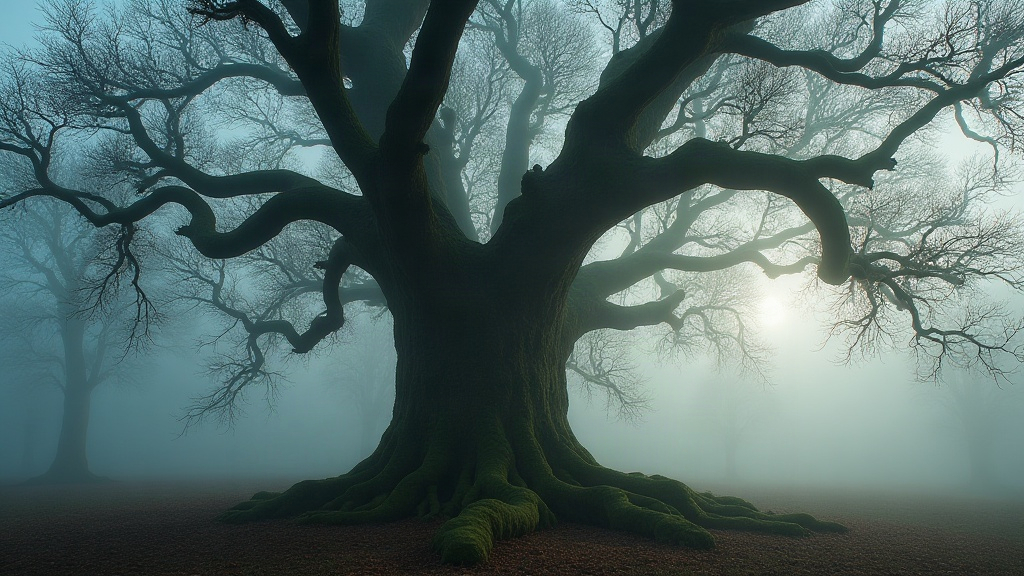
The Sacred Oak: World Tree of Baltic Tradition
The Sacred Oak stands at the center of Baltic cosmology as the world tree connecting earth, sky, and the underworld. Discover how Lithuania and Latvia's ancient oak groves shaped a mythology that survived centuries of Christian suppression.