
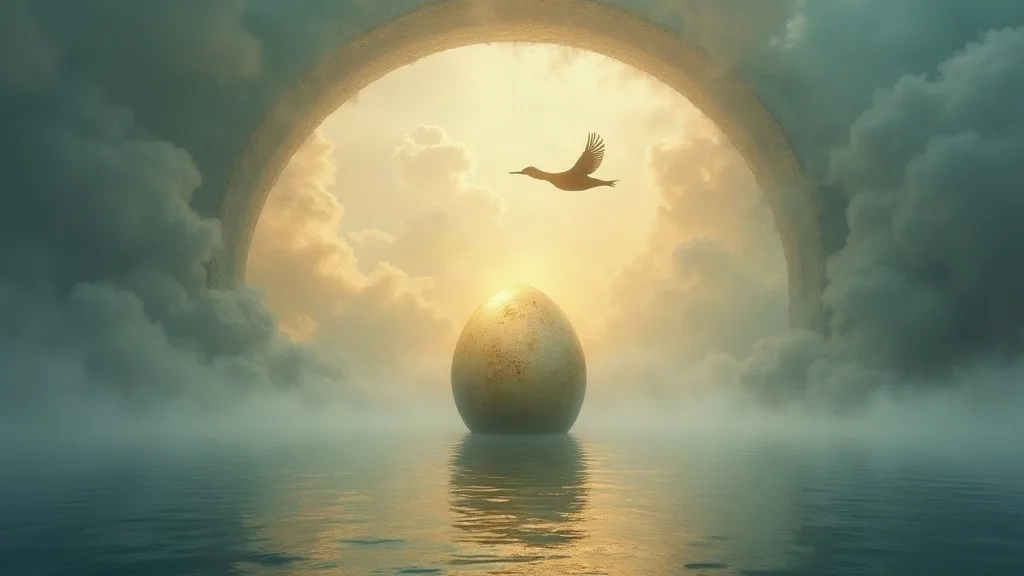
The Creation of the World from the Cosmic Egg in Baltic Mythology
Baltic peoples believed the world hatched from a cosmic egg laid by a celestial waterfowl, a creation motif that bridges Bronze Age Indo-European roots and medieval folk memory. Discover how this myth shaped Baltic cosmology and echoes across global traditions.
Contents
An egg floats in primordial chaos. Water surrounds it, endless and still. A waterfowl circles above, searching for solid ground. The egg splits open. From its shell and contents come the sky, the earth, the sea itself. This is not a vision from an ancient temple or a carefully preserved sacred text. This is a memory that survived in folk songs, rural rituals, and the recollections of scholars who met the last speakers of Lithuania's pagan traditions in the early 20th century.
The Baltic peoples, the Lithuanians and Latvians, preserved one of Europe's most remarkable creation myths: the creation of the world from a cosmic egg. Unlike the Greeks or the Norse, the Baltic cultures did not commit their mythology to written epics. Instead, their cosmology survived underground, encoded in wedding songs, seasonal chants, and the oral testimony of village elders. What we know today comes from fragments, from dainas (traditional Lithuanian and Latvian folk songs of poetic power), and from the scholarly rescue work of figures like Jonas Basanavicius and Balys Sruoga in the 1920s and 1930s.
The Primordial Egg: Setting the Scene
Before creation, there is only water. An undifferentiated cosmic ocean covers all space. In some tellings, the water belongs to Dievas, the sky god and creator figure, who watches from above. In others, the egg itself is older than thought, a primordial container waiting for animation. A waterfowl appears: in most Lithuanian versions, a duck or a goose. Some sources name it a swan. The bird dives deep into the waters, searching for earth where it might nest.

The waterfowl's quest mirrors the diver myths found across Indo-European traditions. It represents action, purpose, and the principle of divine will manifested through creature agency. In Baltic cosmology, animals are not separate from the sacred; they are instruments of creation itself. The duck or goose belongs to no single god but exists as a cosmic agent, like a tool in the hands of fate.
When the bird can find no solid ground, it lays an egg upon the water. This egg is no ordinary vessel. It contains potential, the seeds of all that will be. Some songs describe the egg as immense, as large as the sky itself. Others keep its size ambiguous, letting the listener's imagination fill the void. In this way, the myth remains alive, reshaped by each teller and each ear that hears it.
The Breaking of the Shell: Birth of the World
The egg begins to crack. The process is neither violent nor gentle; it is inevitable, the unfolding of law. From the shell itself, the earth forms: the curved inside of the shell becomes soil, stone, the body of the ground. The top half of the shell rises to become the sky, arching above like a dome. Some versions say the stars are fragments of the interior; others claim the sun and moon are the golden and silver yolks, set into motion across the dome.
The white of the egg becomes the sea. In some tellings, it is the clear liquid, salt-free, that fills the cosmic basin. In others, the distinction between white and yolk blur, and both substances contribute to the waters. The Baltic peoples lived between land and sea, and their creation myth honors both elements as equally primary, neither subordinate to the other.
What emerges is not chaos but order. The three realms are established: the upper world of the sky, the middle world of the earth, and the lower world of the waters. This three-fold structure appears throughout Baltic sacred geometry. It mirrors the tripartite worlds found in Hindu and Germanic cosmologies, suggesting deep Indo-European roots predating the Christian conquest of the Baltic lands in the 13th and 14th centuries.
The waterfowl itself does not disappear. In some retellings, it remains as the guardian of the waters or transforms into a constellation. In others, it simply departs, its work complete. The ambiguity is intentional. Oral traditions thrive in gaps; they allow each listener to complete the story with their own intuition and experience.
Dievas and the Ordering of Creation
Dievas, whose name means "sky" or "daylight," stands above the creation act in the most detailed Baltic sources. He is not a creator in the active, generative sense of the Hindu Brahma or the Judeo-Christian God. Rather, he is the principle of order itself, the law that holds the cosmos in place. His role is maintenance, not genesis.
Some scholars, drawing from the testimony of 19th and early 20th century Lithuanian and Latvian folklore collectors, suggest that Dievas may have set the egg in motion or overseen its breaking. Yet the texts preserved in dainas rarely grant him this explicit agency. Instead, Dievas is the distant king of the sky, the one who ensures that seasons turn, that oaths are kept, that justice prevails. He is almost abstract in his transcendence.
This stands in sharp contrast to Laima, the mother goddess and guardian of the home and fertility. While Dievas watches from above, Laima is present in every dwelling, every birth, every threshold. In the creation framework, one might say Dievas is the cosmos itself; Laima is the life that quickens within it. Together, they represent the dual principles of structure and vitality.
The other major deities occupy intermediate spaces. Perkunas, the thunder god and wielder of lightning, ensures that the order Dievas established is defended against chaos. He is not a creator but a guardian, the enforcer of the law. Velinas, the god of death, stands at the boundary between the living world and the realm below. Like Hades in Greek tradition, he is neither evil nor kind; he is the necessary gate through which all things pass.
The Cosmic Egg Across Indo-European Traditions
The Baltic cosmic egg does not exist in isolation. Similar myths appear throughout Indo-European cultures, suggesting a shared heritage that stretches back to the Bronze Age migrations and the common religious imagination of peoples who split apart millennia ago.
In Hindu cosmology, the hiranyagarbha, often translated as the "golden womb" or "golden egg," appears in the Rigveda, one of the oldest surviving religious texts. From this egg emerges Hiranyagarbha, the golden being, who may be identified with Brahma or with ultimate reality itself. The egg contains the universe in miniature; its breaking releases creation. The resemblance to the Baltic tradition is striking: both center on an egg as the fundamental creative vessel, both depict its opening as the foundation of the ordered world.
The ancient Greek Orphic traditions spoke of the cosmic egg laid by Night or Chaos, from which Eros (the generative force) and the Titans were born. Though the details differ from Baltic accounts, the principle remains: the egg as a container of undifferentiated potential, whose breaking brings forth differentiation and order.
In Finnish mythology, preserved in the Kalevala epic, the primordial egg takes a more tragic form. The egg falls into the cosmic sea, and its pieces scatter, forming the islands, rocks, and shallows. The yolk becomes the sun, the white the moon, and the fragments become clouds and stars. The story is darker than the Baltic version, weighted more toward accident and loss. Yet the underlying architecture is identical: an egg, primordial waters, and the emergence of the structured cosmos.
Baltic Cosmic Egg
The waterfowl lays an egg in cosmic waters. The shell becomes earth and sky; the contents become the sea. Creation is orderly and complete. Dievas oversees but does not directly generate. The waterfowl is an independent cosmic agent.
Hindu Hiranyagarbha
The golden egg is laid by divine or primordial force, often associated with Night or primordial chaos. From it emerges a divine being (Hiranyagarbha or Brahma). Creation is more explicitly generative and willful. The egg contains a conscious entity that unfolds the universe through thought or desire.
The Waterfowl: A Cosmic Diver in Baltic Tradition
The waterfowl is not a minor figure in the Baltic creation story. It embodies a principle found across Siberian, Arctic, and Indo-European cosmologies: the cosmic diver. This motif appears in Native American creation myths (the turtle and the otter), in Siberian Finno-Ugric traditions (the water bird searching for primordial soil), and in Indic myths (the heron or goose diving into cosmic waters).
The waterfowl's dive is an act of grace and intelligence. It does not question the void; it searches it. It does not demand solid ground; it nests on water, accepting the nature of the cosmos as it finds it. In this way, the bird embodies a philosophical stance: acceptance of what is, coupled with the agency to bring forth what may be. It is neither rebellious (like Prometheus in Greek myth) nor passive. It acts in harmony with cosmic law.
In Lithuanian dainas, the bird sometimes appears as the primordial mother or as Laima herself in animal form. The boundary between the waterfowl and the goddess blurs. This is characteristic of archaic mythologies, where beings shift their forms and identities according to narrative need. The bird is not separate from the divine; it is a manifestation of divinity expressed through creature agency.

Some folklorists have suggested that the waterfowl memory preserved in these songs may reflect actual observations of ducks and geese nesting in the Baltic marshes and lakes, behaviors that caught the imagination of a people living in constant contact with water and wetland. The myth is grounded in lived experience, elevated to cosmic significance. This pattern is common in archaic cultures: the most important cosmological principles are derived from the closest observations of the natural world.
Sacred Springs and the Memory of the Cosmic Waters
The cosmic waters in Baltic mythology are not purely abstract. They have their counterpart in the sacred springs, wells, and lakes that dot the Lithuanian and Latvian landscape. These water sources were treated as thresholds to the divine realm, places where the boundary between the human world and the realm of the gods grew thin.
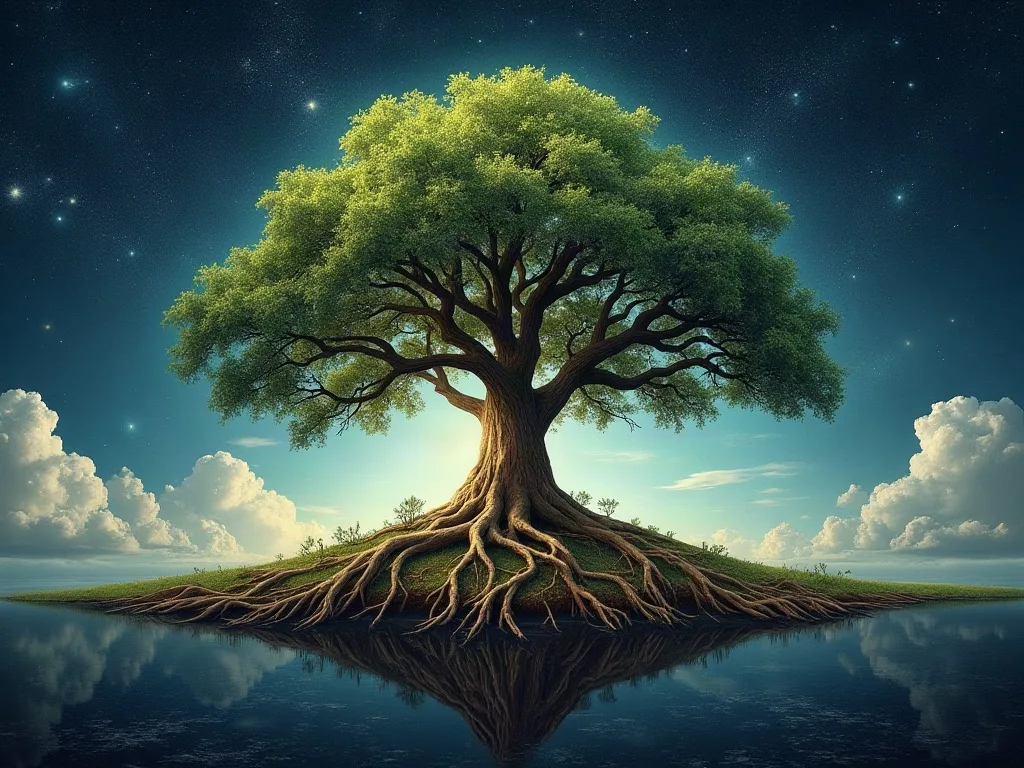
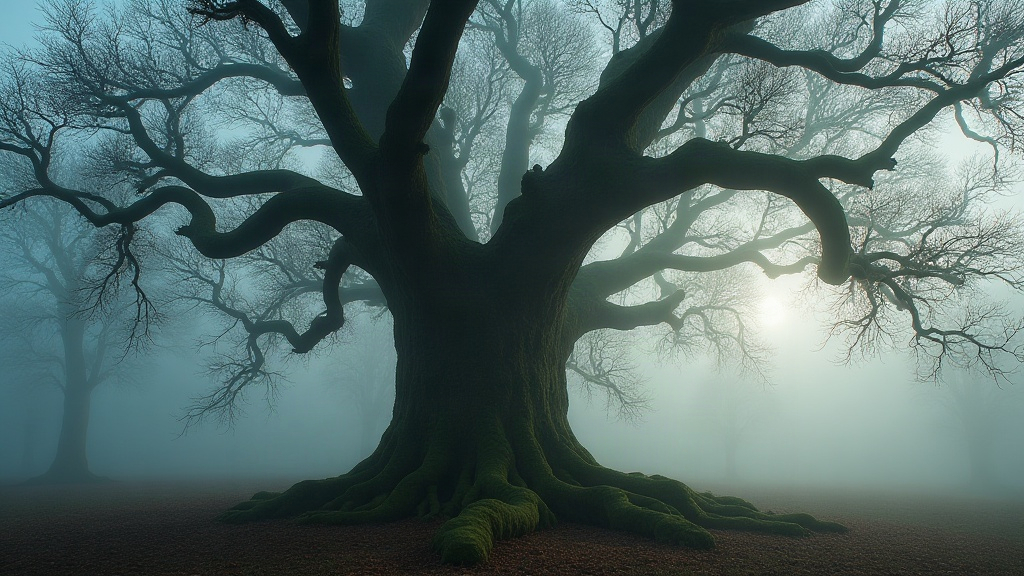
The Oak of Life, a tree sacred to the Baltic peoples, sometimes grew beside these waters. Its roots would descend into the cosmic waters; its crown would reach toward Dievas in the sky. In this image, the sacred tree mirrors the structure of the cosmos itself: earth at the center, sky above, waters below. The tree is the axis around which creation is ordered, much as Yggdrasil serves in Norse cosmology.
Ritual specialists in pagan Baltic society would conduct ceremonies at these sacred sites, especially during the spring thaw, when the waters seemed to come alive and the land began to crack open with new growth. These rituals were not mere commemorations of the creation myth; they were re-enactments, participations in the ongoing work of creation. By honoring the waters and the sky, by making offerings and singing dainas, the community sustained the cosmic order that the egg had established at the beginning of time.
The Cosmic Egg in Christian and Medieval Retellings
When Christian missionaries arrived in the Baltic lands in the 13th century, they encountered a cosmology centered on the cosmic egg. As they worked to convert the population, they faced a choice: suppress the old myths entirely or absorb them into Christian frameworks. The result was a hybrid tradition, one that survived in folk practice long after official pagan religion was declared extinct.
In medieval Lithuanian manuscripts and later folk collections, the cosmic egg sometimes reappears as the egg of a dove or a swan, birds associated with innocence and divine grace in Christian symbolism. The waters become the baptismal flood. The sky and earth that emerge are described in terms compatible with Genesis, while retaining their form from the older myth. This syncretism was not always smooth, but it allowed the fundamental cosmic architecture to survive.
Some scholars have argued that the cosmic egg tradition helped prepare the Baltic peoples for Christian creation theology. Both systems begin with primordial unity and move toward multiplicity and order. Both honor a transcendent sky god, though his nature and his relationship to creation differ. The egg myth may have provided a conceptual bridge that made Christian cosmology less alien to a people who had always imagined creation as the breaking open of a unified whole.
By the 19th and 20th centuries, when folklorists like Basanavicius and Sruoga began collecting dainas, the cosmic egg appeared only occasionally in the oldest songs. Most explicitly mythological content had been layered over with Christian additions, poetic embellishments, or simply forgotten in the trauma of wars, occupations, and diaspora. Yet enough survived to reconstruct the outlines of the original myth. What had been fragmented into ritual gestures and poetic fragments could be reassembled into a coherent vision.
Cosmic Rebirth and the Seasonal Cycle
The Baltic creation myth is not confined to the mythical past. It is renewed with each spring. As ice melts and the earth cracks open, as seeds split their husks and sprout, the cosmic egg opens anew. This is the power of a living mythology: it does not describe something that happened once, in an unreachable past, but something that happens always, seasonally, in the bodies of the land and the people.
This cyclical understanding shapes Baltic ritual life. The winter solstice, the spring equinox, the midsummer festival, and the autumn harvest each mark a moment when the cosmic order confronts the forces of dissolution and renewal. Winter is not merely cold; it is a return to chaos, a freezing of the cosmic waters. Spring is the breaking of the egg, the emergence of order from potential. Summer is the full flourishing of created things; autumn is the inevitable return toward winter's dissolution.
The dainas that accompany these seasons encode this understanding. A wedding song sung in spring invokes the opening of the earth and the fertility it brings. A harvest song thanks the forces that sustained growth through the warm months. A winter ritual quiets the forces of chaos and ensures that spring will come again. The cosmic egg is not a one-time event but the rhythm itself, the pattern that holds existence in being.
This cyclical view stands in contrast to the linear time of Christian theology, which moves from creation toward apocalypse. Yet the two worldviews coexist in Baltic folk practice. The cosmic egg opens in spring; Christ rose on Easter. The waterfowl brings forth creation; God spoke the word. For centuries, the two myths shared the same rituals and the same seasonal calendar, each validating the other through parallel structure.
Modern Scholarship and the Recovery of the Cosmic Egg
The modern study of Baltic mythology is a story of rescue and reconstruction. Unlike the Norse peoples, who committed their cosmology to written form in the Eddas, or the Greeks and Romans, who preserved their myths through extensive literary tradition, the Baltic peoples left almost no written record of their pre-Christian religion. What survives comes from the vigilance of 20th-century scholars and the memory of rural communities.
Balys Sruoga, a Lithuanian poet and scholar, published the most comprehensive account of the cosmic egg in his studies of Lithuanian mythology in the 1920s and 1930s. He collected dainas directly from speakers in the Lithuanian countryside, recording the precise wording and context of each song. His work was interrupted by Soviet occupation and his own imprisonment during World War II, yet his manuscripts survived and have since been translated into multiple languages.
Marija Gimbutas, the Lithuanian-American archaeologist and specialist in Indo-European cultures, drew on Sruoga's work and on her own research into ancient Baltic religion to argue that the cosmic egg motif belonged to a deep layer of Indo-European mythology, one that survived in the Baltic lands longer than anywhere else in Europe. Her work demonstrated that the egg myth was not a late invention or a borrowing from neighboring cultures but a genuine inheritance from the Bronze Age.
However, Gimbutas's more ambitious claims about a peaceful, pre-patriarchal Indo-European society have been questioned by subsequent scholars. Her reconstruction of ancient Baltic religion based on folklore remains influential but contested. Modern scholars like Jonaitiene and Vaitkeviciene have refined the study of dainas, noting that many songs we possess were recorded in forms already shaped by centuries of Christian overlay and political upheaval. The cosmic egg exists in the sources, but its pristine form, if one ever existed, is unreachable.
Despite these scholarly caveats, the cosmic egg remains a compelling and coherent myth. It explains the structure of the cosmos in terms available to an agricultural people living between land and water. It provides a framework for understanding seasonal change and cosmic order. And it connects the Baltic peoples to the broader Indo-European family, showing how far their ancient migrations had carried the patterns of thought and imagination.
Echoes and Influences: The Cosmic Egg Beyond the Baltic
The cosmic egg of Baltic tradition has influenced modern thought and creative work, though often indirectly. When scholars of comparative mythology began to recognize patterns across cultures, the Baltic egg appeared as a key example of independent but structurally similar creation myths. This recognition helped establish the study of mythology as a serious discipline, one that could map deep patterns of human thought across separated cultures and vast spans of time.
In the 20th century, particularly after Lithuania gained independence from Soviet rule in 1990, the cosmic egg became a symbol of Baltic cultural identity and continuity. In art, literature, and academic circles, it represented the survival of an ancient people's wisdom, unbroken despite centuries of foreign domination. The egg became a metaphor for Baltic resilience: crushed under ice for generations, yet capable of opening again when the season turned.
The myth has also entered global consciousness through the work of fantasy and mythological fiction. Authors drawing on Baltic sources sometimes employ the cosmic egg as a foundational image, seeking to recover pre-Christian European mythology in imaginative form. While these works do not always achieve historical accuracy, they keep the myth alive in contemporary culture and invite new readers to engage with Baltic cosmological thought.
Modern cosmology and physics, interestingly, has created new dialogue with ancient myths. The Big Bang theory, which describes the universe as emerging from an infinitesimal point of infinite density, bears a structural resemblance to the cosmic egg. Both systems imagine a unified, undifferentiated origin state that expands or breaks open into the multiplicity we observe. Scholars of mythology and physics have sometimes noted this parallel, though with the caveat that ancient myths operated in a different register than scientific theories and should not be conflated with them.
Frequently Asked Questions About the Cosmic Egg in Baltic Creation
Frequently asked questions
What sources preserve the Baltic cosmic egg myth today?
The myth survives primarily in dainas, traditional Lithuanian and Latvian folk songs collected mainly between the 1890s and 1940s. The most comprehensive scholarly accounts come from Balys Sruoga's studies and Marija Gimbutas's work on Indo-European traditions. No ancient written epic equivalent to the Norse Eddas or Greek Theogony exists; the myth was preserved in oral practice, ritual, and folk memory until modern collectors rescued it from disappearing entirely.
How does the Baltic cosmic egg differ from the Hindu hiranyagarbha?
Both place an egg at creation's origin, but with different emphases. The Baltic egg emphasizes the automatic unfolding of its contents into the three realms of sky, earth, and sea, with a waterfowl as the agent and Dievas as the distant overseer. The Hindu hiranyagarbha contains a conscious divine being who generates the cosmos through will or thought. The Baltic version is more structural and automatic; the Hindu version is more actively generative.
Did the Baltic peoples believe in cyclical or linear time?
The Baltic peoples appear to have conceived of time cyclically, especially in their ritual and seasonal observances. The cosmic egg opens each spring; the world dissolves into chaos each winter. Yet this is not purely mythological abstraction: it maps onto observable natural processes. After Christian conversion, linear time (creation toward apocalypse) and cyclical time (seasonal rebirth) coexisted in Baltic practice, each validating the other through parallel structure.
Is the cosmic egg myth native to the Baltic peoples or borrowed from neighbors?
Scholars generally agree the egg motif belongs to deep Indo-European tradition, predating the separation of Baltic peoples from other Indo-European families in the Bronze Age. The myth appears in multiple Indo-European cultures (Hindu, Greek Orphic, possibly Hittite). The Baltic version is a local preservation of this ancient heritage, not a borrowing from recent neighbors like Slavs or Germanic peoples. Its survival in the Baltic lands was likely aided by the region's cultural conservatism and late Christianization.
What role does the waterfowl play in the myth, and is it identified with any specific deity?
The waterfowl is a cosmic agent, not subordinate to any single god. It embodies the principle of action and creativity within the constraints of the given world. In some dainas, it may be identified with Laima in animal form or treated as an independent manifestation of divine will. Its ambiguous status is characteristic of archaic mythologies, where beings shift form and identity. The waterfowl represents the principle that life emerges through agency and search, not passivity.
How did the Christian conversion affect the cosmic egg myth?
When Christian missionaries arrived in the 13th century, the cosmic egg was not entirely suppressed. Instead, it was reinterpreted through Christian symbolism: the waters became the baptismal flood, the birds became symbols of innocence, and the sky god Dievas was absorbed into concepts of divine transcendence. The basic cosmic architecture survived because it was compatible enough with Christian creation theology. The myth thus persisted as a hybrid tradition, preserving ancient elements within a new religious framework.
The Enduring Power of the Cosmic Egg
The Baltic cosmic egg is not a relic of a dead past. It survives in the consciousness of a people who continue to live close to water, to seasons, to the rhythms that animated this myth for millennia. Every spring, when the land opens and water flows, the myth enacts itself anew. The egg breaks; creation continues.
What the myth offers, even to modern readers far removed from Baltic forests and marshes, is a vision of creation as order emerging from undifferentiated potential. Not through rebellion or violence, but through the simple opening of what was always contained. The waterfowl does not fight the cosmic waters; it accepts them and nests upon them. Dievas does not impose creation through divine decree; he oversees an unfolding that follows its own law.
This is a cosmology for a people who did not seek to dominate nature but to live in relation to it, to understand their place within the cycles of growth and dissolution that define all life. It is a myth that invites reflection on order and chaos, unity and multiplicity, the transcendent and the immediate. In recovering this myth, we recover not just a piece of European history but a way of thinking about creation itself.
Read the full book
Want the whole story?
The complete edition is an instant PDF download here, with a paperback on Amazon for selected titles.
Baltic
The Baltic Mythology Book: Perkūnas, Saulė, Dievas, and the Gods of Lithuania and Latvia
Perkūnas, Saulė, and Dievas
The last pagans of Europe: the Lithuanians and Latvians who kept their old gods into the 1400s. Perkūnas the thunderer, Saulė the sun, the sky-god Dievas, and a forest religion preserved in tens of thousands of folk songs.
More from Baltic
All articles
Baltic
The Grass Snake: Sacred Household Guardian of Baltic Homes
The grass snake was no mere reptile in Baltic homes, it was a household god, a protective spirit that lived in the walls and brought prosperity. Learn how this sacred creature shaped daily life and spiritual belief in Lithuania and Latvia.

Baltic
Dainas: Sacred Folk Songs as Living Mythology
Dainas are more than songs, they are Lithuania and Latvia's oldest mythology preserved in four-line verses sung for millennia. Discover how peasants encoded gods, rituals, and cosmic wisdom into folk poetry that shaped Baltic identity and survives today.

Baltic
Žemyna: Mother Earth Goddess of the Baltic Lands
Žemyna stands at the heart of Baltic spirituality as the life-giving earth mother who nurtures crops, heals the sick, and guards the sacred bond between humans and land. Discover how this ancient goddess shaped Lithuanian and Latvian culture for centuries.
Baltic
The Sacred Oak: World Tree of Baltic Tradition
The Sacred Oak stands at the center of Baltic cosmology as the world tree connecting earth, sky, and the underworld. Discover how Lithuania and Latvia's ancient oak groves shaped a mythology that survived centuries of Christian suppression.