
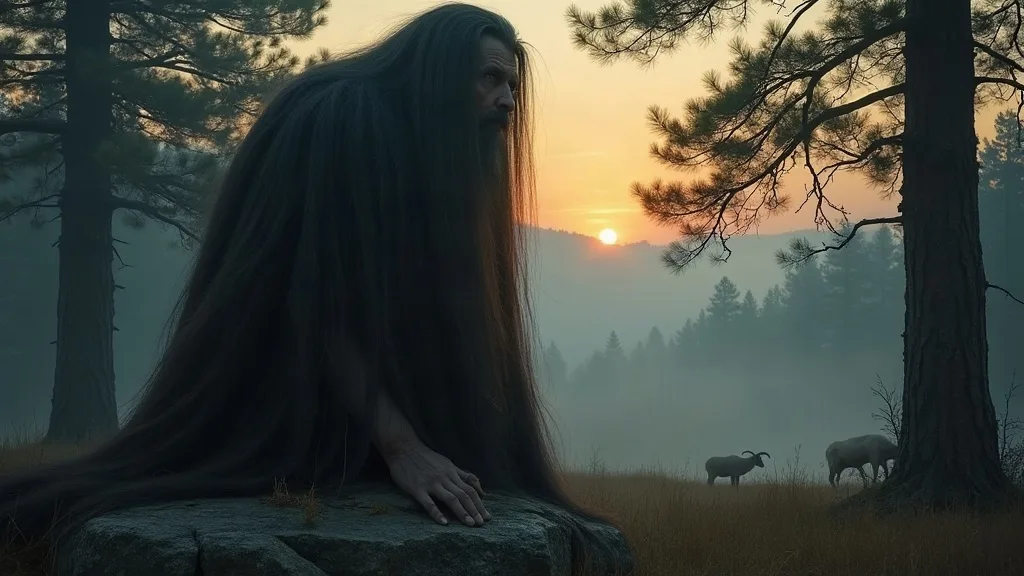
Basajaun: The Wild Man of the Forests
Basajaun, the shaggy forest lord of Basque mythology, guarded the mountains long before humans knew iron or grain. Meet the wild giant who taught and terrified in equal measure.
Contents
The pines go quiet before he arrives. Shepherds on the high Pyrenean slopes know the sign: birds scatter, sheep press together, and a low, territorial cry rolls down through the ravines like thunder that never reaches its storm. Then nothing. Whoever, or whatever, passed through leaves no clear tracks.
Basajaun: the Wild Man of the Forests is one of the oldest figures in Basque oral tradition, a being so deeply rooted in the mountain landscape that scholars debate whether he predates the arrival of Indo-European cultures in the region. He is enormous, hairy, immensely strong, and ancient beyond reckoning. He is also, depending on the story, a guardian, a teacher, a warning, and a neighbor. Few mythological creatures manage all four at once.
What makes Basajaun remarkable is not just his strangeness but his ambivalence. He is not evil. He is not simply noble. He occupies a space between the wild and the human world that Basque tradition refuses to resolve neatly, and that refusal is exactly what has kept him alive in the mountains, in the stories, and in the imagination for millennia.
Who Basajaun Is: Portrait of a Forest Lord
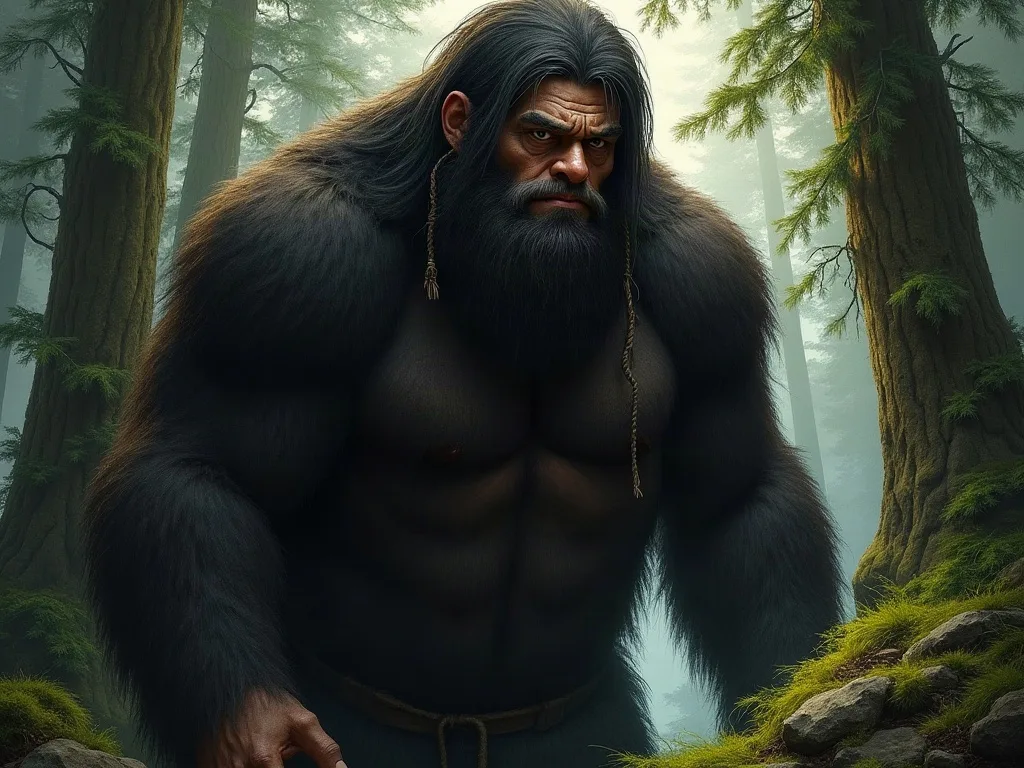
Basajaun stands, by most accounts, far taller than any man. His body is entirely covered in thick hair or shaggy fur, dark and matted, and his hair falls so long from his head that it sweeps the ground as he walks. Some tellings describe a single long forelock that hangs over his face, almost hiding his eyes. He moves through the forest at extraordinary speed, leaping between mountain peaks or crossing deep valleys in a few strides, and he leaves behind a smell of pine resin and earth.
He carries no weapon. He needs none. His hands are the weapons: massive, capable of uprooting old-growth trees or crushing stone. The ethnographer Jose Miguel de Barandiaran, who spent decades in the twentieth century collecting Basque oral traditions, recorded dozens of testimonies from rural communities in which Basajaun appeared as a physical presence, something genuinely encountered rather than merely narrated.
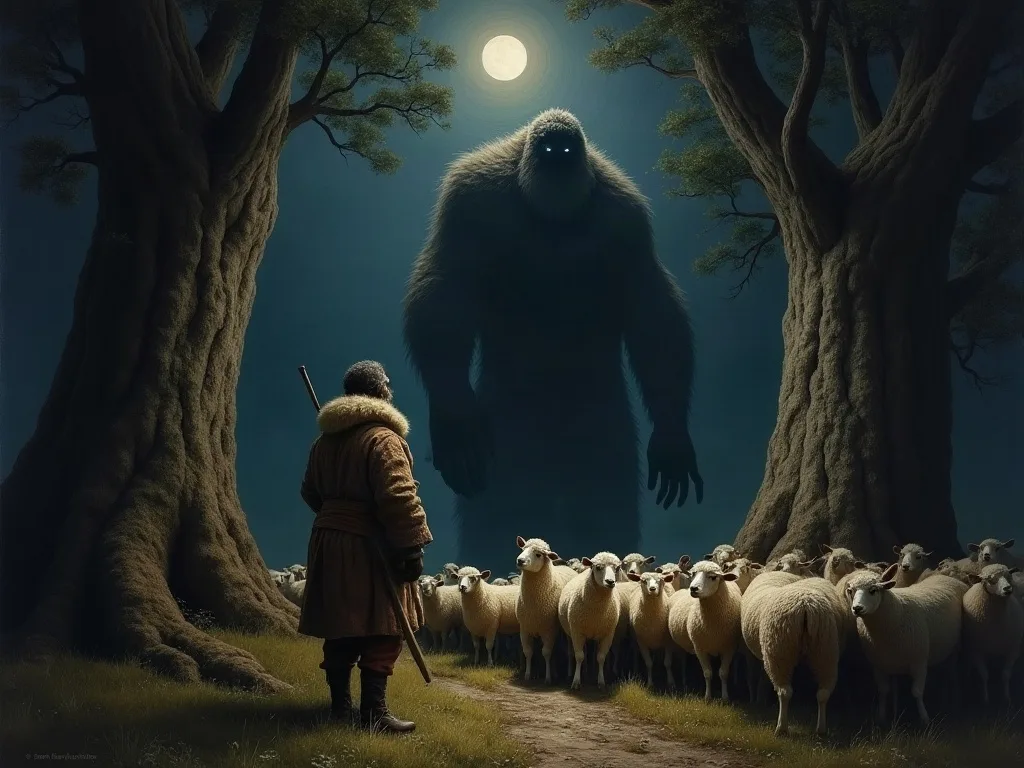
His voice is the other signature. The cry of Basajaun, called the oihu in some regional variants, is a warning shout directed at shepherds when a storm is coming or when wolves approach a flock. Shepherds who heard it were expected to call back, acknowledging the warning. Those who answered correctly found their sheep untouched come morning. Those who ignored it sometimes did not.
This reciprocal etiquette is crucial. Basajaun is not indifferent to humans. He watches, he judges, and he chooses when to help. The relationship is one of cautious coexistence rather than domination on either side.
Basajaun and the Gifts of Civilization
One of the most striking clusters of stories about Basajaun concerns his role as an involuntary teacher of human arts. In multiple versions collected across the Basque Country (in both the Spanish and French Basque territories, on both sides of the Pyrenees), Basajaun is credited with knowing the secrets of agriculture, iron-working, and the milling of grain before humans did.
The logic of these myths follows a recurring pattern. A clever human, usually a shepherd or a traveler, manages to trick Basajaun into revealing one of these secrets, often through a game or a wager. Basajaun loses, or is outmaneuvered, and the knowledge passes to humankind. In one widespread version, a man challenges Basajaun to a game involving a spinning top or a leap across a chasm. Basajaun, confident in his physical superiority, does not notice that the human has positioned himself to observe the exact agricultural technique Basajaun uses, and by the time the trick is revealed, the knowledge is already gone.
These stories belong to a mythological category scholars call the "culture hero" complex: narratives that explain how essential human technologies arrived in the world. What is unusual here is that Basajaun is not the culture hero. He is the repository of knowledge, and the human must steal or trick it from him. The forest lord is older than civilization. He possessed these arts before humans were ready for them, which implies that in Basque cosmology, the wild world came first and contained within it the seeds of the human world.
Basajaun and Sugaar: The Mountain Hierarchy
Basque mythology is not a simple pantheon of gods ranked by power. It is more like a geography of forces, each one bound to a specific landscape. Basajaun rules the forest and the high mountain terrain. He exists alongside other powerful figures whose domains border his.
Mari, the supreme goddess of Basque tradition, rules the mountain peaks and storms. She is the most powerful being in the tradition, shapeshifting and terrifying, equally at home in the sky and the underworld. Basajaun acknowledges her authority, at least implicitly, by remaining a creature of the forest floor rather than the peaks. He does not challenge her. The arrangement feels less like a hierarchy imposed from above and more like a negotiated territorial boundary.
Sugaar, the serpentine male spirit sometimes described as Mari's consort, moves through underground passages and caves. Where Basajaun is the lord of surface wilderness, Sugaar represents the chthonic, the hidden, the beneath. Together, the two figures suggest that Basque mythology divides the non-human world along vertical lines: underground, forest, peak.
This spatial logic matters because it tells us how the ancient Basques organized the landscape morally. The deeper you went into the non-human zones, the more powerful and dangerous the beings became. Basajaun stood at the threshold, just beyond the edge of cultivated land, which made him both the most accessible of the great supernatural figures and the first warning of what lay beyond.
Basajaun and Basandere: The Wild Couple
Basajaun does not live alone. Several traditions, particularly those recorded by Barandiaran in the Aezkoa valley and in Roncal (Erronkari), mention his companion, Basandere, whose name means "Lady of the Forest" or "Wild Woman." She is described similarly: tall, hairy, immensely strong, and deeply tied to the forest landscape.
Basandere appears less frequently in surviving narratives than Basajaun, which may reflect the uneven survival of oral traditions or simply the different thematic interests of the people who told the stories. Where she does appear, she is not subordinate. She is a parallel figure, equally capable of helping or ignoring humans, equally ancient.
Some scholars read the Basajaun-Basandere pairing as evidence that the original tradition imagined an entire community of wild forest beings rather than a single exceptional individual. If so, the "wild man" who appears in later, more consolidated narratives may represent a compression of a richer earlier tradition. The Basque forests, in this reading, were once full of presences. The stories narrowed them down to the most memorable one.
The Wild Man Across Europe: What Basajaun Shares and What He Does Not
The figure of the wild man appears across European tradition with remarkable consistency: the Green Man in English folklore, the Waldmann ("forest man") in German-speaking regions, the Silvanus of Latin tradition. Medieval manuscripts are full of hairy, forest-dwelling giants who terrify travelers and embody untamed nature. Basajaun belongs to this broad European family, but his specific character sets him apart in important ways.
Most European wild men are purely threatening. They kidnap, they destroy, they represent chaos opposed to Christian order. Basajaun, by contrast, warns shepherds of danger, teaches (even if involuntarily) the arts of civilization, and operates within a moral framework of reciprocity. He is dangerous to the disrespectful, but not dangerous by nature.
This distinction likely reflects the Basque cultural context. The Basque people maintained a pastoral mountain economy for thousands of years, and their relationship with the forest was practical and intimate. A tradition that imagined the forest as purely hostile would have been both inaccurate and psychologically untenable. Basajaun is more useful: he is the mountain itself personified, capable of helping those who know how to read its signals.
The comparison with the Norse mythology giants, the Jotnar, is also instructive. Like the Jotnar, Basajaun predates the current world order and possesses knowledge that civilized beings do not. Like them, he is ambivalent toward humans: not an ally, not an enemy, but something that must be navigated carefully. Unlike the Jotnar, however, Basajaun has no cosmological war with the gods. He simply exists, as the forest exists, indifferent to divine politics.
Basajaun in Modern Basque Identity
Basajaun has not faded. If anything, the twentieth and twenty-first centuries have given him new life. The Basque nationalist cultural revival of the late nineteenth and early twentieth centuries, which sought to identify and celebrate pre-Christian Basque cultural heritage, made figures like Basajaun central to a new sense of indigenous identity. He appeared in paintings, in poetry, in sculpture.
Today, Basajaun is a recognizable cultural symbol across the Basque Country. He appears in children's books, in regional festivals, carved in wood on the facades of rural buildings, and on hiking trail signs in the Pyrenees. The Basque-language television channel ETB has aired programming that uses him as an emblem of the wild Basque landscape.
The video game industry also took notice. A 2023 action-adventure game set in Basque mythology used Basajaun as a central figure, bringing the forest lord to an international gaming audience who had never heard of him before. This is not a degradation of the tradition. It is the tradition doing what traditions do: finding new hosts for old stories.
Jose Miguel de Barandiaran's collected works, particularly his Mitología Vasca (1960), remain the single most important primary source for serious study of Basajaun and the broader Basque mythological world. His fieldwork preserved accounts that would otherwise have died with the last generation to grow up hearing them firsthand.
Frequently Asked Questions about Basajaun
Frequently asked questions
Is Basajaun the same as a Bigfoot or Yeti figure?
Superficially, yes: Basajaun is a large, hairy, bipedal wild man reported in mountainous terrain. But the comparison stops at the physical description. Bigfoot and Yeti are cryptozoological figures, treated in popular culture as potentially real animals. Basajaun is a mythological and spiritual being with a defined moral character, a relationship with human communities, and a role in a coherent cosmological tradition. He teaches, he warns, he judges. A cryptid does none of these things.
What is the primary written source for Basajaun myths?
Because Basque mythology was an entirely oral tradition until the modern era, there is no ancient written text equivalent to the Norse Eddas or the Greek Hesiod. The most authoritative collection is Jose Miguel de Barandiaran's Mitología Vasca (1960) and his broader Obras Completas, which gathered oral accounts from communities across both the Spanish and French Basque Country throughout the mid-twentieth century. Earlier partial accounts appear in works by Resurrección María de Azkue in the early 1900s.
Does Basajaun ever harm humans in the stories?
Yes, but specifically: he harms those who show disrespect, ignore his warnings, or attempt to enter his territory without acknowledgment. He is not randomly violent. The moral logic is consistent across regional variants: those who treat the forest with respect are protected; those who treat it with arrogance are punished. This makes him a figure of ethical enforcement rather than senseless danger.
What is the connection between Basajaun and pre-Christian Basque religion?
Scholars including Barandiaran and Julio Caro Baroja have argued that Basajaun belongs to a pre-Christian layer of Basque religion that survived the Christianization of the region relatively intact because it was tied to the landscape rather than to temples or priesthoods. The forest was harder to convert than a building. Basajaun's survival into the modern era, still recognizable in the oral accounts of twentieth-century shepherds, supports the idea that his roots go very deep, possibly to the Neolithic pastoralism of the Pyrenean highlands.
Are there female counterparts to Basajaun in Basque mythology?
Yes. Basandere, whose name means "Lady of the Forest" or "Wild Woman," appears in several regional traditions as Basajaun's companion and a parallel figure in her own right. More broadly, Basque mythology has strong female supernatural figures: the goddess Mari dominates the entire tradition, and the Laminak (fairy-like beings associated with water and the underground) represent a distinctly feminine supernatural force. Basajaun exists within a tradition that takes female power seriously.
How is Basajaun typically depicted in contemporary Basque art?
Contemporary depictions most often emphasize his forest context: he is shown emerging from dense trees, usually massive and partially obscured by shadow or foliage, with long hair and a powerful but not monstrous face. Artists like the Basque sculptor Jorge Oteiza worked with themes of primordial Basque identity that echo the Basajaun archetype, even without naming him directly. In more popular media, including illustrated children's books and festival costumes, he appears warmer and more approachable, reflecting the protective aspect of his character.
The Older World That Basajaun Still Remembers
Every culture has a figure who stands at the edge of the human world and points toward what came before it. Basajaun is that figure for the Basque people, but he is unusually specific about what he remembers. He does not simply represent chaos or danger. He holds, in his enormous hairy body, the actual technical knowledge that made civilization possible: how to grow crops, how to work iron, how to grind grain. The wild world, in Basque tradition, was not ignorant. It was prior.
This is a genuinely unusual mythological claim. Most traditions imagine civilization as the achievement of human ingenuity, sometimes aided by gods who hand down fire or alphabets. In the Basque case, the forest lord had iron-working before the forge was built, agriculture before the field was cleared. Human civilization, in this reading, is not a triumph over nature. It is something borrowed from it, won through cleverness rather than invention.
That relationship between the human and the wild, always negotiated, never resolved, is what gives Basajaun his staying power. He is still out there in the stories, still watching the shepherds, still crying his warning when the wolves come close. The smart move, as any Basque shepherd knew, is to call back. Acknowledge him. Let him know you understand the terms.
The forest does not belong to us. We are permitted to use it, if we know how to ask.
Read the full book
Want the whole story?
The complete edition is an instant PDF download here, with a paperback on Amazon for selected titles.
Basque
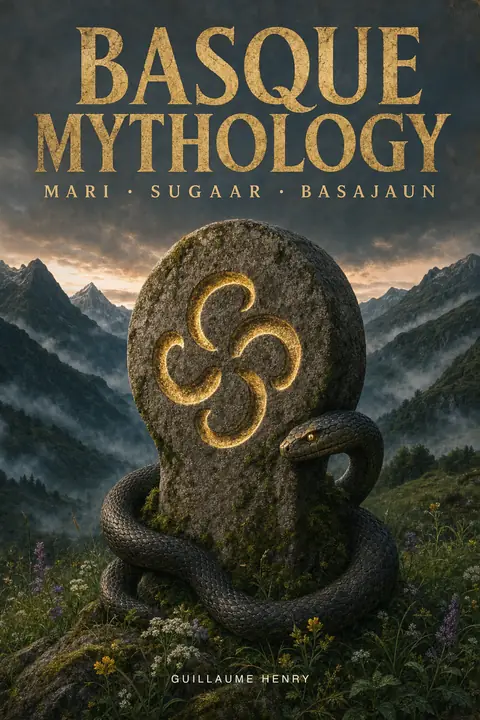
The Basque Mythology Book: Mari, Sugaar, Basajaun, and the Oldest Gods of Europe
Mari, Sugaar, and Basajaun
The mythology of Europe’s oldest people, who speak a language related to no other on earth. Mari the goddess of the mountains, her serpent-consort Sugaar, the wild lord of the woods Basajaun, and a pre-Indo-European world that survived in the Pyrenees.
More from Basque
All articles
Basque
The Lauburu: Basque Cross and Solar Symbol
The Lauburu is a four-pointed cross with curved arms that has protected Basque homes and souls for centuries. This ancient symbol weaves solar magic, Christian faith, and pre-Christian cosmology into a single rotating form.

Basque
Eguzkilore: The Sun Flower Symbol of Basque Protection and Renewal
The Eguzkilore is the sacred sun flower of Basque culture, hung above doorways for protection and blessing. Rooted in ancient sun worship and Christianised into a mark of spiritual abundance, this eight-petalled symbol endures as a living emblem of Basque identity and resilience.
Basque
Anbotoko Mari: The Cave Sanctuaries of the Goddess
High in the Basque mountains, deep inside caves that pierce the earth, Mari dwells. The Anbotoko Mari tradition reveals how a people carved sacred space into rock itself, honoring a goddess whose storms feed the valleys below. Enter the caves where Basque faith shaped the land.
Basque
Gaueko: The Spirit of the Night
Gaueko haunts the Basque night as a shadowy, restless spirit who protects livestock and travelers but demands respect. Learn how this being embodies the Basques' relationship with darkness in the mountains of northern Spain and France.