
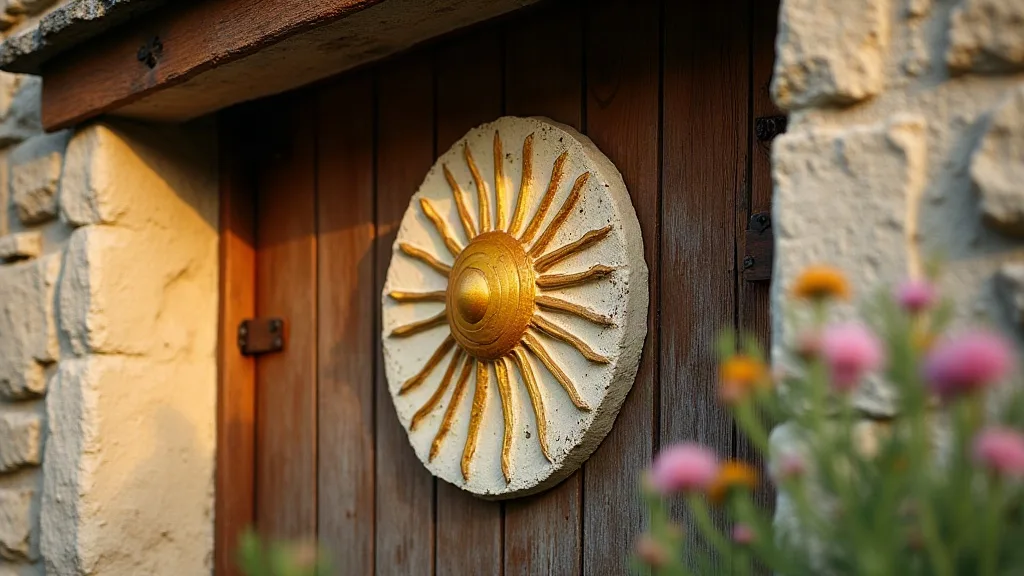
Eguzkilore: The Sun Flower Symbol of Basque Protection and Renewal
The Eguzkilore is the sacred sun flower of Basque culture, hung above doorways for protection and blessing. Rooted in ancient sun worship and Christianised into a mark of spiritual abundance, this eight-petalled symbol endures as a living emblem of Basque identity and resilience.
Contents
Hang an Eguzkilore above your door and you hang the Basque sun itself. This symbol, eight petals radiating from a central circle, appears on the lintels of farmhouses across the Basque Country (the region straddling the French and Spanish Pyrenees). It is not decoration. It is a prayer carved in wood or painted on stone, a barrier against harm and a blessing for abundance. The word Eguzkilore means "sun flower" in Euskera, the Basque language, a tongue so ancient and isolated that linguists still debate its origins.
The Eguzkilore is older than Christianity and survived it. Hung on the homes of Basque farmers for centuries, this symbol holds the memory of a people who watched the sun with reverence long before any priest arrived. Today it marks Basque pride, cultural continuity, and a defiant connection to something older than borders.
The Sun in Basque Memory
The Basque Country sits at the western edge of the Pyrenees, where mountains meet the Atlantic and summers bring long days of light. The Basques, or Euskaldunak (the Euskera speakers), are among Europe's oldest populations, their language a linguistic island with no proven relatives. They built their world around the sun long before Christianity reached them.
The sun held multiple roles in pre-Christian Basque belief. It was the source of fertility and harvest. It was protection: a visible, relentless power that burned away darkness and evil. It was divine, the eye of creation itself. Basque farmers depended on timing their planting and harvest by the sun's arc. They marked its solstices and equinoxes. When Christianity came, the Church recognized that sun veneration would not vanish simply because priests commanded it. Instead, the Church did what it had learned to do in every corner of Europe: it absorbed the old power and gave it a Christian name.
The sun became Christ. The Eguzkilore became a Christian symbol. Yet the symbol itself retained its older pulse. The eight petals do not appear in standard Christian iconography. Eight is a number tied to wholeness, regeneration, and cosmic order in many pre-Christian traditions. In the Basque case, the eight-petalled form likely drew from ancient solar wheels and resurrection myths that preceded any cross.
The Geometry and Meaning of the Eight Petals
Look at an Eguzkilore and you see a circle at the center with eight rays fanning outward. Some versions show petals that curl or taper. Others are strict geometric bursts. The variation is natural; no central authority ever standardized the Eguzkilore. Families carved their own, passing the pattern down through generations. Yet the eight petals remained constant.
The number eight carries deep symbolic weight. In geometry, eight is the midpoint between the four cardinal directions (north, south, east, west) and the infinite. Each petal can be read as a guardian direction, a boundary, a moment in time. The eight sabbats of later pagan traditions (Samhain, Imbolc, Beltane, Lughnasadh, and their cross-quarter days) suggest that eight is a number of sacred cycles, of time turning and returning.
In Basque practice, the Eguzkilore was not merely hung and forgotten. It was touched. Families would place a hand on it for blessing, or trace its petals in moments of hardship. Children would point at it and recite blessings. The symbol became tactile, alive. Over centuries, this repeated contact wore smooth grooves into the wood of ancient farmhouse lintels. Those worn grooves are still visible in Basque Country villages; they are the fingerprints of faith.
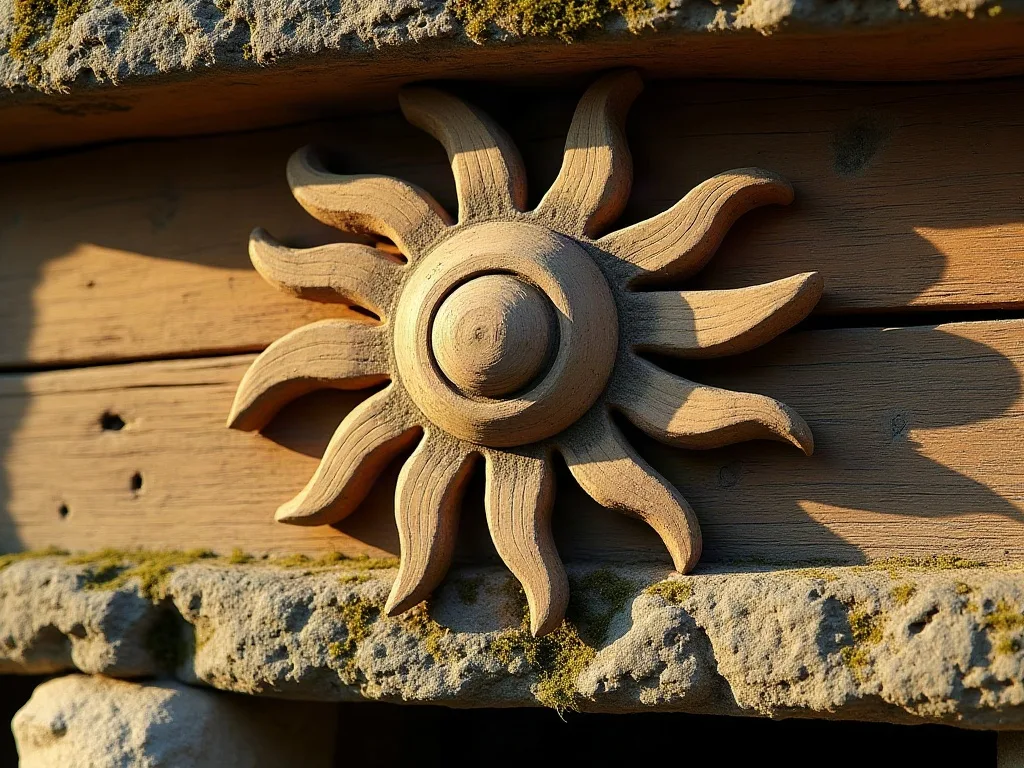
The Eguzkilore also functioned as a ward. In folk belief across Europe, the sun's power repels malevolent spirits and witchcraft. A symbol of the sun hung above a door was thought to protect the household within: not just the people, but the animals, stores, and spiritual integrity of the home. The symbol said: this place is marked, watched, blessed. Enter with ill intent and you face the sun itself.
Syncretism and Christian Reinterpretation
When the Catholic Church began its deep work in the Basque Country in the medieval period (the process was gradual, never violent), it faced a population whose religious life was already woven into the land and the seasons. The Basques had holy caves, sacred groves, and stone monuments that predated Rome. They had rituals tied to the solstice and harvest. They had priestesses (the sorginak, which later became a word for witch) who held knowledge of healing and prophecy.
The Church's strategy was not erasure but absorption. The Eguzkilore was incorporated into Christian symbolism as a manifestation of divine light and Christ's eternal radiance. The eight petals were reinterpreted: sometimes as the eight beatitudes from the Gospel of Matthew; sometimes as the eight gifts of the Holy Spirit in medieval theology. The central circle became the consecrated sun of resurrection. The pagan sun stone became a Christian sacred stone, but it remained a sun stone.
This syncretism was not shallow. For the Basque farmer, the Eguzkilore was still the sun, still the source of life and protection. But now the priest could bless it, and the Basque Christian could claim both his ancestral devotion and his faith in Rome. It was a bargain, and it worked. The Eguzkilore became ubiquitous on Basque farmhouses precisely because it bridged two worlds.
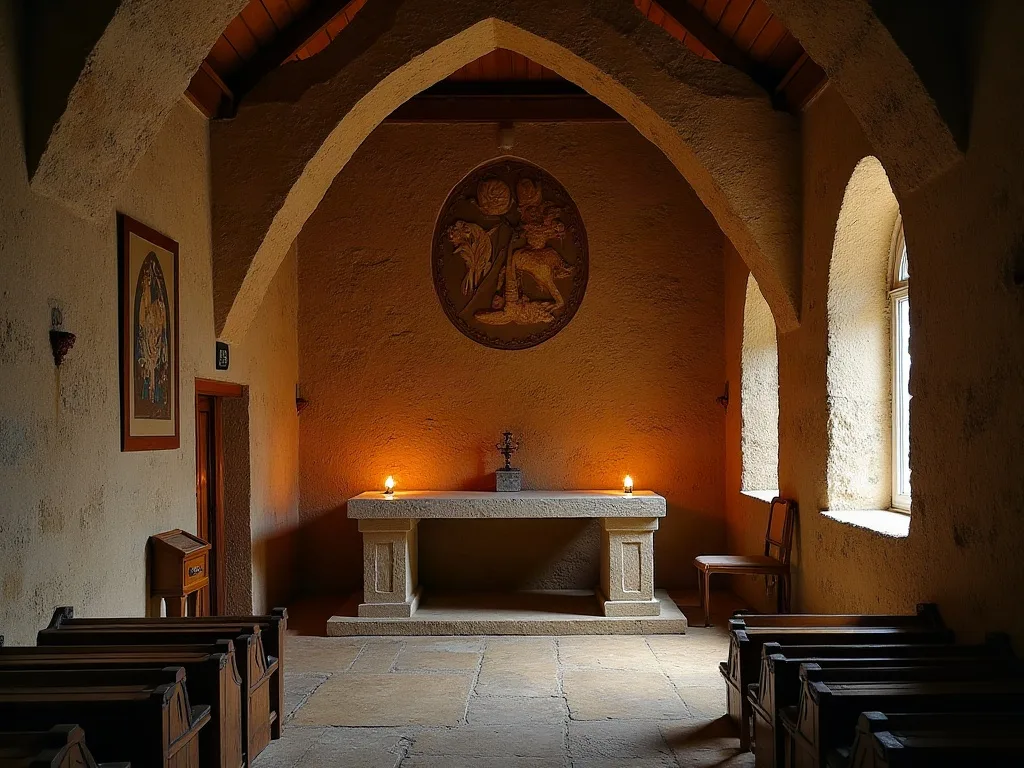
The Eguzkilore also appeared in rural chapels and on church doors. This was unusual. Most rural churches across Europe did not carry pre-Christian symbols visibly. But in Basque Country, the symbol was so woven into popular practice that it would have been culturally impossible to remove it. The priests accepted it. Over time, the symbol became as much a mark of Basque Christianity as of Basque paganism. The boundary dissolved.
Protection and Blessing in Daily Life
For centuries, the Eguzkilore hung above farmhouse doors as a working symbol, not a relic. Basque farmers believed the symbol offered concrete protection: against theft, against witch-work, against crop failure and livestock disease. In a region where winters were harsh and harvests uncertain, any assurance mattered.
The placement of the Eguzkilore was deliberate. It went on the main entry lintel, the threshold between inside and outside, between the protected family space and the untamed world beyond. The lintel was the strongest place on a door, the highest point. To reach the Eguzkilore, you had to raise your eyes. It was impossible not to see it, impossible to enter the home without acknowledging its presence.
Some Basque families carved the date and initials into their Eguzkilore, turning the symbol into a family seal. Others would carve multiple petals from different hands: the master of the house, the wife, a child. Each petal became a signature, a claim of belonging. The Eguzkilore was not one family's property; it was the family's presence made visible.
In folk practice, the Eguzkilore was believed to need renewal. Some families would repaint or refurbish theirs annually, often at spring equinox or before the planting season. This act of renewal was itself a ritual, a moment when the family restated its covenant with the land and the sun. The old symbol was refreshed; the protection was renewed; the year could begin.
The Eguzkilore in Basque Cultural Resistance
For much of modern history, the Basque Country was divided. The French side was gradually assimilated into French culture and language. The Spanish side, especially after the Spanish Civil War (1936-1939) and Franco's regime, faced brutal suppression of Basque language and identity. Speaking Euskera was forbidden in schools. Basque cultural expression was branded as separatist and dangerous. The regime sought to erase Basque uniqueness and forge a unified Spanish nation.
In this context, the Eguzkilore became more than a folk symbol. It became an act of resistance. To hang an Eguzkilore on your house was to say: I am Basque. This is my sun, my language, my people. No government could forbid a carved flower without appearing absurd, yet every Basque knew what the symbol meant. The Eguzkilore was a secret language written in plain sight.
During the Franco years, Basques carried the symbol on jewelry, wove it into textiles, and displayed it on any surface that would hold it. The symbol appeared on flags and in art. It became a rallying point for cultural nationalism. Even as Euskera was driven underground, the Eguzkilore remained visible, stubborn, alive.
After Franco's death in 1975 and the restoration of democratic governance in Spain, the Basque Country regained official recognition of its language and culture. The Eguzkilore emerged from the shadows into daylight. It is now worn openly, displayed on town banners, taught in schools. Yet it retained the depth that centuries of hidden resistance gave it. The symbol is no longer forbidden. But it remains powerful.
Cross-Cultural Solar Symbols and Sacred Flowers
The Eguzkilore is Basque, but sun flowers and solar symbols are not unique to Basque culture. Across the ancient world, peoples carved, painted, and built symbols honoring the sun. The Egyptian sun disk with its rays, the Greek Apollo's chariot, the Celtic solar wheel, the Native American sun face. All speak to a common human recognition: the sun is the source of life, and its symbol is sacred.
The Eguzkilore's eight-petalled form echoes other European solar wheels and regeneration symbols. The triskele, a three-spiralled symbol found in Celtic and Scandinavian art, represents motion and eternal return. The wheel of the year, eight-spoked and divided into eight seasons, appears in reconstructed Celtic and Germanic pagan traditions. These symbols all emerged from cultures that watched the sky closely and coded the sun's movement into sacred geometry.
What distinguishes the Eguzkilore is not its universal solar meaning but its stubborn locality. It is the Basque sun symbol, carried on houses and in hearts by a people whose language and culture have survived isolation and oppression. The symbol's power is not just cosmic but personal, familial, communal. Every Eguzkilore is someone's doorway, someone's prayer, someone's refusal to be forgotten.
Modern Basque Identity and the Eternal Eguzkilore
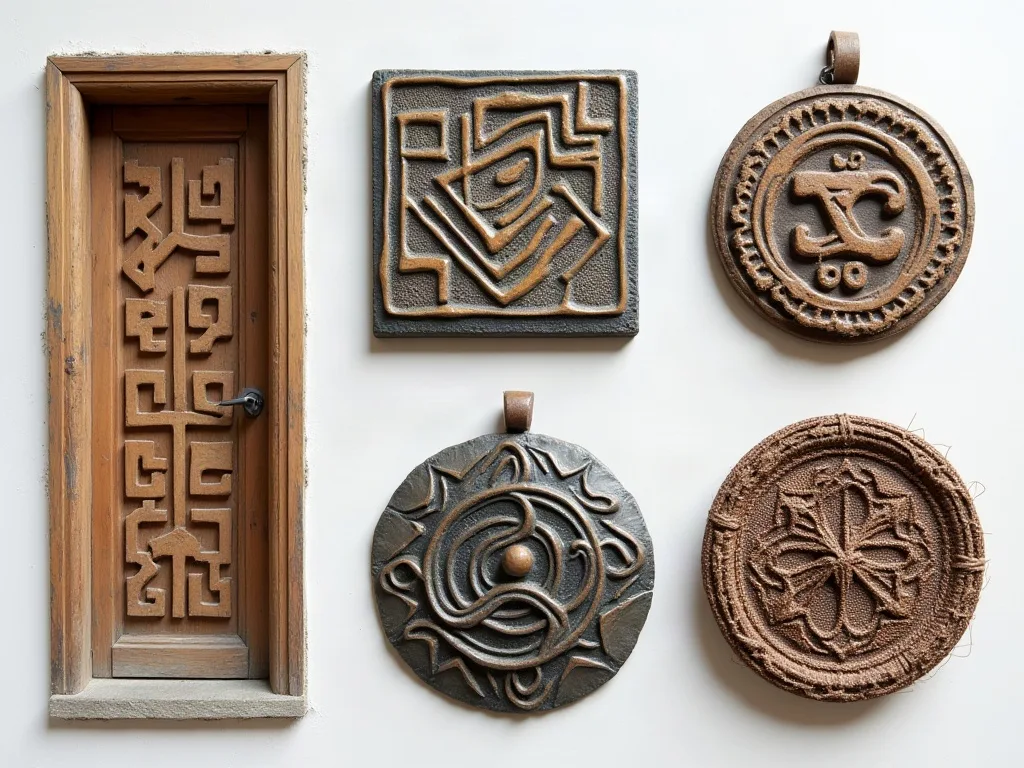
Today, the Eguzkilore appears in contexts its medieval carvers never imagined. It is a logo for Basque cultural organizations. It appears on postage stamps. Modern Basque artists have reimagined it in wood, stone, metal, and digital form. The symbol has become a brand, but not a cheap one. It carries the weight of its history.
In contemporary Basque Country, the Eguzkilore remains hung above farmhouse doors, especially in the most rural regions where tradition runs deepest. But it is also found in city apartments, on modern buildings, in the hands of Basque people living outside the Basque Country. It is a portable sun, a symbol that says: I carry home with me.
The symbol has also attracted scholarly attention. Anthropologists and historians have debated its origins, its pre-Christian roots, its evolution. Some argue it is far older than written records suggest, a symbol inherited from Indo-European sun cults. Others point to Iberian and Lusitanian sun symbols as ancestors. The truth is likely that the Eguzkilore represents a continuous tradition of sun veneration that predates the Basque language itself, passed down through oral culture and carved practice until it became what we see today.
The Eguzkilore also speaks to broader questions of how pre-Christian symbols survive in Christian societies. Rather than being destroyed, the symbol was absorbed, reinterpreted, and made safe. Yet absorption did not diminish its power. Instead, the dual meaning (pagan sun, Christian light) gave it depth. The Eguzkilore holds two truths at once, and this holding is part of its strength.
Frequently asked questions about the Eguzkilore and Basque sun symbolism
Frequently asked questions
Why does the Eguzkilore have eight petals instead of some other number?
Eight appears in many pre-Christian traditions as a number of cosmic wholeness, regeneration, and the turning year. The Basques likely inherited this symbolic use from older European sun cults. Eight also divides the year into quarters and cross-quarters (the eight seasonal festivals that appear in later Celtic and Germanic traditions), and may encode the sun's journey through different phases of strength and rest.
Is the Eguzkilore the same as the Celtic solar wheel or other European sun symbols?
No, though they share a common root in pre-Christian European sun veneration. The Eguzkilore is distinctly Basque in its form and cultural meaning. The Celtic wheel often has four spokes (quarters of the year), while the Eguzkilore consistently shows eight petals. The symbol's specific geometry and the rituals around it (touching it for blessing, annual renewal, placement above farmhouse doors) are unique to Basque tradition.
Why did the Catholic Church allow the Eguzkilore to remain visible on churches and homes?
The Church practiced syncretism across Europe, absorbing local sacred symbols and reinterpreting them as Christian. The Eguzkilore was reframed as a symbol of Christ's eternal light and divine radiance. By allowing the symbol to remain, the Church made Basque Christianity feel continuous with Basque tradition, reducing resistance to conversion. The strategy worked: the Eguzkilore became a shared symbol of both Basque paganism and Basque Catholicism, without clear boundaries between the two.
How did the Eguzkilore function as a protection symbol in Basque folk belief?
In traditional Basque folk practice, the Eguzkilore was believed to repel witchcraft, evil spirits, and misfortune. The sun's power was thought to burn away harm. Hanging the symbol above the threshold of a home marked it as protected, blessed, and under divine watchfulness. Families would touch the symbol while entering or leaving, renewing the blessing. The symbol created a spiritual boundary between the safe domestic space and the dangerous world beyond.
Is the Eguzkilore still used in Basque culture today, or is it only a historical symbol?
The Eguzkilore remains a living symbol in Basque culture. It is still carved and painted on traditional farmhouses in the Basque Country, especially in rural regions. It is also used as a cultural emblem in modern contexts: on flags, logos, jewelry, and in urban art. The symbol carries deep historical resonance from its role in cultural resistance during the Franco regime, and it continues to represent Basque identity, resilience, and continuity with ancient tradition.
What does Eguzkilore mean in Euskera, and can the word be broken down?
Eguzkilore is Euskera (Basque) and means literally "sun flower" or "flower of the sun." It is composed of eguzki (sun) and lore (flower). The term reflects how the Basques understood the symbol: not as an abstract geometric pattern but as a flower that grew from the sun itself, a blooming of solar power and blessing.
The Eguzkilore as a Living Bridge Between Worlds
The Eguzkilore endures because it holds something precious: a living connection between the ancient and the modern, the sacred and the domestic, the pagan and the Christian, the local and the universal. A carved sun flower on a farmhouse lintel is both a prayer to the sun god whose name we do not know and a blessing in the name of Christ. It is both deeply Basque and a voice in humanity's long conversation with light and renewal.
In an age of rapid change and cultural homogenization, symbols like the Eguzkilore matter. They are reminders that cultures survive not through rigid preservation but through adaptation and persistence. The Basques did not defeat Christianization by refusing it; they survived by making it speak their language. The Eguzkilore is one of the most beautiful proofs that this works.
Every Eguzkilore hung above a Basque door today is an act of memory. It is also an act of hope. The sun rises again tomorrow, as it has for countless tomorrows before. The symbol says: we have seen it rise, and we will see it rise again. We are still here.
Read the full book
Want the whole story?
The complete edition is an instant PDF download here, with a paperback on Amazon for selected titles.
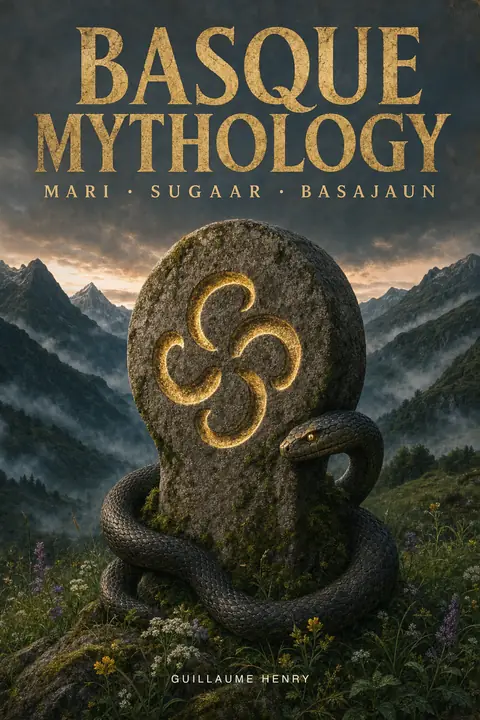
Basque
The Basque Mythology Book: Mari, Sugaar, Basajaun, and the Oldest Gods of Europe
Mari, Sugaar, and Basajaun
The mythology of Europe’s oldest people, who speak a language related to no other on earth. Mari the goddess of the mountains, her serpent-consort Sugaar, the wild lord of the woods Basajaun, and a pre-Indo-European world that survived in the Pyrenees.
More from Basque
All articles
Basque
The Lauburu: Basque Cross and Solar Symbol
The Lauburu is a four-pointed cross with curved arms that has protected Basque homes and souls for centuries. This ancient symbol weaves solar magic, Christian faith, and pre-Christian cosmology into a single rotating form.
Basque
Anbotoko Mari: The Cave Sanctuaries of the Goddess
High in the Basque mountains, deep inside caves that pierce the earth, Mari dwells. The Anbotoko Mari tradition reveals how a people carved sacred space into rock itself, honoring a goddess whose storms feed the valleys below. Enter the caves where Basque faith shaped the land.
Basque
Gaueko: The Spirit of the Night
Gaueko haunts the Basque night as a shadowy, restless spirit who protects livestock and travelers but demands respect. Learn how this being embodies the Basques' relationship with darkness in the mountains of northern Spain and France.

Basque
Lamiak: The Nymphs of Basque Rivers and Caves
Lamiak are the enchanting water spirits of Basque folklore, neither divine nor mortal, who dwell in rivers, caves, and waterfalls across the Pyrenees. Discover their nature, their bargains with humans, and what makes them unlike any other European water spirit.