
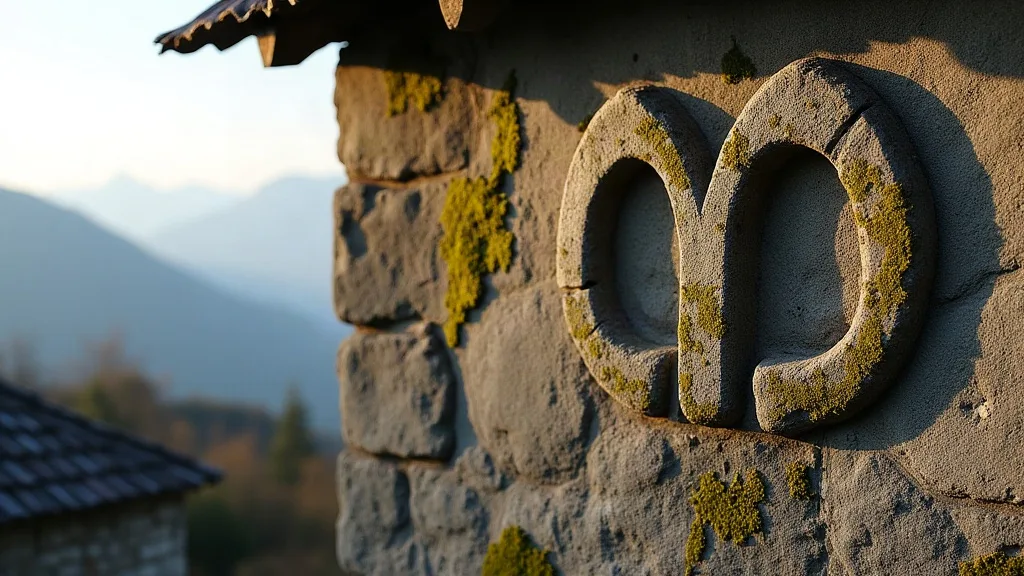
The Lauburu: Basque Cross and Solar Symbol
The Lauburu is a four-pointed cross with curved arms that has protected Basque homes and souls for centuries. This ancient symbol weaves solar magic, Christian faith, and pre-Christian cosmology into a single rotating form.
Contents
On the whitewashed walls of Basque farmhouses, carved into the wooden beams of village meetinghouses, and tattooed onto the shoulders of Basque nationalists, a four-armed cross spins endlessly. Each arm curves inward like the blades of a windmill or the rays of a reluctant sun. This is the Lauburu, and it is perhaps the most potent living symbol in Basque culture. The name itself means "four heads" in Euskera, the Basque language. That singular word holds entire worlds: four directions, four seasons, four elements, the cycle of time itself. For centuries, families carved or painted the Lauburu above their doorways believing it would turn away harm. It still does today.
The Lauburu is far older than anyone can prove, which is precisely what makes it sacred.
Origins in Pre-Christian Basque Cosmology
Nobody knows when the Lauburu was first drawn. The symbol predates written Basque history, which means we must piece its meaning together from fragmentary evidence: carvings on ancient buildings, oral tradition, the scattered references in medieval texts written by people who were not Basque. What we can say with confidence is that the symbol emerged from a culture that lived in the Pyrenean foothills and valleys, surrounded by Indo-European peoples pressing from all sides, yet maintaining a language and identity that belonged to no other people on earth.
The Basques call their homeland Euskal Herria. It spans parts of what is now Spain and France, a region where mountains meet sea, where Atlantic mists roll across green valleys. This landscape shaped the Lauburu's meaning. In Basque pre-Christian belief, the world itself was divided into four cardinal directions, each with its own spiritual weight. The sun, called eguzki in Euskera, was not merely a physical object crossing the sky. It was a guardian, a life-giver, a force that cycled through death and rebirth with the seasons. The four-fold nature of the Lauburu reflects this cosmic order: it is simultaneously a solar wheel and a mandala, a representation of how energy flows outward from a center and curves back inward, eternally.
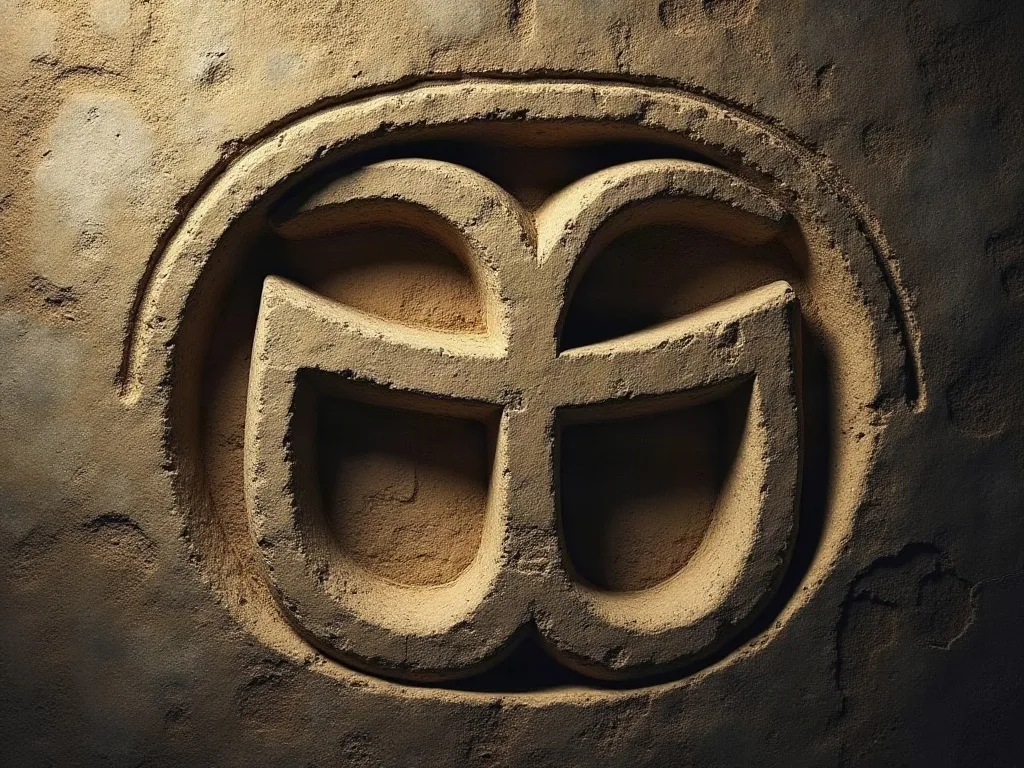
The curves of each arm are deliberate. Unlike a simple plus sign or a Greek cross with straight arms, the Lauburu's arms bend inward as if being drawn by an invisible vortex. Scholars have compared this shape to the Celtic triskele or the Norse swastika, symbols that also employ rotation and circular motion to represent solar cycles and eternal return. The Basque version, however, is distinctly its own: four-fold rather than three-fold, more contained, more domestic. This is a symbol meant to sit above a kitchen door, not to conquer empires.
One theory, advanced by Basque folklorist Xabier Kizkitza in the mid-20th century, proposes that the Lauburu derives from astronomical observation. The Basques, like all ancient peoples, watched the sun's path across the sky with reverence and practical attention. The four arms could represent the solstices and equinoxes, the cardinal moments when the sun's position shifted. The inward curve of each arm would then symbolize the way the sun appears to turn back at these threshold moments, ceasing its movement in one direction before reversing course. This reading transforms the Lauburu into a calendrical tool as much as a protective emblem.
Other scholars, such as Jon Uriarte, have suggested links to pre-Indo-European fertility religions. In this view, the four-fold symbol represents the earth's four quarters and the feminine principle of abundance and regeneration. The curve inward mimics the form of a womb, of containment and nurture. This interpretation sits uneasily alongside the solar reading, yet Basque cosmology was capacious enough to hold both: sun and earth, masculine and feminine, hard and soft. The symbol could signify both without contradiction.
The Lauburu as Shield and Blessing
By the medieval period, the Lauburu was firmly embedded in Basque domestic and spiritual practice. Carved into the lintels of doorways, it served as a protective sigil. Families believed that the rotating arms would ward off witches, envious glances, and supernatural harm. The Basque country has a rich tradition of witchcraft belief, distinct from the European witch hunts but deeply serious nonetheless. Women suspected of having sorginak (the Basque word for witchcraft) were feared. A visible Lauburu proclaimed the home's spiritual defenses and asserted that dark magic would find no purchase inside.
The symbol also marked sacred and communal spaces. Basque churches, built by communities that had only recently (from a Basque perspective) accepted Christianity, sometimes incorporated the Lauburu into their architecture. Sometimes it appears above doorways beside Christian crosses. Sometimes it is hidden in decoration, a continuity with the old world tucked discreetly into the new one. This layering reveals how the Basques negotiated Christianity without erasing what came before. The Lauburu did not disappear when priests arrived; it was absorbed, reinterpreted, allowed to coexist.
Medieval Basque law documents from the 13th and 14th centuries make occasional reference to sacred symbols and protective marks, though the Lauburu is seldom named explicitly. What survives are references to markak (marks), including the symbols carved onto boundary stones, clan emblems, and house signs. The Lauburu would have been one mark among others, though likely the most widespread and oldest. By the time regional aristocratic families were establishing their heraldic crests in the late medieval period, the Lauburu was already old enough that its true origins had been forgotten. People knew it worked. That was sufficient.
The symbol's protective power was not merely superstitious in a Basque framework. It was a form of spiritual technology. A woman carving the Lauburu into her doorframe was not merely avoiding harm; she was placing herself within a cosmological system that affirmed her place in an ordered, intelligible universe. The rotating arms suggested continuity and endless return, offering comfort in a world where seasons changed, loved ones died, and foreign powers threatened. The symbol said: You are held. You are part of a cycle. You will turn through seasons and return.
The Lauburu in the Age of Suppression and Revival
The Spanish Civil War (1936-1939) and the subsequent Franco dictatorship marked a catastrophic rupture for Basque culture. Franco's regime explicitly aimed to erase regional identities and impose a unified Spanish nation-state. The Basque language, Euskera, was forbidden in schools and public spaces. Basque nationalism was criminalized. In this darkness, symbols became resistance.
The Lauburu, which had been quietly used for centuries as a domestic marker and cultural signpost, suddenly acquired radical new meaning. It became the emblem of Basque independence, a visual statement that said: We were here before Spain. We will be here after. Nationalist organizations adopted it. It appeared on illegal pamphlets, graffitied onto walls, worn as jewelry in secret. Young Basques who had never seen their parents use the Lauburu suddenly learned its name and its history because learning it was an act of defiance.
After Franco's death in 1975 and the subsequent restoration of regional autonomy, the Lauburu emerged from hiding. It was no longer necessary to smuggle it or explain it in whispers. Museums in Bilbao and Vitoria began collecting historical examples and studying its origins. Academics like Xabier Kizkitza and Juan Luis Herrero published scholarly work tracing the symbol back through centuries of Basque life. Simultaneously, the Lauburu entered contemporary Basque visual culture in a new way: on flags, logos, tattoos, clothing. It ceased to be only a protective farmhouse mark and became a political and cultural declaration.
This transformation is crucial to understanding the Lauburu today. It is not a museum artifact or a historical curiosity. It is a living symbol actively deployed by millions of Basques to assert identity in the face of ongoing political tensions between the Basque Country and both Spain and France. The symbol's history of protection and endurance made it perfect for this role. It had already survived pre-Christian erasure, Christianization, centuries of foreign rule, and systematic cultural suppression. Using it as a symbol of resistance simply extended a tradition already embedded in the symbol's fabric.
Comparative Solar Symbols in European Traditions
The Lauburu is not unique; solar crosses and rotating symbols appear across Europe and beyond. Understanding its relatives helps illuminate what makes it distinctly Basque.
The Celtic triskele and triskelion (three-fold spirals) were widespread across Ireland, Scotland, Wales, and Brittany. These symbols, often found in prehistoric stone carvings and later incorporated into Christian manuscripts, represent solar motion and eternal return. Like the Lauburu, they are believed to offer protection and to embody cyclical time. However, the triskele's three-fold nature links it to other Celtic numbers: the triple goddess, the three worlds, the three paths. The Lauburu's four-fold structure connects it instead to cardinal directions and seasonal quarters, making it closer in some ways to Mesoamerican or Asian mandalas.
The Norse swastika (or sunwheel), used across Germanic and Scandinavian cultures, shares the rotating arm concept but with crucial differences. Norse solar symbols typically emphasize the relentless forward drive of time and the inevitability of the solar cycle leading toward Ragnarok, the end of the world. The Basque Lauburu, by contrast, emphasizes return and regeneration without apocalyptic finality. It spins eternally without destination; it is both protective and cyclical without being explicitly linked to cosmic doom.
Lauburu
Celtic Triskele
The Roman solaris (sun cross, also called a plus-sign cross) is mathematically simpler: four straight arms radiating from a center. This symbol was used throughout the Roman empire and later incorporated into Christian iconography. The key difference is that straight arms suggest static cardinal points, while the Lauburu's curves suggest motion and return. The Roman version is geometric and celestial; the Lauburu is organic and domestic.
This comparative view shows that the Lauburu occupies a unique niche in European symbolism. It is old enough to predate the Indo-European peoples who settled Europe, yet it survived their arrival and remained distinctly non-Indo-European in character. It incorporates solar symbolism like its Celtic and Germanic cousins, but with a domestic and protective emphasis. It is feminine and masculine simultaneously, cosmic and household-bound, pre-Christian yet compatible with Christian practice.
The Lauburu Today: Symbol, Tattoo, Political Declaration
In contemporary Basque Country, the Lauburu is ubiquitous. It appears on the flag of the Basque Nationalist Party. It is embroidered onto txapelas, the berets traditionally worn by Basque men. Tattooed onto the shoulders and chests of Basque youth, it marks belonging to a nation that has no UN seat, no passport, no formal sovereignty, yet possesses unmistakable cultural reality. The symbol's meaning has evolved without losing its roots.
Young Basques who get a Lauburu tattoo are often unaware of its origins in pre-Christian solar worship or its medieval use as a household protection mark. They know it as the symbol of Basque identity, a declaration that cannot be ignored. The tattoo's permanence transforms the symbol from a doorframe carving into a bodily commitment. It says: I am Basque. This is not negotiable. This is not borrowed. This is ancestral.
The symbol also appears in contexts that would astound medieval Basques. Basque sports teams use it. Basque restaurants display it. It is printed on tourist merchandise sold in Bilbao. This commercialization sits awkwardly alongside the symbol's continuing use in serious nationalist and independence movements. The Lauburu must somehow mean both "Basque heritage" as a consumable product and "Basque liberation" as a political demand. This tension is alive and unresolved.
There is also a dark history that must be acknowledged. Fascist and far-right movements in Europe have appropriated pre-Christian symbols, particularly rotating and solar symbols, to create a false historical mythology supporting racial ideology. The Nordic runes and the swastika have been so thoroughly poisoned by Nazi association that they are now nearly unusable in mainstream contexts, even though they predate Nazism by millennia. The Lauburu has not suffered the same systematic appropriation, but Basque scholars and activists remain vigilant against such distortion. The symbol's protective power, they insist, is tied to its genuine Basque roots and to the specific history of Basque resistance and survival. It cannot be divorced from that context without being degraded into mere decoration.
Unresolved Questions: What the Symbol Tells Us About Basque History
The Lauburu raises profound historical questions that scholars continue to debate. The most pressing is this: what does the symbol's existence tell us about pre-Christian Basque religion and society?
The Basque people remain linguistically isolated. Euskera belongs to no known language family. Archaeological and genetic evidence suggests that Basques are descended from pre-Indo-European populations who inhabited the western Pyrenees before Indo-European speakers (Celts, Romans, Visigoths) arrived. The Lauburu, as a symbol predating Christianization and showing no obvious debt to Indo-European traditions, may represent the oldest surviving religious symbol from this pre-Indo-European substrate. If so, it is invaluable to understanding how ancient Europeans thought about cosmos, time, and protection before the Indo-European invasions fundamentally altered the continent's religions and cultures.
Some scholars have speculated that the Lauburu reflects Basque shamanistic practices. The four arms could represent the shaman's journey through four spirit worlds or directions. The inward curve could symbolize the return from trance or the integration of spiritual knowledge back into everyday life. This is speculative; no Basque shamanic texts exist. Yet the Lauburu's persistent association with protection and spiritual power fits this interpretive frame.
Another question concerns the Lauburu's relationship to Mediterranean and Near Eastern symbols. The Basque region's geography puts it in potential contact with Iberian, Phoenician, and later Islamic influences coming from the south. Some scholars have explored whether the Lauburu might carry distant echoes of Near Eastern solar symbols or the Islamic Rub el Hizb (a rotating four-pointed star used in Quran decoration). The evidence is thin; any such connections would be ancient and deeply transformed. Yet it reminds us that the Basque region was never isolated, and its symbols may carry traces of distant encounters.
Frequently asked questions about the Lauburu
Frequently asked questions
What does Lauburu literally mean in Euskera?
Lauburu means "four heads" (lau = four, buru = head) in Euskera, the Basque language. The name reflects the symbol's four-armed structure and its association with the four cardinal directions, four seasons, or the four aspects of cosmic order in pre-Christian Basque belief.
Is the Lauburu connected to Celtic or Norse symbols like the swastika or triskele?
The Lauburu shares a family resemblance with other European rotating and solar symbols, but it is distinctly Basque. While all three symbols employ circular motion and solar imagery, the Lauburu's four-fold structure and emphasis on inward curvature set it apart. It appears to emerge from pre-Indo-European Basque cosmology rather than from the Indo-European traditions that shaped Celtic and Norse symbolism.
Was the Lauburu used as a protective charm against witches in medieval Basque Country?
Yes. Carvings of the Lauburu appear on medieval and early modern Basque farmhouses, church doors, and boundary markers. Families believed the symbol's rotating arms would turn away sorginak (witches) and supernatural harm. This apotropaic (protective) use persisted for centuries and remains part of the symbol's cultural memory, even as its meaning has expanded to encompass political and national identity.
Did the Lauburu take on new meaning during Franco's dictatorship?
Absolutely. Under Franco's regime (1936-1975), when Basque language and culture were suppressed, the Lauburu became a symbol of resistance and national identity. It was secretly worn and displayed as a declaration that Basque culture predated Spain and would endure. After democracy was restored, the symbol emerged openly and is now prominently used in Basque nationalism, appearing on flags, logos, and as tattoos.
How old is the Lauburu, and where is the earliest evidence for it?
The Lauburu predates any written records of Basque culture, making its exact age unknowable. Medieval building stones and church carvings provide the earliest documented examples, dating to the 13th-14th centuries. However, the symbol's form and embedded cosmology suggest it is far older, likely rooted in pre-Christian Basque religion and possibly connected to pre-Indo-European European spirituality. Scholars believe it may be one of Europe's oldest surviving sacred symbols.
Is there a connection between the Lauburu and shamanic or spiritual practices in ancient Basque society?
This remains speculative, but some scholars have proposed that the symbol may reflect shamanic cosmology, where the four arms represent spiritual journeys through different worlds or directions, and the inward curvature signifies the return from trance or the integration of spiritual power. No direct shamanic texts exist in Basque tradition, but the symbol's persistent association with spiritual protection and its cosmological structure support this reading.
The Lauburu as Living Archaeology
The Lauburu is not dead history. It is a symbol that continues to do what it has always done: it protects, it marks, it affirms belonging. Every time a Basque person carves it into a doorframe, tattoos it onto their skin, or displays it on a flag, they are participating in a practice that reaches back centuries, possibly to the dawn of their culture's emergence as a distinct people.
What makes the Lauburu remarkable is its continuity. Unlike symbols that have been forgotten and rediscovered, the Lauburu has never gone dark. It has been carried forward in unbroken practice from generation to generation. The family that carved it on their farmhouse in the 14th century was doing what their ancestors had done, and what their descendants would do. The young Basque who wears it today as a tattoo is continuing that same gesture, though now its meaning encompasses both household protection and national resistance.
The symbol reminds us that cosmology does not disappear. When Christianity arrived in Basque Country, it did not instantly erase the older religious framework. Instead, the two coexisted, overlapped, and transformed each other. The Lauburu carved into a church doorway is not evidence that the Basques rejected Christianity, but rather that they integrated it into a worldview that was already ancient and deep. This kind of religious layering is common across Europe, yet it is often overlooked in favor of a cleaner narrative of conversion and replacement.
In the Lauburu, we see the Basque people themselves: ancient, rooted, adaptable, resilient. The symbol has survived political suppression, cultural erasure, and the relentless march of modern secularism. It continues to spin, continues to protect, continues to affirm that the Basques are not a conquered people waiting for history to finish with them, but a living culture insisting on its own reality. The four arms rotate endlessly, and the center holds.
Read the full book
Want the whole story?
The complete edition is an instant PDF download here, with a paperback on Amazon for selected titles.
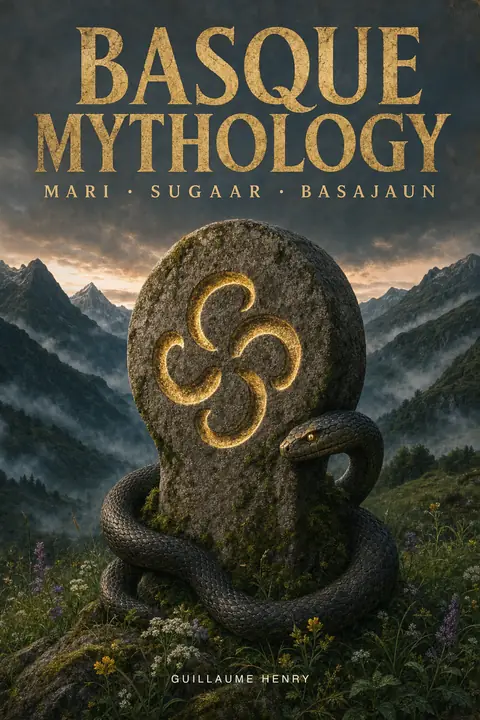
Basque
The Basque Mythology Book: Mari, Sugaar, Basajaun, and the Oldest Gods of Europe
Mari, Sugaar, and Basajaun
The mythology of Europe’s oldest people, who speak a language related to no other on earth. Mari the goddess of the mountains, her serpent-consort Sugaar, the wild lord of the woods Basajaun, and a pre-Indo-European world that survived in the Pyrenees.
More from Basque
All articles
Basque
Eguzkilore: The Sun Flower Symbol of Basque Protection and Renewal
The Eguzkilore is the sacred sun flower of Basque culture, hung above doorways for protection and blessing. Rooted in ancient sun worship and Christianised into a mark of spiritual abundance, this eight-petalled symbol endures as a living emblem of Basque identity and resilience.
Basque
Anbotoko Mari: The Cave Sanctuaries of the Goddess
High in the Basque mountains, deep inside caves that pierce the earth, Mari dwells. The Anbotoko Mari tradition reveals how a people carved sacred space into rock itself, honoring a goddess whose storms feed the valleys below. Enter the caves where Basque faith shaped the land.
Basque
Gaueko: The Spirit of the Night
Gaueko haunts the Basque night as a shadowy, restless spirit who protects livestock and travelers but demands respect. Learn how this being embodies the Basques' relationship with darkness in the mountains of northern Spain and France.

Basque
Lamiak: The Nymphs of Basque Rivers and Caves
Lamiak are the enchanting water spirits of Basque folklore, neither divine nor mortal, who dwell in rivers, caves, and waterfalls across the Pyrenees. Discover their nature, their bargains with humans, and what makes them unlike any other European water spirit.