
Tartalo: The Basque Cyclops
Tartalo is the one-eyed giant of Basque mythology, a creature older than written memory who hunts alone in mountain caves. Meet the giant who predates the Greeks.
Contents
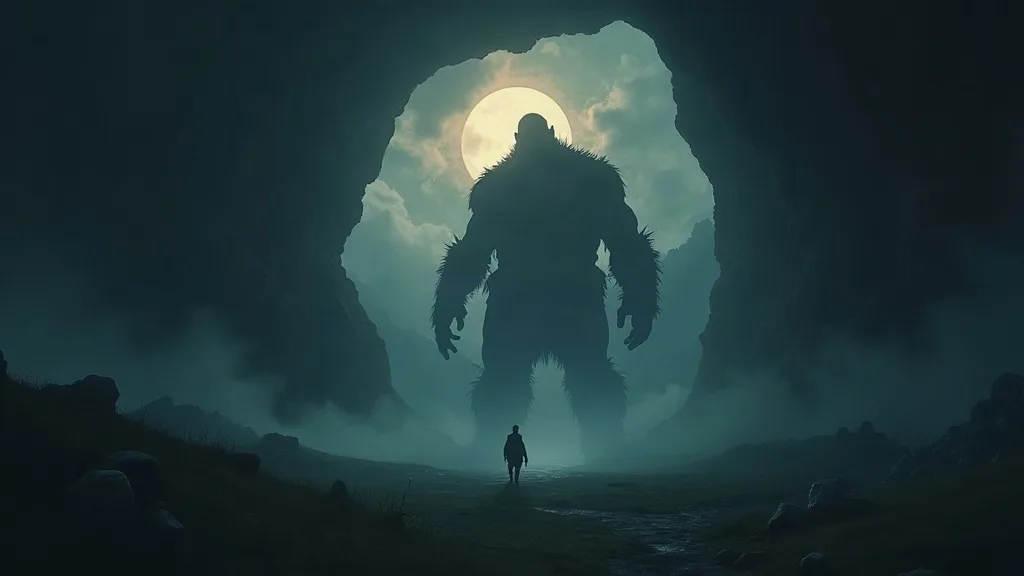
The stone is cold, the cave is dark, and something breathes inside. A shepherd has wandered too far up the mountain. The entrance behind him has gone silent. Then a single eye opens in the blackness, wide as a full moon, catching what little light remains. That is how the oldest Basque stories begin when Tartalo: the Basque Cyclops steps into the tale.
He is not a metaphor. He is not a lesson dressed up in fur and bone. Tartalo is a creature with weight and hunger, a giant who eats men the way men eat mutton. For centuries, people in the Basque Country, a land straddling the western Pyrenees between what is now northern Spain and southwestern France, told his stories around fires, passing them from grandparent to grandchild in a language, Euskara, that has no proven ancestor and no known relative on earth. The giant who lives in those stories is just as singular as the tongue that carries him.
What makes Tartalo remarkable, beyond the terror he inspires, is how closely he echoes the Cyclops Polyphemus from Homer's Odyssey, written around the 8th century BC. The Basques were not colonised by Greeks. They left almost no written records before the medieval period. Yet both traditions produce the same archetype: one eye, a cave, a trapped hero, a blinding, an escape. Scholars have argued for more than a century about what that parallel means.
Who Tartalo Is: Size, Eye, and Appetite
Tartalo appears across Basque oral tradition as a giant of extraordinary size, always distinguished by one central eye set in the middle of his forehead. The Basque scholar and folklorist Jose Miguel de Barandiaran, who spent much of the 20th century collecting oral testimonies in Basque villages, documented dozens of variant tales in which Tartalo's physical description remains strikingly consistent: enormous body, a single eye, a cave dwelling, and an insatiable hunger for human flesh.
The name itself is telling. Some linguists connect Tartalo to Tartarus, the Greek underworld pit, though this connection is disputed. Others see a purely indigenous root, possibly linked to the Basque word tarte (gap, space between things), suggesting a creature that exists at the boundary between the human world and something else. Neither etymology is settled, and the uncertainty fits the creature well.
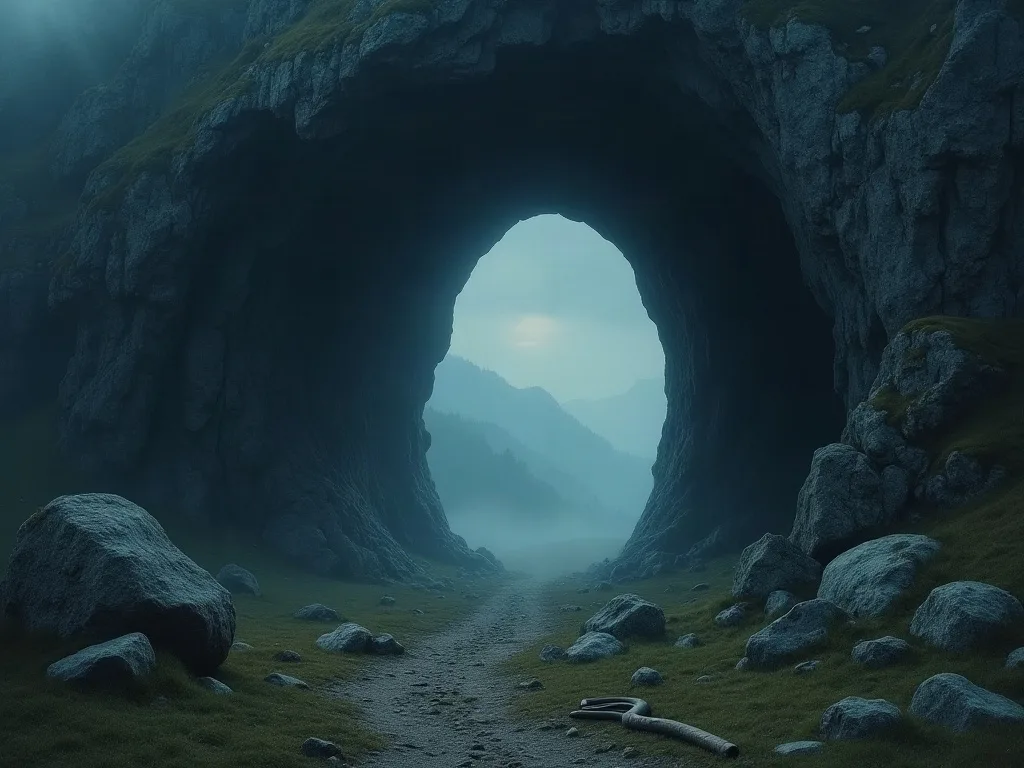
He herds livestock, which aligns with his Greek counterpart. He is not stupid, despite his brutishness. In several recorded tales, Tartalo sets traps, keeps prisoners, and bargains. He can speak. He knows what humans want and uses that knowledge against them. A recurring story type involves a young man captured and imprisoned in the cave while Tartalo goes out to tend his flock. The young man has a brief window, a single night perhaps, to find a way to survive until morning.
Barandiaran collected one tale, published in his monumental Mitología Vasca (1960), in which Tartalo carries a magic ring that he forces onto his prisoner's finger, a ring that calls out and betrays the prisoner's location if he tries to flee. The detail is haunting. It transforms the monster from a dumb brute into something calculating. The ring is not part of the Homeric story. It is distinctly Basque, and scholars point to it as evidence that Tartalo is not simply a borrowing but an independent tradition with its own elaborations.
The Escape: Fire, Cunning, and the Mountain Road
The core plot of the most famous Tartalo tales follows a structure that any reader of Homer will recognise, but with details that shift the meaning.
A hero, usually a young shepherd or a woodcutter's son, is captured by Tartalo and locked inside the cave. Tartalo seals the entrance with a massive boulder. The hero watches the giant eat other prisoners and knows his own turn is coming. Panic would kill him. Instead, he thinks.
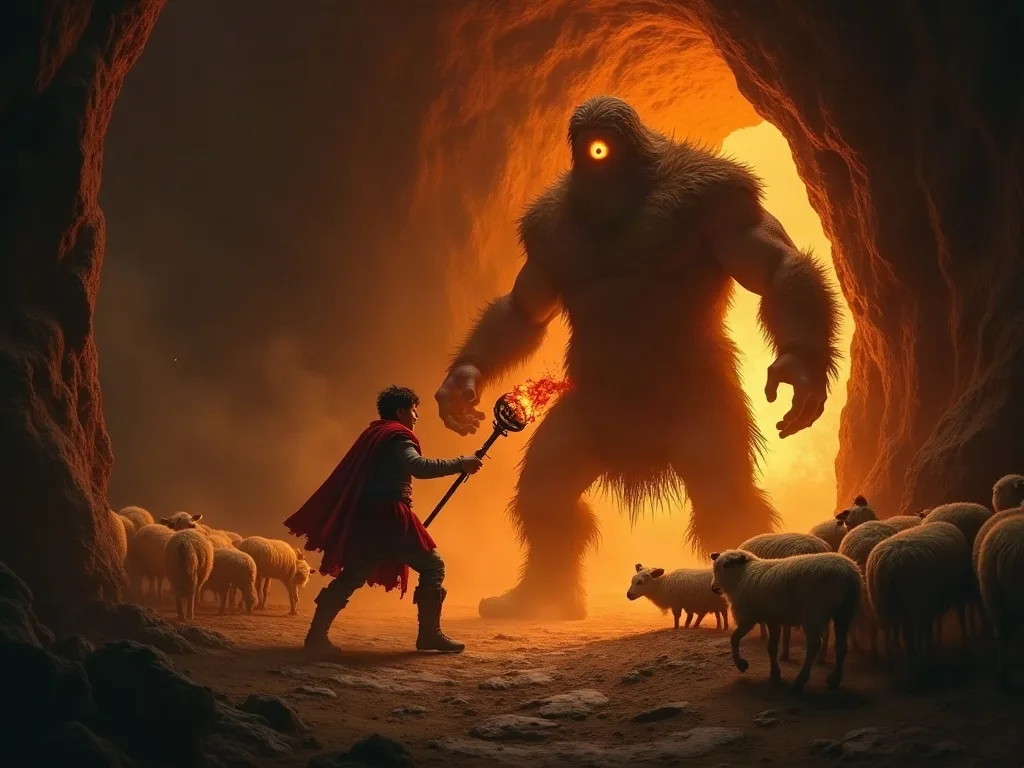
In the Basque variants, the hero often blinds Tartalo using a sharpened wooden stake or an iron spit heated in the fire, exactly as Odysseus blinds Polyphemus with a sharpened olive-wood stake in Homer's Odyssey (Book 9). The blinded giant then removes the boulder to let his sheep out, and the hero clings beneath one of the animals to escape undetected. That structural echo is precise enough that scholars cannot dismiss it as coincidence.
But the Basque story adds its own layer. Because of the magic ring Tartalo placed on the hero's finger, the ring shouts the hero's location as he flees. The hero tears the ring off and throws it into a river, or in some versions hurls it into a crevice in the rock, to silence it. That motif, a possession that turns against its owner, appears in other Basque tales connected to the spirit world and is absent from any Greek parallel.
The hero reaches home. Tartalo, blinded and robbed of his prize, retreats into the cave. He does not die in most versions. He simply disappears back into the mountain, which is its own kind of ending. He is still there. He might always be there.
The broader world of Basque supernatural beings includes many creatures that share this quality of permanent, lurking presence rather than dramatic defeat.
Tartalo and Polyphemus: Two Traditions, One Monster
The parallel between Tartalo and Polyphemus is the most discussed question in Basque mythological scholarship, and it is worth taking seriously on its own terms.
Homer describes Polyphemus in the Odyssey as a son of Poseidon, a shepherd giant with one eye who lives in a cave and eats men. Odysseus blinds him with a stake, escapes under a sheep, and later taunts the giant from his boat, a mistake that earns him the wrath of Poseidon for the rest of the poem. The story is one of the most reproduced in all of world literature.
Tartalo (Basque)
- Single eye in the centre of the forehead
- Lives in a mountain cave in the Pyrenees
- Herds livestock (sheep and cattle)
- Hero blinds him with a heated stake or spit
- Hero escapes hidden beneath a sheep
- Magic ring betrays the hero's position during flight
- Does not die; retreats into the mountain
- Rooted in oral tradition; earliest written records from the 19th century
Polyphemus (Greek)
- Single eye in the centre of the forehead
- Lives in a coastal cave on the island of the Cyclopes
- Herds sheep and goats
- Odysseus blinds him with a sharpened, fire-hardened olive-wood stake
- Odysseus escapes hidden beneath the largest ram
- No equivalent "betraying object" motif
- Survives; his cries summon the other Cyclopes
- Recorded in Homer's Odyssey, approximately 8th century BC
Three main explanations compete in scholarly literature. The first is diffusion: the Greek story spread westward through trade and cultural contact, reached the Basque Country, and was absorbed into local tradition. The second is polygenesis: the same basic scenario (one-eyed cave giant, heroic escape) arose independently in two unrelated cultures because it solves the same imaginative problem, namely how a weaker person defeats a physically superior monster. The third, and most intriguing, is common origin: both traditions independently preserve a far older Proto-European or pre-Indo-European story type, one so ancient that the Basques and the Greeks inherited it from a shared ancestor culture thousands of years before either civilisation left written records.
The linguist and mythologist Frederick Klaeber, and more recently the comparative mythologist Timothy Bridgman in his 2005 study Hyperboreans: Myth and History in Celtic-Hellenic Contacts, have examined the case for and against diffusion carefully. An earlier and equally important voice is that of Julien Vinson, the 19th-century Basque-language scholar whose Le Folk-lore du Pays Basque (1883) was among the first works to document the Tartalo-Polyphemus parallel in print, framing it as a puzzle for comparative mythology rather than a case of simple borrowing. More recently, Joseba Lakarra, a specialist in Proto-Basque linguistics, has argued that the deepest layer of Basque oral tradition reflects a linguistic and cultural substrate that predates the arrival of Indo-European speakers in Western Europe, which would push Tartalo's origins well beyond any possible Greek contact. The Basque evidence complicates the diffusion argument because several Tartalo motifs, including the magic ring, have no Greek parallel and would presumably have been dropped if the story were simply borrowed. That suggests local elaboration of an older, shared substrate.
Tartalo in the Landscape: Mountains, Caves, and the Pyrenean World
Tartalo does not float free of geography. His caves are specific. Barandiaran's field interviews placed Tartalo sightings and stories in particular valleys and mountain ranges: Ataun, Ordizia, the Sierra de Aralar. These are real places, and in many accounts, locals named a specific cave or rock formation as Tartalo's den.
This grounding in landscape is characteristic of Basque mythology broadly. Mari, the supreme female deity of Basque belief, also lives in a mountain cave, specifically identified as Anboto or Txindoki depending on the region. Tartalo and Mari inhabit the same vertical world, a world where the most powerful beings live above the human settlement line, in the high stone country where shepherds go but farmers do not.
That overlap with shepherding culture is not accidental. The Basque Country has a long tradition of transhumance, the seasonal movement of flocks to high summer pastures called txabola in Basque. Young men went alone into the mountains for months. They came back with stories. Those stories needed a credible danger to explain why someone might not come back, and Tartalo fits that role precisely.
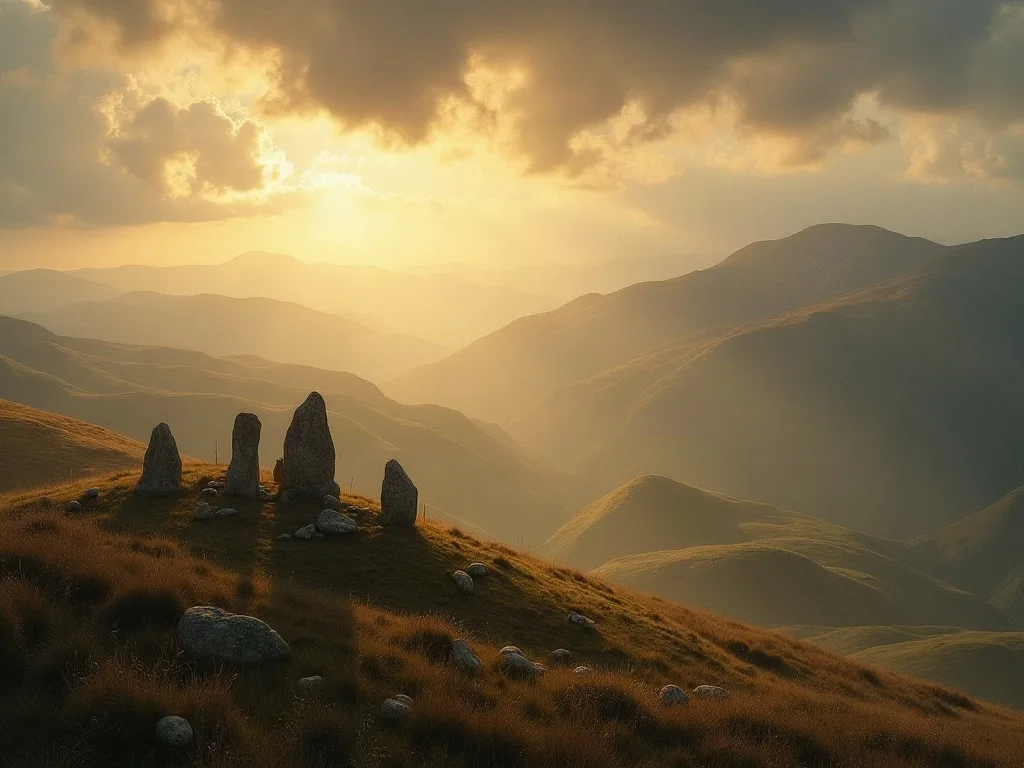
He is also, in several tales, connected to giants called Jentilak (the Gentiles, sometimes translated as "the pagans"), a class of pre-Christian supernatural beings in Basque belief who built the megalithic structures, the dolmens and cromlechs, scattered across the Basque highlands. When Christianity arrived, the Jentilak retreated into the mountains or underground. Tartalo may be a survival of that older giant race, the last one, or the most monstrous one, who never fully left.
Tartalo and the Basajaun: Giants of a Different Kind
Not every mountain giant in Basque belief is Tartalo's equal in menace. The Basajaun, whose name means "Lord of the Forest" in Euskara, is another giant figure whose territory overlaps with Tartalo's high country, yet the two creatures occupy very different moral registers.
Where Tartalo is purely predatory, a being defined by appetite and cunning cruelty, Basajaun is ambivalent. He is enormous, covered in hair, and capable of frightening violence, but Basque tradition also credits him with teaching humans the arts of agriculture, ironworking, and milling grain. He guards flocks against wolves and warns shepherds of coming storms. He is dangerous to cross but not fundamentally hostile to humanity.
The contrast is instructive. Both figures are giants, both live at altitude, both interact with shepherds. But Basajaun belongs to the world, even if he stands at its wild edge. Tartalo stands outside it. No tale credits Tartalo with teaching anything or protecting anyone. His relationship to humans is transactional in the darkest sense: they are his food supply. This distinction may reflect two different layers of Basque prehistoric memory, one giant race that was eventually reconciled with human culture, another that was not. Or it may simply reflect the storytelling economy of a tradition that needed both a monster and a threshold guardian, and assigned those roles cleanly.
The Ring That Speaks: Tartalo's Signature Motif
No element of the Tartalo cycle is more distinctively Basque than the magic ring. It appears in enough variant tales that Barandiaran classified it as a defining feature of the tradition rather than a local addition.
The ring, in most versions, belongs to Tartalo himself. He places it on the prisoner's finger, sometimes as a mark of ownership, sometimes as part of a ritual the stories do not fully explain. When the prisoner tries to flee, the ring cries out: "Here I am! Here I am!" (Hemen nago! Hemen nago! in some recorded versions). The hero cannot simply run. He must deal with the ring first.
The solutions vary. Throwing the ring into water is the most common ending, which silences it because water swallows sound, or perhaps because running water is a barrier to supernatural things, a belief the Basques share with many other traditions. In one striking version from the Ataun valley, the hero cuts off his own finger to remove the ring and throws the finger with it into a gorge. He escapes with nine fingers and his life.
The ring motif has structural echoes in other European folklore traditions. Rings that speak or betray appear in Irish fairy tales, in certain Slavic stories, and in Alpine legend. Whether this is diffusion, coincidence, or a very old shared motif is another open question. What is clear is that in the Tartalo cycle, the ring gives the story its sharpest moment of tension, a second danger that arrives precisely when the hero thinks he has won.
Tartalo Across the Oral Tradition: Variants and Spread
Barandiaran's collections, and those of his predecessor Resurrection Maria de Azkue, who published his Euskaleriaren Yakintza (Knowledge of the Basque Country) in the 1930s and 1940s, reveal that Tartalo stories were not confined to one valley or one village. They appear across the Basque-speaking territory on both sides of the Pyrenees, in the Spanish provinces of Gipuzkoa, Bizkaia, Araba, and Nafarroa, and in the French Basque provinces of Lapurdi, Behe-Nafarroa, and Zuberoa.
The name varies slightly: Tartalo, Torto, Anxo, or simply Erraldoi (giant) depending on the region. The core plot holds. The single eye, the cave, the human prisoner, the blinding, the escape: these elements appear in essentially every variant. The magic ring appears in roughly half the recorded versions, concentrated in Gipuzkoa.
This geographic spread, combined with the linguistic consistency of a tradition carried in Euskara, a language that has no close relatives, makes a strong case for genuine antiquity. Stories don't travel unchanged across mountains and centuries unless they carry something that feels necessary, something that explains the landscape or the human condition in a way nothing else does.
Mari, Basque goddess of storms, shares this landscape with Tartalo, and some scholars note that encounters with both figures follow similar ritual patterns in oral tradition: the hero must show intelligence, not strength, to survive.
What Tartalo Reveals About Basque Belief
Read as mythology rather than folklore, Tartalo is not simply a monster story. He encodes a set of values and anxieties that are legible across cultures but expressed in specifically Basque terms.
The hero who defeats Tartalo never does so with brute force. He is almost always smaller, weaker, and lower-status than the giant. He wins by thinking faster, by using fire and deception rather than muscle. This is a recurring theme in Basque oral tradition: cleverness defeats power. The same pattern appears in stories about Mari and her consort Sugaar, the snake-god, where humans who outwit supernatural beings earn their freedom while those who panic or boast are destroyed.
Tartalo also marks a boundary. He lives where the village ends. He is not in the valley, not in the farmhouse (baserri), not in the marketplace. He is in the high country, the lonely country, the country without roads. Crossing into that territory requires skill and luck. Coming back requires something more. The stories prepare young shepherds, at least symbolically, for what the mountains demand.
There is also the matter of his survival. Unlike so many mythological monsters, Tartalo does not die. He retreats. He goes back into the stone. That choice, if it is a choice on the part of the storytellers, suggests he is not evil in a cosmic sense. He is dangerous the way a rockslide is dangerous: he occupies his own space, and humans who enter it take their chances.
Frequently Asked Questions About Tartalo: The Basque Cyclops
Frequently asked questions
Is Tartalo directly related to the Greek Cyclops Polyphemus?
The relationship is debated. The two figures share striking structural similarities: one eye, a cave, captive humans, a blinding escape. Three explanations exist in scholarship: cultural diffusion (the Greek story spread west), polygenesis (both cultures invented similar stories independently), or common origin in a much older pre-Indo-European tradition. The magic ring motif, which has no Greek parallel, supports the idea that the Basque tradition developed independently or adapted a very old shared substrate rather than borrowing directly from Homer.
Where does the name Tartalo come from?
The etymology is unresolved. Some scholars connect the name to Tartarus, the Greek underworld, suggesting late classical influence. Others argue for a purely indigenous Basque root, possibly related to tarte (a gap or interval), framing Tartalo as a liminal being who exists between worlds. The name also appears in regional variants as Torto and Anxo, which complicate any single etymology.
What is the magic ring in Tartalo stories, and why does it matter?
The magic ring is Tartalo's most distinctively Basque contribution to the one-eyed-giant archetype. Tartalo places it on his prisoner's finger, and the ring cries out the wearer's location if they try to flee. The hero must silence or discard it before escaping. This motif appears in roughly half of all recorded Tartalo variants, concentrated in the Gipuzkoa region, and has no direct equivalent in any Greek Cyclops story. Folklorist Jose Miguel de Barandiaran considered it a defining marker of the Basque tradition.
How do we know about Tartalo if the Basques left so few written records?
Tartalo survives through oral tradition, collected systematically from the 19th century onward. The pioneering work was done by Resurrection Maria de Azkue and, most extensively, by Jose Miguel de Barandiaran, whose Mitología Vasca (1960) and decades of field interviews in Basque villages produced the richest archive of these stories. Barandiaran worked into his 90s, recording testimony from elderly speakers who had heard the tales as children. The oral chain reaches back far beyond any written source.
Are there other giants in Basque mythology besides Tartalo?
Yes. The Jentilak (sometimes translated as "the Gentiles" or "the Pagans") are a class of pre-Christian giants in Basque belief credited with building the megalithic monuments, dolmens and standing stones, found across the Basque highlands. They are generally portrayed as powerful but doomed, retreating underground or into mountains when Christianity arrived. Tartalo may be a survival of this giant race, the most dangerous and most persistent of them, or a separate being of the same general type. The Basajaun, the great hairy "Lord of the Forest," offers a contrasting giant figure, one who guards rather than devours. The two traditions overlap significantly in regional storytelling.
Is Tartalo still part of living Basque culture today?
Tartalo appears in modern Basque children's literature, theatrical productions, and cultural festivals. The Basque Country has experienced a strong cultural revival since the late 20th century, and figures from oral tradition, including Tartalo, Mari, and the Jentilak, have become symbols of a distinct Basque identity. Several illustrated retellings for young readers have been published in Euskara since the 1980s, keeping the giant present in the culture even as the original oral tradition has faded.
Tartalo in the Modern Basque Imagination
The story of Tartalo: the Basque Cyclops did not end when the villages stopped believing in giants. It changed form.
From the late 20th century onward, the Basque cultural revival, driven partly by the push to revitalise Euskara as a living language, brought figures like Tartalo back into public view. He appears in illustrated children's books published in the 1980s and 1990s by presses in Donostia-San Sebastian and Bilbao. He turns up in theatrical productions, in animated short films, and in the permanent collections of Basque ethnographic museums, most notably the Basque Museum in Bilbao and the Zestoa Museum in Gipuzkoa.
Writers and artists have been drawn to the unresolved quality of his stories. Because Tartalo does not die, because he retreats rather than falls, he resists the clean ending that most monster myths provide. He is available for reinterpretation: as a symbol of the pre-Christian past that Christianity could not fully erase, as an embodiment of the wilderness that industrial modernity has enclosed but not tamed, as the thing that is still in the mountain even when no one is looking.
The scholarly conversation continues as well. The question of how a culture with no written language preserved a story structurally identical to one of Homer's most famous episodes remains genuinely open. It connects to larger debates in comparative mythology about how deep oral traditions run, how stable story structures can be across millennia, and what the Basque language and its mythology might reveal about the earliest layers of European prehistory.
Tartalo sits at the centre of all of that. A giant with one eye, a cave for a home, and a story no one has fully explained. He was there before the Greeks wrote anything down. He may have been there longer than anyone has yet had the tools to measure.
Read the full book
Want the whole story?
The complete edition is an instant PDF download here, with a paperback on Amazon for selected titles.
Basque
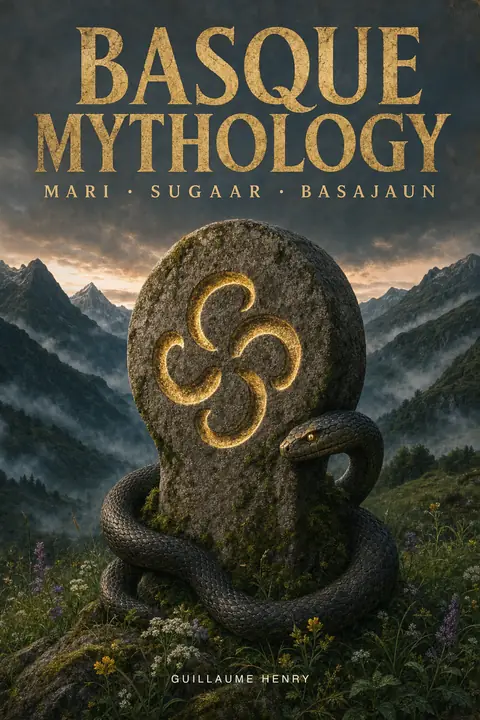
The Basque Mythology Book: Mari, Sugaar, Basajaun, and the Oldest Gods of Europe
Mari, Sugaar, and Basajaun
The mythology of Europe’s oldest people, who speak a language related to no other on earth. Mari the goddess of the mountains, her serpent-consort Sugaar, the wild lord of the woods Basajaun, and a pre-Indo-European world that survived in the Pyrenees.
More from Basque
All articles
Basque
The Lauburu: Basque Cross and Solar Symbol
The Lauburu is a four-pointed cross with curved arms that has protected Basque homes and souls for centuries. This ancient symbol weaves solar magic, Christian faith, and pre-Christian cosmology into a single rotating form.

Basque
Eguzkilore: The Sun Flower Symbol of Basque Protection and Renewal
The Eguzkilore is the sacred sun flower of Basque culture, hung above doorways for protection and blessing. Rooted in ancient sun worship and Christianised into a mark of spiritual abundance, this eight-petalled symbol endures as a living emblem of Basque identity and resilience.
Basque
Anbotoko Mari: The Cave Sanctuaries of the Goddess
High in the Basque mountains, deep inside caves that pierce the earth, Mari dwells. The Anbotoko Mari tradition reveals how a people carved sacred space into rock itself, honoring a goddess whose storms feed the valleys below. Enter the caves where Basque faith shaped the land.
Basque
Gaueko: The Spirit of the Night
Gaueko haunts the Basque night as a shadowy, restless spirit who protects livestock and travelers but demands respect. Learn how this being embodies the Basques' relationship with darkness in the mountains of northern Spain and France.