
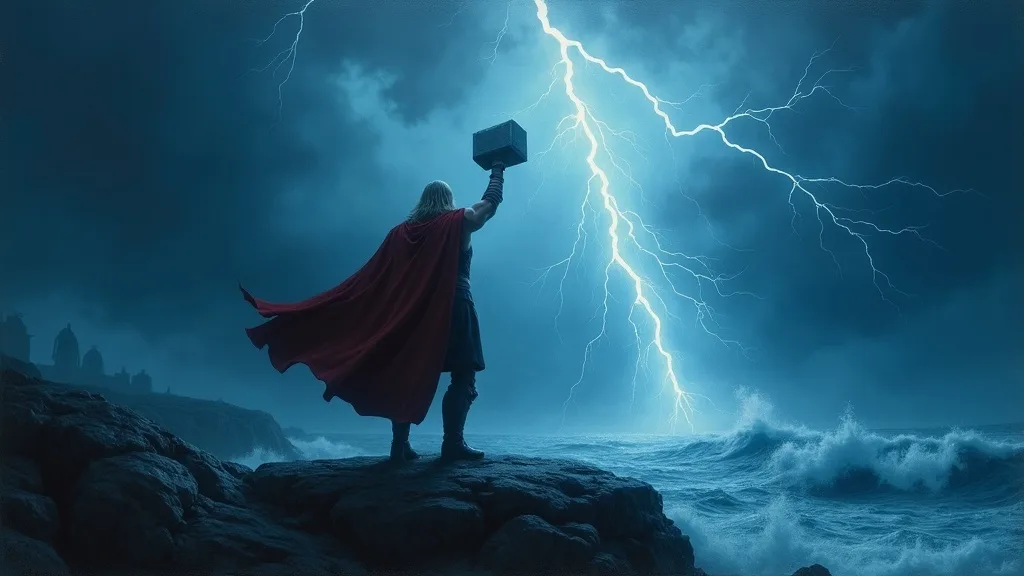
Mjolnir: Thor's Hammer and Symbol of Protection
Mjolnir was not just a weapon. Forged by dwarf smiths and carried by the thundergod Thor, it guarded gods, humans, and the living world against the chaos of giants. Here is its full story.
Contents
The hammer flies. It crosses the sky in a wide arc, splits a giant's skull, and returns to the hand that threw it before the thunder even fades. That is the simplest way to describe Mjolnir: Thor's Hammer and Symbol of Protection, but it is nowhere near the whole picture.
In the Norse world, Mjolnir was more than a battle weapon. It consecrated marriages, it blessed the dead, it hallowed the newborn. Farmers carved its shape onto runestones hoping for rain and good harvests. Viking men and women wore tiny hammer amulets against their skin. When Christianity spread across Scandinavia and people began wearing crosses, the hammer pendants kept appearing alongside them, sometimes cast in the same mould, as if neither tradition could quite replace the other.
The Dwarves Who Forged a God's Weapon
The story of Mjolnir's creation begins with a theft. Loki, the trickster, cut off the golden hair of Sif, Thor's wife, while she slept. Thor's rage was immediate and entirely justified. To save himself from the thundergod's fists, Loki promised to travel to Svartalfheim, the realm of the dwarves, and bring back hair spun from real gold.
He went to the sons of Ivaldi, mastersmith dwarves whose workshop could produce objects no living creature could rival. They delivered the golden hair, and while they were at it they forged two other gifts: a ship called Skidbladnir (meaning "assembled from thin pieces of wood"), which could sail any sea and fold small enough to fit in a pocket, and a spear called Gungnir, which would never miss its target and later became Odin's weapon.
Loki, being Loki, decided to push his luck. He made a bet with another dwarf named Brokkr that Brokkr and his brother Sindri could not produce three items finer than those the sons of Ivaldi had made. The stakes were Loki's own head.
Sindri began working. He placed a pigskin in the forge and told Brokkr to pump the bellows without stopping, no matter what happened. Loki transformed himself into a fly and bit Brokkr on the hand. Brokkr kept pumping. Out came a boar with bristles of gold, Gullinbursti, which could run faster than any horse and lit the darkness with the glow of its fur.
Sindri placed gold in the forge next. The fly bit Brokkr again, harder. Brokkr did not stop. Out came Draupnir, a gold ring that dripped eight identical gold rings every nine nights, later gifted to Odin.
Then Sindri placed iron in the forge. This time the fly bit Brokkr on the eyelid so savagely that blood ran into his eye. Brokkr flinched, just for a moment, and the bellows slipped.
When Sindri pulled the iron from the forge, the hammer was perfect in every way except one: its handle was too short. Loki had corrupted the making.
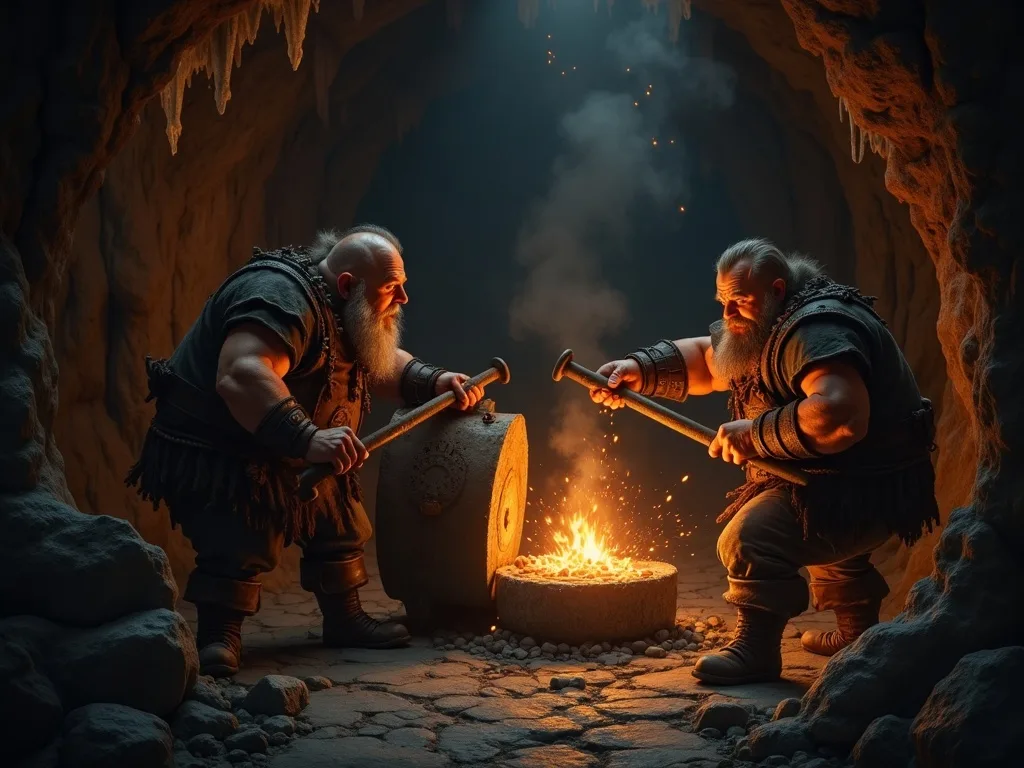
The dwarves brought their gifts to Asgard. The gods judged. The ring and the boar were magnificent. But when they held Mjolnir, every one of them agreed: nothing surpassed it. The short handle was a flaw, but the weapon itself was beyond anything they had seen. Brokkr had won the bet and Loki owed him his head.
Loki talked his way out of losing his neck by pointing out the bet was for his head, not his neck, and Brokkr could not technically take one without the other. The gods permitted this. Brokkr, furious, sewed Loki's lips shut instead. This story comes from the Prose Edda, a 13th-century Icelandic text by the scholar Snorri Sturluson, who compiled Norse myth from older oral traditions.
What Mjolnir Could Actually Do
Mjolnir's short handle made it awkward at arm's length, which is perhaps why Thor threw it rather than swinging it like an axe. But what it could do went far beyond killing giants.
According to the Prose Edda, the hammer had three qualities that made it extraordinary. First, it always hit what Thor aimed at. Second, it always returned to his hand after being thrown. Third, it could be made small enough to tuck inside his shirt, which is how Thor concealed it in at least one famous story.
The hammer also had the power to restore life. In the myth of Thor's goats, Thor killed his two sacred goats, Tanngrisnir and Tanngnjóstr, cooked them for a meal, and then used Mjolnir to resurrect them the next morning, provided all their bones had been kept intact. This detail points directly to Mjolnir's role in blessing and restoration, not merely in destruction.
At funerals, the hammer was held over the body of the dead. The Prose Edda preserves the scene of Baldr's funeral pyre, where Thor waded into the sea to consecrate the pyre with Mjolnir before the fire was lit. The gesture "hallowed" the dead, connecting the idea of thunder-force with the sacred crossing between life and death.
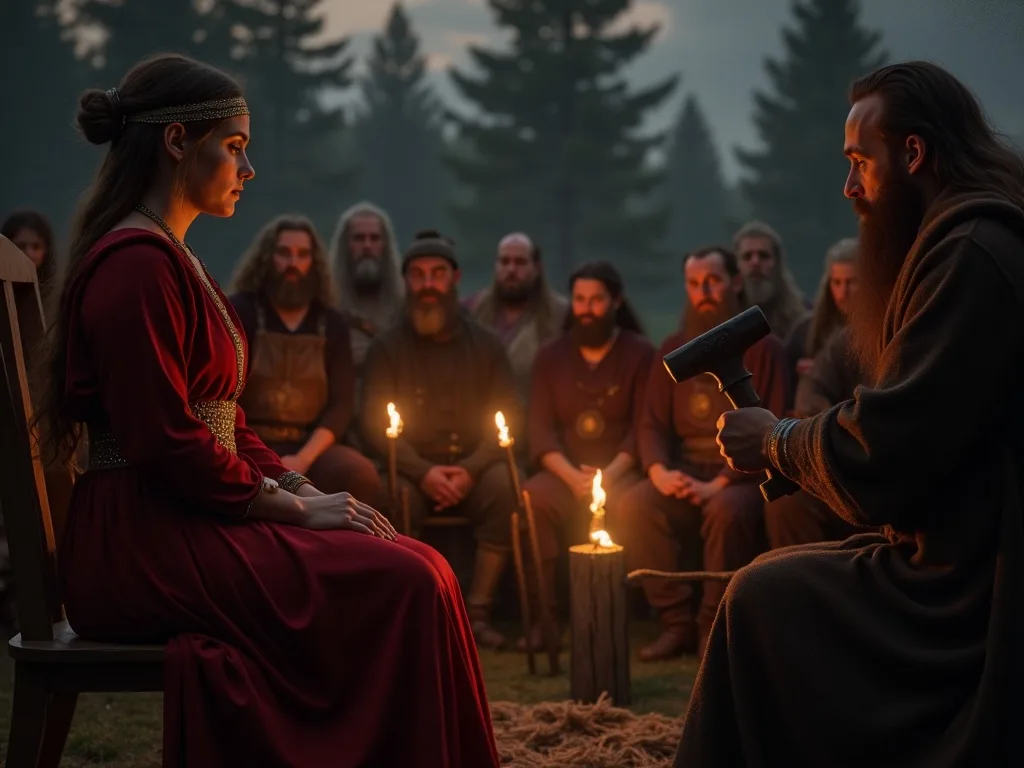
Midwives also placed Mjolnir on the lap of a new bride during wedding ceremonies. A passage in the Thrymskvida, one of the poems of the Poetic Edda (the older collection of Norse poems, some possibly dating back to the 10th century), makes this explicit when the giants themselves know the ritual and use it as a trap.
The Theft of the Hammer: A Story About Disguise and Stakes
The Thrymskvida is one of the most entertaining poems in the Norse canon, and it is built entirely around Mjolnir: Thor's Hammer being stolen.
Thor woke up one morning and the hammer was gone. He immediately went to Loki (the gods apparently defaulted to Loki whenever something was wrong), and together they went to Freyja to borrow her falcon-feather cloak, which granted the power of flight. Loki flew to Jotunheim, the land of the giants.
There he found Thrym, a giant king, sitting on a barrow combing the manes of his horses. Thrym admitted, cheerfully, that he had buried Mjolnir eight leagues underground. His price for returning it: Freyja as his bride.
Freyja, upon hearing this proposal, was so furious her necklace Brisingamen burst from her neck. She refused absolutely. The gods held a council. Heimdall, the watchman of the Aesir, suggested a plan: dress Thor as a bride, put Freyja's necklace on him, and send him to Jotunheim himself to retrieve the hammer from inside.
Thor objected, loudly, because the idea of dressing as a woman struck at his entire identity as the great masculine protector. Loki pointed out that unless they recovered Mjolnir, the giants would overrun Asgard within days. Thor submitted.
The scene that followed, of a very large, very red-faced "bride" arriving in Jotunheim with an alarming appetite, eating an ox and eight salmon before the wedding feast even began, is played for comic effect in the poem. Thrym's suspicions grew. Loki, dressed as the handmaid, deflected every concern with excuses about the bride's nervous travel appetite and "fiery eyes" from eight days without sleep.
When the moment came for the ritual, Thrym called for Mjolnir to be placed on the bride's lap to bless the union. The hammer was brought out. Thor grabbed it. Every giant in the hall died in the next few minutes.
This myth is important for two reasons. It shows how much the giants wanted Mjolnir gone, which tells us how much protection it represented. And it records explicitly the custom of placing the hammer on a bride's lap during marriage rites, anchoring the symbol in real religious practice that archaeology has since confirmed.
The Runestones, the Amulets, and the Living Cult
You could argue that Mjolnir as a symbol of protection mattered more to ordinary Norse people than the myths themselves. The myths were the theology; the amulets were the daily practice.
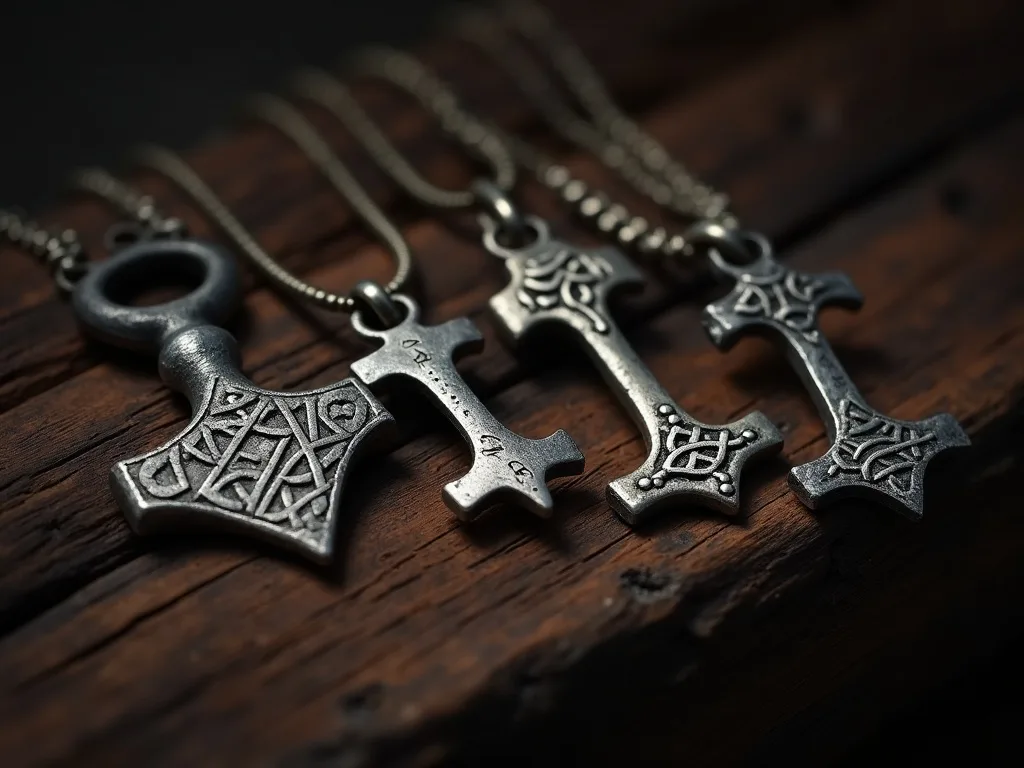
Hammer pendants recovered from Viking Age contexts range from simple iron rings to elaborately detailed silver pieces. The most celebrated single find is the Skane hammer, a silver pendant from Erikstorp in southern Sweden. It is double-headed and uses the same suspension loop design as contemporary cross pendants from the same region, which led archaeologists to conclude it was made in conscious parallel to Christian iconography, as a deliberate Norse counter-symbol during the conversion period.
One runestone from Virring in Denmark, dated to the late 10th century, invokes Thor with the phrase "may Thor hallow these runes." The verb used, vigi, is the same verb used in Christian blessing formulas of the same period. The hammer was not a casual emblem. It was a living sacramental tool in the hands of practitioners who took it as seriously as any priest took a cross or a bishop took his ring.
Odin's ravens, Huginn and Muninn watched the world from above while Mjolnir guarded it below. Together they form two poles of the Norse divine: the intellectual, far-ranging power of Odin and the physical, grounded protection of Thor. Most Norse households would have recognised both.
Thor Himself: Why the Hammer Defined the God
You cannot separate Mjolnir from Thor without losing both. The hammer was not just an accessory. It was the physical expression of everything Thor represented in Norse theology.
Thor was the son of Odin and the earth goddess Jord. He was immensely strong, sometimes portrayed as slow-witted but never cruel, always reliable. Where Odin was the god of kings, poets, and warriors willing to die, Thor was the god of farmers, sailors, and everyone who needed the world to keep working. His chariot, pulled by Tanngrisnir and Tanngnjóstr, rattled the sky and made thunder. His belt Megingjord doubled his already vast strength. His iron gloves Jarngripr let him grip Mjolnir's short handle firmly enough to throw it.
The enemies Thor fought with Mjolnir were not random. The giants, jotnar, represented the primordial chaotic forces that surrounded and threatened the ordered world. Every time Thor killed a giant, he was preserving the structure that allowed humans, gods, and animals to live. The hammer was not violence for its own sake. It was a boundary marker, the force that kept chaos on the other side of the fence.
This is why Mjolnir appears at weddings and funerals. At a wedding, the hammer blessed the beginning of a new household, a new ordered unit in the world. At a funeral, it marked the proper transition of the dead to whatever came next. Both events were moments when chaos could slip in, when the fabric of ordered life was stretched thin, and the hammer held the line.
Yggdrasil, the great world tree connecting all nine realms, held the cosmos together structurally. Mjolnir held it together dynamically, through the active force of a god who never stopped fighting.
Ragnarok: The Hammer's Final Use
The prophecy of Ragnarok, the end of the world described in the Voluspa (a poem from the Poetic Edda), gives Mjolnir its final scene.
At Ragnarok, the serpent Jormungandr, the Midgard Serpent who encircles the world ocean, will rise from the deep. Thor will face it. The two are fated enemies, with the prophecy recorded in the Prose Edda stating that during the final battle they will kill each other. Thor strikes the serpent dead with Mjolnir. Then he takes nine steps and falls from the venom flooding his body.
Nine is a sacred number throughout Norse cosmology, appearing in the nine realms, the nine nights Odin hung on Yggdrasil, and here in the nine final steps of Thor. The hammer kills the serpent. But the hammer cannot save its wielder.
After Ragnarok, the Voluspa suggests that some gods survive and the world is reborn. Two of Thor's sons, Modi and Magni, inherit Mjolnir. The hammer passes to the next generation, still capable of protecting a reborn world. Even at the end, it is not destroyed.
Mjolnir in Modern Revival: From Neo-Paganism to Pop Culture
The hammer did not stay buried with the Viking Age. It came back, in several directions at once.
Asatru, a modern revival of pre-Christian Norse religion formally recognised in Iceland in 1973 and now practiced in communities across Europe and North America, treats Mjolnir as a living sacred symbol. Practitioners wear hammer pendants for the same reasons their ancestors did: protection, connection to Thor, and identification with the Norse spiritual tradition. In 2013, the U.S. Department of Veterans Affairs approved the Mjolnir symbol for placement on military headstones, treating it as a legitimate religious emblem alongside the cross and the Star of David.
Popular culture has amplified the image while stripping most of its original meaning. Marvel Comics introduced a version of Thor in 1962, and the films that followed gave Mjolnir the famous "worthy" enchantment, which has no direct equivalent in the Eddas. In the original myths, the hammer's power is intrinsic, not morally gated. Anyone with the iron gloves and the belt could theoretically hold it. The "worthiness" concept is a modern invention, though it has become so pervasive that many people assume it comes from the original sources.
The archaeological record continues to grow. In 2014, a complete hammer pendant from Lolland in Denmark provided the first example with a runic inscription that explicitly named it as "Hammer of Hrungnir," a kenning for Mjolnir, confirming beyond any doubt that the hammer-pendant tradition was directly tied to Thor's weapon and not some generic protective symbol.
That inscription matters because it connects the physical object in a person's hand to the living stories the community told. The myths were not separate from daily life. They ran through the metal around your neck, the runes on the stone at the crossroads, and the blessing spoken over a new bride.
Frequently Asked Questions About Mjolnir
Frequently asked questions
Why is Mjolnir's handle so short?
According to the Prose Edda, the handle was shortened because Loki, transformed into a fly, bit the dwarf Brokkr on the eyelid during the forging process. Brokkr flinched and the bellows faltered momentarily, depriving the iron of heat at a critical stage. The result was a hammer perfect in every other quality but with a handle too short for two-handed use. Thor compensated with iron gloves (Jarngripr) and a strength-doubling belt (Megingjord).
What did Mjolnir represent beyond combat?
Mjolnir was a consecrating tool across all major life events. It blessed newborn children, it was placed in a bride's lap during wedding rites to ensure fertility and divine protection, and it hallowed the funeral pyre of the dead. The verb used in runic inscriptions for this blessing, vigi, is the same term used in Christian consecration texts of the same period, showing the hammer carried full sacramental weight in Norse religious practice.
Are Mjolnir amulets historically documented?
Yes. More than 98 hammer-shaped pendants have been found across Viking Age archaeological sites in Scandinavia, Britain, and the Baltic, dated primarily between 900 and 1100 AD. A particularly significant find from Lolland, Denmark, recovered in 2014, bears a runic inscription identifying it as a hammer amulet, confirming the direct connection between the pendants and Thor's weapon. Many amulets were cast in moulds that also produced Christian cross pendants, suggesting both traditions coexisted closely during the conversion period.
Did Thor actually use Mjolnir in battles with giants?
The Eddas record several battles. Thor's fight against Hrungnir the giant is among the most detailed, in which Hrungnir threw a whetstone that lodged in Thor's forehead while Thor killed the giant with Mjolnir. Thor also used the hammer in his constant war against the Midgard Serpent Jormungandr, whom he reportedly nearly pulled from the ocean during a fishing trip. At Ragnarok, the Voluspa states that Thor kills Jormungandr with the hammer before dying from the serpent's venom.
What is the connection between Mjolnir and the 'worthiness' concept from Marvel?
The worthiness enchantment, in which only a morally worthy person can lift Mjolnir, does not appear in the original Eddas. In the Norse sources, the hammer's inaccessibility comes from practical barriers: its short handle requires iron gloves to grip, and Thor's belt doubles the strength needed to wield it effectively. The moral-gating concept is a 20th-century invention by Marvel Comics, first introduced in 1962. The original sources suggest that the giant Magni was strong enough to lift a fallen Thor's leg, implying physical power rather than moral worth was the relevant criterion.
What happened to Mjolnir after Ragnarok?
According to the Voluspa and passages in the Prose Edda, Thor's sons Modi and Magni survive Ragnarok and inherit Mjolnir. The world is described as rising again from the sea, green and renewed, and the hammer passes into the hands of the next generation of gods. This detail suggests the hammer was understood as a permanent cosmic fixture, necessary for the protection of any living world, not just the one before the apocalypse.
The Hammer as Cosmic Boundary Marker
Strip the amulets, the Marvel films, and the runestones away, and what remains at the core of Mjolnir: Thor's Hammer and Symbol of Protection is a boundary marker between order and chaos.
Every cosmology needs a mechanism for holding chaos at bay. The Norse found theirs in a short-handled iron hammer thrown by a red-bearded god in a chariot pulled by magical goats. It is specific, physical, almost domestic in its details, and that is precisely why it worked as a symbol for centuries. Abstract forces do not protect your crops or bless your wedding. A god with a weapon that returns to his hand, who can be invoked by anyone with a pendant and a prayer, sits close enough to daily life to matter.
Scholars like Rudolf Simek, in his Dictionary of Northern Mythology, and John Lindow, in Norse Mythology: A Guide to Gods, Heroes, Rituals, and Beliefs, both note that Thor's popularity among common Norse people was likely higher than Odin's, precisely because Mjolnir's protective function was immediate and practical. Odin demanded sacrifice and offered wisdom and victory in battle. Thor offered protection of the household, the harvest, and the family. The hammer was the sign of that offer, made visible and wearable.
The Valkyries chose who died on the battlefield under Odin's direction. Thor's hammer decided who was safe from the forces that wanted to unmake the world entirely. Both functions were necessary. Neither was complete without the other.
That balance, between the selective death of the warrior and the broad protection of the living, is what made Norse cosmology coherent enough to carry a people through centuries of settlement, sea travel, and cultural contact with half the known world. The hammer did not just protect Thor. It protected the idea that the world was worth protecting.
Free 25-page sample
Want the whole story?
Take the first 25 pages free. If it pulls you in, the full edition is yours as an instant PDF download, with a paperback on Amazon for selected titles.
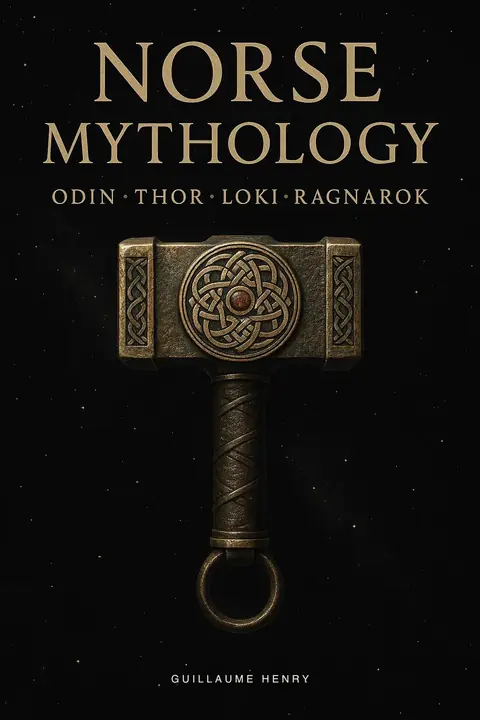
Norse
The Norse Mythology Book: Odin, Thor, Loki, Ragnarok and the Sagas of the Vikings
Odin, Thor, Loki, Ragnarok and the Sagas of the Vikings
The complete guide to Norse mythology drawn from the Eddas, the sagas, and the scholarship of those who read the source texts. Every god, every world, every myth.
More from Norse
All articles
Norse
The Valkyries: Choosers of the Slain
They ride through smoke and carnage, deciding who lives and who dies. The Valkyries are far stranger, older, and more powerful than any modern retelling suggests.
Norse
Fenrir: The Monstrous Wolf Destined to Kill Odin
Born of Loki and bound by the gods who feared him, Fenrir is Norse mythology's most terrifying wolf - the creature fated to swallow Odin at the end of the world.
Norse
Valhalla: Odin's Hall of the Slain Warriors
High in Asgard, Valhalla rises as a hall of gold and spear-shafts where half the battle-slain feast, train, and await Ragnarok. Here is what the Eddas actually say.
Norse
The Valkyries: Choosers of the Slain in Norse Mythology
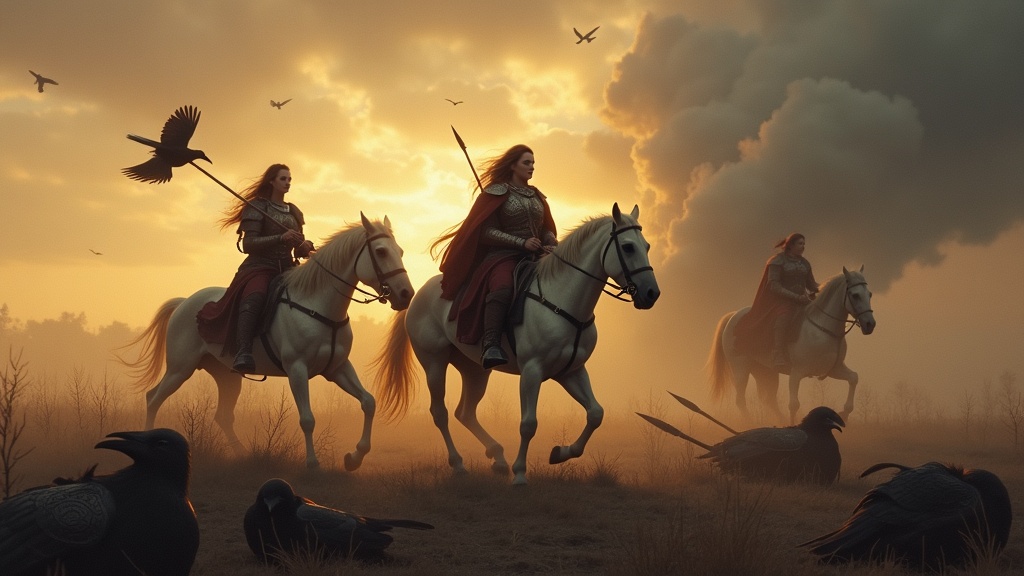
Armored, spear-bearing, and answerable only to Odin, the Valkyries rode into every battle to decide who lived and who fed the ravens. Here is the full story.