
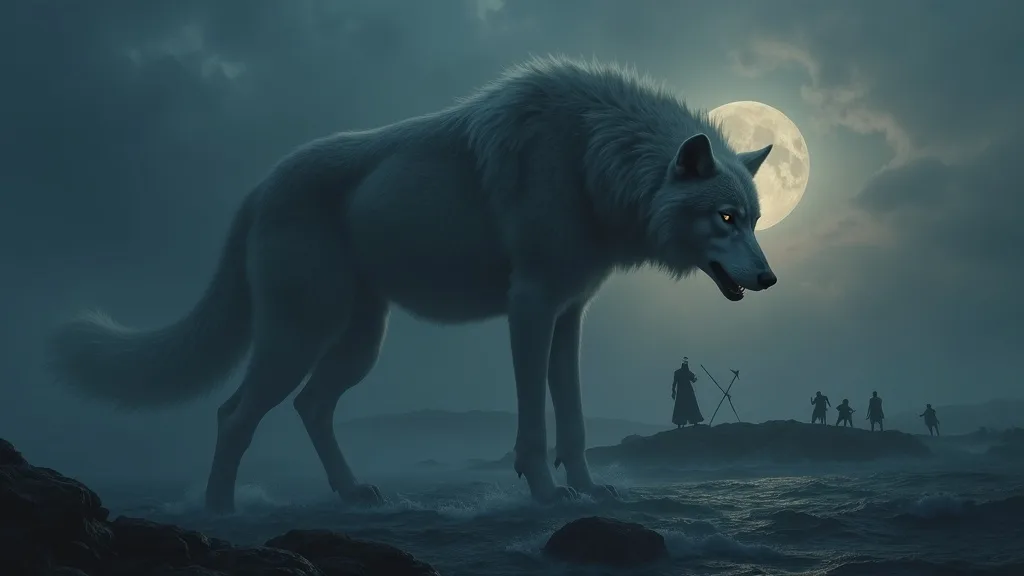
Fenrir: The Monstrous Wolf Destined to Kill Odin
Born of Loki and bound by the gods who feared him, Fenrir is Norse mythology's most terrifying wolf - the creature fated to swallow Odin at the end of the world.
Contents
The chain snapped. Then the second one broke too. The Aesir, the gods of Asgard, watched in silence as the wolf shook the iron links from his neck like a dog shaking off rainwater. He was still a pup.
That moment of failure is where the story of Fenrir: the monstrous wolf destined to kill Odin truly begins. Not with rage or battle, but with dread. The gods of the Norse cosmos were afraid of a young wolf, and that fear set in motion a chain of events that would only end at the end of the world.
Fenrir is no ordinary monster. He is a prophecy made flesh, a son betrayed by the very gods who were supposed to keep the peace, and a force of nature so immense that the cosmos itself must end before he can be stopped.
The Parentage of Fenrir: Child of Loki and the Giantess Angrboda
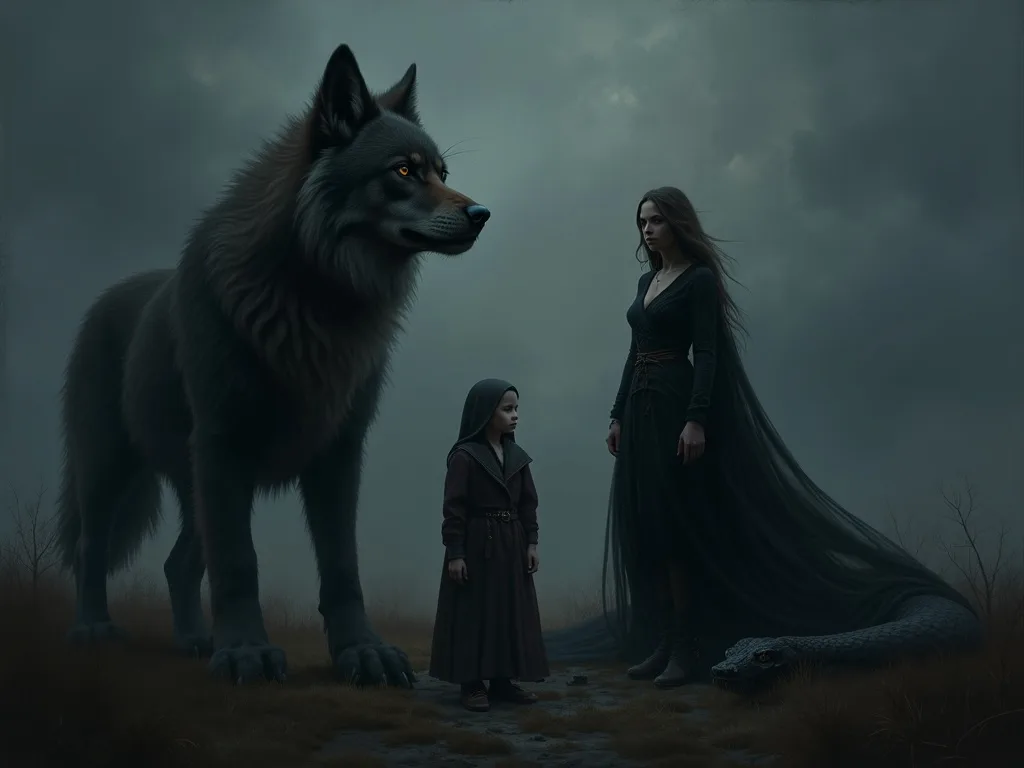
Fenrir was not born in Asgard. His mother was Angrboda, a giantess whose name means "she who brings grief" in Old Norse. His father was Loki, the trickster god whose loyalties were always split between the Aesir and the giants.
Angrboda bore Loki three children in the land of Jotunheim, the realm of giants. Fenrir was the eldest. His siblings were Jormungandr, the great sea serpent who encircles the world, and Hel, the ruler of the realm of the dead who shares her name with her domain.
Three children, three catastrophes. The Aesir learned through prophecy, delivered by seers called volur (singular volva), that each of Loki's three offspring would play a central role in the destruction of the gods. Snorri Sturluson writes in the Prose Edda that Odin himself ordered the children brought to Asgard when they were still young, so that the gods could deal with them before the prophecies came true.
Hel was cast down into the land of the dead to rule it. Jormungandr was thrown into the ocean that circles Midgard, the world of humans. And Fenrir, the wolf, was kept among the gods.
That last decision proved hardest to manage.
Growing Too Large: Why the Gods Could Not Simply Kill Fenrir
Here is the first paradox at the heart of the myth. The Aesir brought Fenrir to Asgard because they feared him. But once he was there, only one god, Tyr, the god of law and justice, was brave enough to feed him. Fenrir grew fast. Alarming fast. Snorri notes that the gods watched his size increase and realized the prophecies were not abstractions. This wolf would eventually be large enough to swallow the sky.
So why not kill him? The Prose Edda is clear: the gods considered themselves bound by the sacred laws of sanctuary. They had invited Fenrir into their halls. Killing him there would have been a violation of griðr, the Old Norse concept of sacred truce and protection. To murder a guest, even a monstrous one, was the deepest dishonor the Norse moral code recognized.
They needed another way.
They tried iron chains first. The Prose Edda describes two attempts. The first chain was called Laeding. The gods brought it to Fenrir and suggested, almost casually, that he try his strength against it. The wolf measured the chain with his eyes, decided it was no great challenge, and let them bind him. He flexed once. Laeding shattered.
They returned with a second chain, Dromi, far heavier than the first. Fenrir agreed to try again, reasoning that breaking stronger fetters would only add to his fame. He struggled, thrashed, slammed the chain against the ground, and Dromi broke into pieces too.
Fame and strength. The wolf was proud of his power, and that pride became the lever the gods would eventually use against him.
The Ribbon That Held the Wolf: Gleipnir and the Sacrifice of Tyr
The gods sent a messenger to Svartalfheim, the realm of the dwarves. These were the master craftsmen of the Norse cosmos, the same beings who forged Thor's hammer Mjolnir and Odin's spear Gungnir. The dwarves produced a binding called Gleipnir, a word that roughly translates from Old Norse as "the open one" or "the deceiver."
Gleipnir looked like a length of smooth silk ribbon. It was almost weightless. But the Prose Edda explains what went into its making: the sound of a cat's footstep, the beard of a woman, the roots of a mountain, the sinews of a bear, the breath of a fish, the spittle of a bird. Six impossible things, all real in the Norse cosmos, all combined into something that could not be broken because it was made of things that do not exist in the way iron exists.
This is one of the most quietly strange details in Norse mythology. The gods did not overcome the wolf with brute force. They overcame him with the principle that what has no conventional existence cannot be conventionally destroyed.
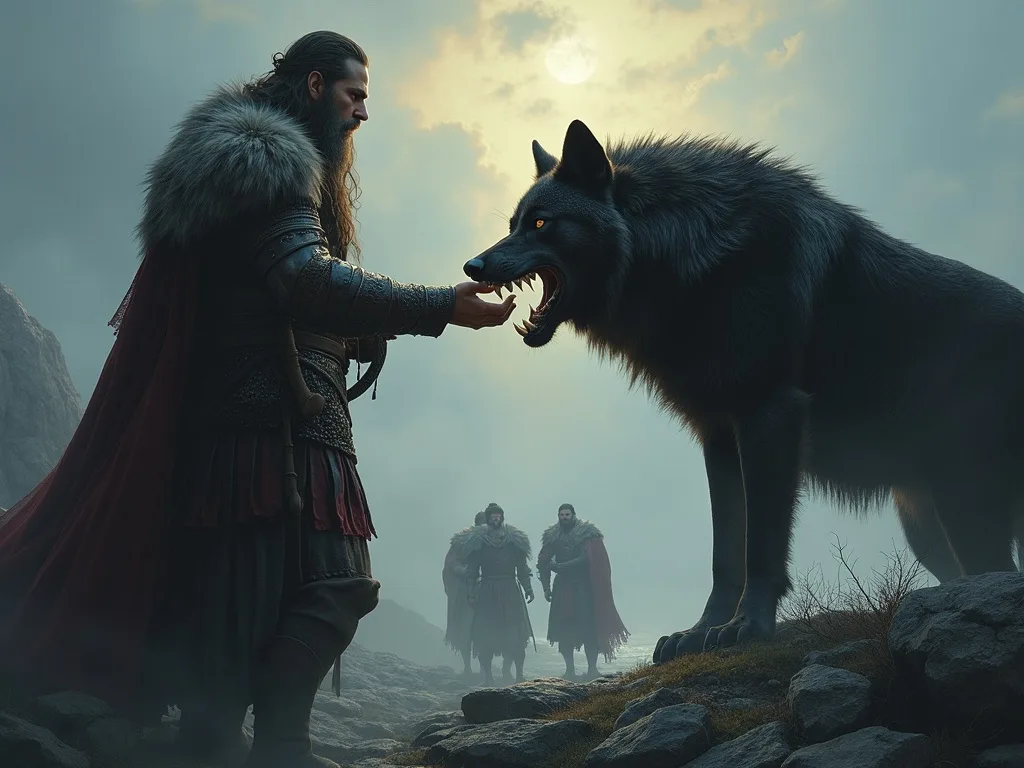
Fenrir, however, was not stupid. When the gods brought the silk ribbon to the island of Lyngvi, in the lake called Amsvartnir, and suggested he test this new binding, the wolf immediately grew suspicious. It looked too slight. He said he would only agree to be bound if one of the gods put a hand in his mouth as a pledge of good faith. If they could not free him from the ribbon, that god would lose the hand.
Only Tyr volunteered. The god of justice placed his right hand between Fenrir's jaws.
The gods bound the wolf with Gleipnir. Fenrir strained with every muscle he had. The ribbon held. The more he pulled, the tighter it became. He was caught.
He looked at Tyr. Tyr did not move to free him. The pledge had been a deception.
Fenrir bit off Tyr's hand at the wrist.
This act carries enormous symbolic weight. Tyr, the god whose domain was law, justice, and honorable oaths, broke an oath to bind Fenrir. He sacrificed his sword hand, the hand that held weapons and swore vows, for the safety of the cosmos. The wolf gained his vengeance. The god gained his wound. Neither outcome cancels the other out. That moral ambiguity is very deliberately built into the story.
The gods then took a cord from Gleipnir, passed it through a large boulder called Gjoll, and tethered that boulder to another called Thviti, anchoring it deep in the earth. They forced a sword vertically into Fenrir's mouth to keep it open. There he lay, the Prose Edda says, until Ragnarok.
A river of drool flowed from his open jaws and became a river called Von, meaning "hope" in Old Norse. The name is grim irony: hope flowing from the mouth of the beast who will end everything.
Fenrir and Odin: The Shape of a Prophecy
Odin knew what was coming. The Poetic Edda, particularly the poem Voluspa ("the Seer's Prophecy"), makes this plain. A volva raised from the dead by Odin's magic recites the sequence of Ragnarok for him, and Fenrir's role is among the most vivid passages in the poem.
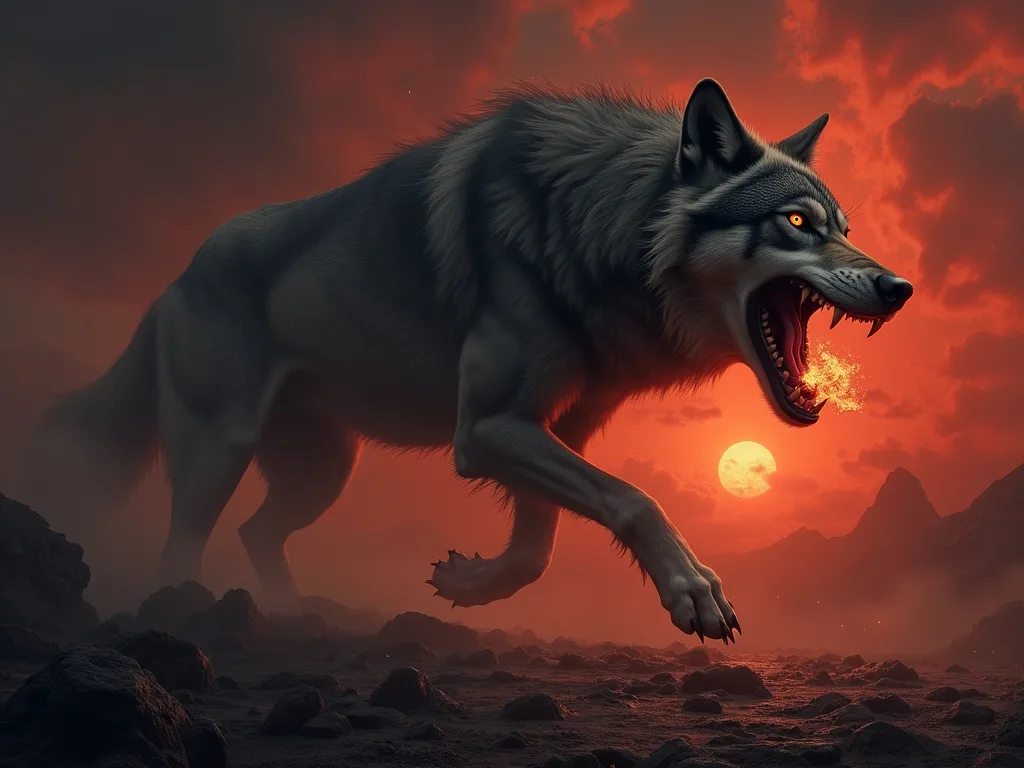
The wolf would break free. The Voluspa describes Fenrir running with his mouth open so wide that his upper jaw touches the sky and his lower jaw scrapes the earth. Given more room, he would open wider still. Fire pours from his eyes and nostrils. He runs toward Asgard as part of the combined assault that brings down the cosmos.
Odin himself rides out to face Fenrir. The Prose Edda confirms what the Voluspa implies: the wolf destined to kill Odin swallows the Allfather whole. No combat. No heroic last stand. The king of the gods is simply consumed.
The vengeance that closes this loop is carried out not by Odin, but by his son Vidar, one of the few gods who survives Ragnarok. The Prose Edda tells us that Vidar wears a special shoe, built up over centuries from the scraps of leather that cobblers trim from the heels and toes of shoes. He places that armored foot in Fenrir's lower jaw, takes the wolf's upper jaw in one hand, and tears the wolf's mouth apart. Other sources suggest he drives a sword through the wolf's palate. Either way, Fenrir dies at Ragnarok, but only after he has already swallowed the god he was always going to swallow.
This is Ragnarok in its purest form: events that cannot be stopped, only met with dignity.
The Symbolism Behind the Wolf: Fear, Chaos, and the Limits of Power
Scholars of Norse mythology have read Fenrir through several lenses, and each one reveals something genuine about how the myth functions.
Fenrir as cosmic chaos. Many researchers, including John Lindow in his 2001 reference work Norse Mythology: A Guide to Gods, Heroes, Rituals, and Beliefs, place Fenrir within a cluster of figures that represent the forces outside the ordered cosmos. Jormungandr encircles and contains the world. Hel rules the boundary between life and death. Fenrir is pure, directed destruction, entropy with teeth. Together, Loki's three children form a triad of cosmic instability that the Aesir can restrain for an age but cannot neutralize permanently.
Fenrir as the product of divine fear. There is an uncomfortable reading of the myth, and it is hard to argue against. The Aesir's treatment of Fenrir is not just: they imprisoned him because of what a prophecy said he would do, not because of anything he had done. Tyr broke sacred law to accomplish it. From Fenrir's perspective, the gods of law and order acted unlawfully. The wolf's eventual destruction of Odin can be read as the cosmos correcting an injustice, as much as it can be read as apocalypse.
The wolf in Norse culture more broadly. Wolves occupied a charged position in the Norse imaginative world. Odin himself kept two wolves, Geri and Freki, who ate from his plate at Valhalla. Warriors called ulfhednar (wolf-coats) wore wolf skins in battle and were thought to channel lupine ferocity. Yet wolves also haunted the edges of settled land, killed livestock, and embodied wilderness beyond human control. Fenrir is that ambivalence made mythological: the wolf that even the god of wolves cannot tame.
The wolf-giant connection. Fenrir is also the ancestor of two other wolves who figure in Norse cosmic time. The Prose Edda says that the wolf who chases the sun, Skoll, and the wolf who chases the moon, Hati Hrodvitnisson, are both descended from Fenrir. Hrodvitnisson means "son of Hrodvitnir," and Hrodvitnir is another name for Fenrir himself. At Ragnarok, Skoll and Hati finally catch the sun and moon and swallow them, darkening the sky. Even Fenrir's lineage participates in the end.
Fenrir Across the Eddas: How the Sources Differ
The two main sources for Fenrir's story agree on the broad sequence but differ in detail, and those differences matter for understanding the myth.
Prose Edda (Snorri Sturluson, c. 1220)
Snorri gives a full prose narrative of Gleipnir's forging, the binding on Lyngvi, and Tyr's hand. He names the two broken chains, names the boulders, names the river of drool. His account is detailed, almost novelistic, and was written as a handbook for poets. He explicitly states that Fenrir swallows Odin whole at Ragnarok, and that Vidar kills the wolf in vengeance.
Poetic Edda (Codex Regius, c. 1270)
The Poetic Edda, especially the Voluspa, presents Fenrir through visionary, fragmented verse. It focuses on the imagery of the wolf's open jaws, the broken binding, the running toward Asgard, with less narrative scaffolding. The Grimnismal poem names Geri and Freki (Odin's wolves) but connects them to Fenrir's broader wolf-family. The Lokasenna, a flyting poem in which Loki trades insults with the gods, confirms his parentage of Fenrir without expanding on it.
Scholars debate whether Snorri was preserving older oral tradition faithfully or reworking it for his Christian-era Icelandic audience. He was writing in a society that had been Christian for roughly two hundred years, and some researchers suggest he imposed a more linear, causal narrative on what were originally more mythologically ambiguous fragments. Still, the core elements of the myth, the binding, the oath, the hand, the prophecy, appear consistent across the textual record.
Fenrir in Modern Imagination: From Tolkien to Video Games
Fenrir's influence on modern culture has been deep and often unacknowledged. J.R.R. Tolkien, who was a professor of Old English and deeply read in the Norse sources, drew on the wolf-chaos archetype for creatures like Carcharoth in The Silmarillion, a wolf that bites off the hand of the hero Beren much as Fenrir bites off Tyr's. Tolkien was also the scholar who produced one of the most serious early twentieth-century academic discussions of the Beowulf poem, another Germanic text in which wolves and cosmic destruction intertwine.
In video games, Fenrir appears in the God of War franchise as a companion and tragic figure in God of War: Ragnarok (2022), where the developers took significant creative liberties while preserving the emotional core of the original myth. The Final Fantasy series has used Fenrir repeatedly as a powerful wolf summon or boss. Marvel Comics adapted Fenrir into the Asgardian narrative alongside Thor.
What persists across all these adaptations is the essential structure: an immense wolf, a binding that cannot hold forever, and a fate that cannot be avoided. That structure is so clean it almost writes itself.
Loki, the father who gave Fenrir life, remains the most enigmatic thread in this story. Loki was punished by the gods after Ragnarok's preliminary events too, bound to a rock with serpent venom dripping onto him until the end. Father and son, both chained, both waiting for the same day of release. The parallel is not accidental.
Frequently Asked Questions About Fenrir and Norse Mythology
Frequently asked questions
What is Fenrir's role at Ragnarok according to the original Norse sources?
According to both the Prose Edda and the Poetic Edda, Fenrir breaks free from his binding, Gleipnir, when Ragnarok begins. He runs with his jaws opened so wide they span from earth to sky, belching fire, and eventually swallows Odin whole. Odin's son Vidar then kills the wolf by tearing his jaws apart or stabbing him through the palate, depending on the source.
Why did the Norse gods use deception to bind Fenrir instead of simply killing him?
The gods were bound by griðr, the sacred law of guest-protection. Since they had invited Fenrir to live among them in Asgard, killing him outright would have violated their own code of honor. They also feared the religious consequences of such a breach. So they chose deception: the silk-like ribbon Gleipnir and the false pledge that Tyr held out as good faith. Tyr lost his hand when the deception was revealed, and the cost was considered acceptable to most of the Aesir.
Who are Fenrir's siblings, and what happens to them at Ragnarok?
Fenrir's siblings are Jormungandr, the world-encircling sea serpent, and Hel, the ruler of the Norse land of the dead. At Ragnarok, Jormungandr emerges from the ocean and battles Thor, who kills the serpent but then walks nine steps and dies from its venom. Hel's realm sends its dead to join the battle. All three of Loki's children by the giantess Angrboda contribute to the fall of the gods.
What are the primary written sources for the myth of Fenrir?
The main sources are the Prose Edda, written by Snorri Sturluson in Iceland around 1220 AD, and the Poetic Edda, a collection of Old Norse poems preserved in the Codex Regius manuscript dating to around 1270 AD. Within the Poetic Edda, the Voluspa ("The Seer's Prophecy") gives the most vivid account of Fenrir at Ragnarok. The Lokasenna and Grimnismal poems add supplementary details about Fenrir's family and wolf-lineage.
Is there a cross-cultural parallel to Fenrir in other mythologies?
Several scholars have noted structural parallels with other chained, world-ending creatures. The ancient Mesopotamian sea-monster Tiamat, slain by the god Marduk at the world's creation, shares the theme of chaos-as-beast that must be defeated before order can persist. Closer to the Norse world, the Old English poem Beowulf features Grendel's wolf-like qualities and a creature that exists outside the law. Within Norse tradition itself, Fenrir connects to the broader Indo-European mythological pattern of a monstrous canid associated with cosmic dissolution, seen in fragments from Vedic sources involving dogs of death called Sarameya.
Does Fenrir represent evil in the same way that Satan represents evil in Christian theology?
This comparison is frequently made but is mostly misleading. Fenrir is not a moral agent of temptation or sin. He is a force of destiny, born into a role he did not choose, treated unjustly by the gods who imprisoned him, and carrying out a fate that was written before his birth. The Norse cosmos does not map neatly onto Christian moral categories. Odin, the "good" god whom Fenrir kills, practiced sorcery, broke oaths, and orchestrated wars for his own purposes. The myth resists a simple reading of hero versus villain.
The Wound That Odin Accepted: Fate as a Norse Virtue
One of the strangest things about the prophecy of Fenrir is that Odin never tried to prevent it. He gathered information compulsively, consulting seers, hanging on the world tree Yggdrasil for nine days to gain the runes, sacrificing his eye at Mimir's Well for a single drink of cosmic knowledge. He knew what Fenrir would do.
He prepared Vidar to avenge him. He built Valhalla and filled it with the warrior dead, training an army called the Einherjar for the final battle. But he did not try to change the outcome.
That acceptance is not fatalism in the passive sense. It is closer to the Norse concept of wyrd, the Old English word for fate, borrowed from a root meaning "what turns" or "what comes around." The world turns. The wolf gets loose. You ride out to meet it.
The Voluspa ends, famously, not with darkness but with something rising: a new earth lifting from the sea after Ragnarok, green and fertile. Some gods survive, including Vidar. The poem implies renewal. Fenrir's role in the destruction is also, indirectly, a role in what comes after. The wolf swallows the old cosmos whole, and something new grows from that ending.
Chaos and order, bound and unbound, oath and betrayal, wolf and god. The myth of Fenrir does not resolve these tensions. It holds them open, the way the sword holds the wolf's mouth open, waiting for the moment the shape of the world finally changes.
Free 25-page sample
Want the whole story?
Take the first 25 pages free. If it pulls you in, the full edition is yours as an instant PDF download, with a paperback on Amazon for selected titles.
Norse
The Norse Mythology Book: Odin, Thor, Loki, Ragnarok and the Sagas of the Vikings
Odin, Thor, Loki, Ragnarok and the Sagas of the Vikings
The complete guide to Norse mythology drawn from the Eddas, the sagas, and the scholarship of those who read the source texts. Every god, every world, every myth.
More from Norse
All articles
Norse
The Valkyries: Choosers of the Slain
They ride through smoke and carnage, deciding who lives and who dies. The Valkyries are far stranger, older, and more powerful than any modern retelling suggests.
Norse
Mjolnir: Thor's Hammer and Symbol of Protection
Mjolnir was not just a weapon. Forged by dwarf smiths and carried by the thundergod Thor, it guarded gods, humans, and the living world against the chaos of giants. Here is its full story.
Norse
Valhalla: Odin's Hall of the Slain Warriors
High in Asgard, Valhalla rises as a hall of gold and spear-shafts where half the battle-slain feast, train, and await Ragnarok. Here is what the Eddas actually say.
Norse
The Valkyries: Choosers of the Slain in Norse Mythology
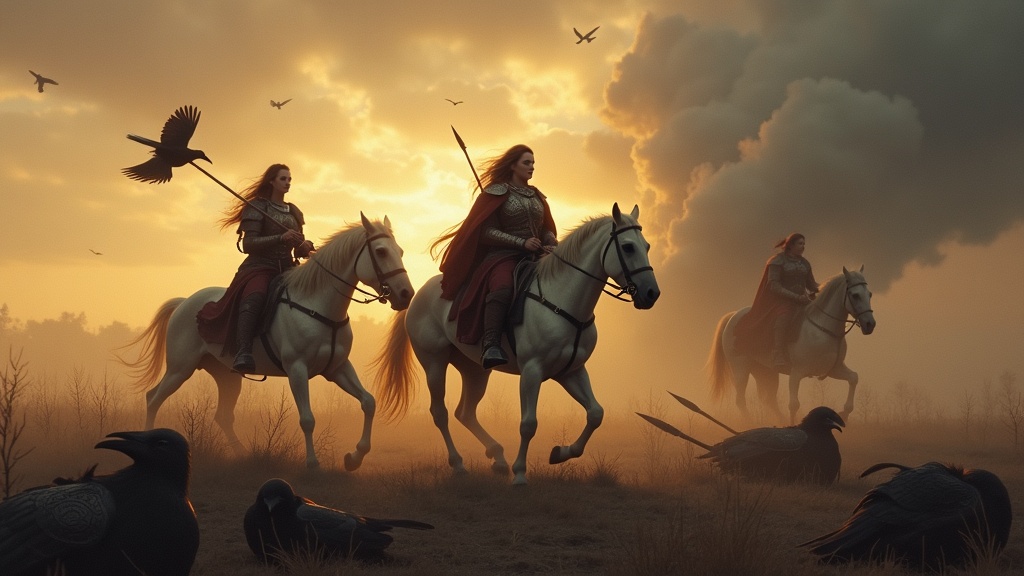
Armored, spear-bearing, and answerable only to Odin, the Valkyries rode into every battle to decide who lived and who fed the ravens. Here is the full story.