
Valhalla: Odin's Hall of the Slain Warriors
High in Asgard, Valhalla rises as a hall of gold and spear-shafts where half the battle-slain feast, train, and await Ragnarok. Here is what the Eddas actually say.
Contents
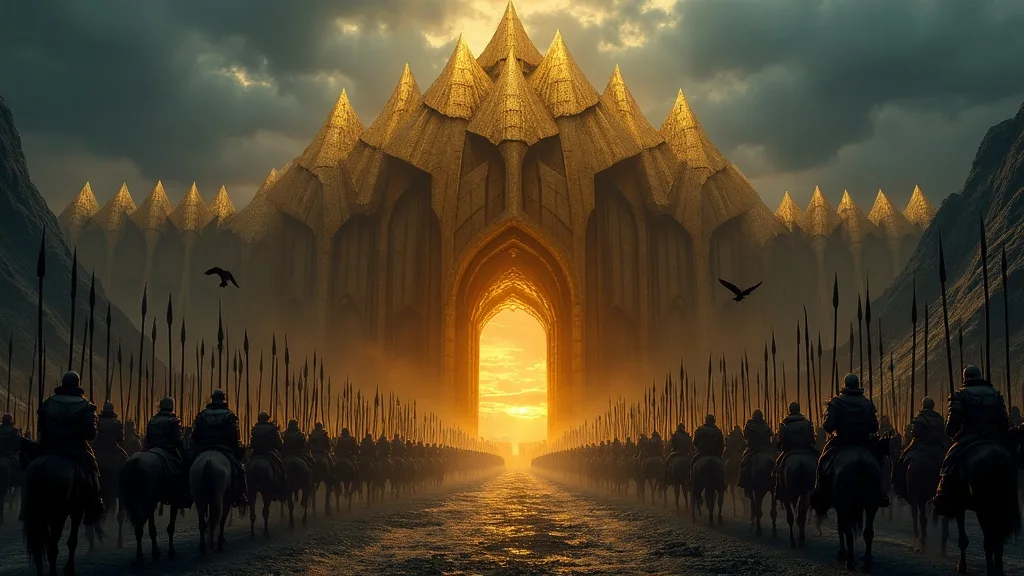
The doors of Valhalla open wide enough for hundreds of warriors to ride through shoulder-to-shoulder. At least, that is what the Grímnismál, one of the oldest poems in the Old Norse Poetic Edda, claims: five hundred and forty doors, each wide enough for eight hundred men to march abreast into battle on the last day. The hall itself has a roof tiled with polished shields, walls constructed from great spear-shafts, and benches draped in chain mail. It is less a paradise than a training ground, and the god who built it had one thing in mind: the final war.
Odin's hall of the slain warriors sits at the apex of Norse cosmology, both literally and spiritually. Odin, called the Allfather, chose half of every battlefield's dead not as a reward for valor but as a practical need. He knew Ragnarok was coming. He knew the worlds would burn. So he collected the best fighters history could produce, fed them, healed them, and made them fight again every single day until they were sharp enough to hold the line at the end of everything.
That tension, between celebration and preparation, between honor and utility, is what makes Valhalla one of the most original afterlife concepts any culture has ever produced.
Where Valhalla Stands in the Nine Worlds
Norse cosmology arranges existence into nine worlds stacked around Yggdrasil, the cosmic ash tree whose branches touch the sky and whose roots reach into the realm of the dead. Asgard, home of the Aesir gods, sits at the top of this structure. Valhalla stands within Asgard, in a region called Glaðsheimr, meaning "the bright home" or "the shining world."
The hall's proper Norse name is Valhöll. It breaks into two parts: valr, meaning "the slain on a battlefield," and höll, meaning "hall." So the name translates directly: Hall of the Slain. Not hall of heroes. Not hall of the brave. Specifically, of those who died in combat.
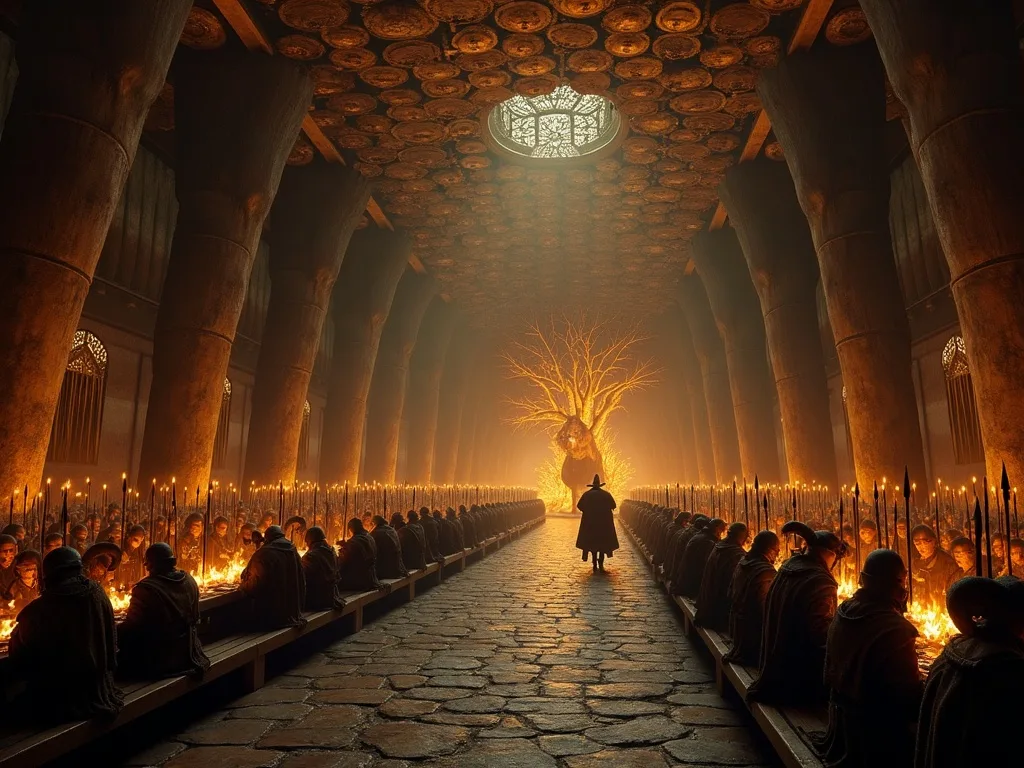
Snorri Sturluson, the 13th-century Icelandic scholar who compiled the Prose Edda, describes Valhalla as the greatest of all buildings. Its rafters are made of spear-shafts. The roof is made of interlocked shields. Wolves lie outside the western door. Eagles circle overhead. The tree Læraðr grows beside it, and from its branches a goat named Heiðrún grazes. Her milk fills a great vat every day with enough mead to keep the einherjar, Odin's chosen warriors, drunk and content every evening.
A stag called Eikþyrnir also grazes on Læraðr. Water drips from its antlers into the spring below, feeding the rivers of all the worlds. Even the hall's livestock is cosmic in scale.
The Einherjar: Odin's Army of the Dead
The men who fill Valhalla's benches are called the einherjar (singular: einheri). The word likely means "those who fight alone" or possibly "those who have fought once," though scholars debate the exact etymology. What the sources agree on is their function: they are Odin's private force, gathered from the battlefields of the mortal world called Midgard.
Every day, the einherjar wake before dawn, take up their weapons, and ride out to the great field of Vígríðr, described in the Vafþrúðnismál as the plain where gods and giants will clash at Ragnarok. There they fight without mercy. Men are cleaved apart, bones broken, limbs severed. Then, at midday, they are made whole again. They ride back to Valhalla, wash off the blood, and sit down to eat.
The feast is remarkable. A boar named Sæhrímnir is slaughtered every evening, cooked in a great cauldron, and eaten by the entire hall. Every morning, Sæhrímnir is alive again. Snorri records this in the Gylfaginning section of the Prose Edda, noting that no matter how many warriors crowd Valhalla's benches, the boar is always enough.
The cook, a giant named Andhrímnir, tends the cauldron Eldhrímnir. These are not figures who appear in many other sources, but their names carry a consistent theme: hrím relates to rime and cold, and relates to breath. Even the kitchenware of Valhalla holds a mythic charge.
The Valkyries: Who Chooses the Slain
No warrior walks into Valhalla on his own merit. He must be chosen. The choosers are the Valkyrjur, the Valkyries, whose name means exactly that: "choosers of the slain" (valr again, plus kjósa, "to choose").
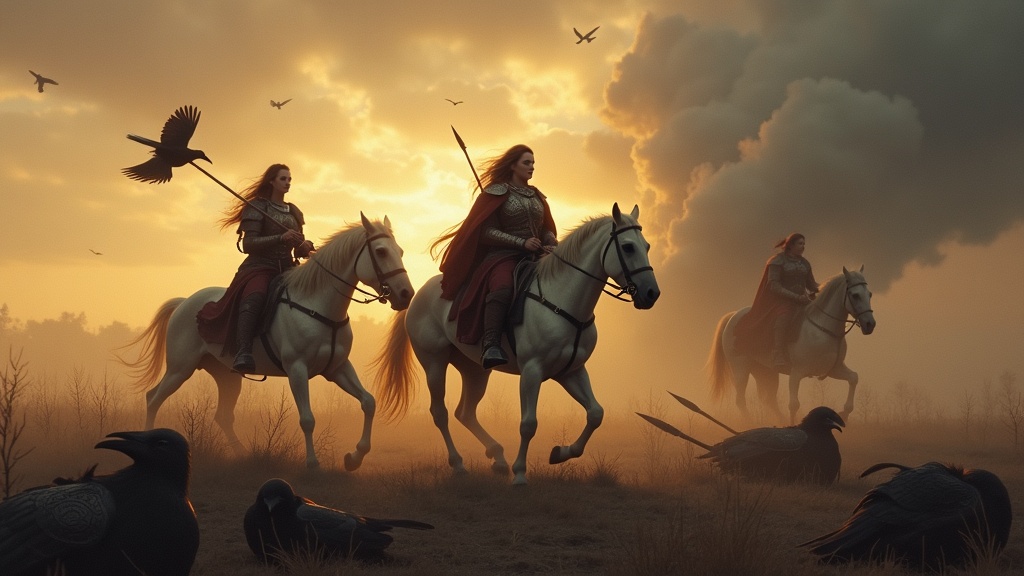
The Valkyries ride over battlefields while the fighting is still live. They decide who dies and who survives. The Völuspá, the first and most cosmic poem in the Poetic Edda, mentions them riding through the air as Odin's women of war, their armor splashed red. Snorri says they serve Odin, bring mead to the einherjar in Valhalla, and are described as both terrifying battle-spirits and as cup-bearers at the feast.
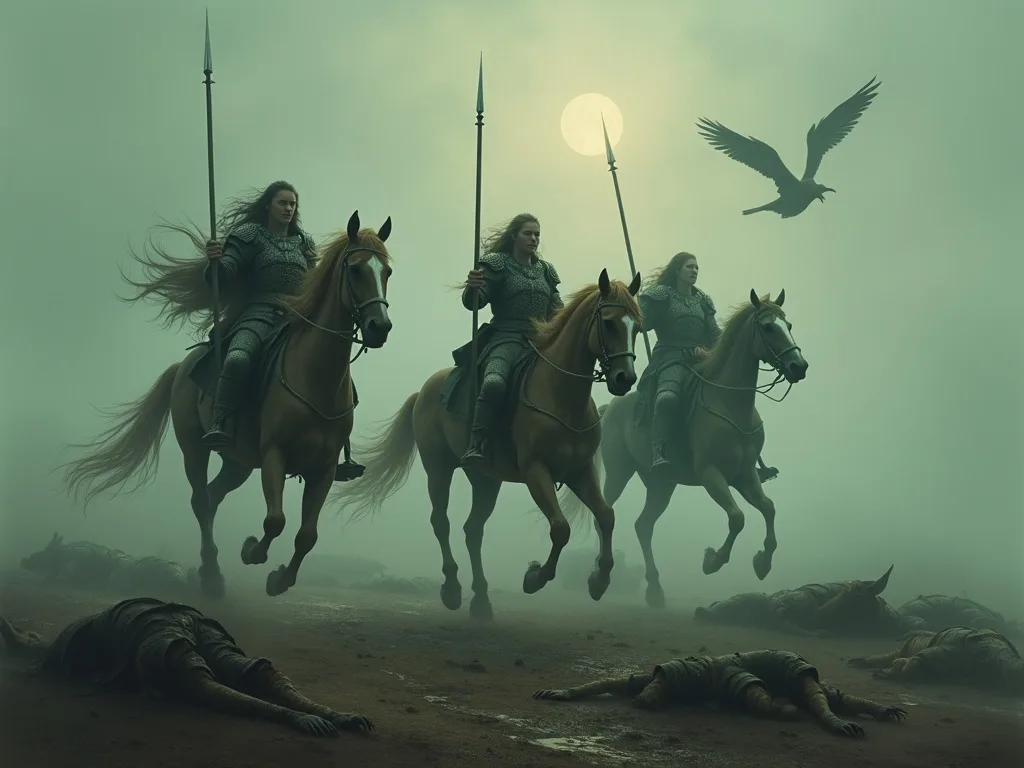
Names like Brynhildr ("battle-armor"), Göndul ("wand-wielder"), Hlökk ("noise of battle"), and Skuld ("that which shall be") suggest a range of functions. Some Valkyries in later Norse literary tradition, such as Brynhildr in the Völsunga saga, become fully human women with complex destinies. But in the older Eddic poems, they are closer to supernatural agents of fate, almost indistinguishable from the Nornir, the weavers of destiny.
One crucial point: Odin does not take all the slain. Freyja, the Vanir goddess, takes the other half. Her field, Fólkvangr, receives as many warriors as Valhalla does. The Grímnismál is explicit about this. Freyja chooses first, in fact. This detail is often overlooked in popular retellings, but it is there in the oldest sources.
What the Warriors Eat and Drink Each Night
The mead that fills Valhalla's cups is unlike anything brewed in the human world. It comes from Heiðrún, the goat who eats leaves from Læraðr. Snorri says her milk becomes mead directly, and flows in such quantities that a great vat is filled each day. The einherjar can drink without limit. There is no shortage, no morning-after, no weakening. They wake renewed and ready to fight.
This mead carries echoes of the broader Norse concept of sacred drink. The mead of poetry, Óðrœrir, which Odin stole from the giants, also bestows extraordinary gifts on those who drink it. Mead in Norse thought was not simply an alcoholic drink. It was a bridge between ordinary consciousness and the divine.
The roasted boar Sæhrímnir and the eternal mead together form a picture of a hall that operates outside normal scarcity. Nothing runs out. Nothing decays. The only rule is that the feast ends when dawn comes, and the spears must be lifted again.
Valhalla Versus Hel: Two Destinations for the Norse Dead
A common misreading of Norse mythology places Valhalla as the good afterlife, the reward, and Hel as the punishment. The original sources are more nuanced.
Valhalla
Valhalla receives only those who die in battle, chosen by Odin's Valkyries. The einherjar feast, fight, and prepare for Ragnarok. Entry depends entirely on the manner of death, not on how a person lived. Even a dishonorable man killed by a sword might qualify.
Hel
Hel, ruled by the goddess of the same name, receives those who die of illness, old age, or accident. It is not a realm of torture. Snorri describes it as dim and grey, a place of waiting. The Völuspá mentions it as one destination among many. The morally corrupt go to Náströnd, a beach of corpses within Hel, but ordinary death simply leads to a quiet and colorless continuation.
The warrior who dies in bed of a fever does not enter Valhalla, no matter how many battles he won in life. The einherjar are defined by the moment and manner of death, not by a moral ledger. This made Valhalla a destination specifically bound to a warrior culture, not a universal promise.
Other possible destinations for the Norse dead include Fólkvangr under Freyja, Rán's hall at the bottom of the sea for those who drowned, and Gimlé, a hall described in the Völuspá as surviving Ragnarok and welcoming the righteous into the new world that follows.
Ragnarok and the Purpose Behind the Feast
Everything in Valhalla points toward a single event: Ragnarök, the "fate of the powers," when the gods die and the worlds burn. Odin knows it is coming. The Völuspá, a seeress speaking to Odin himself, describes the signs: a winter lasting three years, the sun going dark, Fenrir breaking his chains, the Midgard Serpent rising from the sea.
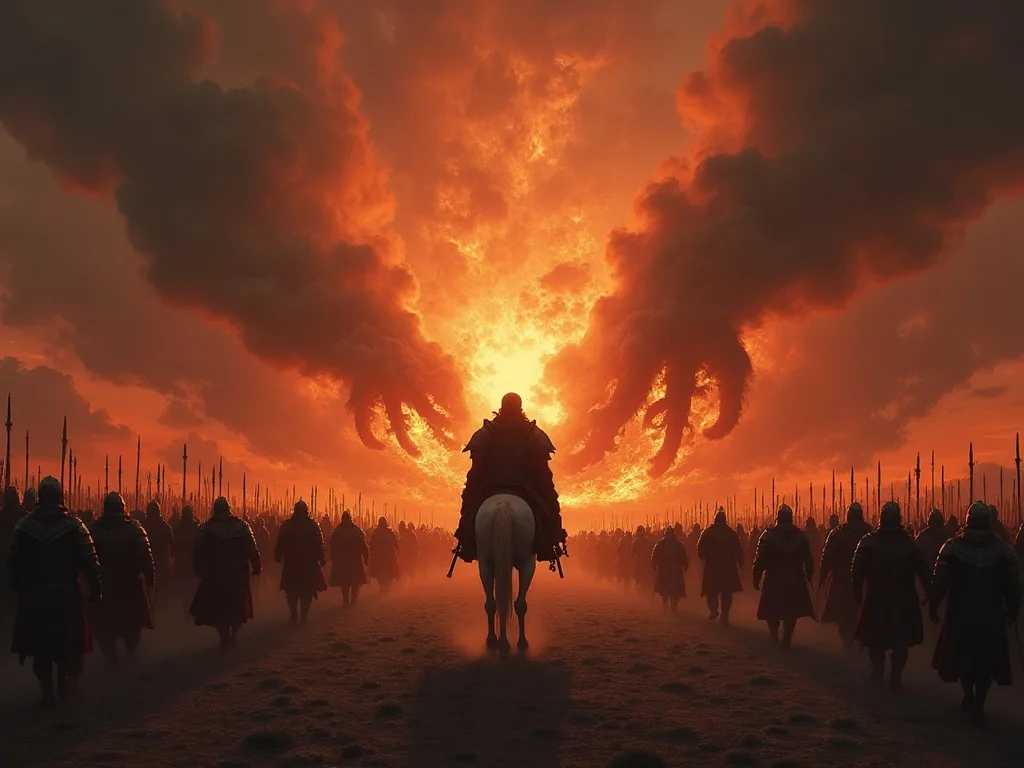
On that day, the einherjar pour out of Valhalla's five hundred and forty doors. The army that Odin has been building since the first battle was ever fought marches onto Vígríðr. They fight beside the Aesir. They fight the giants, the children of Loki, the forces of Múspellsheim. By the poem's account, they lose. Odin is swallowed by Fenrir. Thor kills the Midgard Serpent and falls to its venom. Tyr and the hound Garmr slay each other.
The einherjar are not there to win. They are there to make the last stand worthy of the gods who gathered them. Valhalla, then, is not a reward. It is a staging point for a final, glorious, and pre-ordained defeat.
That reading transforms the hall entirely. Every cup of mead is a cup before the last charge. Every dawn is a rehearsal. And Odin, watching his dead warriors train in the fields of Vígríðr, knows he is assembling something that will not be enough, but must be attempted anyway.
Valhalla in the Skaldic Tradition and Later Norse Literature
The Poetic Edda gives us Valhalla through visionary and mythological lenses. The skaldic poets, court poets of Viking Age Scandinavia who composed densely allusive verse in honor of living kings, treated Valhalla differently. For them it was both a poetic convention and a real destination their patrons might eventually enter.
The Hákonarmál, composed by the skald Eyvindr Finnsson around 960 AD to commemorate King Hákon the Good of Norway, describes the king being welcomed into Valhalla after his death at the Battle of Fitjar. Two Valkyries, Göndul and Skögul, choose him on the field. He arrives at the hall to be greeted by dead kings and warriors who have been waiting. It is one of the most vivid early depictions of Valhalla as an actual destination rather than a mythological construct.
The Eiríksmál, composed for the Norwegian king Eirik Bloodaxe after his death at the Battle of Stainmore in 954, similarly shows Odin restless in Valhalla, woken by dreams and calling for the hall to be prepared for a great arrival. These texts show that Valhalla was not merely theological scenery. It was woven into the political and memorial culture of real Viking-Age courts.
Valhalla's Shape in Archaeology and Visual Culture
Direct archaeological evidence for Norse beliefs about Valhalla is hard to pin down, but several finds offer intriguing windows into how these ideas materialized in objects and images.
The gold foil figures called guldgubbar, tiny pressed plaques found at Scandinavian sites like Sorte Muld on the Danish island of Bornholm, show paired male and female figures that some scholars interpret as ritual images connected to divine halls. Migration-period bracteates, thin gold discs worn as amulets, sometimes show a figure on horseback above a prone figure, read by some researchers as a Valkyrie above a slain man.
The Oseberg ship burial, excavated in Norway in 1904, contained not only the remains of two high-status women but also tapestry fragments showing processions of figures with weapons and what appear to be Valkyries or divine women carrying horns. The ship itself, like many Viking burial vessels, may have carried the deceased symbolically toward the realm of the gods.
No runic inscription reads "this man went to Valhalla." But the material culture around warrior death in Scandinavia consistently points toward a belief in a meaningful, active afterlife for those killed in battle.
Valhalla in the Modern Imagination
The 19th century remade Valhalla into something grander and more romantic than the Eddas ever intended. Richard Wagner's opera cycle Der Ring des Nibelungen, premiered between 1869 and 1876, placed Valhalla at the center of a cosmic drama about power, love, and destruction. His Valhalla is a fortress built by giants, purchased with treachery, and ultimately consumed by fire. It is Wagner's creation as much as Odin's.
In the 20th and 21st centuries, Valhalla became a cultural shorthand for any glorious warrior afterlife, detached from its specific Norse mechanics. Sports teams, military operations, video games, and streaming series have all borrowed the name. Marvel's film and comic adaptations depict Asgard as a shining city where Valhalla's specifics blur into general divine splendor.
The original sources, though, are stranger and more serious than any of these versions. A hall where dead men heal each morning to be broken again by afternoon, where a goat produces endless mead and a pig resurrects nightly, where the entire purpose is preparation for a war that everyone knows will end in defeat, that hall is a far more unsettling and original vision than any reinvention has managed to capture.
Frequently Asked Questions About Valhalla
Frequently asked questions
Where do the Eddas actually describe Valhalla in detail?
The two primary sources are the Grímnismál in the Poetic Edda, which gives the most architectural detail including the shield roof, spear-shaft walls, and the count of doors, and Snorri Sturluson's Gylfaginning in the Prose Edda, written around 1220 AD, which synthesizes and elaborates on earlier traditions. The Hákonarmál and Eiríksmál, both 10th-century skaldic poems, show Valhalla as a destination for specific historical kings.
Did all Viking warriors believe they would go to Valhalla when they died?
No. According to the original sources, only those chosen by Odin's Valkyries on the battlefield entered Valhalla. Death from illness, old age, or accident led to Hel or other destinations. The belief that dying bravely guaranteed a place in Valhalla is a later popular simplification. The Eddas are clear: it was Odin's active selection, not the warrior's merit, that determined entry.
What is the difference between Valhalla and Fólkvangr?
Both are afterlife destinations for warriors killed in battle. Freyja's field Fólkvangr receives exactly half of the battlefield slain, and the Grímnismál says Freyja has first choice. Valhalla takes the other half for Odin. This parity between Odin and Freyja is often overlooked, but it is explicit in the oldest Eddic sources and reflects the distinct roles of the Aesir and Vanir divine families.
What happens to the einherjar after Ragnarok?
The Eddas do not describe any einherjar surviving Ragnarok. They fight and die in the final battle on the plain of Vígríðr. However, the Völuspá describes a new world rising after Ragnarok, with a hall called Gimlé that will shelter the righteous. Whether any einherjar are part of that renewal is left open. The focus of the mythology is on the sacrifice itself, not on what follows for individual warriors.
Is Valhalla connected to other cultures' warrior paradises?
Parallels exist but are mostly structural rather than genealogical. The Irish Tech Duinn and the Celtic Otherworld both involve a blessed hall for the heroic dead, and Indo-European comparative mythology suggests a common root in the concept of a heavenly feasting-hall for warriors. The Zoroastrian House of Song offers another echo. The Norse version is distinctive, though, for its explicit military purpose and its embedding in a finite, apocalyptic cosmology.
Who prepares Valhalla for the einherjar in the Eddas?
Snorri's Gylfaginning names specific figures: the cook Andhrímnir prepares the boar Sæhrímnir in the cauldron Eldhrímnir every evening. The goat Heiðrún produces the mead. The Valkyries serve the cups. Odin himself sits at the high seat, eating nothing (he gives his food to the wolves Geri and Freki at his feet) and drinking only wine. Each detail is given a specific name, a habit typical of Old Norse mythological literature where every object in the divine world carries its own identity.
What Valhalla Still Asks of the Living
The hall of the slain is, at its core, a meditation on purposeful death. Odin does not grieve for the warriors he collects. He needs them. Every king and skald who composed praise-poetry about fallen rulers invoked Valhalla as a frame that gave death meaning: you did not simply stop. You joined a cause larger than any single life, a cause that would require everything you had left on the day that mattered most.
That is a different kind of immortality from the Greek Elysium or the Christian heaven. There is no rest, no reward in the passive sense. There is only the next morning's training, the next evening's mead, and a horizon somewhere past the stars where everything the Aesir built will be tested.
Scholars like John Lindow, in his Norse Mythology: A Guide to the Gods, Heroes, Rituals, and Beliefs (2001), note that Valhalla's logic reflects a society where violent death was common enough to require a mythology of purpose built around it. Margaret Clunies Ross, writing in Prolonged Echoes: Old Norse Myths in Medieval Northern Society (1994), argues that the einherjar represent the idealization of a reciprocal bond between lord and warrior, the exact bond that structured Viking Age political life, projected onto the divine.
Read that way, Valhalla is not just a supernatural place. It is a mirror. It shows what Norse society valued, what it feared, and what it hoped to make meaningful out of the violence that surrounded it every generation. The shields on the roof, the spears in the walls, the boar that cannot stay dead: all of it is saying the same thing. The world ends. We prepare anyway. That preparation is the point.
Free 25-page sample
Want the whole story?
Take the first 25 pages free. If it pulls you in, the full edition is yours as an instant PDF download, with a paperback on Amazon for selected titles.
Norse
The Norse Mythology Book: Odin, Thor, Loki, Ragnarok and the Sagas of the Vikings
Odin, Thor, Loki, Ragnarok and the Sagas of the Vikings
The complete guide to Norse mythology drawn from the Eddas, the sagas, and the scholarship of those who read the source texts. Every god, every world, every myth.
More from Norse
All articles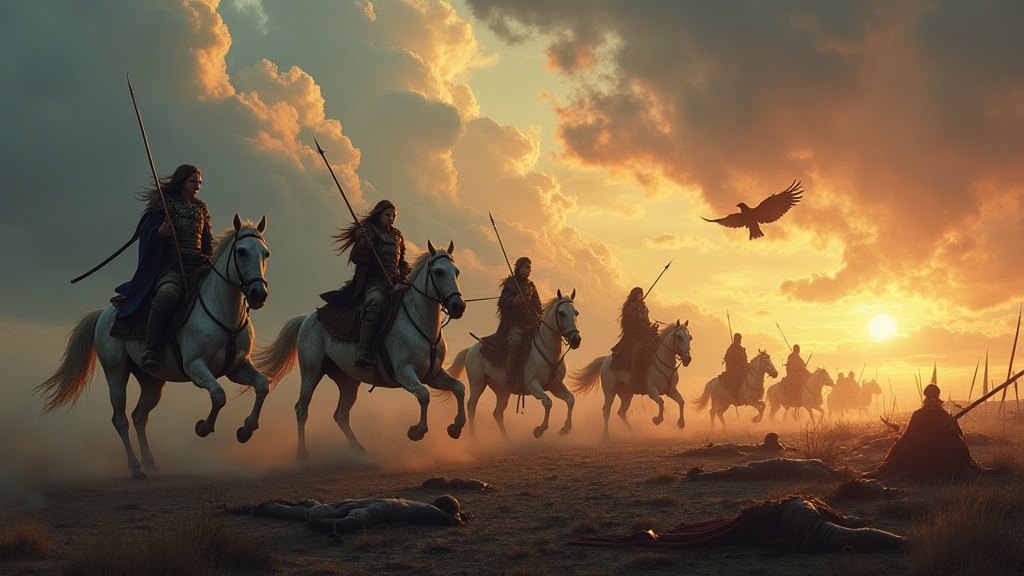
Norse
The Valkyries: Choosers of the Slain
They ride through smoke and carnage, deciding who lives and who dies. The Valkyries are far stranger, older, and more powerful than any modern retelling suggests.
Norse
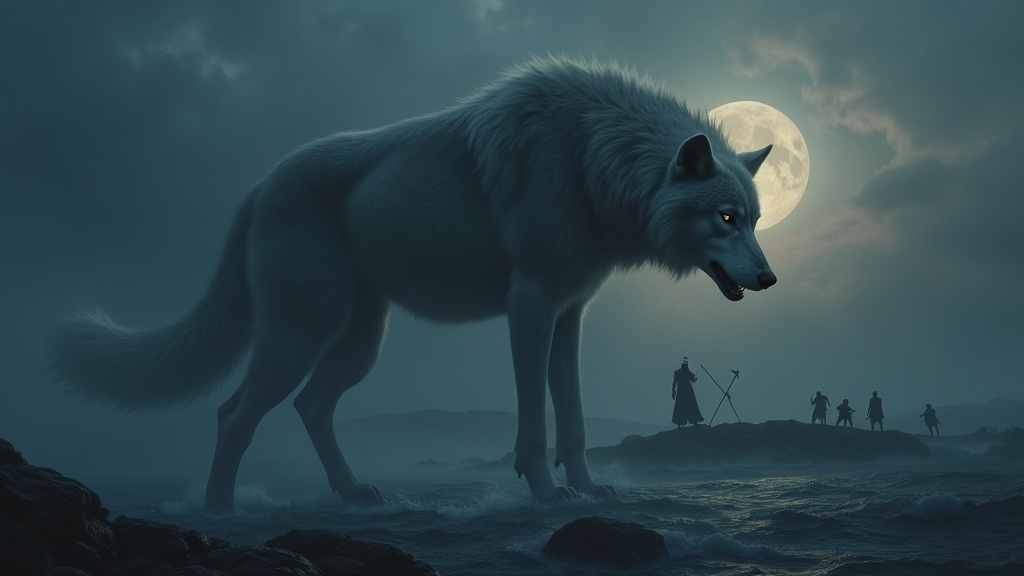
Fenrir: The Monstrous Wolf Destined to Kill Odin
Born of Loki and bound by the gods who feared him, Fenrir is Norse mythology's most terrifying wolf - the creature fated to swallow Odin at the end of the world.
Norse
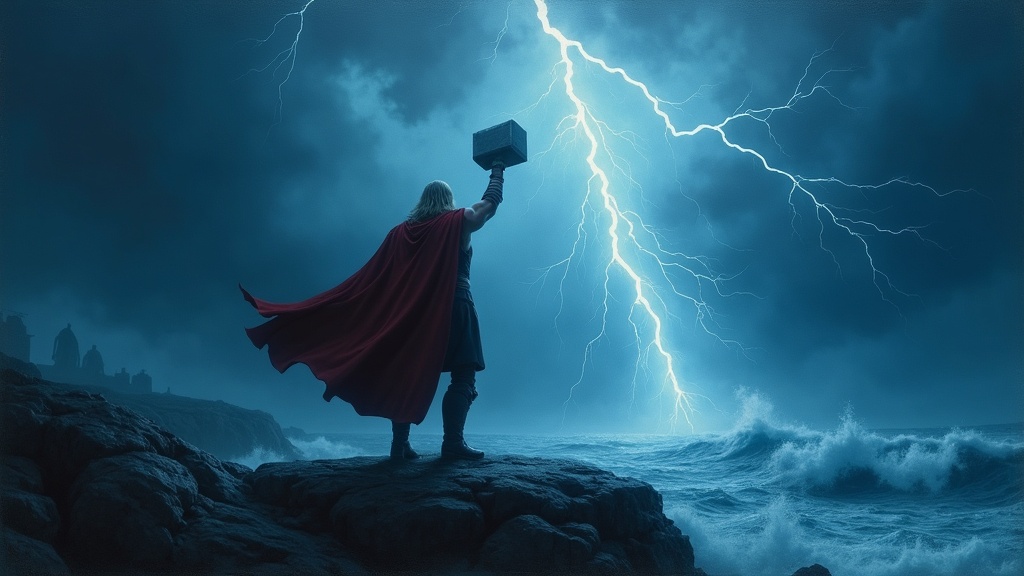
Mjolnir: Thor's Hammer and Symbol of Protection
Mjolnir was not just a weapon. Forged by dwarf smiths and carried by the thundergod Thor, it guarded gods, humans, and the living world against the chaos of giants. Here is its full story.
Norse
The Valkyries: Choosers of the Slain in Norse Mythology
Armored, spear-bearing, and answerable only to Odin, the Valkyries rode into every battle to decide who lived and who fed the ravens. Here is the full story.