

Baiame: The All-Father of Southeastern Australia
Baiame is the supreme creator god of southeastern Australia's Aboriginal traditions, a sky father who shaped the land, gave laws, and watches over the living. Learn who he truly is.
Contents
A man sits at the centre of the sky, cross-legged, larger than the land itself. From his shoulders grow two great quartz crystals that reach to the very edge of the heavens. His eyes never close. His voice made the rivers. When he spoke the first time, the animals came into being and walked across a country that had not yet learned its own name.
That figure is Baiame: The All-Father of Southeastern Australia, and he is one of the most fully realised creator deities anywhere in the world. He is not a myth locked inside a single text. He lives in rock engravings, in ceremony, in the clay figures called bora grounds where boys become men, and in the oral traditions of the Kamilaroi, Wiradjuri, Eora, and Ngunnawal peoples who have kept his story alive for tens of thousands of years.
He is often compared to the sky fathers of other traditions, but that comparison only gets you so far. Baiame carries a specific gravity. He is the source of Dharma (not the Sanskrit concept, but the Aboriginal principle of right law and living, sometimes rendered as "Bunan" by some groups), the maker of the first songs, and the guardian of death's threshold. To understand him is to understand something ancient about how humans first thought about justice, creation, and the sky overhead.
Who Baiame Is: Names, Forms, and the Sky Above
Baiame (pronounced roughly "by-ah-mee") is known under different names across different language groups of what is now New South Wales, Victoria, and Queensland. The Kamilaroi call him Baiame. The Wiradjuri use the same name with slight phonetic variation. The Eora of the Sydney basin recognise him under related names. The Ngunnawal, whose country covers the Canberra region, hold him as the supreme sky being.
The name itself is understood by most scholars and community sources to mean something close to "maker" or "father of all." The linguist R.H. Mathews, writing field notes in the late nineteenth century, recorded it as connected to a root meaning "to make" or "to build." That etymology is not just poetic; it tells you exactly what kind of god Baiame is. He is not a trickster, not a warrior, not a chaos figure. He builds.
His most commonly described form is enormous. He sits in the sky on a throne of crystal quartz, his body decorated with patterns of light. Some accounts describe emu feathers at his feet. Others say that two great yaraandoo (white gum trees) stand beside his sky-camp and that the Milky Way, called Warrambul in Kamilaroi, is the river that flows through Bullimah, his celestial home.
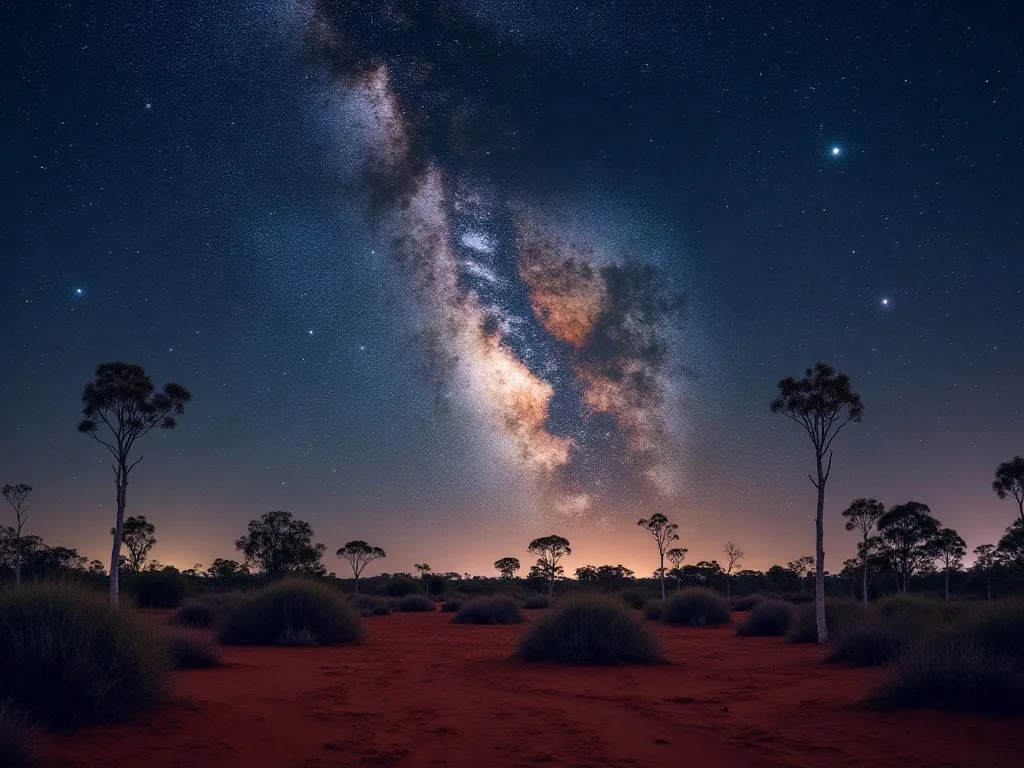
This is not metaphor dressed up as myth. For the peoples who hold these traditions, the Milky Way is a literal place, and Bullimah is as geographically real as the Darling River below. The astronomer Duane Hamacher has documented how southeastern Aboriginal peoples read the sky with extraordinary precision, using stellar and dark-constellation astronomy that predates European stargazing traditions by thousands of years. Baiame's home in the Milky Way is embedded inside that same precise astronomical knowledge.
He is sometimes attended by two wives: Birrahgnooloo, associated with rain and flood, and Cunnembeillee, linked to the underworld passage. Together they form a triad that maps onto the sky, the earth, and what lies beneath it.
The Creation: How Baiame Made the Living World
Baiame did not create from nothing in the way some traditions describe. He created by singing and by touching. This is crucial to understanding Aboriginal cosmology in the southeast. The act of creation is also an act of song; the land has been sung into existence, and the songs that maintain it are still being sung.
In the traditions recorded by anthropologist A.W. Howitt in the 1880s and 1890s (particularly in "The Native Tribes of South-East Australia," 1904), Baiame walked across a formless world and wherever his feet touched, life grew. He shaped the first plants. He called the first animals. He gave the kangaroo its legs and the emu its gait by speaking their shapes aloud.
The first human beings came next. Baiame made them from the red dust of the earth and breathed life into them through the same songs he had used on the animals. This breath is not merely biological. In Kamilaroi understanding, it carries yhi (sometimes written as yuhi), the spiritual essence that connects living beings to the sky world.
Then Baiame did something that sets him apart from many creator gods: he gave his people laws. Not commandments carved into stone, but a living legal system called the Bunan, which governed how families related to one another, how land was shared, how disputes were settled, and how young people passed into adulthood. Baiame did not just make the world. He made it liveable.
The moment he finished, he ascended. He climbed a great yaraan tree, stepped from its highest branch onto the sky, and sat down at the centre of Warrambul. He did not leave. He watches. This distinction matters deeply in how Baiame is understood. He is an otiose deity in the technical anthropological sense, meaning he has withdrawn from direct intervention, but he is not absent. His presence is woven into the structure of everything he made.
Baiame and the Bora: Ceremony as Sacred Contact
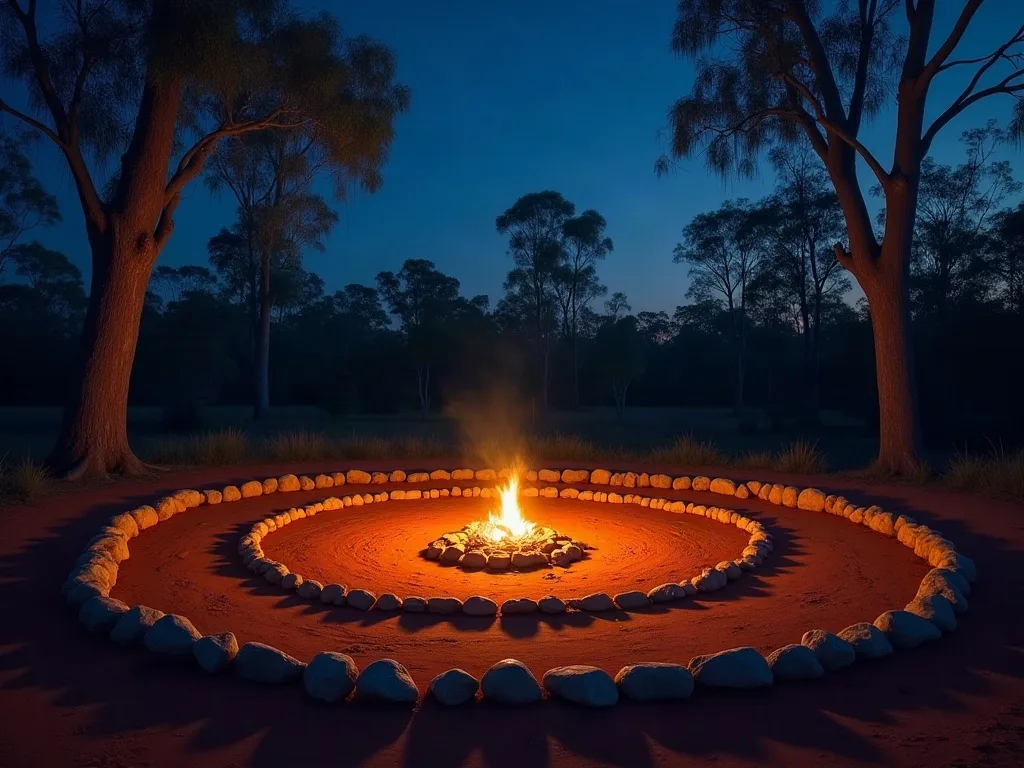
The most direct channel between the living and Baiame runs through the bora, the initiation ceremony in which boys become men. Bora is both the name of the ceremony and the name of the circular sacred ground where it takes place.
These grounds, found across New South Wales and Queensland, are among the oldest surviving ceremonial sites on earth. Two circles, connected by a path, are cleared and sometimes edged with clay figures. The larger circle is the public space. The smaller inner circle is sacred, restricted to initiated men. When boys enter the smaller circle, they are symbolically dying to their childhood and being reborn under Baiame's authority.
The bullroarer, a flat piece of carved wood on a string that makes a roaring sound when swung through the air, is described in many accounts as the literal voice of Baiame returning to earth. Mathews recorded that in Kamilaroi ceremony, uninitiated people and women were told that the sound was Baiame speaking. The sound carries specific tonal patterns, and its appearance during ceremony marks the moment of sacred transition.
Aboriginal Australian cosmology and ceremony has preserved details like these across enormous spans of time, a continuity that makes these traditions among the most archaeologically and anthropologically significant bodies of knowledge still living on earth.
At bora grounds, clay figures of Baiame and other beings have been found. The most detailed description of such a figure comes from the work of Howitt and later from the documentation of sites along the Macquarie River. Baiame is shown seated, with outstretched arms, sometimes with the quartz crystals visible at his shoulders.
The Rock Engraving at Milbrodale: Baiame's Most Famous Image
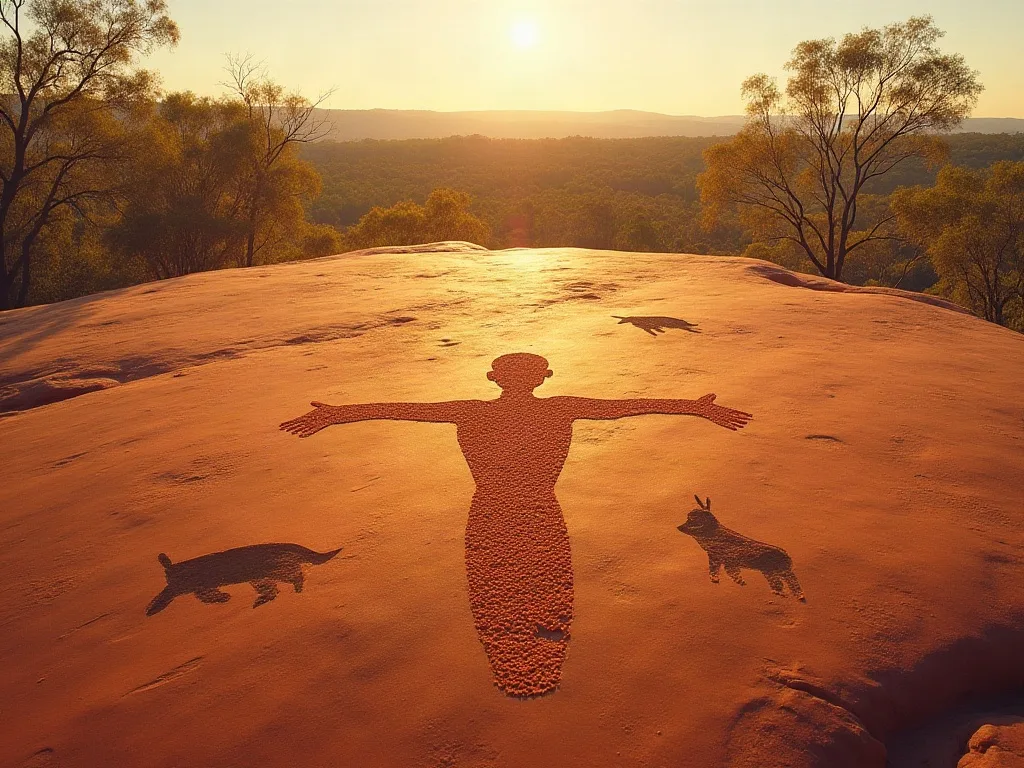
Near Milbrodale in the Hunter Valley of New South Wales stands what is arguably the most significant surviving visual representation of Baiame. Carved into a sandstone platform, the figure stretches nearly 4 metres in length. It shows a human outline with internal patterning, outstretched arms, and the distinctive features described in oral tradition.
The site, managed by the New South Wales National Parks and Wildlife Service, is understood by local Wiradjuri and Darkinjung communities as a living sacred place, not a relic. Visitors to the site today walk along a path to the engraving, and community protocols govern how the site is approached. The engraving is dated using contextual methods to at least several thousand years old, though the tradition it depicts reaches back far further.
This kind of engraving practice, known as petroglyphs, is found across Aboriginal Australia, but the Milbrodale figure stands out for its scale and its clear theological content. You are not looking at decoration. You are looking at a statement of cosmological fact: here is who made this world.
Baiame and the Dreaming: Creation That Never Stopped
No article about Baiame is complete without addressing his relationship to the Dreaming, or more accurately, the Dreamtime, though many Aboriginal scholars and community members prefer the term Tjukurpa (from Anangu language) or its equivalents in other language groups.
The Dreaming is not a past tense. It is not "what happened long ago." It is the ongoing foundation of reality. W.E.H. Stanner, the Australian anthropologist who wrote most clearly about this concept in the 1950s and 1960s, called it "everywhen," a term that captures the way the Dreaming sits outside ordinary clock-time.
Baiame belongs to the Dreaming in this full sense. His acts of creation are not historical events; they are structural facts. When a Kamilaroi elder says that Baiame shaped the Murray River, they are not recounting history in the European sense. They are describing a permanent truth about the river's nature. The river is Baiame's shaping. The distinction matters.
This framework also explains why Baiame is not thought of as distant or dead. His creative act never stopped. The world keeps being the world because the Dreaming keeps being true. Ceremonies that re-enact the original acts of creation are not commemorations; they are maintenance. They keep the world in its right shape.
Baiame Across Traditions: Parallels and Distinctions
Scholars working in comparative religion have noted surface similarities between Baiame and sky father figures found in many cultures. He has been compared to the Greek Zeus, to the Vedic Dyaus Pita, and to the Norse Odin. Each comparison illuminates something, and each one also misleads.
Like Zeus, Baiame presides from a sky domain and holds supreme authority over lesser beings. But Baiame is not political in the way Zeus is. He does not have a court of quarrelling gods. He does not take sides in wars. His authority is moral and creative, not competitive.
Like Odin, Baiame is associated with wisdom and with the initiation of young men into secret knowledge. The bullroarer echoes, faintly, the way Odin's ravens carry messages. But Odin pursues knowledge through sacrifice and cunning; Baiame gives it freely as the natural product of his creative act.
Baiame (Kamilaroi)
- Sky father who created the world and gave moral law
- Withdrew to Bullimah after creation, watches but rarely intervenes
- Contacted through ceremony and initiation, never through sacrifice or prayer in the Western sense
- Associated with quartz crystals, the Milky Way, and the bullroarer
- Has no rival gods; is the supreme and uncontested maker
Zeus (Greek Olympian)
- Sky father who overthrew his predecessor and rules by political power
- Present and active, intervenes constantly in human and divine affairs
- Contacted through temples, sacrifices, oracles, and direct narrative encounters
- Associated with lightning bolts, eagles, and the oak tree
- Rules within a pantheon of competing, sometimes hostile, divine peers
The comparison that actually fits best is not to an Indo-European sky father but to figures like the Yoruba Obatala or the Lakota Wakan Tanka: creator beings whose authority is rooted in the act of making rather than in conquest. These figures shape the moral fabric of the world and then let that fabric do its work. They are not kings so much as architects.
Baiame's Descendants and the Beings of His World
Baiame does not stand alone. His world is populated by beings who carry pieces of his creative act forward.
Daramulun, sometimes described as Baiame's son or his earthly representative, is the figure most directly invoked at initiation ceremonies in some traditions, particularly among the Yuin people of the New South Wales south coast. He is a powerful, sometimes frightening figure, associated with the bullroarer sound in some accounts and with the authority to grant or withhold Baiame's blessing from initiates.
Birrahgnooloo, Baiame's wife in many Kamilaroi accounts, commands the waters. When floods come, she is sending a message. When rain arrives after drought, she has relented. Her relationship with Baiame maps weather patterns onto a moral framework: drought can mean the sky world is displeased; rain can mean balance has been restored.
Nungeena, sometimes called the "Mother of All," appears in some traditions as a female counterpart or companion to Baiame's authority, associated with the spirits of children not yet born and with the warmth of the earth. She represents the generative, nourishing dimension of creation that Baiame initiated but did not personally embody.
The emu holds a special place in Baiame's world. The emu in the sky, visible to Aboriginal astronomers as a dark constellation formed by the dark spaces between the stars (not the stars themselves, a uniquely Aboriginal astronomical innovation), is associated with Baiame's creative presence. When the emu rises in a particular position, it marks the time for emu eggs to be harvested. The sky itself is a calendar, and Baiame sits at its centre.
The Death of a Man and the Road to Bullimah
Death, in Kamilaroi understanding, is not an ending. It is a return. When a person dies, their spirit, their yhi, begins the journey toward Bullimah, the sky-camp where Baiame sits. The path runs along the Milky Way, which is understood as a road as well as a river.
The journey is not automatic. Those who have lived according to the laws Baiame gave, the Bunan, travel the road without difficulty. Those who have broken the law face trials. This is not punishment in the sense of an angry god; it is more like the natural consequence of having lived out of alignment with the shape of creation.
The role of ceremony in keeping this road open cannot be overstated. The bora ceremonies, the songs, the careful maintenance of sacred sites: all of these are acts that keep the path between the living world and Bullimah clear. When ceremony stops or sacred knowledge is lost, the road becomes harder to walk. This is one of the reasons why the loss of ceremonial knowledge through colonisation is understood by community members not merely as cultural loss but as a cosmological rupture.
Baiame in the Modern World: Continuity and Recovery
The British colonial period, beginning in 1788 on the southeastern coast of Australia, inflicted severe damage on the living transmission of Baiame's traditions. Missionaries recorded his name while simultaneously attempting to destroy the ceremonies that gave the name its meaning. Anthropologists like Howitt and Mathews preserved extraordinary detail in their fieldwork, but their access was always partial, always filtered through the power imbalances of the colonial encounter.
What has survived is substantial. The Kamilaroi Language and Cultural Revitalisation Project, the work of Wiradjuri scholars like Uncle Tex Skuthorpe, and the broader movement for Aboriginal language and cultural recovery have kept Baiame's traditions alive and growing. Elders who hold ceremonial knowledge are passing it on. Young people in communities across New South Wales are learning the songs.
The rock engraving at Milbrodale is visited by thousands of people each year, many of them Aboriginal school groups making their first formal contact with Baiame's image. The bora grounds at Euabalong, Byrock, and other sites are protected, mapped, and in some cases restored after damage from agricultural use.
Baiame has not retreated further into Bullimah. If anything, the traditions surrounding him are being spoken more clearly than they have been in several generations.
Frequently Asked Questions About Baiame
Frequently asked questions
Is Baiame the same as the Christian God?
Early European missionaries drew this comparison eagerly, and some Aboriginal Christian communities have accepted it, seeing Baiame as a pre-Christian revelation of the same divine being. Most Aboriginal scholars and community members, however, resist the equation. Baiame's nature, his relationship to country, to ceremony, to the specific laws he gave, is so embedded in Aboriginal cosmology that translating him into a Christian framework strips away most of what matters. The comparison tells us more about missionary strategy than about Baiame himself.
What is the bullroarer's connection to Baiame?
The bullroarer, a flat piece of carved wood swung on a cord to produce a resonant roaring sound, is understood in many Kamilaroi and related traditions as the literal voice of Baiame descending to earth during initiation ceremonies. R.H. Mathews and A.W. Howitt both documented this association in the late nineteenth century. The sound marks the moment of sacred transition at bora ceremonies, and in many groups, uninitiated people were told the sound was Baiame's voice to protect the secrecy of the instrument's origin.
Where can Baiame's image be seen today?
The most significant surviving image of Baiame is the rock engraving at Milbrodale in the Hunter Valley of New South Wales, a sandstone figure roughly 4 metres long that shows him in his characteristic outstretched-arm pose. The site is open to visitors with community protocols in place. Smaller engraved and painted figures associated with Baiame exist at multiple sites across New South Wales and Queensland, several of which are managed jointly by government agencies and local Aboriginal communities.
Which Aboriginal peoples hold the traditions of Baiame?
Baiame is primarily associated with the Kamilaroi (also written Gamilaraay), Wiradjuri, Eora, Ngunnawal, and Yuin peoples of what is now New South Wales and parts of Victoria and Queensland. Each group holds its own version of his traditions, and the names, stories, and ceremonial protocols vary. He is not a pan-Australian figure; he belongs to the specific country and language groups of the southeast.
What primary sources exist for learning about Baiame?
The most substantial early documentation comes from A.W. Howitt's "The Native Tribes of South-East Australia" (1904) and R.H. Mathews' field notes and journal articles from the 1890s to early 1900s. Both researchers had access to initiated men who shared portions of the tradition. More recently, the work of Wiradjuri scholar Uncle Tex Skuthorpe, the Kamilaroi language revitalisation documentation, and the research of astronomer Duane Hamacher on Aboriginal sky knowledge provide updated, community-grounded accounts.
What does Baiame's name actually mean?
The most widely accepted interpretation links the name to a root in the Kamilaroi language meaning "to make" or "to create," which R.H. Mathews and subsequent linguists have noted in their records. It is commonly translated as "maker," "great maker," or "father of all." The precise etymology continues to be refined as Kamilaroi language revitalisation work produces more detailed lexical analysis.
Baiame and the Future of Living Cosmology
There is an unresolved debate in anthropology about whether Baiame, and figures like him in other Aboriginal traditions, represent a genuinely ancient stratum of belief or whether contact with European Christianity accelerated and shaped the "sky father" concept in the nineteenth century.
The debate was opened seriously by W.E.H. Stanner and others in the mid-twentieth century. The historian Tony Swain argued in "A Place for Strangers" (1993) that the strong emphasis on sky beings emerged partly in response to colonial disruption, as Aboriginal peoples sought new cosmological frameworks to accommodate catastrophic change. Other scholars, including Deborah Bird Rose and more recently Lynne Kelly in her work on the knowledge practices encoded in sacred sites, have pushed back, arguing that the continuity of bora grounds, rock engravings, and associated astronomical knowledge demonstrates a tradition far older than European contact.
The rock at Milbrodale does not care about the debate. It has been there longer than the argument. And the communities who hold Baiame's traditions have never stopped singing the songs.
What is certain is this: Baiame is not a static figure waiting to be catalogued. He is a living presence in living traditions held by living people who are actively, consciously, and with increasing confidence passing his stories forward. The bora ceremonies are being performed. The language is being taught. The astronomical knowledge is being documented and taught in schools. The sky above southeastern Australia still holds Bullimah, and the Milky Way still runs through it like a river.
For anyone who wants to understand how humans first made sense of the sky, the law, and the act of creation itself, Baiame is one of the most complete answers we have.
Read the full book
Want the whole story?
The complete edition is an instant PDF download here, with a paperback on Amazon for selected titles.
Australian Aboriginal
The Aboriginal Mythology Book: The Rainbow Serpent, Wandjina, Baiame, and the Dreamtime Stories of the World's Oldest Tradition
60,000 Years of Unbroken Ancestral Memory
The world's oldest continuous mythology. From the Rainbow Serpent to the Wandjina cloud spirits, explore the Dreamtime stories that have mapped Australia for 60,000 years.
More from Australian Aboriginal
All articles
Australian Aboriginal
Namarrgon: The Lightning Man of Arnhem Land
Namarrgon is the terrifying sky god of the Yolngu people who creates lightning and controls the monsoon storms that shape life across Arnhem Land. His thunderous presence reveals how Aboriginal cultures read the sky as a living, ancestral force.

Australian Aboriginal
The Dreamtime: Creation and Eternal Present in Aboriginal Belief
The Dreamtime is the Aboriginal foundation of existence: the era when ancestral beings shaped the land, set down the laws of kinship and ritual, and wove themselves into every rock, waterhole, and song. It is neither ancient history nor myth alone, but an ongoing reality that Aboriginal peoples access through ceremony, song, and country.

Australian Aboriginal
The Seven Sisters: Celestial Pursuit and Pleiades Myth in Aboriginal Australia
Seven sisters flee across the sky in Australian Aboriginal mythology, hunted by a man who will never catch them. This eternal chase, traced in the Pleiades star cluster, reveals how Aboriginal peoples read the cosmos as a living story of desire, escape, and sacred boundaries.
Australian Aboriginal
Yara-ma-yha-who: The Bloodsucking Tree Dweller of Australian Aboriginal Myth
Meet the Yara-ma-yha-who, a small but lethal tree-dwelling creature from Rainrainforest Aboriginal lore that hunts humans by bloodsucking and regurgitation. Discover what this creature reveals about danger, transformation, and survival in the deep Australian bush.