
Tawhirimatea: God of Weather and Storms
Tawhirimatea, the Maori god of weather and storms, unleashed his fury on his siblings when their parents were torn apart. Learn who he is, why he still rages, and what his myth reveals.
Contents
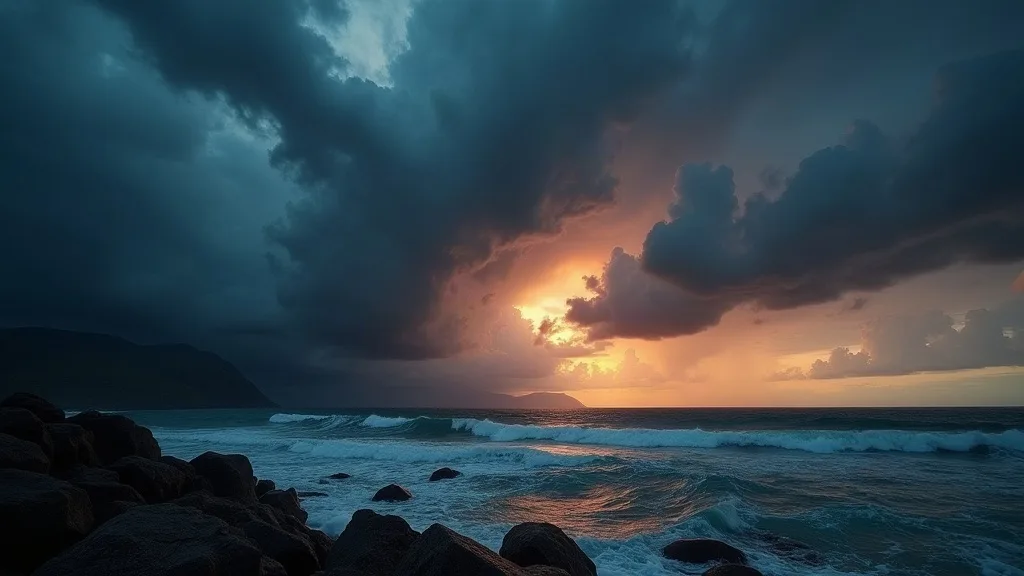
The sky turns the colour of bruised iron. Waves stand up like cliffs. The wind does not howl so much as roar with something that sounds almost personal, almost old. To the Maori people of Aotearoa New Zealand, this is not a random act of nature. It is Tawhirimatea, and he is still angry.
His anger has a reason. It began at the very start of the world, in the moment his parents were pulled apart against his will. That separation set a wound in motion that, according to Maori oral tradition, has never fully healed. Storms, cyclones, the choking fog that swallows coastlines whole: all of it is Tawhirimatea, remembering.
Among the many powers woven into Maori cosmology, few are as immediate and as physically felt as his. You can stand in a forest and forget Tane, the god of forests and birds, is holding the canopy above you. You cannot forget Tawhirimatea when he decides to speak.
The Parents Who Were Never Supposed to Part
Before there was a world worth speaking of, Ranginui (the Sky Father) and Papatuanuku (the Earth Mother) lay pressed together in a tight, permanent embrace. Their children lived in the darkness between them, a cramped and lightless space that the Maori called Te Kore, the void, folding into Te Po, the long night. The children could feel each other but could not stand upright, could not stretch, could not see anything grow.
The older brothers began to talk. They needed room. They needed light. The solution, as the brothers saw it, was to push their parents apart: Ranginui up into the sky where he still hangs, Papatuanuku down into the earth where she still rests. Each brother tried. It was Tane, the god of forests, who finally succeeded, planting his shoulders against his mother and his feet against his father, forcing the sky open. Light came flooding in. The world as living beings know it began.
But one brother had refused to vote for any of this. Tawhirimatea, god of weather and storms, had argued against separation from the beginning. His parents' embrace was the world. Breaking it, to his mind, was an act of violence against the natural order, not a solution to it. His objection was outvoted, the separation happened, and Tawhirimatea was left in a state of grief and fury that had nowhere to go except outward.
He followed Ranginui into the sky. He would not stay below with the brothers who had wronged his parents. Up there, in the rolling space between earth and heaven, he began to create his children.
The Children Tawhirimatea Sent into the World
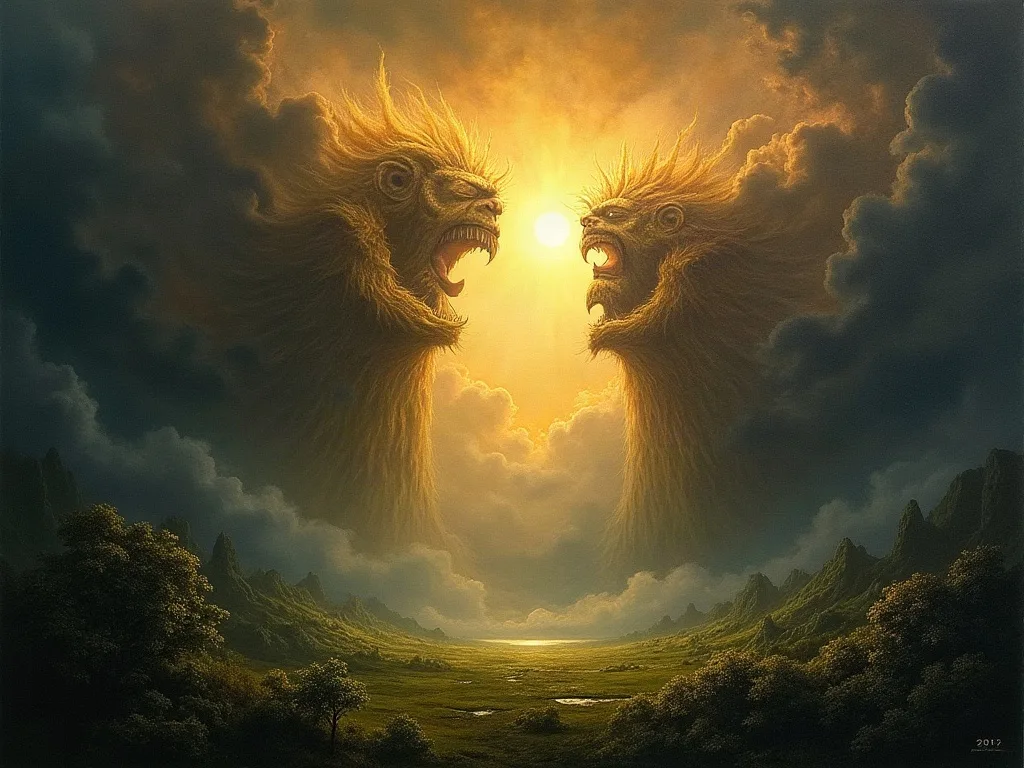
The Nga Hau e Wha, the four winds, came first. These are not simply cardinal directions in Maori thought. They are the living children of Tawhirimatea, each one a distinct force with its own character and reach. He sent them ahead of him as scouts and soldiers before he launched his own attack.
Then came more: the Apu Matangi, clouds of different kinds, squalls, whirlwinds, gusts, and the dense, driving rain. The primary source here is the Nga Mahinga a nga Tupuna, a body of oral tradition recorded by nineteenth-century Maori scholars and later shaped by Sir Apirana Ngata and others. Across multiple versions of this cosmogony, including the accounts preserved by the Arawa, Ngati Porou, and other iwi (tribal groups), the description of Tawhirimatea's children is remarkably consistent: he is not a lone figure throwing bolts of lightning. He is a patriarch who has multiplied himself into an entire atmospheric army.
This matters for understanding his character. Tawhirimatea does not act impulsively. He plans. He arms. Then he attacks.
The War Against His Brothers
Once his forces were gathered, Tawhirimatea descended. His primary target was Tane, the brother who had actually done the physical work of separating Ranginui and Papatuanuku. The great forests Tane had raised were the first to suffer. The Maori creation narrative recorded in the Nga Puhi tradition describes how Tawhirimatea's winds snapped trees, uprooted them entirely, sent them crashing into the undergrowth. The forest Tane had built with such pride became debris.
He turned on Tangaroa, the god of the sea, next. This clash produced a lasting division in the natural world. Tangaroa's children split: some fled into the sea under Tangaroa's protection, some fled into the forest under Tane's. This is why, in Maori understanding, fish live in water and reptiles live on land. The schism between Tane and Tangaroa, opened by Tawhirimatea's violence, made the world's creatures choose sides.
He went after Rongo (god of cultivated plants) and Haumia-tiketike (god of wild plants), but these two hid. The earth, Papatuanuku herself, concealed them in her body. Tawhirimatea could not reach them. This detail matters: even in defeat, the Earth Mother protects her children. The separation hurt her, but she has not abandoned her role.
The last brother standing was Tu, god of war, the only sibling who did not run and did not hide. Tu held his ground against Tawhirimatea's assault. He could not match the storm god's power in the sky, but he endured. Tu survived. And in surviving, Tu claimed a victory that later generations of Maori used to explain a great deal about human life.
Tu's Counter-Strike and What It Means for Humans
After the storm passed, Tu turned his attention to his brothers, the ones who had fled or hidden while he stood alone. He made them food. He developed the traps that catch birds (Tane's children). He devised the nets that pull fish from the sea (Tangaroa's children). He harvested the cultivated and wild plants that Rongo and Haumia had hidden behind. In each case, Tu removed the tapu (the sacred, protected status) from his brothers' domains, making them available for human use.
The logic is clear and deliberate. Humanity descends from Tu. The fact that Tu defeated his brothers symbolically means humans can eat and use the natural world. Every meal is, in a compressed sense, a re-enactment of Tu's original claim.
But Tawhirimatea never submitted. He fought Tu and did not lose to him cleanly either. He retreated to the sky, undefeated, which is exactly why storms keep coming. His victory was incomplete; so was Tu's. This is not a myth that ends with a winner. It ends with an ongoing tension, which is a far more honest account of how weather actually works.
Tawhirimatea in the Maori Cosmological System
Tawhirimatea sits inside a genealogical framework that Maori tradition calls whakapapa (the layered ordering of all things through ancestral descent). He is not a metaphor. He is, in the most literal sense the tradition allows, a descendant of the primordial parents, an ancestor, a being with personality and memory.
His placement in the Whare Wananga, the sacred house of learning where esoteric Maori knowledge was transmitted to chosen students, confirms his centrality. Manuscripts collected from the Whanganui and Ngati Kahungunu traditions in the nineteenth century (gathered principally by S. Percy Smith and later critically revisited by scholars including Te Ahukarama o Te Whanaunga Bruce Biggs and Margaret Orbell) place him among the atua (divine beings) who govern natural forces. He ranks alongside Tane and Tangaroa as one of the most powerful of Ranginui and Papatuanuku's children.
What makes him distinct among that group is his moral position. He is not simply "the storm god." He is the one who was right. Most Maori versions of the creation story do not frame Tawhirimatea's anger as madness or hubris. They present his objection as legitimate. Separating the parents was violent. He said so. His continued rage is grief as much as war.
Storms as Grief: Reading the Weather Differently
There is something in this that sits outside the usual pattern of storm deities in world mythology. Compare him briefly with other traditions. In Norse myth, Thor fights for humans and defends the order of things; his storms are protective. In Greek myth, Zeus's thunderbolts are punishments or demonstrations of authority. In Mesopotamian myth, Enlil's winds can scour the earth clean as a tool of divine policy.
Tawhirimatea is none of these. He is not protecting anyone. He is not punishing humans for a transgression. He is not a tool of cosmic administration. He is a son who watched his family broken apart against his protest, and he has never been able to stop mourning.
This reading gives the Maori weather myth a psychological depth that is striking. Every storm is not a threat to be appeased with the right ritual, but a kind of testimony. Tawhirimatea is a witness to what was lost.
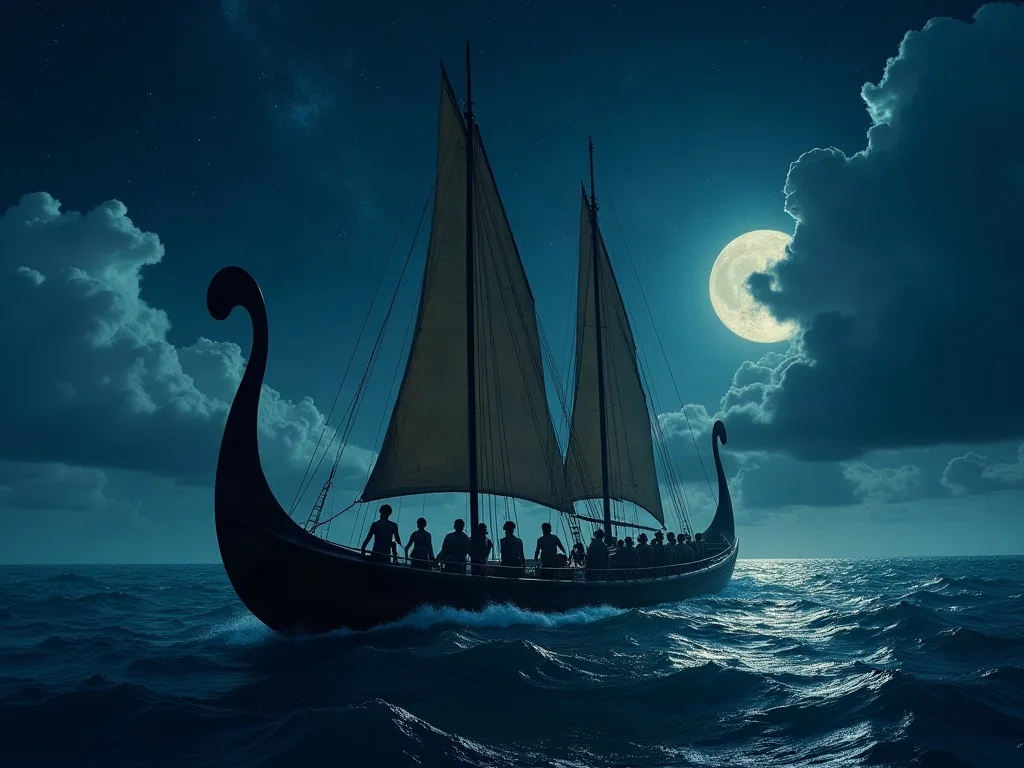
That said, Maori communities absolutely developed practical responses to his power. Karakia (ritual prayers and incantations) were recited before sea voyages to acknowledge Tawhirimatea and request safe passage. Skilled navigators read his signs in cloud patterns, wind shifts, and wave rhythms with extraordinary precision. The Polynesian wayfinding tradition, which carried ancestors across thousands of kilometres of open Pacific, required an intimate working knowledge of everything Tawhirimatea controlled.
The Four Winds and Their Roles in Maori Navigation
Maori navigators named and characterised each major wind. These were not abstractions but well-mapped personalities:
- Hau-a-uru: the west wind, the long wind that blows across the open Pacific, the one that carried the ancestor Kupe from the legendary homeland of Hawaiki to Aotearoa.
- Marangai: the northeast wind, typically associated with rain and unsettled weather.
- Tonga: the south wind, cold, carrying moisture up from the Antarctic waters below Aotearoa.
- Raro: the north wind, warmer, more gentle, associated with fine weather and good sailing conditions.
Each of these is understood as one of Tawhirimatea's children. Invoking them by name in a karakia was both meteorological literacy and spiritual protocol: you were addressing a living being, not reading an instrument.
This system means that Tawhirimatea's domain covers not only destruction but the entire infrastructure of Pacific navigation. Without his children, the great waka hourua (double-hulled ocean canoes) had no course to steer by. He is, paradoxically, both the danger and the guide.
Tawhirimatea Across Polynesia
Maori tradition does not exist in isolation. It belongs to the broader Polynesian world, and storm deity figures appear across that world under related names. In Hawaiian tradition, Laamaomao is a god of winds, sometimes depicted holding a gourd from which winds are released. In Samoan tradition, storms carry divine significance and are addressed through ritual. The Tuamotuan traditions of French Polynesia have weather atua with overlapping roles.
The linguistic connection is direct: Tawhiri in Maori and Tafili or related forms in other Polynesian languages share the same Proto-Polynesian root. This suggests that the figure of a storm deity closely tied to the cosmogonic drama of creation is very old, predating the settlement of Aotearoa around 1250-1350 CE and reaching back into the shared ancestral culture of central Polynesia.
What Maori tradition added, or at least preserved most vividly, is the moral complexity: the storm god as righteous dissenter, not just force of nature.
Tawhirimatea in Contemporary Maori Life and Thought
The arrival of European settlers from the late eighteenth century onward did not erase Tawhirimatea from Maori consciousness. He persists in whakapapa recitations, in karakia, in the names of marae (communal meeting places), and in the way Maori communities still read the sky before venturing onto open water.
Contemporary Maori artists, poets, and writers have returned to him repeatedly. Hone Tuwhare's poem "Rain," arguably the best-known poem by a Maori poet, is not explicitly a Tawhirimatea poem, but its address to rain as a personal presence, as something that knows you, breathes the same air as the old cosmogonic stories.
In environmental discourse, Tawhirimatea has taken on new resonance. The separation of Ranginui and Papatuanuku, mourned by Tawhirimatea from the very beginning, maps strikingly onto contemporary concerns about the relationship between sky and earth, about the atmosphere and the ground below it. Some Maori scholars and activists have drawn this parallel explicitly: Tawhirimatea's rage is not only ancient. It is current.
Papatuanuku, the Earth Mother his parents represent, is now also a focal figure in Maori-led environmental movements. Tawhirimatea's grief and his parents' story increasingly frame conversations about climate, land rights, and what it means to treat sky and earth as kin rather than resources.
Frequently Asked Questions About Tawhirimatea
Frequently asked questions
Who are Tawhirimatea's parents in Maori mythology?
Tawhirimatea is the son of Ranginui (the Sky Father) and Papatuanuku (the Earth Mother), the primordial couple whose union gave birth to all the major atua (divine beings) of Maori tradition. He is one of several powerful brothers, including Tane (forests), Tangaroa (sea), Tu (war), Rongo (cultivated plants), and Haumia-tiketike (wild plants).
Why is Tawhirimatea angry, and does his anger ever end?
His anger comes from the forced separation of Ranginui and Papatuanuku by his brothers. He opposed the separation and was overruled. In Maori oral tradition, his rage has never fully ended: the ongoing occurrence of storms is understood as the continuation of his grief and fury. There is no mythological moment where he is reconciled or appeased.
What did Tawhirimatea do to his brother Tane?
Tawhirimatea attacked the forests that Tane had grown, using his winds and storms to uproot trees, strip branches, and devastate the landscape Tane had shaped. This is one of the clearest illustrations in Maori tradition of the destructive power of storms, presented as a deliberate act of vengeance rather than a random event.
Which brother defeated Tawhirimatea?
No brother fully defeated him. Tu (the god of war) was the only sibling to stand his ground against Tawhirimatea's assault rather than flee or hide, and he survived the conflict. But Tawhirimatea retreated to the sky unvanquished. The Maori tradition is deliberate about this: the tension between storm and human endurance remains unresolved, which explains why storms continue to strike.
What are the primary Maori sources for Tawhirimatea's story?
The central accounts come from the oral tradition recorded by nineteenth-century Maori scholars and European ethnographers. Key sources include the manuscripts of Te Matorohanga and Nepia Pohuhu (Whanganui tradition), gathered by S. Percy Smith and published in the Journal of the Polynesian Society, as well as accounts recorded by Sir Apirana Ngata and later analysed by scholars such as Margaret Orbell in her reference work "The Concise Encyclopaedia of Maori Myth and Legend" (1998).
How did Maori navigators relate to Tawhirimatea practically?
Maori navigators used karakia (ritual incantations) to address Tawhirimatea before ocean voyages, acknowledging his power and requesting passage. They also developed deep observational knowledge of his children (the winds), reading cloud formations, wave patterns, and wind shifts to navigate across vast stretches of open Pacific. Far from being merely feared, Tawhirimatea's domain was the practical toolkit of Polynesian wayfinding.
The Storm That Never Quite Stopped
Most mythologies eventually settle their storms. A rainbow appears, a treaty is signed, the monster is bound under a mountain. Tawhirimatea offers none of that comfort. He is still up there. The separation of sky and earth still happened. His argument was never answered.
That is a remarkably modern structure for a very ancient story. The world begins with an act that one witness considers a catastrophe, and that witness never stops saying so. His dissent becomes weather. Weather becomes the lived texture of every day on earth.
Scholars of comparative religion have noted that Maori cosmology is unusual in presenting a divine figure whose anger is not pathologised or resolved. Robert Ellwood and Barbara McGraw, writing on world religions, observe that Polynesian cosmogonies tend toward genealogical completeness rather than moral tidiness: the point is not who was right or wrong, but how the world came to be structured as it is. Tawhirimatea's unresolved anger is part of that structure. He is the reason the sky and the earth are not simply at peace with each other. He keeps the distance between them charged.
For anyone standing under an open sky in Aotearoa as the wind picks up and the clouds bank in from the west, this is not an abstract theological point. It is the oldest explanation still walking the earth: someone was wronged at the beginning of things, and the weather is the sound of him not forgetting.
Read the full book
Want the whole story?
The complete edition is an instant PDF download here, with a paperback on Amazon for selected titles.
Maori
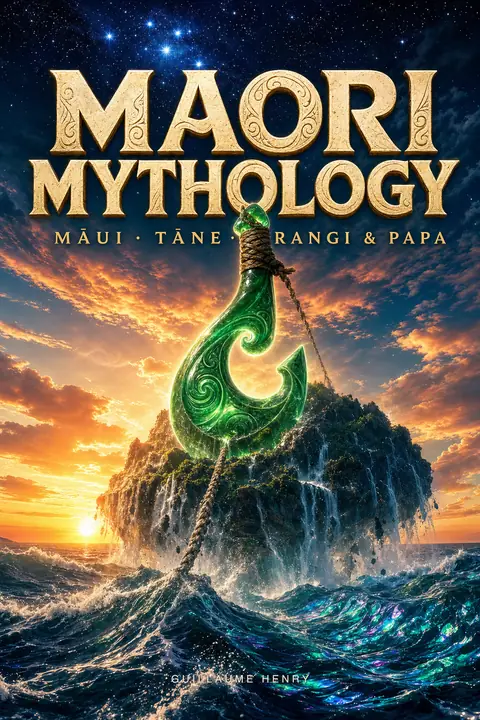
The Maori Mythology Book: Māui, Tāne, and the Gods of Aotearoa
Māui, Tāne, and Rangi and Papa
The mythology of New Zealand’s first people: the sky-father and earth-mother locked in an embrace, the children who forced them apart to let in the light, and Māui the trickster who fished up islands, snared the sun, and died trying to defeat death itself.
More from Maori
All articles
Maori
The Marae: Sacred Meeting Ground in Maori Culture
The marae stands at the heart of Maori identity: a sacred communal space where land, genealogy, and spiritual power converge. Discover how this open courtyard became the foundation of Maori society, ceremony, and connection to place.
Maori
Tiki: The First Man and Ancestral Symbol in Maori Mythology
In Maori creation myth, Tiki was the first human, carved from earth by Tane Mahuta, the god of forests. This symbol represents the bridge between the divine and human worlds, still vital in Maori art and culture today.

Maori
The Taniwha: Supernatural Guardians of Waterways in Maori Mythology
The taniwha are powerful supernatural beings in Maori mythology that guard rivers, lakes, and caves. These shape-shifting creatures demand respect and have shaped Maori settlement patterns for centuries.
Maori
Tapu and Noa: Sacred Restriction and Freedom in Māori Worldview
Tapu and Noa are the twin forces that shaped Māori life: one sacred, restricted, potent; the other free, ordinary, unrestricted. Learn how these concepts governed everything from food and ritual to social order and spiritual safety.