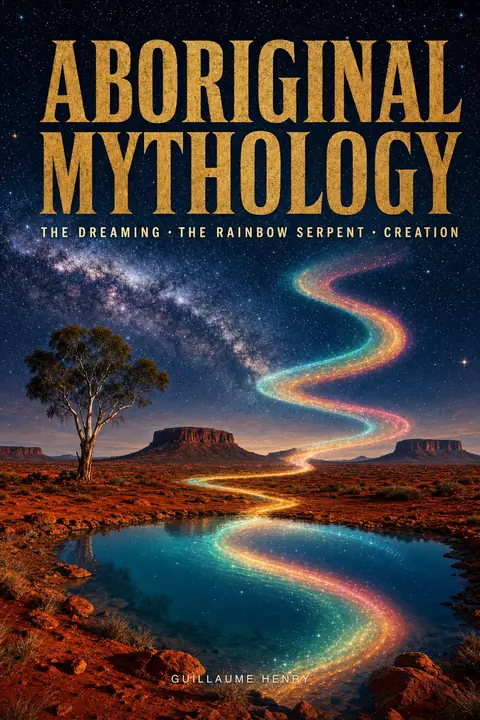
Australian Aboriginal
Explore Dreamtime cosmology, songlines, and the oral traditions of 500+ Aboriginal nations. Regional diversity, ancestral beings, and living law.
Most surveys of Australian Aboriginal mythology collapse half a millennium of distinct oral traditions into a single narrative. The reality is more complex. At the time of European contact, over 500 separate language groups occupied the continent, each with its own cosmology, ancestral narratives, and ceremonial law. To speak of a unified Aboriginal mythology is roughly as accurate as summarising all European traditions under a single heading.
The challenge for any guide is to respect that diversity while identifying genuine patterns. What follows draws on ethnographic fieldwork conducted across the twentieth century, particularly the work of W.E.H. Stanner, Ronald and Catherine Berndt, and A.P. Elkin, alongside oral traditions recorded in Central Australia, the Kimberley, and Arnhem Land. Where regional terms differ, they are noted. Where sources conflict, that too is acknowledged.
The Scale of Diversity: 500+ Nations, Not One Mythology
Before 1788, the Australian continent supported between 500 and 750 language groups, each corresponding to a distinct nation with its own territory, law, and body of ancestral knowledge. Linguistic diversity was profound: languages separated by a few hundred kilometres could be as different as English and Mandarin. The cosmologies carried by those languages were similarly varied.
Some traditions centre on sky heroes. Others focus on subterranean or aquatic beings. The Rainbow Serpent, often presented as a pan-Aboriginal figure, appears in many regions but is absent or marginal in others. In the southeast, Baiame presides as an all-father figure; in the Kimberley, the Wandjina control rain and fertility; among the Yolngu of northeast Arnhem Land, cosmology is structured by the complementary moieties Dhuwa and Yirritja. To flatten these into a single system is to erase the specificity that oral cultures guard carefully.
Ronald and Catherine Berndt, in The World of the First Australians (1964), emphasise that while certain motifs recur, the meaning and function of those motifs shift according to local law and landscape. A serpent in one region may be a creator; in another, a destroyer. The same being may have five names across five language groups, each name carrying different ceremonial obligations.
The Dreamtime: Cosmology, Not Creation
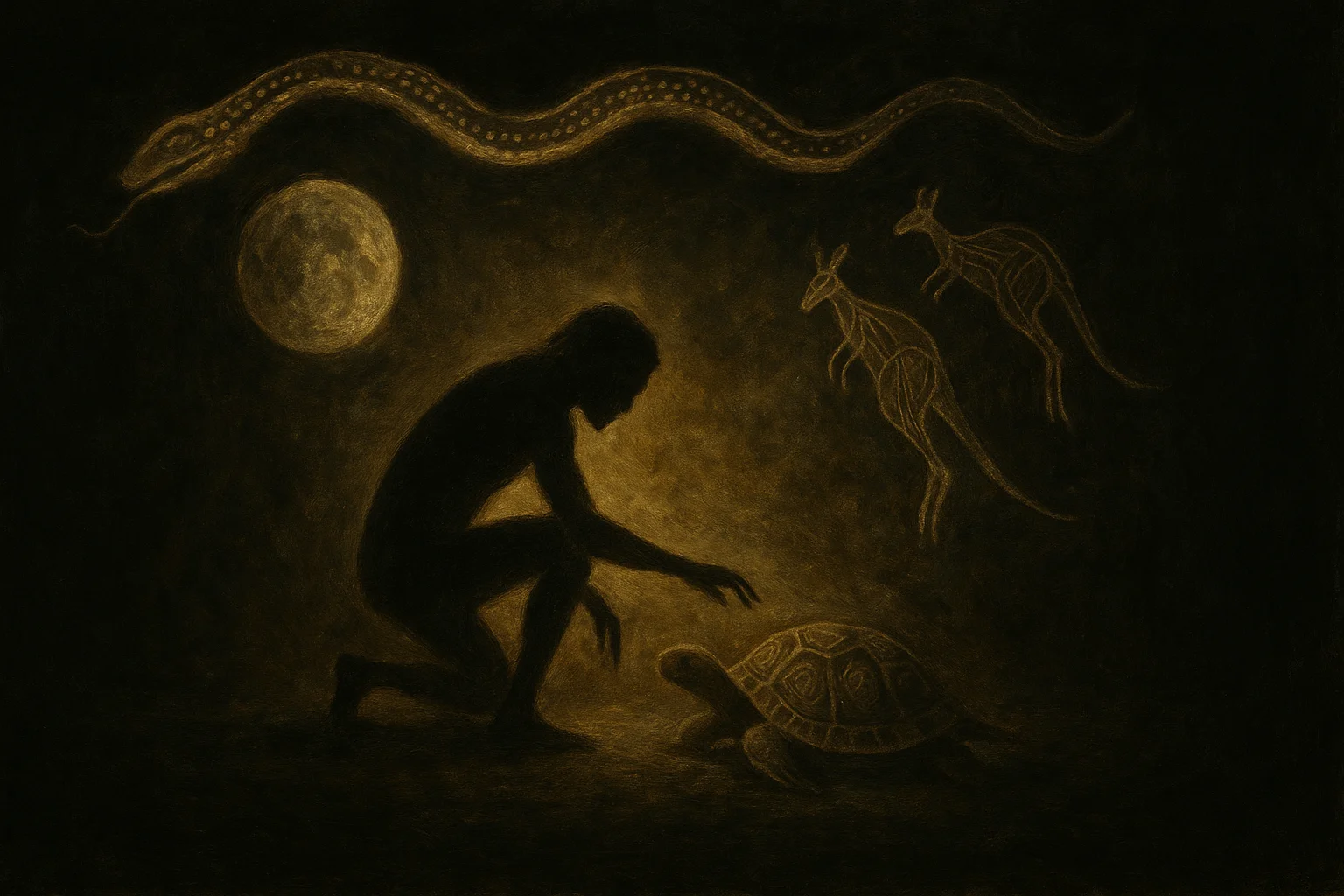
The term Dreamtime is an English gloss, coined by early anthropologists to translate concepts that have no direct equivalent. It has since become shorthand for Aboriginal cosmology, but it risks reducing a living, continuous reality to a mythic past tense.
W.E.H. Stanner's 1953 essay The Dreaming remains the clearest corrective. Stanner argues that the Dreaming is not a time that ended but a dimension that persists. Ancestral beings did not create the world and then depart; they shaped the land, established law, and remain present in it. The Dreaming is both origin and ongoing order.
Tjukurpa, Alcheringa, and Regional Terms
Different language groups use different words. Among the Pitjantjatjara and Yankunytjatjara peoples of Central Australia, the term is Tjukurpa. Among the Arrernte, it is Alcheringa. In the Kimberley, some groups speak of Ngarrangkarni. These are not synonyms in the simple sense; each term carries its own semantic weight, its own relationship to law, ceremony, and country.
Tjukurpa, for instance, refers simultaneously to the ancestral past, the law derived from it, and the stories that encode both. It is noun, verb, and moral framework. To translate it as "Dreamtime" flattens that complexity into a single temporal category.
Ancestral Beings and the Shaping of Country
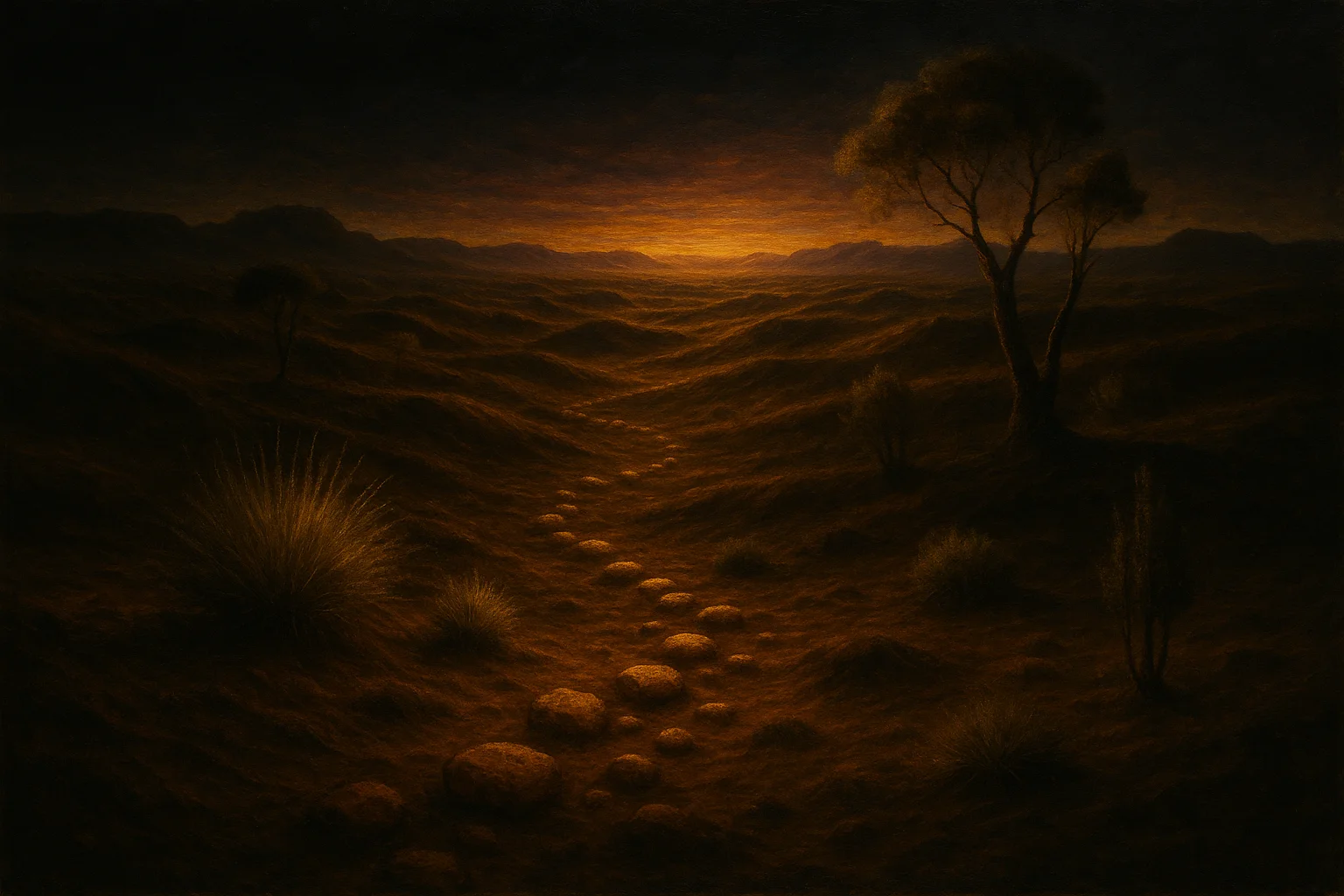
Ancestral beings moved across the land in the formative epoch, and their actions left physical traces. A hill is the body of a sleeping ancestor. A waterhole marks where a serpent burrowed into the earth. A line of rocks records the path of the Seven Sisters fleeing a pursuer. The landscape is text, and those who know the stories can read it.
These beings were not gods in the sense of distant, transcendent powers. They were more like potent ancestors: fallible, passionate, capable of both creation and destruction. Some became features of the land. Others transformed into animals, stars, or weather patterns. A few remain active, requiring propitiation or avoidance.
Songlines: Maps Sung Into Being
Songlines, also called song cycles or dreaming tracks, are mnemonic pathways that encode geography, law, and ceremonial knowledge in verse. An initiated person who knows the songs for a particular track can navigate hundreds of kilometres of country, using the verses as waypoints. Each verse corresponds to a specific landmark: a waterhole, a ridge, a stand of trees.
T.G.H. Strehlow's Songs of Central Australia (1971) documents song cycles among the Arrernte that span vast distances and require days to perform in full. The songs do not merely describe the land; they are understood to maintain it. To sing the song is to re-enact the ancestral journey, to keep the land alive.
Songlines often cross language boundaries. A single track may pass through the territories of multiple nations, each of which holds custodianship over the section that falls within their country. Ceremonial exchange and permission are required to sing the full cycle. This creates a web of relationships and obligations that binds distant groups together.
"The land is a sacred iconography, and the songs are its captions." W.E.H. Stanner, The Dreaming (1953)
Regional Traditions and Ancestral Beings
The Rainbow Serpent Across the Continent
The Rainbow Serpent is perhaps the most widely recognised figure in Aboriginal cosmology, but it is not a single being with a single story. The name itself is an English construction. In the Northern Territory, the Yolngu call it Ngalyod. Among the Gunwinggu, it is Ngalyod or Bolung. In Queensland, the name varies again.
Across these traditions, the serpent is associated with water, fertility, and the creation of watercourses. It is often depicted as a dragon-like being, immense and coiled, capable of both nurturing and devastating floods. In some regions, it is female; in others, male or ambiguous. It may be benevolent or dangerous depending on whether ceremonial law is observed.
The serpent's association with rainbows likely derives from its connection to water and weather. After rain, the rainbow marks the serpent's presence or passage. Rock art across northern Australia depicts serpents with arched bodies and radiating lines, suggesting both the creature and the atmospheric phenomenon.
Similar serpent cosmologies appear worldwide, but the Aboriginal versions are distinguished by their grounding in specific waterholes and river systems. The serpent is not an abstract symbol; it resides in known places and must be approached with care.
Baiame and the Sky Heroes of the Southeast
Among the Wiradjuri, Kamilaroi, and neighbouring groups of New South Wales, Baiame is the principal ancestral figure, often described as an all-father or sky hero. He is credited with establishing law, creating certain animals, and teaching ceremonial practice. His wives, typically two, are associated with specific sites and with the transmission of women's knowledge.
Baiame's role varies by community. In some accounts, he withdrew to the sky after completing his work on earth. In others, he remains accessible through ceremony. A.P. Elkin, in The Australian Aborigines (1938), notes that Baiame is invoked in initiation rites and that his image is sometimes carved into trees or painted on ceremonial grounds.
The southeastern traditions were among the first to be disrupted by colonisation, and much of the detailed ceremonial knowledge has been lost or restricted. What remains suggests a cosmology centred on reciprocal relationships between sky, earth, and human community.
Wandjina and the Kimberley Rock Art
In the Kimberley region of Western Australia, the Wandjina are ancestral beings associated with rain, clouds, and fertility. They are depicted in rock art as large, mouthless figures with halo-like headdresses, often surrounded by radiating lines. The absence of mouths is variously explained: some say it is to prevent them from speaking and causing floods; others say it reflects their role as silent, watchful presences.
The Wandjina are not a single being but a class of ancestors. Each has a name and a specific site. They are repainted periodically by custodians, a practice that maintains both the art and the relationship between people and ancestors. The repainting is not restoration in the Western sense; it is renewal, an act that keeps the Wandjina potent.
The rock art itself is among the oldest continuous artistic traditions on earth, with some Wandjina images dated to over 4,000 years. The figures appear alongside depictions of animals, water spirits and merfolk, and other beings, forming a visual catalogue of mythological creatures specific to the region.
Yolngu Cosmology and the Dhuwa-Yirritja Moieties
The Yolngu people of northeast Arnhem Land organise their cosmology around two complementary moieties: Dhuwa and Yirritja. Every person, animal, plant, place, and ancestral being belongs to one or the other. Marriage, ceremony, and land tenure are all structured by this division.
The moieties are not hierarchical but interdependent. Dhuwa and Yirritja ancestors created different parts of the landscape, and their descendants maintain those relationships through ceremony and song. The system is both social organisation and cosmological map.
Yolngu oral tradition includes detailed accounts of ancestral journeys, many of which involve shape-shifting traditions where beings move between human, animal, and elemental forms. These transformations are not metaphorical; they are understood as literal events that shaped the land and established the patterns that govern life today.
Law, Ceremony, and the Living Tradition
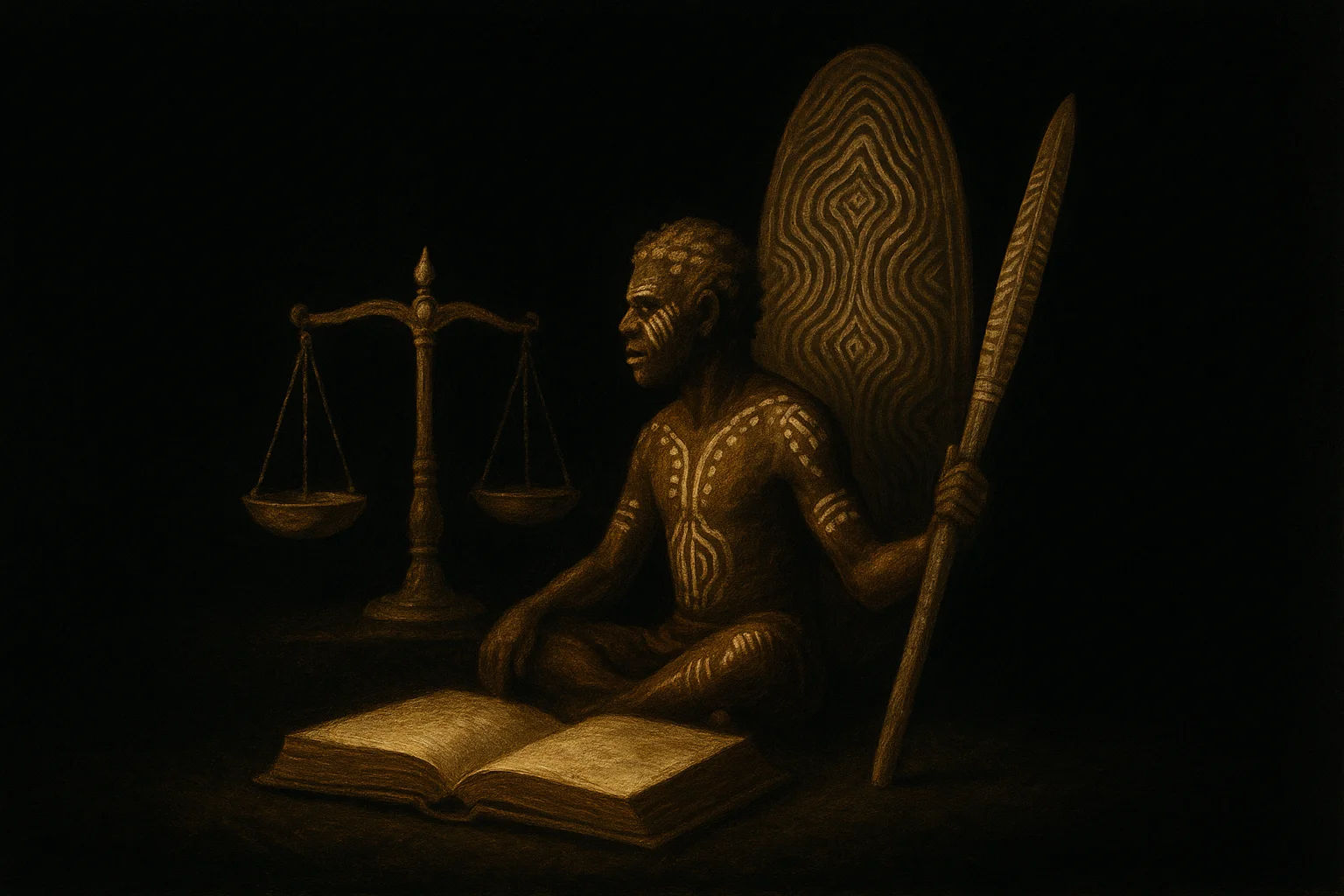
Aboriginal cosmology is inseparable from law. The ancestral beings did not simply create the land; they established the rules by which it must be inhabited. These rules govern everything from kinship and marriage to hunting practices and ceremonial obligations. To break the law is to disrupt the order established in the Dreaming.
Ceremony is the mechanism by which that order is maintained. Initiations, increase rites, and seasonal ceremonies re-enact ancestral events, renewing the connections between people, land, and ancestors. Knowledge is transmitted through these ceremonies, often in stages corresponding to levels of initiation. Not all knowledge is public; some is restricted by gender, age, or clan membership.
The Berndt's fieldwork in the 1940s and 1950s documented ceremonies that could last for weeks, involving participants from multiple language groups. These gatherings were not simply religious events; they were also occasions for trade, dispute resolution, and the negotiation of marriages. Ceremony was the glue that held the social and cosmological order together.
Oral Transmission and the Absence of Written Texts
Aboriginal cultures did not develop writing systems before European contact, but this does not mean they lacked sophisticated methods of preserving and transmitting knowledge. Oral tradition, when supported by ceremony, song, and visual art, can maintain detailed information across millennia.
The songlines themselves are mnemonic devices, encoding not just geography but also law, genealogy, and ecological knowledge. Rock art serves a similar function, acting as a visual prompt for oral narratives. In some regions, message sticks carved with symbols were used to convey specific information between groups.
Daisy Bates, in The Passing of the Aborigines (1938), observed that initiated elders could recite genealogies stretching back dozens of generations and could describe the movements of ancestral beings with precision that matched the physical landscape. This was not rote memorisation but a living engagement with knowledge embedded in country.
The absence of written texts has made Aboriginal traditions vulnerable to disruption. Colonisation, forced removal from country, and the suppression of ceremony have all fractured transmission. Some knowledge has been lost entirely. Other traditions have been revived or reconstructed, sometimes with the aid of early ethnographic records.
Aboriginal Songlines
Encode geography, law, and ancestral narrative in verse; sung to navigate and maintain country; require ceremonial permission to perform in full.
Polynesian Star Compasses
Encode navigation routes across open ocean using star positions and wave patterns; transmitted orally through apprenticeship; similarly bind knowledge to physical practice.
Comparative Notes: Songlines and Other Sacred Geographies
Songlines invite comparison with other traditions that encode knowledge in landscape. The Andean concept of ceque lines, radiating from Cusco and marked by shrines, similarly maps cosmology onto geography. Pilgrimage routes in medieval Europe, such as the Camino de Santiago, functioned as both physical and spiritual pathways.
What distinguishes songlines is their integration with oral performance and their role in daily navigation. They are not pilgrimage routes visited occasionally but working maps used to cross country. The songs are both practical and sacred, collapsing the distinction between the two.
The concept of country itself, central to Aboriginal thought, has parallels in other indigenous traditions. The Sami of northern Scandinavia speak of land as alive and responsive. The Maori concept of whenua ties land to identity and ancestry. In each case, the relationship between people and place is reciprocal, not extractive.
Aboriginal traditions also share with other oral cultures a resistance to abstraction. Knowledge is tied to specific sites, specific ancestors, specific songs. This makes it difficult to translate into the universal categories favoured by comparative mythology, but it also preserves a precision that abstract systems often lose. The land is not a symbol; it is the thing itself, and the stories are its voice.
Comparisons with guardian figures such as the Sphinx or nocturnal beings including vampires are less productive, as Aboriginal cosmology does not generally feature the same class of monstrous or liminal creatures. Where dangerous beings appear, they are typically ancestral figures whose power must be respected rather than cryptid traditions like Bigfoot that exist outside the cosmological order.
Frequently asked questions
What is the Dreamtime in Aboriginal mythology?
The Dreamtime, or Dreaming, is an English term for the ongoing cosmological reality in which ancestral beings shaped the land and established law. It is not a past epoch that ended but a dimension that persists, accessible through ceremony and song. Different language groups use different terms: Tjukurpa among the Pitjantjatjara, Alcheringa among the Arrernte. The concept encompasses origin, law, and the continuing presence of ancestors in the landscape.
How many Aboriginal nations exist in Australia and do they share the same myths?
At the time of European contact, over 500 distinct language groups occupied Australia, each corresponding to a separate nation with its own cosmology. While certain motifs recur, such as the Rainbow Serpent or the importance of ancestral beings, the specific narratives, names, and ceremonial practices vary widely. To speak of a single Aboriginal mythology erases the diversity that oral cultures maintain with precision.
What are songlines and how do they function as maps?
Songlines are mnemonic pathways encoded in verse, with each verse corresponding to a specific landmark. An initiated person who knows the songs can navigate hundreds of kilometres of country, using the verses as waypoints. The songs also encode law, genealogy, and ceremonial knowledge. To sing the song is to re-enact the ancestral journey and to maintain the land itself.
Who is the Rainbow Serpent and is it worshipped across all Aboriginal cultures?
The Rainbow Serpent is a class of ancestral beings associated with water, fertility, and the creation of watercourses, appearing in many but not all Aboriginal traditions. It has different names in different regions: Ngalyod among the Yolngu, Bolung among the Gunwinggu. Its gender, behaviour, and role vary by community. It is not worshipped in the Western sense but respected and propitiated through ceremony, particularly in relation to water sources.
How is Aboriginal mythology transmitted without written texts?
Oral tradition, supported by ceremony, song, rock art, and the physical landscape itself, preserves knowledge across generations. Songlines function as mnemonic devices, encoding detailed information in verse. Initiation ceremonies transmit restricted knowledge in stages. Rock art serves as visual prompts for oral narratives. This system, when intact, can maintain precise information over millennia, though colonisation has disrupted many transmission pathways.
What is the relationship between Aboriginal law and mythology?
Aboriginal cosmology and law are inseparable. Ancestral beings established not only the physical landscape but also the rules governing kinship, marriage, hunting, and ceremony. To break these rules is to disrupt the order established in the Dreaming. Ceremony maintains that order by re-enacting ancestral events and renewing the connections between people, land, and ancestors. Law is not secular legislation but cosmological obligation.