

Aisha Qandisha: Jinn Spirit of Waters and Seduction
Aisha Qandisha is the most feared and desired jinn in North African lore: a water spirit who seduces men at riversides, then binds them for life. Learn her origins, her rites, and why she still matters.
Contents
She appears at the edge of a river, just after dusk. A woman of impossible beauty, her hair loose and wet, her feet hidden in the reeds. Men who see her feel a pull they cannot name. They walk toward the water. Some never come back the same.
Aisha Qandisha, the most famous jinn spirit in the Berber and broader North African tradition, has haunted Morocco's rivers, springs, and coastal shores for centuries. She is seducer and destroyer, healer and curse, goddess-remnant and living fear. Unlike the distant deities carved in stone, she has always been immediate: a shape in the mist, a whisper at the well, a fever that settles into a man's chest and refuses to leave.
Her name alone carries weight in Moroccan homes. Mothers use it to warn sons. Trance musicians invoke her at dawn. Ethnographers have argued over her origins for decades, and none has fully settled the question. She is older than Islam, older than the Arab conquests, and possibly older than Carthage. She walks through time the way she walks through water: without leaving footprints, without making a sound.
Who Aisha Qandisha Is: Portrait of a Water Jinn
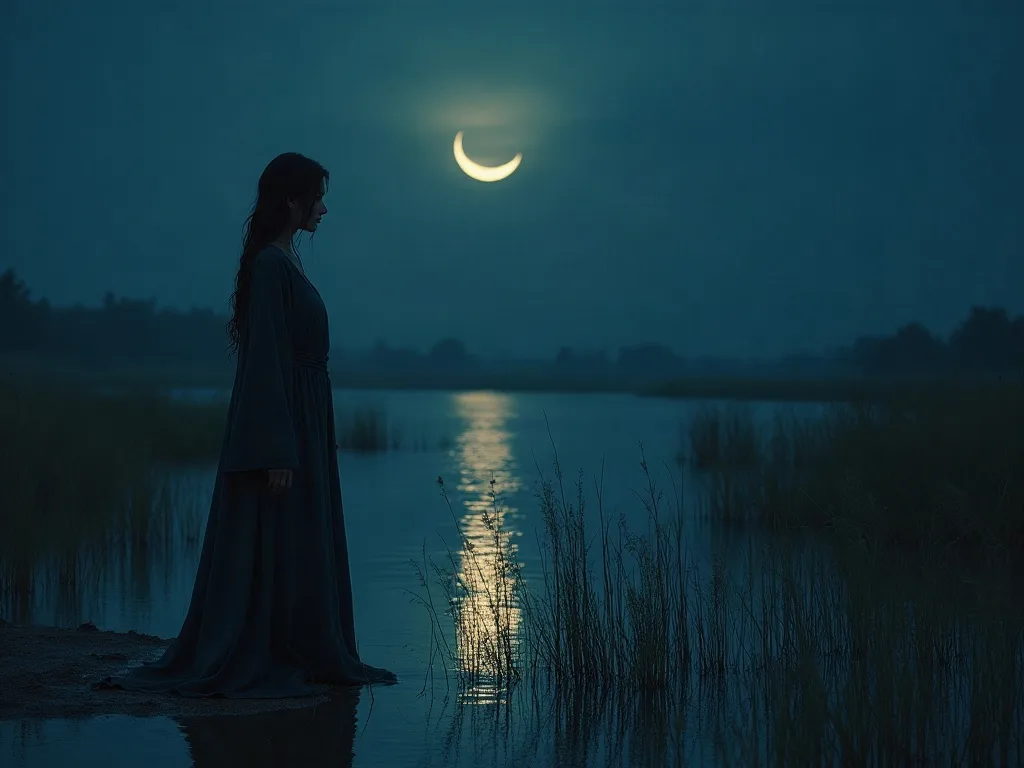
Aisha Qandisha appears in two bodies. The first is the one she chooses: a tall woman of striking beauty, dark-eyed, dressed in robes that cling to her like river water. Her skin is pale or luminous, and her hair falls loose, which in traditional North African culture signals a woman outside social order. The second body is the one she cannot fully hide: below her robes, her feet are the hooves of a goat or a camel. That detail is consistent across nearly every account collected from Morocco's Atlantic coast to the High Atlas foothills.
The hooves are the tell. Folklorists who have recorded testimonies from Moroccan rural communities, including Vincent Crapanzano in his 1973 study The Hamadsha: A Study in Moroccan Ethnopsychiatry, note that men who claim to have survived encounters with Aisha describe the moment of noticing the hooves as the point of no return. To see them is to already be caught.
She lives near water: the Bou Regreg river in Rabat, coastal inlets, limestone springs in the interior. Water in Berber cosmology is a threshold substance, the boundary between the visible world and the invisible one. Aisha inhabits that threshold permanently. She never leaves it entirely.
Her character is not simple cruelty. She has desires, moods, and something resembling loyalty. A man she favors may receive gifts: sudden luck, creative inspiration, sexual vitality. He also becomes, in the vocabulary of Moroccan popular belief, maskhut (captured), meaning his emotional and erotic life now belongs to her. He may find it impossible to sustain relationships with human women. He wakes at night hearing her voice. He craves water.
The Name: Two Origins, One Figure
The name "Aisha Qandisha" has generated serious scholarly debate, because both halves remain contested.
Aisha is an Arabic personal name meaning "alive" or "living," and it is also the name of the Prophet Muhammad's wife. The pairing of that sacred name with a jinn figure is striking enough that some Islamic scholars historically insisted the two must be kept separate, that the water spirit's name was a later corruption. Most ethnographers today treat the name as a genuine cultural fusion: the pre-Islamic spirit was given an Arabic-sounding name as part of the long process of Islamic acculturation after the Arab conquest of North Africa in the seventh century.
Qandisha is harder. Several competing readings exist:
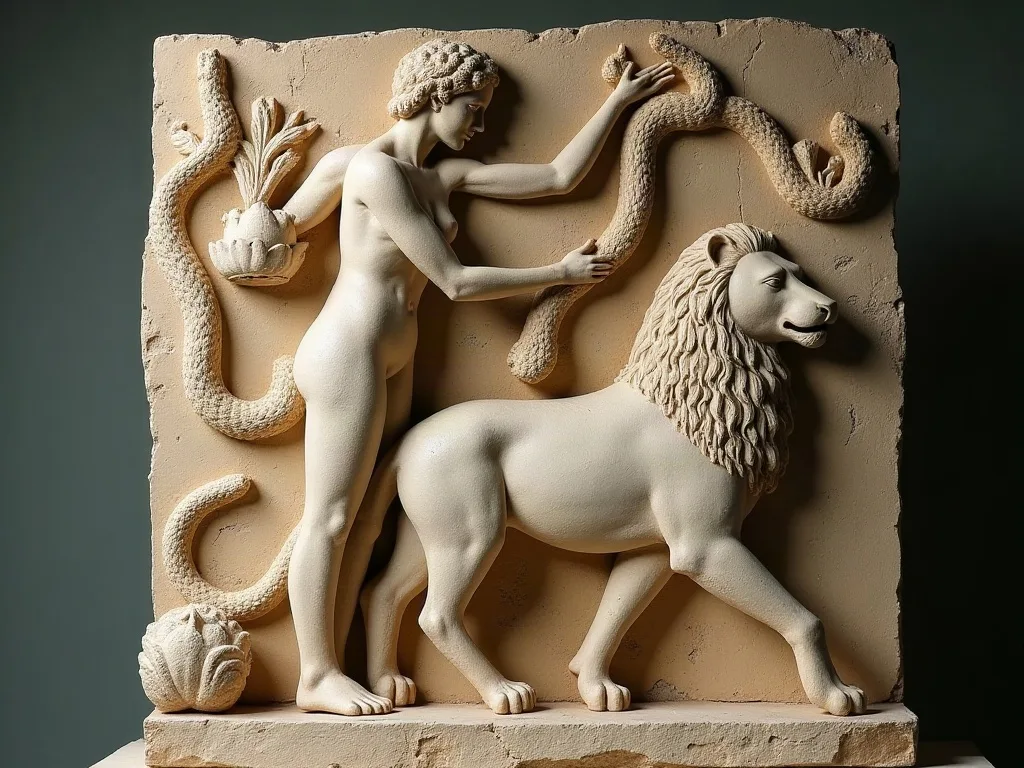
- One school links it to the Phoenician goddess Qadesh, a naked goddess of sacred sexuality venerated across the ancient Levant and attested in Egyptian records from the New Kingdom period. Qadesh was shown standing on a lion, holding serpents and lotus flowers. Her cult spread along Phoenician trade routes, and Carthage, just across the Mediterranean from Morocco, was a Phoenician colony.
- A second school derives qandisha from the Arabic root q-n-d, meaning something sweet or sugared, reading her name as "sweet Aisha" or "Aisha of pleasures."
- A third reading connects it to the Berber-Latin word candida, meaning bright or white, emphasizing the luminous skin described in sightings.
No consensus has settled the matter. What is clear is that the figure is genuinely ancient and that her characteristics align with pre-Islamic water goddesses across the ancient Mediterranean world.
Roots in the Ancient Berber and Carthaginian World
The Imazighen (the Berber peoples, whose name means "free people") inhabited North Africa long before Phoenician merchants arrived on the coast, before Rome built its African provinces, and before the Arab armies rode westward in the 600s CE. Their spiritual world was dense with nature spirits, ancestor powers, and supernatural beings tied to specific landscapes.
Water spirits occupy a central position in Imazighen cosmology. Springs were sacred. Rivers had guardians. The sea was conscious and moody. When Phoenician traders established Carthage in roughly 814 BC and began building coastal settlements across what is now Morocco, they brought their own goddess traditions, including Tanit (the great goddess of Carthage, whose symbol appears on steles across North Africa) and Qadesh. Those figures interacted with existing Berber spirit beliefs over centuries.
The Carthaginian dimension matters because of geography. The cities of Lixus and Mogador, both in modern Morocco, were Phoenician foundations. Their populations were mixed: Berber, Phoenician, later Roman. The syncretic religious life of those port cities created exactly the kind of blended figure that Aisha represents: a water-dwelling, sexually powerful female being who demands reverence and punishes disrespect.
After Rome absorbed the region, Roman Africa preserved Berber sacred geography even while adding new temple gods. The Arab conquest of the Maghreb between 647 and 709 CE brought Islam, a radical reorganization of the spirit world, and a new vocabulary. Pre-Islamic spirits did not disappear; they were reclassified as jnun, absorbed into the Islamic framework that acknowledges the existence of non-human beings created from smokeless fire. Aisha survived that reclassification intact, because she was too immediate, too local, too feared to simply dissolve.
For a broader view of how Berber sacred tradition has carried itself through those successive cultural layers, the Berber mythology hub traces the full geography of that survival.
Aisha and the Gnawa: Sacred Music as Negotiation
The most living context in which Aisha Qandisha still operates is the Gnawa musical tradition, recognized by UNESCO in 2019 as an intangible cultural heritage of humanity. The Gnawa are a brotherhood whose ancestors were enslaved people brought from sub-Saharan Africa into the Maghreb. Their ritual music, called lila (night ceremony), involves hours of trance performance designed to negotiate with specific jnun on behalf of afflicted individuals.
Aisha holds a prominent place in the Gnawa pantheon of spirits. She has her own musical color (black, or sometimes the deep blue-black of the ocean), her own incense (benzoin), and her own moment in the lila sequence. When her music begins, practitioners and possessed individuals move like water: fluid, undulating, low to the ground.
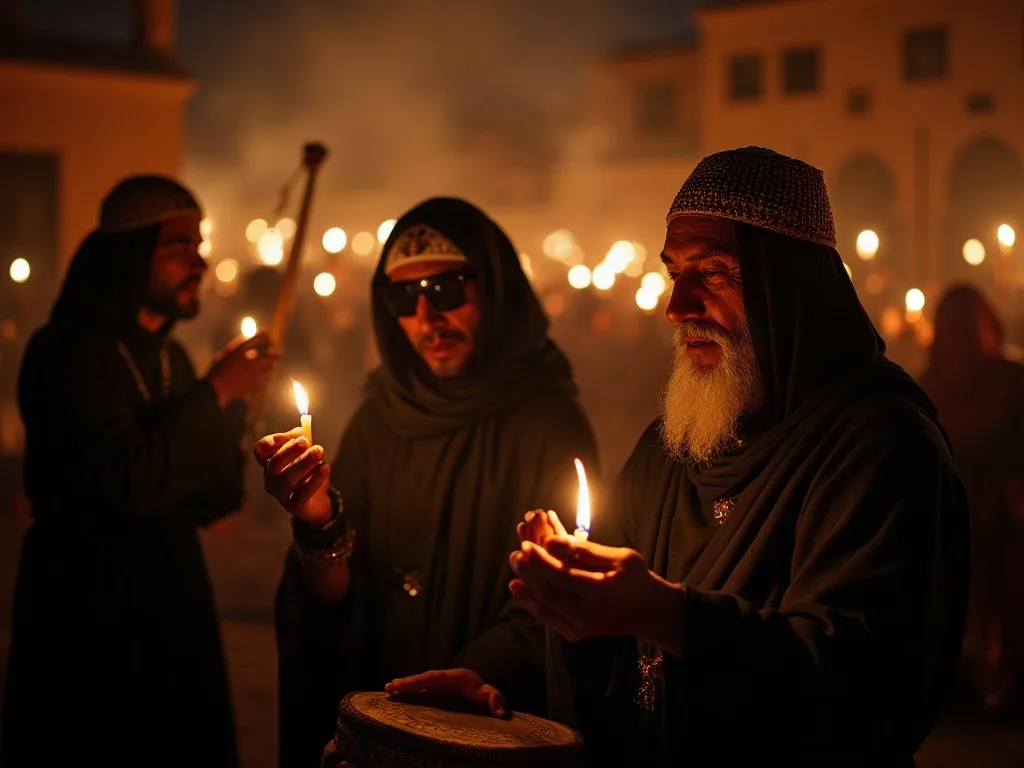
The Gnawa understanding of Aisha is explicitly therapeutic. A person who has been "struck" by her (made ill, obsessive, sexually dysfunctional, or emotionally destabilized) is brought to a lila so that the maalem, the master musician, can open a negotiation. The goal is not exorcism. It is covenant. Aisha is offered what she wants: perfume, candles, certain foods, music. In return, she is asked to ease her grip on the afflicted person.
Vincent Crapanzano's fieldwork among the Hamadsha brotherhood, a related trance group in Morocco, documents case after case of men who describe their illness in terms of erotic captivity. One man told him: "She came to me at the river. After that, I could not look at my wife. I only thought of the water." The Hamadsha ritual, like the Gnawa lila, treats that captivity not as madness but as an actual relational contract that must be managed.
The Seduction Myth: What Actually Happens
The encounter narrative follows a consistent shape across dozens of collected accounts from Morocco, Algeria, and the Moroccan diaspora. It is worth walking through that shape carefully, because it is not simply a morality tale about sexual temptation.
A man is alone near water, usually at dusk or night. He sees a woman. She is beautiful. She speaks to him, or she simply looks at him, and the look is enough. He feels compelled to follow. The moment of capture varies: sometimes it is a touch, sometimes sexual intercourse, sometimes merely accepting food or water from her. But the result is always the same. Something shifts inside him. He returns home changed.
The change manifests as obsession. He cannot stop thinking about the water. He may become impotent with his wife. He may sleepwalk toward rivers. He may hear her voice calling him at odd hours. He may fall ill with fevers that doctors cannot diagnose. In severe cases, he becomes dangerous to those around him, acting out her jealousy when other women approach him.
What is notable is that this narrative is not framed as punishment for moral failure. The man is not blamed for being curious or attracted. Aisha is simply more powerful than human desire, and proximity to her power changes a person permanently. The proper response is ritual, not shame.
The protective measure is equally consistent across accounts: iron. Aisha Qandisha fears iron blades, and a man who thrusts an iron knife into the ground at the moment of encounter can sometimes break her hold. Iron is an ancient apotropaic material across Mediterranean and African cultures, its use against spirits documented from ancient Rome to sub-Saharan West Africa. Among the Imazighen, iron objects near doorways and thresholds remain common protective items.
Aisha Across Borders: Related Figures in the Mediterranean World
Aisha Qandisha is not an isolated figure. She belongs to a family of water-spirit women that spans the ancient Mediterranean and beyond.
Lilith, in Jewish mystical tradition (primarily in the Babylonian Talmud and later Kabbalistic texts), is a night-wandering female being who seduces men in their sleep, causes reproductive illness in women, and harms newborns. She too has features associated with wild nature, refusal of subordination, and sexual power that operates outside human social contracts. The parallel with Aisha is structural: both are female, both are associated with illness and captivity through desire, and both require specific ritual objects for protection.
Melusine, the water fairy of medieval French and Breton legend, adds another angle. Melusine is a woman who transforms below the waist (into a serpent or fish tail) when unobserved, just as Aisha's goat hooves are the visible seam between her human appearance and her true nature. Both figures bind men through desire, both punish disclosure of their secret nature, and both are associated with specific rivers and springs.
The sirens of Greek mythology present yet another structural relative: female beings whose beauty and voice draw men toward water and destruction. Homer's Odyssey, written in the eighth century BC, shows Odysseus lashing himself to his ship's mast to resist their call. The Moroccan man who thrusts iron into the ground performs the same logic: physical restraint against a pull that overrides rational will.
These parallels do not reduce Aisha to a copy of other traditions. They place her within a genuinely ancient Mediterranean understanding of female water power: that bodies of water have a will, that the will is often expressed as desire, and that desire is both gift and danger.
Gender, Power, and the Fear She Carries
Modern scholars reading Aisha Qandisha through a gender studies lens have noted, fairly, that the figure concentrates male anxieties: about female sexuality, about the power of desire, about what happens when a woman cannot be controlled by social structures. She is precisely the woman who refuses the roles that Moroccan patriarchal society historically assigned. She is unmarried by choice. She has no father, no husband, no household. She initiates contact. She chooses her partners. She punishes rejection.
The ethnomusicologist Deborah Kapchan, writing on Gnawa practice and female possession in Morocco, notes that Aisha is simultaneously a site of fear and a site of female power. Women who become Gnawa practitioners often invoke Aisha specifically, because she represents an authority that exists outside male social permission. In that reading, her "captivity" of men is not purely threatening: it is also a fantasy of female agency in a context where female agency was historically constrained.
At the same time, reducing her entirely to a social projection misses what Moroccan people who deal with her actually report: the encounters are visceral, the illness is real, the relief brought by Gnawa ritual is documented. Whether one reads that through neuroscience (dissociative trance states, psychosomatic illness resolving through ritual catharsis) or through the framework of Moroccan Islamic cosmology (a jinn genuinely present and genuinely negotiated with), the phenomenon is not trivial.
Aisha is a figure that carries both dimensions simultaneously: she is a social text AND a living presence for those who take her seriously. That double reality is precisely what makes her one of the most complex beings in North African mythological tradition.
Aisha in Contemporary Morocco and the Diaspora
She has not faded. Moroccan hip-hop artists reference her. Filmmakers have used her image. The artist Hassan Hajjaj photographed Gnawa musicians, and the visual vocabulary of the tradition, including Aisha's colors and symbolic objects, circulates now in global gallery spaces. In Moroccan diaspora communities in France, Spain, the Netherlands, and Belgium, Gnawa associations hold lilas in European cities, bringing Aisha's music into spaces far from the Bou Regreg river.
The writer and anthropologist Fatima Mernissi, one of Morocco's most important intellectual voices, wrote about the jnun world as a parallel Morocco: invisible, gendered, and deeply revealing of the anxieties and desires that the official culture could not openly express. In that sense, Aisha Qandisha remains a living document of what Morocco has feared and wanted across many centuries.
She is also a warning that ancient things resist replacement. Islam has been Morocco's official religion for over 1,300 years. That is long enough to have erased any pre-Islamic spirit that was merely a story. Aisha is not merely a story. She has a music, a color, an incense, a ritual sequence, and a community of practitioners who negotiate with her annually. That kind of survival is not accidental.
Frequently Asked Questions About Aisha Qandisha
Frequently asked questions
Is Aisha Qandisha part of Islamic belief, or does she predate Islam?
She predates Islam, almost certainly by centuries, and her roots likely connect to pre-Phoenician Berber water spirit traditions as well as Phoenician goddess cults like that of Qadesh. However, she was absorbed into the Islamic framework after the Arab conquest of North Africa in the seventh century CE. Today she is classified as a jinn, a category of non-human beings that Islamic theology officially recognizes. Her ritual treatment through Gnawa and Hamadsha ceremonies coexists with Islamic practice in Morocco, though more scripturally conservative Islamic voices have always been skeptical of jinn veneration.
Why does Aisha Qandisha have the hooves of a goat or camel?
The hooves appear consistently across accounts collected from Morocco, and they serve as the marker that distinguishes her from a human woman. In many Mediterranean and Middle Eastern traditions, the feet or lower body of a supernatural being reveal its true nature: Melusine's fish tail, the cloven hooves of various European demons, and the feet of certain Talmudic figures follow the same logic. The hooves also connect her to the wilderness and the animal world, placing her outside human social order even as her upper body imitates it. Iron, which is said to protect against her, is associated in many traditions with the forged human world as opposed to the wild natural one.
What does the Gnawa lila ceremony actually do for someone afflicted by Aisha?
The lila is a negotiation ceremony, not an exorcism. The maalem (master musician) and the brotherhood perform music specific to Aisha across several hours. The afflicted person may enter trance, which practitioners interpret as Aisha taking possession in order to communicate her demands. Those demands are then met with ritual offerings: specific perfumes, candles, foods, cloth in her colors. The goal is to reach an agreement in which Aisha loosens her grip in exchange for regular ritual acknowledgment. Vincent Crapanzano's 1973 study The Hamadsha documents multiple cases where this process produced lasting relief from the symptoms of possession, including obsessive states, sexual dysfunction, and chronic fevers.
Are there protective measures against Aisha Qandisha?
The most widely reported protection is iron, particularly an iron blade thrust into the ground at the moment of an encounter near water. Salt and certain Quranic verses are also mentioned in different accounts. Some traditions say that naming her aloud breaks her power in the moment, though others hold that speaking her name near water actually invites her attention. The safest traditional advice recorded by ethnographers is to avoid rivers and springs at dusk and night, to carry iron near the body when traveling in isolated areas, and to perform the appropriate Gnawa or Hamadsha ceremony if symptoms of possession appear.
Is the name Aisha Qandisha really connected to the Phoenician goddess Qadesh?
The connection is a serious scholarly hypothesis, not a proven fact. Researchers including Crapanzano and the Belgian Islamicist Edmond Doutté noted the phonetic and functional overlap between Qandisha and Qadesh. Both figures are associated with water, sexuality, and a kind of sacred danger. Qadesh's cult spread through Phoenician maritime trade, and Phoenician cities existed on Morocco's Atlantic coast. However, direct documentary evidence linking the two is absent. The connection remains the most compelling available explanation for the Qandisha element of her name, but alternative etymologies involving Arabic and Berber roots also exist, and the question is not closed.
Does Aisha Qandisha appear in Algerian and Tunisian traditions as well?
Yes, variants of the figure appear across the Maghreb, though the name and specific details differ by region. In Algeria, similar water spirits with seductive and possessive qualities are documented in rural oral tradition, particularly in Kabyle Berber communities where jinn beliefs have remained strong. Tunisia, with its Carthaginian heritage, preserves older layers of Phoenician goddess lore that parallel the Moroccan figure. The Moroccan version, tied to the Atlantic coast and the Gnawa ceremony, is the best documented and most widely discussed, partly because Morocco's religious tourism and diaspora culture have amplified it, but the figure belongs to a shared North African spiritual geography.
The Unresolved Question: Goddess, Spirit, or Living Memory
Scholars have not agreed on what Aisha Qandisha ultimately is, and that disagreement is itself revealing.
One school, represented by older colonial-era French ethnographers like Edmond Doutté (Magie et religion dans l'Afrique du Nord, 1909), treated her as a degraded goddess: a deity who lost her temple cult after the Arab conquest and survived only in folk belief, stripped of her original theological dignity. In that reading, she is a kind of fossil, the last remnant of something once grand.
A second school, represented by mid-century Moroccan anthropologists and more recent Berber cultural revivalists, refuses the "degradation" framing. She did not degrade. She adapted. She moved from temple to riverbank, from priestess to maalem, from goddess to jinn, without losing her essential power. That adaptation is not decline; it is survival. It is exactly what ancient things do when civilizations change around them.
A third position, advanced by scholars like Deborah Kapchan in her 2007 book Traveling Spirit Masters, focuses on the living performance rather than the historical origin. What matters is not what Aisha was in 800 BC or 800 CE, but what she does now: she gives shape to unnamed desires, gives language to unnamed illnesses, and gives a community of practitioners a structure for managing the parts of human experience that ordinary social life cannot hold. In that sense, she is not a fossil and not a survivor. She is a current technology, one that happens to be very old.
All three readings are incomplete on their own. Aisha Qandisha is a figure from Berber antiquity who absorbed Phoenician sexual-goddess motifs, survived Islamic reclassification as a jinn, and became the central spirit of a living North African ceremonial tradition. She is, at the same time, older than any of those labels and larger than any single explanation.
The river at dusk does not care what scholars call it. It keeps moving. So does she.
Free 25-page sample
Want the whole story?
Take the first 25 pages free. If it pulls you in, the full edition is yours as an instant PDF download, with a paperback on Amazon for selected titles.
Berber
The Berber Mythology Book: The Gods, Spirits, and Sacred World of the Amazigh
The Amazigh: Gods, Spirits, and North Africa
The beliefs of North Africa’s first people, the Amazigh, who were old when Carthage was young: the sun and the moon, the jnun of the wild places, the cult of the ancestors and the caves, the goddess the Greeks called Athena, and a tradition that outlived every empire.
More from Berber
All articles
Berber
The Azru Oak: Sacred Tree Cult and Ritual Sites in Berber Tradition
The Azru Oak stands as the living spine of Berber sacred geography, where tribal councils, healing rites, and offerings to ancestral spirits converged for millennia. Discover how this revered tree shaped Berber law, spirituality, and community bonds across North Africa.
Berber
Masinissa: King and Cultural Hero of Numidia
Masinissa united Numidia and shaped the destiny of North Africa by walking between Carthage and Rome. His reign (202-148 BCE) transformed a fragmented kingdom into a civilized power that wrote its own laws.
Berber
Yennayer: Berber New Year and Agricultural Festival
Yennayer marks the Berber New Year on January 14, celebrating the spring planting season and ancestral connection to the land. Discover how this 2,944-year-old festival blends agricultural ritual, family tradition, and cultural identity across North Africa.
Berber
The Hand of Fatima in Berber Symbolism: Protection, Blessing, and Identity Across North Africa
The Hand of Fatima, or Khamsa, is far more than Islamic decoration in Berber culture. It carries layers of pre-Islamic protection magic, women's agency, and ancestral wisdom. Discover how Amazigh communities wove this symbol into identity, ritual, and everyday life across Morocco, Algeria, and Tunisia.