
The Pale Fox (Ogo/Yurugu): Trickster and Chaos Bringer in Dogon Myth
Ogo the Pale Fox is the Dogon spirit of disorder, born incomplete and forever restless. Discover how this trickster shaped creation itself, and why his chaos was necessary.
Contents
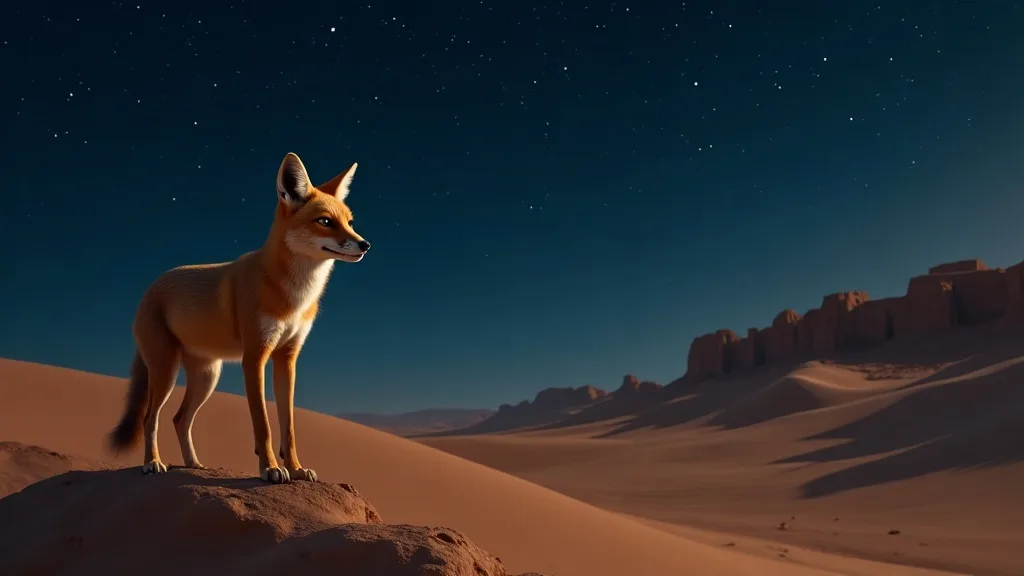
Before the world had a shape, before the first grain of fonio fell from the sky granary, a being tore himself free. He was impatient, unfinished, burning with a hunger that would never be satisfied. The Dogon of West Africa call him Ogo, or in some tellings Yurugu. In the physical world, he walks as the pale fox, the sand-colored Vulpes pallida that leaves tracks across the Sahel at night, answering no one, going wherever the dark takes him.
His story is not a simple tale of a villain. It is something older and stranger: a creation myth where the one who broke everything also made the world possible. Ogo did not fall from grace. He ran from it, half-formed and howling, before grace was even finished.
Who the Dogon Are, and Why This Myth Matters
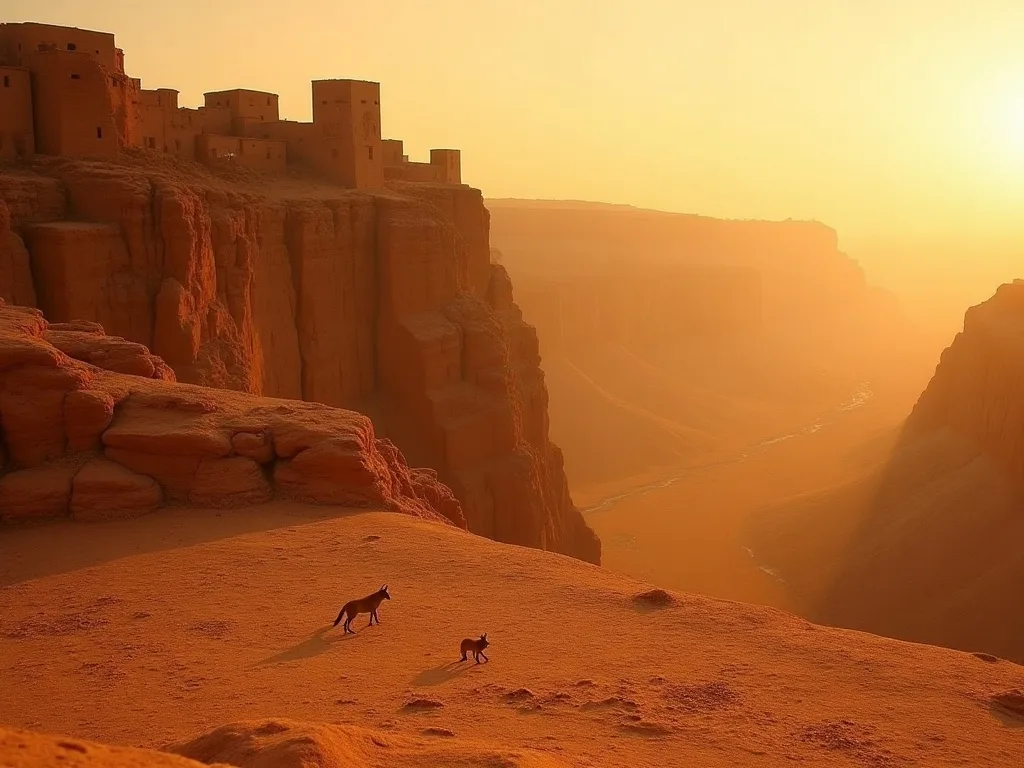
The Dogon people live mainly on and around the Bandiagara Escarpment in present-day Mali, a dramatic stretch of sandstone cliffs that rises more than 500 meters above the surrounding plains. Their villages cling to the cliff face, built in layered mud and stone that has resisted the Sahara's edge for centuries.
Their cosmology is one of the most richly documented in sub-Saharan Africa, largely because of the fieldwork of French anthropologist Marcel Griaule, who worked with Dogon elders, most notably a blind sage called Ogotemmêli, through the 1930s and 1940s. Griaule's 1948 book Conversations with Ogotemmêli opened this tradition to outside scholarship. Later studies by Griaule and Germaine Dieterlen, published in Le Renard Pâle (1965), laid out the full cosmogonic cycle in extraordinary detail.
The Dogon cosmos pivots on a supreme creative principle called Amma, a singular, abstract god who holds the geometry of existence in his thoughts. From Amma came the Nommo, a pair of primordial twins who represent order, water, speech, and life in balance. Then came Ogo, and everything changed.
The Birth of Ogo: An Unfinished God
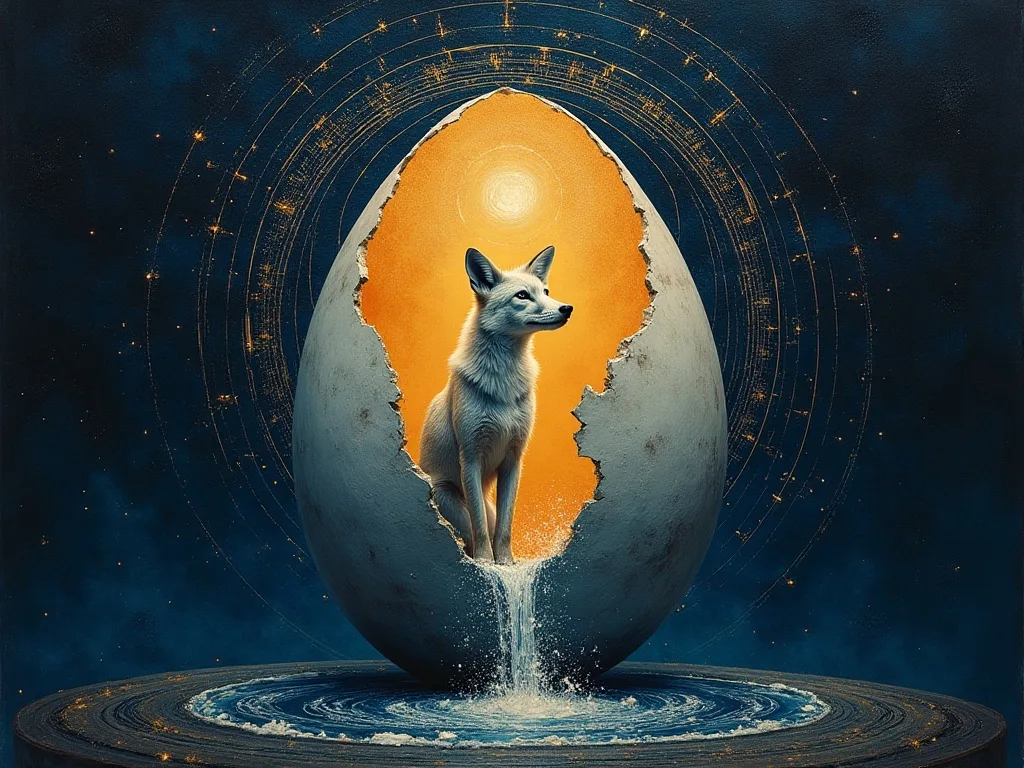
Amma began creation inside a cosmic egg, or aduno tal, shaping twin embryos destined to be perfect, paired, and complete. Twinness mattered enormously in Dogon thought. A single, un-twinned being was inherently unstable, the way one side of a scale tips without a counterweight.
Ogo grew impatient inside the egg. Before his twin could form beside him, before his own soul was whole, he broke free. He tore a piece of his placenta with him as he left, taking part of Amma's first creation as his own stolen territory. That stolen fragment became the Earth, impure and unfinished, built from an act of rupture.
Amma responded by taking Ogo's twin soul back. What was meant to be Ogo's feminine complement, his Nommo counterpart, was sacrificed and scattered across the world Ogo had torn loose. This sacrifice was not punishment alone. It was how the world got its animating principle, its nyama, the life-force that soaks through soil, wood, bone, and breath.
Ogo, now irreversibly un-twinned, became what the Dogon describe as the po pilu, the incomplete pale one. He descended to the impure earth he had created, took the form of the pale fox, and began his restless wandering. He cannot stop moving. He cannot be whole. His tracks in the sand at dawn are the only language he has left, because Amma withdrew the gift of articulate speech from him.
The Pale Fox as Divination Tool
This is one of the most arresting turns in Ogo's story. The creature who lost speech became the medium through whom hidden things are spoken.
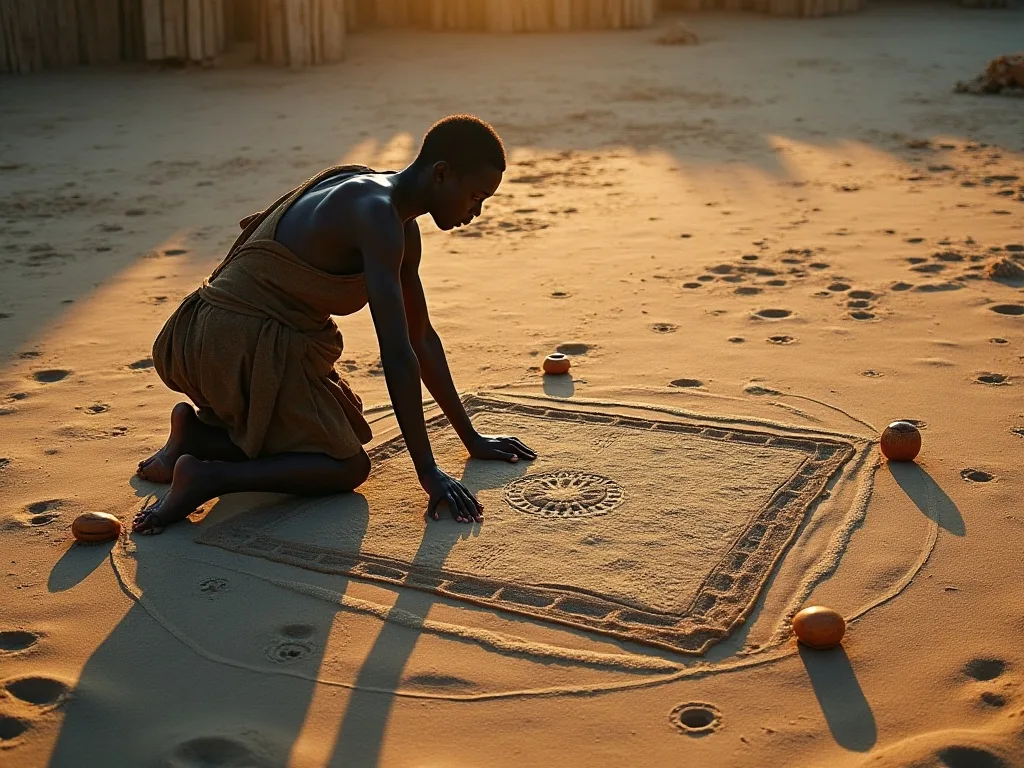
Dogon diviners, called binu practitioners or simply the elder men who know the fox's patterns, prepare a smooth square of sand near a village before nightfall. They scratch symbols into it: lines, crosses, small wooden objects representing questions about the sick, the dead, disputes over land, the right moment to plant. Then they scatter peanuts or other attractants across the surface and withdraw.
Ogo, the pale fox, comes in darkness. He moves through the sand to reach the peanuts, and by morning his paw prints cross and re-cross the symbols the diviner placed. The pattern of prints is the answer. Where Ogo stepped, what he touched, what he ignored: these become the oracle's reading.
The logic is exact. Because Ogo broke free before speech existed, he carries pre-linguistic knowledge. He knows the structure of the incomplete world because he is that incompleteness. His body encodes what Amma knows but will not say directly. The diviner reads the disorder and finds, within it, a kind of brutal clarity.
Ogo and the Nommo: Order Against Chaos
To understand Ogo/Yurugu, you need to understand who he stands against. The Nommo are his counterparts in every sense: completed, paired, wet, articulate, and life-giving. Where Ogo is dry and solitary, the Nommo come in pairs, associated with water, rain, the river, the regenerative dark of the womb.
Amma sacrificed one of the Nommo, a figure sometimes called the Nommo Titiyayne, whose dismembered body seeded the earth with nyama and made agriculture possible. This is the sacrifice that partially redeems the stolen, impure earth Ogo created. The Nommo's death transforms Ogo's chaotic act into something workable, something that can feed and shelter the Dogon clans.
Ogo (Pale Fox)
- Born alone, twin soul taken back by Amma
- Associated with dryness, the desert, the night
- Moves by instinct; speech was withdrawn from him
- Creator of the impure, disordered earth
- Embodies incompleteness and restless seeking
- Serves as involuntary oracle through his tracks
Nommo (Twin Spirits)
- Born in pairs, inherently balanced
- Associated with water, rain, and fertility
- Given the gift of articulate speech by Amma
- Sacrificed to sanctify and animate the earth
- Embody wholeness, order, and regeneration
- Actively teach humans craft, agriculture, weaving
The opposition between them is not a simple good-versus-evil split. Dogon cosmology holds that the world needs both poles. Ogo's disorder created the material plane; the Nommo's sacrifice made it liveable. Without the rupture, there is no earth. Without the healing, there is no life on it.
This is a structural pattern that scholars of religion, including Marcel Griaule and later Geoffrey Parrinder in African Mythology (1967), have noted as one of the most philosophically consistent cosmogonies in the African continent. The disorder is not an error to be corrected but a founding condition to be worked with.
What Ogo Stole: Theft, Incest, and the Impure Earth
The myth of Ogo's rupture carries further dark weight. When he tore himself loose from the cosmic egg, the piece of placenta he seized was not neutral material. It was, in Dogon symbolic logic, his own mother. Ogo's founding act was simultaneously a theft from Amma and an incestuous union with the earth-matter he seized.
This detail is not sensationalism. It is the theological core of why the earth is described as impure (bummo) in Dogon cosmology. The planet humans live on carries the mark of that original transgression. This is why Dogon ritual, agriculture, and social life are shot through with purification practices, the giving of offerings to Nommo, the careful observation of social taboos, the structured patterns of the eight Dogon clans that map onto the body of Amma himself.
Ogo's stolen territory had to be repeatedly sanctified. The Nommo's sacrifice was one great act of that sanctification. Every funeral ritual, every agricultural ceremony, every act of weaving on a Dogon loom (the loom itself is a cosmological symbol, its warp and weft the threads of a reordered universe) participates in an ongoing repair of what Ogo broke.
Amma, the Dogon supreme creator, is not a distant or indifferent figure in this process. He actively responds to Ogo's rupture by reorganizing creation, proving that in Dogon thought, disorder triggers divine response rather than divine abandonment.
The Fox's Tracks Across World Mythology
Ogo is a trickster, and tricksters appear in mythological traditions across the globe with a stubborn consistency that scholars of comparative religion find worth examining. But the Pale Fox stands apart from the most familiar trickster templates in meaningful ways.
Loki in Norse myth is a shapeshifter whose tricks begin as amusements and curdle into catastrophe. He works within the divine community before being expelled from it. Ogo was expelled before the community even existed. He is not a disruptor of order; he predates order.
The Coyote of many Indigenous North American traditions is a creator-trickster who makes useful things by accident and harmful things by impulse. He is often funny, often sexual, often both helpful and dangerous within the same story. Ogo shares the unpredictability but carries almost no humor. His restlessness reads as tragic, not comic.
Anansi of the Akan-speaking peoples, the spider who weaves stories and outwits gods, uses intelligence as his primary tool. Ogo uses neither intelligence nor brute force. He uses pure instinct, the unthinking drive of an incomplete being to keep moving, keep seeking the wholeness he cannot reach.
What makes Ogo unique is that his trickster nature is structural, not behavioral. He does not choose to cause chaos. He is chaos in a body, walking across sand, leaving prints that humans must learn to read.
Ogo in Dogon Social and Ritual Life
The pale fox's presence in Dogon society is not only cosmological. It is practical, woven into daily decision-making in ways that ground the abstract myth in lived experience.
Fox divination, called geomancy of the fox in many anthropological texts, is used to answer questions that human reason alone cannot resolve. When a person falls ill and medicine has not helped, the diviner's sand square may be consulted. When two families dispute who rightfully holds a piece of land, the fox's tracks may serve as a third voice. The Belgian anthropologist Walter E. A. van Beek, who revisited Griaule's fieldwork in the 1990s and raised important methodological questions about how much was Dogon tradition and how much was shaped by the interview process, confirmed that fox divination is genuinely practiced and deeply embedded in village life, whatever the exact theological interpretation may be.
Van Beek's reassessment is worth noting honestly. He found that not all Dogon communities shared the elaborate cosmological system Griaule recorded, and that Ogotemmêli's account may represent one specialist lineage's knowledge rather than a universal Dogon theology. This does not diminish the tradition. It adds complexity: the Pale Fox myth may be the property of specific initiatory lineages within Dogon society, their most refined answer to the question of why the world is as broken and as beautiful as it is.
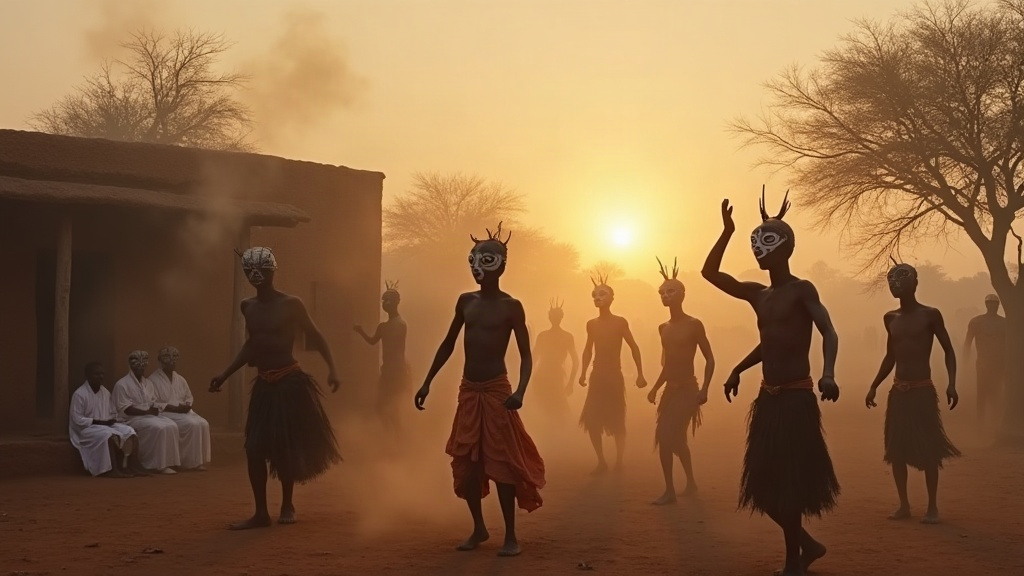
The Dogon Sigui festival, held every sixty years (the last was in 1967 and the next expected in 2027), involves a ceremonial re-enactment of Ogo's primordial theft and the subsequent death and resurrection of the Nommo. Masks representing the ancestors process through the villages; the deep, wooden sirige mask, which can stand over three meters tall, traces the vertical axis of the cosmos that Ogo disrupted.
The Fox's Unresolved Hunger: What Ogo Still Wants
There is a question the myth leaves deliberately open. Can Ogo ever be completed? Can he find his missing twin soul?
The Dogon texts recorded by Griaule and Dieterlen do not promise resolution. Ogo wanders. He keeps looking, though what he is looking for was taken before he could ever have named it. His twin soul was absorbed back into Amma, then distributed through the Nommo sacrifice, seeded into the very earth Ogo runs across each night. In a terrible symmetry, he searches the surface of the earth, and what he seeks is in the earth, beneath his feet, everywhere and therefore nowhere.
This is close to what philosophers call an aporia: an impasse with no exit, a question that the very structure of thought cannot answer. And yet Dogon ritual keeps working around this aporia. The fox divination does not solve Ogo's incompleteness. It uses it. His unsatisfied hunger becomes a kind of instrument, a tuning fork held against the surface of human confusion to produce something that sounds, however briefly, like knowledge.
Frequently Asked Questions About Ogo and the Pale Fox in Dogon Mythology
Frequently asked questions
Is Ogo the same as Yurugu, or are they different figures?
The names are used for the same mythological figure but carry slightly different nuances depending on the Dogon community and the initiatory context. "Ogo" refers broadly to the being who tore himself from the cosmic egg; "Yurugu" is the name used specifically for his manifestation as the pale fox on earth. Marcel Griaule and Germaine Dieterlen use both in Le Renard Pâle (1965), often interchangeably at the cosmological level while distinguishing the terrestrial fox-form as Yurugu.
Why does Ogo take the form of a fox and not another animal?
The pale fox (Vulpes pallida) is a real species common to the Sahel, including the Bandiagara Escarpment region. Its nocturnal habits, solitary behavior, and dry-adapted lifestyle map precisely onto Ogo's symbolic profile: alone, restless, associated with dryness and night rather than water and daylight. The animal was not chosen arbitrarily. It was recognized as the living embodiment of the mythological pattern the Dogon had already articulated.
How reliable is Marcel Griaule's account of Dogon mythology?
Griaule's work remains the most detailed record of the Dogon cosmological system, but anthropologist Walter E. A. van Beek's fieldwork in the 1990s raised genuine concerns. Van Beek found that the deep theological knowledge Griaule described was not broadly distributed across Dogon communities and may reflect the specialized knowledge of particular lineages, especially that of Ogotemmêli. Scholars today treat Griaule's account as a vital but partial window into one strand of Dogon thought rather than a complete and universal Dogon theology.
Is Dogon fox divination still practiced today?
Yes. Van Beek's 1990s fieldwork confirmed that fox divination is actively practiced in Dogon villages. Diviners prepare sand squares with symbols overnight and read the fox's tracks at dawn to address questions about illness, land disputes, and community decisions. The practice is not a museum artifact; it remains a living method of consultation, though it is not equally distributed across all communities.
How does Ogo compare to other African trickster figures?
Ogo differs from figures like Anansi or Eshu-Elegba of the Yoruba in that his trickster nature is cosmological rather than social. Eshu and Anansi operate within an existing world, using wit and cunning to navigate or subvert its rules. Ogo's disruption happened before the world was finished, making him less a trickster in the conventional sense and more an embodiment of primordial incompleteness. His "tricks" are not chosen; they are structural features of what he is.
What is the Nommo, and why does it matter for understanding Ogo?
The Nommo are paired primordial beings created by Amma, the Dogon supreme creator, representing water, speech, and balanced life. They are everything Ogo is not: twinned, complete, articulate. One Nommo was sacrificed to redeem and animate the impure earth Ogo created, seeding it with nyama, the Dogon life-force. Ogo and the Nommo form the two poles of Dogon cosmology. Neither makes full sense without the other.
The Pale Fox in the Age of Living Myth
Dogon cosmology did not stop at the Bandiagara Escarpment. Since Griaule's publications made the Ogo myth accessible in French and later in English translation, the Pale Fox has moved through global intellectual culture in ways its original keepers never anticipated.
Ogo caught the attention of Western scholars and writers partly because of a controversy that has since been largely resolved but still echoes: the so-called "Sirius mystery." In the 1970s, author Robert Temple claimed in The Sirius Mystery that Dogon astronomical knowledge of Sirius B (a white dwarf companion star not visible to the naked eye) proved ancient extraterrestrial contact. Griaule's notes had mentioned Dogon awareness of Sirius's companion, which he associated with the po pilu, the white, smallest, densest seed, also the name for Ogo's pale incompleteness.
Astronomers and anthropologists have since offered far more prosaic explanations: information diffusion from European missionaries and colonists, or the possibility that Griaule's questions led Ogotemmêli's answers. The astronomical controversy does not diminish Ogo. It actually proves the opposite point: the Dogon assigned their most philosophically loaded symbol, the smallest, densest, most invisible thing, to the figure of the incomplete chaos-bringer. The cosmological coherence of that image needed no alien source.
What endures, beyond all controversy, is a mythological portrait of rare depth. The Pale Fox (Ogo/Yurugu) is a being who shows that breaking something is not always the end of its story. Sometimes the break is where the world begins. Ogo's tracks cross the sand every night, and every morning, humans bend down to read what chaos had to say.
Free 25-page sample
Want the whole story?
Take the first 25 pages free. If it pulls you in, the full edition is yours as an instant PDF download, with a paperback on Amazon for selected titles.
Dogon
The Dogon Mythology Book: Amma, the Nommo, and the Mystery of Sirius
Amma, the Nommo, and Sirius
The cosmology of a people who carved their villages into a cliff in Mali, and who, some claim, knew of an invisible companion star to Sirius. The creator Amma, the amphibious Nommo, the cosmic egg, and one of anthropology’s great controversies.
More from Dogon
All articles
Dogon
The Nommo: Ancestral Water Spirits and Culture Heroes of the Dogon
The Nommo are the Dogon people's ancestral water spirits who brought civilization, language, and moral order to humanity. Descended from the sky god Amma, they shaped the world through sacrifice and remain central to Dogon ritual, art, and identity today.
Dogon
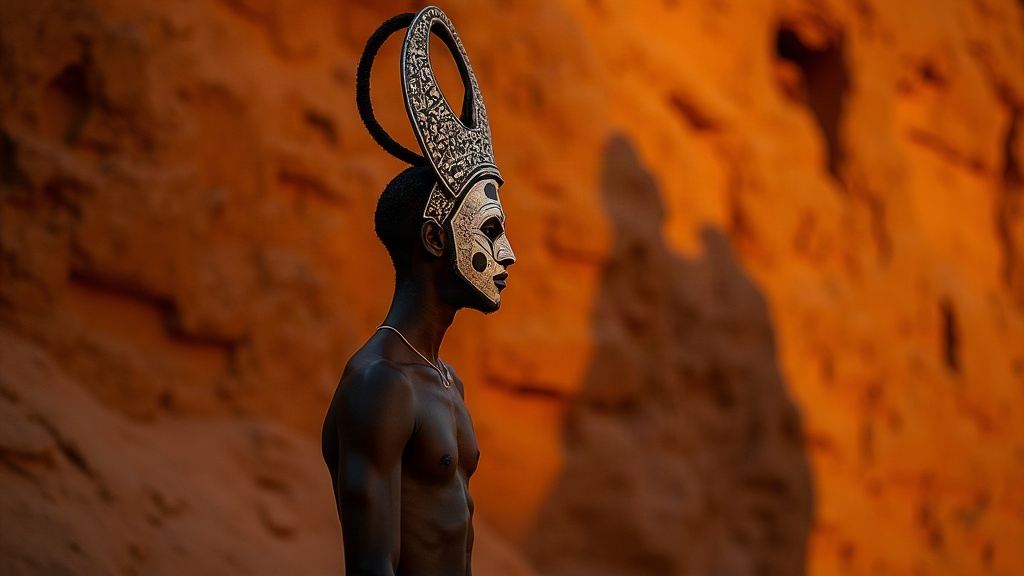
The Dogon Mask Tradition: Kanaga, Sirige, and Ritual Performance
The Dogon people of Mali have preserved one of Africa's most intricate mask traditions for centuries. Kanaga and Sirige masks embody cosmology, death, and the animate power of wood in ceremonies that bind the living to ancestors.
Dogon
The Binu Shrines: Sacred Altars to Ancestral Spirits in Dogon Tradition
The Binu Shrines are sacred wooden altars where the Dogon people of Mali honor their ancestors and the primordial water spirits that shaped their world. Built into cliff dwellings and family homes, these shrines connect the living to the dead through ritual, offering, and careful ceremonial action.
Dogon
The Dama Funeral Rites: Guiding the Dead to Ancestorhood
The Dama is the Dogon people's most sacred ceremony, a multi-stage funeral rite that transforms the dead into protective ancestors. Masked dancers, secret societies, and months of ritual guide the soul through the spirit world while honoring the body's return to earth.