
Ancient Egyptian Costume: Dress, Status, and the Divine
Linen kilts, usekh collars, and wigs were not fashion. They were signals of rank, purity, and divine favour, read from tomb walls and texts.
Contents
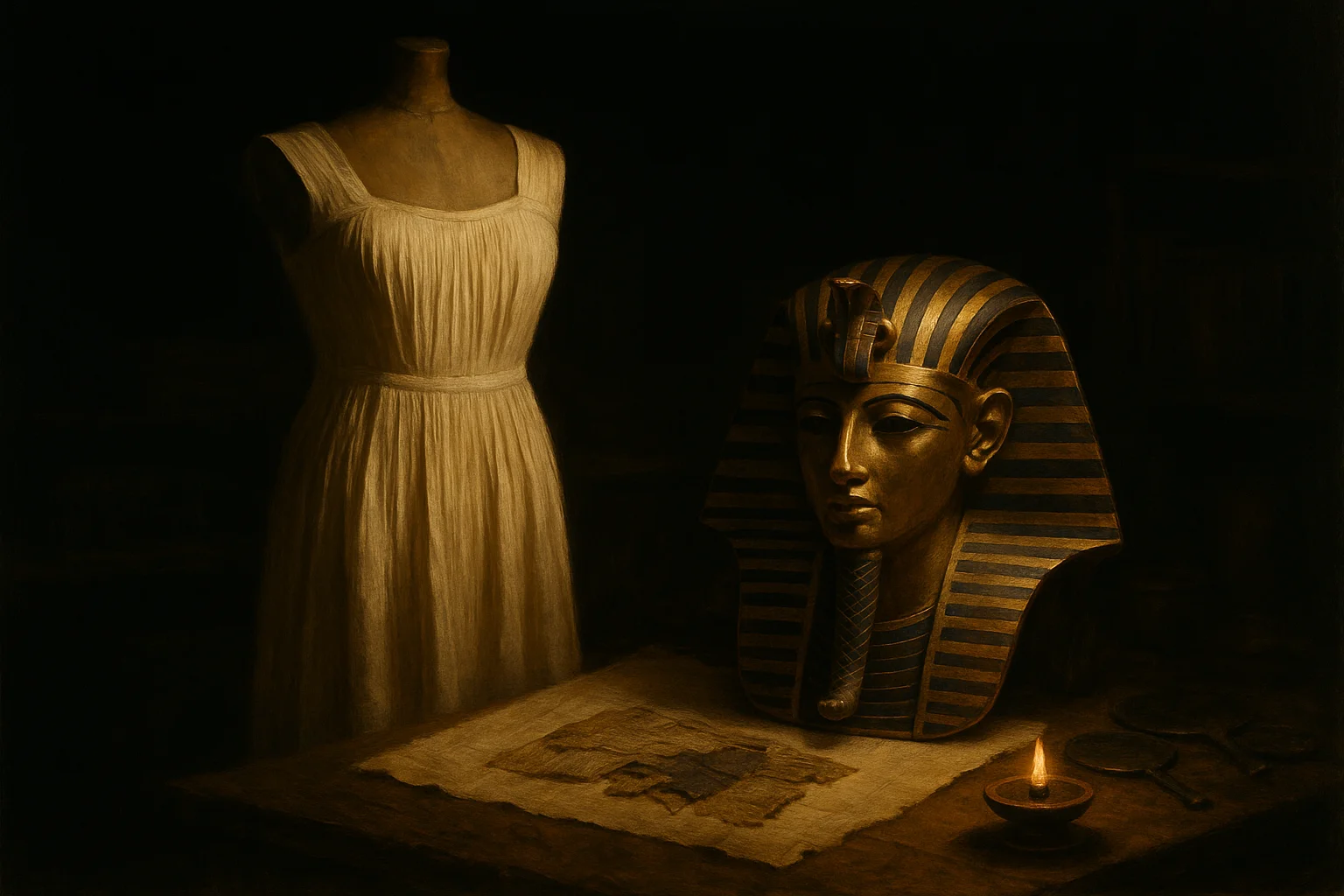
Ancient Egyptian costume consisted primarily of white linen garments whose cut, quality, and ornamentation signaled the wearer's social rank, profession, and ritual purity. Tomb paintings, temple reliefs, and surviving textile fragments from three millennia of Egyptian history reveal a dress code in which simplicity of form coexisted with elaborate jewellery, wigs, and cosmetics. What you wore announced whether you served the pharaoh, tilled the fields, or stood among the priests who served the gods.
The evidence comes from multiple sources: wall paintings in noble tombs at Thebes, statuary spanning the Old Kingdom through the Ptolemaic period, and the rare linen fragments preserved by Egypt's dry climate. These sources agree on essentials but diverge on details, particularly for women's dress. What emerges is not a single costume but a visual language, legible to anyone who walked the streets of Memphis or Thebes.
Linen: The Fabric of Purity and Practicality
Linen dominates the archaeological record because it was the only textile permitted in temples and tombs. Wool, though available, carried associations with animal impurity. Herodotus notes in his Histories 2.37 that Egyptian priests "wear linen garments, which they are especially careful to have always fresh washed," and that they shave their entire bodies every other day to avoid lice. The link between linen and cleanliness was theological as much as practical.
Flax grew along the Nile's banks. Spinning and weaving were domestic tasks depicted in countless tomb scenes, including the Tomb of Menna at Thebes (TT69), where women work upright looms under the supervision of estate overseers. Quality varied. Papyrus Anastasi IV, a New Kingdom administrative text, lists linen grades from coarse sacking to royal-quality fabric so fine it approached translucency. The finest weaves, with thread counts exceeding 200 per inch, were reserved for pharaohs and temple statues of the gods.
Color was rare. Most garments remained the natural white or pale beige of undyed linen. Pleating, a labor-intensive process, became the primary decorative technique during the New Kingdom. Tomb paintings show elaborately pleated kilts and dresses that required constant maintenance. The effect was both visual and auditory: starched pleats rustled when the wearer moved, a subtle announcement of wealth and leisure.
The Shendyt Kilt and the Male Wardrobe
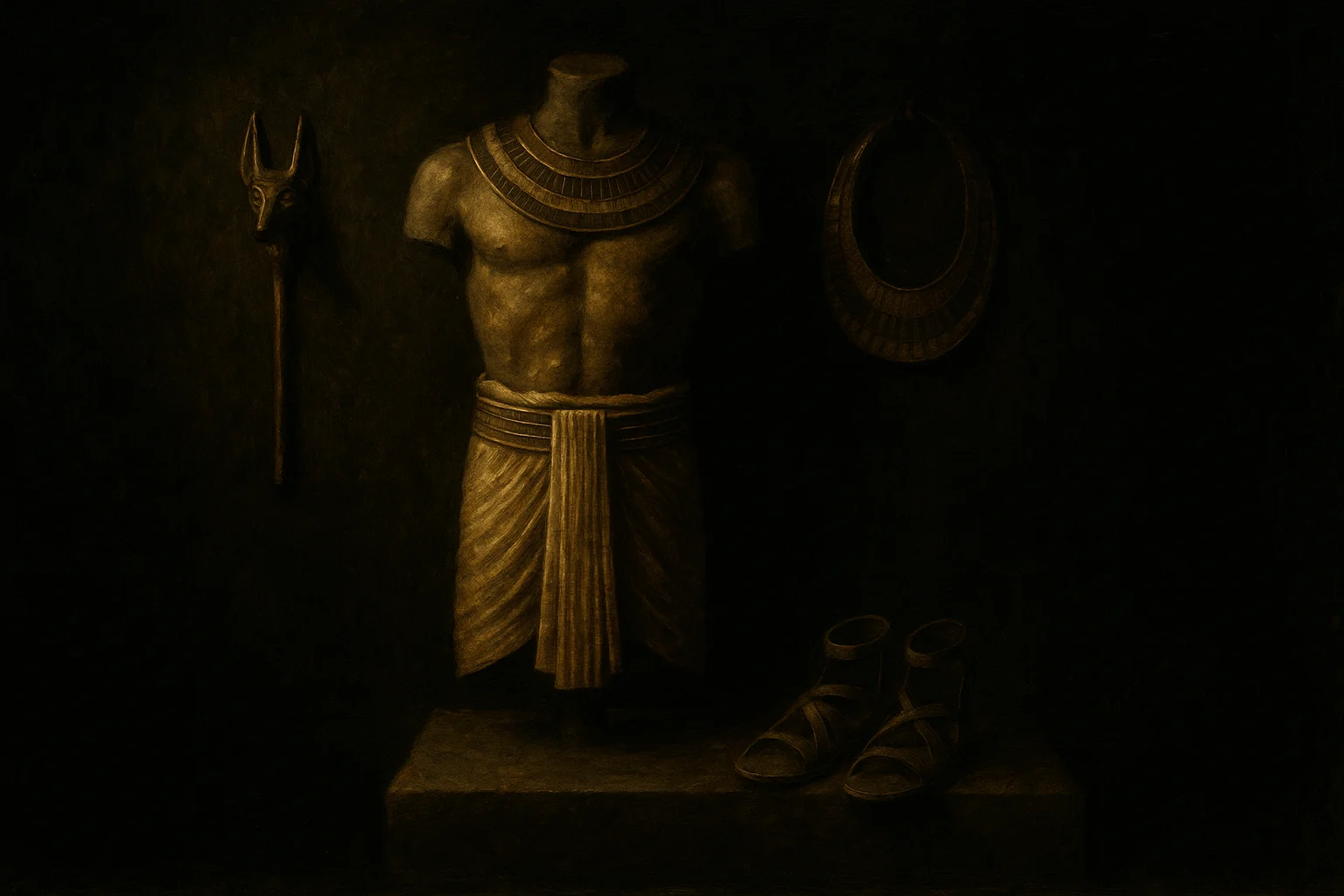
The shendyt, a wrapped kilt secured at the waist, was the foundational male garment from the Old Kingdom onward. Laborers wore short versions that ended mid-thigh, leaving the legs free for fieldwork or construction. The Tomb of Rekhmire at Thebes (TT100) depicts workers in simple white kilts, their torsos bare, hauling stone blocks and mixing mortar. Scribes trained in temple schools and minor officials wore longer kilts that reached the knee, often with a starched triangular front panel that projected outward.
The garment's simplicity allowed for infinite variation in drape and accessory. A man's status was legible in the quality of his linen, the precision of his pleating, and the jewellery he wore over the kilt. The Instructions of Ptahhotep, an Old Kingdom wisdom text, advises that "a man is known by his dress" and counsels modesty in appearance unless one's rank demands display.
Royal and Priestly Variants
Pharaohs wore the shendyt with additions that marked divine kingship: a bull's tail attached to the back of the belt, a ceremonial beard strapped to the chin, and the uraeus serpent on the brow. Temple reliefs show kings in kilts so heavily pleated and starched they resemble sculptural forms. The Stela of Ikhernofret, a Middle Kingdom text, describes ritual garments worn during the Osiris mysteries at Abydos, including a special kilt "of fine linen, worked with gold thread."
Priests who performed daily temple rituals wore kilts of exceptional purity, washed and reworn multiple times per day. Herodotus emphasizes that priests owned no personal garments; temple linen was communal property, laundered by temple staff and stored in sacred precincts. The act of dressing became part of ritual preparation, a shedding of the profane world.
The Bag-Tunic of the Middle Kingdom
During the Middle Kingdom, a new garment appeared: the bag-tunic, a simple rectangular linen sheet folded in half with a hole cut for the head and sewn along the sides. It was worn over the kilt by officials and scribes, offering modest coverage without restricting movement. Tomb paintings from this period show men in white tunics that fall to mid-calf, often belted at the waist. The style persisted into the New Kingdom but never replaced the kilt, which retained its association with tradition and authority.
Women's Dress: The Sheath and the Kalasiris
Women's costume presents interpretive challenges. Tomb paintings consistently show women in tight-fitting sheath dresses that run from below the breasts to the ankles, held up by two straps. The garment appears painted onto the body, revealing every contour. Scholars debate whether this reflects actual dress or artistic convention. No surviving linen sheath matches the painted silhouette; the few extant women's garments are loose tunics.
The kalasiris, mentioned in Greek sources, may resolve the puzzle. It was likely a wrapped garment, similar to a sari, that could be draped tightly or loosely depending on occasion. Nefertari depicted in temple reliefs at Abu Simbel wears a kalasiris with elaborate pleating and a fringed shawl draped over one shoulder. The garment's flexibility allowed for modesty in daily life and display in formal contexts.
Wealthy women wore multiple layers: a linen undergarment, a pleated outer dress, and a sheer overgarment that added visual complexity without warmth. The Tomb of Nakht at Thebes (TT52) shows female musicians and dancers in transparent overdresses, their bodies visible beneath. The effect was not erotic in the modern sense but signaled luxury: the ability to wear impractical, delicate fabrics that required constant care.
Collars, Jewellery, and the Usekh
The usekh, a broad collar of beads arranged in concentric rows, was the most distinctive piece of Egyptian jewellery. It sat flat across the chest and shoulders, its weight distributed by a counterweight hanging down the back. Materials ranged from faience and glazed pottery for commoners to gold, lapis lazuli, and carnelian for the elite. The collar's shape echoed the hieroglyph for "breadth" or "width," symbolically expanding the wearer's presence.
Both men and women wore the usekh on formal occasions. Tomb paintings show banquet guests in matching collars, their uniformity suggesting they were provided by the host as part of the event's staging. The collar functioned as costume jewellery in the literal sense: a temporary ornament that transformed everyday dress into ceremonial attire. Egyptian symbols worn as jewellery carried protective and apotropaic meanings, with the ankh symbol and scarab amulets appearing frequently on necklaces, bracelets, and rings.
Bracelets, anklets, and rings were worn by both sexes. Gold armlets in the form of coiled serpents or falcon heads announced military rank or royal favor. The quantity of jewellery mattered as much as its quality. A Middle Kingdom official might wear a single gold ring; a New Kingdom vizier wore rings on every finger, their combined weight a burden and a boast.
Wigs, Shaving, and the Performance of Cleanliness
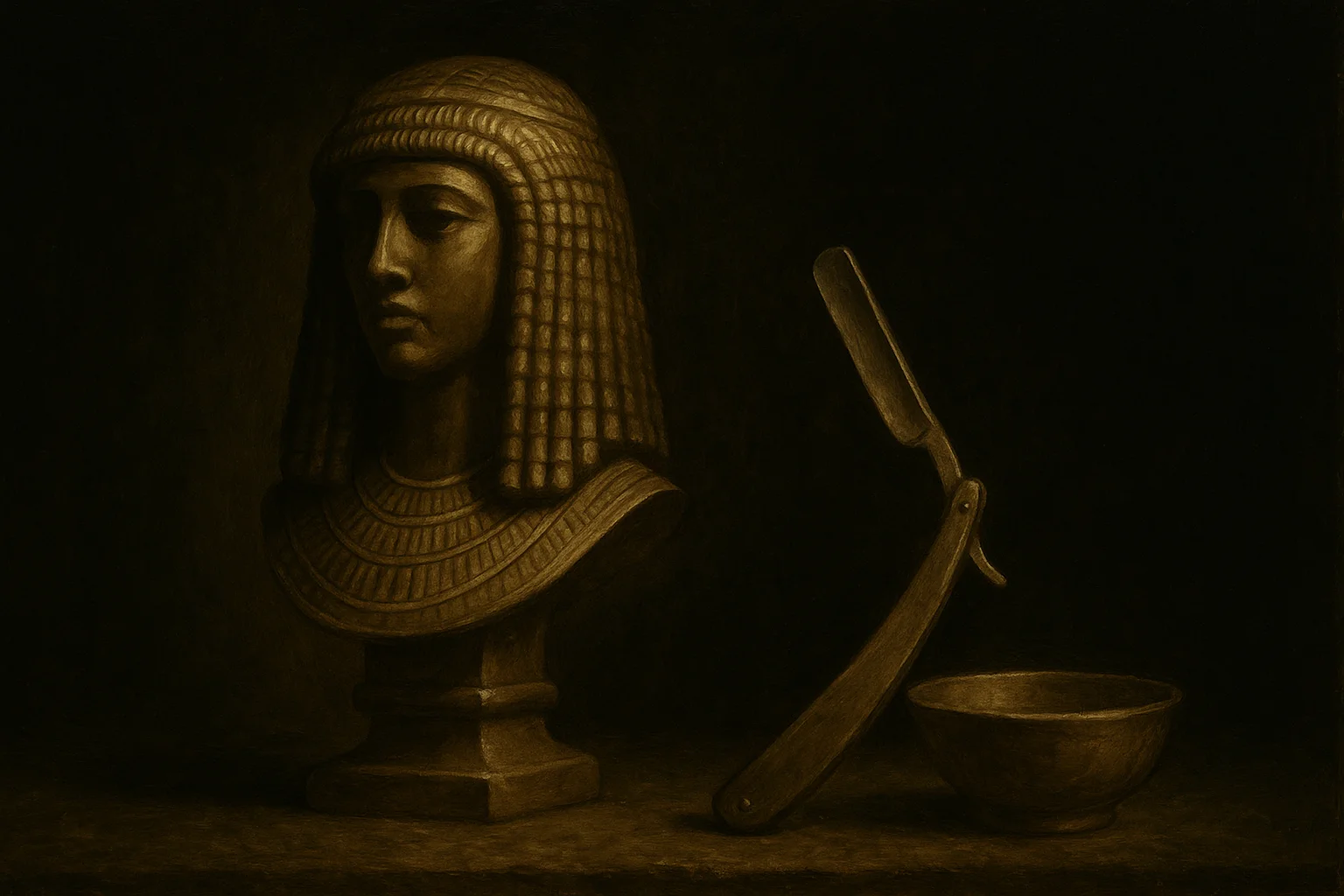
Most Egyptians shaved their heads and wore wigs in public. The practice had hygienic logic in a climate that bred lice, but it also carried religious significance. Priests shaved their entire bodies, including eyebrows, as part of ritual purification. Herodotus describes this practice with a mix of admiration and bemusement, noting that Egyptian priests were "the cleanest of men."
Wigs were made from human hair, vegetable fiber, or a combination of both. Styles changed over time. Old Kingdom wigs were short and practical. New Kingdom wigs grew longer and more elaborate, with braids, curls, and geometric arrangements that required daily maintenance by servants. The wig's artificiality was not concealed but celebrated: it was a crafted object, like a collar or a pleated kilt, that signaled control over one's appearance.
Children had their heads shaved except for a single sidelock, a style visible in countless family portraits. The sidelock marked youth and dependency; its cutting was a rite of passage into adulthood. Akhenaten's religious revolution briefly altered wig styles, with royal family members depicted in elongated, naturalistic wigs that matched the period's artistic innovations. The style did not outlast the reign.
Old Kingdom (2686–2181 BCE)
Short, practical wigs with simple geometric cuts. Minimal pleating on garments. Jewellery restrained, focused on amulets and single collars.
New Kingdom (1550–1077 BCE)
Elaborate wigs with braids and curls. Heavily pleated garments, often sheer. Multiple layers of jewellery, including broad collars, bracelets, and anklets.
Sandals, Bare Feet, and the Ground Beneath You
Most Egyptians went barefoot most of the time. Sandals were luxury items, worn by officials, priests, and the wealthy. They were made from woven papyrus, palm fiber, or leather, with a thong that passed between the first and second toes. The soles were flat; there was no arch support. Tomb paintings show sandal-bearers walking behind their masters, carrying the footwear until it was needed.
Going barefoot in temples was mandatory, even for kings. The ground of a temple precinct was sacred; covering it with sandals would defile it. Funerary preparations included sandals among the grave goods, ensuring the deceased could walk in the afterlife, but the sandals were often unused, their soles unmarked by wear.
The distinction between shod and unshod marked social boundaries. A farmer in the fields went barefoot by necessity. A scribe in the same field wore sandals by choice, a visible claim to a status that exempted him from manual labor. The sandal became a hieroglyph: a sign that could be read at a distance, announcing who belonged where.
Costume in Ritual and Funerary Context
Ritual dress followed stricter rules than daily costume. Priests performing temple rites wore freshly laundered linen kilts and nothing else: no jewellery, no wigs, no sandals. The body itself became the offering, stripped of personal adornment. The mummification process required the deceased to be dressed in their finest garments, wrapped in layers of linen that both preserved the body and signaled the family's wealth.
Funerary costume included items never worn in life. The golden mask of Tutankhamun, though famous, was not a costume but a ritual object, a divine face placed over the mummy's linen-wrapped head. The tomb of Nefertari contained dozens of linen garments, many too fragile for wear, suggesting they were made specifically for burial. The afterlife required its own wardrobe.
"I am clothed in fine linen, I am anointed with the finest oil. I enter the presence of the gods, pure and shining." , Funerary inscription, Tomb of Nakht, Eighteenth Dynasty
Costume also marked festival participation. The Opet Festival at Thebes required participants to wear fresh linen and floral collars made from lotus blossoms. These collars wilted within hours, their impermanence part of the ritual's meaning: beauty and purity were temporary states, requiring constant renewal.
What the Tomb Paintings Leave Out
Tomb art idealizes. It shows the deceased and their household at their best: clean, well-dressed, surrounded by abundance. Daily life was messier. Linen yellowed with sweat and dust. Pleats sagged. Jewellery was stored away except for special occasions. The paintings omit the labor required to maintain the appearance they celebrate.
They also omit the poor. Agricultural workers, fishermen, and laborers appear in tomb scenes, but their dress is generic: a short kilt, sometimes not even that. The paintings are not interested in their individuality. By contrast, Cleopatra's Hellenistic court introduced Greek styles that mixed with Egyptian tradition, creating hybrid costumes that tomb art from earlier periods never anticipated.
Color is another gap. Tomb paintings use vivid pigments: red, blue, green, yellow. But surviving textiles are almost universally white or beige. Either the paintings exaggerate, or dyed garments were rare enough that few made it into tombs. The truth likely lies between: color existed but was reserved for borders, sashes, and accessories rather than whole garments.
Frequently asked questions
What materials did ancient Egyptians use to make their clothing?
Ancient Egyptians made nearly all their clothing from linen, a fabric woven from flax fibers grown along the Nile, because it was considered ritually pure and suitable for temple and funerary contexts. Wool was available but rarely used, as it was associated with animal impurity and forbidden in sacred spaces. The quality of linen varied widely, from coarse sacking for laborers to royal-grade fabric with thread counts exceeding 200 per inch, fine enough to be nearly transparent. Leather was used for sandals and military equipment but not for garments.
How did clothing indicate social rank in ancient Egypt?
Social rank in ancient Egypt was signaled less by the cut of garments, which remained relatively simple across classes, and more by the quality of linen, the complexity of pleating, and the quantity and materials of accompanying jewellery. A laborer wore a short, coarse linen kilt; a scribe wore a longer, finer kilt with starched pleats; a noble wore the same basic garment but in translucent linen with elaborate pleating and a broad collar of gold and semi-precious stones. Priests demonstrated rank through ritual purity rather than ornamentation, wearing freshly laundered plain linen with no jewellery during temple service.
Why did ancient Egyptians wear wigs and shave their heads?
Ancient Egyptians shaved their heads primarily for hygiene in a hot climate prone to lice, then wore wigs made from human hair or vegetable fiber in public and formal settings. The practice also carried religious significance: priests shaved their entire bodies, including eyebrows, every other day as part of ritual purification, as Herodotus notes in his Histories. Wigs were not intended to deceive but were celebrated as crafted objects that demonstrated control over one's appearance and the resources to maintain elaborate styles requiring daily servant care.
What was the usekh collar and who wore it?
The usekh was a broad, flat collar made of beads arranged in concentric rows that sat across the chest and shoulders, balanced by a counterweight hanging down the back, and it was worn by both men and women during formal occasions regardless of social class, though materials varied from faience for commoners to gold and lapis lazuli for elites. The collar's shape echoed the hieroglyph for "breadth," symbolically expanding the wearer's presence, and it functioned as ceremonial costume jewellery that transformed everyday dress into formal attire. Tomb paintings suggest that matching collars were sometimes provided to banquet guests by hosts as part of the event's staging.
Did ancient Egyptians wear shoes or go barefoot?
Most ancient Egyptians went barefoot most of the time, with sandals made from woven papyrus, palm fiber, or leather reserved as luxury items for officials, priests, and the wealthy, and tomb paintings often show sandal-bearers walking behind their masters carrying footwear until needed. Going barefoot in temples was mandatory even for kings because temple ground was sacred and covering it with sandals would defile it. The distinction between shod and unshod marked social boundaries: a farmer went barefoot by necessity, while a scribe in the same field wore sandals by choice as a visible claim to status exempting him from manual labor.
How accurate are tomb paintings as records of everyday dress?
Tomb paintings idealize rather than document everyday dress, showing the deceased and their household at their best in clean, elaborately pleated garments and full jewellery, while omitting the wear, staining, and sagging that daily life produced. The paintings also use vivid colors that rarely appear on surviving textile fragments, suggesting either artistic exaggeration or that dyed garments were uncommon enough to seldom enter tombs. Additionally, tomb art largely ignores the dress of the poor beyond generic short kilts, focusing instead on the elite whose appearance required constant labor to maintain, labor the paintings themselves never depict.
Further reading on Mythologis
Free 25-page sample
Want the whole story?
Take the first 25 pages free. If it pulls you in, the full edition is yours as an instant PDF download, with a paperback on Amazon for selected titles.
Egyptian
The Egyptian Mythology Book: Ra, Osiris, Isis, Anubis, and the Sacred Stories of the Pharaohs
Ra, Osiris, Isis, Anubis, and the Sacred Stories of the Pharaohs
Three thousand years of Egyptian sacred stories. The Duat, the weighing of the heart, the cult of Osiris, and the daily voyage of the sun.
More from Egyptian
All articles
Egyptian
The Book of the Dead: Egypt's Guide to Eternity
Ancient Egypt's most sacred funerary text was not a single book but a living archive of spells, maps, and prayers that guided the dead through the perils between death and eternal life.
Egyptian
Eye of Horus: The Protective Amulet That Watched Over the Living and the Dead
Worn by pharaohs and fishermen alike, the Eye of Horus is one of antiquity's most potent protective symbols, carrying the weight of cosmic battle, divine healing, and eternal vigilance.
Egyptian
Ra the Sun God: Egypt's Supreme Ruler of Light and Creation
Ra, the ancient Egyptian sun god, blazed at the very heart of a civilization that worshipped light as the pulse of creation itself. Discover his origins, his many forms, and the sacred journey he took across the sky and through the underworld every single day.
Egyptian
The Ankh: Egypt's Eternal Symbol of Life
The ankh is ancient Egypt's most recognizable hieroglyph, a looped cross carried by gods and pharaohs alike as the very key to immortal life. Discover its origins, meanings, and sacred legacy.