
Mummification Secrets in Ancient Egyptian Culture
How Egyptian embalmers preserved the body for eternity. The 70-day process, ritual texts, and theological stakes behind the practice.
Contents
Ancient Egyptian mummification was a 70-day embalming process designed to preserve the corpse as a permanent anchor for the ka (life force), ba (personality), and akh (transfigured spirit), enabling the deceased to navigate the afterlife and achieve eternal existence. The techniques, documented in the Pyramid Texts and Book of the Dead, varied significantly by social class, historical period, and regional workshop. Modern experimental archaeology and textual analysis reveal that the "standard" account passed down by Herodotus captures only the elite version of a practice that ranged from elaborate evisceration and resin-soaked wrapping to simple desiccation in sand.
The funerary industry was neither uniform nor static. What worked for Ramses II in the thirteenth century BCE would have been unrecognizable to Old Kingdom embalmers, and a farmer's burial bore little resemblance to a pharaoh's. The theological stakes, however, remained constant across three millennia.
Why the Egyptians Mummified Their Dead
The Egyptians did not mummify out of squeamishness about decay. They mummified because their theology required a physical body in order for the dead to exist at all. The funerary rites of ancient Egypt rested on a tripartite model of the soul that demanded material continuity.
The Ka, Ba, and Akh
The ka was the life force, a kind of spiritual double that required nourishment through offerings. It could not survive without a recognizable body or statue to inhabit. The ba, often depicted as a human-headed bird, represented personality and agency. It traveled between the tomb and the world of the living, but returned each night to reunite with the corpse. The akh was the transfigured, effective spirit, achieved only after successful passage through the weighing of the heart and the recitation of the correct spells.
Pyramid Text Utterance 213 addresses the ka directly: "Your ka is with you, your provisions are with you." The assumption is clear. No body, no ka. No ka, no continuation.
The Body as Anchor
Decomposition was not a metaphor for spiritual failure. It was spiritual failure. Early burials in the predynastic period relied on hot sand to desiccate corpses naturally, and the results were effective enough to seed the entire tradition. Once Egyptians began building tombs with stone and mud brick, bodies decayed. Mummification was the technological response to an architectural problem.
The goal was not aesthetic perfection but recognizability. The face had to remain intact enough for the ba to find it. The limbs had to hold their shape so the deceased could grasp offerings and walk in the Field of Reeds. This is why even poorly mummified bodies received elaborate cartonnage masks: the face was the anchor point.
The 70-Day Process: What the Embalmers Did
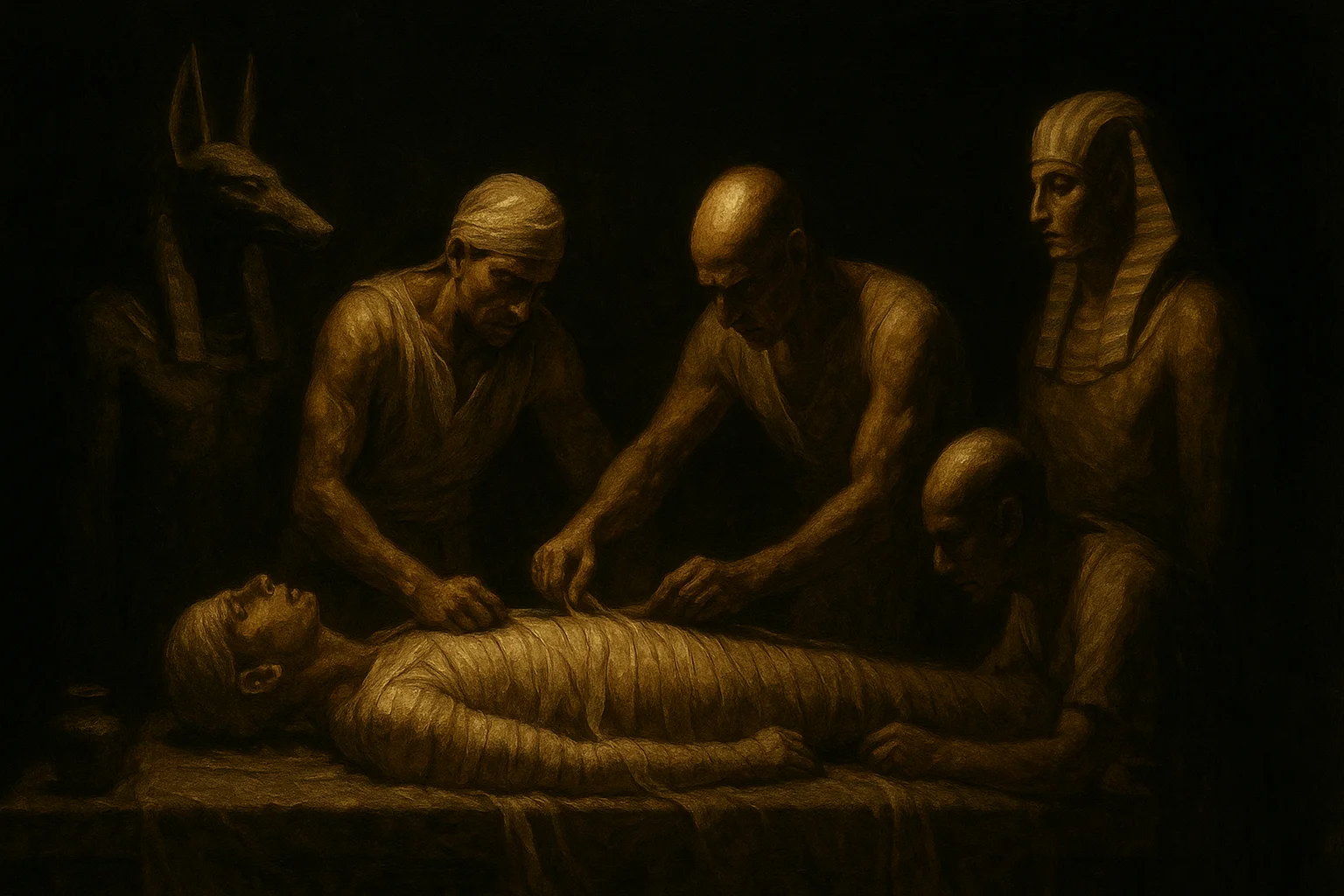
Herodotus, writing in the fifth century BCE, provides the most detailed eyewitness account of mummification in his Histories 2.86-88. He describes three tiers of service, priced according to thoroughness. The top tier, which he claims cost a talent of silver, involved full evisceration, extended natron treatment, and imported resins. The cheapest option skipped organ removal entirely and relied on a purgative enema followed by drying.
The 70-day window was not arbitrary. It corresponded to the period between death and the Opening of the Mouth ceremony, the final ritual that restored the senses of the deceased. Diodorus Siculus, writing four centuries after Herodotus, confirms the same timeframe and adds details about the division of labor among embalmer guilds.
Removal of Organs
The brain was extracted through the nostrils using a hooked bronze tool, then discarded. Egyptians did not recognize the brain as an organ of thought; that role belonged to the heart, which was always left in place. The heart would be weighed against the feather of Ma'at in the afterlife, as depicted in Book of the Dead Spell 125. Removing it would have been theological suicide.
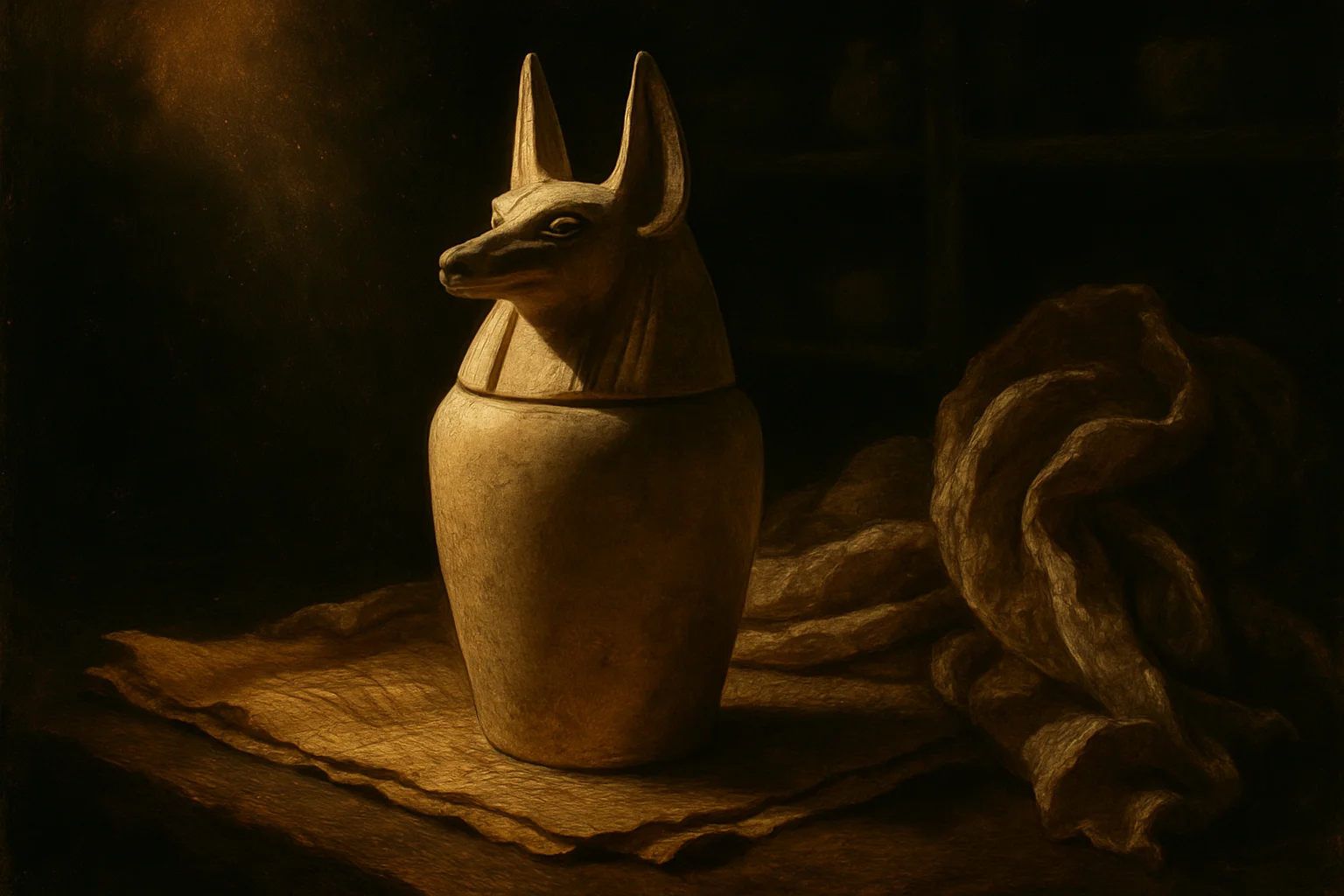
The liver, lungs, stomach, and intestines were removed through an incision in the left flank, washed in palm wine, and dried separately. By the New Kingdom, these organs were placed in four canopic jars, each protected by one of the Sons of Horus: Imsety (liver), Hapy (lungs), Duamutef (stomach), Qebehsenuef (intestines). Earlier periods simply wrapped the dried organs and returned them to the body cavity.
Desiccation with Natron
Natron, a naturally occurring mixture of sodium carbonate and sodium bicarbonate mined from the Wadi Natrun, was the chemical engine of preservation. The body was packed inside and out with dry natron and left for 40 days. Experimental mummification conducted by Bob Brier and Ronn Wade in 1994 confirmed that natron alone, without heat or airflow, is sufficient to achieve complete desiccation if the ambient humidity is low.
After the natron treatment, the body was washed, anointed with oils and resins, and sometimes stuffed with linen, sawdust, or sand to restore a lifelike contour. The resins served both as preservatives and as offerings to the Egyptian gods. Frankincense and myrrh were imported from Punt at considerable expense.
Wrapping and Amulets
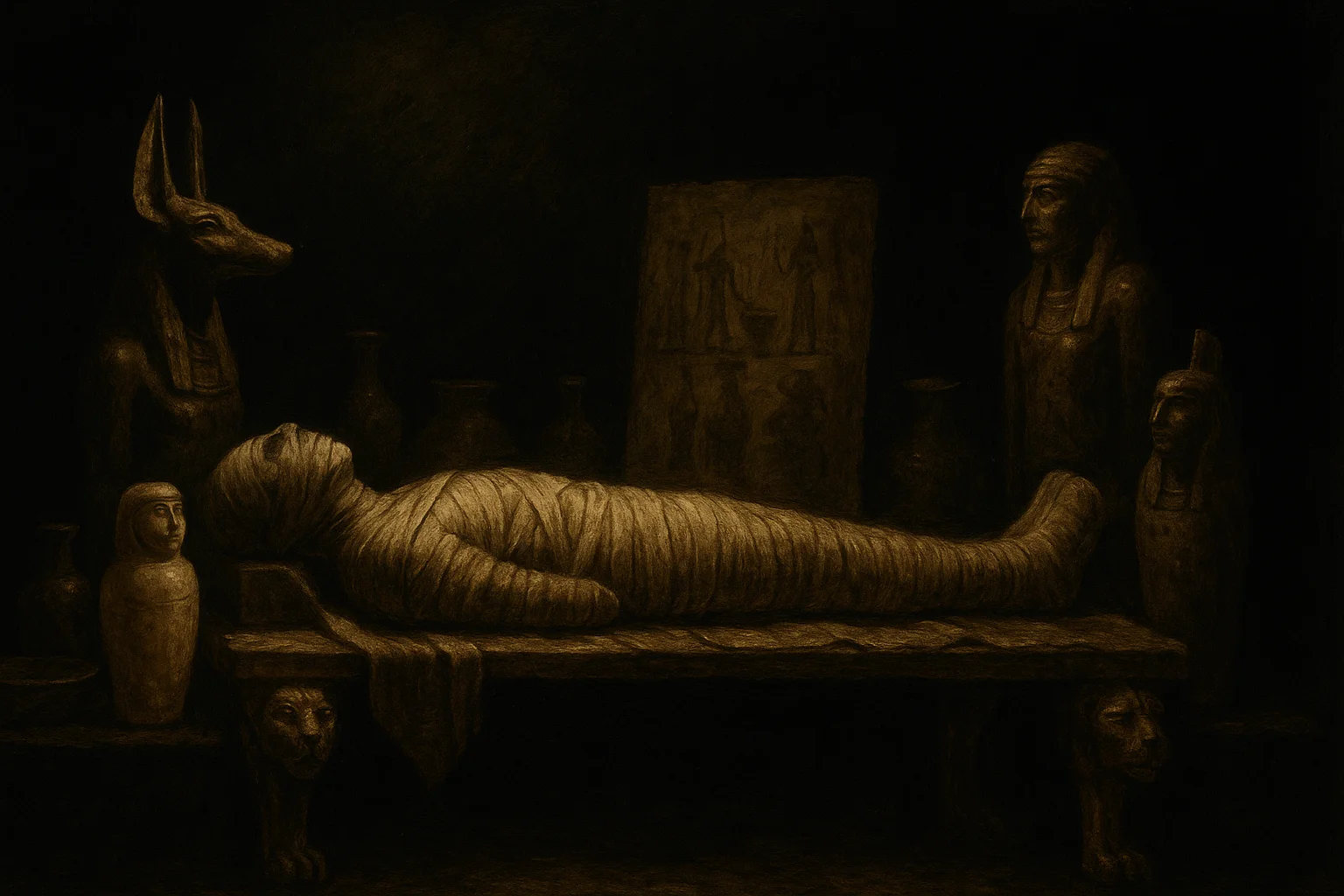
Linen wrapping was not mere bandaging. Each layer carried ritual significance, and sacred symbols were painted or sewn onto the fabric. Eye of Horus amulets, scarab beetles, and ankh signs were placed between the layers at prescribed locations. Book of the Dead Spell 151 specifies the exact placement of amulets on the mummy: the heart scarab over the chest, the djed pillar at the spine, the tyet knot at the throat.
The total length of linen used on a royal mummy could exceed 400 square meters. Tutankhamun's mummy was wrapped in 16 layers.
The Ritual Texts: What Was Said Over the Body
Mummification was not a silent procedure. The Papyrus Rhind and other embalmer's manuals preserve fragments of the recitations spoken at each stage. These were not prayers in the modern sense but performative utterances that transformed the corpse into a divine body, equated with Osiris.
"You are purified with natron, you are cleansed with incense. Your bones are the bones of the hawk-gods, your flesh is the flesh of the gods." Pyramid Texts, Utterance 219
The language is transactional. The recitation does not ask the gods to transform the body; it declares the transformation complete. Pyramid Texts Utterances 273-274 describe the deceased as "pure" and "equipped," terms that recur throughout the embalming liturgy. The embalmer functioned as a priest, and the workshop was a temple space governed by ritual purity codes similar to those documented in priestly education texts.
The Opening of the Mouth ceremony, performed on the 70th day, restored the senses and allowed the deceased to eat, speak, and breathe in the afterlife. A priest touched the mummy's mouth with an adze while reciting: "Your mouth is opened by Ptah with the tool with which he opened the mouths of the gods."
Class and Cost: Not All Mummies Were Equal
Herodotus describes three price tiers, but the archaeological record reveals far greater variation. The majority of Egyptians could not afford evisceration, natron, or linen. Their bodies were wrapped in reed mats and buried in shallow pits, where the dry sand performed a crude desiccation. These "natural" mummies often survive in better condition than poorly embalmed elite burials.
Elite mummification
Full evisceration, 40 days in natron, imported resins, multilayer linen wrapping, canopic jars, gilded cartonnage, stone sarcophagus. Reserved for royalty, high priests, and senior officials.
Commoner burial
No evisceration, minimal or no natron, single-layer linen or reed mat, shallow pit grave. Relied on natural desiccation. Represented 90 percent of the population.
Middle-tier options existed. Some families paid for partial evisceration: the brain and intestines removed, but the liver and lungs left in place. Others purchased natron treatment without full wrapping. The embalming workshops operated as commercial enterprises, not state monopolies, and pricing was competitive.
Even within the elite, standards shifted. Old Kingdom mummies are often poorly preserved because the techniques were still experimental. Middle Kingdom embalmers achieved better results with less material. New Kingdom mummies, especially royal burials, used extravagant quantities of resin but sometimes sacrificed structural integrity for visual splendor. Third Intermediate Period mummies are the technical peak: the best balance of preservation, aesthetics, and theological correctness.
Regional Workshops and Material Evidence
Embalming was not centralized. Each nome (province) operated its own workshops, and local practices varied. Theban embalmers favored heavy resin application. Memphite workshops used more linen and less resin. Delta sites show evidence of cheaper substitutes: beeswax instead of imported resins, local plant oils instead of myrrh.
The Saqqara animal necropolis reveals that mummification extended beyond humans. Ibises, cats, dogs, crocodiles, and bulls were mummified by the million, often as votive offerings. The techniques mirror human mummification but are scaled to industrial volume. Some ibis mummies contain only a single bone or feather wrapped in linen: the appearance of a mummy mattered more than the contents.
Chemical analysis of resins, linen, and natron allows archaeologists to trace trade networks. Resins from the Levant, natron from Wadi Natrun, linen from the Fayyum. The supply chain for a single royal mummification involved dozens of suppliers across the Mediterranean.
What the Greeks and Romans Saw
Herodotus visited Egypt around 450 BCE, more than a millennium after the Great Pyramids were built. By his time, mummification was already an ancient tradition, and he admits he is reporting secondhand information from Egyptian priests. His account is broadly accurate but incomplete. He does not mention the ritual recitations, the canopic jars, or the theological rationale.
Diodorus Siculus, writing in the first century BCE, adds details about the social organization of embalmers. He describes a chief embalmer called the "scribe" who marked the incision line on the body, and a separate caste of workers called "slitters" who made the cut and were ritually pelted with stones afterward, a symbolic punishment for violating the corpse.
Roman-era mummies from the Fayyum show a hybrid tradition: traditional Egyptian mummification techniques combined with naturalistic painted portraits in the Greco-Roman style. These portraits, painted on wooden panels and placed over the face, were intended for the living to see during the funeral procession. They represent the final phase of mummification before Christianity displaced the practice entirely.
Modern Experimental Mummification
In 1994, Bob Brier and Ronn Wade mummified a human cadaver using only materials and techniques described in ancient sources. The experiment, conducted in Maryland, confirmed that natron alone is sufficient for desiccation, that the 40-day period is not arbitrary, and that linen wrapping provides structural support as the tissues dry. The mummy remains stable after 30 years.
CT scanning of ancient mummies has revealed details invisible to Howard Carter and earlier archaeologists. Some mummies contain prosthetic eyes made of stone or linen. Others have false limbs attached to replace those lost to injury or disease. The embalmers were concerned with completeness: the body had to be whole to function in the afterlife, even if the wholeness was cosmetic.
Isotopic analysis of mummy tissue allows researchers to reconstruct diet, disease, and geographic origin. Some royal mummies show evidence of tuberculosis, malaria, and sickle-cell anemia. Others reveal that the deceased consumed large amounts of honey, beer, and bread in their final years, consistent with elite dietary patterns.
Frequently asked questions
Why did ancient Egyptians mummify their dead?
Ancient Egyptians mummified their dead because their theology required a preserved physical body to serve as an anchor for the ka (life force), ba (personality), and akh (transfigured spirit), without which the deceased could not achieve eternal existence in the afterlife. The practice emerged as a technological solution to the problem of decomposition in above-ground tombs, replacing the natural desiccation that occurred in predynastic sand burials. Funerary texts such as the Pyramid Texts make clear that bodily integrity was a prerequisite for participation in the underworld journeys and the rituals of resurrection.
How long did the mummification process take?
The mummification process took 70 days from death to burial, a period that included 40 days of desiccation in natron, followed by washing, anointing, wrapping, and ritual preparation for the Opening of the Mouth ceremony. This timeframe is confirmed by both Herodotus and Diodorus Siculus and corresponds to the liturgical calendar governing funerary rites. The 70-day period was not merely practical but also theologically significant, marking the transition from corpse to divine body.
What organs were removed during mummification?
During elite mummification, embalmers removed the brain (through the nostrils), liver, lungs, stomach, and intestines, while the heart was always left in place because it was believed to be the seat of thought and would be weighed in the afterlife judgment. The removed organs were dried separately and either placed in canopic jars protected by the Sons of Horus or returned to the body cavity wrapped in linen. The brain was discarded, as Egyptians did not recognize its function.
Did all Egyptians receive the same mummification treatment?
No, mummification treatment varied drastically by social class, with elite burials involving full evisceration, extended natron treatment, imported resins, and multilayer linen wrapping, while the majority of Egyptians received minimal treatment or simple burial in sand that achieved natural desiccation. Herodotus describes three price tiers, but archaeological evidence reveals a continuum of practices ranging from royal mummies wrapped in hundreds of meters of linen to commoners buried in reed mats. Regional workshops also employed different techniques and materials based on local availability and tradition.
What texts were recited during mummification?
Embalmers recited passages from the Pyramid Texts, Book of the Dead, and specialized liturgies preserved in documents such as the Papyrus Rhind, which declared the corpse purified, transformed, and equated with the god Osiris at each stage of the process. These recitations were performative utterances that effected the transformation rather than prayers requesting divine intervention. The Opening of the Mouth ceremony, performed on the 70th day, included the declaration "Your mouth is opened by Ptah with the tool with which he opened the mouths of the gods," restoring the deceased's ability to eat, speak, and breathe in the afterlife.
How do we know what the mummification process involved?
Modern knowledge of mummification comes from three sources: classical accounts by Herodotus and Diodorus Siculus who observed the practice firsthand, Egyptian funerary texts and embalmer's manuals such as the Papyrus Rhind that preserve ritual instructions, and direct examination of thousands of mummies using autopsy, CT scanning, and chemical analysis. Experimental mummification conducted by Bob Brier in 1994 confirmed that ancient techniques described in texts are sufficient to achieve long-term preservation. The combination of textual, material, and experimental evidence allows researchers to reconstruct both the physical procedures and the theological rationale behind them.
Further reading on Mythologis
Free 25-page sample
Want the whole story?
Take the first 25 pages free. If it pulls you in, the full edition is yours as an instant PDF download, with a paperback on Amazon for selected titles.
Egyptian
The Egyptian Mythology Book: Ra, Osiris, Isis, Anubis, and the Sacred Stories of the Pharaohs
Ra, Osiris, Isis, Anubis, and the Sacred Stories of the Pharaohs
Three thousand years of Egyptian sacred stories. The Duat, the weighing of the heart, the cult of Osiris, and the daily voyage of the sun.
More from Egyptian
All articles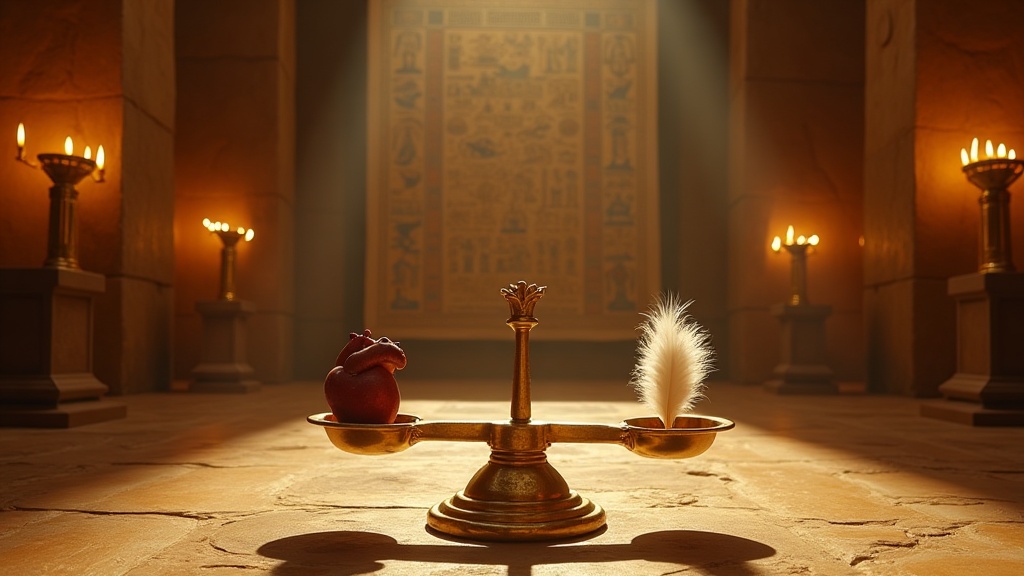
Egyptian
The Book of the Dead: Egypt's Guide to Eternity
Ancient Egypt's most sacred funerary text was not a single book but a living archive of spells, maps, and prayers that guided the dead through the perils between death and eternal life.
Egyptian
Eye of Horus: The Protective Amulet That Watched Over the Living and the Dead
Worn by pharaohs and fishermen alike, the Eye of Horus is one of antiquity's most potent protective symbols, carrying the weight of cosmic battle, divine healing, and eternal vigilance.
Egyptian
Ra the Sun God: Egypt's Supreme Ruler of Light and Creation
Ra, the ancient Egyptian sun god, blazed at the very heart of a civilization that worshipped light as the pulse of creation itself. Discover his origins, his many forms, and the sacred journey he took across the sky and through the underworld every single day.
Egyptian
The Ankh: Egypt's Eternal Symbol of Life
The ankh is ancient Egypt's most recognizable hieroglyph, a looped cross carried by gods and pharaohs alike as the very key to immortal life. Discover its origins, meanings, and sacred legacy.