
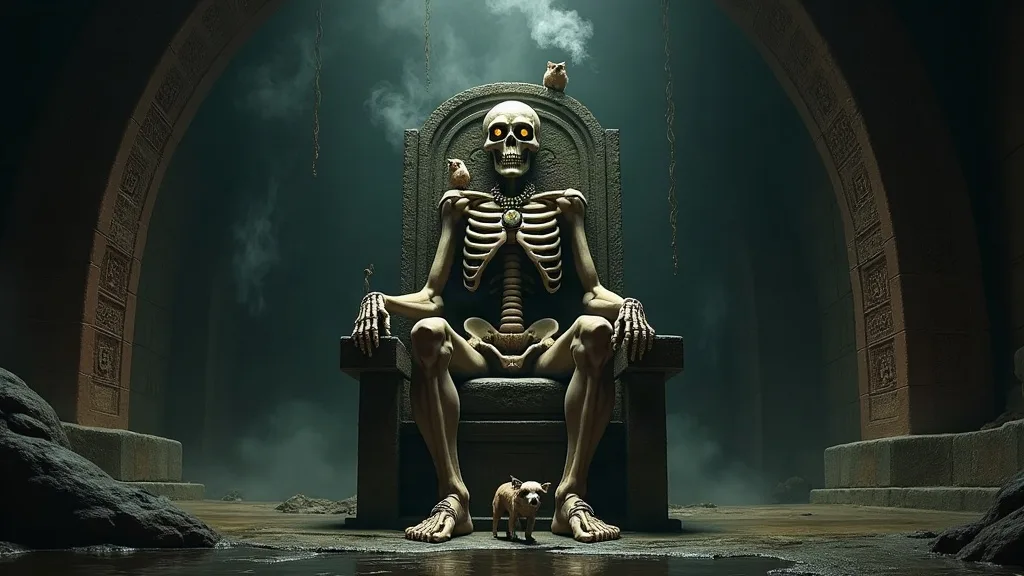
Mictlantecuhtli and the Underworld Mictlan: Lord of the Dead in Aztec Mythology
Mictlantecuhtli ruled Mictlan, the Aztec underworld's nine perilous levels. Learn who this death god was, what the dead faced below, and why Aztec death was never simply darkness.
Contents
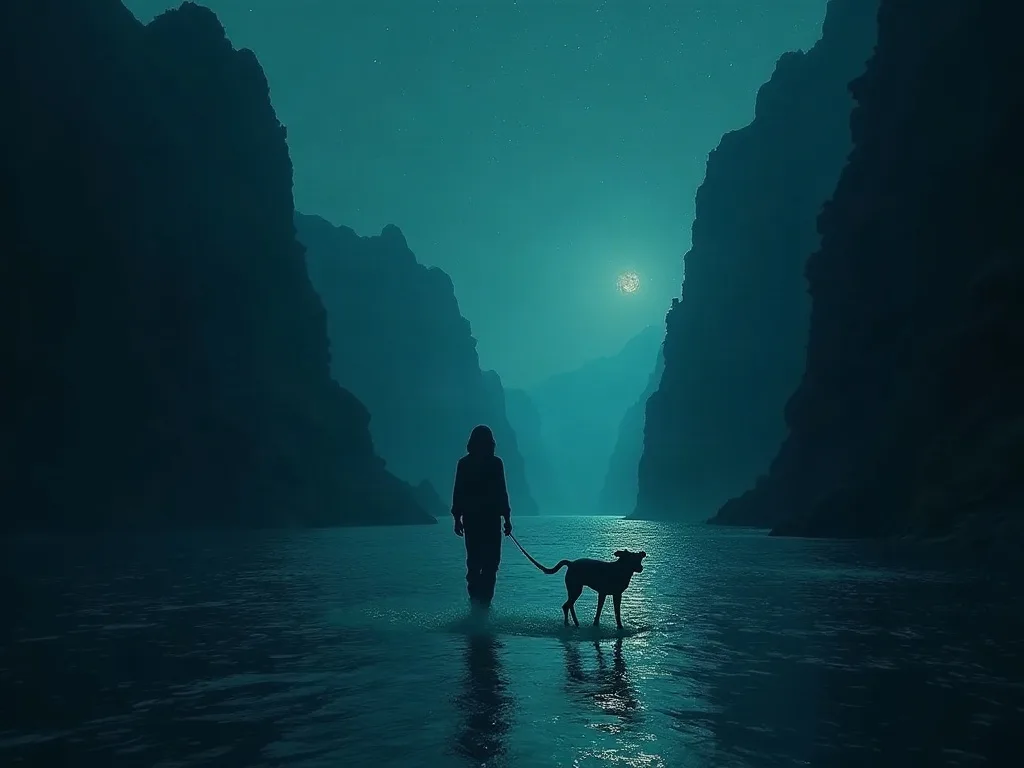
The body was stripped down to bone before it ever arrived. No flesh, no name, no social rank. Only a small dog trotted alongside the soul, carrying it across the first river into a place the Aztecs called Mictlan, the land of the dead.
At the end of nine long levels of that journey, a skeletal figure sat waiting. His face was a bare skull. His body was painted black. Owls screamed around him. His name was Mictlantecuhtli, and he was the absolute lord of the dead in Aztec belief, a deity whose power touched every household, every burial, every breath drawn in the world above.
He was not a figure of punishment. He was not a devil. He was something stranger and, in many ways, more honest: the god who simply received everyone, without judgment, without exception.
Who Was Mictlantecuhtli: Portrait of a Skeletal God
Mictlantecuhtli (pronounced roughly meek-tlan-TEH-koo-tlee in Classical Nahuatl) means "Lord of Mictlan." His name is built from two Nahuatl words: mictlan, the underworld, and tecuhtli, meaning lord or ruler.
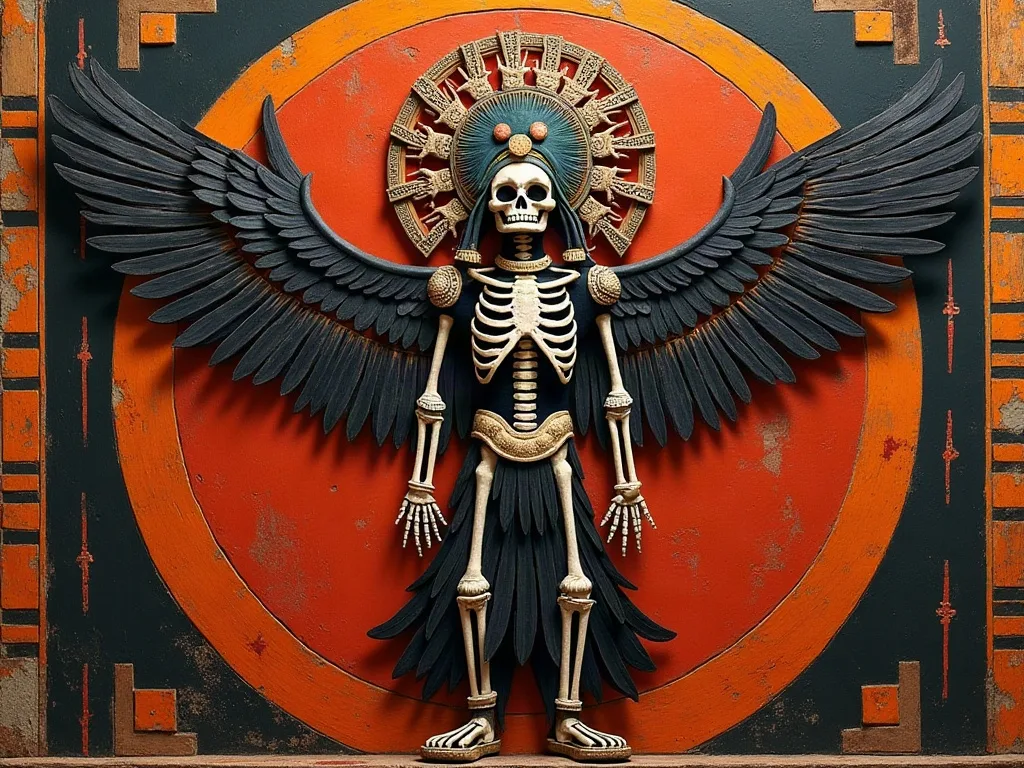
His iconography is among the most immediately recognizable in all of Mesoamerican art. Codex images and stone sculptures show him with a bare human skull for a head, often with round disk-eyes meant to represent stars. His body is sometimes skeletal, sometimes fleshed but painted black with chalk-white bones drawn over the skin, as if the skeleton beneath were showing through. He wears a headdress decorated with owl feathers and paper ornaments. His sandals curl upward at the toe, a royal detail among the Aztecs. A necklace of human eyeballs hangs around his neck in several depictions. Blood-drenched hair fans out beside him.
The Aztec artists who painted him in screenfold books called amoxtli (the singular is amoxtle) knew exactly what they were doing. Every detail was deliberate. Owls in Aztec culture were harbingers of death: to hear one call your name meant you would die. The star-disk eyes placed him in the night sky and in the underground dark simultaneously, a god who occupied both extremes of the vertical cosmos. The chalk paint on his body echoed the white used in funeral rites.
He ruled alongside his consort Mictecacihuatl, "Lady of the Dead," who watched over the bones of the deceased. Together they formed a paired divine couple, which followed a deep pattern in Aztec theology where major cosmic forces came in male-female pairs. She is the figure now popularly associated with Dia de los Muertos imagery, though the direct connection requires careful untangling across several centuries.
The Nine Levels of Mictlan: A Journey, Not a Judgment
The Aztec afterlife was not a single place. It was a structured cosmos with multiple destinations. Warriors who died in battle, or were sacrificed, went to accompany the sun as it moved across the sky. Women who died in childbirth became powerful spirits called cihuateteo. Those who drowned or were struck by lightning went to Tlalocan, the lush paradise of the rain god Tlaloc. Children who died very young went to a separate realm where a milk-giving tree nourished them.
Everyone else, the vast majority of people who died of illness, old age, or accident, made the four-year journey through Mictlan's nine levels.
The Histoyre du Mechique, a 16th-century Spanish account drawn from indigenous informants, and the Florentine Codex compiled by Fray Bernardino de Sahagún around 1577, are the two richest sources for the underworld geography. They describe the nine levels like this:
- Itzcuintlan - Crossing the great river Apanohuaia, aided only by the small dog buried with the dead.
- Tepectli Monamictia - Passing between two mountains that crash together.
- Iztepetl - Crossing a field of obsidian wind that cuts like blades.
- Itzehecayan - The plain of obsidian wind, where cold becomes unbearable.
- Pancuecuetlacayan - A place where banners of wind strike the traveler.
- Timiminaloayan - Where arrows are shot at the passing dead.
- Apanohuaia - A second water crossing, this one wider and darker.
- Chicoloapan - The nine rivers converge.
- Chicunauhmictlan - The ninth level, the deepest place, where Mictlantecuhtli waits.
The soul arrived at Mictlantecuhtli's presence bearing offerings gathered at the funeral: food, water, copal incense, a small clay dog, fine cloth, tools relevant to the person's work in life. These were burned at the funeral so they could make the same journey as the soul. After four years of this travel, the soul reached the lord, presented its offerings, and dissolved into the deep rest of the ninth level.
There was no trial. No weighing of sins. The journey was hard, but it was traversable by anyone. The difficulty was practical, not moral.
Mictlantecuhtli in the Sacred Texts and Codices
The most direct mythological account of Mictlantecuhtli appears in the Leyenda de los Soles ("Legend of the Suns"), preserved in the Codex Chimalpopoca, a Nahuatl manuscript from the early colonial period. It tells how the feathered serpent god Quetzalcoatl descended into Mictlan to retrieve the bones of the previous human race, so that a new humanity could be created for the current Fifth Sun.
Mictlantecuhtli agreed to hand over the bones, then immediately set traps. He ordered his servants to blow a conch shell that had no holes, making sound impossible. Quetzalcoatl was clever: he called on worms to drill holes in the shell and on bees to make it hum. Mictlantecuhtli gave in, then changed his mind. He ordered a pit dug in the path, and Quetzalcoatl fell into it. In the fall, the bones shattered and scattered. This is why humans now come in different sizes: the bones broke into unequal fragments, and the goddess Cihuacoatl ground them together with maize dough to shape the new race.
This story does something remarkable. It makes Mictlantecuhtli not a passive custodian but an active, cunning adversary who must be outwitted. His reluctance to surrender the bones is not cruelty; it is the logic of death itself. The dead belong to him. Life must struggle and bargain to reclaim even the raw material of new existence.
The Codex Borgia, a pre-contact screenfold book of ritual and divination, dedicates several pages to Mictlantecuhtli and his opposing deity Quetzalcoatl. On one extraordinary page, the two figures sit back-to-back sharing a single body, their spines joined. Life and death are literally fused at the backbone. Scholars like Elizabeth Hill Boone, who studied the Codex Borgia extensively, read this image as a cosmological statement: the creative and the destructive are not opposites but two faces of the same cosmic process.
In the Aztec ritual calendar, the tonalpohualli (a 260-day sacred count), Mictlantecuhtli ruled the first trecena, the first thirteen-day period. He also governed the eleventh trecena alongside Mictecacihuatl. His days were considered dangerous but not simply unlucky. People born under his sign were thought to have an intimate, unafraid relationship with death, which could make them healers, priests, or warriors of great courage.
The Temple and the Skull Rack: How Aztec Ritual Honored the Dead
In Tenochtitlan, the Aztec capital built on an island in Lake Texcoco (now buried beneath Mexico City), Mictlantecuhtli had a dedicated temple called Tlalxicco. Archaeological work at the Templo Mayor site, led by Eduardo Matos Moctezuma from the 1970s onward, has uncovered remarkable material associated with death ritual.
In 2006, excavations at a structure near the Templo Mayor revealed two life-sized ceramic statues of Mictlantecuhtli, each around 1.7 meters tall. Both showed his skeletal form in vivid detail, with liver-shaped cutouts in the torso where real human hair had once been inserted, a detail no text had mentioned. The hair was almost certainly from the deceased individuals whose remains were found nearby.
The tzompantli, the famous skull rack visible from many parts of the city center, displayed the skulls of sacrificed captives. These were not trophies in a modern sense. They were an architectural statement about the relationship between life, death, and cosmic debt. The Aztecs believed that the sun itself ran on the blood of sacrifice; without it, the Fifth Sun would stop moving and the world would end in darkness. Mictlantecuhtli stood at the receiving end of this cosmic economy.
Merchants who traveled long dangerous roads made offerings to Mictlantecuhtli before departure and upon return. Midwives prayed to him at difficult births, where the mother's death was possible. Physicians working with the bones, with deep wounds, with wasting diseases, invoked his attention. He was not feared the way a monster is feared. He was respected the way a very large, very permanent fact is respected.
Mictlantecuhtli and Tezcatlipoca: Death, Night, and the Smoking Mirror
Mictlantecuhtli was not the only Aztec deity associated with darkness and mortality. Tezcatlipoca, the "Smoking Mirror," was a god of night, sorcery, and the unpredictable forces of the cosmos. Where Mictlantecuhtli was a fixed endpoint, Tezcatlipoca was chaos in motion. The two deities represented different registers of death's power.
Mictlantecuhtli governed what came after. Tezcatlipoca governed the danger before, the illness, the accident, the enemy's blade. Tezcatlipoca could reach into any life and end it without warning. Mictlantecuhtli simply waited at the bottom of the world to receive what Tezcatlipoca and fate delivered.
The contrast is useful for understanding Aztec theology more broadly. Death in this system was not one thing. It was a field with multiple actors, multiple registers, multiple ritual addresses. A person facing illness might pray to Tezcatlipoca to lift the threat. A person preparing a funeral would focus on Mictlantecuhtli and the practical needs of the soul's journey.
Mictlantecuhtli
- Lord of Mictlan, the deep underworld
- Receives the dead who died of ordinary causes
- Fixed, patient, inevitable presence
- Rules bones, rest, the final dissolution
- Associated with the north and the color black
- Paired with Mictecacihuatl, his consort
Tezcatlipoca
- God of night sky, sorcery, and earthly conflict
- Can strike the living without warning
- Unpredictable, mischievous, terrifying
- Rules fate, war, illness, rulers' power
- Also associated with the north and black, but as active darkness
- Eternal rival of Quetzalcoatl
Dogs, Maize, and the Ethics of Dying Well
The small hairless dog buried with the dead was not a luxury or a sentiment. It was a practical necessity. The dog's job was to recognize its owner at the river crossing and carry them across. The xoloitzcuintli (often called the Mexican hairless dog) was specifically bred in part for this ritual function. Archaeological sites across central Mexico have yielded dog skeletons buried beside human remains, sometimes with food offerings placed near both.
Maize also appears throughout Mictlan mythology, most prominently in the Quetzalcoatl bone-retrieval story, where ground bone mixed with maize dough creates human beings. This detail places death and food production in the same cycle. Maize is planted in the earth, disappears, and returns. Humans are made from bone and maize, live above ground, and return below. The agricultural and mortuary calendars were deeply intertwined in Aztec ritual life.
The four-year duration of the journey through Mictlan's levels was not arbitrary. Four was a number with cosmological weight in Aztec thought, connected to the four cardinal directions and the four previous suns that had each been destroyed before the current one. The soul's journey mirrored the great cosmic cycles: a period of effort and passage, then transformation into something that could no longer be called by its previous name.
Mictlantecuhtli Across Mesoamerica: Parallel Death Lords
Mictlantecuhtli and the Underworld Mictlan do not exist in isolation. Across Mesoamerica, other traditions had their own lords of the dead and structured underworlds, and the overlaps reveal a shared cosmological grammar stretching back well before the Aztecs rose to power.
The Maya had Xibalba, the underworld described in extraordinary detail in the Popol Vuh, the K'iche' Maya creation epic written down around 1550 but preserving far older oral traditions. Xibalba had twelve lords of death, including Hun-Came ("One Death") and Vucub-Came ("Seven Death"), who ruled over specific torments: houses of cold, houses of blades, houses of darkness. The hero twins Hunahpu and Xbalanque descended into Xibalba, defeated its lords through wit, and rose again, an arc that prefigures the ball game, sacrifice, and resurrection that ran through all of Mesoamerican religious thought.
The Mixtec tradition had its own death deity, and the Codex Zouche-Nuttall, a pre-contact Mixtec manuscript, shows elaborate funeral processions and underworld journeys with iconography that parallels Aztec representations closely.
The Toltec city of Tula, which the Aztecs regarded as a legendary precursor civilization, almost certainly transmitted death deity concepts that shaped later Aztec theology. The Aztec claim that their gods inherited the Toltec cosmological framework is not simply political myth-making; it reflects a real continuity of religious ideas across centuries of Mesoamerican history.
The Olmec civilization (roughly 1500-400 BC), considered the earliest major Mesoamerican culture, produced jaguar-deity imagery associated with earth, caves, and the underworld that may be the ultimate ancestor of the death-lord tradition Mictlantecuhtli represents. The cave, in Mesoamerican cosmology, was the mouth of the earth, the entrance to the underworld. Every market, every ballcourt, every temple was in some sense a formalized version of that cave-mouth.
Mictlantecuhtli in the Modern World: From Colonial Suppression to Cultural Reclamation
The Spanish conquest of 1521 brought systematic destruction of the codices and ritual objects associated with Aztec religion. Franciscan, Dominican, and Augustinian missionaries understood that Mictlantecuhtli represented a competing cosmology, and they worked to replace indigenous death ritual with Catholic funerary practice. The Florentine Codex itself was compiled as part of this missionary effort: Sahagún gathered the information to understand what he hoped to displace.
Despite this pressure, Aztec death theology proved remarkably resilient. Dia de los Muertos (Day of the Dead), celebrated on November 1 and 2, is often described as a syncretic blend of Catholic All Saints' Day and All Souls' Day with pre-Columbian ancestor veneration. The UNESCO designation of the festival as Intangible Cultural Heritage in 2003 helped codify this reading. Scholars including Claudio Lomnitz, in his 2005 study Death and the Idea of Mexico, argue that the fusion was never smooth or equal: indigenous communities preserved their own death practices while externally performing Catholic mourning, and the two strands never fully merged.
The popular image of a calavera (sugar skull) decorated for Dia de los Muertos festivals does not map directly onto Mictlantecuhtli's skull imagery. The calavera tradition draws heavily from the satirical prints of José Guadalupe Posada, a late 19th-century Mexican printmaker whose skeletal figures mocked the political elite. Posada's "La Catrina," the elegantly dressed female skeleton, became the icon of the holiday in the 20th century, then was merged in popular consciousness with the far older figure of Mictecacihuatl. The result is a layering of at least four distinct historical strata: ancient Aztec death theology, colonial Catholic adaptation, 19th-century political satire, and 20th-century cultural nationalism.
Mictlantecuhtli himself has returned to public view through archaeology. The two life-sized statues found in 2006 are now on display at the Museo del Templo Mayor in Mexico City. The museum sits directly over the excavated base of the Templo Mayor, the central pyramid of Tenochtitlan. Walking through it, visitors pass from the current street level down into the Aztec earth, which is the most apt physical metaphor for Mictlantecuhtli's story: the living world sits on top of the dead, and the distance between them is measurable in stone.
Frequently Asked Questions About Mictlantecuhtli and Mictlan
Frequently asked questions
Why did ordinary Aztec people go to Mictlan rather than a paradise?
In Aztec theology, the afterlife realm was determined by the circumstances of death, not moral behavior during life. Mictlan was not a punishment. Warriors who died in battle, women who died in childbirth, and those sacrificed went to realms closer to the sun or to Tlalocan. Mictlan was simply the realm for everyone else, the vast majority of people who died of illness or old age. The Florentine Codex makes this structure explicit: it is a cosmological system, not an ethical one.
What role did the dog play in the journey to Mictlan?
The dog, typically a xoloitzcuintli, was buried with the deceased specifically to guide the soul across the first great river of Mictlan. The Aztecs believed the dog would recognize its owner and carry them safely across water that could not be crossed alone. Archaeological sites across central Mexico confirm this practice: dog skeletons are found beside human burials, often with their own food offerings, across centuries of pre-contact habitation.
What is the connection between Mictlantecuhtli and the Quetzalcoatl bone myth?
The Leyenda de los Soles, preserved in the Codex Chimalpopoca, recounts how Quetzalcoatl descended into Mictlan to retrieve the bones of the previous human race from Mictlantecuhtli. The lord of the dead agreed, then set traps to reclaim the bones. Quetzalcoatl partially escaped but fell into a pit, shattering the bones into unequal pieces. Those fragments were ground with maize dough by the goddess Cihuacoatl to create the current human race. This is the Aztec explanation for why humans vary in size.
Is Mictlantecuhtli the same as the figure celebrated in Dia de los Muertos?
Not directly. Dia de los Muertos draws from multiple historical layers: Aztec ancestor veneration and death theology, Catholic All Saints' and All Souls' Day observances introduced after 1521, 19th-century Mexican satirical printmaking, and 20th-century cultural nationalism. Mictecacihuatl, Mictlantecuhtli's consort, has a stronger modern popular association with the holiday through the "La Catrina" figure. Mictlantecuhtli himself is the older, more strictly theological figure, ruler of the underworld geography rather than symbol of the festival.
Are there primary sources that describe Mictlan in detail?
Yes. The most important are the Florentine Codex (compiled by Sahagún from indigenous informants, c. 1577), the Codex Chimalpopoca (containing the Leyenda de los Soles and the Annals of Cuauhtitlan, written in Nahuatl in the early colonial period), the Codex Borgia (a pre-contact ritual book with detailed Mictlantecuhtli imagery), and the Histoyre du Mechique (a French summary of a now-lost Spanish text, early 16th century). Together these sources describe the nine levels of Mictlan and the rituals associated with the dead with considerable consistency.
How does Mictlan compare to the Maya underworld Xibalba?
Both Mictlan and Xibalba are structured underworlds with multiple levels governed by specific death deities. Xibalba, described in the K'iche' Maya Popol Vuh, has twelve lords of death and specific houses of torment. Mictlan has nine levels but no torment in a punitive sense; the difficulty is environmental and navigational. Both require the soul to traverse dangerous geography. The shared structure points to a deep Mesoamerican cosmological grammar predating both the Aztec and classic Maya civilizations, possibly rooted in Olmec earth-deity traditions from the second millennium BC.
What the Bones Say: Mictlantecuhtli's Unresolved Legacy
Archaeology keeps revising the picture. The 2006 discovery of those two life-sized ceramic statues at the Templo Mayor was accompanied by the remains of at least four individuals, their bones deliberately disarticulated and arranged around the statues. The investigation team, reporting in the journal Ancient Mesoamerica, found evidence that these were not sacrificial victims in the conventional sense but possibly individuals who had died of disease, their bodies curated and arranged in a ritual context months or years after death.
This suggests a more complex mortuary practice than the simplified narrative of sacrifice-and-disposal often applied to Aztec religion. Mictlantecuhtli's cult may have involved the long-term tending of human remains, a kind of ongoing ritual relationship between the living community and its specific dead, not just the generic souls making the underworld journey.
The question of what ordinary Aztec people actually believed, as opposed to what the priestly and noble classes encoded in the codices, remains genuinely open. Household archaeology in the settlements around Tenochtitlan shows a range of burial practices, some following the canonical Mictlan-journey model with dog burials and grave goods, others much simpler. Regional variation was significant. The Aztec empire was not a monolith, and neither was its death theology.
What does hold across all the evidence is this: Mictlantecuhtli and the Underworld Mictlan were not peripheral concerns, not the shadowy edge of Aztec religious life. They were central. The lord of the dead sat at the end of the longest journey every person would ever take. He waited at the root of the world tree, at the bottom of the ninth level, with patience that had no limit and power that no living thing could escape. The Aztecs did not look away from this. They built temples to it, painted it in their most sacred books, buried their dogs beside their dead, and carried the whole weight of it with them every morning when the sun, fed by sacrifice and kept moving by human effort, crossed the sky above a world built on bones.
Read the full book
Want the whole story?
The complete edition is an instant PDF download here, with a paperback on Amazon for selected titles.
Aztec
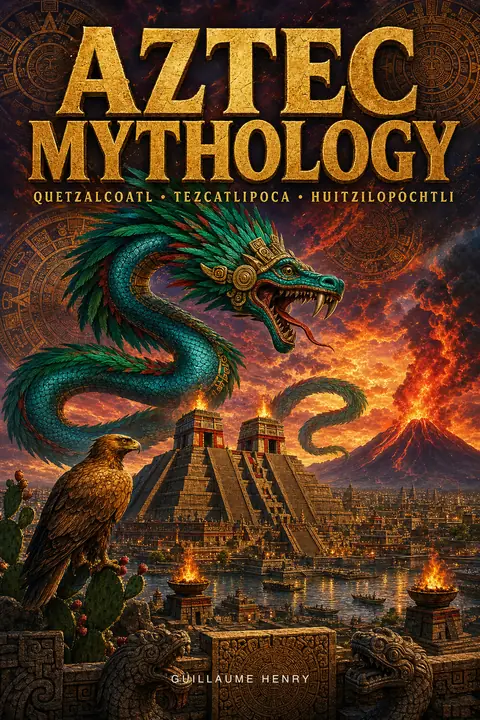
The Aztec Mythology Book: Quetzalcoatl, Huitzilopochtli, Tezcatlipoca, and the Five Suns of the Mexica
Blood, Feathered Serpents, and the Cosmic Engine of Tenochtitlan
The gods, heroes, and sacred calendar of the Mexica civilization. From the feathered serpent Quetzalcoatl to the five world ages, the complete mythology of Tenochtitlan.
More from Aztec
All articles
Aztec
Tenochtitlan: The Sacred Aztec Capital
Tenochtitlan rose from an island in Lake Texcoco as the Mexica people's promised homeland, guided by their god Huitzilopochtli. Discover how this sacred city became the center of the Aztec Empire and why its temples, waterways, and ceremonial heart shaped an entire civilization.
Aztec
The Legend of the Fifth Sun: Why the Aztecs Believed Humanity Required Divine Blood
The Aztecs lived under a cosmological clock. They believed the world had been created and destroyed four times before. The fifth world, their world, could only survive if the gods received constant nourishment: human blood. Discover how mythology, astronomy, and ritual wove together in one of history's most misunderstood civilizations.

Aztec
Coatlicue: Mother of Gods and the Aztec Pantheon
Coatlicue, the serpent-skirted mother, bore the sun god and ruled over fertility, childbirth, and death in Aztec belief. Discover how the Aztecs honoured her as the generative force behind their entire pantheon and cosmos.

Aztec
Tlaloc: God of Rain and Fertility in Aztec Mythology
Tlaloc brought water to the Aztec world, but his gifts came with terror. Discover how the rain god shaped Mesoamerican religion, from mountain shrines to the sacred cenotes where thousands sought his blessing.