
The Flood Myth: Destruction and Renewal in Tupi Tradition
The Tupi and Guarani peoples preserved a flood myth of striking depth: a world drowned, a remnant saved, and a new earth shaped from the ruins of the old. Here is what that story actually says.
Contents
The water rose without warning. Not a slow tide but a surge that swallowed the forest, the river banks, the cooking fires, the bones of the ancestors. In the oral traditions of the Tupi and Guarani peoples of South America, the great flood is not a peripheral story. It sits at the center of their cosmological memory, a hinge between a flawed first world and the one human beings now inhabit.
The narratives collected from different Tupi-speaking groups, from the coastal Tupinambá recorded by sixteenth-century Jesuit and French missionaries to the inland Guarani communities documented by ethnographers like Curt Nimuendajú in the early twentieth century, do not form a single tidy account. They form a family of accounts, each carrying the same structural bones: a corrupted world, a catastrophic flood sent by divine will, survivors who reach high ground or take refuge in a tree, and a covenant or transformation that opens the age we live in now. The variety is itself important. It tells us the myth was alive, still being shaped by the communities that lived it.
What follows is a careful reading of those variants, their theological stakes, their imagery, and the tradition that holds them together.
A World That Had to End: The First Age in Tupi Cosmology
Before the flood, there was already a world. Tupi-Guarani cosmogonies typically describe a sequence of cosmic ages, each one created and then destroyed by the supreme divine force. Among the Guarani, this force is most often named Ñamandu (also rendered Ñande Ru, "Our Father"), the first cause who generates light from his own heart before the sun exists. He sings the world into being. Words, in this tradition, are generative. The ayvu rapyta, the "foundation of language," is the first act of creation.
The world that preceded the flood was not innocent. Several variants describe it as a place where humans had grown arrogant, noisy, or morally disordered. The Tupinambá accounts collected by the French Calvinist Jean de Léry in the 1570s mention a cultural hero named Monan, sometimes glossed as "Ancient of Days," who created the first humans and then, disgusted by their ingratitude, withdrew from them. The destruction that followed was not always a flood in those accounts: Monan sent tata, fire from the sky. But another hero, Maire Monan (or in other variants, a figure linked to the trickster-transformer Maíra), intervened, using his breath to raise a storm that extinguished the fire and produced the great waters.
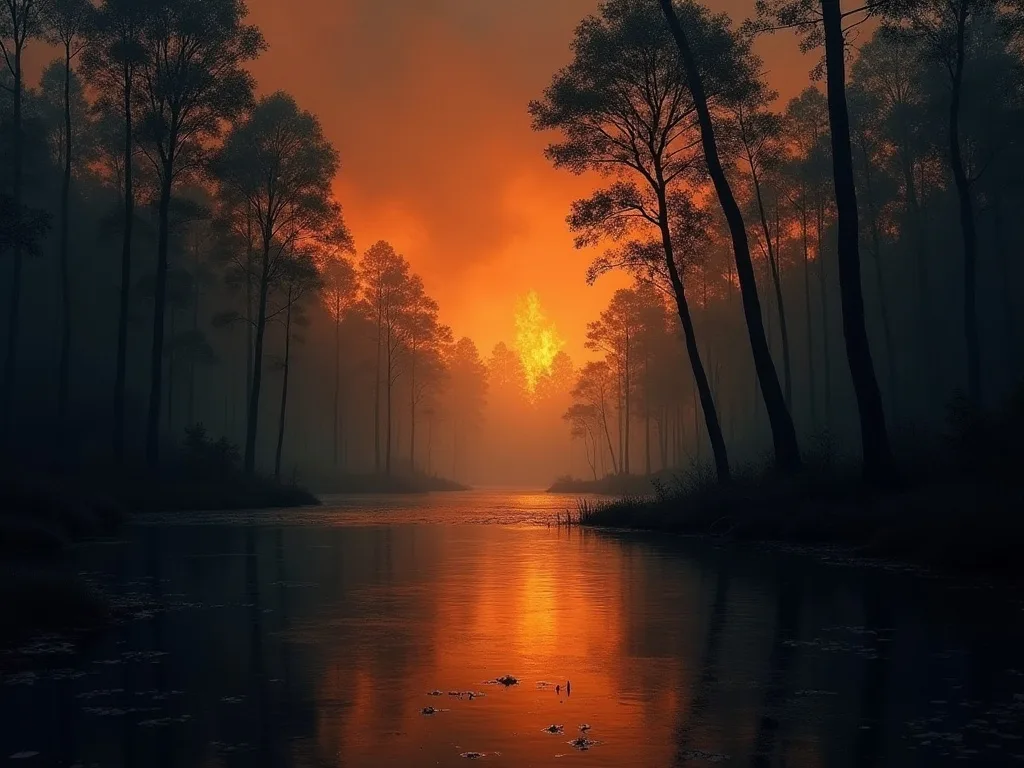
That moment of overlap between fire and flood is theologically precise. The world does not simply drown. It is first burned and then drowned, a double annihilation that leaves nothing of the old order intact.
Survivors and the Sacred Mountain: Variants of the Escape
The question of who survives cuts to the heart of what the myth is arguing. In some variants, the survivors are simply the righteous or the chosen, those who maintained the proper relationship with the divine. In others, the escape is purely structural: a man and a woman climb to the top of a palm tree or a high peak and wait out the waters.
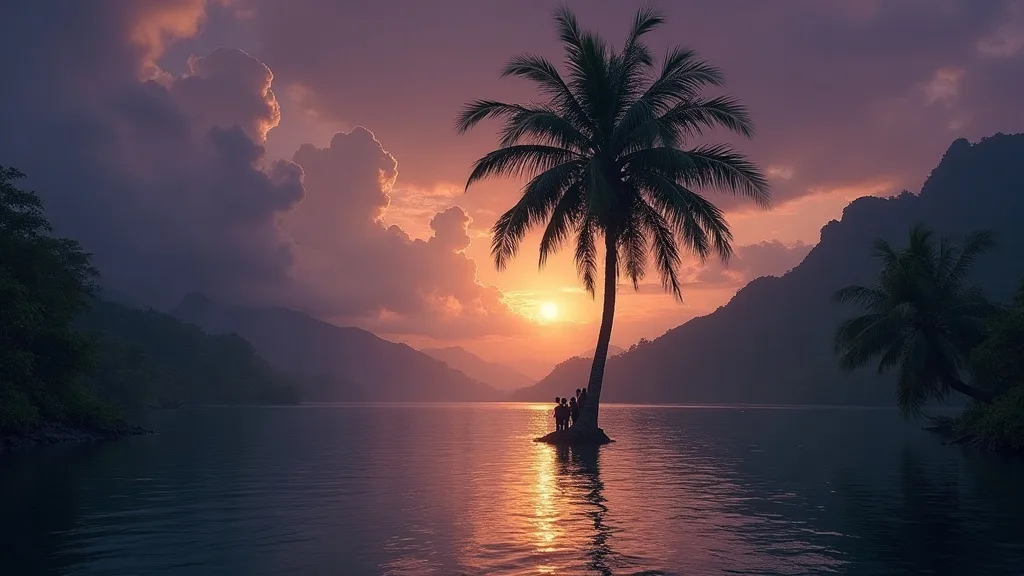
The palm tree motif deserves attention. The pindó palm (Syagrus romanzoffiana), sacred in Guarani tradition, recurs in several accounts as the refuge that lifts survivors above the flood line. This is not arbitrary. The pindó is the "eternal palm" in Guarani symbolic geography, associated with the paradise land called Yvy Marã Ey, "the land without evil." Using the palm as an ark is already encoding a destination: those who cling to it are aligned with the imperishable world.
Among some Guarani groups, the survivors are two brothers, sometimes named as the twin culture heroes Tupã and his counterpart. Among coastal Tupinambá variants, the rescued figures are a man and a woman who repopulate the earth. The ethnographer Alfred Métraux, writing in the 1940s based on earlier missionary records, noted that several groups placed the survivors on the peak of Itamimbaba, a real coastal mountain in what is now Brazil, lending the myth a geographic anchor that made it simultaneously history and theology.
The animals pose their own question. Unlike the Mesopotamian flood traditions where Utnapishtim loads every species onto a vessel, the Tupi-Guarani accounts are not generally concerned with a comprehensive rescue of the animal world. The focus is narrower: the human thread must not be cut. The rest of creation can reconstitute itself because the world's generative power is divine, not dependent on the survival of every biological sample.
What Monan and Maíra Reveal About Divine Justice
The two figures most active in the flood narratives, Monan and Maíra, represent different modes of divine engagement with humanity.
Monan is the remote creator, the one who makes and then withdraws. His destruction of the first world reads less like rage and more like disengagement: he stops maintaining the covenant, and the world he built collapses. This is not the wrathful anthropomorphic deity of Near Eastern flood myths. Monan's withdrawal is a theological statement about the fragility of worlds that lose their connection to the sacred source.
Maíra operates differently. Sometimes cast as a culture hero, sometimes as a trickster, occasionally as a solar figure, Maíra (also spelled Maira-Monan or linked to the twinned figure Maíra-Ata) is the one who intervenes, bargains, or transforms. In certain variants it is Maíra who carries the survivors through the flood, teaches them what to plant when the waters recede, and re-establishes the proper ceremonies. He is the bridge between cosmic reset and human renewal.
Monan
Remote first creator who withdraws from humanity after moral failure. Triggers catastrophe through disengagement rather than wrath. Represents the danger of broken sacred bonds.
Maíra
Active transformer and culture hero who intervenes during crisis. Carries knowledge across the catastrophe. Represents the possibility of renewed relationship between humans and the divine order.
This pairing maps onto a wider Tupi-Guarani cosmological structure: a transcendent first principle (Ñamandu or Monan) paired with an immanent mediator who gets his hands wet, literally, in the business of the world.
The Land Without Evil: Flood as Pilgrimage Logic
No reading of the Tupi flood myth is complete without its most consequential afterlife: the concept of Yvy Marã Ey, "the land without evil," sometimes translated as "the imperishable land" or "the earth without decay."
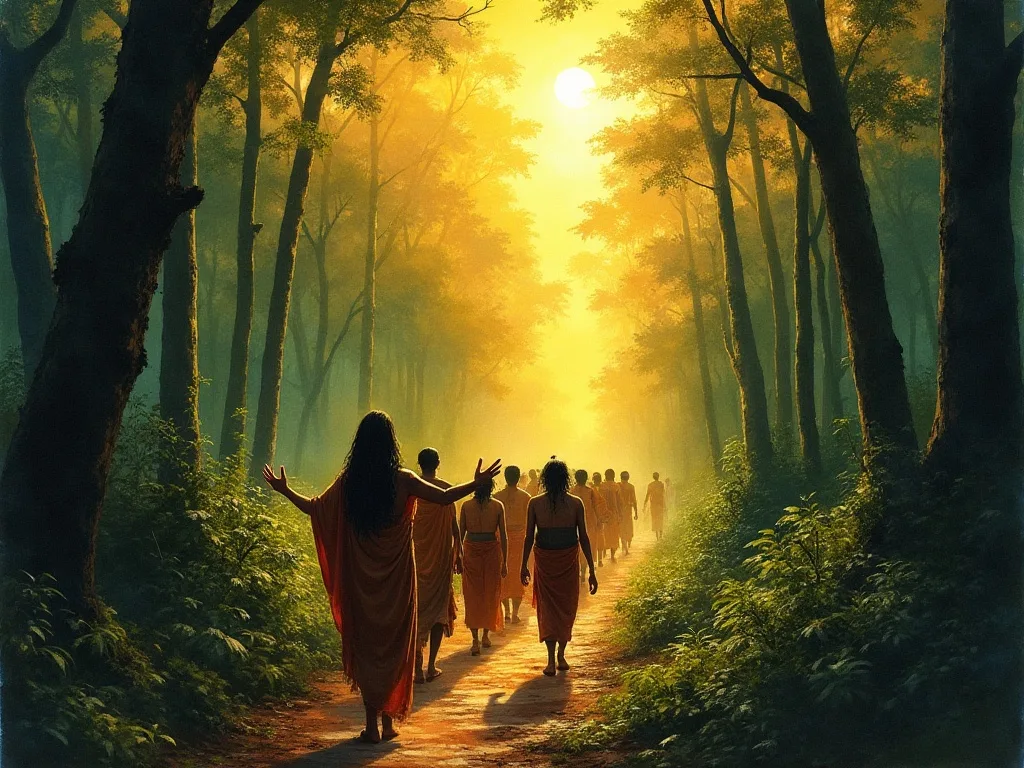
This is the destination that Guarani karaí (prophets-shamans) drove entire communities toward in the great migration movements recorded from the sixteenth through the nineteenth centuries. Groups of hundreds, sometimes thousands, of Guarani people abandoned their villages and marched toward the eastern coast or the west, guided by a prophet singing the sacred chants, searching for a terrestrial paradise where the flood would never come and the earth would not be destroyed again.
The flood myth is the engine of this motion. If the world has already been destroyed once, it will be destroyed again. The only safety is to find, before the next catastrophe, the place that stands outside the cycle. Alfred Métraux, and later the anthropologist Hélène Clastres in her 1975 study La Terre Sans Mal, documented how the myth of destruction by water powered real, historically documented population movements. The flood was not ancient allegory. It was an active theological threat that organized living communities.
This connects the Tupi-Guarani flood to the Guarani vision of paradise in a way that distinguishes it sharply from, say, the Mesopotamian or biblical parallels. In Genesis, Noah's flood ends with a rainbow covenant: it will not happen again. In Guarani tradition, the opposite logic applies: it will happen again, and the righteous must keep moving toward the land that is exempt.
Cross-Cultural Echoes and the Debate Over Diffusion
The Tupi flood narrative shares structural features with flood myths from Mesoamerica to Mesopotamia, a fact that has fueled a century of debate among anthropologists and historians of religion.
Early missionaries, like the sixteenth-century Portuguese Jesuit Manuel da Nóbrega, were astonished by what they took to be a garbled memory of the biblical Noah, and they used the apparent parallel to argue that the Tupi had already received some fragment of divine revelation. Later scholars rejected this confidently. The independent origins hypothesis gained ground: flood myths arise wherever floods are a real threat, and the Amazon basin, seasonally inundated, offered direct experiential grounds for imagining a universal deluge.
A more careful position, advanced by researchers like Rafael José de Menezes Bastos and others working in the ethnomusicological tradition, treats the structural parallels not as evidence of borrowing but as evidence of shared cognitive templates. Humans across cultures, confronting the possibility of total destruction, generate remarkably similar narrative solutions: a guilty world, a preserved remnant, a transformed aftermath.
Compare the Tupi tradition to the Aztec myth of the Five Suns, where each cosmic age ends in destruction, including one age ended by water (the sun Nahui Atl, "Four Water"), and the structural kinship is unmistakable. Both traditions use cyclical destruction not to threaten the reader with despair but to locate the present world inside a meaningful sequence: we are here because the right people survived, and the task now is to live in a way that justifies that survival.
Shamanism, Water, and the Ritual Re-Enactment of Renewal
The flood does not only live in narrative. It lives in Tupi-Guarani ritual practice, particularly in the ceremonies tied to shamanic initiation and renewal.
Guarani pajé (shamans) undergo ritual ordeals that include symbolic submersion, extended fasting, and periods of isolation that re-enact the destruction and reconstitution of the person. The initiate must, in a real sense, die to the old self before the new self can emerge. This is the flood logic applied to individual bodies: just as the world had to be drowned before it could be reborn, so the shaman must pass through dissolution to gain the power to mediate between worlds.
The karaí prophets who led the migration movements toward Yvy Marã Ey performed this logic at the collective level. They sang, they danced, they sometimes fasted communities toward a state of ritual lightness, a condition called aguyje or "perfection," in which the body might become light enough to pass directly into the imperishable land without dying. Water, in this context, is not simply a metaphor. It is a cosmological substance: the medium through which transformation passes, the boundary between the world that was and the world that might be.
The ethnomusicological recordings of Guarani sacred chants made by Menezes Bastos and others reveal how structurally central renewal is to every major ceremony. The songs do not describe the flood as a past event. They enact it as a present possibility, always already happening, always being survived.

Frequently Asked Questions About the Tupi-Guarani Flood Myth
Frequently asked questions
Who are the main divine figures in the Tupi-Guarani flood myth?
The principal figures vary by group and period of documentation. Monan, the remote creator who withdraws from a corrupt world, appears most consistently in Tupinambá accounts recorded by French and Portuguese missionaries in the sixteenth and seventeenth centuries. Maíra, a culture-hero and transformer, often acts as the intercessor who carries knowledge through the catastrophe. Among Guarani communities, Ñamandu, the supreme first father, provides the overarching cosmological frame within which the flood is one destruction among several successive world-ages.
What is 'Yvy Marã Ey' and how does it connect to the flood?
Yvy Marã Ey, meaning "the land without evil" or "the imperishable land" in Guarani, is the mythic paradise toward which Guarani prophets led mass migrations from the colonial period onward. The flood myth provides its urgency: because the present world was once destroyed by water and will be destroyed again, the only true security lies in reaching a land that stands outside the cycle of cosmic catastrophe. The anthropologist Hélène Clastres documented these historically real migrations in her 1975 study, showing how the flood theology organized actual community behavior across centuries.
How does the Tupi flood myth compare to the biblical account of Noah?
Early Jesuit missionaries drew the comparison immediately, and some argued it proved pre-Columbian divine revelation. Modern scholarship rejects any direct link. The structural overlap, a corrupt world, a preserved remnant, a post-flood renewal, is now understood as a convergent narrative pattern found across cultures where flooding is a real environmental experience. The theological logic is almost inverted: the biblical covenant promises the flood will not recur, while the Guarani tradition teaches that it will, making the search for the imperishable land not nostalgia but necessary action.
What role does the pindó palm play in the survival narrative?
The pindó palm (Syagrus romanzoffiana) appears in multiple Guarani variants as the tree survivors climb to escape the rising waters. Its selection is not incidental: the pindó is the "eternal palm" in Guarani sacred geography, associated with Yvy Marã Ey and with permanence beyond mortal time. Using it as a refuge encodes the destination in the act of survival itself. To cling to the pindó during the flood is already to orient oneself toward the imperishable.
Who documented these flood myths and how reliable are the sources?
The earliest records come from sixteenth-century French and Portuguese missionaries and travelers, including Jean de Léry's Histoire d'un voyage faict en la terre du Brésil (1578) and the Jesuit Cartas from Brazil. Later, the German-Brazilian ethnographer Curt Nimuendajú produced careful fieldwork accounts in the early twentieth century. Alfred Métraux synthesized much of this material for the Handbook of South American Indians in the 1940s. These sources carry the filters of their time, translation gaps, missionary interpretive frames, and the disruption of colonial violence on living traditions. Cross-reading multiple sources and later indigenous-led scholarship produces a more reliable picture.
Is the flood myth still alive among Guarani communities today?
Yes. Among contemporary Guarani groups in Brazil, Paraguay, and Argentina, the cosmological framework that includes flood mythology, the prophetic tradition of karaí, the concept of Yvy Marã Ey, and shamanic practice remains active. Guarani communities have worked to document and protect their oral traditions, and indigenous scholars like those associated with the Organização das Nações e Povos Indígenas no Brasil (ONPIB) have engaged critically with earlier ethnographic representations. The tradition is living, contested, and continuously reinterpreted.
The Flood Myth as a Theology of Motion
What finally separates the Tupi-Guarani flood tradition from its nearest structural relatives elsewhere in world mythology is not the water itself. It is what the survivors are supposed to do next.
The flood, in this tradition, does not close a chapter. It opens a permanent condition: the awareness that the world can end, that it has ended before, and that the appropriate response is neither despair nor complacency but active orientation toward the imperishable. Every ceremony that re-enacts the flood's logic, every shaman who undergoes ritual dissolution, every prophet who sang a community toward the east, is performing the same theological conviction: survival is not passive. It is earned through sustained alignment with the sacred, through the aguyje of perfected living, through the refusal to let the sacred bonds go slack the way they did in Monan's first world.
This is a profoundly demanding cosmology. It places responsibility squarely on human communities, not as obedience to commandment but as participation in the ongoing work of keeping the world coherent. The flood already happened. The next one is already possible. What stands between the present earth and its dissolution is the quality of the life lived on it.
For traditions that have survived five centuries of colonial violence, forced relocation, missionary disruption, and cultural erasure, that theology carries a particular weight. The Guarani who still sing the sacred chants, who still know the name Yvy Marã Ey, are not repeating an archaic text. They are performing the oldest argument their tradition makes: that the world can always be remade, and that the people who carry the right knowledge are the ones who make it.
Free 25-page sample
Want the whole story?
Take the first 25 pages free. If it pulls you in, the full edition is yours as an instant PDF download, with a paperback on Amazon for selected titles.
Tupi-Guarani
The Tupi-Guarani Mythology Book: The Land Without Evil, the Twin Heroes, and the Spirits of the Rainforest
Namandu, the Twin Heroes, and the Land Without Evil
The mythology of the Tupi and Guarani peoples of the Amazon and the Atlantic forest: Namandu the creator who unfolded the world out of darkness, the twin heroes raised by jaguars, Tupa of the thunder, the fire-serpent Boitata, and the long search for the Land Without Evil.
More from Tupi-Guarani
All articles
Tupi-Guarani
Tupã: The Thunder God and Supreme Creator of Tupi-Guarani Myth
Tupã commands the sky as both destroyer and creator: the Tupi-Guarani supreme god who speaks through thunder, shapes the cosmos, and rules over all lesser powers. Discover how this ancient deity shaped the worldview of millions across the Amazon and beyond.

Tupi-Guarani
The Origin of Manioc: Mani and the Gift of Cassava
In Tupi-Guarani lore, a girl named Mani died of a broken heart and transformed into the cassava root, becoming the foundation of survival for generations. Discover how a myth of grief became the story of a continent's staple crop.

Tupi-Guarani
Anhangá: The Forest Protector and Trickster Spirit
Anhangá is the shape-shifting guardian of Tupi-Guarani forests, a spirit who punishes hunters who show disrespect to animals and plants. Part protector, part deceiver, this creature embodies the deep ecology of Amazonian belief.

Tupi-Guarani
Sumé: The Culture Hero and Civilizing Prophet of the Tupi-Guarani
Sumé taught agriculture, language, and moral law to the Tupi-Guarani peoples before vanishing into the sea. This foundational culture hero bridges the sacred and the everyday in South American oral tradition.