
Thunor: The Thunder God of the Anglo-Saxons
Thunor ruled the storms long before Thursday got its name. Meet the Anglo-Saxon thunder god whose hammer, oak groves, and sacred power shaped early medieval England.
Contents
The sky split open, and the harvest fields shook. Somewhere above the chalk downlands and the dense oak forests of early England, a god was at work. His name was Thunor: the Thunder God of the Anglo-Saxons, and when his hammer fell, the rain came with it.
He was not gentle. He was not distant. He was the crack overhead during a barley storm, the reason a man breathed easier after lightning missed the barn. Farmers watched the clouds and knew his moods. Warriors asked for his strength before a shield-wall clash. And though barely a handful of Anglo-Saxon texts survive to carry his name forward, the traces Thunor left across the English landscape are still there, if you know where to look.
Across the North Sea, his Scandinavian cousin Thor gathered saga after saga. The Eddas gave Thor a whole mythology, rich and loud. Thunor received no such treatment. No poem survives in his name alone. Yet his footprints run through place names, personal names, sacred plants, and the very structure of the week. He was real and present in the lives of the Anglo-Saxon people, a working god in a working landscape.
Who Was Thunor? Origins and the Germanic Family Tree
Thunor is the Old English form of a name that echoes across every branch of the Germanic world. The Proto-Germanic root is reconstructed as Þunraz, from a word meaning "thunder." In Old Norse, he became Þórr (Thor). In Old High German, Donar. In Dutch, Donder. The same deity, wearing different dialects.
The scholarly consensus, represented in the work of Hilda Ellis Davidson in her landmark 1964 study Gods and Myths of Northern Europe, treats these figures as regional expressions of a single inherited Proto-Germanic thunder deity. This god was himself likely related to the Proto-Indo-European sky-father and storm figure, a deep ancestral pattern visible in the Vedic Indra, the Greek Zeus, and the Roman Jupiter.
The Anglo-Saxons arrived in Britain from the continental Germanic homelands across the fifth and sixth centuries AD, carrying their gods with them. Among those gods, Thunor stood as one of the most potent. He represented raw atmospheric power, the protection of ordinary people, and the vitality of the natural world. Where the high god Wōden (Odin in Norse tradition) appealed to kings, warriors, and poets, Thunor was the god of fields and fences, of the thunderstorm that both threatened and fed the land.
What Thunor Looked Like: The Iconography of the Anglo-Saxon Storm
No Anglo-Saxon image of Thunor survives with a label, the way a medieval manuscript might caption a saint. Scholars work by analogy, cross-referencing Germanic archaeological finds, Continental Donar iconography, and the later Norse material.
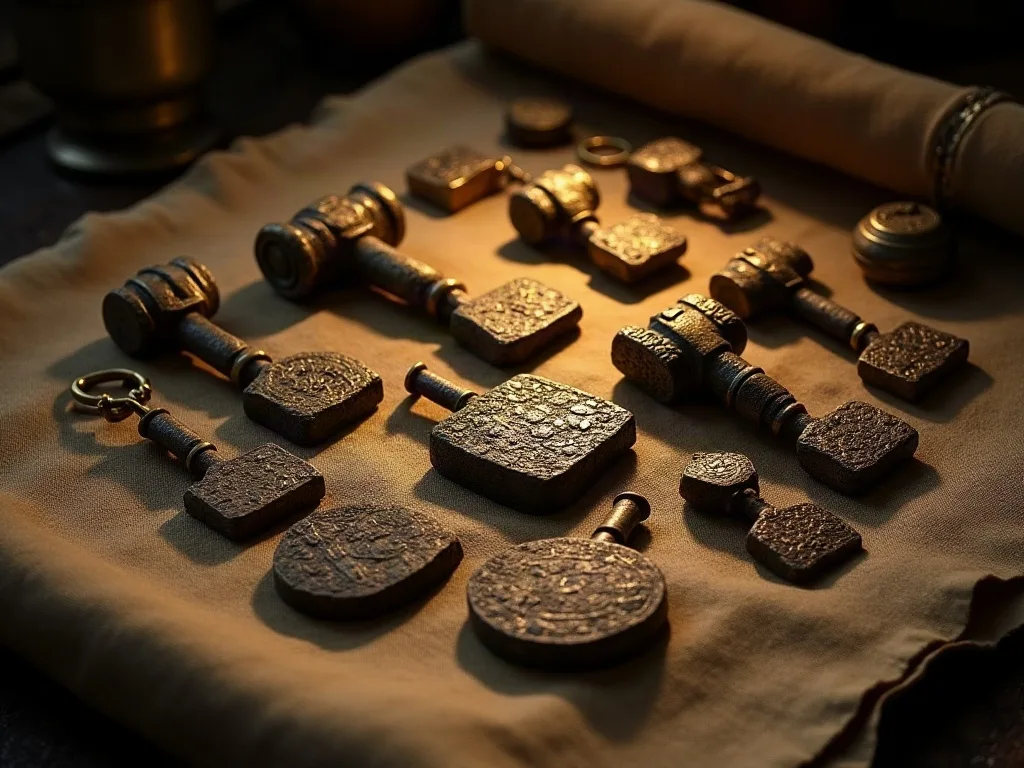
The hammer is the clearest constant. Miniature amulets shaped like a stylised hammer appear across migration-period Germanic burial sites from Denmark through to England. These objects, worn at the throat, follow the same design as the famous Mjolnir pendants of Viking Age Scandinavia. The hammer was a symbol of consecration: it blessed marriages, sanctified newborns, and warded off malevolent forces. In Anglo-Saxon England, swastika-like symbols called fylfot found on bracteates (thin gold discs) and cremation urns have been linked by archaeologists including John Hines to protective, thunder-related beliefs.
The oak tree was specifically Thunor's tree. Both ancient Roman sources like Tacitus in his Germania (written around AD 98) and later medieval glosses connect the oak with the Germanic thunder god. Sacred oak groves served as outdoor ritual spaces before Christian churches replaced them. A grove dedicated to Thunor, called a þunorleah ("Thunor's woodland clearing"), gave its name to several English places, and those names survived.
The colour red appears in some Continental Donar traditions, and the Norse Thor is associated with red hair and beard. Whether Thunor shared this visual signature in Anglo-Saxon imagination is less certain, but the association of redness and heat with storm-fire is plausible across the family.
Thunor Across the English Landscape: Place Names and Sacred Sites
Here is where the evidence becomes surprisingly rich. Thunor left his name on the English ground.
Place-name scholars, most systematically Margaret Gelling in her foundational work on English place names, have identified several English locations whose names contain the þunor- element:
- Thundersley in Essex preserves Old English þunreslēah, "Thunor's woodland clearing."
- Thunderfield in Surrey points to a field associated with the god.
- Thunderidge in Hertfordshire carries a similar origin.
- Thundridge, also in Hertfordshire, repeats the pattern.
These were not random sonic coincidences. Place names ending in -lēah (a woodland clearing) or -feld (an open field) typically record real sites of ritual activity. They mark where people gathered, where offerings were made, where the land itself was understood to belong to a divine presence. Thunor's cult was rooted in the soil of southern and central England, places within reach of the earliest Anglo-Saxon settlements.
Beyond place names, personal names offer a second line of evidence. Thunorgifu ("Thunor's gift") and Thunorhere ("Thunor's warrior") appear in early Anglo-Saxon records, suggesting that parents named children in Thunor's honour the same way Christian parents later chose saints' names.
Thunor and the Rhythms of Anglo-Saxon Life
To understand why Thunor mattered, picture an early Anglo-Saxon farming community. The agricultural calendar was everything. Too little rain meant famine. Too much meant flooded fields and rotting grain. A god who controlled the sky and brought the thunder-rain held the balance of life and death over every farmstead.
Thunor's power was explicitly tied to fertility, not in the abstract, but in the practical sense of a good harvest. Rain, lightning, and the booming sky were not merely frightening spectacles; they were signs that the god was active, that he was doing his work. In the Norse tradition, Thor's hammer blows were understood to fertilise the earth. The same logic almost certainly applied to Thunor's role in Anglo-Saxon agricultural religion.
He was also a god of protection. The hammer amulet worn at the chest was apotropaic, a word meaning "designed to ward off harm." Evil spirits, harmful magic, the curses of enemies: Thunor's force was believed to repel them. This protection extended to boundaries. The edge of a field, the threshold of a hall, the frontier of a community: all could be brought under the god's shelter. A boundary marked by Thunor was a boundary with divine muscle behind it.
Warriors also called on him, though he shared military patronage with Wōden. Thunor's strength was physical and direct; Wōden's was strategic and uncanny. A fighter who wanted brute power and stamina in the shield-wall would have looked to Thunor. His energy was not cunning but force, not guile but storm.
What the Anglo-Saxon Texts Actually Say
The honest answer is: not much, directly. Anglo-Saxon England converted to Christianity between roughly AD 597 and 686, and the monks who preserved Old English literature had reasons to suppress pagan theology rather than record it.
Yet hints survive, scattered and tantalising.
The famous list of pagan deities in the "Baptismal Vow" preserved in Old Saxon (and paralleled in an Old English version) instructs converts to renounce Thunaer, Wōden, and Saxnōt along with all the devils associated with them. Thunaer here is the Old Saxon form of Thunor, confirming the god's central place in the pre-Christian pantheon alongside Wōden. The vow was serious: these were the names you had to explicitly disavow before you could be baptised.
The Lacnunga, a tenth-century Old English collection of medical and magical charms, contains a passage called the "Nine Herbs Charm." It describes nine sacred plants used in healing and references Wōden explicitly. Some scholars, including Karen Louise Jolly in her 1996 study Popular Religion in Late Saxon England, argue that thunder-related imagery in Anglo-Saxon charms connects to Thunor even when his name does not appear directly.
Bede, the Northumbrian monk writing around AD 730, mentions in his De Temporum Ratione that Thursday (Þūnresdæg) was named for the thunder god when the Germanic peoples translated the Roman planetary week into their own framework. This is the clearest written attestation linking Thunor to a specific cultural practice that survived Christianisation intact: the day of the week.
Runic inscriptions from early Anglo-Saxon England sometimes carry protective markings that scholars connect to thunder-cult practice, though attributing individual runes to specific deities is contested territory.
Thunor and Wōden: Two Gods, Two Powers
The Anglo-Saxon divine world was not monotheistic, obviously, but it was not a flat democracy of equally weighted gods either. The surviving evidence suggests a hierarchy in which Wōden held special status for the nobility and the royal lines, while Thunor held a broader, more democratic reach into everyday life.
Thunor
Thunor controlled thunder, rain, and the storm sky. His power was physical and visible. He protected farmers, craftsmen, and warriors seeking brute strength. His symbol was the hammer. His tree was the oak. His cult was rooted in clearing and field. He asked for loyalty and received it from the ground up.
Wōden
Wōden (the Anglo-Saxon form of Odin) controlled wisdom, war-fate, poetry, and death. His power was hidden and cunning. He patronised kings, poets, and berserker warriors. His symbol was the spear and the raven. His presence was felt in riddles, in sacrifice, and in the uncanny. Anglo-Saxon royal genealogies traced descent directly from Wōden.
Both gods were real and present in early Anglo-Saxon religious life. They were not rivals but complementary forces: Thunor for the storms you could see, Wōden for the storms inside the mind.
The Conversion and What Happened to Thunor
When Pope Gregory the Great sent Augustine to England in AD 596, the mission was to win the Anglo-Saxons away from their gods. The strategy, famously, was not always direct confrontation. Gregory's own letters (preserved in the Registrum Epistularum) advised converting pagan temples into churches rather than destroying them, redirecting festival energies rather than suppressing them violently.
Thunor's sacred places were among those repurposed. Thundersley in Essex eventually hosted a Christian church. The oak groves came down, or the rites performed there were reinterpreted. Thunder itself was re-explained: not the voice of Thunor but the sound of God's power, or in folk tradition, sometimes the sound of angels moving heavenly furniture.
Yet the complete erasure of Thunor from the English consciousness never quite happened. Thunor's legacy in Anglo-Saxon culture persisted in folk magic and superstition well beyond the conversion period. The practice of placing iron objects (including hammer-shaped pieces of metal) near thresholds for protection survived in English folk custom into the early modern period. The association of storms with divine anger, the nervous counting of seconds between lightning and thunder: these are old reflexes, and some of them are very old indeed.
Ecclesiastical writers sometimes rail specifically against thunder-worship. A tenth-century penitential text warns against those who perform ritual actions during thunderstorms, a good sign that people still did exactly that.
Thunor in Comparative Mythology: The Indo-European Thunder Complex
The pattern Thunor belongs to is one of the oldest and most widespread in human religious history. Across the Indo-European world, a thunder god associated with a weapon (hammer, bolt, club, axe) defeats a monstrous serpent or chaos-figure to restore cosmic order. This "dragon-slayer" or "storm god vs. chaos monster" pattern appears in:
- Indra vs. Vritra (the Rigveda, composed c. 1500-1200 BC)
- Zeus vs. Typhon (Hesiod's Theogony, c. 700 BC)
- Thor vs. Jormungandr (the Prose and Poetic Eddas, written down c. 1220 AD but preserving older oral traditions)
- Perun vs. Veles in Slavic tradition
Thunor almost certainly carried this battle-myth in some form. The Norse Thor's greatest adversary is the World Serpent; the Vedic Indra's great deed is slaying the serpent Vritra to release the rivers. The comparative mythologist Calvert Watkins, in his 1995 study How to Kill a Dragon, traces this formula to Proto-Indo-European roots at least 6,000 years old.
Thunor's place in this lineage is not speculative: it is the expected default for a Germanic thunder deity. The lack of surviving Anglo-Saxon texts giving us the specific story is a gap in the evidence, not proof the story didn't exist.
Frequently Asked Questions About Thunor, the Anglo-Saxon Thunder God
Frequently asked questions
Is Thunor the same god as Thor?
Yes and no. Thunor and Thor are cognate deities, regional expressions of the same Proto-Germanic thunder god Þunraz. They share the hammer symbol, the oak association, and the role of protector against chaos. But they developed separately in different cultural settings. The Norse Thor accumulated centuries of saga material in Iceland and Scandinavia. Thunor was worshipped in early medieval England with a distinct cult, distinct place names, and an independent tradition that was largely destroyed or absorbed by Christianisation before it could be written down in detail.
How do we know Thunor was actually worshipped in Anglo-Saxon England?
Several converging lines of evidence confirm the cult. Place names like Thundersley in Essex and Thundridge in Hertfordshire preserve the Old English word þunor in ritual landscape contexts. The Old Saxon Baptismal Vow explicitly names "Thunaer" as a god converts must renounce. Bede confirms the naming of Thursday as "Thunor's Day." Hammer amulets found in Anglo-Saxon burial contexts mirror Thor-amulet traditions across the Germanic world. Together, these sources build a solid picture of an active thunder cult in early medieval England.
What was Thunor's relationship to fertility and agriculture?
Deeply intertwined. Thunder and rain were not just frightening natural events to Anglo-Saxon farmers; they were the mechanisms by which the sky god fed the earth. Thunor's hammer, in the Norse tradition explicitly and the wider Germanic tradition by inference, was a tool of consecration and fertilisation, not just a weapon. Scholars like Hilda Ellis Davidson argue that the thunder god's primary social function in Germanic religion was the protection and nourishment of the human community through control of the weather. Thunor's cult sites in southern England, where grain farming was essential, reflect this agricultural centrality.
Why do we have so little written evidence about Thunor compared to Thor?
Timing and literacy. Anglo-Saxon England converted to Christianity in the seventh century, and the monks who ran scriptoria, the workshops where manuscripts were produced, had no interest in preserving pagan mythology in detail. By the time a literary culture was recording Old English verse, pagan theology was already being actively suppressed. Scandinavia converted much later, and the Icelanders who eventually wrote down the Eddas in the thirteenth century did so at a moment when recording the old myths was seen as culturally valuable rather than dangerous. Thunor's tradition was oral, seasonal, and local; it did not survive the shift to a Christian, literate culture the way the Norse material did.
Does Thunor appear in any surviving Old English literature?
Not by name in surviving poetry. The richest indirect evidence comes from the Baptismal Vow (naming Thunaer), Bede's explanation of Thursday's etymology, and the penitential literature warning against thunder-related ritual practices. The Nine Herbs Charm in the Lacnunga manuscript uses storm and Wōden imagery that some scholars see as connected to Thunor's world. Runic inscriptions add further layers. But no surviving Old English poem names Thunor as its subject. The contrast with the Eddic material on Thor is one of the sharpest gaps in the study of pre-Christian English religion.
What happened to Thunor's sacred places after Christianisation?
Most were converted or abandoned. Pope Gregory's famous letters to Augustine advised building churches on pagan sites rather than demolishing them, aiming to redirect existing sacred associations rather than simply delete them. Thundersley in Essex is one probable example: a site bearing Thunor's name eventually became the location of a medieval parish church. Oak groves were cleared or consecrated under different names. The process took generations, and folk practices associated with thunder and storms persisted in rural England well into the early modern period, often absorbed into Christian frameworks rather than eliminated entirely.
Thunor's Long Echo: Modern Resonance and Unresolved Questions
The name Thunor still hums through English every Thursday morning. That is not a small thing. It means the Anglo-Saxon thunder cult was strong enough that even total religious transformation, the conversion of an entire people to Christianity, could not dislodge the god's name from the calendar. He is embedded in the week itself, a rhythm that billions of people follow without knowing his name.
The scholarly debate around Thunor is, in many ways, a debate about what archaeology and place-name evidence can prove in the absence of literary sources. Researchers like John Blair, in his 2005 study The Church in Anglo-Saxon Society, argue that the pagan landscape of early England was richer and more structured than the fragmentary evidence suggests. Blair identifies a pattern of "central places" associated with pagan cult, including sites bearing divine name elements like þunor, that pre-dated the Christian landscape. His work implies that Thunor's cult was not scattered folk magic but part of an organised, landscape-embedded religious system.
What remains genuinely uncertain is the narrative mythology. Did Thunor have a great serpent to fight, as Thor fought Jormungandr? Did he have a wife, children, a hall? The comparative evidence says almost certainly yes. The direct evidence says nothing. Every reconstruction of Thunor's mythology beyond his name, his hammer, and his association with oak and storm is an informed inference rather than a documented fact.
That gap, the silence where the Anglo-Saxon thunder myths should be, is one of the most evocative absences in the study of northern European religion. The stories existed. They were told around fires, used in charms, implied by the names given to children and fields. A world where Thunor ruled the sky was real and vivid for the people who lived under it. The loss is not Thunor's; the loss is ours. And knowing he was there, that Thursday belonged to him long before it belonged to anyone's weekly commute, is itself a kind of contact with that vanished world.
Read the full book
Want the whole story?
The complete edition is an instant PDF download here, with a paperback on Amazon for selected titles.
Anglo-Saxon
The Anglo-Saxon Mythology Book: Woden, Thunor, Beowulf, and the Lost Gods of Pre-Christian England
The Sacred Stories Before Christianity Buried Them
The mythology of pre-Christian England: Woden's ravens, Thunor's thunder, Beowulf's monsters, and the Wyrd sisters who wove fate. Recovered from Beowulf, royal genealogies, and the grave goods.
More from Anglo-Saxon
All articles
Anglo-Saxon
Hengist and Horsa: Legendary Founders of Anglo-Saxon England
Two brothers from Germanic lands, Hengist and Horsa led the first English settlers across the North Sea. Their arrival around 449 CE marks the beginning of Anglo-Saxon England, though history and legend now blur beyond recognition.
Anglo-Saxon
The Wild Hunt in Anglo-Saxon Belief: Spectral Riders and the Hunt for Souls
The Wild Hunt in Anglo-Saxon belief was a ghostly procession across the night sky, led by divine or demonic riders who hunted both the living and the dead. Discover how this ancient vision shaped English folklore for over a thousand years.

Anglo-Saxon
The Sutton Hoo Ship Burial: Archaeology and Myth
In 1939, archaeologists uncovered a 27-meter ship buried in Suffolk, England, holding treasures and weapons from the 6th century. The Sutton Hoo ship burial bridges Anglo-Saxon reality and the epic worlds of Beowulf, revealing how real kings were sent to their gods.
Anglo-Saxon
Eostre: Goddess of Spring and Dawn
Eostre is the Anglo-Saxon goddess of spring, dawn, and fertility, known through a single historical mention by the Venerable Bede. Discover how this shadowy deity shaped the season of renewal and inspired the modern holiday of Easter.