
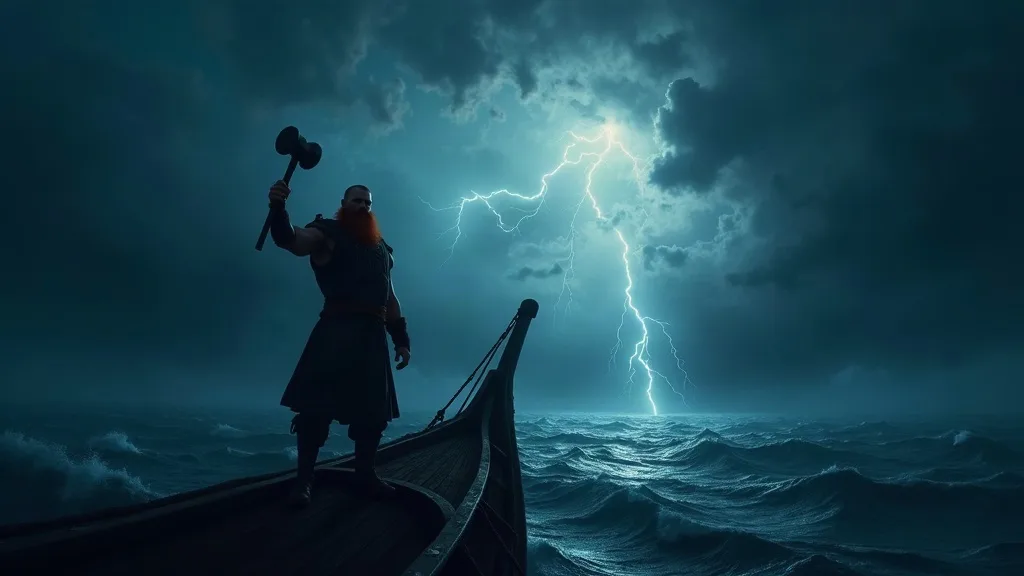
Thor: God of Thunder and Protector in Modern Heathenry
Thor swings Mjolnir across Norse myth and modern Heathen altars alike. Learn who he truly is, what the Eddas say, and why he still matters in living religious practice.
Contents
The sky splits open. A crack of thunder rolls across the North Sea, and somewhere in the longhouse a farmer nods: Thor is on his way. He is not a metaphor. To the people who first told these stories, the thunder really was his chariot wheels grinding across the vault of heaven, and the lightning really was Mjolnir striking.
That image has never quite faded. Two thousand years separate the Viking Age from 2026, and yet Thor: God of Thunder and Protector remains one of the most recognized divine figures on earth. He sells movie tickets, yes, but he also sits at the center of a living religious tradition practiced by hundreds of thousands of modern Heathens. Few gods bridge ancient myth and contemporary worship so directly. Fewer still do it while swinging a hammer.
This article moves from the oldest Norse sources through Thor's epic deeds, his role in everyday human life, and finally to the altars being built for him right now.
Who Thor Is: Lineage, Appearance, and Divine Role
Thor is the son of Odin and the earth goddess Jörð (also called Fjörgyn), which makes him literally half sky, half earth. His mother's soil-and-stone nature shows in everything about him: he is immense, broad-shouldered, red-bearded, and built for the physical work of protecting the world rather than its scheming.
The Prose Edda, a mythological compendium written by the Icelandic scholar Snorri Sturluson around 1220 CE, describes Thor as the strongest of all the Aesir gods. His wife is Sif, a goddess associated with golden grain and harvest. He has three children who matter enormously to his mythology: Magni (strength) and Modi (courage) from the giantess Járnsaxa, and Þrúðr from Sif. That he fathered two sons with a giantess is worth pausing over: Thor fights giants constantly, yet also reproduces with them. Norse myth is rarely clean in its categories.
He drives a chariot pulled by two goats, Tanngrisnir and Tanngnjóstr (literally "tooth-gnasher" and "gap-tooth"). He can slaughter and eat them each night, then resurrect them the next morning with his hammer, provided no bones are broken. In the Prose Edda, a farmer's son snaps a leg bone to suck the marrow; Thor's fury at discovering this is one of the few moments where he genuinely frightens humans rather than monsters.
Three objects define him visually and functionally:
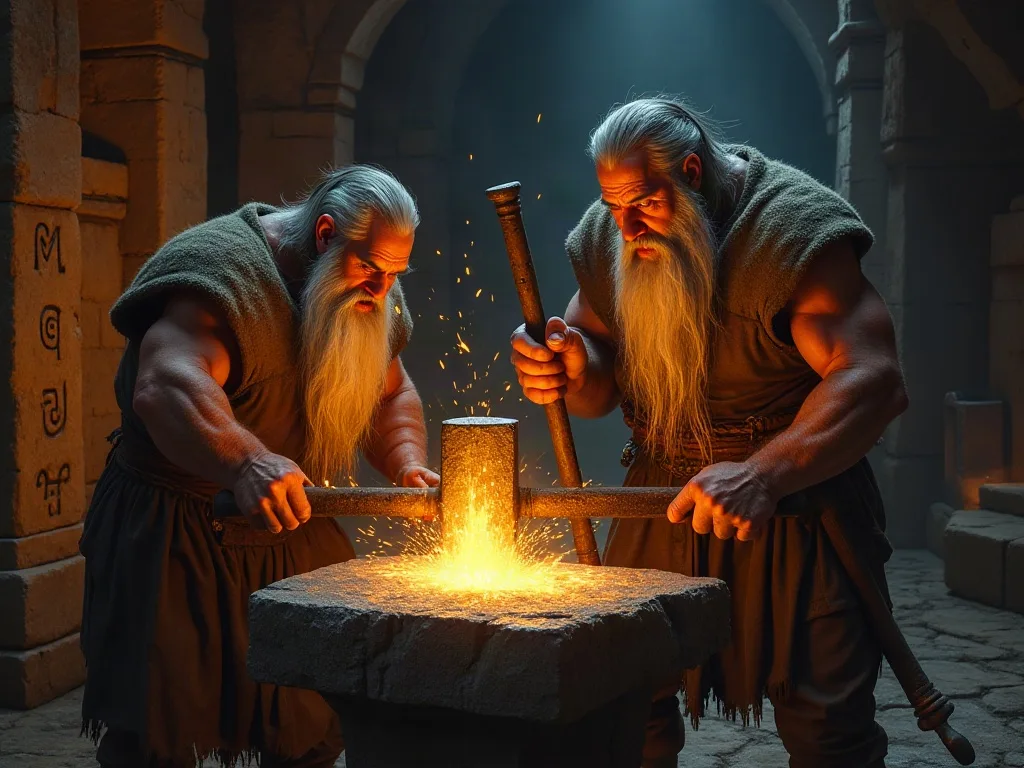
- Mjolnir: his hammer, forged by the dwarf brothers Sindri and Brokkr. Short-handled by accident (Loki sabotaged the forge), but capable of leveling mountains.
- Megingjörð: a belt of power that doubles his already enormous strength when worn.
- Járngreipr: iron gloves without which he cannot grip Mjolnir's handle.
Together these three items make Thor the ultimate weapon against chaos. Without them he is still formidable, but the Poetic Edda (a collection of older mythological poems preserved in the 13th-century Codex Regius) makes clear that the hammer is his core identity. When it is stolen, everything unravels.
The Myths That Define Him: From Utgard to Jormungandr
The Theft of Mjolnir
The poem Þrymskviða in the Poetic Edda opens with a problem: Thor wakes up and his hammer is gone. The giant Thrym has buried it eight miles underground and will only return it if he receives the goddess Freyja as a bride. Freyja refuses so violently that her necklace shatters. Loki then proposes a plan that says everything about Norse myth's relationship to gender and cunning: Thor dresses as a bride, Loki dresses as her handmaiden, and the two of them attend the wedding feast.
What follows is broad comedy with a sharp edge. Thor eats an entire ox, eight salmon, and all the sweet cakes, then drains three barrels of mead. Thrym wonders about his bride's appetite. Loki explains that she has been too excited to eat for eight days. Thrym leans in to kiss the bride and recoils from the eyes blazing beneath the veil. Loki says she hasn't slept either. Finally Thrym places Mjolnir in the bride's lap to hallow the marriage, and Thor grabs it and kills every giant in the hall.
The poem is funny and fast-moving, but scholars like Rudolf Simek, in his Dictionary of Northern Mythology (1993), read the episode as an inversion ritual: the warrior temporarily adopts chaos-adjacent disguise precisely to restore cosmic order. The hammer returns to its proper guardian, and the world is safe again.
Thor at Utgard-Loki's Hall
In the Prose Edda's Gylfaginning section, Thor, Loki, and two young companions travel to Utgard, a hall of giants in the far east. The giant king Utgard-Loki challenges them to contests. Loki loses an eating race. A young companion named Þjálfi loses a footrace. Thor fails to drain a drinking horn, fails to lift a cat from the floor, and is wrestled to one knee by an old woman.
Only after they leave does Utgard-Loki reveal the truth. Loki was racing against fire itself, which devours everything. Þjálfi ran against thought, which nothing outruns. The horn connected to the ocean, and Thor's three sips lowered sea levels visibly. The cat was the Midgard Serpent Jormungandr in disguise, and lifting it even slightly shook the cosmos. The old woman was old age, Elli, and no one has ever defeated her.
The lesson is not that Thor failed. It is that Thor's "failures" were near-victories against forces that cannot be defeated. He almost drank the ocean dry. He almost lifted the world serpent. He wrestled old age to a draw. Snorri seems to be making a theological point: even the mightiest protector operates within limits, and those limits are not weaknesses but markers of the shape of reality.
The Killing of Hrungnir
The Skáldskaparmál in the Prose Edda records Thor's duel with the stone giant Hrungnir, the strongest of all giants. Hrungnir carries a shield and a whetstone for a weapon. Thor charges with Mjolnir; Hrungnir throws the whetstone. They collide mid-air. The whetstone shatters, embedding fragments in Thor's skull, where they reportedly remain. But Mjolnir lands squarely, crushing Hrungnir's head. The giant falls, his enormous leg trapping Thor's neck beneath it.
None of the other gods can lift the leg. Only Magni, Thor's three-year-old son, removes it casually. Thor rewards him with Hrungnir's horse. Odin grumbles that such a prize should have gone to him. Thor does not seem to care. He is already thinking about the whetstone fragments in his skull and how to get them out.
A völva (seeress) named Gróa begins chanting spells to loosen the stone. It starts to move. But Thor, grateful, tells her that her husband Aurvandil has been rescued from the land of giants. She is so overjoyed she forgets the spell words. The whetstone stays in Thor's head forever. The story ends there, without resolution, as if the wound is simply part of him now.
Thor and Jormungandr: The Destined Fight
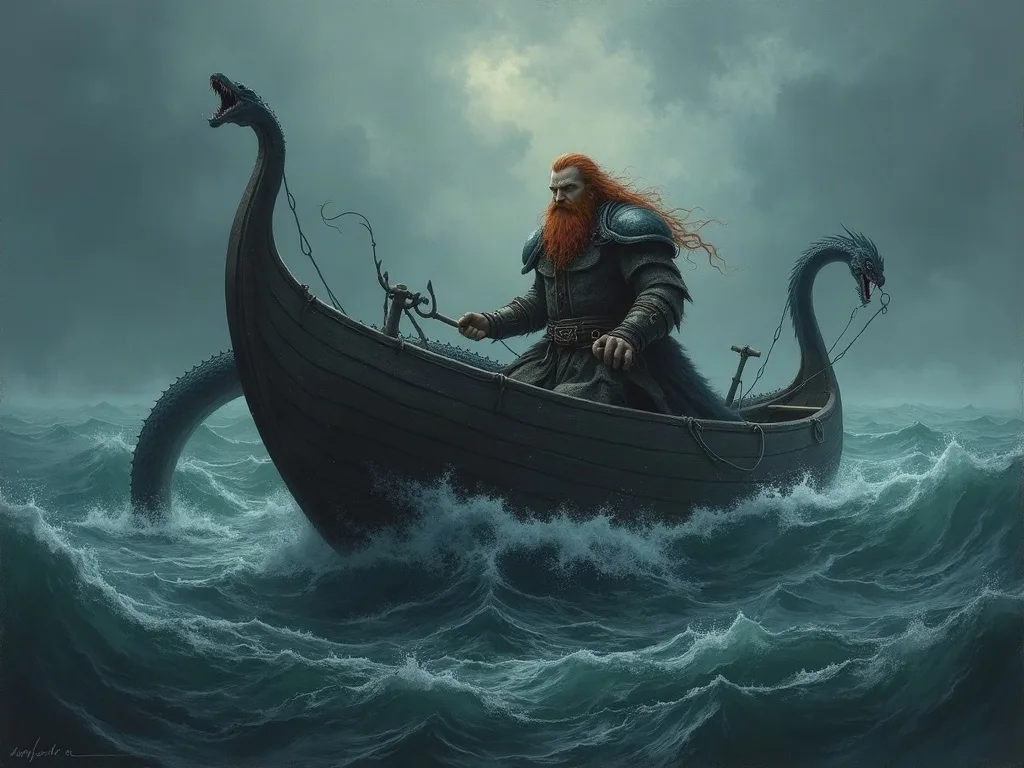
Thor's deepest mythological relationship is with Jormungandr, the Midgard Serpent, the monstrous child of Loki who encircles the entire world in the ocean's depths. They have already met at Utgard; they will meet twice more.
The second meeting comes during a fishing trip. Thor rows out to sea with the giant Hymir, baits a hook with an ox head, and drops it into the deep water. Jormungandr bites. The Hymiskviða poem describes Thor hauling so hard his feet punch through the boat's floor. He drags the serpent's head above the surface. For a moment, god and cosmic serpent stare at each other. Hymir panics and cuts the line. Jormungandr sinks back to the bottom. Thor hurls his hammer after it, but nobody knows whether it connects.
The third meeting is the last. At Ragnarök, the Norse apocalypse, Thor: God of Thunder and Jormungandr finally fight to the finish. Thor kills the serpent with Mjolnir. He then walks nine steps and falls dead, poisoned by the creature's venom. Nine is the most sacred number in Norse cosmology. The Völuspá poem, the Poetic Edda's great visionary text, records this as fact: this is how Thor dies, and it has always been coming.
Thor as Protector: Farmers, Sailors, and the Boundary of Worlds
In the grand mythological narratives, Thor fights Jotnar (giants), cosmic serpents, and stone-skinned monsters. But the people who actually worshipped him were not epic heroes. They were farmers worried about frost killing their barley, sailors afraid of squalls, smiths watching their fires, midwives attending births in winter darkness.
Thor as protector of ordinary human life is the thread that runs through every layer of his cult. The hammer Mjolnir was not only a weapon. It was a hallowing tool, drawn in sign over brides at weddings, over newborns at naming ceremonies, over the dead at funerals. Miniature Mjolnir pendants have been found across Scandinavia, the Baltic, and Anglo-Saxon England, worn by men and women alike. Some pendants have been found at the same archaeological sites as Christian cross pendants, which tells its own story about how these beliefs overlapped and competed during the conversion period.
The Eddas consistently portray Thor as the god who stands between humanity and the encroaching Jotnar, the forces of chaos and entropy that press constantly at the edges of the ordered world. Asgard, the realm of the gods, and Midgard, the human realm, are the two things he is sworn to defend. Utgard, the giants' territory, is always threatening to swallow both.
Adam of Bremen, the 11th-century German chronicler, described the great temple at Uppsala in Sweden and noted that Thor held the central position among three god-statues, with Odin on one side and Freyr on the other. Thor controlled the sky, storms, thunder, and lightning. He gave rain for crops. He drove away disease. He had power over marriage and conception. Adam was a Christian and viewed all of this with contempt, but his report is one of the most direct historical windows onto actual Norse religious practice.
Thor's Name in Landscape and Calendar
The reach of Thor's cult can be measured in place names. Across Norway, Sweden, Denmark, Iceland, and England, hundreds of settlements, hills, and natural features incorporate his name: Torsby, Thornbury, Thundersley, Thurso. The English county of Yorkshire likely contains an echo of him, though scholars debate the etymology.
Thursday exists in every Germanic language because Thor's day (Þūnresdæg) replaced the Roman dies Iovis, Jupiter's day, when Germanic peoples adopted the Roman seven-day week and matched Roman gods to their own equivalents. The equation of Thor with Jupiter is ancient: both are sky-father types who wield lightning, both protect society from violent chaos, both have complex relationships with their fathers and with serpentine enemies.
The planet Jupiter was called Þors stjarna ("Thor's star") in Old Norse. The oak tree was sacred to him, probably because oaks attract lightning. The color red, his beard's color, and the number nine, the steps he walks before falling at Ragnarök, both carry his mark in later Scandinavian folk belief.
Thor in Modern Heathenry: A Living Cult
Modern Heathenry, also called Asatru or Norse Paganism, is a reconstructionist religious movement that began formally in the 1970s, though its intellectual roots go back to 19th-century Romantic nationalism in Scandinavia and Germany. Today its practitioners number in the hundreds of thousands across North America, Europe, and Australia, with organizations such as the Asatru Folk Assembly (founded 1994) and The Troth (founded 1987) representing two distinct theological and political poles within the movement.
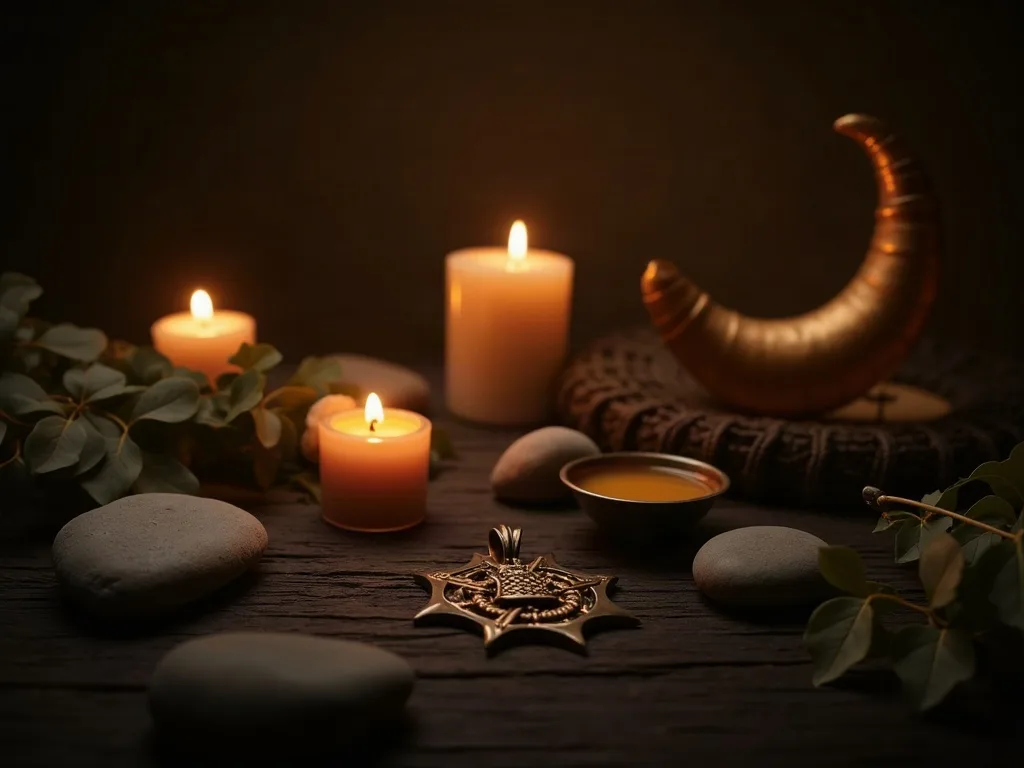
Thor as protector in modern Heathenry is not a symbolic or metaphorical role. For practicing Heathens, he is a deity with genuine presence, petitioned through blót (ritual sacrifice or offering) and galdr (spoken chant). His altar typically holds a Mjolnir pendant or replica, red or orange candles representing lightning and fire, storm water, oak leaves or acorns, and sometimes images of goats. Offerings include mead, ale, bread, and meat.
Asatru practitioners call on Thor particularly in situations that mirror his mythological function: protection from physical danger, strength during illness, safe travel through storms, and the blessing of new homes or marriages. The hallowing gesture (drawing Mjolnir in the air over a space or object) replicates the ritual role described in the medieval sources.
Scholarly observers like Mattias Gardell, in Gods of the Blood (2003), and Michael Strmiska, in Modern Paganism in World Cultures (2005), have noted that Thor is the deity most commonly reported as a personal patron by Heathen practitioners. He is accessible in a way that Odin is not. Odin demands ordeals, self-sacrifice, and dangerous knowledge. Thor shows up, hammer in hand, and does the work.
This accessibility has a theological dimension. Several modern Heathen communities stress that Thor protects mannfólk, humankind, specifically and intentionally. He is not remote or cryptic. He gets angry, he gets tricked, he makes mistakes, but he always comes back to do his job. Many practitioners describe their relationship with him in terms closer to a trustworthy elder relative than an inscrutable cosmic authority.
Thor Across Cultures: Jupiter, Indra, and the Thunder God Pattern
Thor does not exist in isolation. He is the Norse branch of a Proto-Indo-European figure that linguists and mythologists call the "storm god" or "thunder god" archetype. The comparison is not metaphor. The connections are traceable through etymology and shared mythological structure.
The Sanskrit god Indra, storm deity of the Rigveda (composed roughly 1500-1200 BCE), kills the serpent Vritra who has blocked the world's waters, releasing rain and life. Thor kills Jormungandr. Indra wields the thunderbolt vajra; Thor wields Mjolnir. Indra drinks enormous quantities of soma (a sacred ritual drink); Thor drains entire barrels of mead. The structural parallelism across thousands of years and miles is exact enough that most comparative mythologists treat them as reflexes of the same original deity.
Jupiter Tonans ("thundering Jupiter") in Roman religion and Zeus in Greek mythology occupy the same structural position as sky-king thunder-wielders. But Thor is a more specialized warrior figure than either: he is less king and more champion, less lawgiver and more bodyguard. Where Zeus rules, Thor patrols.
The Slavic thunder god Perun, who battles the serpent-like Veles, offers another parallel. The Celtic Taranis, whose name means "thunder," carries similar iconographic markers. The pattern is consistent enough that George Dumézil, the 20th-century comparative mythologist whose three-function theory shaped the entire field, placed Thor firmly in what he called the warrior function: the second of three divine roles (sovereign, warrior, provider) that Indo-European mythologies consistently exhibit.
Thor (Norse)
- Wields Mjolnir, a hammer forged by dwarves
- Kills Jormungandr at Ragnarök, at the cost of his own life
- Protects Midgard (human world) from giants
- Drinks mead in vast quantities
- Red-bearded, physically massive
- Thursday named after him in Germanic languages
Indra (Vedic)
- Wields the vajra, a thunderbolt weapon
- Kills the serpent Vritra to release the world's waters
- Protects cosmic order (Rita) from chaos demons
- Drinks soma in vast quantities
- Described as immensely powerful, golden
- Associated with the number of cattle slaughtered in his honor
Thor's Legacy in Art, Literature, and Popular Culture
Mjolnir amulets are the most common single Viking Age jewelry type found archaeologically. The famous Købelev amulet, discovered in Denmark in 2014, is the only one ever found with a runic inscription: it reads Hmar x is ("this is a hammer"), which scholars found both informative and slightly amusing given that the shape makes it rather obvious.
Medieval Icelandic skalds composed intricate praise poetry called drápa in Thor's honor. Eilífr Goðrúnarson's Þórsdrápa, dated to around 990 CE, describes Thor's journey to the hall of the giant Geirröðr in elaborate, multilayered verse that requires considerable scholarly unpicking even now. These poems were not folk material. They were court art, suggesting Thor commanded elite patronage as well as popular devotion.
Richard Wagner incorporated Norse myth, including Thor, into his Ring cycle operas (1869-1876), though he transformed the material heavily for German Romantic purposes. J.R.R. Tolkien, whose academic career centered on Old Norse and Old English, absorbed the thunder god tradition deeply; the character of Gandalf owes more to Odin, but the dwarves of the Hobbit and Lord of the Rings carry clear Eddic DNA.
Marvel Comics introduced their Thor in Journey into Mystery #83 (1962), created by Stan Lee, Larry Lieber, and Jack Kirby. The Marvel version radically remakes the Norse figure (Donald Blake, a medical doctor, finds a walking stick that becomes Mjolnir), but it has introduced tens of millions of readers to the name, the hammer, and the basic cosmological vocabulary of Asgard and Midgard. Modern Heathen practitioners have varied reactions: some find the popular version harmlessly entertaining, others find the divergence from their living religious tradition disrespectful.
Frequently Asked Questions About Thor, God of Thunder
Frequently asked questions
What are Thor's primary symbols, and what did they mean in Viking Age religion?
Mjolnir is his most important symbol, functioning as both weapon and hallowing tool. In the Viking Age, miniature Mjolnir pendants were worn as protective amulets across Scandinavia and the British Isles. Archaeological finds at sites like Aska in Sweden show these pendants worn alongside Christian crosses, suggesting people chose whichever symbol felt appropriate, or wore both. The hammer also appears in ritual contexts: the Prose Edda records that it was held over brides to bless the marriage, placed on the laps of the dead, and used to consecrate objects and spaces.
How does Thor die at Ragnarök, and what happens afterward?
The Völuspá, one of the oldest poems in the Poetic Edda, describes the sequence precisely. Thor and Jormungandr fight their final duel during the great catastrophe of Ragnarök. Thor kills the serpent with Mjolnir, then walks nine steps away from the body before collapsing, killed by its venom. His sons Magni and Modi survive Ragnarök and inherit Mjolnir in the new world that rises afterward, suggesting the protective function passes to a younger generation rather than disappearing.
Is modern Heathenry (Asatru) a genuine religion, or mainly a cultural or political movement?
Modern Heathenry is a legally recognized religion in several countries, including Iceland, the United States, and several European nations. Organizations like The Troth and Asatru UK conduct public rituals, prison chaplaincy programs, and theological education. Scholarly researchers including Mattias Gardell and Strmiska have studied it extensively as a genuine new religious movement with reconstructionist methodology. It is also true that some far-right groups have appropriated Norse symbols including Mjolnir, which mainstream Heathen organizations actively contest. The vast majority of practitioners are not affiliated with these groups.
Why does Thor sometimes lose or fail in the myths, if he is supposed to be the protector?
The Eddic poets were not writing propaganda. Thor is tricked at Utgard-Loki's hall, loses his hammer to Thrym, and cannot pull Jormungandr fully out of the sea. These episodes reflect a sophisticated theological idea: the universe contains forces that even the greatest protector cannot simply overpower. Thor's near-victories against the ocean, against the Midgard Serpent, against time itself (personified as the old woman Elli) are framed as evidence of extraordinary power, not failure. Snorri Sturluson seems to be making the point that reality has limits and that working within those limits is what makes a guardian trustworthy.
Are the Norse Thor and the Roman Jupiter really the same deity?
They are not identical, but they share a common ancestor. Linguists trace both back to the Proto-Indo-European sky-father figure Dyeus Pater, whose name also gives us Zeus and Dyaus Pita in Sanskrit. The connection is linguistic and structural rather than direct mythological borrowing. When Germanic peoples adopted the Roman seven-day week, they equated their own Þunraz with Jupiter because both wielded lightning and protected civic order, which is why Thursday replaced the Latin dies Iovis. They are distinct gods in distinct religious systems, but they carry the same ancient inheritance.
What primary sources should someone read to understand the original Thor mythology?
The two essential texts are the Poetic Edda and the Prose Edda. The Poetic Edda is a 13th-century manuscript preserving older mythological poems, including the Völuspá (the creation and end of the world), the Þrymskviða (Mjolnir's theft), and the Hymiskviða (the fishing trip for Jormungandr). The Prose Edda was written by Snorri Sturluson around 1220 CE and serves as a systematic handbook of Norse mythology. Carolyne Larrington's translation of the Poetic Edda (Oxford, 1996, revised 2014) and Anthony Faulkes's translation of the Prose Edda (Everyman, 1987) are both reliable and readable in English.
The Unresolved Archaeology of Thor's Cult Sites
One persistent gap in the historical record is the near-total absence of dedicated Thor temples with confirmed archaeological evidence. Adam of Bremen's description of the Uppsala temple is the best-known textual source, but the site itself has never been definitively located or excavated in a way that confirms his account. The great temple he described, with gilded statues and sacrificial groves, may have been exaggerated for his Christian audience or may simply lie under the medieval cathedral built on top of it.
What archaeologists have found are deposits: hoards of Mjolnir pendants, votive offerings in bogs and rivers, and place names clustering in agricultural lowland areas rather than dramatic mountain heights, which aligns with Thor's function as a god of farming weather rather than a god of raw wilderness. The Norse cosmological structure places him at Bilskirnir, a hall in Asgard said by the Grímnismál poem to have 540 rooms, the largest building in existence. This is mythological hyperbole, of course. But the underlying idea, that Thor's domain is the biggest, the most populous, the most used, reflects something real about where his cult actually lived: not in grand temples but in ordinary houses during ordinary storms.
Modern Heathen scholarship is actively piecing this together. Researchers like Hilda Ellis Davidson, whose Gods and Myths of Northern Europe (1964) remains a standard reference, and more recently Neil Price, whose The Children of Ash and Elm (2020) reconstructs Viking Age religious life from archaeology and text together, are building a picture of Thor's cult that is more domestic and more distributed than the grand temple narrative suggests.
The thunder still rolls. The question scholars and practitioners are working through together, each in their own way, is exactly what it meant to hear it, and what it still means to answer.
Read the full book
Want the whole story?
The complete edition is an instant PDF download here, with a paperback on Amazon for selected titles.
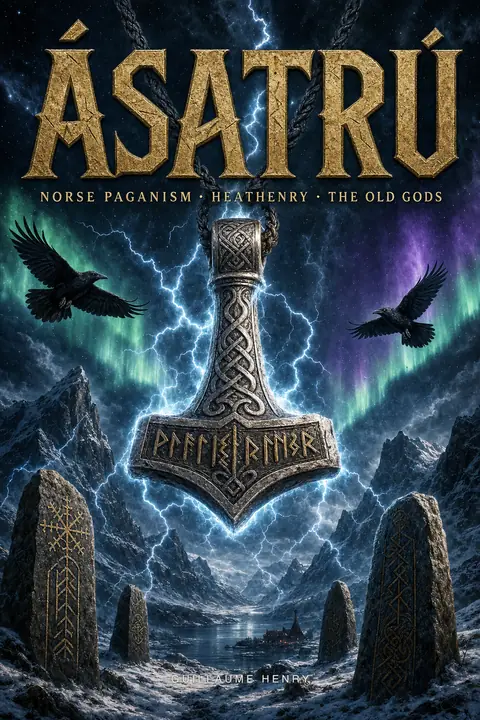
Asatru
The Asatru Book: Norse Paganism, Heathenry, and the Worship of the Old Gods
Norse Paganism, Heathenry, and the Old Gods
The living revival of Norse paganism: who the heathens worship, how the blót and the sumbel work, what the Nine Noble Virtues are, and how a faith that ended a thousand years ago came back to life in the modern world. Rooted in the Eddas, practiced today.
More from Asatru
All articles
Asatru
Mjolnir: Thor's Hammer as Symbol and Talisman
Mjolnir, Thor's legendary hammer, embodies divine power, protection, and order in Norse mythology. Discover how this symbol shaped Viking belief, ritual, and endures in modern culture.
Asatru
Winter Nights and Yule: Heathen Seasonal Festivals and Their Sacred Roots
Winter Nights and Yule are the two cornerstone heathen seasonal festivals that mark the darkest months of the year. Rooted in pre-Christian Norse and Germanic traditions, these observances honor the cycle of death and rebirth, ancestor veneration, and the sacred interplay between human and divine realms.
Asatru
Folkish versus Universalist Asatru: The Inclusion Debate
Asatru splits between two visions: one rooted in ancestry and ethnicity, one open to anyone who honors the Norse gods. We trace the ideological divide, its history, and how it shapes modern practice.
Asatru
Wyrd and Orlog: Fate and Personal Destiny in Norse Mythology
In Norse tradition, **Wyrd and Orlog** are the twin forces that shape destiny. Wyrd flows from the present moment, personal and mutable; Orlog is the ancient law laid down at creation. Together they answer the oldest question: how much of our fate is written, and how much is ours to choose?