
Akerbeltz: The Black Goat Spirit of Basque Mythology
Akerbeltz, the Black Goat Spirit of Basque mythology, guarded livestock, healed the sick, and stood at the crossroads of ancient nature worship and Christian demonization. Who was he really?
Contents
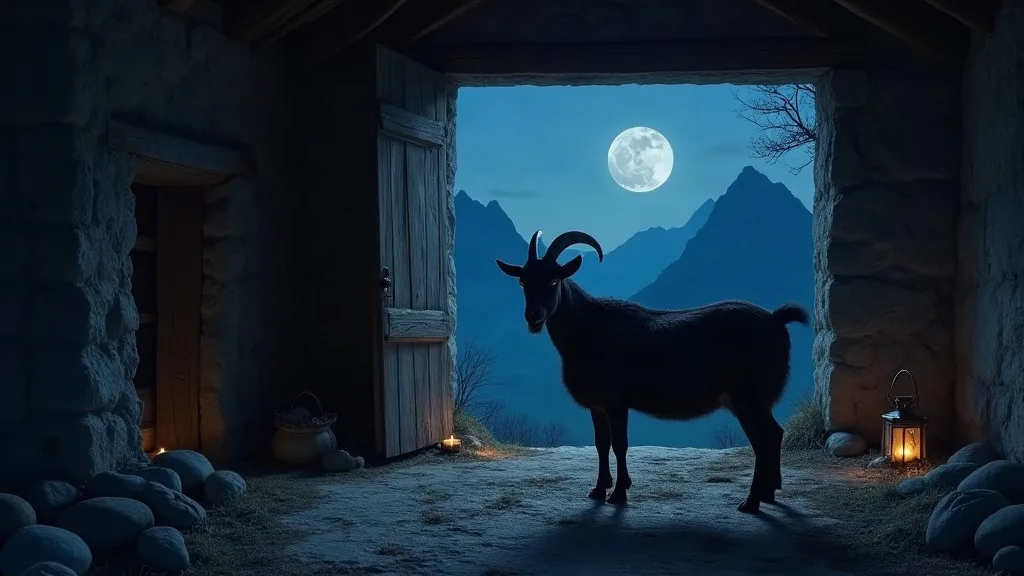
The black goat is alone in the barn. The farmer doesn't shoo it away. He built the stall for it. His cows sleep soundly beside it, his horses breathe easy through the night, and his sheep never catch the murrain that kills his neighbour's flock. The black goat is not a pest. It is a guardian.
That is Akerbeltz: The Black Goat Spirit, the most ambiguous, most misread, and arguably the most ancient figure in the Basque mythological world. His name breaks down cleanly in the Basque language (Euskara): aker means billy goat, beltz means black. No metaphor, no circumlocution. He is exactly what his name says. And yet what he does with that simple, animal form touches healing, witchcraft, the night, the earth, the underworld, and a tradition of rural devotion that survived Christianisation for centuries.
Basque mythology sits in the western Pyrenees, shared between Spain and France, in a culture whose language has no confirmed relatives anywhere in the world. The stories were not written down in a medieval epic. They were collected from living mouths by the ethnographer Jose Miguel de Barandiaran (1889-1991), whose sixty-year fieldwork remains the foundational archive for everything scholars know about Basque supernatural beings. When Barandiaran writes about Akerbeltz, he is recording something people still half-believed.
Akerbeltz in the Basque Supernatural World
Basque mythology has a deep ecology of spirits. At the centre stands Mari, the great mountain goddess who commands storms from her cave on Mount Anboto. Her consort Sugaar, the serpent lord, travels across the sky as a ball of fire. Beneath them stretch dozens of regional spirits, household protectors, cave-dwellers, and nature beings, each tied to a specific function and a specific landscape.
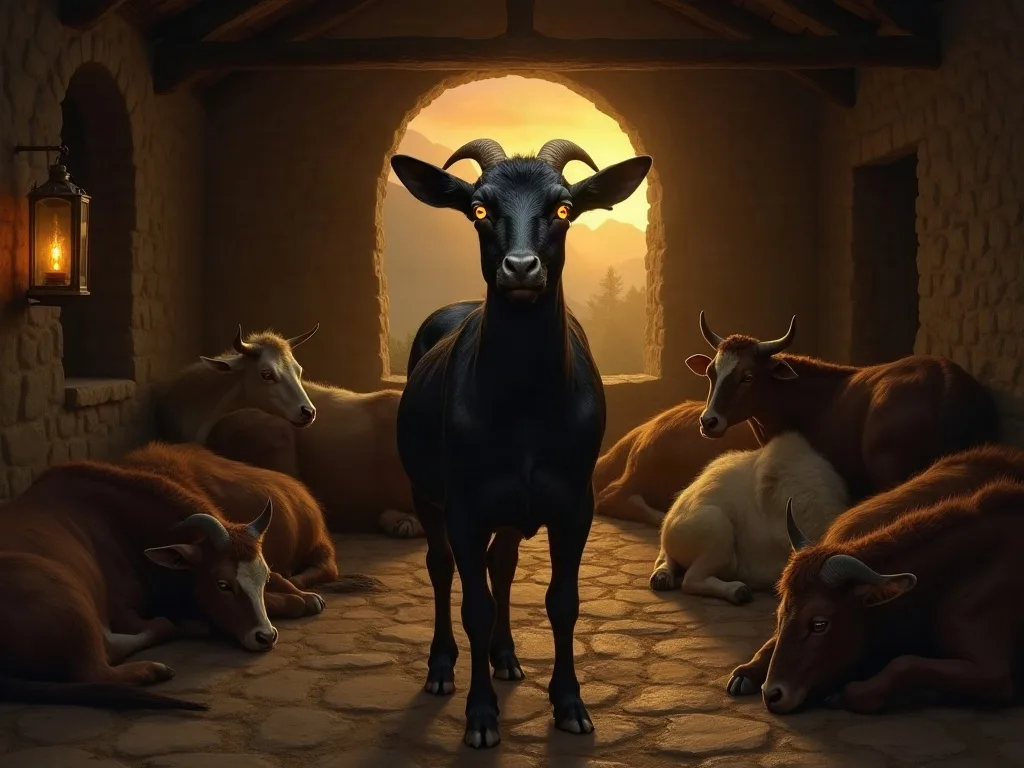
Akerbeltz belongs to this functional tier. He is, above all, a protector of domestic animals. Farmers who kept a black billy goat in their stables believed the animal was either the spirit himself made flesh, or a living vessel through which his power flowed. This was not a metaphor they debated philosophically. It was a practical arrangement: you house the black goat, your livestock thrive. You remove it, your animals fall ill.
Barandiaran documented this belief across multiple Basque provinces. In some accounts the black goat was never slaughtered, never sold, and treated with a respect no other farm animal received. It was the guardian animal, a category that appears in many pre-Christian European traditions but nowhere with quite the same specificity as in the Basque case.
The name Akerbeltz also carried a second register. In Basque, aker can mean a mature, sexually vigorous male goat, with all the fertility connotations that implies. Combined with beltz, the black colour associated in Basque symbolic thought with the underground, the hidden, and the night (not necessarily with evil), the name positions him at the boundary between the living world above and whatever lies beneath it.
The Healer Behind the Horns
One of the most striking aspects of Akerbeltz that gets lost in later demonised retellings is his role as a healing spirit. Sick animals were brought into contact with the black goat, or prayers were directed toward him on behalf of ailing livestock. This was veterinary religion in the most literal sense: a spiritual technology for keeping herds alive through hard winters.
The logic runs deeper than superstition. In some parts of the Basque Country, sick people were also thought to benefit from Akerbeltz's protection. His domain was not limited to goats and sheep. He governed the health of living creatures generally, standing between illness and recovery in the way a hearth deity stands between cold and warmth.
This healing function connects Akerbeltz to a broader pattern in European pre-Christian belief, where the spirits closest to animals and the earth often carried medical power. The Celtic goddess Epona protected horses and their riders. The Slavic domovoi kept household animals safe. Akerbeltz fits this template but is more precisely documented than most, thanks to Barandiaran's meticulous fieldwork.
Scholars like Julio Caro Baroja, whose 1961 book The World of the Witches remains a landmark study of Iberian folk belief, noted that Akerbeltz occupied a position in Basque rural life that was intensely practical rather than mystical. You did not pray to him for abstract spiritual gifts. You prayed to him because your mare was coughing.
Witches, Sabbaths, and the Inquisition's Rewrite
Here is where the story gets thornier. By the sixteenth and seventeenth centuries, Akerbeltz had been fully absorbed into the European witch-trial apparatus. Inquisitors working through the Basque Country framed him as a devil figure, the presider over the akelarrre.
Akelarre (sometimes written aquelarre) is a Basque compound: aker (goat) plus larre (field or pasture). Literally: "the goat's field." This word, almost certainly drawn from the actual worship of Akerbeltz or from the physical meeting places near goat pastures, became the standard Basque term for the witches' sabbath. It passed from Basque into Spanish, where aquelarre still means a witches' gathering.
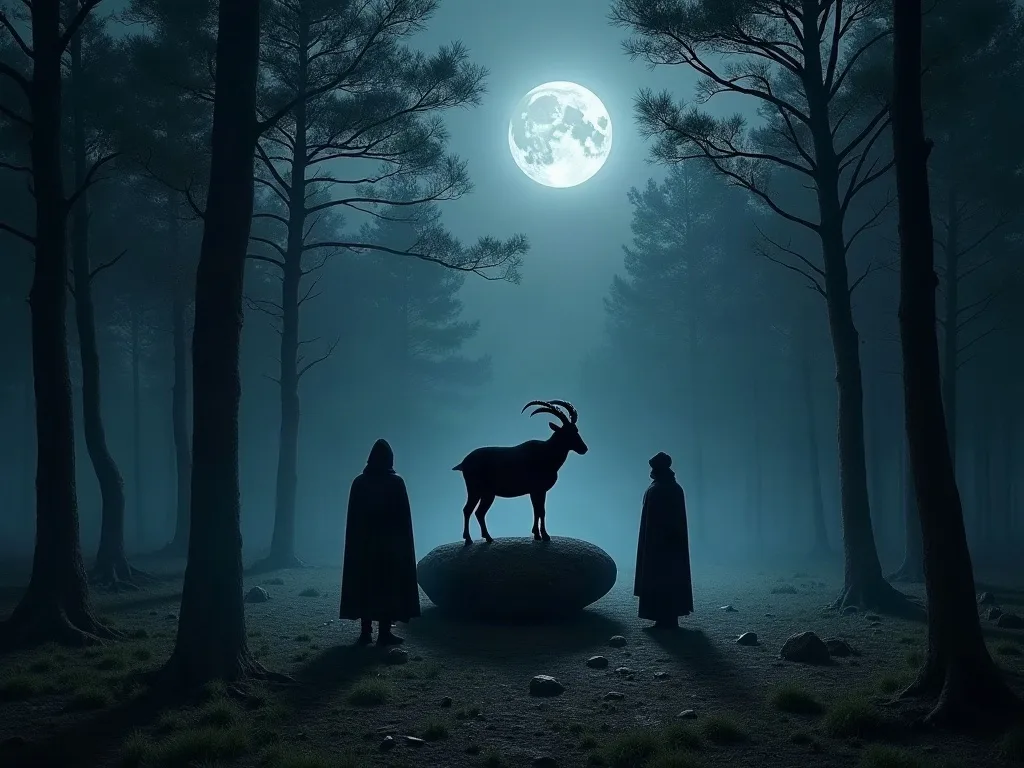
The connection was cemented by the Zugarramurdi trials of 1609-1610, one of the most documented witch-trial episodes in Spanish history. Dozens of villagers from Zugarramurdi, a town in Navarre on the French border, were accused of attending aquelarres where a large black goat presided. The Spanish Inquisition's records describe him sitting on a throne, receiving worship, and accepting the kiss of his followers at the base of his tail, a gesture lifted directly from the broader European sabbath template and applied to the local Basque figure.
Alonso de Salazar Frias, the Inquisitor who investigated the Zugarramurdi cases most carefully, ultimately concluded that most of the confessions were fabricated or coerced. His 1612 report to the Spanish Inquisition is a remarkably skeptical document for its time: he found no physical evidence of the sabbaths, no corroborating witnesses, no material proof. His conclusion was that the terror had fed on itself. But the damage to Akerbeltz's image was already done.
Akerbeltz and the Figure of the Basajaun
Akerbeltz does not stand alone in the Basque pantheon as a wild, animalistic male spirit. He belongs to a cluster of such figures, most notably the Basajaun, the Lord of the Forest. The Basajaun is a giant wild man who lives in the mountains and protects flocks from wolves. He sometimes teaches humans agriculture. He is strong, hairy, unpredictable, but not evil.
The parallel is striking. Both Akerbeltz and the Basajaun are male, animal-adjacent or animal-formed protectors of livestock who predate the Christian schema of good-versus-evil. Both were partially absorbed into devil imagery by early modern writers. Both retained their protective identity in genuine folk practice even as the Church reframed them as dangerous.
Scholars including Marija Gimbutas and more recently Marian Martinez have suggested that this cluster of male animal spirits in Basque mythology may reflect very old strata of European religion, possibly reaching back to Neolithic pastoral cultures in which the male animal god served as guarantor of herd fertility. Akerbeltz's goat form would then be continuous with the goat-legged figures that appear in the art of ancient Iberia, the Greek Pan, and the Sumerian goat-fish Capricorn.
This does not mean Akerbeltz is the same deity as Pan. It means that the social need for a male animal-guardian spirit runs very deep in herding cultures, and the Basque tradition preserved one of the clearest surviving examples of how that spirit functioned before it was demonised.
The Black Colour and Its Meaning
In most European Christian contexts, black signals danger, death, or moral corruption. Applied to a goat, it made Akerbeltz easy to assimilate into devil iconography. But in pre-Christian Basque symbolic thought, beltz carried a different weight.
Basque cosmology centres on the earth, lurra, as a living entity. Mari herself lives underground, inside mountains, and her domain is associated with darkness that is not evil but primordial. The colour black in Basque folk belief connects to the inside of the earth, to hidden fertility, to the underside of the visible world where life is generated rather than destroyed.
Akerbeltz's blackness, in this reading, marks him as a creature of that hidden generative space. He is black the way a seed in dark soil is black: not dead, but working. Not threatening, but essential.
This symbolic register was systematically erased by the Inquisition's application of the standard European witch-trial iconography, where the black animal was the devil's mount or the devil in disguise. When the trial records from Zugarramurdi describe a great black goat, they are projecting that iconography onto a figure whose local meaning was precisely the opposite.
Akerbeltz in the Twentieth Century and After
The post-Enlightenment recovery of Basque mythology began with Resurrección María de Azkue's monumental folkloric collections in the early twentieth century and reached its systematic peak with Barandiaran. Both men noted that Akerbeltz was not entirely dead in living memory. Farmers in the early twentieth century still kept black goats as stable guardians, sometimes without being able to explain clearly why, a practice that had outlived the theology behind it.
In contemporary Basque culture, Akerbeltz has become a symbol of cultural identity and pre-Christian heritage. He appears in Basque art, in the work of writers like Bernardo Atxaga (whose fiction draws on Basque folklore), and in the revival of interest in Basque mythology that has accompanied the broader political and cultural Basque renaissance since the 1970s. Craft breweries, music groups, and cultural associations have adopted his name.
This modern Akerbeltz is stripped of the Inquisition's shadow and restored, at least in spirit, to something closer to his original protective function. He represents the persistence of pre-Christian Basque identity, the idea that underneath the centuries of Romanisation, Christianisation, and political absorption, something distinctly Basque survived in the pastures and the mountain barns.
The word akelarre, his great ironic gift to the Spanish language, remains in common use for any chaotic gathering. Every Spanish speaker who uses it is, unknowingly, invoking the black goat's field.
Frequently Asked Questions About Akerbeltz
Frequently asked questions
Was Akerbeltz originally worshipped as a god or revered as a spirit?
The distinction matters less in Basque tradition than in Greek or Roman frameworks. Barandiaran's fieldwork suggests Akerbeltz functioned as a protective spirit or genius loci tied to domestic animals, not as a god in the sense of a creator or cosmic ruler. He received practical devotion: a black goat kept in the stable, prayers for sick animals. The category closest to his function in comparative religion is "guardian spirit" rather than "deity."
What is the connection between Akerbeltz and the word 'akelarre'?
Akelarre combines the Basque words aker (billy goat) and larre (field or pasture). It originally referred to the physical spaces where goats grazed, and likely where outdoor rituals involving Akerbeltz took place. Inquisitors adopted the word to label the witches' sabbath. From Basque it passed into Spanish as aquelarre, still used today for a witches' gathering or any chaotic assembly.
Is Akerbeltz the same as the Christian Devil?
No. The Church deliberately mapped Akerbeltz onto devil iconography during the sixteenth and seventeenth centuries, particularly through the Zugarramurdi trials of 1609-1610. Inquisitor Alonso de Salazar Frias, who investigated those trials most rigorously, concluded the confessions were largely coerced or fabricated. In genuine Basque folk belief, Akerbeltz was a healer and protector, not a figure of evil.
Which primary sources document Akerbeltz?
The main scholarly source is Jose Miguel de Barandiaran's decades of ethnographic fieldwork, compiled in works including his Diccionario de Mitologia Vasca (1960). Julio Caro Baroja's The World of the Witches (1961) contextualises Akerbeltz within Iberian witch-trial history. The Inquisition records from the Zugarramurdi trials, held in the Archivo Historico Nacional in Madrid, provide primary documentation of how his image was reframed.
Are there parallels to Akerbeltz in other European mythologies?
Several. The Greek Pan, a goat-legged deity who protected flocks and haunted wild places, shares the animal form and the pastoral function. The Slavic domovoi protected household animals. The Celtic Cernunnos, the antlered lord of wild things, fills a comparable ecological niche. What makes Akerbeltz distinctive is the precise documentation of his healing role and the specific trajectory of his demonisation, both recorded in unusual detail thanks to Barandiaran and the Inquisition's own records.
Why did Basque farmers keep a black goat in their stables?
According to Barandiaran's fieldwork, the black goat was believed to embody or channel Akerbeltz's protective power. Its presence kept other animals healthy. The black goat was never sold or slaughtered and was treated with a respect no other farm animal received. This practice survived in some areas into the early twentieth century, long after the theological reasoning behind it had been suppressed or forgotten.
What the Black Goat Teaches About Surviving Demonisation
Akerbeltz: The Black Goat Spirit is one of mythology's clearest case studies in how a figure's meaning is made and remade by whoever holds power over the record. The farmers who kept black goats in their stables were not devil-worshippers. They were doing something far older: maintaining a relationship with a local protective spirit in the way their grandparents had taught them, without an overarching theology to defend.
The Inquisition needed a devil for its legal machinery to function. Akerbeltz's goat form, black colour, and association with nocturnal outdoor gatherings made him the ideal raw material. The word akelarre was taken, reloaded with terror, and fired back at the communities who had coined it. This is not a uniquely Basque story. It is the story of Pan being reclassified as the prototype for Satan. It is the story of the Norse Loki being reduced to pure malice. It is what happens when a polytheistic protective spirit meets a theological system that has no category for morally ambiguous nature-guardians.
What survives is the practice. People kept the black goat. The word akelarre stayed in the language. Barandiaran found the memory alive in the 1930s. And today, in a Basque Country that is actively reclaiming its pre-Christian heritage, Akerbeltz stands again closer to what he was: a black goat in a barn, keeping watch over the animals through the long mountain night.
Read the full book
Want the whole story?
The complete edition is an instant PDF download here, with a paperback on Amazon for selected titles.
Basque
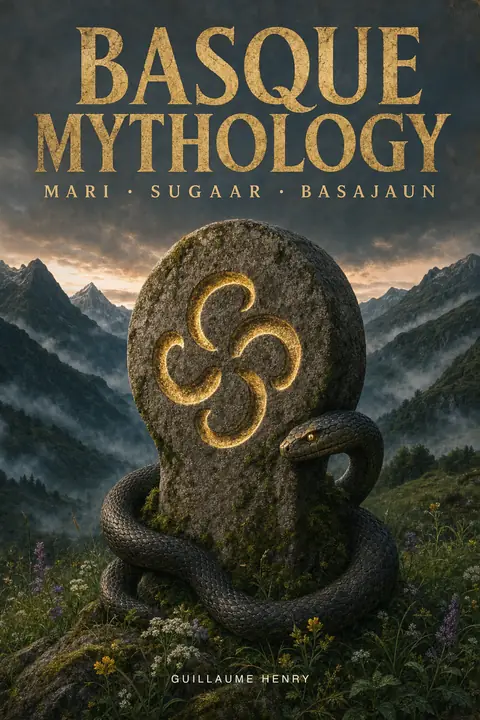
The Basque Mythology Book: Mari, Sugaar, Basajaun, and the Oldest Gods of Europe
Mari, Sugaar, and Basajaun
The mythology of Europe’s oldest people, who speak a language related to no other on earth. Mari the goddess of the mountains, her serpent-consort Sugaar, the wild lord of the woods Basajaun, and a pre-Indo-European world that survived in the Pyrenees.
More from Basque
All articles
Basque
The Lauburu: Basque Cross and Solar Symbol
The Lauburu is a four-pointed cross with curved arms that has protected Basque homes and souls for centuries. This ancient symbol weaves solar magic, Christian faith, and pre-Christian cosmology into a single rotating form.

Basque
Eguzkilore: The Sun Flower Symbol of Basque Protection and Renewal
The Eguzkilore is the sacred sun flower of Basque culture, hung above doorways for protection and blessing. Rooted in ancient sun worship and Christianised into a mark of spiritual abundance, this eight-petalled symbol endures as a living emblem of Basque identity and resilience.

Basque
Anbotoko Mari: The Cave Sanctuaries of the Goddess
High in the Basque mountains, deep inside caves that pierce the earth, Mari dwells. The Anbotoko Mari tradition reveals how a people carved sacred space into rock itself, honoring a goddess whose storms feed the valleys below. Enter the caves where Basque faith shaped the land.
Basque
Gaueko: The Spirit of the Night
Gaueko haunts the Basque night as a shadowy, restless spirit who protects livestock and travelers but demands respect. Learn how this being embodies the Basques' relationship with darkness in the mountains of northern Spain and France.