
Sugaar: The Serpent God and Consort of Mari
Sugaar is the male serpent deity of Basque mythology, storm-bringer and underground wanderer, whose union with the goddess Mari generates the storms that shake the Pyrenean peaks.
Contents
A fiery arc crosses the night sky above the Pyrenees. Shepherds in the valley below do not reach for a word like "lightning." They say Sugaar is on his way to meet Mari. When the serpent god rises from his mountain cave and coils toward the goddess on her peak, thunder follows. The Basque people have explained storms this way for longer than anyone can reliably measure.
Sugaar: the Serpent God and Consort of Mari sits at the heart of a pre-Christian religious world that survived centuries of Roman occupation and Christian conversion with unusual tenacity. He is not a minor spirit or a decorative detail. He is one of the two load-bearing pillars of the Basque divine order, the male half of a sacred pair whose love-meetings are literally the weather.
Sugaar in the Basque Mythological World
The Basques are an ancient people of northern Spain and southwestern France whose language, Euskara, has no proven relatives anywhere on Earth. Their mythology is equally singular. There is no single canonical text like the Norse Eddas or the Greek Theogony (a Greek poem from around 700 BC that lays out where the gods come from). Instead, Basque myths survived through oral tradition: folktales, place-names, shepherd songs, and the careful fieldwork of 20th-century ethnographers.
The scholar who did the most to preserve this material was José Miguel de Barandiaran, a Basque priest and anthropologist who spent decades collecting accounts from rural informants across the Basque Country. His multi-volume Obras Completas (Complete Works) remain the primary reference for anyone studying figures like Sugaar. Without Barandiaran's interviews with farmers and elderly villagers, much of what we know would have dissolved into silence.
Within that collected tradition, the Basque cosmos rests on the tension between two realms: the surface world of light and agriculture, presided over by the solar goddess Mari, and the underground world of caves, metals, and hidden fire. Sugaar belongs to the second realm. He lives beneath the earth, moving through cave systems that the Basques understood as passages into a different order of existence.
Who Sugaar Is: Appearance, Names, and Sacred Geography
Sugaar does not take a single form. Basque mythology is flexible on this point, and regional variation was built into the tradition. The most common description is a serpent, sometimes described as a great curved snake of fire, sometimes as a sickle-shaped light moving across the sky. In some areas of Navarre and the Pyrenean foothills, local accounts describe him appearing as a simple man who walks the mountain paths at night.
His names vary by region:
- Sugaar is the most widely documented form.
- Maju appears in accounts from Gipuzkoa and parts of Navarre, and is the name Barandiaran encountered most often in the Aralar mountain range.
- Sugoi appears in some coastal traditions.
- Culebro (simply "serpent" in Spanish) shows up in bilingual communities where Basque and Spanish storytelling had merged.
These are not different deities. They are the same being filtered through centuries of regional oral tradition. The scholar Julio Caro Baroja, whose 1946 book Algunos mitos españoles (Some Spanish Myths) gives significant attention to Basque beliefs, argued that regional name variation is a signature of genuinely ancient traditions: gods who have been told about long enough accumulate local nicknames.
The caves most strongly associated with Sugaar are real, specific places. The cave system at Aralar in Navarre is one. Muru in the same region is another. Local memory in these areas, recorded by Barandiaran in the mid-20th century, held that the cave went deep enough to reach Sugaar's domain. These were not metaphorical passages. They were treated as functional geography, places where the membrane between the human world and the underground divine world was thin.
The Union with Mari: How Storms Are Born
The central drama of Sugaar's mythology is not war, not a creation battle, not a flood. It is a marriage. Every Friday night, by the most common account, Sugaar rises from his cave and travels to the mountain peak where Mari waits. Their meeting produces storms. Lightning, thunder, and hail are the byproduct of their union.
Mari, the supreme goddess of Basque mythology, is typically described as a luminous woman who lives on the summits of the highest mountains, particularly Anboto in Biscay and Txindoki in Gipuzkoa. She controls the weather, the seasons, and the moral order of the Basque countryside. She punishes liars. She rewards those who keep their word. She is not simply a nature goddess in a decorative sense; she is the ethical guarantor of Basque rural life.
Sugaar is her complement. Where Mari operates in light, on peaks, in the visible sky, Sugaar operates in darkness, underground, in hidden spaces. Where she is associated with the surface world of cultivation and community, he is associated with the subterranean world of ore, fire, and animal vitality. Their union is not a power struggle. It is a cosmic necessity. The storms their meeting produces bring rain to the fields. Without those storms, without that periodic union, the agricultural cycle breaks down.
This pairing follows a pattern found in many ancient traditions: a sky or surface goddess paired with an underworld or chthonic male figure whose periodic contact with the upper world regulates the seasons. But the Basque version has a distinctive shape. Sugaar does not rule the underworld in a Hades-like sense, presiding over the dead. He simply inhabits it, as a serpent inhabits a burrow. He is not king of the dead. He is a force of underground fire and masculine vitality whose purpose is completed only in relation to Mari.
Sugaar and the Laminak: The Broader Basque Spirit World
Sugaar does not operate in isolation. The Basque mythological landscape is populated with a rich ecology of spirits. The laminak are female supernatural beings, sometimes beautiful and sometimes terrifying, who live near rivers, springs, and forest clearings. The basajaun (lord of the forest) is a wild hairy giant who guards flocks and punishes trespassers. The jentilak are a race of pre-Christian giants who, in some accounts, once built the stone monuments that dot the Basque countryside.
Sugaar stands above all of these in the hierarchy. He is not a spirit of a particular spring or a guardian of a particular forest. He is a cosmic figure, one of the two primary deities in a tradition that otherwise has very few beings at that level of power and abstraction.
His relationship to the laminak is worth noting. Some accounts collected by Barandiaran describe the laminak as daughters of Mari, which would make Sugaar their father. This detail is not universal, and Barandiaran himself was careful to flag the variation between informants. But it points to a coherent family structure at the top of the Basque spirit world: Sugaar and Mari as a divine pair whose offspring populate the intermediate layer of the cosmos.
Sugaar and the Serpent: Symbol, Fear, and Hidden Fire
The serpent is one of the oldest and most cross-culturally persistent symbols in human religious history. In the Basque case, the serpent is not simply a symbol of evil imported from Christian tradition, though Christian missionaries certainly tried to read it that way. The Basque serpent is older than that reading.
In pre-Christian Basque culture, snakes held an ambiguous but powerful status. Certain snakes, called suge in Basque, were thought to live inside the household and bring luck if left undisturbed. Killing the household snake was believed to bring death to a family member. This domestic serpent cult, documented by Barandiaran, reflects a broader attitude toward snakes as creatures that belong to both worlds: they live in the earth but appear on the surface, they are cold-blooded but associated with fire in the figure of Sugaar, they move without limbs in a way that marks them as fundamentally different from ordinary animals.
Sugaar as a serpent deity concentrates all of this ambiguity. He is not a monster. He is not a symbol of sin. He is a being of enormous power whose nature simply cannot be contained by the categories of the surface world. The fiery arc he draws across the sky when travelling to Mari is the most visible sign of that power, and the storms that follow are its fruit.
The comparison to other serpentine deities across traditions is instructive. The Hindu Naga spirits (supernatural serpent beings from Hindu and Buddhist cosmology) occupy a similar intermediate space: neither fully divine nor simply animal, at home in underground waters, capable of both harm and blessing. Quetzalcoatl, the feathered serpent of Aztec mythology, combines serpent and bird in a single body to mark the junction between earth and sky. Sugaar's fiery arc across the sky does something similar: it is a serpent's body drawing a line between his underground home and the mountaintop where Mari lives, crossing the boundary between below and above in a single luminous movement.
Sugaar's Children: Atarrabi and Mikelats
Mari and Sugaar have two sons in the most widely told version of their mythology. Their names are Atarrabi and Mikelats, and they represent a moral opposition that runs through the centre of Basque traditional ethics.
Atarrabi is good. He is patient, honest, and protective of human beings. Mikelats is malicious, trickster-like, and associated with the kind of harm that falls on people who break the moral codes Mari enforces. Several folktales recorded by Barandiaran involve Atarrabi trying to escape from his father's underground realm, where both sons were imprisoned or held in some capacity. In one version, Atarrabi nearly makes it to the surface world, but Sugaar catches his shadow at the last moment. Atarrabi escapes, but leaves his shadow behind. The story explains why good people sometimes seem to carry a dark side they cannot fully account for.
Mikelats, by contrast, has no interest in leaving. He is content in the underground realm, and some accounts align him loosely with the figure of the Devil as Christian missionaries described him to Basque converts. This alignment is almost certainly a later overlay, the result of Christian evangelisation trying to make sense of an existing figure by mapping it onto a familiar template. The original Mikelats is not the Christian Devil. He is the dangerous child of a storm god, the embodiment of the harm that accompanies all real power.
The moral structure this family creates is worth sitting with. Sugaar and Mari are not good and evil in any simple sense. They are necessary cosmic forces. Their children inherit this complexity. One son turns toward human welfare, the other toward human harm. Both are real. Both are present in the world.
What Survives: Sugaar in Modern Basque Culture
The Basque Country modernised rapidly across the 20th century. The industrial Basque coast, centred on Bilbao, became one of the heaviest industrial zones in Europe. Urbanisation pulled people out of the mountain villages where Sugaar's stories had lived. The ethnographic surveys that Barandiaran conducted in the 1920s through the 1960s captured a tradition already in retreat.
Yet Sugaar did not disappear. He survived in several overlapping ways.
First, in the place-names of the Basque Country, many of which preserve pre-Christian religious geography in compressed form. Cave names, mountain passes, and spring names carry traces of the old spirit world even when the stories attached to them have been forgotten.
Second, in the revival of Basque cultural identity that intensified from the late 20th century onward. Writers, visual artists, and game designers working in Basque have returned to figures like Sugaar not as nostalgic decoration but as living material for new stories. The graphic novel tradition in Bilbao has produced several retellings of the Sugaar-Mari cycle that treat the old myths with real narrative seriousness.
Third, in academic mythology studies, where the Basque tradition attracts growing international attention precisely because of its linguistic isolation. A mythology built by speakers of a language with no known relatives is, by definition, a mythology that developed in unusual independence. Scholars working on the deep prehistory of European religion, including researchers associated with the Santa Barbara School of Comparative Mythology, have pointed to Basque material as a potential window into pre-Indo-European belief systems.
Whether Sugaar preserves memories of a religious world that predates the arrival of Indo-European speakers in Western Europe is a question that cannot yet be answered with certainty. What can be said is that he is unlike any other serpent deity in the European record, and that his difference is not a gap but a signal.
Frequently Asked Questions about Sugaar
Frequently asked questions
Is Sugaar the same as a devil figure in Basque mythology?
No. The identification of Sugaar with the Christian Devil is a later interpretation, the result of Christian missionaries trying to map existing Basque beliefs onto familiar categories. Sugaar predates Christian influence in the Basque Country and has a genuinely different character: he is a cosmic force, the underground counterpart to the goddess Mari, whose union with her produces storms. He is neither a tempter nor a ruler of the damned. The occasional conflation with devilish attributes in some collected folktales reflects post-conversion syncretism, not the original tradition.
What is the primary source for information about Sugaar?
The most comprehensive source is the field research of José Miguel de Barandiaran, collected in his Obras Completas (Complete Works), a multi-volume set documenting Basque mythology, folklore, and religious belief based on decades of interviews with rural informants. Julio Caro Baroja's comparative studies, particularly Algunos mitos españoles (1946), provide additional analysis. There is no single ancient text comparable to the Greek Iliad or the Norse Prose Edda for Basque mythology; the tradition is entirely oral and ethnographic.
Why does Sugaar meet Mari on Friday nights specifically?
The Friday meeting is the most common detail in accounts collected by Barandiaran, though not universal. Some scholars suggest Friday may have acquired this role through the association of the day with a pre-Christian sacred cycle that Christian conversion then preserved in folk memory. Friday is also associated in several European traditions with feminine or liminal significance. The specific day may also simply reflect the agricultural week's rhythm in Basque rural life, with Friday marking a boundary before a rest day. The exact origin of the Friday detail is not definitively resolved in the scholarly literature.
Are there other serpent deities similar to Sugaar in neighboring traditions?
Partial parallels exist, but none are close enough to suggest direct borrowing. The Celtic world has serpentine divine figures, and Roman-era dedications in southern France mention horned serpent deities. The Norse Jormungandr (the great world-serpent of Norse mythology) is another serpentine cosmic figure, though his role is eschatological rather than meteorological. The clearest structural parallel may be with certain Hindu Naga traditions, where serpent beings mediate between underground waters and surface fertility. Sugaar's specific combination of underground dwelling, fiery aerial travel, and storm-generating union with a mountain goddess is not precisely replicated anywhere else in the European mythological record.
What does Sugaar's name actually mean?
The most widely accepted etymology connects su (fire in Basque) and ar (male), giving "male fire" or "fiery male." A second reading connects it to suge (serpent in Basque) and ar, giving "male serpent." Both readings are linguistically plausible in Basque. Scholars including Barandiaran and later linguists such as Luis Michelena, who produced foundational work on the history of the Basque language, noted that the ambiguity may be intentional, preserving two aspects of the deity simultaneously: his serpent form and his fiery nature.
The Question of Pre-Indo-European Memory
The Basque language is the oldest surviving language in Europe with no known ancestor or relative. Linguists call it a language isolate: it did not descend from Proto-Indo-European, the ancestral language of Greek, Latin, Sanskrit, and most modern European tongues. This makes the Basque people and their mythological tradition a genuine anomaly in the European record.
Some researchers, working at the intersection of linguistics, archaeology, and comparative mythology, have asked whether Basque mythology might preserve traces of a religious world that existed in Western Europe before Indo-European-speaking populations arrived, somewhere between 5000 and 3000 BC. The question is serious and ongoing. The archaeologist David W. Anthony, in his foundational 2007 study The Horse, the Wheel, and Language, traces the expansion of Indo-European speakers across Europe with considerable precision, but the pre-Indo-European religious world those speakers displaced is far harder to reconstruct.
Sugaar is one of the few pieces of evidence that tradition might offer. A male serpent deity who lives underground, rises periodically to meet a mountain goddess, and generates storms through their union does not map neatly onto anything in the Indo-European pantheon. He is not a sky-father like Zeus or Jupiter. He is not a trickster like Loki. He does not fit the standard tripartite structure that the scholar Georges Dumézil identified as the organizing principle of Indo-European mythology (priest-kings, warriors, and producers). Sugaar operates outside that structure entirely.
This does not prove ancient origin in any strict sense. Traditions evolve, and unique features can develop within a single community without requiring prehistoric roots. But it does mean that Sugaar: the Serpent God and Consort of Mari stands as one of the most genuinely uncharted figures in European mythology. He is not waiting to be explained by another tradition's categories. He is waiting to be understood on his own terms, which is, in the end, the only way to understand any god who has survived this long.
Read the full book
Want the whole story?
The complete edition is an instant PDF download here, with a paperback on Amazon for selected titles.
Basque
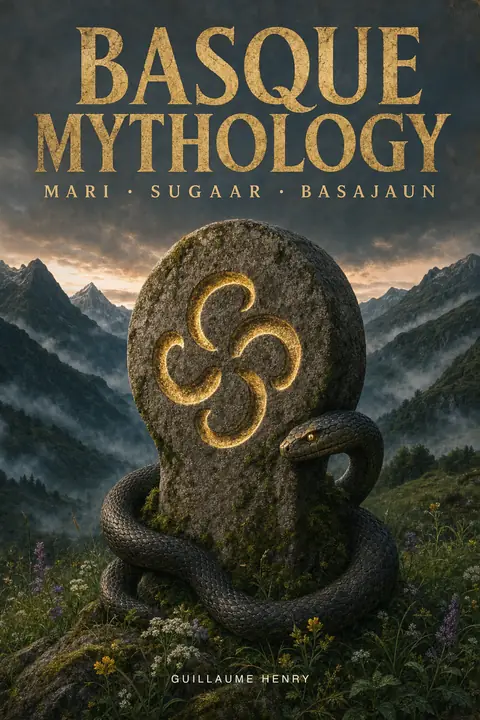
The Basque Mythology Book: Mari, Sugaar, Basajaun, and the Oldest Gods of Europe
Mari, Sugaar, and Basajaun
The mythology of Europe’s oldest people, who speak a language related to no other on earth. Mari the goddess of the mountains, her serpent-consort Sugaar, the wild lord of the woods Basajaun, and a pre-Indo-European world that survived in the Pyrenees.
More from Basque
All articles
Basque
The Lauburu: Basque Cross and Solar Symbol
The Lauburu is a four-pointed cross with curved arms that has protected Basque homes and souls for centuries. This ancient symbol weaves solar magic, Christian faith, and pre-Christian cosmology into a single rotating form.

Basque
Eguzkilore: The Sun Flower Symbol of Basque Protection and Renewal
The Eguzkilore is the sacred sun flower of Basque culture, hung above doorways for protection and blessing. Rooted in ancient sun worship and Christianised into a mark of spiritual abundance, this eight-petalled symbol endures as a living emblem of Basque identity and resilience.
Basque
Anbotoko Mari: The Cave Sanctuaries of the Goddess
High in the Basque mountains, deep inside caves that pierce the earth, Mari dwells. The Anbotoko Mari tradition reveals how a people carved sacred space into rock itself, honoring a goddess whose storms feed the valleys below. Enter the caves where Basque faith shaped the land.
Basque
Gaueko: The Spirit of the Night
Gaueko haunts the Basque night as a shadowy, restless spirit who protects livestock and travelers but demands respect. Learn how this being embodies the Basques' relationship with darkness in the mountains of northern Spain and France.