
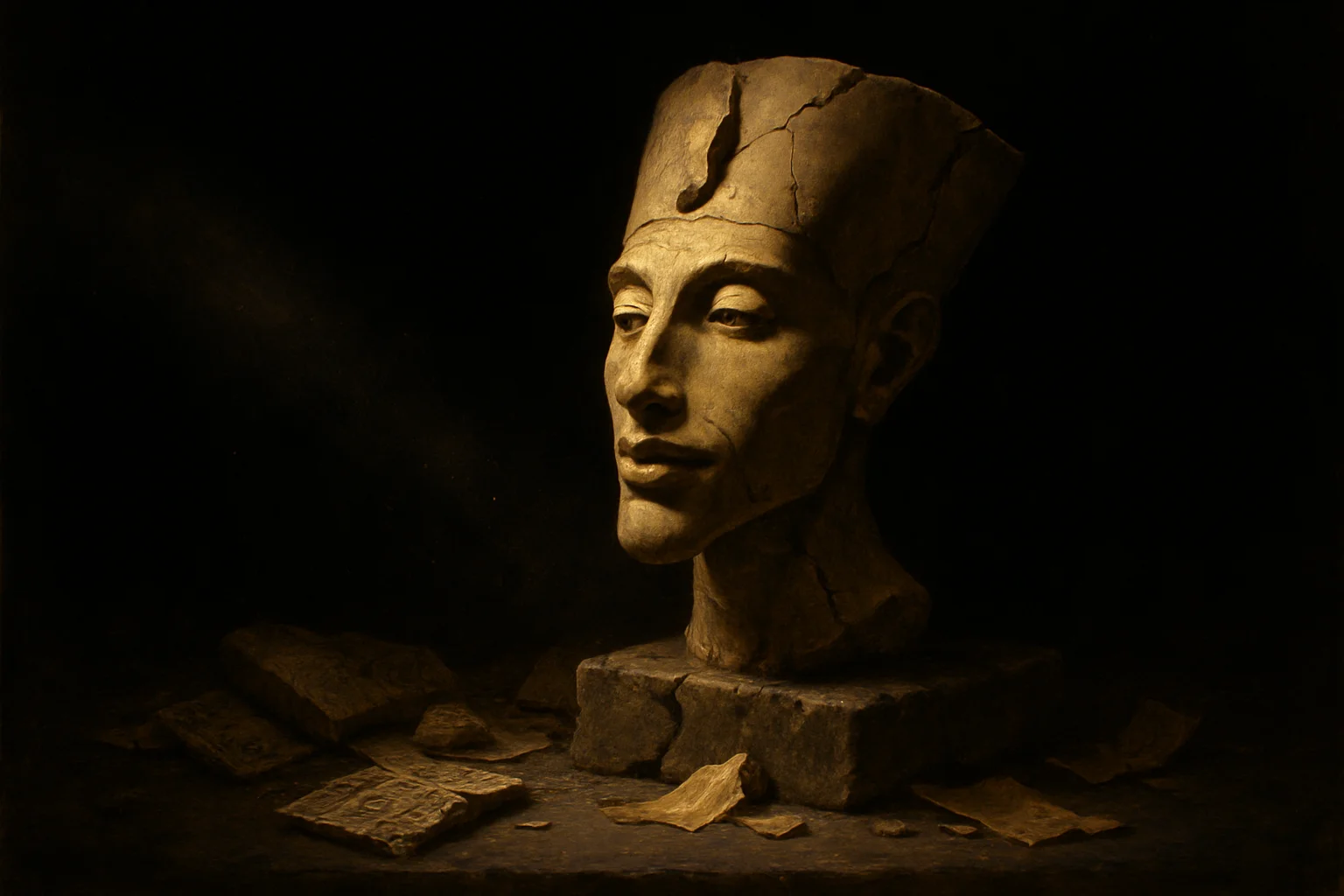
Akhenaten: The Heretic Pharaoh Who Rewrote Egyptian Religion
Akhenaten dismantled Egypt's priesthood and elevated the Aten. Primary sources reveal a revolution driven by theology, politics, or both.
Contents
Akhenaten was an 18th-Dynasty Egyptian pharaoh who reigned around 1353 to 1336 BCE and abandoned Egypt's traditional polytheism in favor of an exclusive cult of the sun-disc Aten, closing temples, erasing the names of other gods, and building a new capital devoted entirely to his chosen deity. His reforms represent the first documented attempt at something resembling monotheism in recorded history. The experiment collapsed within years of his death, and later rulers systematically erased his name from official records.
Most accounts stop at calling him a visionary or a fanatic. The primary inscriptions from his capital at Amarna tell a more complicated story: a pharaoh who dismantled the priesthood of Amun, rewrote hymns to sound like older solar theology, and left much of Egypt's funerary traditions untouched. Whether his revolution sprang from genuine theological conviction or calculated political strategy remains one of the sharpest debates in Egyptology.
Who Was Akhenaten?
Birth and Early Reign as Amenhotep IV
Born Amenhotep, son of Amenhotep III and Queen Tiye, he inherited a prosperous empire at the height of New Kingdom power. The first five years of his reign followed convention. He honored Amun-Ra at Karnak, maintained diplomatic relations documented in the Amarna Letters, and performed the expected rituals. Then something shifted.
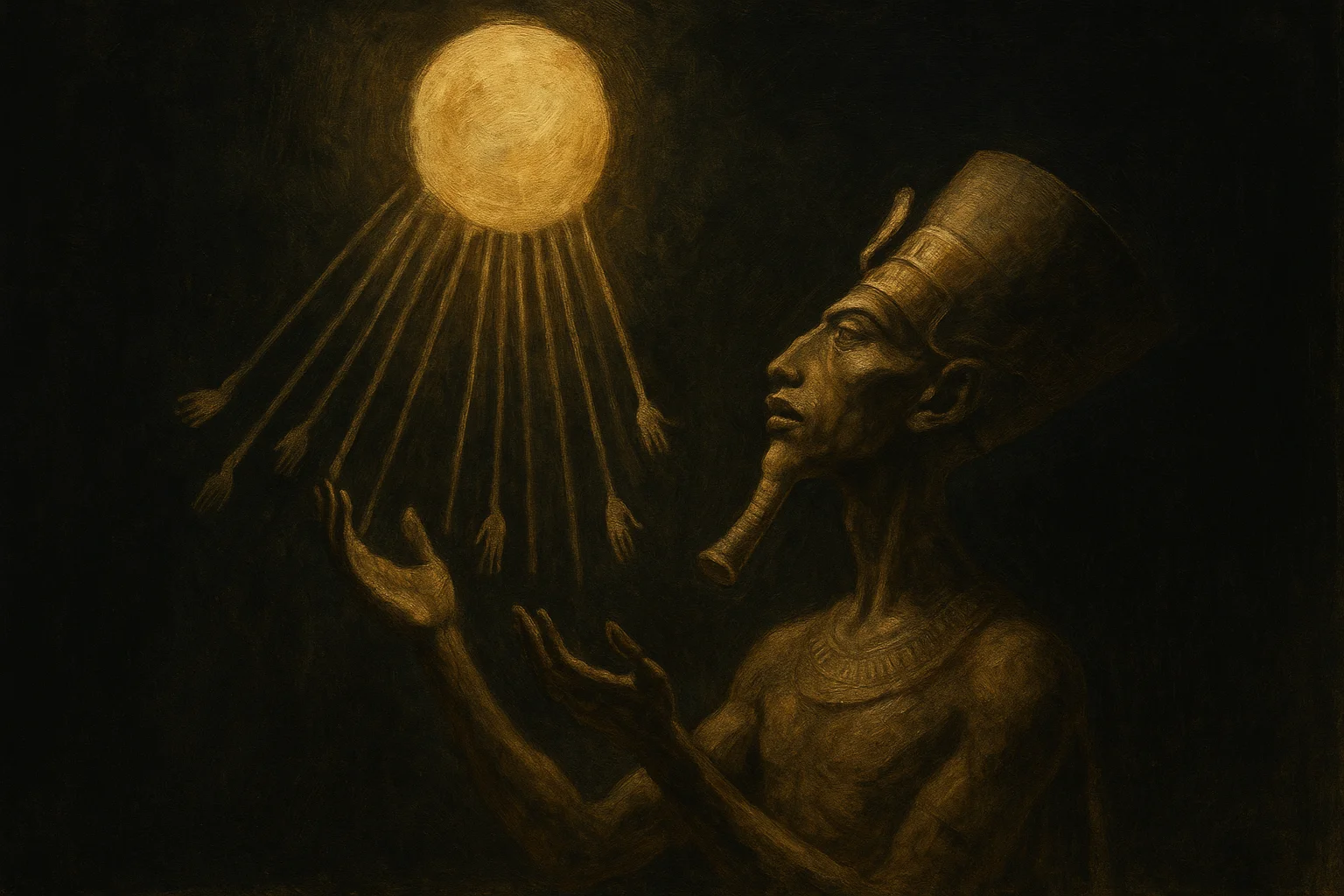
By year five he began construction of temples to the Aten at Karnak itself, directly beside Amun's precinct. The iconography changed: no longer the traditional ram-headed or falcon-headed deities, but a simple solar disc with rays ending in hands. The break was not yet total, but the direction was clear.
The Name Change and Its Meaning
In year five or six, Amenhotep IV became Akhenaten: "Effective for the Aten" or "Horizon of the Aten." The queen, Nefertiti, took the additional name Neferneferuaten, "Beautiful are the Beauties of Aten." The royal family became living embodiments of the new theology. The Boundary Stelae at Akhetaten record the king's oath never to extend the city's limits beyond what the Aten himself had shown him, a claim to direct divine revelation unprecedented in Egyptian royal ideology.
The Aten: Sun Disk or Sole God?
What the Amarna Inscriptions Say
The Aten appears in inscriptions as "the living sun disc" and "lord of all that the disc encircles." The Great Hymn to the Aten, preserved in the tomb of Ay at Amarna, describes a creator deity who brings life to all lands, makes the Nile in Egypt and rain in foreign countries, and forms the child in the womb. The language echoes older hymns to Ra and Amun-Ra, but strips away the mythological narrative. No battles with Apophis. No birth from the primordial waters. No divine family.
You rise beauteous in the horizon of heaven, O living Aten, creator of life. When you set in the western horizon, the land is in darkness, in the manner of death. Great Hymn to the Aten, tomb of Ay, Amarna
The Aten has no mythology in the traditional sense. He simply is, and his presence is the sun itself.
How the Aten Differed from Ra and Amun
Ra had a mythology: he sailed the sky in a solar barque, battled the serpent of chaos nightly, and could take multiple forms. Amun was hidden, unknowable, manifest in wind and breath. The Aten was visible, constant, and universal. He required no priests to interpret mysteries because his light was self-evident. Akhenaten positioned himself as the sole intermediary, the one who truly understood the Aten's teaching.
Traditional Egyptian Solar Theology
Ra travels through the underworld at night, battles Apophis, has a divine family including Hathor and Horus. Requires complex priestly rituals and mythological knowledge passed through the education of scribes and priests.
Akhenaten's Aten
No underworld journey, no mythology, no divine offspring. The sun disc itself is the god. Worship consists of hymns praising visible solar phenomena. Only the king fully comprehends the Aten; others worship through him.
The Religious Revolution: What Akhenaten Actually Changed
Closing the Temples and Erasing Amun
By year nine, Akhenaten ordered the closure of temples throughout Egypt. Crews chiseled out the name of Amun from monuments, even inside royal tombs. The plural "gods" was erased wherever it appeared. The vast temple estates, which controlled significant portions of Egypt's wealth and agricultural land, were shut down or redirected. Thousands of priests lost their positions. The economic and political disruption was enormous.
He did not, however, erase every deity. Local gods in some regions remained in use. Protective household deities like Bes and Taweret appear in Amarna domestic contexts. The program was targeted: Amun and the major state cults were the primary casualties.
The Great Hymn to the Aten
The Great Hymn is the longest and most complete statement of Atenist theology. Scholars have noted its structural and thematic similarities to Psalm 104 in the Hebrew Bible, though any direct influence remains speculative. What is clear is its universalism: the Aten cares for all peoples, not just Egypt. He makes "a Nile in the sky" for foreign lands and provides for Syrians and Nubians as he does for Egyptians. This was a radical departure from traditional Egyptian theology, which positioned Egypt as the center of cosmic order and other lands as inherently chaotic.
What Remained: Funerary Practices and the Afterlife
Akhenaten did not abolish the afterlife. Tombs at Amarna contain prayers for the deceased to "breathe sweet air" and enjoy the light of the Aten. Funerary goods, mummification, and tomb construction continued, though the iconography changed. Osiris, judge of the dead, was excluded. The weighing of the heart and the complex journey through the Duat disappeared from tomb decoration. Instead, the deceased hoped to remain in the light of the Aten, sustained by offerings made at the tomb entrance.
This continuity is telling. Akhenaten reformed theology and dismantled the priesthood, but he did not upend every aspect of Egyptian religious life. The revolution had limits.
Akhetaten: The City Built for One God
In year five or six, Akhenaten founded a new capital on virgin land in Middle Egypt, halfway between Memphis and Thebes. He named it Akhetaten, "Horizon of the Aten." The Boundary Stelae describe the site as chosen by the Aten himself, a place untainted by the worship of other gods. Construction proceeded rapidly: palaces, temples, administrative buildings, and residential quarters for officials and workers.
The Great Temple of the Aten was open to the sky, unlike the dark inner sanctuaries of traditional temples. Hundreds of offering tables lined its courts. Worship happened in sunlight, not shadow. The city's layout and the positioning of key structures aligned with solar phenomena tracked through ancient Egyptian astronomy.
Akhetaten was abandoned within a few years of Akhenaten's death. The court returned to Thebes and Memphis. The city was never reoccupied, which is why it provides such a complete archaeological snapshot of Amarna-period life.
Nefertiti and the Royal Family in Aten Worship
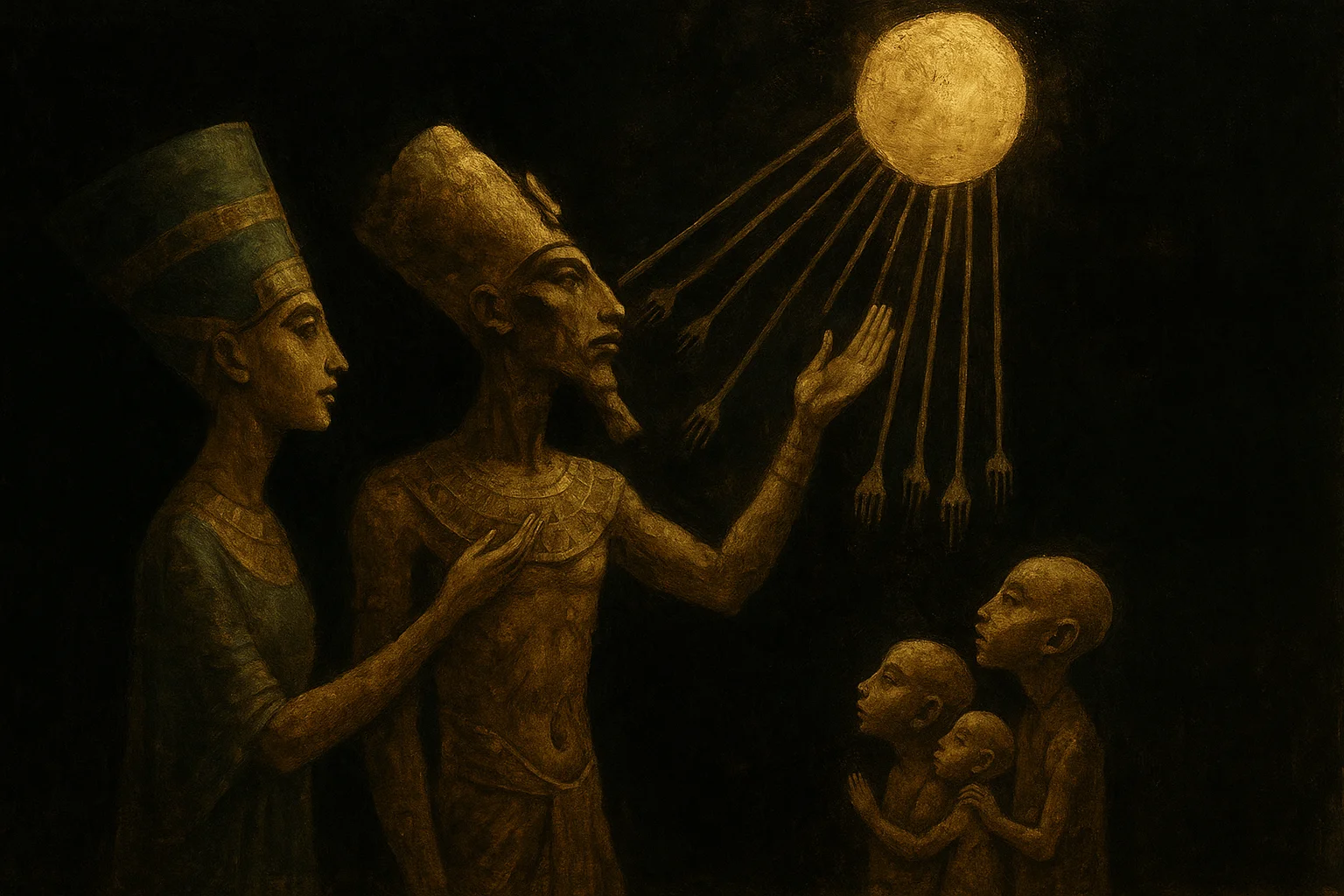
Nefertiti was not merely a consort. Amarna art depicts her performing rituals traditionally reserved for the king: smiting enemies, making offerings to the Aten, wearing the crowns of Upper and Lower Egypt. Inscriptions in the tomb of Meryre II describe her as having a religious role equal to Akhenaten's. Some scholars argue she may have ruled briefly as co-regent or sole pharaoh after Akhenaten's death, possibly under the name Neferneferuaten.
The royal daughters appear constantly in Amarna art, often accompanying their parents in ritual scenes. This emphasis on the nuclear family was new. Traditional royal iconography focused on the king alone or the king with gods. At Amarna, the royal family becomes the model of proper Aten worship, a living theological statement.
The Collapse: Why the Reforms Failed
Akhenaten's reforms required continuous royal enforcement. The moment that enforcement weakened, the old cults resurged. His immediate successor, possibly Smenkhkare or Neferneferuaten, began a cautious restoration. Tutankhamun, who may have been Akhenaten's son, completed it. The Restoration Stela of Tutankhamun describes Egypt in ruin: temples abandoned, gods unresponsive, prayers unanswered.
- The priesthood of Amun had controlled vast wealth and political influence for centuries
- Regional elites resented the centralization of cult and resources at Akhetaten
- The army, which relied on divine sanction for campaigns, found Atenism theologically inadequate
- Common Egyptians never abandoned household gods and local shrines
- The Aten cult had no mythology to sustain popular devotion
Without Akhenaten's personal authority, the system collapsed. Tutankhamun restored Amun's temples, reopened the priesthoods, and moved the capital back to Thebes. The old order returned as if Akhenaten had never reigned.
Erasure and Memory: How Egypt Tried to Forget Him
Later pharaohs, particularly Horemheb and the early Ramessides, systematically erased Akhenaten from official records. King lists skip from Amenhotep III directly to Horemheb, omitting Akhenaten, Smenkhkare, Tutankhamun, and Ay. Monuments were dismantled, reliefs defaced, cartouches chiseled out. In the timeline of Egyptian history, he became "the enemy" or "the criminal of Akhetaten."
This damnatio memoriae was not complete. Akhetaten's abandonment preserved its inscriptions and art. Blocks from Akhenaten's Karnak temples, reused as fill in later construction, survived. The Amarna Letters, buried in the city's archives, documented diplomatic correspondence. By the time Cleopatra VII ruled more than a millennium later, Akhenaten was entirely forgotten. He remained lost until modern archaeology rediscovered him.
Theology or Politics: What Drove the Revolution?
Was Akhenaten a genuine monotheist, a political opportunist, or something else? The evidence supports multiple readings. The Great Hymn's theology is coherent and sophisticated, suggesting real intellectual commitment. The systematic dismantling of Amun's priesthood, however, removed the primary rival to royal power. The two motives need not be exclusive.
Some scholars argue Akhenaten suffered from a medical condition that influenced his worldview. Others see him as a visionary ahead of his time. Still others read the reforms as a failed attempt to centralize authority in a period of external pressure and internal dissent. The Amarna Letters document diplomatic crises and vassal rebellions that Akhenaten apparently ignored, focused instead on his religious project.
What remains undeniable is the scale of the attempt. No other pharaoh before or after tried to rewrite Egyptian religion so completely. The experiment failed, but it reveals how contingent even the most stable religious systems can be when confronted with determined royal will.
Frequently asked questions
Did Akhenaten invent monotheism?
Akhenaten established the first documented state religion focused on a single deity to the exclusion of all others, but whether this constitutes true monotheism depends on definition. The Aten was worshipped as the sole god, and Akhenaten ordered the closure of other temples and the erasure of divine names, particularly Amun. However, Akhenaten himself occupied a semi-divine role as the Aten's sole interpreter, and some household deities remained in use at Amarna. The reform resembles henotheism or monolatry more than the philosophical monotheism of later Abrahamic traditions.
What happened to Akhenaten's city after his death?
Akhetaten was abandoned within a few years of Akhenaten's death, likely during the reign of Tutankhamun, when the court returned to Thebes and Memphis. The city was never reoccupied, and its buildings were gradually dismantled for stone. This abandonment preserved a unique archaeological record: the site provides the most complete picture of an Egyptian city from a single brief period. Modern excavations have recovered thousands of objects, inscriptions, and the famous Amarna Letters, offering unparalleled insight into daily life, administration, and international diplomacy during Akhenaten's reign.
Why did later pharaohs erase Akhenaten from official records?
Later rulers, particularly Horemheb and the early Ramessides, viewed Akhenaten's religious reforms as catastrophic heresy that had angered the traditional gods and brought disorder to Egypt. The Restoration Stela of Tutankhamun describes temples in ruins and gods who no longer answered prayers, blaming the Amarna period. Erasing Akhenaten's name and monuments was both political and theological: it removed a dangerous precedent for royal overreach and symbolically restored cosmic order. King lists omitted his reign entirely, referring to him only as "the enemy" or "the criminal of Akhetaten," ensuring his memory would not inspire future challenges to the restored priesthoods.
What role did Nefertiti play in the Aten cult?
Nefertiti held an unprecedented religious role in Aten worship, performing rituals and making offerings typically reserved for the king alone, and appearing in temple reliefs wearing royal crowns and smiting enemies. Inscriptions describe her as having authority equal to Akhenaten's in religious matters. Some scholars believe she may have ruled briefly as co-regent or sole pharaoh after Akhenaten's death, possibly under the name Neferneferuaten. Her prominence in Amarna art and inscriptions suggests she was integral to the theological program, not merely a symbolic consort, though the exact nature of her power remains debated.
Further reading on Mythologis
Free 25-page sample
Want the whole story?
Take the first 25 pages free. If it pulls you in, the full edition is yours as an instant PDF download, with a paperback on Amazon for selected titles.
Egyptian
The Egyptian Mythology Book: Ra, Osiris, Isis, Anubis, and the Sacred Stories of the Pharaohs
Ra, Osiris, Isis, Anubis, and the Sacred Stories of the Pharaohs
Three thousand years of Egyptian sacred stories. The Duat, the weighing of the heart, the cult of Osiris, and the daily voyage of the sun.
More from Egyptian
All articles
Egyptian
The Book of the Dead: Egypt's Guide to Eternity
Ancient Egypt's most sacred funerary text was not a single book but a living archive of spells, maps, and prayers that guided the dead through the perils between death and eternal life.
Egyptian
Eye of Horus: The Protective Amulet That Watched Over the Living and the Dead
Worn by pharaohs and fishermen alike, the Eye of Horus is one of antiquity's most potent protective symbols, carrying the weight of cosmic battle, divine healing, and eternal vigilance.
Egyptian
Ra the Sun God: Egypt's Supreme Ruler of Light and Creation
Ra, the ancient Egyptian sun god, blazed at the very heart of a civilization that worshipped light as the pulse of creation itself. Discover his origins, his many forms, and the sacred journey he took across the sky and through the underworld every single day.
Egyptian
The Ankh: Egypt's Eternal Symbol of Life
The ankh is ancient Egypt's most recognizable hieroglyph, a looped cross carried by gods and pharaohs alike as the very key to immortal life. Discover its origins, meanings, and sacred legacy.