
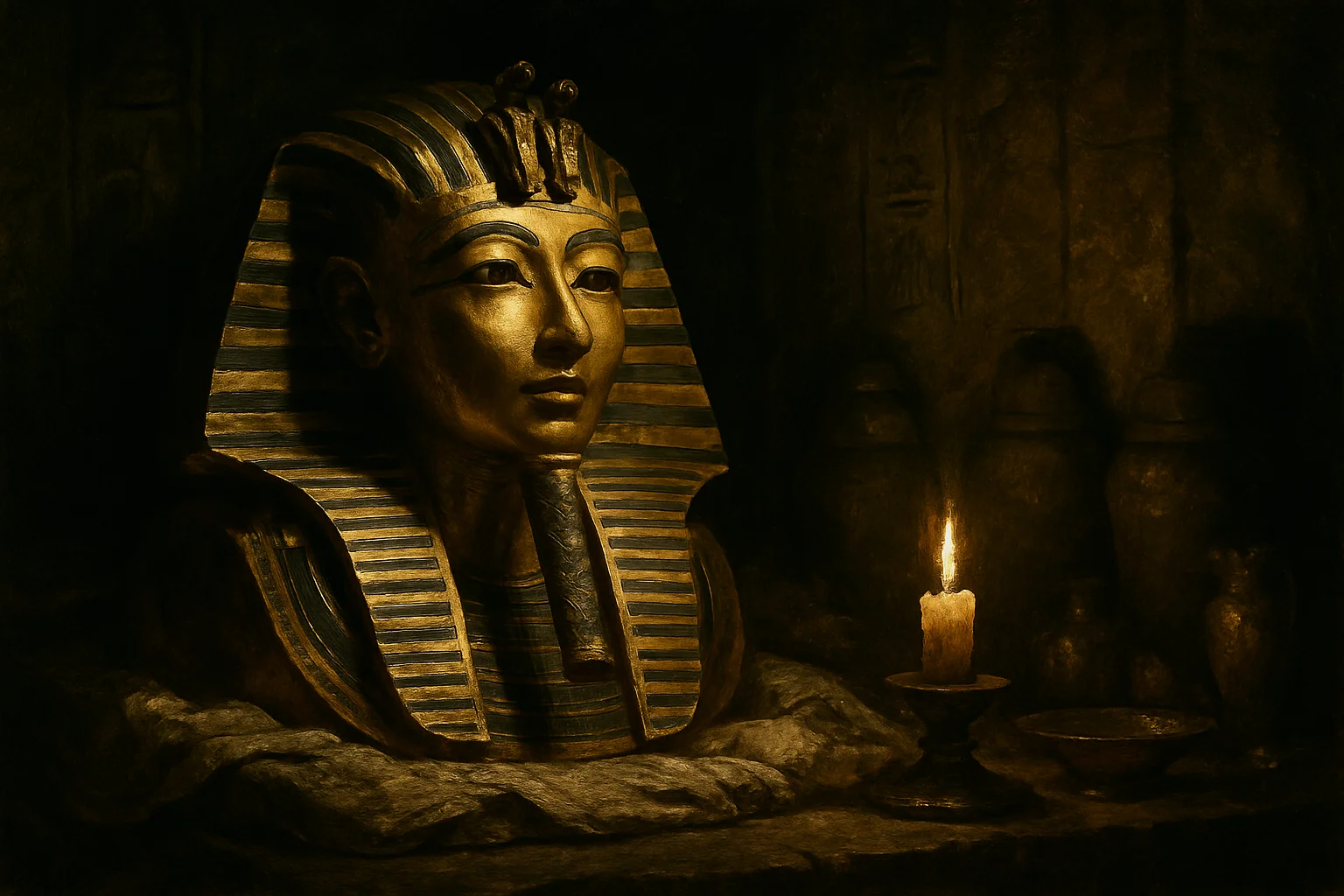
Tutankhamun: The Boy King Who Restored Egypt
The boy king who restored the old gods after Akhenaten's revolution. What the tomb tells us about death, power, and the Eighteenth Dynasty.
Contents
Tutankhamun was an Egyptian pharaoh of the Eighteenth Dynasty who reigned from approximately 1332 to 1323 BCE, ascending the throne at age nine and dying at nineteen. He is famous not for military conquests or monumental building projects, but because his tomb, discovered nearly intact in 1922, provided the most complete royal burial assemblage ever found in Egypt. His reign marked the restoration of traditional polytheistic worship after his father's radical religious experiment.
The paradox of Tutankhamun is that he achieved in death what he never accomplished in life. A minor king who ruled briefly during a period of political recovery, he became the most recognizable pharaoh in the modern world because grave robbers missed his tomb. The gold mask is iconic, but the real story lies in what the burial goods reveal about Egyptian theology and the desperate effort to erase his father's legacy.
Who Was Tutankhamun?
Tutankhamun ruled Egypt for approximately nine years during the late Eighteenth Dynasty, a period of recovery following the religious upheaval initiated by his predecessor. Born around 1341 BCE, he was originally named Tutankhaten, meaning "living image of the Aten," reflecting the monotheistic solar cult imposed by his father. By his third regnal year, he had changed his name to Tutankhamun, "living image of Amun," signaling the restoration of the old pantheon.
The timeline of the Eighteenth Dynasty places Tutankhamun at a pivot point. His reign bridged the Amarna period, when Egypt's capital moved north and traditional temples were closed, and the return to orthodoxy under Theban control. Unlike later pharaohs such as Ramses II, who ruled for 66 years and left colossal monuments, Tutankhamun's historical footprint was deliberately obscured by successors who erased his cartouches and attributed his restoration work to themselves.
He married Ankhesenamun, his half-sister and daughter of Akhenaten and Nefertiti. Two stillborn daughters were buried with him, their tiny mummified bodies placed in nested coffins. No surviving children meant the royal line ended with his death.
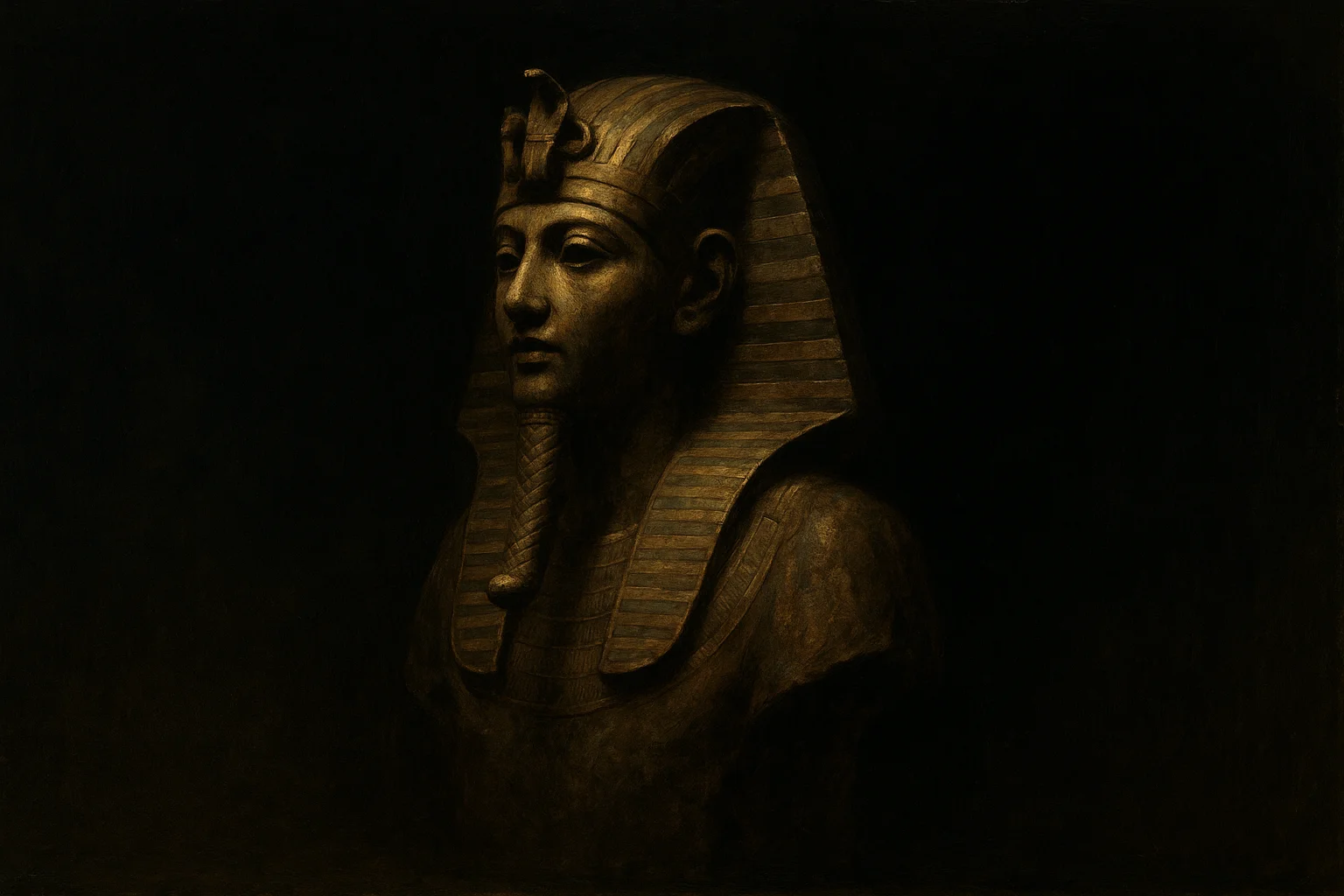
Son of the Heretic: Parentage and the Amarna Aftermath
Tutankhamun's parentage was contested for decades until DNA analysis in 2010 provided genetic evidence. The results, published in the Journal of the American Medical Association, confirmed what inscriptions had hinted: he was the son of Akhenaten and a sister-wife whose identity remains uncertain.
The Evidence for Akhenaten as Father
DNA extracted from Tutankhamun's mummy and compared with other royal mummies from the Eighteenth Dynasty established a direct paternal link to the male mummy found in tomb KV55, widely accepted as Akhenaten. This genetic confirmation resolved earlier debates fueled by the deliberate erasure of Amarna-period records. Tutankhamun's original name, Tutankhaten, also points unambiguously to Akhenaten's household, as no other pharaoh promoted the Aten cult with such exclusivity.
Akhenaten's religious revolution had closed temples to Egyptian gods, redirected state resources to a new capital at Akhetaten, and alienated the powerful Amun priesthood at Thebes. Tutankhamun inherited a kingdom in theological and economic disarray. The restoration he oversaw was as much political necessity as religious conviction.
The Identity of His Mother
The 2010 DNA study identified Tutankhamun's mother as the female mummy from KV35, labeled the "Younger Lady." She was Akhenaten's sister, making Tutankhamun the product of a full sibling marriage. Her name is lost. Some scholars propose she was Nefertiti, but the genetic evidence argues against this; others suggest a lesser-known sister of Akhenaten. The practice of sibling marriage among royalty, intended to preserve divine bloodlines, likely contributed to the genetic disorders evident in Tutankhamun's remains.
Accession and the Restoration of the Old Order
Tutankhamun ascended the throne at approximately nine years old, which meant real power rested with advisors. Chief among them were Ay, an elderly courtier who may have been Nefertiti's father, and Horemheb, a military commander who would later seize the throne. These men guided the young king through a program of religious and political restoration designed to stabilize Egypt and appease the displaced priesthoods.
The Restoration Stela
The most important document of Tutankhamun's reign is the Restoration Stela, erected at Karnak and now housed in the Cairo Museum (CG 34183). The text describes Egypt's condition when he took power: temples abandoned, shrines overgrown, the gods unresponsive to prayers. It declares that Tutankhamun reopened the temples, restored cult statues, and reinstated offerings and festivals. The stela presents the king as a pious restorer, though the language suggests the work of experienced scribes shaping royal propaganda.
His Majesty made monuments for the gods, fashioning their cult statues of genuine electrum from the highlands, building their sanctuaries anew as monuments for the ages, endowed with possessions forever, setting up for them divine offerings as a regular daily observance, and provisioning their food-offerings on earth. Restoration Stela, lines 13-16
The stela was later usurped by Horemheb, who erased Tutankhamun's name and inserted his own, a common practice that contributed to the boy king's near-erasure from history.
Moving the Capital Back to Thebes
One of the first acts of Tutankhamun's regency was abandoning Akhetaten, Akhenaten's purpose-built capital in Middle Egypt. The court returned to Memphis for administrative purposes and Thebes for religious ones. Thebes, home to the cult of Amun-Ra, had been sidelined during the Amarna period. Restoring it as the religious center was both symbolic and practical: the Amun priesthood controlled vast wealth and land, and their support was essential for political stability.
The move also required reestablishing the bureaucratic and ritual infrastructure that Akhenaten had dismantled. Temples needed repair, priesthoods required endowments, and the annual festivals that structured Egyptian religious life had to resume. Tutankhamun's name appears on building projects at Karnak, Luxor, and other sites, though many were later attributed to Horemheb.
Death at Nineteen: What the Mummy Reveals
Tutankhamun died around 1323 BCE, approximately 19 years old. The cause of death has been debated since Howard Carter first examined the mummy in 1925. Early theories ranged from murder to tuberculosis. Modern imaging and genetic analysis provide a more prosaic explanation: complications from a broken leg.
CT scans conducted in 2005 revealed a severe fracture of the left femur that occurred shortly before death. The fracture showed no signs of healing, indicating it happened within days of his demise. DNA testing detected Plasmodium falciparum, the parasite responsible for malaria. The combination of malaria, a compromised immune system due to inbreeding, and a serious fracture likely led to a fatal infection. No evidence supports the assassination theories that circulated for decades.
The mummy also revealed physical abnormalities consistent with genetic disorders: a pronounced overbite, slight curvature of the spine, and the aforementioned foot condition. These were common in the Eighteenth Dynasty royal family, where sibling marriage was standard practice. Tutankhamun walked with a cane; more than 100 walking sticks were found in his tomb.
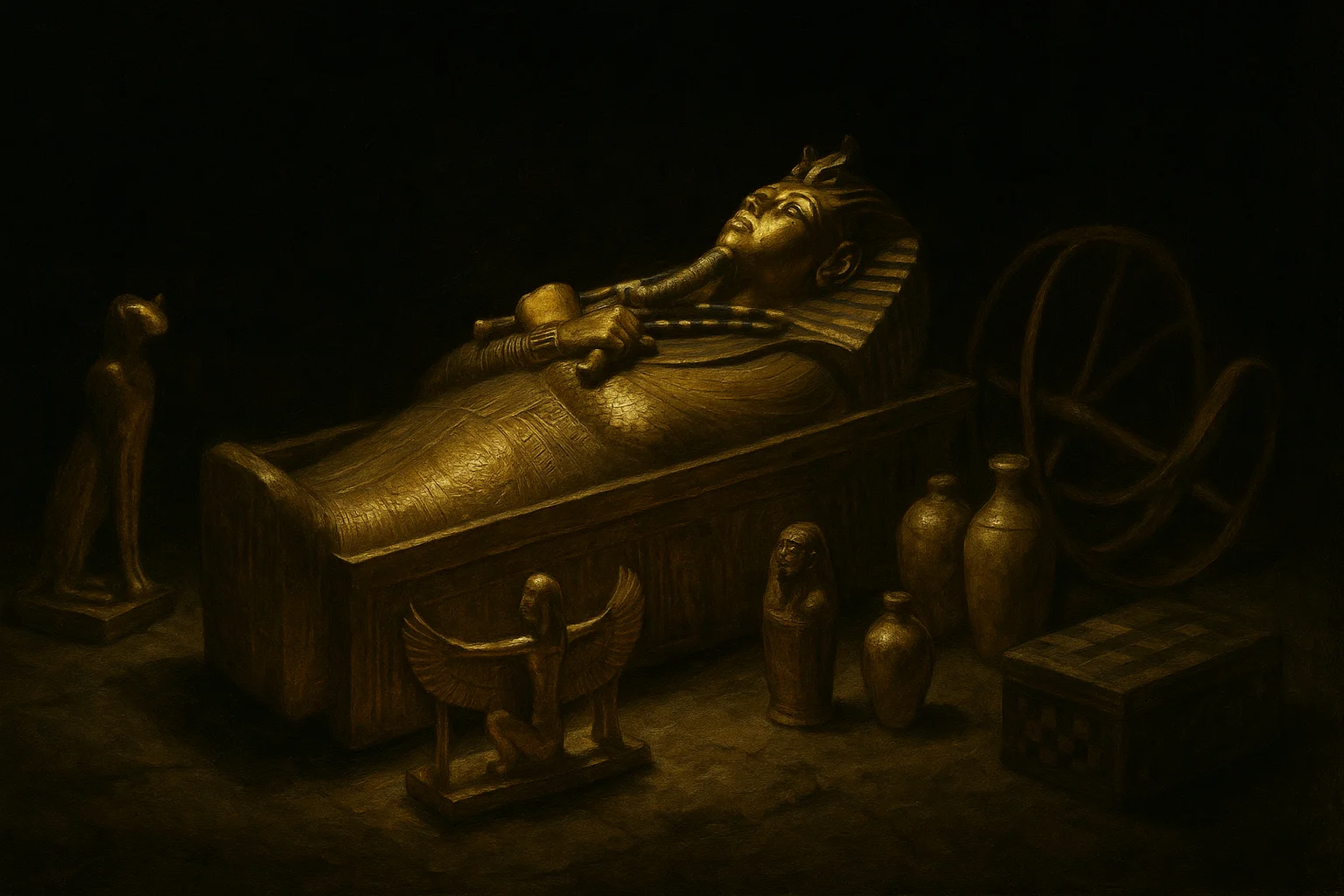
The Tomb: KV62 and Its Contents
Tomb KV62 in the Valley of the Kings is small for a royal burial, suggesting it was not originally intended for a pharaoh. The hasty nature of the burial is evident: walls were still damp when sealed, and objects were crammed into chambers with little organization. Yet it contained more than 5,000 items, the most complete royal burial assemblage ever recovered from ancient Egypt.
Discovery by Howard Carter
Howard Carter, working under the patronage of Lord Carnarvon, discovered the tomb on November 4, 1922, after years of systematic excavation. The tomb had been entered twice in antiquity by thieves who stole small portable items, but officials resealed it, and subsequent debris from the construction of Ramses VI's tomb buried the entrance. This accident of geology preserved Tutankhamun's burial for over 3,000 years.
Carter's meticulous excavation and documentation set a new standard for archaeology. The clearance of the tomb took ten years. Photographs, drawings, and object cards recorded every item in situ, creating an unparalleled archive of Egyptian funeral practices.
The Burial Goods as Theological Programme
The tomb contents were not random treasures but a carefully selected theological program designed to ensure the king's successful journey through the afterlife. Mummification preserved the body as a vessel for the ka and ba, the spiritual components that required reunification. Amulets, including scarab amulets and the Eye of Horus, protected the deceased from dangers described in funerary texts.
Four nested shrines of gilded wood surrounded the quartzite sarcophagus. Inscriptions on the shrines invoke protective deities and include excerpts from the Book of the Dead and the Amduat, guides to the nocturnal journey of the sun god through the underworld. The king's rebirth depended on aligning his passage with Ra's cycle.
Everyday objects, chariots, weapons, furniture, and food provisions were included not as grave goods in the modern sense but as functional items the deceased would need in the afterlife. The theology assumed continuity between earthly and eternal existence. The ankh symbol appears repeatedly, signifying life sustained beyond death.
The Golden Mask and Coffins
The golden mask, weighing 10.23 kilograms and inlaid with lapis lazuli and carnelian, covered the head and shoulders of the mummy. It depicts the king in the nemes headdress with the vulture and cobra of Upper and Lower Egypt. The mask is not portraiture but an idealized divine image, transforming the deceased into Osiris, god of the dead and resurrection.
Three anthropoid coffins nested inside the sarcophagus. The outermost two are gilded wood; the innermost is solid gold, weighing 110.4 kilograms. Inscriptions invoke protective goddesses: Isis, Nephthys, Neith, and Selket. The iconography emphasizes the king's identification with Osiris and his role as Horus, the rightful heir.
Tutankhamun's burial
Hasty, modest tomb with reused and unfinished items, reflecting sudden death and political instability. Theological completeness prioritized over grandeur.
Ramses II's burial
Monumental tomb in the Valley of the Kings with extensive wall reliefs and vast chambers, reflecting 66-year reign and deliberate preparation. Looted in antiquity.
Tutankhamun in Egyptian Religion and Afterlife Belief
Tutankhamun's burial reflects core Egyptian beliefs about death and resurrection. The body, preserved through mummification, served as the anchor for the ka, the life force, and the ba, the mobile aspect of the soul depicted as a human-headed bird. Reunification of these elements allowed the deceased to exist in the Field of Reeds, a paradisiacal mirror of earthly Egypt.
The tomb's religious texts emphasize the solar journey. The king accompanies Ra through the twelve hours of night, facing demons and obstacles before emerging reborn at dawn. This cyclical model of death and rebirth underpins Egyptian cosmology. The pharaoh's successful passage ensured cosmic order, ma'at, and by extension the prosperity of Egypt itself.
Tutankhamun's restoration of traditional worship was framed in these terms. The Restoration Stela claims that under Akhenaten's Aten cult, the gods withdrew and chaos threatened. By reopening temples and resuming offerings, Tutankhamun restored the reciprocal relationship between gods and humans that maintained ma'at. His afterlife depended on this restored order functioning properly.
Legacy and Modern Fame
In antiquity, Tutankhamun was nearly forgotten. Horemheb and later Ramessid pharaohs omitted him from king lists or attributed his works to themselves. The Amarna period, including Tutankhamun's reign, was an embarrassment to be erased. Only the accident of his tomb's preservation allowed him to speak across millennia.
Modern fame began with Carter's discovery and the media frenzy that followed. The "Treasures of Tutankhamun" exhibition, which toured internationally from 1972 to 1979, attracted millions. The golden mask became shorthand for ancient Egypt in popular culture, appearing on everything from magazine covers to Hollywood films. This celebrity status is ironic: a king who accomplished little in life became the most famous pharaoh because thieves overlooked his grave.
The tomb's scientific value extends beyond spectacle. It provides the most complete evidence for royal burial practices, offering insights into theology, craftsmanship, and the material culture of the Eighteenth Dynasty. Ongoing study of the mummy and artifacts continues to refine understanding of ancient Egyptian medicine, genetics, and religious thought.
Frequently asked questions
Who were Tutankhamun's parents?
Tutankhamun's father was Akhenaten, the pharaoh who imposed monotheistic worship of the sun-disc Aten, and his mother was one of Akhenaten's sisters, identified through DNA analysis as the female mummy from tomb KV35 known as the "Younger Lady." This full sibling marriage was practiced among Egyptian royalty to preserve divine bloodlines but resulted in genetic disorders evident in Tutankhamun's remains. His mother's name is lost to history, though some scholars have proposed she might be a lesser-known sister of Akhenaten rather than Nefertiti.
Why is Tutankhamun so famous if he was a minor pharaoh?
Tutankhamun became famous because his tomb, discovered nearly intact by Howard Carter in 1922, contained over 5,000 objects including the iconic golden mask, making it the most complete royal burial ever found in Egypt. Unlike the tombs of more powerful pharaohs such as Ramses II, which were thoroughly looted in antiquity, Tutankhamun's small tomb was accidentally buried under debris and escaped major plundering. His reign was brief and politically minor, but the preservation of his burial goods provided unprecedented insight into Egyptian funeral practices and captured global imagination.
How did Tutankhamun die?
Tutankhamun died at approximately 19 years old from complications following a severe fracture of his left femur, likely exacerbated by malaria and immune compromise from genetic disorders caused by inbreeding. CT scans conducted in 2005 revealed the fracture occurred shortly before death with no signs of healing, and DNA testing published in 2010 detected the malaria parasite in his tissues. The combination of a serious leg injury, active infection, and weakened immune system likely caused fatal sepsis, contradicting earlier theories of assassination or tuberculosis.
What was found in Tutankhamun's tomb?
Tomb KV62 contained more than 5,000 objects including three nested coffins (the innermost of solid gold), a golden funerary mask, four gilded shrines, chariots, weapons, furniture, jewelry, clothing, food provisions, and ritual objects such as scarab amulets and protective figurines. The burial goods formed a complete theological program designed to ensure the king's successful journey through the afterlife, with inscriptions from the Book of the Dead and the Amduat guiding his passage. Two mummified stillborn daughters were also buried with him in miniature coffins.
What role did Tutankhamun play in restoring traditional Egyptian religion?
Tutankhamun reversed his father Akhenaten's religious revolution by reopening temples to the traditional gods, restoring cult statues and offerings, and moving the capital from Akhetaten back to Thebes, the center of Amun worship. The Restoration Stela erected at Karnak describes Egypt's temples as abandoned and the gods unresponsive under Akhenaten's exclusive Aten cult, presenting Tutankhamun as the pious restorer who reestablished ma'at, the cosmic order maintained through proper worship. This restoration was politically essential to regain support from the powerful Amun priesthood and stabilize the kingdom after the upheaval of the Amarna period.
How does Tutankhamun's reign fit into the history of the Eighteenth Dynasty?
Tutankhamun's reign from approximately 1332 to 1323 BCE marked the transition from the Amarna period's religious upheaval back to traditional Egyptian orthodoxy, bridging the radical monotheism of Akhenaten and the deliberate erasure of that experiment by later rulers. He ascended at age nine during a period of political and economic instability caused by his father's closure of temples and relocation of the capital. His early death without surviving heirs ended the direct royal line, leading to the succession of his advisor Ay and then the military commander Horemheb, who systematically erased Tutankhamun's name from monuments and attributed his restoration work to themselves.
Further reading on Mythologis
Free 25-page sample
Want the whole story?
Take the first 25 pages free. If it pulls you in, the full edition is yours as an instant PDF download, with a paperback on Amazon for selected titles.
Egyptian
The Egyptian Mythology Book: Ra, Osiris, Isis, Anubis, and the Sacred Stories of the Pharaohs
Ra, Osiris, Isis, Anubis, and the Sacred Stories of the Pharaohs
Three thousand years of Egyptian sacred stories. The Duat, the weighing of the heart, the cult of Osiris, and the daily voyage of the sun.
More from Egyptian
All articles
Egyptian
The Book of the Dead: Egypt's Guide to Eternity
Ancient Egypt's most sacred funerary text was not a single book but a living archive of spells, maps, and prayers that guided the dead through the perils between death and eternal life.
Egyptian
Eye of Horus: The Protective Amulet That Watched Over the Living and the Dead
Worn by pharaohs and fishermen alike, the Eye of Horus is one of antiquity's most potent protective symbols, carrying the weight of cosmic battle, divine healing, and eternal vigilance.
Egyptian
Ra the Sun God: Egypt's Supreme Ruler of Light and Creation
Ra, the ancient Egyptian sun god, blazed at the very heart of a civilization that worshipped light as the pulse of creation itself. Discover his origins, his many forms, and the sacred journey he took across the sky and through the underworld every single day.
Egyptian
The Ankh: Egypt's Eternal Symbol of Life
The ankh is ancient Egypt's most recognizable hieroglyph, a looped cross carried by gods and pharaohs alike as the very key to immortal life. Discover its origins, meanings, and sacred legacy.